Quotulatiousness

January 22, 2021

Canada’s Governor General resigns, avoiding dragging the Queen into another Canadian political drama

Filed under: Cancon, Government — Tags: , , — Nicholas @ 05:00

Colby Cosh notes in Thursday’s NP Platformed newsletter:

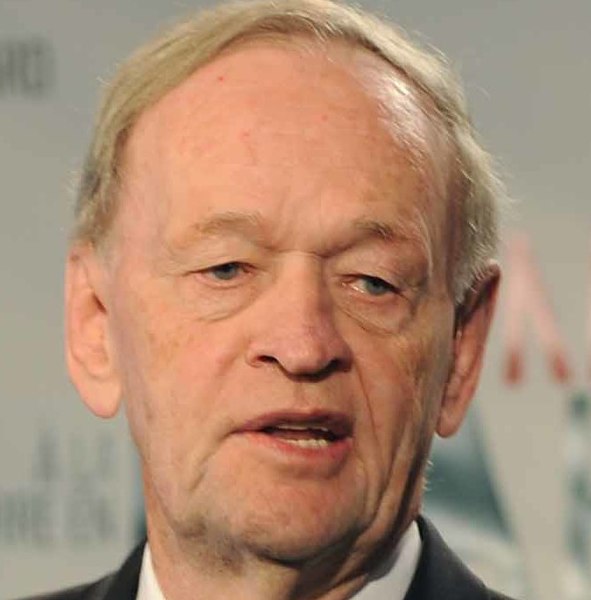
The Right Honourable Julie Payette, 29th Governor General of Canada (October 2, 2017 – January 21, 2021).

When NP Platformed saw Robert Fife’s Globe and Mail report this morning, our thought was that leaking the news of the report’s completion was an obvious political manoeuvre. (You know how a fife works: put some wind in it, and it will play a tune for you.)

Even a prime minister as callow as the current one would not want to try firing a governor general, which would require the personal intervention of the Queen. This would be a failure in itself, a blot on Canada’s copybook, even if the PM had the support of other parliamentary parties.

As hours passed, the thought naturally occurred to us: why should Payette be making anyone wait for some written report anyway? We know she has sometimes balked at most of the easily identifiable parts of her job, including travel to ceremonies and (for heaven’s sake) giving royal assent to legislation. Hired to be a dynamic female STEM mascot (for a Liberal government, sort of), she somehow degenerated, with unseemly speed, into an immured princess from a fairy tale, evidently driven half-mad by some faerie spell.

The main job, the essence of the governor general gig, is to be above suspicion, like Caesar’s wife in the proverb. The mere whisper of abusiveness or of clownish behaviour involving public funds ought to have been enough to settle things, possibly with a convenient health excuse. (If she offers one now, it can only provoke snide laughter.) The vicereine is, in our system of government, the passage through which national honours flow from the sovereign. The mention of “honour” in connection with this Governor General was becoming mighty awkward. She should have our thanks for doing the right thing today.

December 6, 2020

“As ever, our Liberal friends prefer to be judged by their pure intentions rather than their rather tattered record”

The good folks at The Line suggest that we monsters in the peanut gallery stop hurting poor Little Potato’s feeeeeeeeeelings:

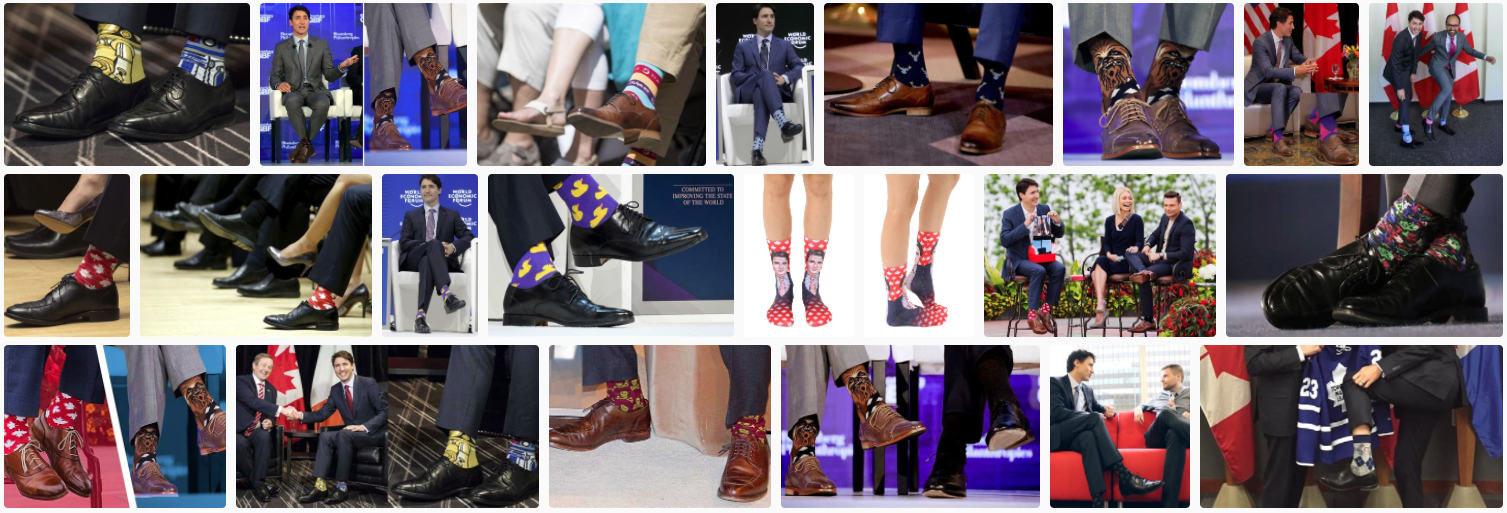
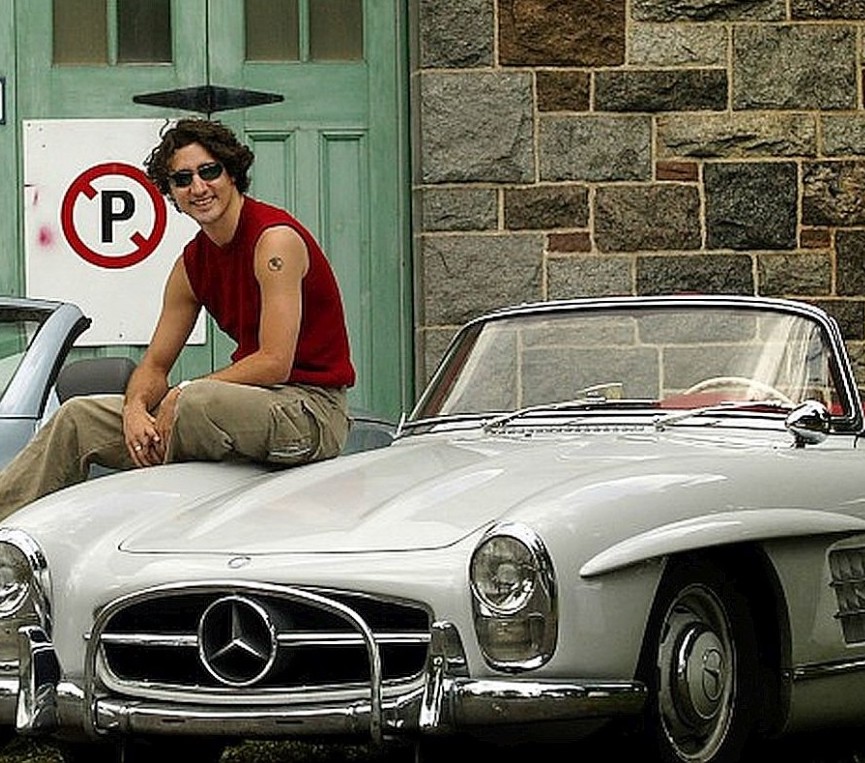
Typical image search results for “Justin Trudeau socks”

What we can say is that supporters of our current government continue to insist that the prime minister and his cabinet be granted a level of benefit of the doubt that they simply have not earned. Declarations that the Liberals have botched the vaccine rollout are premature, but they are not preposterous. As ever, our Liberal friends prefer to be judged by their pure intentions rather than their rather tattered record. We at The Line have known enough true Grits in our time to believe that this isn’t an act. Liberals really do believe that so long as they mean well, they should be forgiven their failures. Indeed, the failures should be forgiven and forgotten.

And boy, can they get testy when someone declines to do them the courtesy of treating this five of a government like a nine. They’ll shriek about Harper and Ford and Kenney and American-style whatever, they’ll argue in bad faith, they’ll demand an audit of Andrew Scheer’s household expenses, they’ll shut parliament down in the middle of a national emergency to spare the boss from embarrassing questions about his latest ethical flub. In short, they’ll do anything to avoid admitting that this Liberal government has blown more than enough high-profile issues to have forfeited any right to be bummed out when someone dares wonder if they’ll do any better on vaccines.

Over the last five years, the Liberals have failed to hit their own targets on balancing the budget and cleaning up Indigenous water supplies. They failed to hit Harper’s targets on carbon reduction, failed to win a UN seat, failed to deliver promised military procurements, failed on electoral reform, failed to improve our decrepit transparency system, and failed to notice any number of outrageous policies and proposals so long as they were proffered en français, in which case they couldn’t avert their eyes fast enough.

We could go on, but the point is made. And they’ve done it all after daring to talk in their opening days of deliverology, a term that’s now a political punchline thanks to how badly Trudeau and the Gang failed to live up to the hype of their own managerial jargon.

The problem with all this failure is far bigger than the sum of its various sad parts. A government that routinely writes cheques its competence can’t cash may be in a hurry to forgive itself, but not all Canadians are as fond of Justin Trudeau as Justin Trudeau clearly is. A proven track record of failure by the state erodes public confidence in the state, and the sneering contempt Liberals have for anyone who notices the failure doesn’t help. We find it absolutely amazing how many Liberals (rightly!) decry the rise of populism without ever seeming to ponder for a New York minute what role their own manifest mediocrity has played in fuelling it. So we’ll kindly hear no more from the Liberals about the know-nothing idiocy of the woke left and the destructive buffoonery of the nationalist right until they stop doing such a shabby job with the goddamned centre.

November 27, 2020

Is clean water too much to ask for in a first world nation?

Ted Campbell explains how he would resolve the TWENTY-FIVE YEAR OLD PROBLEM in the Neskantaga First Nation in northern Ontario, which is one of the many First Nation public health issues the federal government has been promising to address for years:

A few weeks ago I was horrified to read about the 25 year long water problems that continue to plague the Neskantaga First Nation in North-Western Ontario ~ yes you read that right: it’s been 25 years since these Canadians have had clean, potable water! I begged the government to Do Something! and I offered one concrete idea based upon by near certain knowledge of what the Canadian Armed Forces can and have done for people overseas. One of my readers, a retired colonel in our Military Engineering branch confirmed that what I suggested was doable.

Now I read, in a report by Campbell Clark in the Globe and Mail, that the main problems are a combination of political over-promising and bureaucratic ineptitude. I am going to blame Justin Trudeau for pretty much all of the political over-promising: he made it a centrepiece of his 2015 election campaign and then totally failed to follow through. He has to wear at least a large part of the bureaucratic ineptitude, too, because he’s been prime minister of Canada for over five years. He’s failed, again.
OK, I can hear you saying: if you’re so smart how would you fix things?

For a start I would stick with the outlines of my earlier proposal: I would ask the Army to help, right now, using existing technology. We would declare this a disaster ~ and if Canadians going without clean water for 25 years doesn’t qualify as a disaster then I don’t know what does ~ and send the Canadian Armed Forces’ Disaster Assistance Response Team (the DART) to the Neskantaga First Nation and tell them to fix whatever needs fixing ~ using the Indigenous Services department’s budget. When they finished there we would buy them a new water purification system and send them the next First Nation that has a water disaster on its hands. People overseas will have to wait or we’ll have to build a second DART.

Next I would ask the Army and the Canadian manufacturers of water purification systems to work together with First Nations corporations, like Matawa First Nations Management, to develop (at the Indigenous Services department’s expense) concrete, workable plans to install, operate and maintain, over their complete life-cycle, water purification and waste disposal systems and the electrical power and the power and water distribution systems necessary to support them.

After this long, it may not be that the government can’t deliver these services, it might be that the government has deliberately chosen not to deliver.

November 18, 2020

Trudeau’s internet policy — cash grab or power grab? Embrace the healing power of “and” (TM Instapundit)

Filed under: Business, Cancon, Government, Media, Technology — Tags: , , , , , , — Nicholas @ 03:00

The Canadian government is taking advantage of the ongoing economic and social disruption of the Wuhan Coronavirus to widen their existing regulation of both broadcasting and internet entertainment. It’s not just a bit of maple-flavoured cultural imperialism, but it’s also a blatant cash grab:

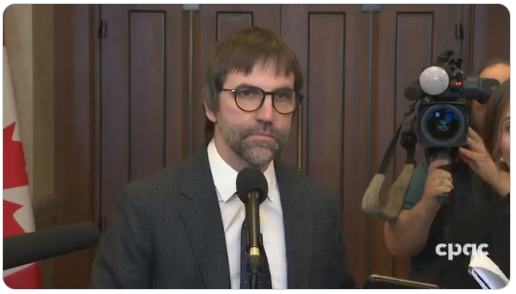
Canadian Heritage Minister Steven Guilbeault, 3 February 2020.
Screencapture from CPAC video.

I see, in the Globe and Mail, that Justin Trudeau and Steven Guilbeault want to further regulate the broadcasting services in Canada. Their goals seem to be, in part, a cash grab ~ online streaming services, like Netflix, are offering Canadians, for a price, what they want, while the CBC offers Canadians, thanks to a $1+ Billion annual subsidy from taxpayers like you and me, what we, pretty clearly, do not want to watch and the Liberals want a share of that money ~ and also an appeal to those who play identity politics.

I think we need to look at the “products” of broadcasting ~ information (news and “public affairs” and documentary programmes) and entertainment, including sports, as “consumable products,” rather like food and, say, soft drinks.

We do allow, even demand that governments exercise some important regulatory functions in regard to food and soft drinks: we want to make sure that they are safe to consume and Canadians want to know what is in the food we consume.

The Canadian Radio-television and Telecommunications Commission (CRTC) was, originally, conceived to solve a fairly simple problem: allocating broadcast licences. Government engineers calculated how many radio channels could be used in any given place but they didn’t want to have to decide who should get to use them. Politicians didn’t want to do it, either, because while the successful applicant was (usually) happy the more numerous unsuccessful ones were disappointed and politicians hate to disappoint people. Thus they created an arms length agency to make the tough decisions for them. Licence allocation is still an important job for the CRTC. But the CRTC’s mandate was expanded with the birth of cable TV. Companies, like Rogers, built cable systems ~ and they received both direct and indirect government support to reach more and more Canadians ~ and then “sold” access to consumers. In the normal course of events one might have thought that the government would attach some business conditions to its loans, grants and tax deductions, but there was an ever-growing demand, from the Canadian cultural community ~ based almost entirely in Montreal and Toronto ~ to regulate the fledgling cable and “pay TV” market to ensure that Canadian programmes were not shut out but, in fact, could have privileged positions in the cable lineup, which led to the government, in the 1960s, telling the CRTC to regulate how companies like Famous Players, Maclean Hunter and Rogers configured the private product they sold to individual consumers.

The initial government argument was “we regulate all kinds of things for the common good: that’s why we all drive on the right, for example, and the delivery of broadcasting by cable is like that.” “No it’s not,” the cable operators replied, “you build and maintain the roads, using taxpayers’ dollars, so you’re allowed to regulate how they’re used, plus it’s a safety issue. Cable service and ‘pay TV’ are private, commercial transactions between us, the companies who built and operate the systems, and the individual consumer who wants to subscribe to what we offer. You don’t presume to regulate, beyond the laws against libel and pornography, what people can read in MacLean’s magazine or the Globe and Mail, why is ‘pay TV’ and cable different?” It’s still a good question. But the cable operators surrendered gracefully and the CRTC has been, broadly, for the last half-century, protective of the rights of incumbents in the infotainment markets. In return the cable and internet operators have agreed to “tiers” of programming which means that if you want to watch, say, BBC World Service or Deutsche Welle or Fox News, you must also pay for CBC News Network and CTV News Channel and, no matter who you are and what your individual preferences might be, when you subscribe to a cable/internet service you must also support a number of French stations/channels; it’s the law. And now Minister Guilbault wants to ensure that you pay for the output of indigenous producers, writers, actors and so on, on both indigenous networks ~ to which you must already subscribe if you have a “basic” Canadian cable or satellite TV package ~ and, it appears to me, in programmes produced by Canadians and even by Netflix.

November 13, 2020

Oddly, the Canadian media evince no interest whatsoever in the Trudeau government’s malign plans for the Internet

Filed under: Business, Cancon, Government, Media — Tags: , , , , , , — Nicholas @ 03:00

In The Line, Peter Menzies shows how little the mainstream media outlets in Canada care about the power grab the feds are attempting with their proposed “get money from web giants” shakedown:

Canadian Heritage Minister Steven Guilbeault, 3 February 2020.
Screencapure from CPAC video.

In order to understand where media and public attention has been the past couple of weeks, all you had to do was listen in on Monday morning’s Ottawa news conference.

Six days after Heritage Minister Steven Guilbeault had introduced ground-breaking legislation to regulate content online, Prime Minister Justin Trudeau announced more cash to bring better Internet to rural and remote communities. There were also some COVID-19 updates and something about help for agriculture.

And, of course, the questions asked by the media were about the U.S. election. What else could possibly be of interest?

Eventually there were a few inquiries about Telesat and low-Earth-orbit satellites, but you get the point: things that matter to people’s daily lives such as cable bills, data plans, Netflix, cellular service, crappy WiFi and slow Internet connections haven’t been of much interest to Canadian media lately.

So there has been a dearth of chatter about Guilbeault’s controversial plan to (my words, not his): restrict consumer choice, tax Netflix to finance certified Canadian content (Cancon) and bring to an end the greatest period of prosperity in the history of the Canadian film and television industry. Did I mention stifling innovation, increasing streaming subscription costs and scaring away investment? No? My bad. Those too.

Guilbeault has decided that the agency dedicated to defining the nation’s TV and radio diet — the Canadian Radio-television and Telecommunications Commission (CRTC) — is now going to be in charge of what you are allowed to dine on online as well. No longer will you be able to manage your preferences. No more popcorn and candy for you. Going forward, Cancon spinach and broccoli will be on your plate every evening. Breathtakingly, Guilbeault has “modernized” communications legislation by giving authority over the Internet to something called a “radio-television” commission by using something still called the “broadcasting” act.

October 29, 2020

QotD: The art of the politician

Filed under: Cancon, Politics, Quotations, USA — Tags: , , , — Nicholas @ 01:00

Politics, it has been said (by me, I think), is the art of the hardly possible. One demands, or promises, things that cannot be delivered in this world, and that no one could want if they thought through the consequences. The successful politician does not lie, except when cornered. Rather, he fantasizes, “dreams,” and seeks a constituency that will dream with him. To my mind, Barack Obama was near to the perfect politician, and while lacking his class and cunning, Canada’s child prime minister, “Justine” (see the 4,000-page novel by the Marquis de Sade), has attempted to offer the same billboard attractions. It is what all modern capitalism has aspired to: nothing, in a very spiffy package; a triumph of pure advertising.

The perfect politician, as the perfect salesman, sells this “vision” — dwarfing any specific programme with its stated assumptions and checkable facts. Details, details; to the uninitiated, these are always boring, and the voting masses will never be initiated. The people, especially in this Age of Netflix, want entertainment, and what they call “leadership.” A leader is a person who does your thinking for you. In politics, he has a rôle like that of film director, in a movie where he will be the principal star. We must go through the movie emotionally on his side; grieve his little setbacks, feel that we participate when he wins. Black hats, white hats: his opponents are clearly marked and can be seen at every moment to be deplorable.

David Warren, “Now playing”, Essays in Idleness, 2018-07-13.

October 18, 2020

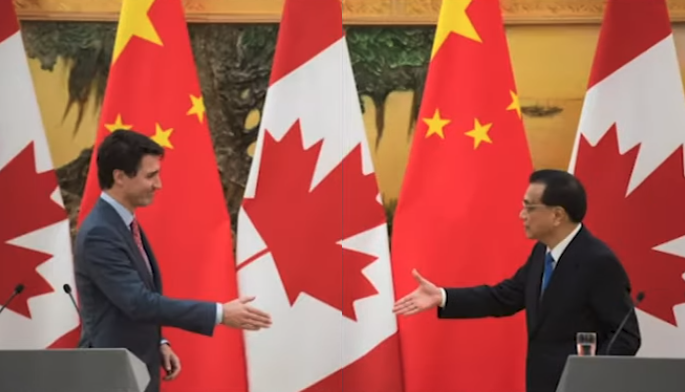
The diplomatic spat with China is “forcing the prime minister to bring out the biggest guns in his arsenal: his really serious socks”

Filed under: Cancon, China, Government, Politics — Tags: , , , — Nicholas @ 03:00

The Line shows just how seriously Justin Trudeau is taking China’s most recent not-so-veiled threats against Canadians in Hong Kong:

The warm glow of a good feed faded quickly in Ottawa, alas, where our nice little vacation from history continues its unravelling apace. China’s ambassador to Canada is issuing increasingly dire threats to the safety of our citizens, specifically the hundreds of thousands of Canadians living in Hong Kong, forcing the prime minister to bring out the biggest guns in his arsenal: his really serious socks, a very frowny photograph by Adam Scotti, and, we expect, the imminent announcement that on top of all her current duties, Chrystia Freeland will be appointed Progressive Minister In Charge Of Figuring Out What The Hell We Should Do About China But Not In A Way That Offends Anyone The Middle Class Build Back Green Error Error Program Alarm—

Whoa! Sorry! The Freeland Job Generator glitched again. No surprise, considering the miles Trudeau has put on it in only five years. Let’s hope it doesn’t give out entirely — we’d need 47 years to procure another one.

Anyway, as to the matter at hand, your Line editors are pragmatic folk. Canada can’t punch at the same level as China; under Mr. Trudeau, indeed, despite all our for-Liberal-egos-only preening about Canada being back, we can’t even punch at the same level as Ireland and Norway. But it’s time Canadians face facts: we can either continue pretending that China’s increasingly aggressive and threatening behaviour is a problem that will go away if we ignore it long enough, or we can at least pretend that we have balls and take what actions we can. Obviously we’re not going to send a fleet to parade up and down their coast, but there are things we can realistically do, and we aren’t. Australia, for instance, also in Beijing’s sights, has rolled out a series of measures to curtail China’s substantial influence there. Canada ought to be doing the same. And we could start by immediately banning Huawei, and encouraging every other country that would listen — which doesn’t seem to be many — that they should too.

Do we expect the Liberal government to do this? No. Making money shilling for the Chinese regime is the best thing to happen to post-politics Liberals since Ontario’s air ambulance service. But they should do this. And the delay is only gonna make it hurt more when events eventually force us to accept that China is not our friend, never has been, and never will be under the current political leadership.

September 19, 2020

QotD: Dictatorship of the Cancel Culture proletariat

Filed under: Cancon, Media, Politics, Quotations, Sports, USA — Tags: , , , , — Nicholas @ 01:00

This sort of thing is, to put it mildly, not good. There are at least three major problems with cancel culture. First, almost anyone could be cancelled, on the basis of the (claimed) standards prevalent on the modern “social justice” left. Secondly, cancellation tends in practice to be a non-random process targeted at political and ideological opponents, rather than a genuine attempt at a new moral standard. Finally, and most importantly, the declaration by wokesters that many conversations are now simply off-limits prevents the communication of important information that would make it possible for citizens better to judge the arguments of movements like Black Lives Matter.

While not the most important, the first of these points is the most relevant on a day-to-day basis. Without endorsing these behaviours, the plain fact is that the huge majority of people have probably at some point told an ethnic or regional joke, sent a pornographic or un-PC snap, had sex while intoxicated, used a slur tied to sexual orientation / race / gender online or in the lockerroom, worn a St Paddy’s Day or Cinco de Mayo outfit they would really prefer a mulligan on, or committed other Cardinal Sins against Wokeness. As a result of this, many young people are intently aware that Twitter and Facebook wars involving the unearthing of old content generally end with egg on the face of everyone involved. Caucasian NBA point guard Donte DeVincenzo was humiliated in late 2018 by the revelation that – at age 14 – he had described his hoops handle as “ballin’ on these nig*as like I’m Derrick Rose”. He ended up deleting his entire social-media presence. The point of monitoring this sort of thing, for the many people and organisations that do so, is not punishing the tiny minority of real racists and abusers out there so much as keeping normal citizens too terrified by the potential unearthing of past indiscretions to comment lustily on the issues of the day.

The fact that virtually anyone could in fact “legitimately” be cancelled leads into extreme partisan hypocrisy. While anyone who attended church as a lad might correctly suspect that the hard right is capable of similar behaviour, cancellers today are overwhelmingly concentrated on the “social justice” left – and they are, at least occasionally, reluctant to eat their own. This often results in remarkable and hilarious double standards. In February 2018, for example, liberal Virginia governor Ralph Northam – nicknamed “Coonman” – escaped any serious censure after he was revealed to have apparently appeared in a mid-1980s high-school yearbook photo wearing shoe-polish blackface.

To be fully fair to Northam, the same photo included a student dressed in full white robes as a Ku Klux Klansman, and CNN has noted that Northam has never actually said “whether he was wearing the Ku Klux Klan outfit or [the] blackface”. Oh, fair enough. At any rate, he serves as governor of Virginia today. Not to be outdone by any of his neighbors to the south, Canadian prime minister Justin Trudeau was revealed that same year to have worn black- and brown-face several times, and as late as 2001, once apparently painting his entire body to appear in costume as Aladdin at an Arabian Nights revue! He, too, remains solidly entrenched in office today.

Wilfred Reilly, “They can’t cancel all of us”, Spiked, 2020-06-17.

September 13, 2020

Are the Kielburgers fleeing before the real story breaks?

Filed under: Cancon, Government, Politics — Tags: , , , , — Nicholas @ 05:00

Ted Campbell listened to an Evan Solomon radio report recently and spells out the key points:

The Kielburgers, he notes are neither newcomers nor naifs. Mark Kielburger is a Rhodes Scholar and Craig Kielburger has, he say, “been rubbing shoulders with politicians since he was 12 years old.” They have, Mr Solomon says, been selling the “halo effect” to politicians and other celebrities, a list which he tells us includes Justin Trudeau, Barack Obama, Oprah Winfrey and Erin O’Toole and the “halo effect” says, in effect, if you come out and make us look good then we, being a famous, big-league charity will make you look good, too. It’s all part of an astute marketing plan.

But then Evan Solomon gets to the real question: if Tylenol, he says, can survive a scandal in which people died then why are the Kielburgers reacting so dramatically to what is, really, on the surface, a minor league scandal? So the Kielburgers paid Margaret Trudeau a few hundred thousand dollars to make a few charity appearances, is that such a big deal? I mean the Trudeaus are wealthy, aren’t they? They can’t be bought, can they? Well, most if us don’t have million dollar plus trust funds and most of us didn’t earn $450,000 in speaking fees in a year, but the Trudeau family is unlikely to have just forgotten about $250,000 in speaking fees paid to Margaret Trudeau. Bill Morneau may have forgotten about owning a villa in France, but unlike the Trudeaus, Mr Morneau is rich … really rich. So are the Kielburgers. The commercial property part of their WE empire, alone, is worth $50 Million. Could a few thousands dollars per appearance (she made 28 over four years, about one every couple of months) paid to Margaret Trudeau really threaten the entire WE empire?

[…]

My guess, and that’s all it is, is that there is real fear in the WE boardrooms and in WE’s legal department that Prime Minister Trudeau might be guilty of something more than just conflict of interest. Someone like Pierre Poilievre or the Lobbying Commissioner, for example, might think that further, deeper investigations are needed and those questions might lead investigators to look more deeply into why and how Justin Trudeau and the Kielburger brothers, themselves, cooked up the idea of WE Charity running a multi-hundred-million-dollar government programme and then trying to cover-up the whole thing.

Might those questions be enough to bring Justin Trudeau down?

Might those questions be enough to threaten the Kielburgers’ fortunes, even their freedom?

September 2, 2020

Cold War 2.0 — you’re soaking in it

Ted Campbell responds to a recent article in Foreign Affairs by Nadia Schadlow:

Dr Schadlow posits that “A new set of assumptions should underpin U.S. foreign policy … [and, concomitantly, the foreign polices of the US led West, including Canada’s, because] … Contrary to the optimistic predictions made in the wake of the Soviet Union’s collapse, widespread political liberalization and the growth of transnational organizations have not tempered rivalries among countries. Likewise, globalization and economic interdependence have not been unalloyed goods; often, they have generated unanticipated inequalities and vulnerabilities [and] although the proliferation of digital technologies has increased productivity and brought other benefits, it has also eroded the U.S. military’s advantages and posed challenges to democratic societies.”

After outlining the rosy assumption made by leaders and policy makers from Richard Nixon through Bill Clinton to Barack Obama ~ assumption which I shared, Nadia Schadlow says that “China had no intention of converging with the West [because] The Chinese Communist Party never intended to play by the West’s rules; it was determined to control markets rather than open them, and it did so by keeping its exchange rate artificially low, providing unfair advantages to state-owned enterprises, and erecting regulatory barriers against non-Chinese companies. Officials in both the George W. Bush and the Obama administrations worried about China’s intentions. But fundamentally, they remained convinced that the United States needed to engage with China to strengthen the rules-based international system and that China’s economic liberalization would ultimately lead to political liberalization. Instead, China has continued to take advantage of economic interdependence to grow its economy and enhance its military, thereby ensuring the long-term strength of the CCP.” Of course, from a Chinese perspective it might, very reasonably, appear that the liberal, US made (in the late 1940s) “rules based international system” was, in fact, designed to strengthen the US economy and enhance its military and ensure America’s long term strength … and that is not, many would say, a totally unreasonable view.

[…]

America’s allies, including Canada, need to step up and help the USA (and India) with the containment of both China and Russia in several regions: in Asia, Africa, the Middle East and Europe, too. Canada is a G-7 nation. It needs to start acting like one.

Australians, Brits, Canadians and Danes need not share Dr Schadlow’s Trumpian view of the world and of Cold War 2.0 to understand that:

  1. It is here. We are in it, like it or not; and
  2. Like its predecessor, it can turn hot if we do not manage it with care.

Now, at this time, the conventional wisdom is that foreign and defence policy must take a back seat to beating COVID-19 and restarting the economy. But, the Chinese and the Russians are not putting their plans on hold while they deal with the pandemic. (Maybe that’s why Justin Trudeau admires China’s “basic dictatorship” so much.) They will both be moving ahead with plans that aim to put the US-led West, including Canada, at a disadvantage. Additionally, now is a good time to announce plans to build more new warships ~ two or three large helicopter carriers, another supply ship (for a total of four) 16 major surface combatants (the new Type 26 ships) and a dozen smaller corvettes … can be and politicians should say will be built here in Canada, by Canadian workers. Defence related projects, when well conceived and directed, can be great long-term job creators. Canada can do both: speed up our recovery from the pandemic and strengthen our global position by making defence procurement a priority for the recovery.

An artist’s rendition of BAE’s Type 26 Global Combat Ship, which was selected as the Canadian Surface Combatant design in 2019, the most recent “largest single expenditure in Canadian government history” (as all major weapon systems purchases tend to be).
(BAE Systems, via Flickr)

August 23, 2020

Trudeau’s hopes for re-election hinge on promising “an organic chicken in every pot and a solar panel on every shed”

The Line wonders who the hell the Liberals think they are:

It may have been easy to miss amid the news coming out of Ottawa, but as the government lost its finance minister, appointed Chrystia Freeland to yet another job, prorogued parliament, halted testimony into its latest scandal, prepared for the announcement of a new Conservative Party of Canada leader and braced for a likely second wave of COVID-19, the prime minister promised to announce a transformative agenda. One that promises sweeping social change, and a wholesale re-invention of our economy in line with the greenest ambitions. We here at The Line have but one question.

Who the hell do these people think they are?

It is obvious to anyone who has been reading the news and possesses even residual brain function why the prime minister would like to be talking about a plan for transformative change. Talking about all the amazing things he could do for Canadians with borrowed money beats talking about his government’s bumbling of the WE file and the departure of now-former finance minister Bill Morneau.

Promising an organic chicken in every pot and a solar panel on every shed is obviously more appealing to Trudeau than repeating the last month. But it is astonishing to us — as jaded as we have undeniably become — that the government is talking about this instead of the necessary steps needed to shore up this country ahead of a likely second wave of COVID-19.

This government has a mandate to respond to the emergency, by mere unlucky virtue of being in power at the moment the virus hit. It is the duty of every Canadian government to safeguard the wellbeing of the population, full stop. But the emergency, contrary to what you may believe if you’ve been reading Liberal Party HQ memos, is not over. We have an urgent need to secure more medical equipment, to harden our long-term care facilities, to prevent any further lockdowns from derailing a fragile economic recovery, to ensure the resiliency of critical supply chains, and to shore up our health-care system. This is what every Canadian official should be focused on right now.

[…]

But can anyone maintain faith that the Liberals will stick to their knitting when we hear buzzwords like “transformative” social change? Sweeping climate-change reforms? Engineering a new green economy? They are all fine notions — let’s put them to the people and vote on them. Until calling that election is feasible (mid-pandemic, it is not) this government simply does not have the mandate to undertake such far-reaching efforts.

It’s easy to forget now, but only nine months ago this government was reduced to a minority of seats in parliament. The Liberals lost the popular vote, and saw one million of their own prior voters abandon them. They are only in government because the Conservatives, to the surprise of no one, found several novel and exciting new ways to fail.

August 1, 2020

“All style and no substance made it the perfect match for Trudeau”

Filed under: Cancon, Government, Politics — Tags: , , , , , — Nicholas @ 03:00

Andrew Lawton on the Prime Minstrel’s performance in “explaining” his role in the WE scandal:

“Don’t look at me – I’m just the prime minister.”

That about sums up Justin Trudeau’s defense in a Canadian scandal starring grifters, shell corporations, virtue signallers and a federal ethics probe.

The WE-Scam, as it’s come to be known in Canadian circles, is, on its surface, a simple one.

Trudeau’s government created a $912 million government program to pay students to volunteer – formerly known as “working” if memory serves – and outsourced the administration of it to WE Charity, one of those purported international development charities more known for holding glitzy, celebrity-filled parties than digging any wells in Africa.

All style and no substance made it the perfect match for Trudeau.

WE would have netted about $44 million from the program had the government not pulled the plug amid the backlash. The charity would also have had a budget to pay teachers up to $12,000 each to funnel their students into the paid volunteer channels.

The program itself was a boondoggle, but bad policy became a scandal because Trudeau and virtually everyone in his immediate family have personal and financial connections to WE, as do at least two of his cabinet ministers, not to mention his chief of staff – all of whom say their relationships had nothing to do with WE getting the sole-sourced contract.

After weeks of ducking scrutiny from his political opponents, Trudeau made a rare appearance before the parliamentary finance committee Thursday, though his testimony was heavy on the sanctimony and light on the details.

July 30, 2020

“Muzzling” scientists only ever happens under Conservative governments…

… so even though the circumstances might look remarkably similar to the layman’s eyes, Justin Trudeau can’t possibly be accused of doing the same thing as that evil, anti-science Stephen Harper:

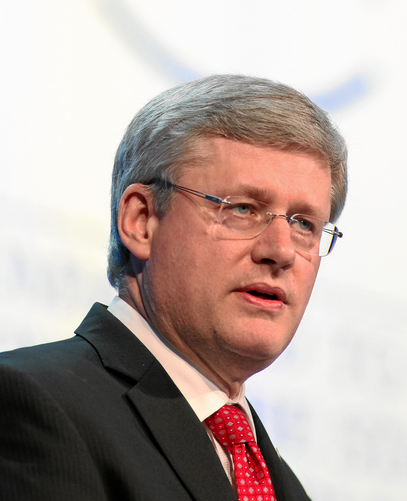
Prime Minister Stephen Harper speaking at the Annual Meeting 2012 of the World Economic Forum at the congress centre in Davos, Switzerland, January 26, 2012.
World Economic Forum photo via Wikimedia Commons.

In fact, Grant Robertson reports, the Trudeau regime effectively shuttered a small, cheap (less than $3 Million dollars ~ petty cash in Canada’s government) research and early warning team called the Global Public Health Intelligence Network (GPHIN) which

    was among Canada’s contributions to the World Health Organization, and it operated as a kind of medical Amber Alert system. Its job was to gather intelligence and spot pandemics early, before they began, giving the government and other countries a head start to respond and – hopefully – prevent a catastrophe. And the results often spoke for themselves.

Unfortunately, by the time the COVID-19 pandemic was getting started, just when the GPHIN should have provided “early warning,” it had been told, by the Trudeau regime, to focus on domestic issues. But global pandemics don’t often start in Canada, do they? The GPHIN sifted through data from around the world, often from places like China, Iran and Russia which hide or manipulate medical information, conducting something akin to military reconnaissance so that Canadian (and global (WHO)) officials could “see” what might be headed our way.

Did Justin Trudeau give the order to “muzzle” the GPHIN scientists? No, of course not … no more than Stephen Harper gave the order to “muzzle” scientists in Environment Canada. The decision to “refocus” the GPHIN on useless, domestic busywork was likely made by an Assistant Deputy Minister who was acting on yet another demand from the Treasury Board Secretariat to justify every programme dollar … again.

You should be glad that the Treasury Board Secretariat casts a sceptical eye on every single government programme and is a constant thorn in the side of operational people (like I was when I was serving and like the GPHIN folks were, too). They, skilled, hard-working civil servants, are just trying to ensure that your tax dollars are not being wasted. They are good people doing good work. But sometimes the wheat gets tossed away with the chaff. That appears to have been the case with the GPHIN. In retrospect, it seems almost criminally stupid to have deprived Canada of a valuable medical reconnaissance agency just because there had not been an “attack” recently. But that appears to have been the bureaucratic justification ~ it’s like me saying that since my house hasn’t burned down recently we should disband the fire department.

Did Justin Trudeau muzzle scientists? No.

Did Justin Trudeau’s government disable a valuable (and cheap) “early warning” system just to make its own wild spending look a little less careless? Yes, that’s what the Globe and Mail‘s investigation says ~ and we have paid a horrendous price in lives for that decision.

This story, it seems to me, is very much like the “Harper muzzles scientists” stories from a few years ago … but minus the massive media attention. It appears very evident, from Mr Robertson’s investigations that bureaucrats, acting on their own, internal priorities, emasculated the GPHIN just when we needed it most. That, bureaucratic action, was I believe what was, mainly, behind the “Harper muzzles scientists” stories, too. But in the 2010s much of the mainstream media was in a sort of undeclared war against Stephen Harper and so the claims of climate activists became “news” and opinions were treated as facts.

Membership in the Laurentian Elite isn’t about intelligence, it’s about power and status

Filed under: Cancon, Government, Politics — Tags: , , , , — Nicholas @ 03:00

In The Line, Andrew Potter wonders why Canadian political elites tend to be so … dumb:

Typical image search results for “Justin Trudeau socks”

Recent events in Canadian federal politics have raised anew the familiar conundrum: why are high status people so stupid?

Anyone who has had much interaction with high status individuals is familiar with the phenomenon. It isn’t the shallow ignorance of the merely uneducated, or the malevolent brainlessness of the criminal class. It’s not even your bog-standard lack of intelligence. No, high class stupidity is of a very special type: A sort of studied lack of interest in facts, an offhand relationship with norms, an outright animosity to new ideas.

But it is important to specify just what we mean by “high status,” because status means different things to different people. (Indeed, how you define “status” is one of the key markers of class differences in Canada.) For some people status is defined by money or wealth, for others it is a function of education, while for still others it is a matter of taste. And even if you are sure it comes down to money, there are clear status differences based on how you got rich. Everyone instinctively understands the difference between the guy who got rich off a chain of used car dealerships and the one who made his bundle selling his dotcom startup, and there’s a reason why “nouveau riche” is a derogatory term.

And so the high-status individuals we are talking about here are the highest of high, the upperest of upper, the ones whose wealth is inherited, whose lives are defined by their privilege, and for whom the question of which rung of the status ladder they stand upon never arises, because there is no one above them.

Which brings us to the Liberal government, and in particular to Prime Minister Justin Trudeau, Minister of Finance Bill Morneau and the scandal over the sole-sourced contract (sorry, “contribution agreement”) with a branch of the Kielburger-led WE conglomerate. First, Canadaland broke the story two weeks ago that Trudeau’s mother and brother had received almost a quarter of a million dollars in speakers’ fees from the WE organization.

[…]

Trudeau and Morneau are both very wealthy men, and if they were going to get into the business of selling their offices it wouldn’t be to a children’s charity for penny ante sums. No, as a number of columnists have pointed out, what is at work here is not corruption, it is privilege: It probably never occurred to either Trudeau or Morneau that this sort of thing was wrong. And it didn’t occur to them, because they are the sort of people who have spent their lives not worrying about the comings and goings of money and how it may affect their lives.

That is why the defining feature of the WE scandal is not the corruption, but the almost deliberate stupidity that is on display — in particular the lack of interest in basic material facts or in following the rules that govern the lives of most people. Which brings us back to the question we started with.

Update: Corrected the attribution for this … Andrew Potter’s article appeared in The Line, not The Dominion. Apologies for the brain fart…

July 23, 2020

Justin Trudeau and the Overton Window

Filed under: Cancon, Media, Politics — Tags: , , , , , , — Nicholas @ 05:00

Ted Campbell explains how Canada’s mainstream media work so hard to move the Overton Window to benefit Justin Trudeau and the Liberal Party:

… this explanation from Politico might help:

    The concept of the “Overton window,” the range of ideas outside which lie political exile or pariahdom, was first batted around in a series of conversations by the late free-market advocate Joseph Overton in the 1990s. After Overton’s untimely death in a plane crash in 2003, his friend and colleague at the libertarian Mackinac Center, Joseph Lehman, formalized and named the idea in a presentation meant to educate fellow think-tank warriors on the power of consistent advocacy. Ring the bell loudly for your idea, no matter how unpopular, and back it up with plenty of research and evidence, so the thinking went. Today’s fringe theory can become tomorrow’s conventional wisdom by the shifting of the finely tuned gears that move popular opinion; to Overton and Lehman the role of the think tank was to at least familiarize voters with these ideas, giving them an institutional home when public opinion finally moved their way.

Or, and even more brief visual explanation is:

Anyway, I believe that the Liberal Party of Canada and its allies in e.g. the CBC, The Star, and amongst the others who speak for the Laurentian Elites are working very hard, right now, to move the Overton Window frame of one idea from “Unthinkable” to at least barely “Acceptable.” That idea is that Justin Trudeau’s personal corruption (I believe that’s the right word) is acceptable because the alternative is a Conservative government that is, by Liberal/Laurentian Elite definition, authoritarian (fascist), homophobic, militaristic, racist, and sexist.

That’s right, the Liberal/Laurentian Elites admit that Justin Trudeau is dishonest, that he, unthinkingly, breaks the rules, over and over again ~ because, you see, he’s a really nice person but, sadly, he’s just not very smart. I have even made that case for them. I suggested, almost a year ago, that Justin Trudeau is an intellectual lightweight who is in no way qualified to hold high office … but he has the “second hand” celebrity of a famous name and he’s photogenic, too, and so, in 21st-century Canada he’s electable.

« Newer PostsOlder Posts »

Powered by WordPress