
Forgotten Weapons
Published 5 Jun 2016Spain was historically a major center of patent infringement in firearms manufacture because its patent law left open a big loophole: patents were only enforceable if the patent holder actually manufactured their guns in Spain. The major European and American firearms manufacturers were not interested in setting up plants in Spain, and so their patents were not enforced there, leaving Spanish shops and factories legally free to copy them.
One of the more successful copies was the “El Tigre“, a clone of the Winchester 1892 lever action rifle made by Garate Anitua y Cia. Ironically, Garate actually registered their own patent on the design since Winchester hadn’t bothered to, and that patent was enforced, since Garate did make the guns in Spain. Their copy was chambered for the .44-40 Winchester cartridge, known in Spain as the .44 Largo. This made it compatible with many of the revolvers in the country of American, Spanish, and Belgian origin, and thus quite popular with a wide variety of groups. Rural citizen militias and the Guardia Civil both used significant numbers of El Tigre carbines. They were also fairly popular in the United States, as the cost was substantially lower than a true Winchester. Many Hollywood films and shows used them as less expensive prop guns, especially for scenes where guns would be handled roughly.
Despite their competitive cost, the El Tigres were actually quite good guns, and served their owners well.
February 20, 2023
Garate Anitua y Cia “El Tigre” – Winchester 1892 Copy
February 7, 2023
The Soviet Union Adopts an SMG: Degtyarev’s PPD-34/38
Forgotten Weapons
Published 21 Oct 2022The Soviet Union adopted its first submachine gun in 1935 after trials of some 14 different design in 1932/33. The winner of the trials was Vasily Degtyarev, once of the Soviet Union’s most prolific firearms designers. His model 1934 was a simple blowback gun reminiscent of the MP-28,II albeit with different trigger and magazine systems. The PPD34 used a 25-round box magazine, chambered for 7.62x25mm Tokarev. It was put into slow production, with just 3,300 or so produced by the end of 1938. During that time, Degtyarev made a number of small improvements to the gun, smoothing out the teething problems that are always found in new production systems. This improved version was designated the PPD34-38.
During the time, the submachine gun was not considered a priority by the Red Army. The leading generals did not see the value in the class of arms, and actually pulled all the PPDs from service in 1939 and had them put into storage. Only a few months later, the Red Army would be given a grim demonstration of SMG effectiveness when they closed the border into Finland and encountered determined Finnish resistance with kp/31 Suomi SMGs.
Some Suomis were captured by Soviet troops, and were very well liked — for obvious reasons. The inevitable inquiry into why the Red Army did not have such a weapon led to a frantic re-issuing of PPDs and production of as many as possible. At Stalin’s direction, the Suomi drum magazine was copied and adapted to the PPD34-38 as well. This required the addition of a short feed tower to fit the magazine well initially deigned for a standard box magazine. While PPD34-38 production continued, the PPD40 was quickly designed and put into production alongside the older model. Eventually, both were replaced in service by the PPSh-41, which was truly designed for mass industrial production.
(more…)
February 3, 2023
Tank Chats #166 | SOMUA S35 | The Tank Museum
The Tank Museum
Published 14 Oct 2022Join David Willey in this week’s Tank Chat as he details the history of the SOMUA S35, a French cavalry tank of the Second World War.
(more…)
January 18, 2023
Ask Ian: Why No German WW2 50-Cal Machine Guns? (feat. Nick Moran)
Forgotten Weapons
Published 20 Sep 2022From Nathaniel on Patreon:
“Why didn’t Germany or Axis powers have a machine gun similar to the American M2?”Basically, because everyone faced the choice of a .50 caliber machine gun or 20mm (or larger) cannons for anti-aircraft use, and most people chose the cannons — including Germany. There were some .50 caliber machine guns adopted by Axis powers, most notably the Hotchkiss 1930, a magazine-fed 13.2mm gun that was used by both Italy and Japan (among others). However, the use of the .50 caliber M2 by the US was really a logistical holdover form the interwar period. The M2 remained in production because it was adopted by US Coastal Artillery as a water-cooled anti-aircraft gun, and commercial sales by Colt were slim but sufficient to keep the gun in development through the 20s and 30s. It was used as a main armament in early American armor, but obsolete in this role when the war broke out.
However, with the gun in production and no obvious domestic 20mm design, the US chose to simply make an astounding number of M2s and just dump them everywhere, from Jeeps to trucks to halftracks to tanks to self-propelled guns. And that’s not considering the 75% of production that went to coaxial and aircraft versions …
Anyway, back to the question. The German choice for antiaircraft use was the 20mm and 37mm Flak systems, and not a .50 MG on every tank turret. And so, there was really no motive to develop such a gun. The Soviets did choose to go the US route, though, and developed the DShK-38 for the same role as the US M2 — although it was made in only a tiny fraction of the quantity of the M2.
(more…)
January 11, 2023
Repurposing Obsolete Rifles: The Lebel R35 Carbine
Forgotten Weapons
Published 19 Dec 2017The French military had investigated the possibility of a Lebel carbine in the 1880s, but by the 1930s a different set of priorities was in place. In an effort to make some use of the vast stockpiles of obsolete Lebel rifles France had, a plan was put in place to shorten then into carbines for auxiliary troops like artillery crews and engineers. These men needed some sort of rifle or carbine, but they did not need the best and newest weapons. By giving them shortened Lebel carbines, it would free up more modern rifles like the M34 Berthiers in 7.5mm and the new MAS-36 rifles to go to the front line infantry who needed them most.
The R35 conversion was developed by the Tulle arsenal and adopted in January of 1936. The French government ordered 100,000 to be made, and deliveries began in April of 1937. Production would accelerate and continue right up to the spring of 1940, with a total of about 45,000 being actually delivered before the armistice with Germany. The conversions were all assembled at Tulle, but four other factories manufactured barrels for them: Chatellerault (MAC), St Etienne (MAS), Société Alsacienne de Constructions Mécaniques (SACM), and Manufacture d’Armes de Paris (MAP). These barrels were 450mm long (17.7 inches), and with the similarly shortened magazine tube, the R35 carbines held just 3 rounds. Production would not continue after the liberation of France in 1944.
(more…)
January 7, 2023
Converting the Lebel to 7.5mm: The M27 Lebel
Forgotten Weapons
Published 12 Dec 2017In the aftermath of World War One, the French military instituted a plan to introduce a completely new roster of small arms. This would begin with the development of a modern rimless rifle cartridge, which was adopted in 1924. With the new cartridge in hand, programs were begun to develop a light machine gun, bolt action rifle, and semiautomatic rifle using it. To supplement these new arms — especially during their development and production — plans were also made to convert existing 8mm rifles to the new cartridge.
The two rifles in large supply, of course, were the Lebel and the Berthier. The St Etienne arsenal was tasked with developing a Berthier conversion (this would become the M34 Berthier), and the Tulle arsenal was assigned to do the same with the Lebel. The first prototype was ready for testing in 1927. That first example was not satisfactory, and iterative development would continue into the early 1930s. Ultimately, the Lebel conversion was simply not as well liked by troops or as effective as the M34 Berthier, and so the Berthier was chosen for mass production. A total of about 1500 Lebel M27 conversions would be made by 1940, in a wide variety of configurations including different barrel lengths, rifling patterns, and optics mounting setups. While this did not result in a successful production rifle, it would inform the development of the MAS-36, and not go to waste. In addition, a number of M27 rifles would be converted into pressure testing guns to assist in ammunition development.
(more…)
December 18, 2022
Belgian GP-35: Pre-War Browning High Power Complete Rig
Forgotten Weapons
Published 17 Aug 2022The Browning High Power (“Grande Puissance“, aka GP-35) was developed by Fabrique National in Belgium, designed primarily by John Browning’s apprentice Dieudonné Saive. It began in the very early 1920s as a pistol designed for a new French Army requirement, but eventually split into two separate development tracks. By the early 1930s the French procurement process was still ongoing, but FN felt that the current iteration of their pistol (the Grand Rendement) was sufficiently mature to be a viable military sidearm. They began offering it for sale, and the Belgian Army quickly took an interest. One thousand were purchased for Belgian field trials in 1933, and with a few minor changes it was adopted by Belgium as the GP-35 in 1935.
The first guns are delivered in May of 1935, and the first troops to receive them were troops like machine gun crews, tank crews, messengers and other men who needed a weapon, but not a full-length rifle. By 1938 enough have been delivered that the specialty troops and NCOs have been fully equipped, and guns begin to go to officers, replacing things like the FN Model 1900. By the time of the German invasion in May 1940, some 30,000 — 35,000 High Powers had been delivered to the Belgian Army. In addition to this, several other military contracts were made by FN, selling the pistol to Estonia, Lithuania, Paraguay, China, and Finland. However, the Belgian orders account for the significant majority of all pre-war made High Powers.
Note that in the US, original pre-war High Powers with original stocks, 500-meter tangent sights, and serial numbers below 47,000 (no prefix) are exempted from the NFA, and are not legally considered short-barreled rifles.
(more…)
December 12, 2022
Before the High Power was the FN Grand Rendement
Forgotten Weapons
Published 8 Aug 2022The Browning High Power story begins with a French 1921 request for a new military pistol. FN engineer Dieudonné Saive developed a double stack, single feed magazine and John Browning adapted a Browning 1903 pistol to use it, and this was sent to France for consideration. This pistol worked well enough, but the French trials board requested changes … and they would continue requesting changes and more trials for the next decade.
By 1931, FN felt that the current iteration of the pistol — while still not meeting all the French requirements — was good enough to stand on its own as a service pistol for the Belgian Army and other clients. They named it the “Grand Rendement” (High Efficiency) and began marketing it. The Belgian Army showed a definite interest, and bought 1,000 pistols for field trials, based on the prototype example we have in today’s video. These would become the Grande Puissance, aka the High Power.
For more details on this and other FN Browning pistols, I highly recommend Anthony Vanderlinden’s FN Browning Pistols, soon to be released in its third edition:
December 3, 2022
QotD: Mantetsu and the Kwantung Army
When the Japanese decided to become a modern power, they consciously chose to emulate American business practices. But these were the business practices of the Gilded Age, so Japanese businesses ran in a way that would have the most hardened Robber Baron drooling — horizontal integration, vertical integration, trusts, combines, mergers, the works.
Thus the South Manchuria Railway Corporation, originally contracted to develop a defunct line in a disputed territory, soon developed into a full-spectrum enterprise. Pretty much all heavy industry in the Japanese areas of Manchuria were divisions of Mantetsu. But since all the heavy industry depended on mines, and transportation, and food and housing for workers, and banks, and schools for the workers’ children, etc., pretty soon Mantetsu ran all of that, too. By the late 1920s, you could argue that Mantetsu was almost its own country.
It even had its own army, and that’s where things get really interesting.
The Kwantung Army was the security force assigned to the South Manchuria Railway Zone. The Japanese weren’t stupid; they knew the perils of independent commands far from home, and they rotated units through with some regularity. Nonetheless, the command staff remained fairly stable over the years … and so did Mantetsu’s.
The Japanese weren’t stupid, but they were people, and people being people, soon enough the lines between the Kwantung Army and Mantetsu began to blur. And since the lines between Mantetsu, the Imperial Army, and the government were already pretty blurry, pretty soon the concerns of one became the concern of all. (Nor was the Navy left out, though I’m not discussing them in order to keep it simple. They were up to their eyeballs in Mantetsu, too, because warships need lots of steel and steel comes from Manchuria).
A small but highly committed and totally ideologized faction developed inside the Kwantung Army. Several, in fact, and one of them (the Imperial Way faction) attempted an actual coup d’etat in 1936. It was put down, and the Imperial Way faction dissolved (in theory), but the problem of an intensely ideologized officer corps remained. Long story short, you had a small group of highly ideologized officers garrisoning a remote province pulling the entire Empire into big, unwinnable wars.
One could make the case that World War II in the Pacific was ultimately caused by about fifteen or twenty guys in the Kwantung Army.
That’s overly reductionist, but it highlights the huge problem with organizations slipping the leash. In theory, there was a clear chain of command, and even the head of the Kwantung Army was a down it a ways — he was subordinate to the Army Council, which was subordinate to the War Minister, who was subordinate to the Parliament, who were subordinate to the Emperor. In theory, lots of people could’ve sacked Gen. Araki, or his mini-me Ishiwara Kanji (a lieutenant colonel through most of it). Equally in theory, Mantetsu had no say in any of it — the Kwantung Army was a formation of the Imperial Japanese Army, not Mantetsu’s private security force.
But in reality, Mantetsu was so wired in to the Japanese government that in a lot of cases, it was the government. But not always, because the same could be said about the Army, and the Navy, both of which were also wired into Mantetsu up to the very top (or vice versa, your choice). And Mantetsu had their Media arm, of course, as did the Army and Navy …
What all this boiled down to, then, was a power vacuum. I know, that seems weird, but a skilled bureaucratic infighter like Ishiwara never lacked for groups to play against each other. The Army and Navy would oppose on principle any move that seemed to aggrandize the other, neither could go against Mantetsu (and neither could control it), and all had to pay at least lip service to the civilian government. Because of this, real power fell to whomever had the balls to grab it …
… which was the officer corps of the Kwantung Army. They assassinated at least two Manchurian warlords, staged a number of false flag attacks on their own positions, and generally got up to however you say “standard issue Juggalo fuckery” in Japanese, up to and including a full-scale war with China.
Severian, “Slipping the Leash”, Founding Questions, 2022-08-27.
November 18, 2022
The Model SS41 – A Czech Bullpup Anti-Tank Rifle for the SS
Forgotten Weapons
Published 23 Jun 2017The SS41 was a bullpup, bolt-action antitank rifle manufactured in small numbers by CZ for the SS. Contrary to common assumption, the SS were not a part of the standard German military arms procurement system, and were forced to scrounge for their weapons from other sources. Czech factories were one of the more popular sources, as smaller production lines could escape being integrated into Wehrmacht oversight and were able to contract privately with groups like the SS (the ZK383 as used by the SS is another example of this).
The Model 41 had been in development by the Czech military when the Germans occupied, and it was adapted to the German Patrone 318 cartridge for this production run. That cartridge was also used in the PzB-39, and fired a 220 grain tungsten-cored bullet at 4000 fps — although even this extremely high velocity only allowed it to defeat 30mm of vertical armor at 100m. As with the other antitank rifles of WW2, it would obsolete almost as soon as it was introduced, although it did remain useful for attacking emplaced positions and light armored vehicles (much like the Soviet PTRD and PTRS rifles).
Only a few thousand of the SS41 were manufactured, and they served primarily on the Eastern Front. As a result very few exist in American collections, and this is a particularly excellent example. Thanks to the Institute of Military Technology for allowing me to have access to this very cool AT rifle and bring it to you! Check them out at:
November 15, 2022
How Was The Soviet Union Founded?
The Great War
Published 11 Nov 2022Vladimir Lenin had led the Bolshevik movement through the October Revolution and the Russian Civil War but by 1922 his health was failing and infighting among Bolshevik leadership caused friction. In the end Josef Stalin was able to prevail over Leon Trotsky and lead the newly founded Soviet Union until his death in 1953.
(more…)
October 29, 2022
Witches, beware! It’s the Malleus Maleficarum!
It’s the season for ghosts, goblins, and — of course — witches, so Scott Alexander decided to review that famous book for witch-hunters, the Malleus Maleficarum:
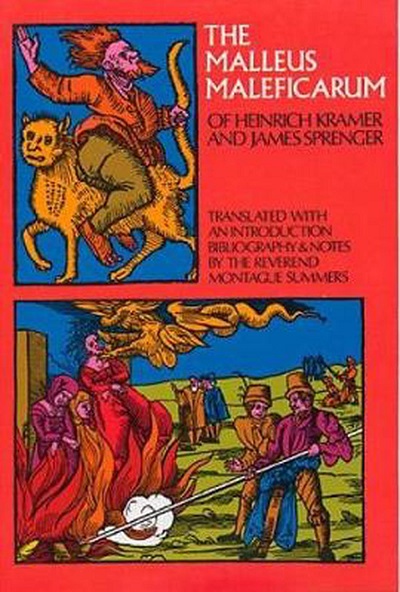
Did you know you can just buy the Malleus Maleficarum? You can go into a bookstore and say “I would like the legendary manual of witch-hunters everywhere, the one that’s a plot device in dozens of tired fantasy novels”. They will sell it to you and you can read it.
I recommend the Montague Summers translation. Not because it’s good (it isn’t), but because it’s by an slightly crazy 1920s deacon every bit as paranoid as his subject matter. He argues in his Translator’s Introduction that witches are real, and that a return to the wisdom of the Malleus is our only hope of standing against them:
Although it may not be generally recognized, upon a close investigation it seems plain that the witches were a vast political movement, an organized society which was anti-social and anarchical, a world-wide plot against civilization. Naturally, although the Masters were often individuals of high rank and deep learning, that rank and file of the society, that is to say, those who for the most part fell into the hands of justice, were recruited from the least educated classes, the ignorant and the poor. As one might suppose, many of the branches or covens in remoter districts knew nothing and perhaps could have understood nothing of the enormous system. Nevertheless, as small cogs in a very small [sic] wheel, it might be, they were carrying on the work and actively helping to spread the infection.
And is this “world-wide plot against civilization” in the room with us right now? In the most 1920s argument ever, Summers concludes that this conspiracy against civilization has survived to the modern day and rebranded as Bolshevism.
Paging Arthur Miller…You can just buy the Malleus Maleficarum. So, why haven’t you? Might the witches’ spiritual successors be desperate to delegitimize the only thing they’re truly afraid of — the vibrant, time-tested witch hunting expertise of the Catholic Church? Summers writes:
It is safe to say that the book is to-day scarcely known save by name. It has become a legend. Writer after writer, who had never turned the pages, felt himself at liberty to heap ridicule and abuse upon this venerable volume … He did not know very clearly what he meant, and the humbug trusted that nobody would stop to inquire. For the most part his confidence was respected; his word was taken.
We must approach this great work — admirable in spite of its trifling blemishes — with open minds and grave intent; if we duly consider the world of confusion, of Bolshevism, of anarchy and licentiousness all around to-day, it should be an easy task for us to picture the difficulties, the hideous dangers with which Henry Kramer and James Sprenger were called to combat and to cope … As for myself, I do not hesitate to record my judgement … the Malleus Maleficarum is one of the most pregnant and most interesting books I know in the library of its kind.
Big if true.
I myself read the Malleus in search of a different type of wisdom. We think of witch hunts as a byword for irrationality, joking about strategies like “if she floats, she’s a witch; if she drowns, we’ll exonerate the corpse”. But this sort of snide superiority to the past has led us wrong before. We used to make fun of phlogiston, of “dormitive potencies”, of geocentric theory. All these are indeed false, but more sober historians have explained why each made sense at the time, replacing our caricatures of absurd irrationality with a picture of smart people genuinely trying their best in epistemically treacherous situations. Were the witch-hunters as bad as everyone says? Or are they in line for a similar exoneration?
The Malleus is traditionally attributed to 15th century theologians/witch-hunters Henry Kramer and James Sprenger, but most modern scholars think Kramer wrote it alone, then added the more famous Sprenger as a co-author for a sales boost. The book has three parts. Part 1 is basically Summa Theologica, except all the questions are about witches. Part 2 is basically the DSM 5, except every condition is witchcraft. Part 3 is a manual for judges presiding over witch trials. We’ll go over each, then return to this question: why did a whole civilization spend three centuries killing thousands of people over a threat that didn’t exist?
October 14, 2022
That time that H.G. Wells fell afoul of Muslim sentiments
In the New English Review, Esmerelda Weatherwax recounts an incident from the 1930s where Muslim protestors took to the streets of London in reaction to a recent Hindustani translation of H.G. Wells’ A Short History of the World:
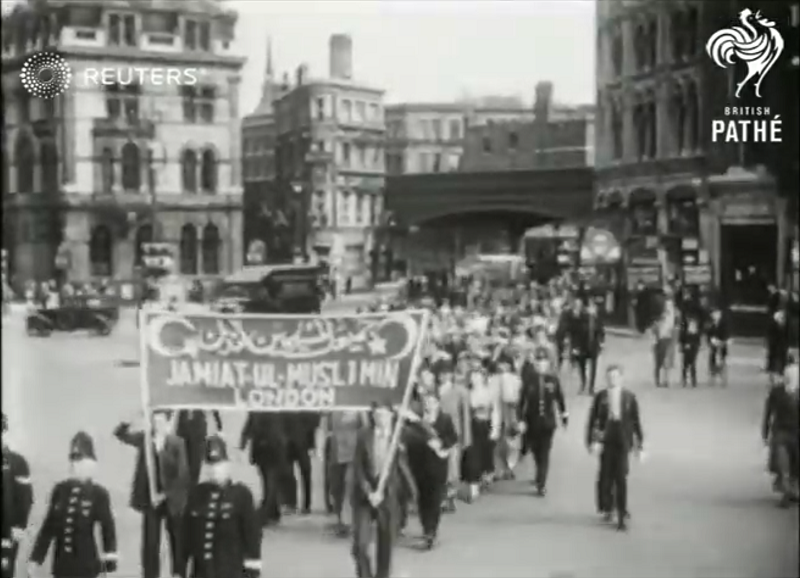
Screen capture of the 1938 Muslim protest march in London from a British Pathé newsreel – https://www.youtube.com/watch?v=ADausiEe4pM
… my husband was at the Museum of London and spotted a very brief mention of this protest in 1938 on a list of 20th century London events. I did some research.
The book they objected to was HG Wells’ A Short History of the World. This was originally published in 1922 but in 1938 an abridged version was tranlated into Hindustani and published in India. His observations about the Prophet Mohammed did not find favour with Indian Muslims (and as you know pre-partition the area called India covered what is now Pakistan and Bangladesh). There were protest meetings in Calcutta and Mumbai (then transliterated as Bombay) and the consignments of the books that WH Smith the booksellers sent to Hyderabad mysteriously never arrived. Investigation showed that the Sind government banned its import. Protests spread to east Africa and were reported in Nairobi and Mombasa.
The paragraphs concerned said “He seems to have been a man compounded of very considerable vanity, greed, cunning, self-deception, and quite sincere religious passion”. Wells concludes, not unfavourably, that “when the manifest defects of Muhammad’s life and writing have been allowed for, there remains in Islam, this faith he imposed upon the Arabs, much power and inspiration”.
There had been a number of Muslims living in east London for some years, sailors who came through the docks, retired servants, some professional men and in 1934 they formed a charitable association for the promotion of Islam called Jamiat-ul-Muslimin; they met on Fridays at a hall in Commercial Road.
On Friday 12th August 1938 a copy of A Short History of the World was, as apparently reported in the Manchester Guardian the following day “ceremoniously burned”. The main Nazi book burnings were over 5 years previously but I can’t but be reminded of them. I can’t access the Guardian on-line archive for 1938 as I don’t have a subscription, but I have no reason to doubt what they reported.
A few days later Dr Mohammed Buksh of Jamiat-ul-Muslimin attended upon Sir Feroz Khan Noon, the high commissioner for India. Sir Feroz tried to explain that in Britain we could (or could then) freely criticise Christianity, the Royal family and government as a right. He reminded Dr Buksh that Muslims were “a very small minority in England, and it would do them no good to try and be mischievous in this country, no matter how genuine their grievances were”.
October 12, 2022
Walther P38 Development
Forgotten Weapons
Published 13 Apr 2016The Walther P38 was adopted by Germany in 1938 as a replacement for the P08 Luger — not because the Luger was a bad pistol, but because it was an expensive pistol. Walther began development of its replacement in 1932 with two different development tracks — one was a scaled-up Model PP blowback in 9x19mm and the other was the locked-breech design that would become the P38.
The initial prototypes look externally quite similar to the final P38, although the locking system went through several changes and the controls did as well. Several of the early developmental models used shrouded hammers.
In this video I will take a look at both initial “MP” pistols (the blowback and the locked breech), then the Armee Pistole (aka the AP) in its standard configuration and also a long barreled model with a shoulder stock, then the second Model MP, and finally the HP which was the commercial model of the final P38. In addition, I will check out a sheet metal prototype of the locked breech model form the very beginning of the development program.
(more…)
September 21, 2022
Radom’s Vis 35: Poland’s Excellent Automatic Pistol
Forgotten Weapons
Published 9 Feb 2016In the 1920s Poland began looking for a new standard military pistol, and tested a variety of compact .380s. The representative from FN brought along an early iteration of the High Power (along with their other entry) even though it was much too large and heavy to meet the Polish requirements. After a couple iterations of testing, it became clear to the Polish Ordnance officers that the High Power was a much more effective service pistol than the compact guns they had been instructed to look for.
Lo and behold, the ultimate choice was a domestic design based largely on the High Power (a direct deal with FN was not an option after Poland’s relationship with FN had suffered through problems with the wz.28 version of the BAR). Toss in a delay to redesign the early decocking mechanism to satisfy the Cavalry (who didn’t realize that the decocker wasn’t actually meant to be used, but rather to just add another claim to the patent), and by 1935 the pistol was finished and formally adopted.
The Vis 35 is one of the best automatic pistols of WWII in terms of both handling and quality. In total 46,000 were made pre-war for Poland’s military, and German occupation forces built another 300,000+ during the war.
(more…)


