Forgotten Weapons
Published 25 Sep 2017There is a common assumption that the MAS-36 was a fool’s errand from the outset — why would a country develop a brand new bolt-action rifle in the mid 1930s, when obviously semiautomatic combat rifles were just on the cusp of widespread adoption? Well, the answer is a simple one — the French were developing a semiautomatic rifle at the same time, and the MAS-36 was only intended to go to rear echelon and reserve troops. It would serve as a measure of economy, reducing the number of the more complex and expensive self-loaders necessary, while still providing sufficient arms to equip the whole reserve in case of a mobilization.
Well, the plan didn’t quite work out that way, because Germany invaded France before the semiauto rifle was ready for production (it was, at that point, the MAS-40 and was in trials). Not until 1949 would the self-loader go into mass production with the MAS-49 (discounting the short-lived MAS-44). With this in mind, the MAS-36 suddenly makes much more sense. It is a simple, economical, and entirely adequate rifle without extraneous niceties. In a word, it is a Russian rifle rather than a Swiss one.
Production began in the fall of 1937, and by the time of the German invasion there were about 205,000 in French stockpiles. They saw extensive use in the Battle of France, along with M34 Berthiers in 7.5x54mm. Some would escape to serve the Free French forces worldwide through the war, and others would be captured and used by German garrisons in France and along the Atlantic Wall. Production resumed upon the liberation of St Etienne in 1944, and by 1957 about 1.1 million had been made. They basically fall into two varieties, with several pre-war milled components changed to more economical stamped designs after the war.
(more…)
September 11, 2022
MAS-36: The Backup Rifle is Called to Action
September 4, 2022
Experimental Primer-Actuated Semiauto Springfield 1903
Forgotten Weapons
Published 3 Sep 2016During the 1920s, a lot of experimental rifle development work was being done in the US. The military was interested in finding a semi-automatic rifle, and plenty of inventors were eager to get that valuable military contract. One particular item of interest to the military was the possibility of being able to convert large existing stockpiles of bolt-action 1903 Springfield rifles into semi-automatics, and that is what this particular example was an attempt at.
This rifle is built with a barrel and receiver made in 1921 (it was not uncommon for the government to provide parts to inventors working in this area), and uses an operating system which is pretty much unheard of today: primer actuation. In this system, the primer pushes back out of the cartridge case (intentionally) upon firing, acting as a small piston. This pushes the firing pin backwards (as well as the bolt face in this rifle), which begins the process of unlocking and cycling. It is a system that saw some popularity for a brief time in the 20s, as it allowed semi-automatic action without the need for a drilled gas port or a moving barrel — several of John Garand’s early prototypes operated this way. However, substandard performance and the need for special ammunition (most military ammunition had primers solidly crimped in place) led to its abandonment.
(more…)
August 29, 2022
1930s German Rearmament: JP Sauer’s Pre-K98k Rifle
Forgotten Weapons
Published 3 May 2022When the German Army announced in 1934 that it would be adopting a new standard rifle, the JP Sauer company jumped at the chance to submit a model for consideration. Sauer had a complete production line for the Mauser pattern rifles, having produced Gewehr 98s during World War One, and it had access to Mauser’s “Gewehr für Deutsches Reichspost” rifles that were clearly the basis for what the Army wanted. So Sauer didn’t just submit a model for Army consideration, they actually put it into full production without waiting for the Army’s decision (Mauser did the same).
As it turned out, the Sauer rifle differed from the final K98k standard only in its barrel-band retention system. After this pattern was announced in June 1935, the company transitioned its production to meet those details. The rifles already made were still taken into military service, though.
This example is marked S/147/K, indicating Sauer production in 1934. It is the highest known serial number of this year, and a beautiful example. It is all matching, and still has very good finish and very nice stock markings. A really interesting piece of the story of German 1930s rearmament!
(more…)
August 20, 2022
How Turkey Fought a WW1 Peace Treaty – The Greek-Turkish War 1919-1923
The Great War
Published 19 Aug 2022The defeat of the Ottoman Empire in 1918 meant that it got its own peace treaty like the other three Central Powers. But the emerging Turkish National Movement under Mustafa Kemal resisted the Treaty of Sevres and occupation by various Entente Powers. Their successful resistance led to the creation of modern Turkey and the Treaty of Lausanne in 1923.
(more…)
August 11, 2022
US Navy Fleet Problems – Now its time to play with carriers (VIII-XII)
Drachinifel
Published 10 Aug 2022Today we take a look at the background and thinking behind the inter-war USN Fleet Problems, with summaries of Fleet Problems 8 through 12
(more…)
July 17, 2022
The Berthier After World War One
Forgotten Weapons
Published 31 Jul 2017http://www.patreon.com/ForgottenWeapons
In the aftermath of World War One, France would face the need to replace virtually all of its small arms, because nearly everything it had been using was either a wartime stopgap (like the Ruby, Chauchat, and Berthier 07/15) or had been obsolete before the war began (like the Lebel and Mle 1892 revolver). The first focus of the rearming was a new light machine gun, which would be adopted in the form of the Chatellerault M24/29. Plans were made to develop a semiautomatic infantry rifle and bolt action support troops’ rifle (both in the new 7.5mm rimless cartridge), but these would not prove to be as quickly realized. As a result, the Berthier Mle 1916 carbines would remain in major frontline service right up to the outbreak of World War Two.
During the twenty years between the wars, the Berthiers would see a series of changes and upgrades including:
– Sling bars replacing swivels
– Revised handguard profile
– Raised sights
– Removal of the clearing rods
– Adoption of the 1932N cartridge and associated rechambering
– New metal finishesProduction of new carbines in fact continued all the way until 1939, with at least 160,000 made in 1919 and later. Many of the alterations made during this postwar period are evident on examples found today, and there is a collecting premium on guns that do not exhibit these peacetime modifications. So, let’s have a look, shall we?
If you enjoy Forgotten Weapons, check out its sister channel, InRangeTV! http://www.youtube.com/InRangeTVShow

June 16, 2022
Mussolini’s Pope? – The Geopolitics of the Vatican
World War Two
Published 14 Jun 2022Pope Pius XI is the first Pope to guide the Catholic Church through the age of fascism. How has his Vatican responded to Fascists Italy and Nazi Germany, and what is the geopolitical position of the Papacy on the eve of war of World War Two?
(more…)
May 21, 2022
Ed Browning’s Winchester G30 Prototypes
Forgotten Weapons
Published 25 Jul 2016http://www.patreon.com/ForgottenWeapons/
After Jonathan Edward “Ed” Browning had his 1929 rifle dropped from US military testing, he took the design back to his shop in Utah and kept working on it. By 1938 he had made enough improvements that he was ready to present the gun to Winchester, hoping they would be interested in purchasing the design. Specifically, he redesigned the receiver to move much of the bolt travel into the wrist of the stock, shortening the action. He also replaced the short recoil action with an annular gas piston. He made two sample rifles, one in military configuration and one in sporting configuration.
Winchester was looking for a self-loading rifle to market at the time, because they could see that war in Europe appeared to be imminent. They had been caught without a military rifle of their own during World War One, and did not want to be in that situation again. They thought that Ed Browning’s design showed merit, so they agreed to purchase it, and brought Browning onboard to help continue development.
With Winchester’s resources, it was possible to make the guns more professionally. Winchester designated the rifle the G30, and we have one of the examples made by Winchester in the video as well.
The tilting bolt mechanism took inspiration from John Moses Browning’s 1911 pistol, and the trigger housing bears an interesting resemblance to that of the French Berthier rifles (which may or may not be coincidental). The rifles appear to have worked reasonably well, although the annular gas piston was a hindrance which Browning apparently was unwilling to abandon. With his death in 1939, the project moved on to a new phase with David Marshall Williams taking on the job of improving it.

May 15, 2022
Tank Chat #147 M14/41 | The Tank Museum
The Tank Museum
Published 4 Feb 2022► JOIN OUR PATREON: Our Patreons have already enjoyed Early Access and AD free viewing of our weekly YouTube video! Consider becoming a Patreon Supporter today: https://www.patreon.com/tankmuseum
► TIMESTAMP:
00:00 – INTRO
00:22 – FEATURES
(more…)
May 8, 2022
Tank Chat #146 Carro Veloce | The Tank Museum
The Tank Museum
Published 28 Jan 2022► JOIN OUR PATREON: Our Patreons have already enjoyed Early Access and AD free viewing of our weekly YouTube video! Consider becoming a Patreon Supporter today: https://www.patreon.com/tankmuseum
► TIMESTAMP:
00:00 – INTRO
00:33 – FEATURES
(more…)
April 16, 2022
Tank Chats #143 | Hetzer | The Tank Museum
The Tank Museum
Published 31 Dec 2021Our Patreons have already enjoyed Early Access and AD free viewing of our weekly YouTube video! Consider becoming a Patreon Supporter today: https://www.patreon.com/tankmuseum
The Munich Agreement averted the outbreak of war but for Czechoslovakia, it meant giving way to German occupation. Join David Willey to discover how Germany was able to use the country’s existing military outputs to build the tank destroyer, Hetzer.
00:00 – Intro
00:28 – The history of the tank destroyers name
14:55 – Wartime production
(more…)
April 12, 2022
Calvin Coolidge: The Silent President
Biographics
Published 27 Sep 2021Simon’s Social Media:
Twitter: https://twitter.com/SimonWhistler
Instagram: https://www.instagram.com/simonwhistler/This video is #sponsored by Squarespace.
Source/Further reading:
Miller Center, in-depth overview: https://millercenter.org/president/co…
History Today, overview: https://www.historytoday.com/archive/…
New Yorker, “The case for Coolidge” (cached): https://webcache.googleusercontent.co…
NY Times, “Coolidge, the great refrainer”: https://www.nytimes.com/2013/02/17/bo…
NY Times, 1933 obituary for Coolidge: https://archive.nytimes.com/www.nytim…
Atlantic, “Coolidge and depression”: https://www.theatlantic.com/magazine/…
Politico, “How Coolidge survived the Harding-era scandals”: https://www.politico.com/magazine/sto…
History, “Boston Police Strike of 1919”: https://www.history.com/this-day-in-h…
Coolidge letter written after death of his son: https://www.shapell.org/manuscript/pr…

March 26, 2022
Hollywood: Government Propaganda? – WW2 Special
World War Two
Published 24 Mar 2022Along with its arsenal of carriers, bombers, and tanks, America has perhaps the most powerful weapon of all: Hollywood. Hollywood is pumping out American and Allied propaganda as quickly as it can. But was this always the case?
(more…)
March 14, 2022
“Mister, we could use a man like Herbert Hoover Warren Harding again …”
Kind words for the oft-maligned 29th president of the United States? Daniel J. Mitchell is all over it:
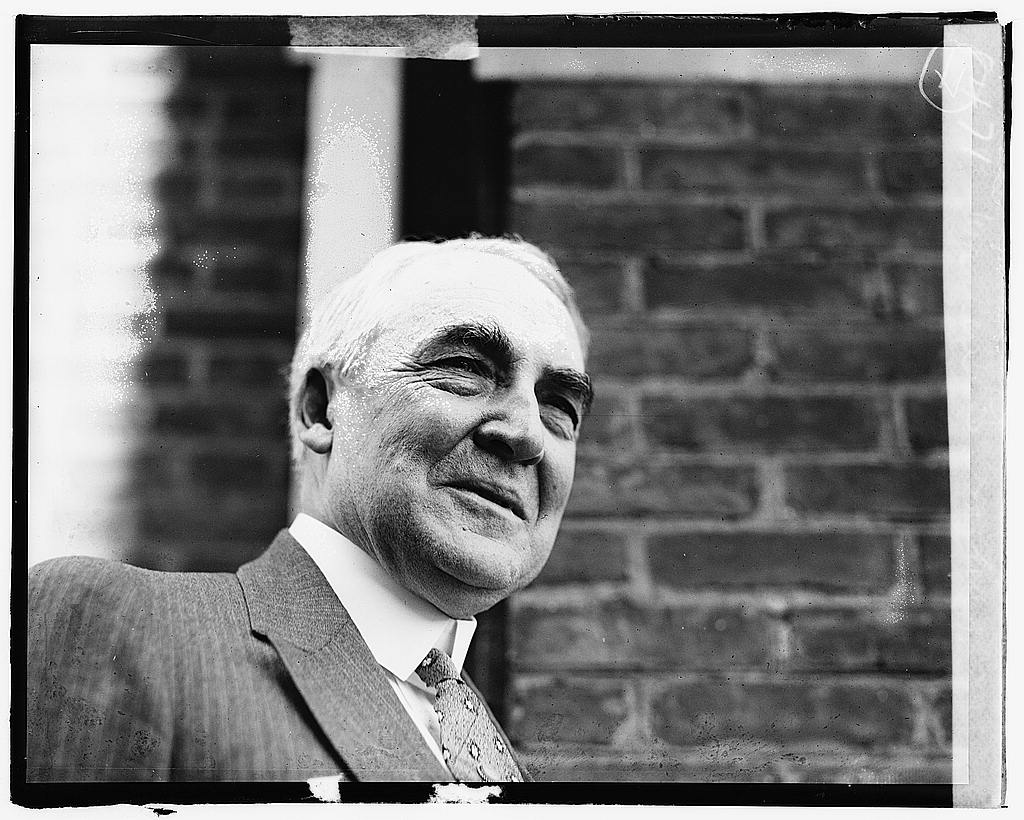
Warren G. Harding, 14 June 1920.
Library of Congress control number 2016828156
Today, we’re going to celebrate the fiscal achievements of Warren Harding.
Most notably, as illustrated by this chart based on OMB data, he presided over a period of remarkable spending discipline.
Harding also launched very big — and very effective — reductions in tax rates.
And his agenda of less government and lower tax rates helped bring about a quick end to a massive economic downturn (unlike the big-government policies of Hoover and Roosevelt, which deepened and lengthened the Great Depression).
In an article for National Review last year, Kyle Smith praised President Harding’s economic stewardship.
In a moment of national crisis, Warren G. Harding restored the economic health of the United States … America in 1921 was in a state of crisis, reeling from the worst recession in half a century, the most severe deflationary spiral on record … Unemployment, it is now estimated, stood somewhere between 8.7 and 11.7 percent as returning soldiers inflated the size of the working-age population.
Between 1919 and August of 1921 the Dow Jones average plummeted 47 percent. Harding’s response to this emergency was largely to let the cycle play out … The recession ended in mid-year, and boom times followed. Harding and Congress cut federal spending nearly in half, from 6.5 percent of GDP to 3.5 percent. The top tax rate came down from 73 percent to 25, and the tax base broadened. Unemployment came down to an estimated 2 to 4 percent … Harding was a smashing success in a historically important role as the anti-Wilson: He restored a classically liberal, rights-focused, limited government, and deserves immense credit for the economic boom that kicked off in his first year and continued throughout the rest of the 1920s.
Smith’s article also praises Harding for reversing some of Woodrow Wilson’s most odious policies, such as racial discrimination and imprisoning political opponents (Wilson also had a terrible record on economic issues).
Of course, Harding’s term is much more often remembered for the scandals, and as most modern historians are far more interested in Woodrow Wilson’s bold progressivism they almost always decry Harding and then Coolidge for dismantling a lot of Wilson’s more enthusiastic progressive projects. Even H.L. Mencken — very much not a Wilson fan — found Harding to be not to his taste in turn:
On the question of the logical content of Dr. Harding’s harangue of last Friday, I do not presume to have views … But when it comes to the style of the great man’s discourse, I can speak with … somewhat more competence, for I have earned most of my livelihood for twenty years past by translating the bad English of a multitude of authors into measurably better English. Thus qualified professionally, I rise to pay my small tribute to Dr. Harding. Setting aside a college professor or two and half a dozen dipsomaniacal newspaper reporters, he takes the first place in my Valhalla of literati. That is, he writes the worst English that I have ever encountered. It reminds me of a string of wet sponges; it reminds me of tattered washing on the line; it reminds me of stale bean soup, of college yells, of dogs barking idiotically through endless nights. It is so bad that a sort of grandeur creeps into it. It drags itself out of the dark abysm … of pish, and crawls insanely up to the topmost pinnacle of posh. It is rumble and bumble. It is flap and doodle. It is balder and dash.
March 13, 2022
The amazing railroad movie that damaged Buster Keaton’s career – The General
Train of Thought
Published 26 Nov 2021In this video, we take a look at the tragedy of The General and how, what is now considered a classic of the silent era, was panned by audiences upon its release. Yes, I have been watching a lot of Buster Keaton films recently, how can you tell.
The General (Give it a watch): https://youtu.be/iHlBMKtgPOA
Please subscribe for more
This video falls under the fair use act of 1976