
TimeGhost History
Published 28 Feb 2022What do you get when you combine vigorous grain-tax policies, bad harvests with Stalin’s fear and animosity for the rural population of Ukraine? A man-created murder famine, designed to kill millions of Ukrainian men, women and children.
(more…)
March 1, 2022
Genocide in Ukraine: The Holodomor | Into Context | War in Ukraine 01
Comments Off on Genocide in Ukraine: The Holodomor | Into Context | War in Ukraine 01
February 25, 2022
This tiny railway across the sea has an important job
Tom Scott
Published 15 Nov 2021The Lorenbahn, the Lüttmoorsiel-Nordstrandischmoor island railway, is famous for the tiny, private trains that take residents to and from the mainland. But that’s not why it was built: and it’s got a more useful purpose as well.
Thanks to everyone from Landesbetrieb für Küstenschutz, Nationalpark und Meeresschutz Schleswig-Holstein, and to the islanders, for all your time and patience!
Camera operator: Richard Bielau
Producer: Maximilian Thesseling of Klein Aber https://kleinaber.de/I’m at https://tomscott.com
on Twitter at https://twitter.com/tomscott
and on Instagram as tomscottgo

Comments Off on This tiny railway across the sea has an important job
February 22, 2022
Triumph of the Will and the Cinematic Language of Propaganda
Folding Ideas
Published 10 Feb 2017Clickbait title: Nazis hate him! Secrets of propaganda exposed!
This took far longer to put together than I’d anticipated. It wasn’t even the work itself, it’s the emotional load. I eventually had to start chopping out huge planned segments, like looking at modern propaganda like that awful “Surfing in the DPRK” white guy rap video. I’m sorry about the downer ending, but there’s no way to spruce it up. To a certain degree we lost.
You should seriously read, and then re-read, Umberto Eco’s “Ur-Fascism”. It’s available online for free. It’s not that long. Here, I’ll even link it for you. http://www.nybooks.com/articles/1995/…
Books mentioned:
Urania’s Children
The Occult Roots of Nazism
The Origins of TotalitarianismWritten and performed by Dan Olson
Twitter: https://twitter.com/FoldableHuman

Comments Off on Triumph of the Will and the Cinematic Language of Propaganda
February 15, 2022
Krieghoff: Lugers for the Luftwaffe
Forgotten Weapons
Published 20 Oct 2021http://www.patreon.com/ForgottenWeapons
https://www.floatplane.com/channel/Fo…
Cool Forgotten Weapons merch! http://shop.forgottenweapons.com
One of the scarce, small-production manufacturers of the Luger is Krieghoff — Heinrich Krieghoff to be exact. Kreighoff Waffenfabrik was a smallish arms company that wanted to get into major contracts with the rearming German military in the 1930s. They began by bidding on a contract for 10,000 Luger pistols for the Luftwaffe, and won. Krieghoff had previously worked as a subcontractor for the Simson company rebuilding Lugers under the Weimar government. Kreighoff got control of the Simson Luger tooling, and used it to manufacture a new set themselves.
Krieghoff built a total of 13,825 Luger pistols. The first 10,000 were delivered to the Luftwaffe between 1935 and 1937. A further 2,000 were delivered in small batches between 1940 and 1944, with a final 200 in 1945. In addition to these, 1,625 were sold commercially, including a few highly embellished examples. They are renowned for their excellent quality, and have always attracted particular collector interest.
Contact:
Forgotten Weapons
6281 N. Oracle 36270
Tucson, AZ 85740

Comments Off on Krieghoff: Lugers for the Luftwaffe
January 24, 2022
David Starkey – The Churchills episode 3
Whitehall Moll History Clips
Published 29 May 2019How did Winston Churchill draw on the lessons of his ancestor John Churchill to fight World War II? The Duke of Marlborough’s influence is apparent as Dr David Starkey explains
Comments Off on David Starkey – The Churchills episode 3
January 23, 2022
QotD: The British governments of the 1930s
It follows that British democracy is less of a fraud than it sometimes appears. A foreign observer sees only the huge inequality of wealth, the unfair electoral system, the governing-class control over the Press, the radio and education, and concludes that democracy is simply a polite name for dictatorship. But this ignores the considerable agreement that does unfortunately exist between the leaders and the led. However much one may hate to admit it, it is almost certain that between 1931 and 1940 the National Government represented the will of the mass of the people. It tolerated slums, unemployment and a cowardly foreign policy. Yes, but so did public opinion. It was a stagnant period, and its natural leaders were mediocrities.
In spite of the campaigns of a few thousand left-wingers, it is fairly certain that the bulk of the English people were behind Chamberlain’s foreign policy. More, it is fairly certain that the same struggle was going on in Chamberlain’s mind as in the minds of ordinary people. His opponents professed to see in him a dark and wily schemer, plotting to sell England to Hitler, but it is far likelier that he was merely a stupid old man doing his best according to his very dim lights. It is difficult otherwise to explain the contradictions of his policy, his failure to grasp any of the courses that were open to him. Like the mass of the people, he did not want to pay the price either of peace or of war. And public opinion was behind him all the while, in policies that were completely incompatible with one another. It was behind him when he went to Munich, when he tried to come to an understanding with Russia, when he gave the guarantee to Poland, when he honoured it, and when he prosecuted the war half-heartedly. Only when the results of his policy became apparent did it turn against him; which is to say that it turned against its own lethargy of the past seven years. Thereupon the people picked a leader nearer to their mood, Churchill, who was at any rate able to grasp that wars are not won without fighting. Later, perhaps, they will pick another leader who can grasp that only Socialist nations can fight effectively.
George Orwell, “The Lion And The Unicorn: Socialism and the English Genius”, 1941-02-19.
Comments Off on QotD: The British governments of the 1930s
January 20, 2022
David Starkey — The Churchills episode 2
Whitehall Moll History Clips
Published 11 Feb 2019Dr David Starkey reveals how Winston Churchill’s biography of his ancestor John Churchill marked out Winston as the only politician who truly understood war — just as WWII loomed.
Comments Off on David Starkey — The Churchills episode 2
January 19, 2022
Neville Chamberlain, the “great appeaser”
Alexander Larman considers an attempt to paint British Prime Minister Neville Chamberlain in a much more positive light than his popular image after appeasement failed:
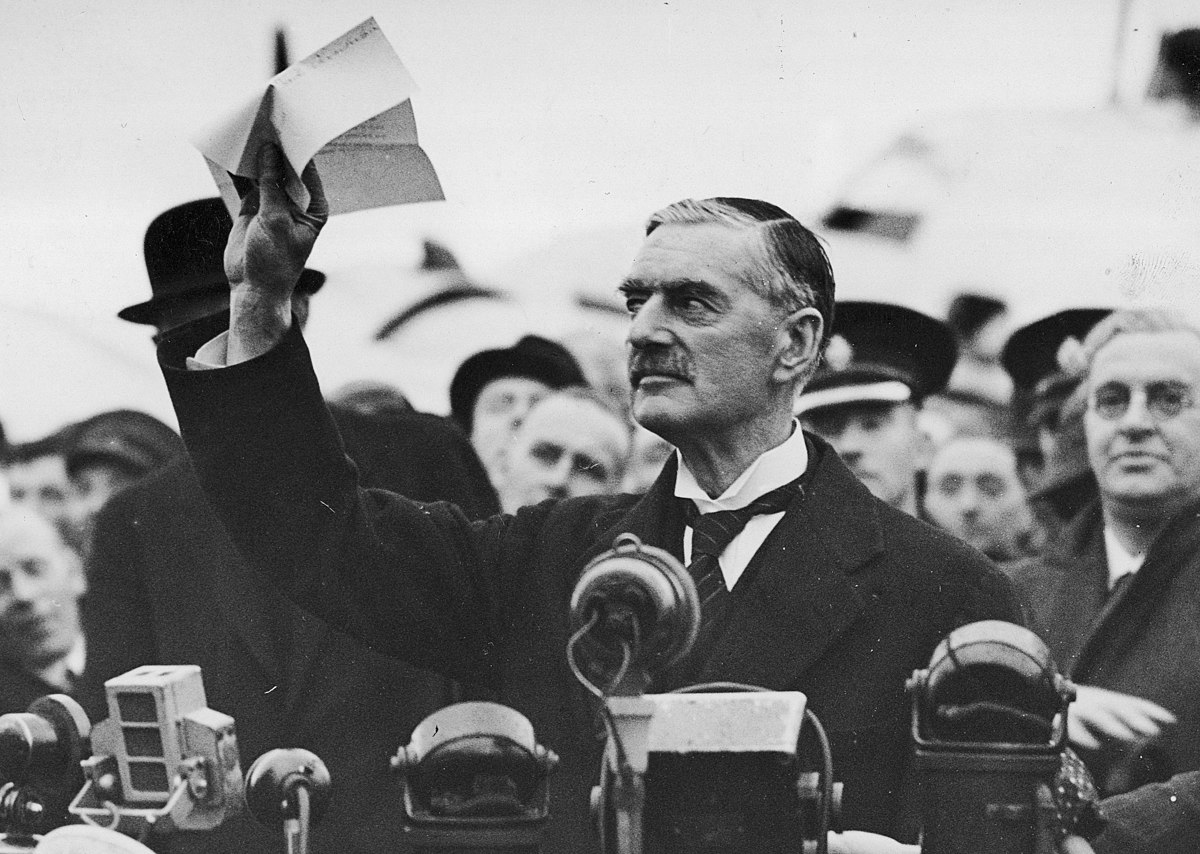
Prime Minister Neville Chamberlain at Heston Aerodrome, holding up a copy of the Anglo-German Declaration he had negotiated with Adolf Hitler, 30 September, 1938.
Narodowe Archiwum Cyfrowe via Wikimedia Commons.
On 30 September 1938, the Prime Minister Neville Chamberlain waved a piece of paper in his hand and declared “My good friends, for the second time in our history, a British Prime Minister has returned from Germany bringing peace with honour. I believe it is peace for our time.” He was, of course, incorrect. Less than a year later, Britain was at war with Germany, and the piece of paper was rendered meaningless.
Posterity has been hard on Chamberlain, regarding him as one of the least effective British premiers, and he has been entirely overshadowed by his more charismatic and successful replacement, Winston Churchill. Yet the bestselling author Robert Harris took a more sympathetic view of Chamberlain, and suggested in his 2017 novel Munich that, far from the Prime Minister being a hapless blunderer, he was in fact a canny tactician who bought his country an invaluable extra year to prepare for the coming conflict. This novel has now been filmed by Netflix, and has attracted particular attention for Jeremy Irons’ sympathetic and warm portrayal of Chamberlain.
Harris has even suggested that “I could perhaps show him as a tragic hero rather than merely the gullible old fool of popular myth … it is a mark of maturity to be able to hold two competing views in one’s head at the same time: that Churchill was vital to the defeat of Germany, and so, in a different way, was Neville Chamberlain.” Does he have a point, or is this just the canny spin of a novelist who has found a new and profitable angle to bring a well-worn story to life?
For my forthcoming book The Windsors at War, dealing with the royals in WWII and their relationships with the politicians of the day, I researched many letters and documents written by Chamberlain, members of the Royal Family and those around him in Downing Street. Several things came to light. There was residual antipathy between Chamberlain, who was an instinctive appeaser, and Churchill, who was not, and the Prime Minister privately derided the other politician as “a bandit” and “a pirate”. He also despised Attlee’s Labour party, calling them experts in “sob-stuff” sentimentality. He can undeniably be accused of high-handedness and complacency. Yet the charge of incompetence is a more deadly one.
Chamberlain himself came from a distinguished political family. His father Joseph was a ruthless Liberal parliamentarian who was said to have originated the phrase “you cannot teach old dogs new tricks”, and his elder brother Austen, one-time Chancellor of the Exchequer and leader of the Conservative Party, demonstrated a confidence in his intellectual abilities that his sibling did his best to emulate. He was not universally popular with his own side – the Conservative MP and diarist Harold Nicolson called him “a bourgeois shit” – but he generally had the support of his party in pursuing his policy of appeasement towards Hitler and Germany, believing – correctly – that Britain could not win the conflict outright.
Comments Off on Neville Chamberlain, the “great appeaser”
January 17, 2022
QotD: The British ruling class reaction to fascism and communism
The British ruling class were not altogether wrong in thinking that Fascism was on their side. It is a fact that any rich man, unless he is a Jew, has less to fear from Fascism than from either Communism or democratic Socialism. One ought never to forget this, for nearly the whole of German and Italian propaganda is designed to cover it up. The natural instinct of men like Simon, Hoare, Chamberlain, etc. was to come to an agreement with Hitler. But – and here the peculiar feature of English life that I have spoken of, the deep sense of national solidarity, comes in – they could only do so by breaking up the Empire and selling their own people into semi-slavery. A truly corrupt class would have done this without hesitation, as in France. But things had not gone that distance in England. Politicians who would make cringing speeches about “the duty of loyalty to our conquerors” are hardly to be found in English public life. Tossed to and fro between their incomes and their principles, it was impossible that men like Chamberlain should do anything but make the worst of both worlds.
One thing that has always shown that the English ruling class are morally fairly sound, is that in time of war they are ready enough to get themselves killed. Several dukes, earls and what-not were killed in the recent campaign in Flanders. That could not happen if these people were the cynical scoundrels that they are sometimes declared to be. It is important not to misunderstand their motives, or one cannot predict their actions. What is to be expected of them is not treachery or physical cowardice, but stupidity, unconscious sabotage, an infallible instinct for doing the wrong thing. They are not wicked, or not altogether wicked; they are merely unteachable. Only when their money and power are gone will the younger among them begin to grasp what century they are living in.
George Orwell, “The Lion And The Unicorn: Socialism and the English Genius”, 1941-02-19.
Comments Off on QotD: The British ruling class reaction to fascism and communism
January 11, 2022
QotD: The decline of the “Blimp class” in the British empire
Thirty years ago the Blimp class was already losing its vitality. The middle-class families celebrated by Kipling, the prolific lowbrow families whose sons officered the army and navy and swarmed over all the waste places of the earth from the Yukon to the Irrawaddy, were dwindling before 1914. The thing that had killed them was the telegraph. In a narrowing world, more and more governed from Whitehall, there was every year less room for individual initiative. Men like Clive, Nelson, Nicholson, Gordon would find no place for themselves in the modern British Empire. By 1920 nearly every inch of the colonial empire was in the grip of Whitehall. Well-meaning, over-civilized men, in dark suits and black felt hats, with neatly rolled umbrellas crooked over the left forearm, were imposing their constipated view of life on Malaya and Nigeria, Mombasa and Mandalay. The one-time empire builders were reduced to the status of clerks, buried deeper and deeper under mounds of paper and red tape. In the early ‘twenties one could see, all over the Empire, the older officials, who had known more spacious days, writhing impotently under the changes that were happening. From that time onwards it has been next door to impossible to induce young men of spirit to take any part in imperial administration. And what was true of the official world was true also of the commercial. The great monopoly companies swallowed up hosts of petty traders. Instead of going out to trade adventurously in the Indies one went to an office stool in Bombay or Singapore. And life in Bombay or Singapore was actually duller and safer than life in London. Imperialist sentiment remained strong in the middle class, chiefly owing to family tradition, but the job of administering the Empire had ceased to appeal. Few able men went east of Suez if there was any way of avoiding it.
George Orwell, “The Lion And The Unicorn: Socialism and the English Genius”, 1941-02-19.
Comments Off on QotD: The decline of the “Blimp class” in the British empire
January 9, 2022
A century of William Brown books
In The Critic, Alexander Larman celebrates the centenary of Richmal Compton’s William Brown books:

Growing up in suburban Bristol in the Eighties and Nineties, my reading matter was of a suitably timeless disposition, even if it seldom, if ever, included any Enid Blyton. Amidst the colonial and deeply un-PC likes of Biggles and Rider Haggard, my trio of preferred characters never really changed: Jennings, Billy Bunter and William Brown. Of the three, Jennings was probably my favourite, being closest to my own life as a prep school boy of a vaguely similar appearance and age, and also because the situations were the most recognisable. Bunter I found uproarious but also rather tasteless and absurd, for reasons that have now, alas, become much clearer. And then there was William Brown: would-be outlaw, committed dog owner and perpetual enemy of soap-and-water, to say nothing of his perpetual nemeses, Hubert Lane and Violet Elizabeth Bott.
I enjoyed the books as picaresque stories of bad behaviour without seeing much of myself in William, or indeed his friends. Their author Richmal Crompton’s evocation of invincible pre-war suburbia — not so very far from a benign version of the half-idylls, half-nightmares portrayed by Orwell in Coming Up For Air and Patrick Hamilton in Hangover Square — was certainly compelling, but I was too young to appreciate Crompton’s social satire, itself considerably more piquant than anything that could be found in Jennings and Bunter, let alone the stiff-upper-lip fantasias of English manhood peddled by WE Johns with Biggles, Gimlet and the rest. All of them now sound to me like nothing so much as industrial-strength cocktails. Drink a couple, and you too will want to revive the Empire.
Yet now, a century after the first appearance of Just William, I reassess Crompton’s universe afresh, and so I respond far more warmly to her characters and creations. William Brown himself is an entertaining if undeniably two-dimensional figure, at his most amusing when he is required to fit into the adult world temporarily, as in the story William’s Truthful Christmas, when he causes social outrage and misery by offering an honest opinion of the gifts that he has received. But it is the rich panoply of figures around William who give the stories their interest and colour, and which make them as entertaining for adults to read today as they ever might be for their children. If, of course, eleven-year olds can be distracted from their iPads and Netflix and nefarious online activities long enough to enjoy the William books.
Leaving aside the children for a moment, the adult supporting characters in the unnamed village provide endless humour and intrigue. There is William’s neurotic mother, desperately saying of her son that “he means well” even as he is involved in yet another humiliating scrape. His father, meanwhile, is a hard-drinking Conservative whose cynicism at the world sees him reward his errant son with extra pocket money for his more outrageous actions, as long as he is not bedbound with “his liver”. Not for nothing is this stalwart representative of middle England named John Brown.
Then there is William’s would-be romantic elder brother Robert, desperately professing each of his girlfriends “the most beautiful girl in the world” until his eye is taken by another. Mr and Mrs Bott are a pair of arriviste millionaires who have made their money via “Bott’s Digestive Sauce”, a substance that William contends, probably accurately, has been constructed from squashed beetles. Needless to say, they take up residence in the nouveau riche establishment Bott Hall, where their social status irks them. (“We ought to have some ancestors, Botty,” said Mrs Bott. “We’ve got ’em, dear,” said Mr Bott after a moment’s thought. “We must have. Come to think of it, we shouldn’t be here now if we’d not.”) Floating around the periphery is Robert’s friend, the splendidly named Jameson Jameson, of whom Crompton writes, with caustic humour, “[his] parents had perpetrated on him the supreme practical joke of giving him his surname for a Christian name, so that people who addressed him by his full name seemed always to be indulging in some witticism.”
Comments Off on A century of William Brown books
January 7, 2022
QotD: British intelligentsia and imperial decline
It should be noted that there is now no intelligentsia that is not in some sense “Left”. Perhaps the last right-wing intellectual was T.E. Lawrence. Since about 1930 everyone describable as an “intellectual” has lived in a state of chronic discontent with the existing order. Necessarily so, because society as it was constituted had no room for him. In an Empire that was simply stagnant, neither being developed nor falling to pieces, and in an England ruled by people whose chief asset was their stupidity, to be “clever” was to be suspect. If you had the kind of brain that could understand the poems of T.S. Eliot or the theories of Karl Marx, the higher-ups would see to it that you were kept out of any important job. The intellectuals could find a function for themselves only in the literary reviews and the left-wing political parties.
The mentality of the English left-wing intelligentsia can be studied in half a dozen weekly and monthly papers. The immediately striking thing about all these papers is their generally negative, querulous attitude, their complete lack at all times of any constructive suggestion. There is little in them except the irresponsible carping of people who have never been and never expect to be in a position of power. Another marked characteristic is the emotional shallowness of people who live in a world of ideas and have little contact with physical reality. Many intellectuals of the Left were flabbily pacifist up to 1935, shrieked for war against Germany in the years 1935-9, and then promptly cooled off when the war started. It is broadly though not precisely true that the people who were most “anti-Fascist” during the Spanish civil war are most defeatist now. And underlying this is the really important fact about so many of the English intelligentsia – their severance from the common culture of the country.
George Orwell, “The Lion And The Unicorn: Socialism and the English Genius”, 1941-02-19.
Comments Off on QotD: British intelligentsia and imperial decline
December 22, 2021
The Nazi-Islam Alliance? – Amin al-Husseini – WW2 Biography Special
World War Two
Published 21 Dec 2021Amin al-Husseini is one of the leading figures in global Islam. He’s an Arab nationalist, an anti-Semite, and anti-Zionist. But he’s also willing to work with imperialist powers if it suits him. He’s been loyal to the Ottomans and the British. In 1941, he throws his lot in with Hitler and the Nazis.
(more…)
Comments Off on The Nazi-Islam Alliance? – Amin al-Husseini – WW2 Biography Special
December 14, 2021
Chatellerault M24/29: France’s New Wave of Post-WWI Small Arms
Forgotten Weapons
Published 26 Aug 2017France fought the Great War with an array of weapons which were all sub-par in one way or another — the Lebel rifle was obsolescent by 1914, the Berthier was a cavalry carbine forced into rifle service, the Chauchat was an emergency wartime design optimized for production volume instead of quality, and the handguns were a mixture of old revolvers and desperate imports from Spain. Once the war finally ended, the French military would move to replace the whole lot with new and modern arms.
This would begin by finally replacing the 8mm Lebel cartridge with a non-tapered, rimless cartridge — something that would be well suited to use in magazines and repeating arms. Simultaneously, a new light machine gun would be found, as this was deemed to most important improvement to be made. The cartridge was adopted in 1924 as the 7.5x58mm, but it would soon be realized that there was a critical problem with that round. The French military had a large supply of German arms taken as war reparations, and the new 7.5mm cartridge looked very similar to the 8x57mm Mauser cartridge. Worse, the Mauser round would chamber and fire in the new French chambers, causing serious damage to guns when the 8mm bullet was squeezed down to 7.5mm. To fix this issue, the French cut their cartridge down by 4mm, resulting in the 1929 adoption of the 7.5x54mm round — the chamber of which would no longer fit a German 8mm round.
As for the machine gun, the first choice was to simply adopt the Browning BAR — but France insisted on obtaining the technical data package and producing the guns in France, and they could not come to an agreement with Colt over the price of such a license. So, the French held trials of other guns, looking at virtually everything then available. In the aftermath of the trials, it was decided that the Chatellerault arsenal could design its own weapon using the best features of the other existing guns. The arsenal rather quickly produced prototypes, and they were adopted in 1924 (and then updated to use the shorter version of the 7.5mm cartridge in 1929).
The Chatellerault M24/29 is a quite good weapon, especially considering how early it was designed. It uses a tilting bolt and a top-mounted 25 round magazine. It has two triggers, the front one firing in semiautomatic and the rear one in fully automatic. The wooden front handguard allows for fire from the hip or shoulder if desired, and a set of thorough dust covers keep the gun free from ingress of mud or dirt. About 188,000 would be manufactured, and it would stay in service for many decades.
http://www.patreon.com/ForgottenWeapons
Cool Forgotten Weapons merch! http://shop.bbtv.com/collections/forg…
If you enjoy Forgotten Weapons, check out its sister channel, InRangeTV! http://www.youtube.com/InRangeTVShow

Comments Off on Chatellerault M24/29: France’s New Wave of Post-WWI Small Arms
December 12, 2021
QotD: Britain’s alienated intelligentsia of the 1930s
It is clear that the special position of the English intellectuals during the past ten years, as purely negative creatures, mere anti-Blimps, was a by-product of ruling-class stupidity. Society could not use them, and they had not got it in them to see that devotion to one’s country implies “for better, for worse”. Both Blimps and highbrows took for granted, as though it were a law of nature, the divorce between patriotism and intelligence. If you were a patriot you read Blackwood’s Magazine and publicly thanked God that you were “not brainy”. If you were an intellectual you sniggered at the Union Jack and regarded physical courage as barbarous. It is obvious that this preposterous convention cannot continue. The Bloomsbury highbrow, with his mechanical snigger, is as out-of-date as the cavalry colonel. A modern nation cannot afford either of them. Patriotism and intelligence will have to come together again. It is the fact that we are fighting a war, and a very peculiar kind of war, that may make this possible.
George Orwell, “The Lion And The Unicorn: Socialism and the English Genius”, 1941-02-19.
Comments Off on QotD: Britain’s alienated intelligentsia of the 1930s


