After 1918 there began to appear something that had never existed in England before: people of indeterminate social class. In 1910 every human being in these islands could be “placed” in an instant by his clothes, manners and accent. That is no longer the case. Above all, it is not the case in the new townships that have developed as a result of cheap motor cars and the southward shift of industry. The place to look for the germs of the future England is in the light-industry areas and along the arterial roads. In Slough, Dagenham, Barnet, Letchworth, Hayes – everywhere, indeed, on the outskirts of great towns – the old pattern is gradually changing into something new. In those vast new wildernesses of glass and brick the sharp distinctions of the older kind of town, with its slums and mansions, or of the country, with its manor-houses and squalid cottages, no longer exist. There are wide gradations of income, but it is the same kind of life that is being lived at different levels, in labour-saving flats or council houses, along the concrete roads and in the naked democracy of the swimming-pools. It is a rather restless, cultureless life, centring round tinned food, Picture Post, the radio and the internal combustion engine. It is a civilization in which children grow up with an intimate knowledge of magnetoes and in complete ignorance of the Bible. To that civilization belong the people who are most at home in and most definitely of the modern world, the technicians and the higher-paid skilled workers, the airmen and their mechanics, the radio experts, film producers, popular journalists and industrial chemists. They are the indeterminate stratum at which the older class distinctions are beginning to break down.
This war, unless we are defeated, will wipe out most of the existing class privileges. There are every day fewer people who wish them to continue. Nor need we fear that as the pattern changes life in England will lose its peculiar flavour. The new red cities of Greater London are crude enough, but these things are only the rash that accompanies a change. In whatever shape England emerges from the war it will be deeply tinged with the characteristics that I have spoken of earlier. The intellectuals who hope to see it Russianized or Germanized will be disappointed. The gentleness, the hypocrisy, the thoughtlessness, the reverence for law and the hatred of uniforms will remain, along with the suet puddings and the misty skies. It needs some very great disaster, such as prolonged subjugation by a foreign enemy, to destroy a national culture. The Stock Exchange will be pulled down, the horse plough will give way to the tractor, the country houses will be turned into children’s holiday camps, the Eton and Harrow match will be forgotten, but England will still be England, an everlasting animal stretching into the future and the past, and, like all living things, having the power to change out of recognition and yet remain the same.
George Orwell, “The Lion And The Unicorn: Socialism and the English Genius”, 1941-02-19.
December 7, 2021
QotD: The decline of class distinctions in Britain
November 24, 2021
Tank Chats #133 | Renault UE Chenillette | The Tank Museum
The Tank Museum
Published 6 Aug 2021In this weeks Tank Chat, Curator David Willey talks about the Renault UE Chenillette. A light tracked armoured carrier produced by France between 1932 and 1940.
(more…)
November 21, 2021
QotD: Britain’s middle class after WW1
England is a country in which property and financial power are concentrated in very few hands. Few people in modern England own anything at all, except clothes, furniture and possibly a house. The peasantry have long since disappeared, the independent shopkeeper is being destroyed, the small business-man is diminishing in numbers. But at the same time modern industry is so complicated that it cannot get along without great numbers of managers, salesmen, engineers, chemists and technicians of all kinds, drawing fairly large salaries. And these in turn call into being a professional class of doctors, lawyers, teachers, artists, etc., etc. The tendency of advanced capitalism has therefore been to enlarge the middle class and not to wipe it out as it once seemed likely to do.
But much more important than this is the spread of middle-class ideas and habits among the working class. The British working class are now better off in almost all ways than they were thirty years ago. This is partly due to the efforts of the Trade Unions, but partly to the mere advance of physical science. It is not always realized that within rather narrow limits the standard of life of a country can rise without a corresponding rise in real-wages. Up to a point, civilization can lift itself up by its boot-tags. However unjustly society is organized, certain technical advances are bound to benefit the whole community, because certain kinds of goods are necessarily held in common. A millionaire cannot, for example, light the streets for himself while darkening them for other people. Nearly all citizens of civilized countries now enjoy the use of good roads, germ-free water, police protection, free libraries and probably free education of a kind. Public education in England has been meanly starved of money, but it has nevertheless improved, largely owing to the devoted efforts of the teachers, and the habit of reading has become enormously more widespread. To an increasing extent the rich and the poor read the same books, and they also see the same films and listen to the same radio programmes. And the differences in their way of life have been diminished by the mass-production of cheap clothes and improvements in housing. So far as outward appearance goes, the clothes of rich and poor, especially in the case of women, differ far less than they did thirty or even fifteen years ago. As to housing, England still has slums which are a blot on civilization, but much building has been done during the past ten years, largely by the local authorities. The modern council house, with its bathroom and electric light, is smaller than the stockbroker’s villa, but it is recognizably the same kind of house, which the farm labourer’s cottage is not. A person who has grown up in a council housing estate is likely to be – indeed, visibly is – more middle class in outlook than a person who has grown up in a slum.
George Orwell, “The Lion And The Unicorn: Socialism and the English Genius”, 1941-02-19.
November 13, 2021
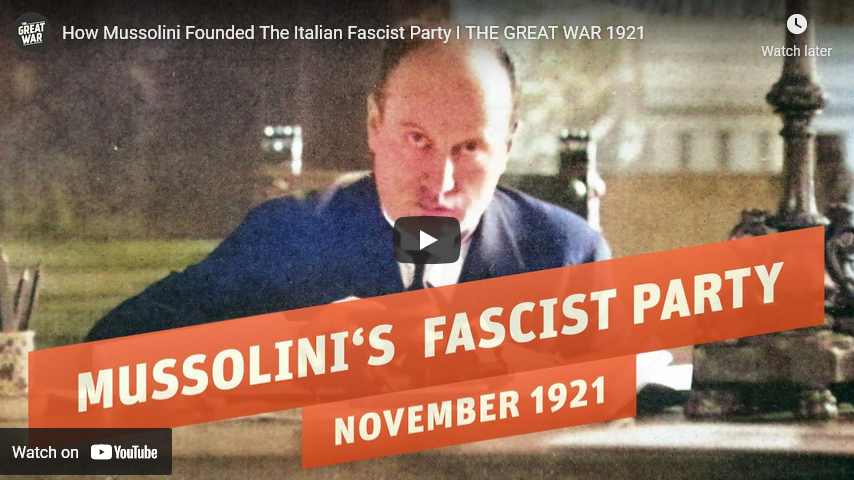
How Mussolini Founded The Italian Fascist Party I THE GREAT WAR 1921
The Great War
Published 12 Nov 2021Sign up for Curiosity Stream and get Nebula bundled in and SAVE 26%: https://curiositystream.com/thegreatwar
Benito Mussolini’s National Fascist movement was a fringe phenomenon right after the First World War and couldn’t gain much traction in the 1919 elections. But soon after Mussolini was increasing his political standing and the National Fascist Party gained more members than ever before.
» SUPPORT THE CHANNEL
Patreon: https://www.patreon.com/thegreatwar» OUR PODCAST
https://realtimehistory.net/podcast – interviews with World War 1 historians and background info for the show.» BUY OUR SOURCES IN OUR AMAZON STORES
https://realtimehistory.net/amazon *
*Buying via this link supports The Great War (Affiliate-Link)» SOURCES
Alcalde, Ángel, War Veterans and Fascism in Interwar Europe, (Cambridge: Cambridge University Press, 2017)Bosworth, R. J. B., Mussolini, (London: Bloomsbury Academic, 2010)
De Grand, Alexander, Italian Fascism: Its Origins & Development, (Lincoln, NB: University of Nebraska Press, 1989)
Duggan, Christopher, Force of Destiny: A History of Italy since 1796, (London: Penguin Books, 2008)
Martins, Carlos Manuel, From Hitler to Codreanu: The Ideology of Fascist Leaders, (London: Routledge, 2020)
Neville, Peter, Mussolini, (London: Routledge, 2004)
Weyland, Curt, Assault on Democracy: Communism, Fascism, and Authoritarianism During the Interwar Years, (Cambridge: Cambridge University Press, 2021)
» MORE THE GREAT WAR
Website: https://realtimehistory.net
Instagram: https://instagram.com/the_great_war
Twitter: https://twitter.com/WW1_Series
Reddit: https://reddit.com/r/TheGreatWarChannel»CREDITS
Presented by: Jesse Alexander
Written by: Jesse Alexander
Director: Toni Steller & Florian Wittig
Director of Photography: Toni Steller
Sound: Toni Steller
Editing: Jose Gamez
Motion Design: Philipp Appelt
Mixing, Mastering & Sound Design: http://above-zero.com
Maps: Daniel Kogosov (https://www.patreon.com/Zalezsky)
Research by: Jesse Alexander
Fact checking: Florian WittigChannel Design: Yves Thimian
Contains licensed material by getty images
All rights reserved – Real Time History GmbH 2021
November 9, 2021
Bayonet Development for the Lee Enfield No4 Rifle
Forgotten Weapons
Published 22 Jul 2021http://www.patreon.com/ForgottenWeapons
https://www.floatplane.com/channel/Fo…
Cool Forgotten Weapons merch! http://shop.forgottenweapons.com
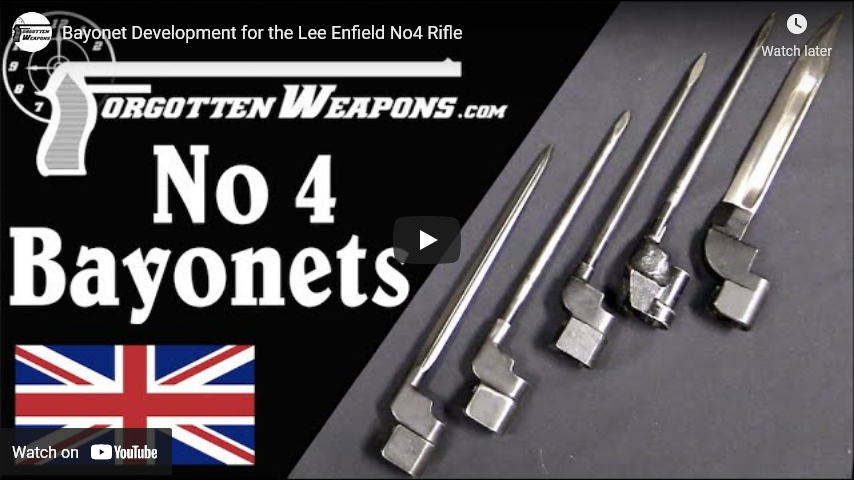
Having wrapped up our series on the major development of the Lee Enfield rifle in British service, I figured it would be a nice addendum to talk about the bayonets developed for the No4 rifle. These went through a substantial evolution, and are an interesting field for collectors all by themselves.
During World War One, the British used the Pattern 1907 bayonet, a long blade type essentially copied from the Japanese Type 30. By the 1920s, this was being reconsidered – the long blades were expensive, fragile, and perhaps not really necessary. When the No1 Mk VI rifle was put into trials, it was given a new bayonet style. This was inspired by the Swiss cyclists’ bayonet, with a cruciform spike instead of a true blade. It was only 8 inches long; this was determined to be long enough for virtually all use cases and being short minimized weight and bulk.
As World War Two progressed, the spike bayonet was simplified several times. Before the initial production of the first standard model (No4 MkI) was completed, the cruciform pattens had already been abandoned for a much simpler (and faster and cheaper) round body spike with a screwdriver-like point at the end. This was in turn simplified by separating the socket and spike into two parts for easier production, and then further simplified by casting the socket instead of forging it. After the war, the spike was replaced by a short blade-type socket bayonet (the No9), although this was rather short-lived because of the adoption of the SLR (FN FAL).
Contact:
Forgotten Weapons
6281 N. Oracle 36270
Tucson, AZ 85740
October 29, 2021
QotD: Another proof of Parkinson’s “Law of the Custom-Built Headquarters Building”
John Terraine, The Mighty Continent, 1974, quoted by Brian Micklethwait, 2021-07-20.
October 24, 2021
QotD: Origins of the upper-class twit
George Orwell, “The Lion And The Unicorn: Socialism and the English Genius”, 1941-02-19.
October 22, 2021
L-34 Sampo: Aimo Lahti’s Rejected Masterpiece
Forgotten Weapons
Published 30 Jun 2021http://www.patreon.com/ForgottenWeapons
https://www.floatplane.com/channel/Fo…
Cool Forgotten Weapons merch! http://shop.forgottenweapons.com
Finland’s standard light machine gun going into the Winter War was the LS-26, a gun which did not succeed in field use. It was complex and cumbersome, and Finnish troops quickly replaced it with captured Russian DP-27 LMGs. Part of the problem of the LS-26 was its recoil-operated design. Finnish military authorities specified a recoil-operated mechanism for their LMG in light of the success of the recoil-operated heavy Maxim guns in Finnish service. Gas operation was quickly recognized as a superior system for light machine guns, but too late to stop adoption of the LS-26.
In the early 1930s, Aimo Lahti did design a gas-operated LMG, heavily influenced by the Czech ZB-26 system. A handful of prototypes were made by VKT, looking for both Finnish military acceptance and international sales. The gun was made in several calibers, most notably 7.62x54R for Finland and 7.92x57mm Mauser for export. However, bureaucratic issues prevented its consideration by the Finnish Army, and the timing was too late for exports. The L-34 was significantly lighter and simpler than the LS-26, and it was performed quite well in Finnish trials — which did not happen until the 1950s. By that time, the Finnish military was looking for an intermediate-caliber belt-fed gun, and the L-34 was not suitable regardless of its performance.
Many thanks to Sako for providing me access to film this L-34 from their reference collection!
Contact:
Forgotten Weapons
6281 N. Oracle 36270
Tucson, AZ 85740

October 20, 2021
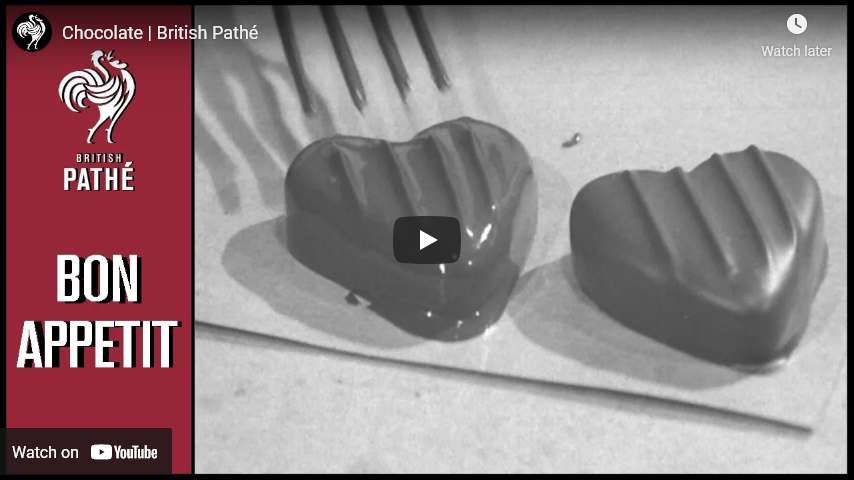
Chocolate | British Pathé
British Pathé
Published 22 Sep 2016BON APPETIT – FOOD MONTH ON BRITISH PATHÉ (SEPTEMBER 2016): Chocolate.
We all love a bit of chocolate, so have a watch of these vintage films which show different chocolates being made, as well as the celebrations when sweet rationing came to an end.
(Film Ids: 1601.11, 313.13, 1108.14, 1401.17)
Music:
The Show Must Be Go (incompetech.com)
Licensed under Creative Commons: By Attribution 3.0 License
http://creativecommons.org/licenses/b…A NEW THEME EVERY MONTH!
Each month, a range of new uploads and playlists tell the story of a particular topic through archive footage. Let us know what themes you’d like to see by leaving us a comment or connecting with us on social media.BRITISH PATHÉ’S STORY
Before television, people came to movie theatres to watch the news. British Pathé was at the forefront of cinematic journalism, blending information with entertainment to popular effect. Over the course of a century, it documented everything from major armed conflicts and seismic political crises to the curious hobbies and eccentric lives of ordinary people. If it happened, British Pathé filmed it.Now considered to be the finest newsreel archive in the world, British Pathé is a treasure trove of 85,000 films unrivalled in their historical and cultural significance.
ALL RIGHTS RESERVED
A VIDEO FROM BRITISH PATHÉ. EXPLORE OUR ONLINE CHANNEL, BRITISH PATHÉ TV. IT’S FULL OF GREAT DOCUMENTARIES, FASCINATING INTERVIEWS, AND CLASSIC MOVIES. http://www.britishpathe.tv/
FOR LICENSING ENQUIRIES VISIT http://www.britishpathe.com/
British Pathé also represents the Reuters historical collection, which includes more than 136,000 items from the news agencies Gaumont Graphic (1910-1932), Empire News Bulletin (1926-1930), British Paramount (1931-1957), and Gaumont British (1934-1959), as well as Visnews content from 1957 to the end of 1984. All footage can be viewed on the British Pathé website. https://www.britishpathe.com/
October 12, 2021
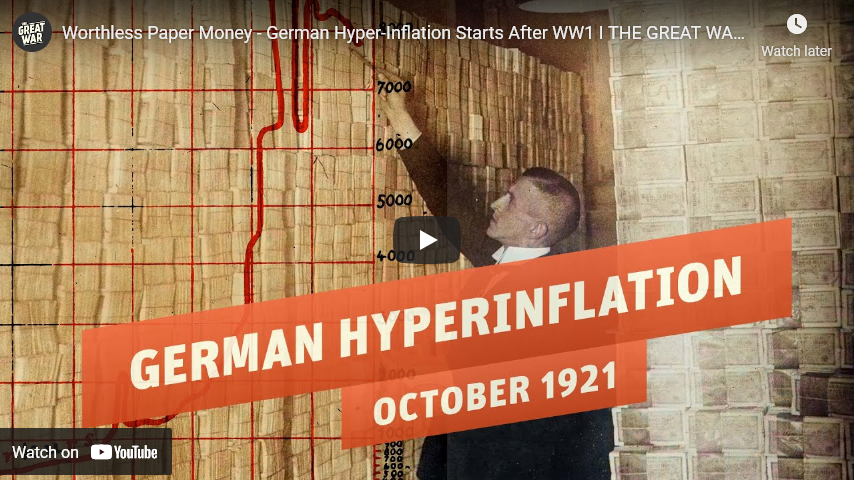
Worthless Paper Money – German Hyper-Inflation Starts After WW1 I THE GREAT WAR 1921
The Great War
Published 8 Oct 2021Sign up for Curiosity Stream and get Nebula bundled in and SAVE 26%: https://curiositystream.com/thegreatwar
The German post-WW1 economy was under pressure: the loss of territory, the war bonds issued during the war and the reparations under the Treaty of Versailles. All this lead to a downward spiral of rising inflation and living costs for German citizens.
» SUPPORT THE CHANNEL
Patreon: https://www.patreon.com/thegreatwar
Shop: https://www.realtimehistory.net» OUR PODCAST
https://realtimehistory.net/podcast – interviews with World War 1 historians and background info for the show.» BUY OUR SOURCES IN OUR AMAZON STORES
https://realtimehistory.net/amazon *
*Buying via this link supports The Great War (Affiliate-Link)» SOURCES
Feldman, Gerald: Vom Weltkrieg zur Weltwirtschaftskrise. Studien zur deutschen Wirtschafts-und Sozialgeschichte 1914-1932. 1984.Fergusson, Adam: Das Ende des Geldes. Hyperinflation und ihre Folgen für die Menschen am Beispiel der Weimarer Republik, 1975.
Grosch, Waldemar: Deutsche und polnische Propaganda während der Volksabstimmung in Oberschlesien 1919-1921. 2002.
Lewek, Peter: Arbeitslosigkeit und Arbeitslosenversicherung in der Weimarer republik 1918-1927. 1989.
Michalczyk, Andrezej: Celebrating the nation: the case of Upper Silesia after the plebiscite in 1921.
Neubach, Helmut: Die Abstimmung in Oberschlesien am 20. März 1921. 2002.
» MORE THE GREAT WAR
Website: https://realtimehistory.net
Instagram: https://instagram.com/the_great_war
Twitter: https://twitter.com/WW1_Series
Reddit: https://reddit.com/r/TheGreatWarChannel»CREDITS
Presented by: Jesse Alexander
Written by: Jesse Alexander
Director: Toni Steller & Florian Wittig
Director of Photography: Toni Steller
Sound: Toni Steller
Editing: Jose Gamez
Motion Design: Philipp Appelt
Mixing, Mastering & Sound Design: http://above-zero.com
Maps: Daniel Kogosov (https://www.patreon.com/Zalezsky)
Research by: Jesse Alexander
Fact checking: Florian WittigChannel Design: Yves Thimian
Contains licensed material by getty images
All rights reserved – Real Time History GmbH 2021
October 6, 2021
Let’s Visit Finland (1935) – Helsinki Liinakhamari Lapland Arctic Ocean Highway
PeriscopeFilm
Published 2 Aug 2020Love our channel? Help us save and post more orphaned films! Support us on Patreon: https://www.patreon.com/PeriscopeFilm Even a really tiny contribution can make a difference.
This travelogue film shows Finland in the 1930’s. It was presented by Joseph Harris and Martin Ross. Finland is in northern Europe bordering Sweden, Norway and Russia. The capital city of Helsinki as well as the Arctic Ocean Highway running to the port of Liinakhamari which once touched the Arctic Ocean will be shown. It refers to Helsinki as Helsingfors which is the former Swedish name of the capital. The Arctic Ocean Highway was rerouted after WW2. Finland had long been a battleground due to the imperial ambitions and growing pains of Sweden and Russia. Finland was absorbed by the Russian Empire in 1807 (:32). A 1917 revolution overthrew the Czarist regime (:38). Due to wars and fires, few remnants existed of historical value in Helsinki (:47). Some of the old wooden houses have managed to remain (:53). Granite columns and entryways of the city point to early architects’ desire to use the country’s reserve of granite (1:14). Russian influence is exemplified in a Russian style church (1:35) and the cathedral of St. Nicholas (1:38). Architects sought to stray from the influences of foreign domination (1:45). The red granite railway station in the Market Square (1:59), the parliament building (2:05) and white factory buildings show no allegiance to former occupiers (2:08). A newly erected suburb consisting of flats constructed with reinforced steel (2:26) lay encircled by forests and lakes. Roads are lined with trees and intermittent flower beds (2:49). Helsinki harbor follows (2:59). Town parks and gardens were erected with artistic sculptures throughout showing Finland’s growing appreciation for the arts (3:22). The capital is also the terminus of the road leading northward for over a thousand miles to the port of Liinakhamari (3:34). A map is provided which still has USSR on it as this was before the fall of Soviet Russia (3:35). The port of Liinakhamari lay about 300 miles beyond the polar circle (3:43). The film follows this road which remains concrete for 20 miles after leaving the capitol (3:58). Land alongside had been cleared for agriculture (4:06). A farmer reaps hay with a scythe as modern farm machinery had not yet reached the area (4:34). A striking feature of the Finnish countryside are the impaled corn husks on wooden poles for drying (5:03). A double arched bridge of granite follows crossing one of the waterways along the route (5:09). A close up shot of the farm houses show they are crudely erected structures reminiscent of the middle ages (5:28). Corn fields dissipate and the countryside becomes hilly and wooded (6:03). Finland is known as the land of a thousand lakes, though it should be known as the land of 60,000 lakes (6:11). The route continues on for 300 miles until hitting another agricultural district (6:44) sprinkled with one-story windmills. It continues around the Gulf of Bothnia (6:54). The only important town along the way is Oluu where the Oulujoki River cuts the city into three (7:28). Uneven cobblestone roads (7:38) and wooden buildings with elaborate ornate facades. Rivers float timber out from the forests (8:18). Finland’s timber industry racks in 80 million pounds annually (8:28). The timber is sent to sawmills along the coast (9:35). Stacks along the road await trucks (9:40). A car heads to be taken across a river by ferry as bridges become less frequent (10:27). The pulley system is operated by the ferryman, his young daughter and by the passengers (10:45). The government auctioned the ferries to those who would operate them at the lowest cost (11:02). Further on, another farm area appears with small white wooden churches (11:33). Most of the water for homes are sourced by well (11:49). The road then re-enters the wilderness (12:03). A sign with “Arctic Circle” in four different languages (12:05) follows as the road crosses the imaginary line marking the Arctic circle. Cattle are wandering through the road (12:31), hay farms (13:08), and stacks of wood to heat the homes in the winter (13:24). A housewife washes her clothes using water from a brook (13:32). The road hits Lapland (13:54) and turns into a dirt road (14:01). Reindeer feed on the lichen in winter (15:05). A log hut has reindeer antlers placed on top (15:22). Laplanders with their colorful handcrafted headdresses and pointed toe tall boots (15:43). Vegetation becomes stunted while approaching the northern coastline (16:29). The film wraps up as the road reaches the deep-water port of Liinakhamari (16:40).
This film is part of the Periscope Film LLC archive, one of the largest historic military, transportation, and aviation stock footage collections in the USA. Entirely film backed, this material is available for licensing in 24p HD, 2k and 4k. For more information visit http://www.PeriscopeFilm.com

September 30, 2021
Tank Chats #126 | Guy Armoured Car | The Tank Museum
The Tank Museum
Published 21 May 2021David Fletcher MBE looks at the rare and most interesting Guy Armoured Car, thought to be the first welded vehicle used by the British Army.
(more…)
September 7, 2021
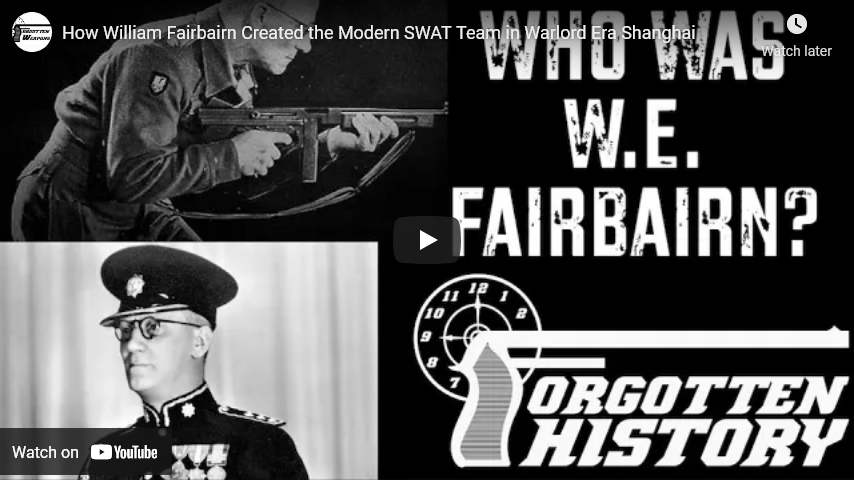
How William Fairbairn Created the Modern SWAT Team in Warlord Era Shanghai
Forgotten Weapons
Published 1 Jun 2021William E. Fairbairn is best known for his work with Eric Sykes and their “Commando” knife design during World War Two. However, Fairbairn spent some 33 years in the Shanghai Municipal Police, working his way up from a beat constable to Assistant Commissioner. There he was responsible for the SMPD adopting truly forward-thinking fighting methods, and he essentially invented the modern SWAT team (the “Reserve Unit”, which Fairbairn led for 10 years). He combined expertise in formal marksmanship, instinctive practical shooting, and hand-to-hand combat schools (including jiu-jitsu and judo) into a comprehensive training program like no other on earth at the time.
Book references:
The World’s First SWAT Team, by Leroy Thompson:
https://amzn.to/2TrYiNvGentleman & Warrior, by Peter Robins:
https://amzn.to/3vuODn9http://www.patreon.com/ForgottenWeapons
https://www.floatplane.com/channel/Fo…
Cool Forgotten Weapons merch! http://shop.forgottenweapons.com
Contact:
Forgotten Weapons
6281 N. Oracle 36270
Tucson, AZ 85740
September 2, 2021
Road to WWII: A Basic Causal Analysis
Thersites the Historian
Published 19 Nov 2019This video is a primer for undergraduates in broad history survey courses that will hopefully help make sense of the interwar years between World War I and World War II.
Patreon link: https://www.patreon.com/thersites
PayPal link: paypal.me/thersites
Twitter link: https://twitter.com/ThersitesAthens
Minds.com link: https://www.minds.com/ThersitestheHis…
Steemit/dtube link: https://steemit.com/@thersites/feed
BitChute: https://www.bitchute.com/channel/jbyg…
Backup Channel: https://www.youtube.com/channel/UCUrD…
August 29, 2021
MP-28: Hugo Schmeisser Improves the MP18
Forgotten Weapons
Published 22 Aug 2017The MP28,II was Hugo Schmeisser’s improved take on the original World War One MP18,I design. It used a simple box magazine in place of the Luger drum magazines, and this magazine would form the basis for a long series of military SMG magazines. It was a double-stack, single feed design because Schmeisser thought this would prevent some malfunctions that were possible with double-feed magazines (and because Mauser probably had a patent on the double feed box magazine at the time). This magazine would be used in conversions of MP18 guns, and would also be the model for the MP-38/40 and subsequent British Sten gun magazines.
The MP28 also introduced a semiautomatic selector switch, where the MP18 had been a fully automatic-only design. It is the presence of this selector button over the trigger, along with a tangent sight instead of a simple flip-up notch that can be used to distinguish between an updated MP18 and an MP28.
While the MP28 was not formally adopted by the German military, it was used by police and SS units, as well as being adopted or copied by a wide selection of other nations, including Portugal, Spain, China, Japan, and Ethiopia.
http://www.patreon.com/ForgottenWeapons
Cool Forgotten Weapons merch! http://shop.bbtv.com/collections/forg…
If you enjoy Forgotten Weapons, check out its sister channel, InRangeTV! http://www.youtube.com/InRangeTVShow