Naturally this all made me think of 4chan. The swirling chaos that dominates the more subaltern corners of online bears an eerie resemblance to the mutability of identity that [James C.] Scott chronicles as a form of resistance to domination. If the channers and the Twitter anons seem a little barbaric (in the less descriptive, more judgmental sense of the word), well, they are, but hill people frequently are too. “Self-barbarization” can be be a very effective conscious or unconscious strategy of resistance while simultaneously making a group unpleasant to be around (in fact these things are linked).
The digital barbarians have for now made themselves illegible to the hyper-surveillance, algorithmic discipline, and intrusive analytics that loom like the hundred-eyed Argos over all online interactions. In fact, insofar as a key technique of the cyber-panopticon is the construction of predictive models of user behavior, to be unpredictable is an important component of being ungovernable. The other option is to hide.
Hiding is a strategy that some people attempt offline as well, either by building a compound in the woods or by adopting protective coloration and hiding in plain sight. But as the bots grow ever more omniscient, hiding gets more expensive and less effective. Another classic barbarian-inspired strategy is to maximize mobility, and indeed contemporary economic and technological conditions seem ripe for a renaissance of nomadism. But the trouble with always being ready to pack your bags is it makes it hard for anybody to count on you.1 Is there anything that can be done for those of us who want to live marginally more barbarically, but still sip lattes and put down roots? Yes, because the ultimate lesson of Scott’s book is that barbarism is really more of a state of mind that can be practiced anywhere. Three brief examples of ways to increase your Barbarism Quotient (BQ), suitable for the discerning urban barbarian:
- Keep your identity small. Paul Graham once said this, but we can go much further. An expansive identity implies its contrapositive: a similarly expansive set of ideas, behaviors, and lifestyles which we cannot adopt without incurring psychic damage. This limits our space for action, and makes us easier for the machines to predict and for the man to control. Better far to figure out what you really care about, figure out what the real red lines are, and convert everything else from a non-negotiable into a piece of the optimization frontier. The ethnic and cultural mutability of barbarous peoples is an example of this kind of suppleness, but there are other sorts of mutability that can be useful too.
- The great Boston T. Party once declared: “it’s better to have $1,000 of ammunition in your garage than $1,000 in your bank account; but it’s even better to have only $100 of ammunition in your garage and $900 of practice.” A lot of would-be modern barbarians daydream about burying gold bars in the ground or sewing them into the lining of their clothes (like the barbarians of yore hiding their tubers in the ground), but Mr. Party’s insight generalizes well here. Physical gold is admittedly a less legible form of wealth than T-bills or CBDC; but skills, knowledge, and relationships are even harder to seize than bullion, and even easier to transport across borders. The wise barbarian judiciously transmutes a fixed percentage of his financial capital into human capital. Nothing improves your ultimate BATNA like having friends or being useful.
- Barbarians have a deserved reputation for not taking too kindly to strangers, but this xenophobia and clannishness is tactical. For the hill dweller, most strangers are in one way or another the representatives of hostile alien entities that are out to conscript, tax, and subjugate. The situation for we cosmopolitan, urban, dare I say urbane barbarians is a little bit different. We’ve already reached an accommodation with centralized despotic states, having found the advantages they offer to be worth the tradeoffs. Be that as it may, states have a tendency to try to unilaterally change the terms of the deal. To protect ourselves from this form of encroachment, the correct attitude is not xenophobia, but rather paranoia. The toolkit of modern states is to direct all our enthusiasm towards the Current Thing whilst deadening our senses towards everything else. “We had no idea it could get this bad” is a recurring theme in testimonies given by survivors of oppression and genocide, to which a family culture of “they really are out to get us” is a salutary corrective. Every pinprick ought to raise an alarm, because it could be the prick that precedes the onset of anesthesia. Finally, the cultured barbarian remembers that states are not the only hostile, alien entities waiting for us in the night with drooling jaws.
I could come up with a dozen more such practices, inspired by the hill people Scott documents, and ready for incorporation into the family culture you’re creating. But barbarism is a state of mind, and reflecting on how to keep yourself distinct and aloof from the fat, decadent agriculturalists is part of it. So read this book, and then begin carving out your cultural mountain fastness or your ideological swamp hideout. The barbarians are within the gates, they live among us, and we welcome you to join our ranks.
John Psmith, “REVIEW: The Art of Not Being Governed by James C. Scott”, Mr. and Mrs. Psmith’s Bookshelf, 2023-01-16.
1. Unless, that is, you all move together. If somebody wants to pitch me on peripatetic cyber-gypsy life, I am all ears.
October 31, 2024
QotD: How to increase your Barbarism Quotient (BQ)
October 23, 2024
More on “Millennial Snot” from Freddie deBoer
The conversational tone of the perpetually online cohort — called “Millennial Snot” by Dudley Newright in a guest post at The Upheaval — has Freddie deBoer nodding in agreement:

This piece at The Upheaval is useful. Though I think the turn towards explicit partisan politics at the end goes badly wrong, it’s very perceptive and correct when it comes to its object of interest, “Millennial snot”, an important concept and appropriate term. Though there are many examples offered in the piece, you already know what Millennial snot is. It’s some overeducated shithead with an email job saying “Uh, I’ve unpacked the privilege knapsack in intersectional space, OK sweetie? Get on my level.” “Whoa, did you just say ‘handicapped’? That’s a big yikes, chief.” It’s a form of engagement, quintessentially Millennial, that’s defined by a combination of self-righteous liberal politics, out-of-date internet lingo, terms from university humanities departments that have become mimetic in the past decade, and a performative, shit-eating quality of being perpetually amused with oneself. Anyone who was on Twitter between 2012 and 2022 or so knows Millennial snot. It’s fake courage as meme, a rehearsed facsimile of self-confidence deployed by people who’ll never know the real thing.
Writer Dudley Newright invokes Tom Scocca’s famous “On Smarm” essay, which is a useful reference. Scocca is far too sharp and well-spoken to engage in Millennial snot, but his essay helped contribute to a permission structure for congenitally not-witty people to engage in what they thought was wit. Scocca’s essay counterposed smarm against snark, presumably because Gawker was constantly accused of popularizing the latter; he defended the value of blank meanness and universal sarcasm as the antidote to false, sunny positivity that exists to foreclose on criticism. Scocca’s piece was a sensation among his Twitterati peers, which is unsurprising given that it was ultimately an essay in defense of being deliberately unhappy and they were all unhappy people. The whole debate looks rather funny to me, in hindsight, a battle royale between a couple of meaningless abstractions that provoked a lot of trivial people to man the imaginary battlements. The week that Gawker published Scocca’s essay, they had been running post after post about “Batkid“, a charming little fellow with cancer who was given a Make a Wish-style experience that Nick Denton’s crew lustily wrung some clicks out of — that is, textbook smarm. Commerce!
Anyway, part of the basic confusion of that little cultural moment was to suppose that snark (reflexive, dismissive negativity) and smarm (treacly positivity in which power might hide) were antonyms. But Millennial snot demonstrates that they were always kissing cousins, easily integrated, two complementary spices begging to be added to the same chowder. Millennial snot is smarmy in that it depends on the speaker’s certainty that they are the good, righteous being in every exchange, and it is snarky in that it operates under a logic of being limitlessly disaffected, an asserted perpetual superiority that’s always believed to be apparent to everyone. It’s a simulation of being witty and cutting the way people are in movies, impressed with the self and literally nothing else, like asking ChatGPT to make you into the cool kid at the back of the class that you’ve always longed to be. Millennial snot so easily integrates two supposedly opposed approaches to communicative integrity because it’s the vocabulary of people who have no particular interest in integrity. They simply want to feel powerful, if however briefly, if only in insincere and meaningless online exchanges.
“Imagine not knowing that I’m a tenure-track professor in Problematic Studies. Not a good look. Read some bell hooks and get on my level.”
The purveyors of Millennial snot attempt to fool themselves and the world about their level of self-belief with two primary tools: one, through embracing the preening sanctimony of contemporary left politics, acting as though they simply are the campaigns against racism or injustice or need, themselves, expressed of course in an obfuscatory academic vocabulary; two, through the language of droll disdain that has become the default idiom of the 21st century as insecurity has become the universal marinade of American elite life. It’s the fusion of modern progressivism’s self-celebratory nature, the discourse norms of our most overeducated age cohort, and the reflexive retreat into triviality as a self-defense strategy. It’s an inescapable style of online engagement even though the heyday of this way of talking is now firmly in the past, just like the heyday of the Millennials who popularized it. It’s the idiom of a failed generation, the unconvincing puffery of millions of unhappy front-of-class kids who have spent their adulthoods expecting the pure beauty of their creative souls to someday be rewarded with fame and riches, somehow, just like Orson Welles giving Kermit and the rest of the Muppets the standard rich and famous contract. It floats the ineradicable belief that success is just around the corner, exactly the way it seemed to be when they wore jumpsuits to warehouse parties in 2005.
I’m not a fan.
October 12, 2024
Government-mandated backdoor access – “weakening security for anybody weakens it for everybody”
After all this time, it’s no surprise to discover that unlike the police — who theoretically only use these government-required “backdoors” with a legal warrant — foreign hackers have been merrily using these “law enforcement tools” for their own purposes:
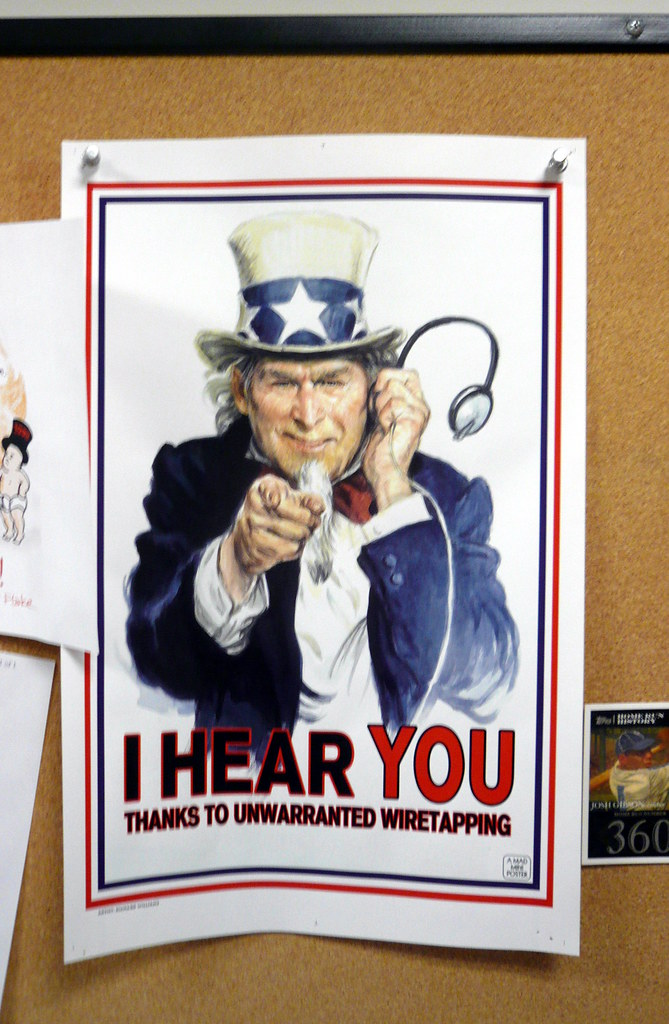
“I Hear You wiretapping poster, Mad Magazine, NYC” by gruntzooki is licensed under CC BY-SA 2.0 

 .
.
For as long as law enforcement has sought a way to monitor people’s conversations — though they’d only do so with a court order, we’re supposed to believe — privacy experts have warned that building backdoors into communications systems to ease government snooping is dangerous. A recent Chinese incursion into U.S. internet providers using infrastructure created to allow police easy wiretap access offers evidence, and not for the first time, that weakening security for anybody weakens it for everybody.
Subverted Wiretapping Systems
“A cyberattack tied to the Chinese government penetrated the networks of a swath of U.S. broadband providers, potentially accessing information from systems the federal government uses for court-authorized network wiretapping requests,” The Wall Street Journal reported last week. “For months or longer, the hackers might have held access to network infrastructure used to cooperate with lawful U.S. requests for communications data.”
Among the companies breached by the hacker group, dubbed “Salt Typhoon” by investigators, are Verizon, AT&T, and Lumen Technologies. The group is just one of several linked to the Chinese government that has targeted data and communications systems in the West.
While the Journal report doesn’t specify, Joe Mullin and Cindy Cohn of the Electronic Frontier Foundation (EFF) believe the wiretap-ready systems penetrated by the Chinese hackers were “likely created to facilitate smooth compliance with wrong-headed laws like CALEA”. CALEA, known in full as the Communications Assistance for Law Enforcement Act, dates back to 1994 and “forced telephone companies to redesign their network architectures to make it easier for law enforcement to wiretap digital telephone calls,” according to an EFF guide to the law. A decade later it was expanded to encompass internet service providers, who were targeted by Salt Typhoon.
“That’s right,” comment Mullin and Cohn. “The path for law enforcement access set up by these companies was apparently compromised and used by China-backed hackers.”
Ignored Precedents
This isn’t the first time that CALEA-mandated wiretapping backdoors have been exploited by hackers. As computer security expert Nicholas Weaver pointed out for Lawfare in 2015, “any phone switch sold in the US must include the ability to efficiently tap a large number of calls. And since the US represents such a major market, this means virtually every phone switch sold worldwide contains ‘lawful intercept’ functionality.”
October 10, 2024
The malignant persistence of snotty Millennial slang into adult life
At The Upheaval, a guest post by Dudley Newright tries to decipher what the hell all of the permanently online Millennial snots are saying:
Back in May, a black studies professor – an academic of the type who writes dissertations about the semiotics of Beyonce – “clapped back” at one of her peers, a white man who had dared complain that all the jobs in his corner of academia had been given to minorities. Their grating exchange went viral, and the poor schmuck certainly won’t be finding work now.
Setting aside the content of the argument, I was struck by how these people spoke to one another:
“I mean, I’m sorry –“
“Let’s be *very* clear here”
“So true 🙄”
“You’re so right 🙄”
“This is an *extremely* bad look for you”
“Umm, frankly…”
These are middle-aged PhDs with prestigious careers, talking like snotty teenagers or sassy black drag queens. Note the overuse of sarcasm, emphasizing asterisks, exclamation points, and pregnant pause ellipses to denote how “over it” they are. They all speak in the dramatic tone of the mean girl.
“History PhD here, and uh, this thread is…a lot!”
You see this language, and these people, everywhere today. You know them by the “fluent in sarcasm” in bio. The PhDs, the columnists, the policy wonks and Wonkettes, the assorted professional quippers and clappers back – public intellectuals did not talk this way twenty years ago. Lionel Trilling did not call things “brat”. This is new. Yet this bumptious patois is how our ascendant elites talk now.
I call it “Millennial Snot”.
It’s the defining feature of our degraded public discourse, and the apotheosis of secular enlightenment liberalism. The last 20 years of economic decline and consolidation of blue America into fake laptop work culminated in tweets like this:
What is Millennial Snot? Where did it come from? How did it become the prevailing liberal voice? What exactly is the matter with these people? And are we going to have to suffer this obnoxious style forever?
The nerds who never got over high schoolLiberals who have time to goof around on social media all day are probably nerds with more-or-less fake laptop jobs. They aren’t working class, otherwise they’d be working all day, but they aren’t terribly successful either, otherwise they’d have better things to do. The Bluesky-American sits awkwardly in the middle, and this feeds his resentment. He got good grades. He’s credentialed, and believes he’s smarter than his boss. He should be running things. If only society weren’t so dumb. If only society were fair, like when he was in school, when a kind teacher rewarded his intelligence and punished ne’erdowells.
Pity the “front row kid”, the wordcel who grinds his youth away for straight A’s only to find that the spoils of the market go to the back row goober who inherits his dad’s used car lot. If only there was some way to turn society upside down, so the front row kid could be on top. If only society could be more like grade school …
That would be a start, but the nerd doesn’t just want to be recognized for his intelligence. He also desperately wants to be cool. He wants to prove to the world that he won’t be shoved into a locker any more. He’s with it now, he uses the latest teen slang, he “understands the assignment”. This is how you get balding hetero professors saying stuff like “she ate and left no crumbs”, and “big mad” and other phrases that will sound embarrassingly dated in a few weeks.
October 1, 2024
The pros and cons of living the digital life
Spaceman Spiff considers how much of modern western life is now being experienced online rather than in the real world and what are the trade-offs inherent in the switch to the life digital:
Life is what you pay attention to. Increasingly many of us are immersing into virtual worlds and spending less time out in the real world. We are attending to digital realms.
Everything it seems is going online, from shopping to entertainment to work. Almost no aspect of life remains untouched by the slow creep of technology.
Our entertainment is digital and our social networks are found online. For increasing numbers this may be their only connection to others.
Even work is becoming unavoidably remote with Zoom and comparable tools now standard fare.
The digitization of life continues apace. As a result, we are present in the real world less and less and this cannot be altogether healthy.
Many benefits
There are obvious benefits to our new digital world.
Thanks to the internet much has become convenient and easy. We can access a wide array of goods and have them delivered for a small fee.
The scale of the options is impossible to beat. The real world could not possibly provide the options on display. We can peruse virtual warehouses with everything. No bookstore is as big as Amazon.
The post-Covid world accelerated aspects of digital adoption, particularly video-based conferencing and other virtual tools. This is now ubiquitous, particularly in work settings.
One-click ordering and fast delivery makes everything else seem unreasonably tedious and complicated. It is a hassle going to a physical location to buy clothes or books or food when you can pay a slave to deliver it.
But people sense they lose something with digital tools even when it is convenient to not travel or leave home. It is not the same as face to face. Importantly it brings the world into our homes, so we cannot easily escape.
Other less visible changes are apparent too. We seem to socialize less. We go out less often.
We dine in and often by having unhealthy food delivered, all chosen and prepared by others. The appeal of going out and mixing with strangers is waning.
Behind this is a gradual bureaucratization of everything as we are continually reminded of external dangers; germs, extreme weather, domestic terrorism, none of which are likely to ever touch us but we are told are ever present. These require interventions we never get to vote on but affect us nonetheless.
The safety-obsessed post-Covid world wants you at home where you are safe and sound. Digital tools have proliferated to serve this need.
But of course, for all the benefits we can enjoy for living the internet lifestyle, there are also significant negatives …
September 30, 2024
“This quite obviously proves that free speech is a tyrannical concept”
At The Critic, Titania McGrath decries the manifest horrors of letting ordinary people say whatever they want … without punishment:

“Titania McGrath” and Andrew Doyle
The government has repeatedly pointed out that the riots in the UK were directly caused by bad words on the internet. One of those arrested was an elderly retired midwife from Devon, who had accidentally read an inflammatory Facebook post whilst browsing for cupcake recipes. Within ten minutes, she found herself punching Persian toddlers and throwing grenades at a mosque.
For all the endless whingeing of free speech extremists, Starmer appreciates that words must be controlled to ensure that his subjects behave themselves. Surely most reasonable people would rather have their liberties restricted than live in a fascist state?
The next step is to see Elon Musk extradited. It was bad enough that he renamed Twitter as “X”, which is just a swastika with a few bits chopped off. But he has also allowed users to say whatever they like. As a result, wrong opinions are being duplicated at an alarming rate.
“Regulators around the world should threaten Musk with arrest if he doesn’t stop disseminating lies and hate on X,” wrote Robert Reich in the Guardian. Although I don’t approve of his surname, he makes a valid case.
Back in 2013, Starmer was quoted as saying that too many Twitter prosecutions could “have a chilling effect for free speech”. These were dangerous words, and although Starmer has since changed his mind, he should probably be calling for his own prosecution.
If you don’t want to be arrested, don’t say the wrong things. It really is that simple.
QotD: Compound eyes as models of how the surveillance state operates
The compound eye is a good way to imagine how the surveillance state will keep tabs on the subjects in the near future. Unlike the dystopian future imagined by science fiction, it will not be one eye focusing on one heretic, following him around as he goes about his business. Instead it will be tens of millions of eyes obtaining various bits of information, sending it back to the data-centers run by Big Tech. That information will be assembled into the broad mosaic that is daily life.
For example, rather than use informants and undercover operatives to flesh out conspiracies against the state, the surveillance state will use community detection to model the network of heretics. Since everyone is hooked into the grid in some fashion and everyone addresses nodes of the grid on a regular basis, keeping track of someone is now something that can be done from a cubicle. There is no need to actually follow someone around as they go about their life.
For example, everyone has a mobile phone. At every point, the phone is tracking its location, which means it is tracking your location. It also knows the time and day when you go into various businesses. Most people use cards to pay miscellaneous items, so just that information would tell the curious a lot about you. Combine that information with the same information from other phones that come into close proximity with your phone and figuring out the community structure is simple.
Of course, the mobile phone is not the only input device. Over Christmas, millions of Americans were encouraged to install surveillance devices in their homes by friends and family. Maybe it was an Alexa listening device from Amazon or a Nest Doorbell surveillance device from Google. All of these gadgets are collecting data on your life inside and around your home. It is then fed to the same data-centers that have all of your movements and associations collected from your phone.
The Z Man, “The Compound Eye”, The Z Blog, 2020-01-08.
September 16, 2024
Anger sells – “Words like ‘wrong’, ‘bad’, ‘awful’, ‘hate’, ‘sick’, ‘fight’, and ‘scary’ each predict a 2.3% increase in click-through rates”
Rob Henderson explains the incentives that lead to provoking as much anger as possible among readers (and especially voters):

It seems like people are angrier than ever. According to a poll by CBS News, 84 percent of Americans believe we are angrier than previous generations. Another survey recently found that nine in ten Americans can name either a recent news event or something about American politics that made them angry, while only half could identify a recent news event or something about American politics that made them proud.
What explains this feeling of rage? One noteworthy reason is that exploiting anger is politically convenient.
The strategic use of anger in politics has transformed it from a natural human emotion into a weapon of division, with far-reaching consequences for our social cohesion and democratic governance.
According to Steven Webster, author of “American Rage: How Anger Shapes Our Politics” and assistant professor of political science at Indiana University, “Anger provides ample benefits to those politicians who are able to use it most skillfully”.
Indeed, across political settings, angry people are more likely to vote than those who are not angry. In other words, politicians who can stoke anger can use it to motivate their base. The angrier voters are at the opposing party, the more likely they are to show up to the polls to support their own party. As Webster puts it, “angry voters are loyal voters”.
Political anger has consequences that extend beyond how Americans view their governing institutions or the opposing political party. When American voters are angry about politics, they are inclined to avoid social interactions or social events where they are likely to come into contact with those whose political leanings differ from their own.
In a chapter titled “Emotions in Politics” published last year, the psychologists Florian van Leeuwen and Michael Bang Peterson suggest that along with other emotions, anger “seems to be a distinct strategy for increasing what one is entitled to in the minds of others”.
Provoking rage against selected groups is an effective way to promote unity in politics. Today, many Americans across the political spectrum are encouraged to feel they are being victimized. It’s no coincidence that one of Donald Trump’s go-to lines on the campaign trail is “They’re laughing at us”. Being laughed at induces humiliation, which often quickly transforms into rage.
In a notable historical illustration of a political movement using anger as a limitless source of ideological fuel, consider the case of the “Recalling Bitterness” campaign in Maoist China. In the 1960s, the communist dictator Mao Zedong grew worried that ordinary Chinese citizens were developing lukewarm attitudes about the socialist revolution. In response, the regime forced people into rituals in which they publicly announced how bad life was before they had been liberated. Mao ordered writers and artists to rewrite history through the lens of class struggle to suit the needs of his political agenda. Regime officials held meetings encouraging peasants to describe how much better life was now compared to pre-liberation, hoping to convince them that the revolution’s successes outnumbered its failures. The “devils” here were reactionaries, landlords, rich farmers, and counterrevolutionaries. Documenting the rituals of the Recalling Bitterness campaign, the historian Guo Wu has written, “Only poor peasants were allowed to speak; former landlords and rich peasants were silenced”.
September 10, 2024
“The world has gone mad. But nothing is as crazy as the AI news”
Ted Gioia is covering the AI beat like nobody else. In this post he shares several near-term predictions involving AI development and deployment:

The world has gone mad. But nothing is as crazy as the AI news.
Every day those AI bots and their human posse of true believers get wilder and bolder — and recently they’ve been flexing like body builders on Muscle Beach.
The results are sometimes hard to believe. But all this is true:
- The movie trailer for Francis Ford Coppola’s new film got pulled from theaters because “the studio had been duped by an AI bot“.
- Just one person in North Carolina was able to steal $10 million in royalties from human musicians with AI-generated songs. They got billions of streams.
- The promoters of National Novel Writing Month angrily declared that opposition to AI books is classist and ableist.
- Children are now routinely using AI to make nude photos of other youngsters.
- Nearly half of the safety team at OpenAI left their jobs — and almost nobody seems to care or notice.
- AI tech titan Nvidia lost a half trillion in market capitalization over the course of just a few days — including the largest daily decline in the history of capitalism.
- By pure coincidence, Nvidia’s CEO sold $633 million worth of stock in the weeks leading up to the current decline.
We truly live in interesting times — which is one of the three apocryphal Chinese curses.
(The other two, according to Terry Pratchett, are: “May you come to the attention of those in authority” and “May the gods give you everything you ask for”. By tradition, the last is the most dangerous of all.)
I get some credit for anticipating this. On August 4, I made the following prediction:
But it’s going to get even more interesting, and very soon. That’s because the next step in AI has arrived — the unleashing of AI agents.
And like the gods, these AI agents will give us everything we ask for.
Up until now, AI was all talk and no action. These charming bots answered your questions, and spewed out text, but were easy to ignore.
That’s now changing. AI agents will go out in the world and do things. That’s their new mission.
It’s like giving unreliable teens the keys to the family car. Up until now we’ve just had to deal with these resident deadbeats talking back, but now they are going to smash up everything in their path.
But AI agents will be even worse than the most foolhardy teen. That’s because there will be millions of these unruly bots on our digital highways.

September 9, 2024
Bill C-63, the Online Harms Act
In the National Post, Barbara Kay explains why the Trudeau government will probably be urgently trying to get Bill C-63 through into law when Parliament resumes sitting later this month:

The sands of time were already running low for Justin Trudeau’s government. Jagmeet Singh’s just-announced withdrawal from their mutually supportive contract has widened the waist of the hourglass. Parliament resumes sitting on Sept. 16, and the Liberals will urgently seek to pass Bill C-63, the Online Harms Act, now in its second reading.
If passed in its present incarnation, this deeply flawed bill will drastically curtail freedom of speech in Canada (which, to be fair, is not an outlier on digital crackdowns in the West. Switzerland, of all places, just passed similar legislation).
We already have hate-crime laws in the Criminal Code that address advocacy for genocide, incitement of hatred and the wilful promotion of hatred. Apart from its laudatory intentions in removing online content that sexually victimizes children, Bill C-63 seeks to curb all online hate speech through unnecessary, inadvisable and draconian measures inappropriate to a democracy.
The law would create a new transgression: an “offence motivated by hated” which would raise the maximum penalty for advocacy of genocide from five years to life imprisonment. What kind of mindset considers the mere expression of hateful ideas as equivalent in moral depravity to rape and murder? Such instincts call to my mind the clever aperçu by anti-Marxist pundit David Horowitz that “Inside every progressive is a totalitarian screaming to get out”.
Another red flag: The law would give new powers to the federal cabinet to pass regulations that have the same force as legislation passed by Parliament, and that could, say, shut down a website. Unlike legislation, regulations created by cabinet do not require debate, votes or approval of Parliament. They can be decided in secrecy and come into force without public consultation or debate.
Yet another is the restoration of the “communication of hate speech” offence to the Canadian Human Rights Act, a provision similar to the one repealed in 2012. Frivolous or malicious complaints could be made against persons or organizations, granting complainants significant potential for financial reward at no personal cost, win or lose. Moreover, under this law, a complainant’s sense of injury from published words would trump a defence of objective truth. This is an open invitation for myriad social malcontents and grievance-mongers to swarm the system, with no regard for the inevitable harm done to those who they target.
August 6, 2024
The CrowdStrike outage and regulatory capture
Peter Jacobsen discusses the July technical and financial fiasco as a faulty software patch from CrowdStrike took down huge segments of the online economy and how regulatory capture may explain why the outage was so widespread:
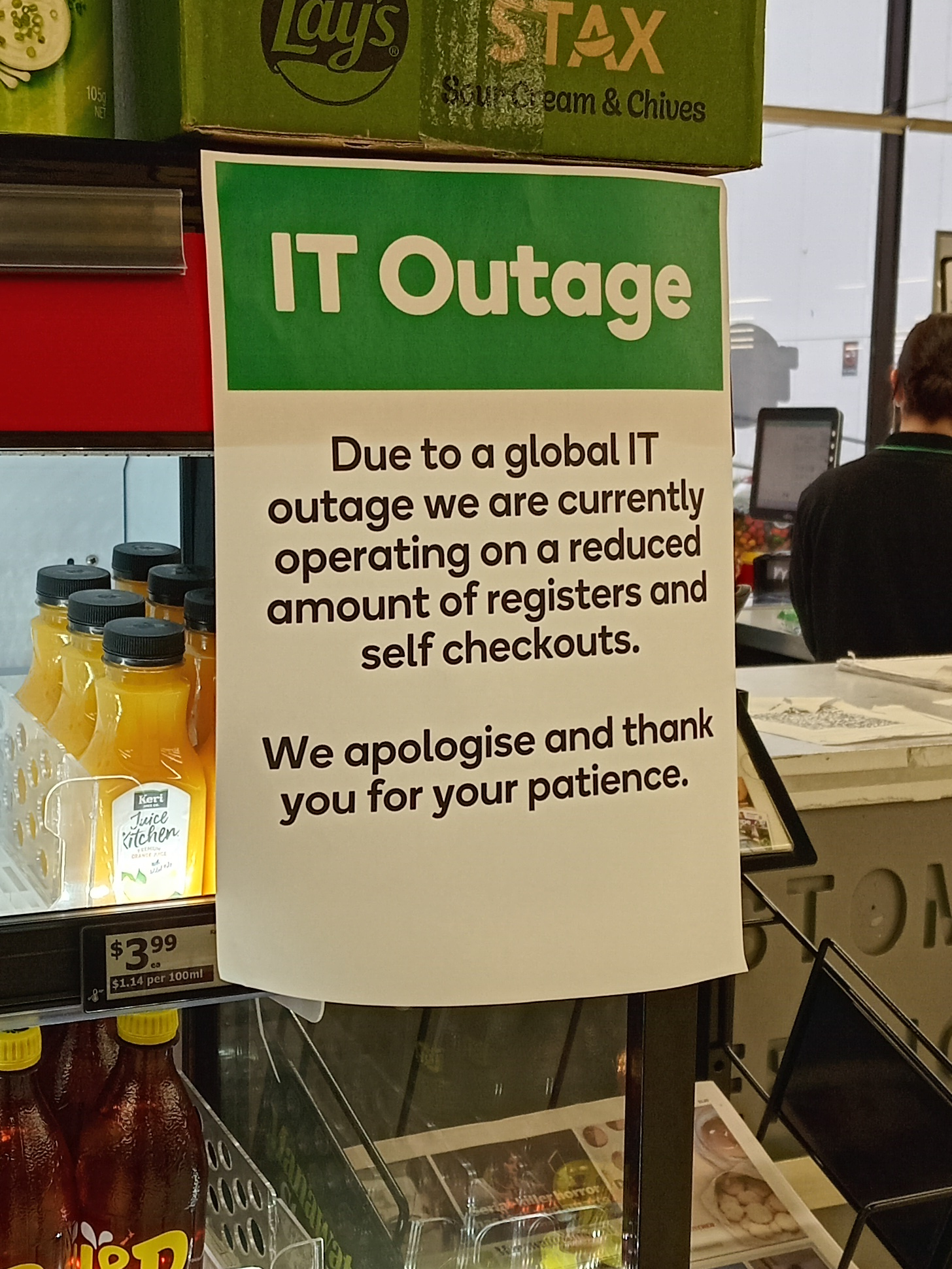

On July 19th, something peculiar struck workers and consumers around the world. A global computer outage brought many industries to a sudden halt. Employees at airports, financial institutions, and other businesses showed up to work only to find that they had no access to company systems. The fallout of the outage was huge. Experts estimate that it totaled businesses $5 billion in direct costs.
The company responsible, CrowdStrike, was also severely impacted. Shareholders lost about $25 billion in value, and some are suing the company. The outage has led to expectations of, and calls for, stricter regulations in the industry.
But how did the blunder of one company lead to such a massive outage? It turns out that the supposed solution of “regulation” may have been one of the primary culprits.
Regulatory Compliance
CrowdStrike, ironically, is a cybersecurity firm. In theory, they protect business networks and provide “cloud security” for online cloud computing systems.
Cloud security, in and of itself, is likely a service that businesses would demand on the market, but the benefit of increased security isn’t the only reason that businesses go to CrowdStrike. On their own website, the company boasts about one of its most important features: regulatory compliance.
[…]
When experts who have relationships with companies are called in to help write regulations, they may do so in a way favorable to industry insiders rather than outsiders. Thus, regulation is “captured” by the subjects of regulation.
We can’t say with certainty that this particular outage is the result of an intentional regulatory capture by CrowdStrike, but it seems clear that CrowdStrike’s dominance is, at least in part, a result of the regulatory environment, and, like most large tech companies, they’re not afraid to spend money lobbying.
In any case, without cumbersome regulations, it’s unlikely that cybersecurity would take on such a centralized form. Despite this, as is often the case, issues caused by regulation often lead to more calls for regulation. As economist Ludwig von Mises pointed out:
Popular opinion ascribes all these evils to the capitalistic system. As a remedy for the undesirable effects of interventionism they ask for still more interventionism. They blame capitalism for the effects of the actions of governments which pursue an anti-capitalistic policy.
So despite the reflexive call for regulation that happens after any disaster, perhaps the best way to avoid problems like this would be to argue that in terms of regulation, less is more.
August 5, 2024
Short-term technological forecast – “If I were a commercial pilot, I’d tell you to return to your seats and buckle up”
Most of this Ted Gioia post is behind the paywall (and if you can afford it, I’m sure you’d get your money’s worth for a subscription):
I anticipate extreme turbulence on every front for the remaining five months in 2024. You will see it in politics, business, economics, culture, world affairs, the stock market, and maybe even your own neighborhood.
That’s one of the themes of my latest arts and culture update below.
What happened to the AI business model last week?
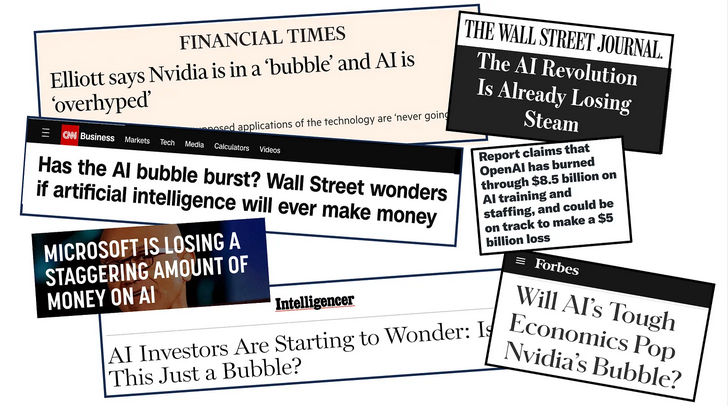
After almost two years of hype, the media changed its opinion on AI last week.
The hype disappeared almost overnight
All of a sudden, news articles about AI went sour like reheated 7-Eleven coffee. The next generation AI chips are delayed, and 70% of companies are behind in their AI plans. There are good reasons for this — most workers now say AI makes them less productive.
People are also noticing that AI businesses want to use the entire electricity grid to run their money-losing bots. Meanwhile AI companies are burning through cash at historic levels. Even under the best case scenario, this all feels unsustainable.
But the worst disclosure, in my opinion, came on July 24 — just eleven days ago.
A study published in Nature showed that when AI inputs are used to train AI, the results collapse into gibberish.
This is a huge issue. AI garbage is now everywhere in the culture, and most of it undisclosed. So there’s no way that AI companies can remove it from future training inputs.
They are caught in the doom loop I described last week.
That same day, the Chief Investment Officer at Morgan Stanley warned investors that AI “hasn’t really driven revenues and earnings anywhere”. One day later, Goldman Sachs quietly released a report admitting that the AI business model was in serious trouble.
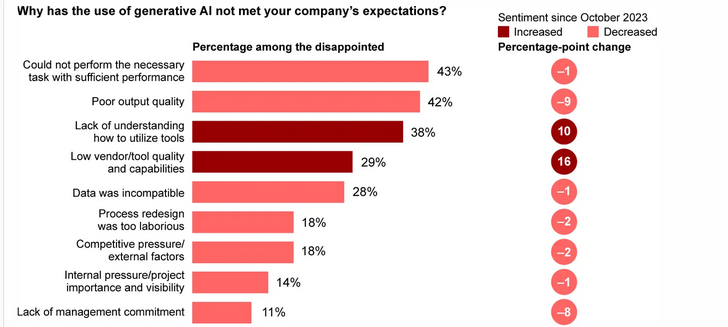
Even consulting firms, who make a bundle hyping this tech, are backtracking. Bain recently shared the following chart (hidden away at the end of a report) which explains why AI projects have failed.
These findings are revealing. They show that management is absolutely committed to AI, but the tools just don’t deliver.
And, finally, last week the media noticed all this.
They published dozens of panic-stricken articles. Investors got spooked too — shifting from greed to fear in a New York minute. Over the course of just two days, Nvidia’s stock lost around $400 billion in market capitalization.
In this environment, true believers quickly turn into skeptics. The whole AI business model gets scrutinized — and if it doesn’t hold up, investment cash flow dries up very quickly.
This is exactly what I predicted 6 months ago. Or even a year ago.
I expect that the next few weeks — or maybe even the next few days — will be extremely turbulent in the AI world.
Buckle up!
The dominant AI music company just admitted that it trained its bot on “essentially all music files on the Internet”.
Suno is a huge player in AI music — it tells investors it will generate $120 billion per year. Microsoft is already using its technology.
But there’s a tiny catch.
The company now admits in a court filing:
Suno’s training data includes essentially all music files of reasonable quality that are accessible on the open internet, abiding by paywalls, password protections, and the like, combined with similarly available text descriptions
Hey, this is totally illegal — it’s like Napster all over again.
Suno will need to prove that all these copyrighted songs are “fair use” in AI training. I doubt that any court will take that claim seriously.
If the music industry is smart, they will use this violation to shut down AI regurgitation of copyrighted songs.
If the music industry is stupid — run according to my “idiot nephew theory” — they will drop charges in exchange for some quick cash.
August 1, 2024
QotD: Sex and dating in the internet dating age
In 1996, Helen Fielding’s Bridget Jones helped women realise that half the human race (men) might usefully be called “fuckwits” when it came to dating and romance. The dynamics of internet dating, with its illusion of graspable sexual paradise, has either created a new tsunami of apparent fuckwits, or it has made the sheer extent of them inescapable.
Meanwhile, the boredom and jadedness stitched into heavy use of apps (“nope”, “like”, “nope”, “nope”, “nope”, “like”) has produced a ubiquitous undercurrent of queasy unpleasantness. The result is that men, formerly seen as an alternating source of fun, trouble and heartbreak, become “men: ugh”. Women, once the promised land for many a Romeo, become bitches, gold-diggers, game-players, and, most significantly, for a depressing bloc known as “women: meh”.
This sexual stand-off, characterised by simmering distrust and putrid fatigue, oozes off internet dating portals. I’ve often found myself, after a night of binge-scrolling, surprised to remember that dating is filed under “romance”, which is supposed to be — at least at the start — a little about positive, fuzzy feelings or the potential to develop them.
Zoe Strimpel, “Why the young are falling out of love with sex”, UnHerd, 2019-11-25.
July 23, 2024
The next phase of the campaign to replace “Orwellian” with “Trudeaupian”
On the Fraser Institute blog, Jake Fuss and Alex Whalen outline the Trudeau government’s latest attempt to drive the word “Orwellian” out of common usage by making “Trudeaupian” the more authoritarian descriptor:
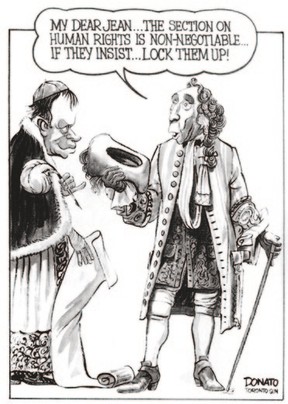
A Toronto Sun editorial cartoon by Andy Donato during Pierre Trudeau’s efforts to pass the Canadian Charter of Rights and Freedoms. You can certainly see where Justin Trudeau learned his approach to human rights.
This year marks the 75th anniversary of George Orwell’s classic novel 1984 (and it’s been 40 years since the actual year 1984). In the novel, Orwell explains the dangers of totalitarianism by exploring what happens when government exercises extreme levels of control over citizens including censoring and controlling language. While Canada is a relatively free country in 2024, there are aspects of Orwell’s world reflected in government policy today.
The Human Freedom Index, published annually by the Fraser Institute and Cato Institute, defines freedom as a social concept that recognizes the dignity of individuals by the absence of coercive constraint. In a free society, citizens are free to do, say or think almost anything they want, provided it does not infringe on the right of others to do the same.
Canada currently fares relatively well compared to other countries on the Human Freedom Index, placing 13th out of 165 countries. However, our score has dropped six spots on the index since 2008 when Canada recorded its highest ever rank.
This is not surprising given the Trudeau government’s recent efforts to control and manage the free exchange of ideas. The recent Online Streaming Act imposes various content rules on major streaming services such as Netflix, and requirements to extract funds to be redirected toward favoured groups. The Act seemingly seeks to bring the entire Internet under the regulation of a government body.
In another piece of recent legislation, the Online News Act, the government attempted to force certain social media platforms to pay other legacy news outlets for carrying content. In response, the social media platforms chose simply not to allow content from those news providers on their platforms, resulting in a dramatic reduction of Canadians’ access to news.
Now, a new piece of federal legislation — Bill C-63, the Online Harms Act — seeks to control language and grant government power to punish citizens for what the government deems to be unfavourable speech.
The government has sold Bill C-63 as a way to promote the online safety of Canadians, reduce harms, and ensure the operators of social media services are held accountable. In reality, however, the bill is Orwell’s Big Brother concept brought to life, where government controls information and limits free exchange. The legislation seeks to punish citizens not just for what the governments deems as “hate speech” but also grants the state power to bring Canadians before tribunals on suspicion that they might say something hateful in the future. Not surprisingly, many have raised concerns about the constitutionality of the Bill, which will surely be tested in court.
July 4, 2024
“In other words, God is a deliverable for the R&D team”
Ted Gioia isn’t impressed with the changes we’ve seen over the years among the Silicon Valley leadership:
Yes, I should have been alarmed when this cult-ish ideology took off in Silicon Valley — where the goal had previously been incremental progress (Moore’s law and all that) and not being evil.
When I first came to Silicon Valley at age 17, the two leading technologists in the region were named William Hewlett and David Packard. They used their extra cash to fund schools, museums, and hospitals — both my children were born at the Lucile Packard Children’s Hospital — not immortality machines, or rockets to Mars, or a dystopian Internet of brains, or worshipping at the Church of the Singularity.
Tech leaders were built differently back then. When famous historian Arnold Toynbee visited Stanford in 1963, he had a chance encounter with William Hewlett. Afterwards Toynbee marveled over his new acquaintance, declaring: “What an amazing fellow. He has more knowledge of history than many historians.”
In other words, Bill Hewlett had more wisdom than ego. He invested in the community where he lived — not the Red Planet. Instead of promulgating social engineering schemes, Hewlett and Packard built a new engineering school at their alma mater, and named it after their favorite teacher.
They wouldn’t recognize Silicon Valley today. The FM-2030s are now in charge.
Bill Hewlett and Dave Packard invested in engineering, not social engineering
Another warning sign came when Google hired cult-ish tech guru Ray Kurzweil — a man who had once created a reasonable music keyboard that even Stevie Wonder used.
But Kurzweil went on to write starry-eyed books of utopian tech worship which come straight out of the weird religion playbook (The Age of Spiritual Machines, The Singularity is Near, etc.)
What does tech look like when it gets turned into a religion? Kurzweil summed it up when asked if there is a God. His response: “Not yet.”
In other words, God is a deliverable for the R&D team.
I note that, when Forbes revisited Ray Kurzweil’s predictions, they found that almost every one went wrong.
So what does he do?
Kurzweil follows up his book The Singularity is Near with a new book entitled The Singularity is Nearer. Give the man credit for hubris. This is exactly what religious cults do when their predicted Rapture doesn’t occur.
They just change the date on the calendar — Utopia has been delayed for another 12 months.
But, of course, Utopia is always delayed another 12 months. Meanwhile the cult leaders can do a lot of damage while preparing for the Rapture.

And despite the techno-elite’s apparent endless quest for perfection in their own lives, the enshittification of the technology they deliver to us proles continues relentlessly:
Here’s a curious fact. The more they brag about their utopias, the worse their products and services get.
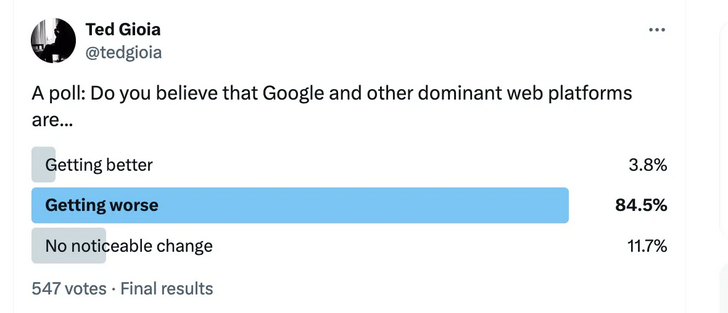
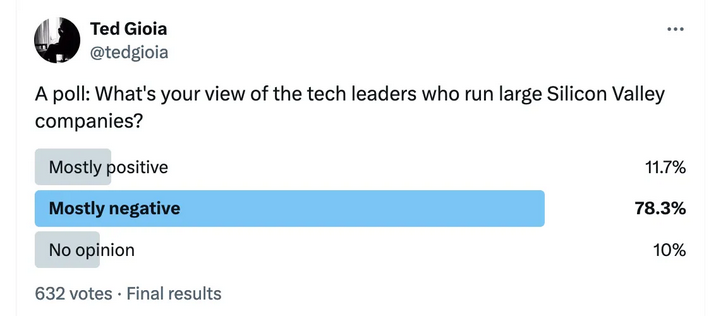
Even the word upgrade is now a joke — whenever a tech company promises it, you can bet it will be a downgrade in your experience. That’s not just my view, but overwhelmingly supported by survey respondents.
For the first time since the dawn of the Renaissance, innovation is now feared by the vast majority of people. And the tech leaders, once admired and emulated, now rank among the least trustworthy people in the world.
It was different when Linus Pauling was peddling his horse pills — he eventually set up shop in Big Sur, far south of the tech industry, in order to find a hospitable home for his wackiest ideas.
Nowadays, Big Sur thinking has come to the Valley.
And when you set up cults inside the largest corporations in the history of the world, we are all endangered.
Just imagine if Linus Pauling had enjoyed the power to force everybody to take his huge vitamin doses. Just imagine if Bill Shockley had possessed the authority to impose his racist eugenics theories on the populace.
It’s scary to think of. But they couldn’t do it, because they didn’t have billions of dollars, and run trillion-dollar companies with politicians at their beck and call.
But the current cultists include the wealthiest people in the world, and they are absolutely using their immense power to set rules for the rest of us. If you rely on Apple or Google or some other huge web behemoth — and who doesn’t? — you can’t avoid this constant, bullying manipulation.
The cult is in charge. And it’s like we’re all locked into an EST training sessions — nobody gets to leave even for bathroom breaks.
There’s now overwhelming evidence of how destructive the new tech can be. Just look at the metrics. The more people are plugged in, the higher are their rates of depression, suicidal tendencies, self-harm, mental illness, and other alarming indicators.
If this is what the tech cults have already delivered, do we really want to give them another 12 months? Do you really want to wait until they deliver the Rapture?