Quillette
Published Jun 19, 2024Jonathan Kay talks to Atlantic Magazine staff writer Conor Friedersdorf about a censorious government bill that would allow officials to investigate Canadians for things they haven’t done yet.
https://quillette.com/2024/06/19/just…
——
Quillette is an Australian-based online magazine that focuses on long-form analysis and cultural commentary. It is politically non-partisan, but relies on reason, science, and humanism as its guiding values.
Quillette was founded in 2015 by Australian writer Claire Lehmann. It is a platform for free thought and a space for open discussion and debate on a wide range of topics, including politics, culture, science, and technology.
Quillette has gained attention for publishing articles and essays that challenge modern heterodoxy on a variety of topics, including gender and sexuality, race and identity politics, and free speech and censorship.
(more…)
June 24, 2024
May 27, 2024
“Product recommendations broke Google, and ate the Internet in the process”
Ted Gioia says the algorithms are broken and we need a way to get out of the online hellscape our techbro overlords have created for us:
Have you tried to get information on a product or service from Google recently? Good luck with that.
“Product recommendations broke Google,” declares tech journalist John Herrman, “and ate the Internet in the process.”
That sounds like an extreme claim. But it’s painfully true. If you doubt it, just try finding something — anything! — on the dominant search engine.
No matter what you search for, you end up in a polluted swamp of misleading links. The more you scroll, the more garbage you see:
- Bogus product reviews
- Fake articles that are really advertisements
- Consumer guides that are just infomercials in disguise
- Hucksters pretending to be experts
- And every scam you can imagine (and some that never existed before) empowered by deepfakes or AI or some other innovative new tech
The Google algorithm deliberately makes it difficult to find reliable information. That’s because there’s more money made from promoting garbage, and forcing users to scroll through oceans of crap.
So why should Google offer a quick, easy answer to anything?
Everybody is now playing the same dirty game.
Even (previously) respected media outlets have launched their own recommendation programs as a way to monetize captured clients (= you and me). Everybody from Associated Press to Rolling Stone is doing it, and who can blame them?
Silicon Valley sets the dirty rules and everybody else just plays the game.
Welcome to the exciting world of algorithms. They were supposed to serve us, but now they control us—for the benefit of companies who impose them on every sphere of our lives.
And you can’t opt out.
For example, when I listen to music on a streaming platform, the algorithm takes over as soon as I stop intervening—insisting I listen to what it imposes on me. Where’s the switch to turn it off?
I can’t find it.
That option should be required by law. At a minimum, I should be allowed to opt out of the algorithm. Even better, they shouldn’t force the algorithm on me unless I opt in to begin with.
If this tech really aimed to serve me, opting in and opting out would be an obvious part of the system. The fact that I don’t get to choose tells you the real situation: These algorithms are not for our benefit.
Do you expect the coming wave of AI to be any different?
[…]
The shills who want us to lick the (virtual) boots of the algorithms keep using the word progress. That’s another warning sign.
I don’t think that word progress means what they think it means.
If it makes our lives worse, it isn’t progress. If it forces me into servitude, it isn’t progress. If it gets worse over time — much worse! — it isn’t progress.
All the spin and lobbying dollars in the world can’t change that.
So that’s why I became a conscientious objector in the world of algorithms. They give more unwanted advice than any person in history, even your mom.
At least mom has your best interests at heart. Can we say the same for Silicon Valley?
May 4, 2024
Process optimization can definitely be taken too far
Freddie deBoer considers systems that have been overoptimized to the detriment of most users and the benefit of a small, privileged minority:
I know a guy who used to make his living as an eBay reseller. That is, he’d find something on eBay that he thought was underpriced so long as the auction didn’t go above X dollars, buy it, then resell it for more than he paid for it Classic imports-exports, really, a digital junk shop. Eventually he got to the point where, with some items, he didn’t ever have physical possession of them; he had figured out a way to get them directly from whoever he bought an item from to the person he had sold the item to, while still collecting his bit of arbitrage along the way. This buying and selling of items on eBay, looking for deals, was sufficient to be his full-time job and pay for a mortgage. But the last time I saw him, a few years ago, he had gotten an ordinary office job. He told me that it had become too difficult to find value; potential sellers and buyers alike had access to too many tools that could reveal the “real” price of an item, and there was little delta to eke out. He’s not alone. If you search around in eBay-related forums, you’ll find that many longtime sellers have reached similar conclusions. The hustle just doesn’t work anymore.
I don’t suppose there’s any great crime there — it’s all within the rules. And there does appear to still be an eBay-adjacent reselling economy; it’s just that, as far as I can glean, it’s driven by algorithms and bots that average resellers simply don’t have access to. It appears that some super-resellers have implemented software solutions to identify underpriced goods and buy them automatically and algorithmically. They have optimized the system for their own use, giving them an advantage, putting other sellers at a disadvantage, and arguably hurting buyers by eliminating uncertainty that sometimes results in lower-than-optimal-to-sellers prices. This is all in sharp contrast to the early years, when my friend would keep listings for lucrative product categories open – in separate windows, not tabs, that’s how long ago this was – and refresh until he found potential moneymakers. That sort of human searching and bidding work stands at a sharp disadvantage compared to those with information-scraping capacity and automated tools. It’s a good example of how access to data has left systems overoptimized for some users. One of the things that the internet is really good at is price discovery, and these digital tools help determine the “optimal” price of items on eBay, which results in less opportunity for arbitrage for other players.
My current working definition of overoptimization goes like this: overoptimization has occurred when the introduction of immense amounts of information into a human system produces conditions that allow for some players within that system to maximize their comparative advantage, without overtly breaking the rules, in a way that (intentional or not) creates meaningful negative social consequences. I want to argue that many human systems in the 2020s have become overoptimized in this way, and that the social ramifications are often bad.
Getting a restaurant reservation is a good example. Once upon a time, you called a restaurant’s phone number and asked about a specific time and they looked in the book and told you if you could have that slot or not. There was plenty of insiderism and petty corruption involved, but because the system provided incomplete information that was time consuming to procure, there was a limit to how much you could game that system. Now that reservations are made online, you can look and see not only if a specific slot has availability but if any slots have availability. You can also make highly-educated guesses about what different slots are worth on the market through both common sense (weekend evenings are the most valuable etc) and through seeing which reservations get snapped up the fastest in an average week. And being online means that the reservation system is immediate and automatic, so you can train a bot to grab as many reservations as you want, near-instantaneously, and you can do so in a way that the system doesn’t notice. (Unlike, say, if you called the same restaurant over and over again and tried to hide your voice by doing a series of fake accents.) The outcome of all this is that getting a reservation at desirable places is a nightmare and results in a secondary market that, like seemingly everything in American life, is reserved for the rich. The internet has overoptimized getting a restaurant reservation and the result is to make it more aggravating and less egalitarian.
As has been much discussed, nearly the exact same scenario has made getting concert tickets a tedious and ludicrously-pricy exercise in frustration.
April 30, 2024
April 24, 2024
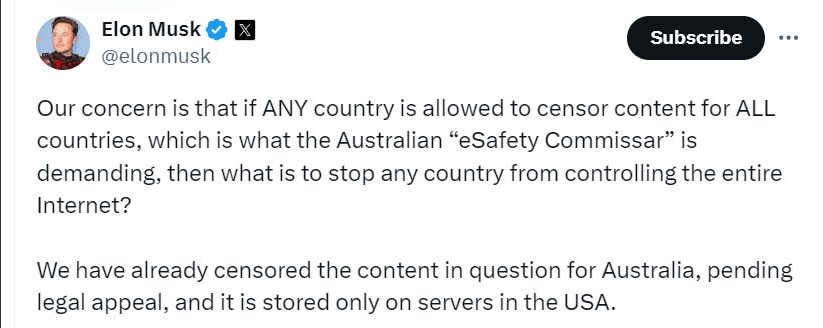
Australia cribs from Trudeau’s notes and tries to censor the internet outside their borders
Tim Worstall explains to the Australian federal government why their attempt to force Elon Musk to obey Australian diktats on Twit-, er, I mean “X” outside Australia is extreme over-reach and should be firmly rejected:
It’s entirely true that Elon Musk is a centibillionaire currently telling the Australian Government that they can fuck off. It’s also true that if Elon Musk were of my level of wealth — or perhaps above it and into positive territory — he should be telling the Australian Government to fuck off.
This also applies to the European Union and that idiocy called the right to be forgotten which they’ve been plaguing Google with. Also to any other such attempts at extraterritoriality. Governments do indeed get to govern the places they’re governments of. They do not get to rule everyone else — the correct response to attempts to do so is fuck off.
So, Musk is right here:
What this is about doesn’t really matter. But, v quickly, that attack on the Armenian Church bishop is online. It’s also, obviously, highly violent stuff. You’re not allowed to show highly violent stuff in Oz, so the Oz government insist it be taken down. Fair enough – they’re the government of that place. But they are then demanding further:
On Monday evening in an urgent last-minute federal court hearing, the court ordered a two-day injunction against X to hide posts globally….
Oz is demanding that the imagery be scrubbed from the world, not just that part of it subject to the government of Oz. Leading to:
Australia’s prime minister has labelled X’s owner, Elon Musk, an “arrogant billionaire who thinks he is above the law”
And
Anthony Albanese on Tuesday said Musk was “a bloke who’s chosen ego and showing violence over common sense”.
“Australians will shake their head when they think that this billionaire is prepared to go to court fighting for the right to sow division and to show violent videos,” he told Sky News. “He is in social media, but he has a social responsibility in order to have that social licence.”
To which the correct response is that “Fuck off”.
For example, I am a British citizen (and would also be an Irish one if that country ever managed to get up to speed on processing foreign birth certificates) and live within the EU. Australian law has no power over me — great great granny emigrated from Oz having experienced the place after all. It’s entirely sensible that I be governed by whatever fraction of EU law I submit to, there are aspects of British law I am subject to as well (not that I have any intention of shagging young birds — or likelihood — these days but how young they can be is determined not just by the local age of consent but also by British law, even obeying the local age where I am could still be an offence in British law). But Australian law? Well, you know, fu.. … .
April 19, 2024
Yet another unintended consequence of the Online Harms Act – easier deportation of non-citizens
In The Line, Kevin Wiener explains another of the hidden “gems” of the Trudeau government’s ill-considered and repressive Online Harms Act that at least will please a few anti-immigration activists:
According to the Trudeau government and its defenders, the Online Harms Act is nothing to worry about. This is supposed to be a bill that will protect equity-seeking groups like racial minorities — yet one little-discussed provision will make millions of permanent residents open to deportation for even the most minor criminal offences, as long as a prosecutor can show that the crime was hate-motivated.
The resulting power to turn any crime into a deportable offence will make non-citizens — many of whom are racial and religious minorities — even more vulnerable in the criminal justice system compared to citizens.
The main focus of the Online Harms Act is regulating online platforms, but it also makes major changes to the way the criminal justice system deals with hate-motivated crimes. Under current law, if a crime is motivated by hate based on a protected characteristic, that’s considered an aggravating factor at sentencing. That means the judge can impose a higher sentence than they normally would, although they can never exceed the maximum sentence for the underlying crime. For many minor crimes, that maximum sentence is two years less a day.
The Online Harms Act uses a totally different approach to hate crimes. Rather than just being a sentencing factor, the Act would create a brand-new hate crime offence. Committing any crime, if motivated by hatred, would make someone guilty of a second crime, with a maximum sentence of life imprisonment. To counter public concern, the Trudeau government has recently sent one of its senior advisors, Supriya Dwivedi, to argue that critics of this provision are “engaging in bad faith tactics”, going so far as to make the absolutely false statement that the bill won’t allow an increased sentence unless the underlying crime already had that sentence.
That is an accurate description of the current sentencing regime, but the text and clear purpose of the new bill is to let judges go further: a serious aggravated assault that might normally attract the maximum 14-year sentence can lead to life imprisonment if the attack was hate-motivated.
Further, Dwivedi’s defence of the bill ignores that maximum sentences play an important role in Canada’s immigration policy. If someone is neither a citizen nor a permanent resident, they can only be deported if they commit a more serious (called an “indictable”) offence, or two separate less serious (or “summary”) offences.
The new hate crime provision would be an indictable offence.
April 10, 2024
We can expect to see a lot more commercial bankruptcies in future
Although Tim Worstall is talking specifically about commercial properties in the UK, I suspect the same basic mechanism is in place here in Canada, the US, and many other countries and the outcomes will be broadly similar: declining retail sales intersecting with rising rents do not result in healthy retail markets.
The specific point is something that has become common to near universal in commercial property leases in the decades since the War. This is that rents can only ever be revised upwards.
So, the standard thing about commercial property is that it’s not so much rented as leased. The difference is not wholly clear but, roughly enough, you can leave a rental and you can’t leave a lease. That is, if you’ve a 21 year lease and you want to leave before the 21 years are up then it’s up to you to find another tenant. Not the landlord — and if that tenant that you do find then leaves/goes bust/doesn’t pay the rent then you have to. At least a rental you can leave.
OK — but that’s all pretty standard. The UK has one more thing. Obviously, there are rent reviews during the period of the lease. Inflation taught landlords that this was something they needed to do after all. OK — but the standard, and it really is standard in UK commercial leases, rent review is upwards only. Now, for most of this past 70 years this hasn’t been a problem. The country has been getting richer, inflation has persisted, retail’s been ever more of the economy, rents have been going up.
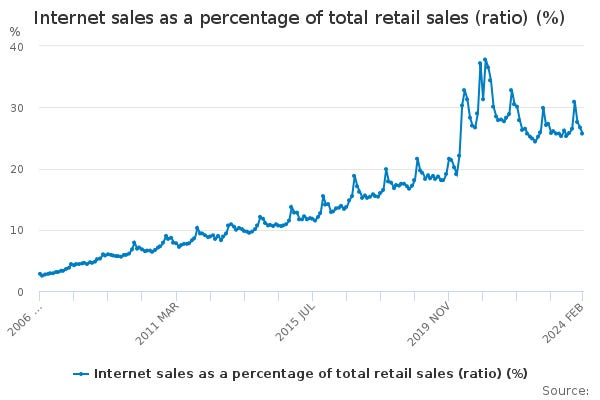
Ah, but now, eh? Firstly, we’ve the internet eating retail.
About, and roughly, 1% of the total market each year moves online. We all thought that the lockdown boom was going to persist and it didn’t. This caused all sorts of problems for all sorts of people — Boohoo ended up terribly overstocked. Made.com was able to come to market and then went bust as the right hand end of that chart happened and we returned to trend after the blip. Revolution Beauty had its own problems but the overvaluation was at least partly to do with this and so on.
But this had already been happening — Intu went bust well before the pandemic, as we know. It’s now about true that 15% or more of UK retail space is empty. Because sales are moving online. This — naturally enough — means that prices, rents, of retail are falling. Well, OK.
But now this meets upwards-only rent reviews. If you’re a new retailer looking for space then the High Streets are your mollusc of choice. You can probably get in on low rents, substantial rent-free periods and even get the landlord to pay your fitting out costs (landlords would much rather give rent-free periods, pay costs of moving in, than let at low rents. Because the terms of their own mortgages and loans make it better for them to keep headline rents stable whatever the hell the truth of the real value is). But if you’re a long established retailer paying high street rents then you’re screwed.
Your new competition might be able to get in by paying half the rent you are. And yes, rent is a really, really, big part of retail in the UK. You are, in fact, fucked and right royally.
April 1, 2024
March 31, 2024
March 19, 2024
Canada’s new international role: the object lesson in failure and tyranny
Tristin Hopper rounds up some of the foreign impressions of Canada’s descent into the west’s object lesson in what not to do in almost every area:
In just the last week, there have been two separate columns in British newspapers framing Canada as a model of what not to do.
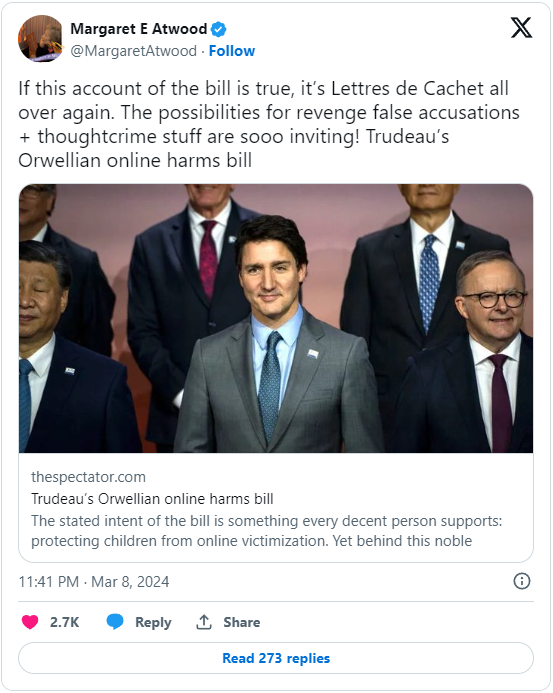
Both were inspired by the tabling of Bill 63, the Liberals’ Online Harms Bill. The Spectator said that it effectively engendered the founding of a Canadian “thought police”. The Telegraph cited it as evidence that “Canada’s descent into tyranny is almost complete”.
This didn’t used to happen. It wasn’t too long ago that Canadian politics were famously inaccessible to the wider world. For Canada’s 2008 federal election, The Spectator covered it with a blog post that mostly mused on how nobody cared. “It’s curious that Canada receives almost no foreign coverage, even in Britain where there are, after all, plenty of people with Canadian relatives or connections,” it read.
But now – on topics ranging from assisted suicide to housing affordability to internet regulation – it’s not infrequent that Canada will be cited in foreign parliaments and in foreign media as the very model of a worst-case scenario.
It was just six months ago that The Telegraph scored a viral hit with a mini-documentary framing the political situation in Canada as a “warning to the West”.
“Under Justin Trudeau, Canada has sought to position itself as the global bastion of progressive politics,” reads a synopsis for the film Canada’s Woke Nightmare, which has garnered more than five million views.
The documentary notes that Canada is now at the absolute global vanguard of progressive issues including harm reduction, assisted suicide and gender ideology.
[…]
If the Online Harms Act is suddenly garnering headlines across the rest of the Anglosphere, it’s not because Canadian politics are inherently interesting to the wider world. Rather, it’s because Bill C-63 – just like any number of Trudeau policies before it – is proposing to do things that no other Western democracy has yet proposed.
While plenty of Canada’s peer countries have hate speech controls, Bill C-63 was able to raise even European eyebrows with life sentences for “advocating genocide”, and a provision for police to mandate house arrest merely on suspicion that a Canadian was likely to commit a hate crime.
The Wall Street Journal, for one, profiled the bill as a real-life example of the 2002 film Minority Report, which depicts a dystopian future in which citizens are jailed for “pre-crime”.
Or in the critical words of The Spectator, “this legislation authorises house arrest and electronic tagging for a person considered likely to commit a future crime … if that’s not establishing a thought police, I don’t know what is”.