Quotulatiousness

March 3, 2024

The five “generations” of warfare

At Postcards from Barsoom, John Carter outlines the definitions for the way wars have been waged from pre-history down to today:

Warfare is fundamentally about breaking the enemy’s will to fight. This can be done with violence, or without it – before the fight even starts, through raw intimidation. Working from this understanding, military theorists have divided the history of warfare into five generations.

First Generation Warfare, abbreviated 1GW, was war as it was waged from the dawn of civilization up through roughly the Civil War. This style of conflict involved massed line infantry, equipped with spears, pikes, swords, or line-of-sight ranged weapons such as longbows, crossbows, or muskets. The basic tactic was to draw up two large groups of armed men, bring them into close contact, and have them hack at one another until one side grew demoralized by the slaughter, at which point their line would break and the real slaughter could begin.

These defined “generations” of war apply only to states, as Bret Devereaux described warfare before states (and between early states and non-state groups) this way:

The oldest way of war was what Native North Americans called – evocatively – the “cutting off” way of war (a phrase I am borrowing from W. Lee, “The Military Revolution of Native North America” in Empires and Indigines, ed. W. Lee (2011)), but which was common among non-state peoples everywhere in the world for the vast stretch of human history (and one may easily argue much of modern insurgency and terrorism is merely this same toolkit, updated with modern weapons). The goal of such warfare was not to subjugate a population but to drive them off, forcing them to vacate resource-rich land which could then be exploited by your group. To do this, you wanted to inflict maximum damage (casualties inflicted, animals rustled, goods stolen, people captured) at minimum risk, until the lopsided balance of pain you inflicted forced the enemy to simply move away from you to get out of your operational range.

[…]

We may call this the first system of war. It is the oldest, but as noted above, never entirely goes away. We tend to call this style “asymmetric” or “unconventional” war, but it is the most conventional war – it was the first convention, after all. It is also sometimes denigrated as primitive, but should not be judged so quickly – first system armies have managed to frustrate far stronger opponents when terrain and politics were favorable.

That (important, IMO) digression aside, back to John Carter’s definitions:

Industrial or Second Generation Warfare (2GW) brought rifled firearms, machine-guns, and indirect artillery. Men could now be killed at a great distance, without ever seeing the enemy. Camouflage, concealment, and cover became the keys to victory. Its heyday was roughly from the Civil War to the Great War.

Mechanized warfare or 3GW arrived with the internal combustion engine and powered flight. Tactics now depended on speed and manoeuvrability. It dawned with the Second World War and reached its apogee with the invasion of Iraq.

Mechanized warfare created an overwhelming advantage for large industrial states. Small states and non-state actors responded with 4GW, which can be thought of as televisual warfare – combat via propaganda. This is war as fought with cameras and media distribution networks. It is guerrilla warfare via weaponized morality: using the enemy’s own military actions against it by showing the consequences of war for one’s civilian population to the enemy civilian population. Bait the enemy into killing babies, then ask them how many more babies they’re willing to murder. Think Vietnam, Afghanistan, Iraq.

The response to 4GW is 5GW – warfare by psyop, utilizing misinformation and sentiment engineering. Its characteristic weapons platform is the social network. Where 4GW seeks to use the enemy’s own morality against it, 5GW seeks to change that morality, to transform the enemy’s inner nature, getting the enemy to attack themselves for you, to surrender with open arms and smiles on their faces … ideally, without the enemy even realizing that they’re under attack.

An excellent introduction to the 5GW campaign that is being waged against us as we speak was provided by Tucker Carlson’s interview with Mike Benz. Robert W Malone MD, MS has provided it on his blog, complete with transcript: The End of Democracy: “What I’m Describing is Military Rule”. This is worth watching in full. It provides a cogent, lucid description of what’s been happening to our precious networks over the last decade.

Benz argues that until 2014, a free and open Internet was seen by the Western spook state as a powerful tool of foreign policy. Uncensorable many-to-many telecommunications networks could be leveraged to foment and guide colour revolutions against “authoritarian” regimes, meaning any country that was not yet fully on board with the rules-based international new world order of post-Cold War liberal democracy. Thus, in the early oughts we saw the 2003 Rose Revolution in Georgia, the 2004 Orange Revolution in the Ukraine, the 2005 Tulip Revolution in Kyrgyzstan, and the 2005 Cedar Revolution in Lebanon. The subsequent development of social media platforms such as Facebook and Twitter in the mid-oughts, followed by their rapid, mass global adoption, set the stage for these tactics to be taken to the next level, with the Arab Spring spreading across the Middle East in the early 2010s, toppling governments in Tunisia, Egypt, Libya, and Yemen, and destabilizing Morocco, Iraq, Algeria, Lebanon, Jordan, Kuwait, Oman, Sudan, and especially Syria.

The zenith of this strategy as an offensive foreign policy implement came in 2014, when the Euro-Maidan protests unseated the elected government of Ukraine, prizing the post-Soviet rump state away from the political orbit of Mother Russia.

Russia responded to America’s 5GW triumph in Ukraine immediately, swooping in and annexing the Crimean peninsula. Russia’s geopolitical imperative was clear – no Crimea, no access to the Black Sea – as was its moral justification, the population of the Crimea being almost entirely ethnically Russian. There was also a democratic justification: the Crimean populace held a referendum, and chose overwhelmingly to rejoin their traditional homeland, rather than remain at the tender mercies of the dubious new regime in “Keev” and its Neo-Nazi battalions.

NATO didn’t buy the referendum results at all. Having spent the last two decades knocking over one country after another by destabilizing their governments with carefully orchestrated popular uprisings, their assumption was that the FSB had finally figured out how to play the game. That meant that an open Internet was now a strategic vulnerability: if Moscow could brainwash adjacent populations into rejecting the obvious superiority of the Hegemony at the End of History, maybe they could do the same to the West’s domestic populations1.

The next few years provided apparently abundant justification for the Regime’s paranoia: Brexit; Trump, Bolsonaro, and most recently Milei; populist opposition to the European migrant invasion; repeated failures to gather support for an invasion of Syria (while Russia was defending the Assad government); stubbornly persistent, widespread skepticism towards both the supposed scientific consensus regarding climate change, as well as the policies supposedly intended to prevent it; and most recently, the push-back against the pharmaceutical and non-pharmaceutical interventions mandated in the name of mitigating SARS-CoV-2. In each case the mantra from the Regime has been the same: failures on the part of the consumer-residents of Western states to show appropriate enthusiasm for the Regime’s preferred policies and favoured political candidates could not possibly be organic, but could only be explained as results of misinformation seeded by Russian influence operations, Putler’s troll farms hacking Our Democracy with bot swarms.

The Regime responded with the Great Shuttening.


    1. Benz doesn’t mention it, but Occupy Wall Street was probably the establishment’s first “oh shit” moment regarding the politically disruptive potential of social media. It came out of nowhere, within no time at all it was everywhere, and it brought together a broad spectrum of malcontents across traditional ideological boundaries. Occupy is left-coded now, so people forget that in its gestational phase tankies and anarcho-syndicalists were marching alongside End-the-Fed Ron Paulists and techno-libertarians, all of them united against the extractive criminality of Wall Street and its cozy, too-big-to-fail relationship with FedGov. The Regime put the uprising down in short order, and then opportunistically hijacked the movement’s cultural momentum to inject Woke into the everyone’s veins. That said, it should not be ruled out that Occupy was not spontaneous: it’s possible that it was a 5GW op from the beginning, intended to harness popular outrage against the bailouts following the real estate implosions, and direct it towards popularization of the race communism that took over the West over the past decade.

March 1, 2024

Online “harmful content” is in the eye of the beholder

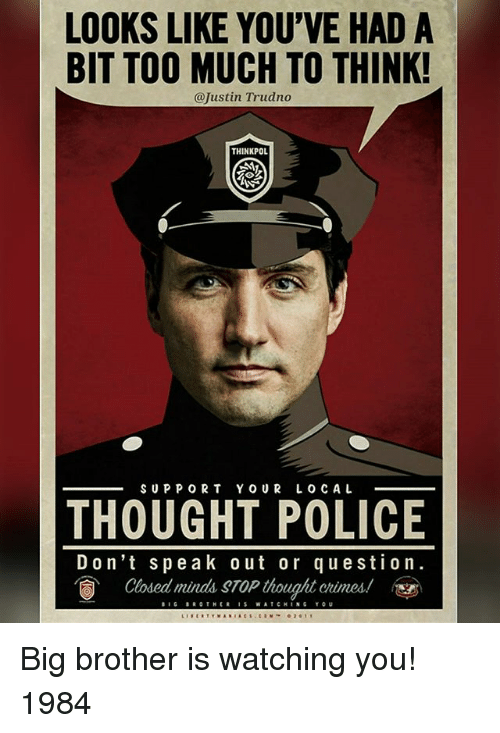
It’s almost refreshing to find so many people realizing just how dystopian the Trudeau government’s proposed Online Harms Act could be if implemented in its current form. Ezra Levant on Twit-, er, I mean “X” points out to Jordan Peterson just how the system would be set up to suppress and punish online speech the complainant didn’t like:

For years the Canadian Human Rights Act (CHRA) has banned discrimination against people based on “gender identity or expression”. You of course have never discriminated against anyone.

But this new bill adds s. 13 to the CHRA, which now says that mere speech is considered discrimination if it is “likely to foment detestation or vilification of an individual or group”.

So now, if someone watches one of your YouTube videos or reads on of your tweets about, say, transgender athletes changing in the girls change room, and as a result is “likely” to have hard feelings towards trans people, that’s hate speech.

That’s step 1. Here’s step 2.

Any member of the public (including non-citizens) can lodge a complaint against you to the Canadian Human Rights Tribunal — an activist quasi-judicial tribunal run by non-judges, appointed by Trudeau.

They can get up to $20,000 per complaint from you — and they don’t have to be the “victim”. (There doesn’t have to be a victim at all — remember it’s a future crime. They only have to show that your tweet or video is “likely to” (i.e might) cause one person to have hard feelings about another person. $20,000 that you’d pay the complainant — plus $50,000 in fines to the government.

Per complaint.

So there could be a new complaint for every tweet you make. Every video. And the complainants can be professional busybodies and activists — they don’t have to be a “victim”.

Why wouldn’t woke activists literally file a CHRA complaint after every single thing you do or say on social media? It’s free. There’s no limit. Even if you “win”, you lose — the process is the punishment. And of course, they’re going to win. This will become an industry — to enrich woke grifters and destroy you financially.

But here’s the truly amazing part: the complainants can keep their identity a secret from you. Secret testimony from secret witnesses — who get paid up to $20,000 to take a run at you.

That’s how they’re going to come for you — and for us at @RebelNewsOnline

In the National Post, Jamie Sarkonak considers how the “digital safety” provisions of the Online Harms Act might be implemented:

The law would put “harmful content” in scope of government regulation by way of “arm’s-length” agencies. Targeted content would include media depicting sexual abuse (and understandably so), as well as any content that “expresses detestation or vilification” of any group considered by human rights legislation to be vulnerable and is likely to foment such feelings given the context of the communication (less understandably so). Identity-based protections are inherently more subjective, and they aren’t afforded equally to everyone: human rights law tends not to protect white people, for example.

The bill states that expressing disdain and dislike — or discrediting, humiliating, hurting or offending — is not necessarily hateful for the purposes of online regulation. Critically, it’s silent on what does make speech cross over into unacceptable territory. There’s no hard threshold.

At what point does discussion of the fact that most gender-diverse sex offenders in federal prison are transwomen (male) cross over into “harmful content” territory? Or the fact that Black people make up only three per cent of the population, but represent six per cent of all accused in criminal courts? Or the fact Eritreans in Canada, half of whom arrived after 2016, and who come from a country known for not cooperating with the deportation process, are increasingly rioting in response to politics back home?

Regardless, the promotion of actual hate propaganda, and the incitement of genocide, are already crimes in Canada, so the very worst speech was already covered by the current law and enforceable by the police. If the Liberals wanted better work done on these fronts, they could have simply raised police funding and staffed the courts with judges, as manpower is a primary constraint in dealing justice.

Instead of maintaining the systems that exist, the online harms law would add proactive measures in the form of a new bureaucracy to ensure that everything from genocide advocacy to the insulting recitation of upsetting facts don’t get out of hand. These will work in tandem with reactive measures: the crime of “hate crime” will be enforceable at criminal law, and the Canadian Human Rights Commission will be empowered to adjudicate cases of rights-violating content online.

February 29, 2024

The incredibly harmful Online Harms Act

Michael Geist thinks a substantial part of the Online Harms Act should be removed:

Having a spent virtually the entire day yesterday talking with media and colleagues about Bill C-63, one thing has become increasingly clear: the Criminal Code and Human Rights Act provisions found in the Online Harms Act should be removed. In my initial post on the bill, I identified the provisions as one of three red flags, warning that they “feature penalties that go as high as life in prison and open the door to a tidal wave of hate speech related complaints”. There is no obvious need or rationale for penalties of life in prison for offences motivated by hatred, nor the need to weaponize human rights complaints by reviving Human Rights Act provisions on communication of hate speech. As more Canadians review the bill, there is a real risk that these provisions will overwhelm the Online Harms Act and become a primary area of focus despite not being central to the law’s core objective of mitigating harms on Internet platforms.

Indeed, these concerns are already attracting media coverage and were raised yesterday in columns and commentary from Andrew Coyne and Professor Richard Moon, who I think rightly describes the core provisions of the Online Harms Act as “sensible and workable” but notes that these other provisions are troubling. Bill C-63 is effectively four bills in one: (1) the Online Harms Act, which forms the bulk of the bill and is focused on the duties of Internet platforms as they respond to seven identified harms, (2) the expansion of mandatory child pornography reporting requirements to include those platforms, (3) the Criminal Code provisions, which opens the door to life in prison for committing offences that are motivated by hatred of certain groups, and (4) the changes to the Canadian Human Rights Act, which restores Section 13 involving communicating hate speech through the Internet as a discriminatory practice. The difference between the first two and the latter two is obvious: the first two are focused on the obligations of Internet platforms in addressing online harms, while the latter two have nothing directly to do with Internet platforms at all.

The Criminal Code and Human Rights Act changes originate in Bill C-36, which was introduced in 2021 on the very last sitting day of the Parliamentary session. The bill died on the order paper with an election call several weeks later and did not form a core part of either the online harms consultation or the 2022 expert panel on online harms. These provisions simply don’t fit within a legislative initiative that is premised on promoting online safety by ensuring that social media services are transparent and accountable with respect to online harms. Further, both raise legitimate concerns regarding criminal penalties and misuse of the human rights complaint system.

At the National Post, Carson Jerema points out that under the Online Harms Act, the truth is no defence:

As much as the Liberals want everyone to believe that their proposed online harms act is focused almost exclusively on protecting children from predators, and that, as Justice Minister Arif Virani said, “It does not undermine freedom of speech,” that simply isn’t true. While the legislation, tabled Monday, could have been much worse — it mercifully avoids regulating “misinformation” — it opens up new avenues to censor political speech.

Under the bill, condemning the Hamas massacre of 1,200 people on Oct. 7, could, under some circumstances, be considered “hate speech”, and therefore subject to a human rights complaint with up to $50,000 in penalties. As part of the new rules designed to protect Canadians from “online harms”, the bill would reinstate Section 13 of the Canadian Human Rights Act, the hate speech provision repealed under the Harper government.

The new version is more tightly defined than the original, but contains the same fatal flaws, specifically that truth is no defence and that what counts as hate speech remains highly subjective.

Under the new Section 13: “it is a discriminatory practice to communicate or cause to be communicated hate speech by means of the Internet or any other means of telecommunication in a context in which the hate speech is likely to foment detestation or vilification of an individual or group of individuals on the basis of a prohibited ground of discrimination”.

It is distressingly easy to imagine scenarios where everyday political speech finds itself under the purview of the Canadian Human Rights Commission. Criticizing Hamas and the murderous ideology that motivates it could, to some, be seen as “likely to foment detestation or vilification” against a group, especially if the condemnation of Hamas notes that Palestinians generally support the terrorist group or that Hamas is driven by religious fanaticism.

Dan Knight calls it “the sequel no one asked for”:

Morning my fellow Canadians and lets break into the liberals latest sequel with Bill C-63 the its failed predecessor, Bill C-36, which is a sequel nobody asked for in the saga of online hate speech legislation. We’re witnessing a government’s second attempt to police what you can say online.

Now, the Liberal government in Canada initially put forward Bill C-36. This bill aimed to tackle extreme forms of hate speech online. It sought to bring back a version of a section that was repealed from the Canadian Human Rights Act in 2013. Why was it repealed, you might ask? Because critics argued it violated free speech rights. But here we are, years later, with the Liberals trying to reintroduce similar measures under the guise of combating hate speech. Under the proposed changes, folks could be fined up to $20,000 if found guilty of hate speech that identifies a victim. But here’s the kicker: the operators of social media platforms, the big tech giants, are initially left out of the equation. Instead, the focus is on individuals and website operators. Now, the government says it plans to hold consultations over how to make these social media platforms more accountable. But the details are hazy, and the timeline is, well, as clear as mud.

The justice minister of Canada has framed these amendments as a way to protect the vulnerable and hold individuals accountable for spreading hatred online. But let’s be clear: there’s a thin line between protecting individuals and infringing upon free speech. And that line is looking blurrier by the day in Canada. Critics, including the Opposition Conservatives, have voiced concerns that these measures could curb freedom of speech and be difficult to enforce. They argue that the government’s efforts might not just be about protecting citizens but could veer into controlling what can and cannot be said online. And when the government starts deciding what constitutes “hate speech”, you have to start wondering: Who gets to draw that line? And based on what standards?

And, just when you thought it couldn’t get any more Orwellian, enter the pièce de résistance: the Digital Safety Commission of Canada. Because, clearly, what’s missing in the fight against “hate speech” is another layer of bureaucracy, right? Another set of initials to add to the alphabet soup of governmental oversight. So, here’s the deal: this newly minted commission, with its CEO and officers — oh, you better believe there will be officers — is tasked with overseeing the online speech of millions. And let me tell you, nothing says “independent” like a government-appointed body policing what you can and cannot say on the internet. I can just imagine the job postings: Now Hiring: Online Expression Regulators, proficiency in silencing dissent highly valued.

February 27, 2024

Thank goodness we don’t get all the CBC we pay for!

Filed under: Cancon, Government, Media, Politics — Tags: , , , , , — Nicholas @ 05:00

In the dim, dark recesses of history … say twenty-five years ago … the CBC was what the government still seems to believe it is: a credible, trusted source of news and entertainment. In truth, it was never as loved as some might claim, as it had a deep bias in favour of Quebec and Ontario issues and tended to only occasionally remember the rest of the country. The federal government has been subsidizing the CBC, yet the network’s audience has shrunk to the point that it’s rare to encounter anyone who consumes very much of the programming on offer. Part of that is just the sheer variety of other options available to Canadians and part of it is the CBC’s sour, toxic, hectoring tone when lecturing about “the current thing”. Far from being a major player in upholding Canadian culture, the CBC is clearly one of the major factors that are destroying it:

… looking at the viewer and listener stats for the CBC, our national behemoth, which eats up $1.5 billion annually, and which amounts to 50% of the media dollars spent, is equally disheartening. The state spends another $600 million supporting once-successful media because “internet”. CBC television is watched by 3.9% of Canadians and only 0.8% watch CBC News. Again, half of all media dollars, half. Half is spent engaging less than 4% of Canadians. CBC radio is considered reasonably good, and is listened to by 10%, despite its vindictive calling out of anyone who disagrees with their hard socialist stance. As to other mainstream media, propped up by government via hundred of millions, it is still shedding staff and readers in double digits.

Despite every conceivable advantage, advertising on the CBC dropped 20% during the pandemic. In fact, they are so disliked that CBC is hiring “close protection security” for the next two years. They are so disliked, they have turned off commenting on their various programs. They are so disliked that there is a brand of coffee called “Defund the CBC”. This isn’t passive ignoring, this is active dislike to the point of needing bodyguards.

Why? Because our media show us to ourselves as racist, stupid, sexist, stupid, stupid and more stupid. And while they are at it, shallow and violent. That is the real reason, and the only reason CanCon is dying. They hate us. Why? The only people who have thrived during the past twenty years in Canada when private and public wealth doubled then doubled again, are the ones who live off the government, whether through mandated consulting in the enviro and other business, or direct granting or though quasi-private-sector jobs that are heavily subsidized. Public Private Partnerships have to be the most fiendish way to flat out loot the public ever been invented. Or straight up public sector jobs which are among the most lushly funded and unionized in the known universe, the number of which have grown 400% in the last ten years. Do or did you get six weeks of paid holiday a year?

And do they hate us, in fact correcting us is how they get the grants, the jobs, the subsidy. Everything they do is meant to fix us deplorable Canadians.

Sit at a downtown Toronto dinner party as I have, with say, the head of CBC drama, as I have and listen to just how much they hate the rest of Canada. Why? They hate the rest of Canada because they feel guilty. They know they are cheating and they know they are stealing. I tell ya, I needed close protection security — this woman was terrifying. “Sit Down While I’m Talking to You“, she roared at me.

February 25, 2024

Canadian publishing “has been decimated since Ottawa took an active interest in it and while federal policies haven’t been the whole problem, they’ve been vigorous contributors”

In the latest SHuSH newsletter, Ken Whyte contrasts the wholesome intentions of the Canadian federal government on cultural issues with the gruesome reality over which they’ve presided:

Even James Moore, [Liberal cabinet minister Melanie] Joly’s Conservative predecessor in the heritage department, applauded her initiative as good and necessary, although he warned it wouldn’t be easy. Moore had wanted to do the job himself, but his boss, Stephen Harper, didn’t want to waste political capital on fights with the arts community. He told Moore his job in the heritage department was to sit on the lid.

Joly got off to a promising start, only to have her entire initiative scuppered by a rump of reactionary Quebec cultural commentators outraged at her willingness to deal with a global platform like Netflix without imposing on it the same Canadian content rules that Ottawa has traditionally applied to radio and television networks. Liberal governments live and die by their support in Quebec and can’t afford to be offside with its cultural community. Joly was shuffled down the hall to the ministry of tourism.

She has been succeeded by four Liberal heritage ministers in five years: Pablo Rodriquez, Steven Guilbeault, Pablo Rodriguez II, and Pascale St-Onge. Each has been from Quebec and each has been paid upwards of $250,000 a year to do nothing but sit on the lid.

The system remains broken. We’ve discussed many times here how federal support was supposed to foster a Canadian-owned book publishing sector yet led instead to one in which Canadian-owned publishers represent less than 5 percent of book sales in Canada. The industry has been decimated since Ottawa took an active interest in it and while federal policies haven’t been the whole problem, they’ve been vigorous contributors.

Canada’s flagship cultural institution, the CBC, is floundering. It spends the biggest chunk of its budget on its English-language television service, which has seen its share of prime-time viewing drop from 7.6 percent to 4.4 percent since 2018. In other words, CBC TV has dropped almost 40 percent of its audience since the Trudeau government topped up its budget by $150 million back in the Joly era. If Pierre Poilievre gets elected and is serious about doing the CBC harm, as he’s threatened since winning the Conservative leadership two years ago, his best move would be to give it another $150 million.

The Canadian magazine industry is kaput. Despite prodigious spending to prop up legacy newspaper companies, the number of jobs in Canadian journalism continues to plummet. The Canadian feature film industry has been moribund for the last decade. Private broadcast radio and television are in decline. There are more jobs in Canadian film and TV, but only because our cheap dollar and generous public subsidies have convinced US and international creators to outsource production work up here. It’s certainly not because we’re producing good Canadian shows.

[…]

When the Trudeau government was elected in 2015, it posed as a saviour of the arts after years of Harper’s neglect and budget cuts. It did spend on arts and culture during the pandemic — it spent on everything during the pandemic — but it will be leaving the cultural sector in worse shape than it found it, presuming the Trudeau Liberals are voted out in 2025. By the government’s own projections, Heritage Canada will spend $1.5 billion in 2025-26, exactly what it spent in Harper’s last year, when the population of Canada was 10 percent smaller than it is now.

That might have been enough money if the Liberals had cleaned up the system. Instead, they’ve passed legislation that promises more breakage than ever. Rather than accept Joly’s challenge and update arts-and-culture funding and regulations for the twenty-first century, the Trudeau government did the opposite. Cheered on by the regressive lobby in Quebec, it passed an online news act (C-18) and an online streaming act (C-11) that apply old-fashioned protectionist policies to the whole damn Internet.

This comes on top of the Liberals transforming major cultural entities, including the CBC and our main granting bodies, The Canada Council and the Canada Book Fund, into Quebec vote-farming operations. The CBC spends $99.5 per capita on its French-language services (there are 8.2 million Franco-Canadians) and $38 per capita on Canadians who speak English as the first official language. The Canada Council spends $16 per capita in Quebec; it spends $10.50 per capita in the rest of Canada. The Canada Book Fund distributes $2 per capita in Quebec compared to $.50 per capita in the rest of the country. Even if one believes that a minority language is due more consideration than a majority language, these numbers are ridiculous. They’re not supporting a language group; they’re protecting the Liberal party.

February 10, 2024

Fake artists? On my Spotify feed? Say it ain’t so …

Filed under: Business, Media — Tags: , — Nicholas @ 05:00

Ted Gioia rounds up a bunch of smaller music-related items in this post, including more evidence that Spotify continues to use fake artists:

I’ve griped a lot about the fake artists problem at Spotify. It’s like a stone in my shoe, and just gets worse and worse.

I’m especially alarmed by those strange playlists — filled with mysterious artists who may not really exist, or almost identical tracks circulating under dozens of different names.

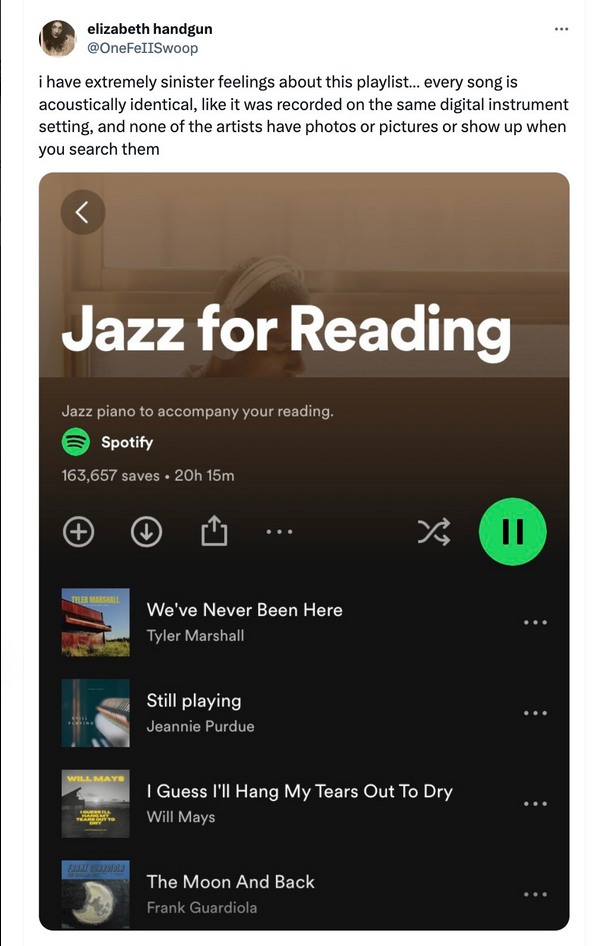
Here’s a new example — a 20 hour playlist called “Jazz for Reading”.

I’m supposed to be a jazz expert. So why haven’t I heard of these artists? And why is it so hard to find photos of these musicians online?

I listened to twenty different tracks. There’s some superficial variety in the music, but each track I heard had the same piano tone and touch. Even the reverb sounds the same.

But the musicians are allegedly different.

Of course, I haven’t listened to the whole playlist. It feels endless, lasting almost an entire day!

But what’s going on here?

In other fields, this would be a scandal.

Imagine if you ran a medical office with physicians’ names on the door, but patients never got a glimpse of a flesh-and-blood doctor. Or a law firm gave out legal advice, but no lawyers were ever seen in the office.

Maybe Spotify will allay my concerns by putting these “artists” on tour. Why do I doubt that will happen?

February 8, 2024

North American newspaper economics

Tim Worstall discusses some of the issues ailing Canadian and American newspapers which are not easily solvable (government subsidies, as attempted in Canada, just turn the recipients into an underpaid PR branch of the governing party … not a good look in a democratic nation):

“Newseum newspaper headlines” by m01229 is licensed under CC BY 2.0 .

So, as a little corrective, a quick jaunt through what actually ails American journalism. The concentration is upon the big newspapers because that’s where the problem is worst. The conclusion is that it’s gonna get a lot, lot, lot, worse too. Because the industry is facing a base economic problem that it’s not willing to actually face up to. Or, at least, all the journalists writing about it aren’t — there’s the occasional sign that some of the business side of the equation grasp it.

[…]

Before Y2K American newspapers were segmented along geographic lines. The size of the country, the lack of a long distance passenger railroad network, meant that this was just so. If you’re printing a daily paper then you’ve got to deliver it daily. On the day it’s meant to refer to as well. If Chicago is 1,100 miles (no, I’ve not looked it up but that’s within an order of magnitude of being right, which is better than many newspapers manage with numbers) from New Orleans then the same newspaper is going to find it difficult to print and deliver to both markets. Add in the fact that trains take a week to traverse that distance, passenger trains – anyone who has ever travelled Amtrak will say it feels that long at least — included.

You could not and therefore did not have national newspaper (USA Today, with satellite printing plants, was an attempt to deal with this and slightly earlier than our cut off date but doesn’t change the basic story) distributions. What you had was a series of local and regional monopolies. Each one centred on a large population centre and serving the area around it that could be reasonably reached by truck overnight. Chicago and Cincinnati, not 1,100 miles away from each other, did have entirely different newspapers.

By contrast, and just as an example, the British newspaper market was national from pre-WWI. We simply did have overnight at worst passenger rail that covered the country. Partly it’s a much, much, smaller place, partly the passenger rail system was just different. So, printing overnight (and some maintained separate Scottish editions and plants) meant that those papers that came off the press in London at 8pm were on sale in Glasgow at 8 am, those that came off the press in London at 4 am were on sale in London at 8am. That’s not exact but it’s a good enough pencil sketch.

Cincinnati newspaper(s) served Cincinnati. Chicago, Chicago and New Orleans the area of New Orleans. There simply wasn’t a “national press” in the US in that British sense.

OK. But this also meant that American newspapers were much more like a monopoly in their local area than anything else. Network effects still exist even before computer networks after all. The most important of which was the classifieds.

As with Facebook, we’re all on Facebook because everyone else is on Facebook. So, if we’re to join a social network we’re going to be on Facebook where everyone else is — except those three hipsters who are where it isn’t cool yet. This applies to classifieds sections. Folk advertise in the one with the most readers, the widest market. Readers buy the one with the most ads in it, the widest market. You advertise the bronzed baby shoes, unused, where there are the most people looking for bronzed baby shoes, unused.

So, the dominant paper will suck up the classifieds in any particular market. Classifieds, fairly obviously back in the days of prams, cheap used cars, waiters’ jobs and so on being geographically based.

No, this is important. A useful pencil sketch of American newspaper revenues pre-Y2K was that subscriptions produced some one third of revenues. They also, around and about, covered print costs and distribution. They were, roughly you understand, about a face wash in fact.

Display ads produced another one third and classifieds the final one third. Classifieds were also wildly profitable — no expensive journalists to pay, no bureaux, just a few women waiting to get married on the end of the phone line.

February 2, 2024

QotD: Financial bubbles

Filed under: Economics, History, Quotations, Technology — Tags: , , , — Nicholas @ 01:00

That financial markets sometimes go off on one has been noted for centuries now. Dutch Tulips, the South Sea Bubble, Dotcom and more recently Bitcoin have all shown that the lust for easy speculation profits can lead to, well, to financial excess at minimum. Those with an orderly cast of mind like to point out that all of this is waste. If instead the truly wise and clever people – after we’ve installed them in government or at least the bureaucracy – could apportion society’s assets very much better. You know, truly invest in the diversity advisers civilisation so badly needs.

The thing is, economists often disagree at this point. Sure, financial bubbles, they occur. Sure, there’s waste in them. But perhaps the very bubble itself is an either useful or necessary part of the process.

Necessary in that perhaps it needs a mania to get some new technology over the finish line. I tend to think it’s not going to happen with Tesla but it did with Railway Mania. Without speculators searching for easy money the network never would have been built out. Without Dotcom Amazon probably wouldn’t have got funded through the decade it was scratching a living.

It’s also possible that it’s just useful. For the overbuilding in the mania might then leave assets that are repurposed to get other technologies over that finish line into general use. Global Crossing lost a fortune – no, really billions – on building out fibre optic cabling to girdle the world. Which was, after the bankruptcy, bought up by the Googles and the like to carry all this web and video stuff. It’s arguably true that without the previous overinvestment we’d simply never have developed – or perhaps not for decades – such resource and bandwidth-hungry hogs.

Tim Worstall, “Cloud Rendering – The Latest Proof That Investment Bubbles Actually Work”, Continental Telegraph, 2019-03-17.

January 23, 2024

Sometimes the deciding factor in success really is just “dumb luck”

Filed under: Books, Media — Tags: , , — Nicholas @ 03:00

Virginia Postrel doesn’t disparage the role of quality, but as one of her own experiences clearly illustrates, you can’t discount the sometimes disproportionate role of luck:

AI is coming along … but it ain’t there yet.
Image by Virginia Postrel, using Ideogram.ai

No amount of planning beats dumb luck. That saying, which I will always associate with the gubernatorial campaign of South Carolina’s James Edwards1, occurred to me while reading Damon Linker’s latest Substack post. His praise of Martin Gurri’s book The Revolt of the Public reminded me of a corollary: When it comes to books, no amount of intellectual quality is enough without dumb luck. It’s an absolute miracle Martin Gurri’s book, which is excellent, has become well known.

I know because I gave The Revolt of the Public a crucial boost — and I only discovered it because my own book, The Power of Glamour, was languishing in obscurity (where it remains). Frustrated with the lack of attention, I spent an evening Googling “visual persuasion” in hopes of finding smart people who might find my analysis interesting enough to mention to others. My search led me to a 2010 article for the Army War College, co-authored by Gurri, titled “Our Visual Persuasion Gap“. I sent him a note: “I read your article on the visual persuasion gap and would like to send you a copy of my book. Could you send me your mailing address? Are you related to Adam?” He responded that he preferred to think that Adam was related to him — his son — and that we should trade books.

To review: 1) I wrote a book related to visual persuasion. 2) Martin Gurri has a long-standing interest in visual persuasion. 3) Gurri wrote a book relevant to visual persuasion. 4) I knew Gurri’s son. And neither of us knew the other existed.

I was impressed by his book. So when Cato Unbound invited me to write an essay on “visual persuasion and politics” and to suggest people to write responses, I recommended him. That was in July 2014. The symposium came and went. Still The Revolt of the Public didn’t break into public consciousness, even among the kind of people who read Cato Institute publications.

Then, in December 2015, I wrote a Bloomberg Opinion column on The Revolt of the Public. I’m sure many people read the column, but only one of them mattered to the book’s public profile: Arnold Kling, who wrote about it on his blog in January 2016. The timing was perfect and Arnold proved an effective, well-connected evangelist. In 2018 Stripe Press issued an updated version in print, audio, and electronic formats. Since then, the book has become a touchstone for understanding the rise of populist movements. Agree or disagree, people trying to figure out our political moment have to consider Gurri’s analysis — which they know about because of dumb luck.


    1. Edwards, an oral surgeon by profession, was a Republican party activist who ran in the 1974 primary against the much better known General William Westmoreland. Then, as now, South Carolina did not have party registration. Any voter could vote in either primary, but if you voted in one party’s primary you couldn’t vote in the other party’s runoff election. The Democratic primary was where the action was that year, with multiple candidates. Only the most stalwart Republicans voted in that primary and they preferred the guy they knew to the celebrity general. The Democratic primary went to a runoff between young post-Watergate reformer Charles “Pug” Ravenel and old guard Congressman William Jennings Bryan Dorn. Ravenel, a South Carolina native who’d only recently moved from New York, won the runoff, only to have his candidacy disqualified for not meeting residency requirements. The Democrats put Dorn in his place, but he was a weakened candidate and voters went with Edwards, making him the first Republican governor since Reconstruction. Edwards used to have a sign with this motto, or some version of it, on his desk.

January 19, 2024

Music journalism, RIP

Filed under: Business, Media — Tags: , , , — Nicholas @ 05:00

Ted Gioia explains why music journalism is collapsing and who committed the murder:

Just a few weeks ago, Bandcamp laid off 58 (out of 120) employees — including about “half of its core editorial staff“.

And Bandcamp was considered a more profitable, stable employer than most media outlets. The parent company before the recent sale (to Songtradr) and subsequent layoffs, Epic Games, will generate almost a billion dollars in income this year — but they clearly don’t want to waste that cash on music journalism.

Why is everybody hating on music writers?

Many people assume it’s just the same story as elsewhere in legacy media. And I’ve written about that myself — predicting that 2024 will see more implosions of this sort.

Sure, that’s part of the story.

But there’s a larger problem with the music economy that nobody wants to talk about. The layoffs aren’t just happening among lowly record reviewers — but everywhere in the music business.

Meanwhile, almost every music streaming platform is trying to force through price increases (as predicted here). This is an admission that they don’t expect much growth from new users — so they need to squeeze old ones as hard as possible.

As you can see, the problem is more than just music writers — something is rotten at a deeper level.

What’s the real cause of the crisis? Let’s examine it, step by step:

  1. The dominant music companies decided that they could live comfortably off old music and passive listeners. Launching new artists was too hard — much better to keep playing the old songs over and over.
  2. So major labels (and investment groups) started investing huge sums into acquiring old song publishing catalogs.
  3. Meanwhile streaming platforms encouraged passive listening — so people don’t even know the names of songs or artists.
  4. The ideal situation was switching listeners to AI-generated tracks, which could be owned by the streaming platform — so no royalties are ever paid to musicians.
  5. These strategies have worked. Streaming fans don’t pay much attention to new music anymore.

I’ve warned about each of these — but we are now seeing the long-term results.

This is why Pitchfork is in deep trouble. If people don’t listen to new music, they don’t need music reviews.

And they don’t need interviews with rising stars. Or best of year lists. Or any of the other things music writers do for their readers.

But this problem will get much, much worse. Even the people who made these decisions will suffer — because living in the past is never a smart business strategy.

If these execs were albums, they’d deserve a zero score on the Pitchfork scale.

QotD: How the internet changed the dating world

Filed under: Health, Media, Quotations, Technology, USA — Tags: , , , — Nicholas @ 01:00

Before online dating, the available dating pool was just the people in your town: the people at your local bar, at your church, at your office, etc. Online dating expanded that pool by orders of magnitude, which changed how we think about dating in general. Which makes sense: When people have millions of people to choose from instead of hundreds, lots of things start to change.

First, preferences get formalized. 90% of swipes by women are for men over 6’0, which does not reflect the importance women place on height in the real world. This also makes sense: When people only spend 2-3 seconds per app, superficial qualities rise to the top.

Online dating also changes our expectations regarding relationships more broadly. Since we now date outside of our circles, it’s now easier to cheat or ghost or just otherwise leave if the relationship isn’t perfect. Why stay in a non-perfect relationship, the logic goes, when there are millions of other potential matches at your fingertips?

This perhaps explains why breakup rates for couples who meet via apps are twice as high as couples who meet via friends and family. Friends and family not only refer better, but there’s a higher incentive to stay in a relationship when there’s the social encouragement of family and friends.

What online dating does is enable hypergamy at a massive scale. Hypergamy is the tendency for women to want to date the best men, no matter where the woman is in the hierarchy. Men also want top women of course, but they’re on average willing to settle for any woman, at least for casual sex, whereas women are much more discerning, which makes sense given women have a much bigger risk than men when it comes to sex, since women can get pregnant. It’s basic biology: Sperm is cheap, eggs are expensive.

What we see with algorithmic online dating isn’t a mechanism to assign the perfect match to each person of the opposite sex. Instead, we’ve created a machine where the top 20% of men mate with many different partners and the top 80% of women try to get the top 20% of men to date and ultimately marry them (and not just have sex with them).

Algorithmic dating conflates two markets, the market for relationships and the market for sex under the ambiguous banner of “dating”. What happens then is men on apps try to match with as many women as possible and women try to match with a small selection of higher status men. That leads to the situation where a dating app’s natural equilibrium is that a narrow set of men have “dating” access to almost all the women if they choose to, and they typically do. Even with the best intentions, these men aren’t interested in long-term relationships with all these women. The more options a man has, the less inclined he is to want one single relationship.

To put some numbers on it:

  • Men swipe right on 60% of women, women swipe right on 4.5% of men.
  • The bottom 80% of men are competing for the bottom 22% of women and the top 78% of women are competing for the top 20% of men.
  • A guy with average attractiveness can only expect to be liked by slightly less than 1% of females. This means one “like” for every 115 women that see his profile.

And if the majority of women are vying for these men and ignoring the rest of them, that creates both a large amount of lonely women and men. Indeed: 28% of men under 30 have reported no sex in the last year, which has doubled in the last decade. This celibacy level is reminiscent of feudal medieval times. In the old days these men would have become monks or cannon fodder for the war. But these days, they just watch porn and play video games (don’t give up, guys!).

Erik Torenberg, “The Matching Problem in Dating”, Erik Torenberg, 2023-09-23.

January 13, 2024

The ongoing encrapification of the internet – “When I hear the phrase ‘web platform’ I reach for my gun”

Filed under: Business, Economics, History, Media, Technology — Tags: , , — Nicholas @ 05:00

Ted Gioia used to be a techno-optimist, eagerly looking forward to ever-improving online experiences. He, like so many of us, has reluctantly come to the conclusion that those hopes are fading out of sight:

I once loved new technology. I lived in the heart of Silicon Valley for 25 years, and was bursting with enthusiasm for its free-wheeling mission to transform the world — and have some fun along the way.

When the Worldwide Web made its debut, I thought I’d found Nirvana. It was like tech was turning everything into a game.

But look at me now. When I hear the phrase “web platform” I reach for my gun.

Where did it go wrong? Did I just get old and embittered? Or did something change in the tech world?

Let me share a story that might help us decide.

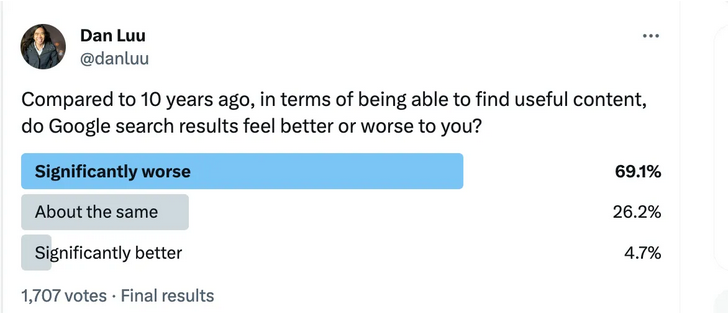
What kind of business spends hundreds of billions over 10 years — just to get worse?

This is a story about the birth of the search engine.

There were no commercial search engines back in 1993. But a Stanford student named David Filo compiled a list of his 200 favorite websites.

His buddy Jerry Yang helped turn this into an online list. They called it “Jerry’s Guide to the Worldwide Web”. Filo and Yang added new websites every day to their list — and classified them according to categories.

This turned into Yahoo.

Here’s my favorite part of the story: These two students didn’t even know they were running a business.

They did it for fun. They did it out of love. They did it because it was cool. “We wanted to avoid doing our dissertations”, Yang later explained.

But a venture capitalist named Mike Moritz heard about Filo and Yang, and tracked them down. The founders of Yahoo were living in total squalor in a trailer littered with stale food and pizza boxes, strewed alongside sleeping bags and overheating computers. A phone rang constantly — but nobody bothered to pick it up.

Moritz was dismayed by this dorm-room-gone-wild ambiance, but he was impressed with the students’ web searching technology. So he asked them the obvious question: How much did they plan to charge users?

Filo and Yang had no answer for this. They wanted to give their tech away for free.

Yahoo wasn’t even selling ads back then. It wasn’t tracking users and selling their private information. It didn’t even have a bank account.

But it was a community and had millions of users.

That was a word you heard frequently in Silicon Valley in the early days. People didn’t build web platforms — they formed online communities.

It was a FUN community. People enjoyed being a member. Even the absurd name Yahoo was part of the game — although early investors hated it.

Yang’s job title was “Chief Yahoo”. Filo’s position was “Cheap Yahoo”.

Investors always hate those kinds of things.

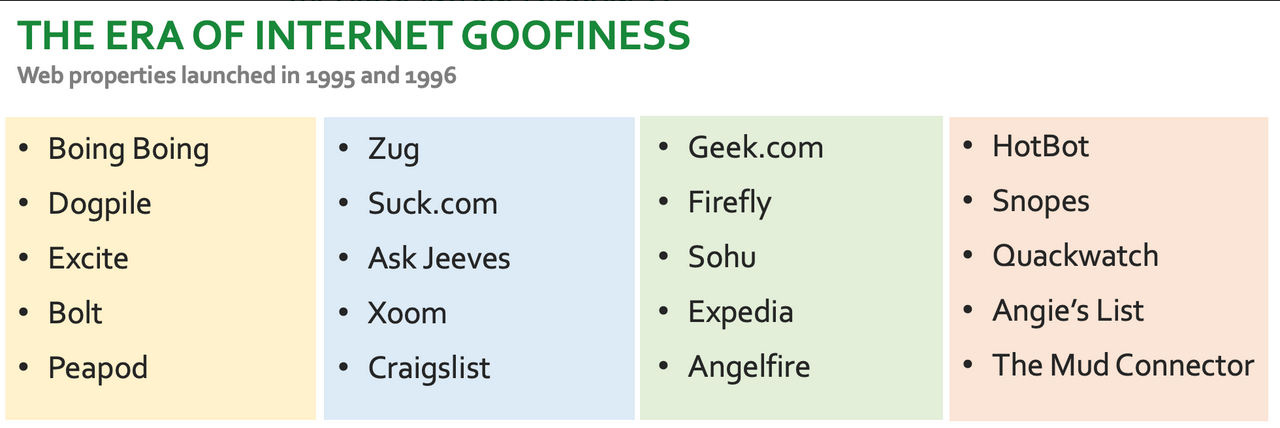
But a new web business, back then, was expected to have a silly name. Here are some of the websites launched in the mid-1990s.

Moritz wanted to turn Yahoo into a business. And the founders realized that their fun community was growing faster than they could handle in their down-and-out trailer. So they sold out 25% of Yahoo for $1 million.

January 12, 2024

The rise of “anti-woke” comedy

Filed under: Media, Politics — Tags: , , — Nicholas @ 03:00

Andrew Doyle suggests we should stop calling Ricky Gervais “anti-woke”:

Stop me if you’ve heard this one. A man’s wife divorces him and shacks up with his boss. Soon after, a friend suggests that he should remarry. “What for?” he asks. “Are you looking for a wife as well?”

It may not be the funniest joke, but that’s because it’s an anecdote from The Lives of the Caesars by the Ancient Roman historian Suetonius. The comedian in this case was a senator called Aelius Lamia whose wife had left him for the Emperor Domitian. For making this casual quip, Domitian had Lamia put to death. Now that’s a bad review.

It might be worth keeping this anecdote in mind when the usual debates flare up about whether comedy “goes too far”. The notion of people being offended by jokes is as old as comedy itself, and often people react angrily if humour isn’t to their taste. The current manifestation of this age-old debate takes the form of a simple dichotomy: “woke comedy” versus “anti-woke comedy”.

Already we are in treacherous waters. It is very unwise to define whole genres by terms that have no settled definitions. The actor Kathy Burke believes that “woke” simply refers to people who are neither racist nor homophobic, which would surely mean that the overwhelming majority of us would happily embrace the term. But for those who have been on the receiving end of the bullying, harassment and intimidation by activists who self-define as “woke”, it is clear this issue is not so straightforward.

Over the past few years, we have seen the emergence of a new comedy movement, one branded by commentators as “anti-woke”, that seeks to push back against the orthodoxies of our time. Its closest historical precedent is the “alternative” comedians of the Eighties, who also took aim at establishment norms and were often similarly blunt in their approach. The key difference today is that there is no broad agreement about where the power in society lies, and so while “anti-woke” comedians see themselves as anti-establishment, their critics insist that the opposite is true.

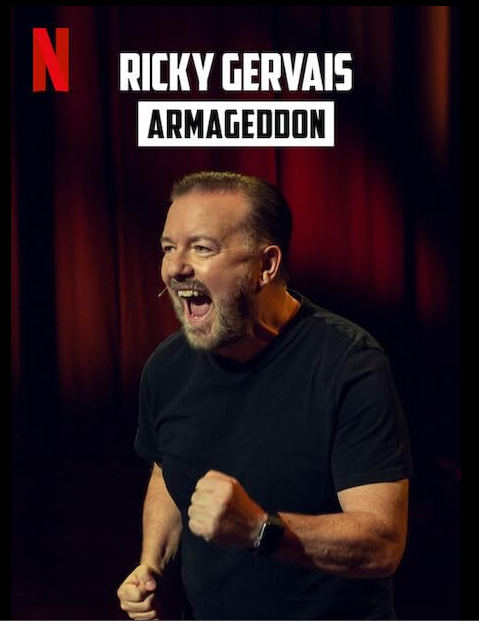
Consider the example of Ricky Gervais, whose new Netflix stand-up special Armageddon has sparked this most recent round of discussions about the supposed red lines in comedy. Some have accused Gervais of taking a reactionary stance, most notably because of jokes relating to migrants and disabled children. Gervais has been branded an “anti-woke” comedian, but I doubt very much that he would see it in such reductive terms. Anyone familiar with his work will know that he has always lampooned closed systems of thought, and it just so happens that “wokeness” currently represents the dominant incarnation. There was a time when many of Gervais’s critics were perfectly happy to see him take a wrecking ball to the certainties of religious faith. It would appear they take a different view when it’s their own belief system taking a battering.

December 17, 2023

Justapedia, the latest “new Wikipedia

Filed under: Media, Technology — Tags: , , , — Nicholas @ 03:00

At Quillette, Shuichi Tezuka introduces the latest challenger to the ever-more-biased free online encyclopedia Wikipedia:

In the aftermath of Elon Musk’s purchase of Twitter late last year, the journalist Jon Levine asked him: “I wonder how much Wikipedia would cost?” Musk had recently complained that Wikipedia has a “non-trivial left-wing bias”, and a few months earlier, had commented that “Wikipedia is losing its objectivity.” But regardless of whether Musk would have liked to purchase the site, there never was any real possibility of that happening, as stated by Wikipedia’s symbolic leader Jimmy Wales: “Wikipedia is not for sale”.

Following this exchange, there were several discussions on Twitter (as it was called at the time) about whether Musk might create his own alternative to Wikipedia. In the end Musk did not make such an attempt, but approximately eight months later, someone else did.

This new online encyclopedia, known as Justapedia, is the latest in a long series of attempts by various individuals to create a competitor to Wikipedia. So far all previous attempts have either been unsuccessful, or morphed into something so unlike Wikipedia that they could no longer be considered a competitor. However, one thing working in Justapedia’s favor is that the need for such a competitor is stronger now than it has been in past years, due to several recent controversies revolving around the manipulation and/or politicization of Wikipedia, along with a widespread perception that Wikipedia has not done enough to prevent this type of problem.

Justapedia was recently publicized by Larry Sanger, who co-founded Wikipedia alongside Wales, during an interview with Russell Brand and in a subsequent blog post. This article will present a more detailed examination of Justapedia’s background, including some of the recent controversies that demonstrate why it is needed, as well as the poor record of success other Wikipedia alternatives have had up to this point. Will Justapedia succeed where most other Wikipedia competitors have failed?

December 15, 2023

Bill S-210 “isn’t just a slippery slope, it is an avalanche”

You sometimes get the impression that the only person in Ottawa who actually pays attention to online privacy issues is Michael Geist:

“2017 Freedom of Expression Awards” by Elina Kansikas for Index on Censorship https://flic.kr/p/Uvmaie (CC BY-SA 2.0)

After years of battles over Bills C-11 and C-18, few Canadians will have the appetite for yet another troubling Internet bill. But given a bill that envisions government-backed censorship, mandates age verification to use search engines or social media sites, and creates a framework for court-ordered website blocking, there is a need to pay attention. Bill S-210, or the Protecting Young Persons from Exposure to Pornography Act, was passed by the Senate in April after Senators were reluctant to reject a bill framed as protecting children from online harm. The same scenario appears to be playing out in the House of Commons, where yesterday a majority of the House voted for the bill at second reading, sending it to the Public Safety committee for review. The bill, which is the brainchild of Senator Julie Miville-Duchêne, is not a government bill. In fact, government ministers voted against it. Instead, the bill is backed by the Conservatives, Bloc and NDP with a smattering of votes from backbench Liberal MPs. Canadians can be forgiven for being confused that after months of championing Internet freedoms, raising fears of censorship, and expressing concern about CRTC overregulation of the Internet, Conservative MPs were quick to call out those who opposed the bill (the House sponsor is Conservative MP Karen Vecchio).

I appeared before the Senate committee that studied the bill in February 2022, where I argued that “by bringing together website blocking, face recognition technologies, and stunning overbreadth that would capture numerous mainstream services, the bill isn’t just a slippery slope, it is an avalanche”. As I did then, I should preface criticism of the bill by making it clear that underage access to inappropriate content is indeed a legitimate concern. I think the best way to deal with the issue includes education, digital skills, and parental oversight of Internet use including the use of personal filters or blocking tools if desired. Moreover, if there are Canadian-based sites that are violating the law in terms of the content they host, they should absolutely face investigation and potential charges.

However, Bill S-210 goes well beyond personal choices to limit underage access to sexually explicit material on Canadian sites. Instead, it envisions government-enforced global website liability for failure to block underage access, backed by website blocking and mandated age verification systems that are likely to include face recognition technologies. The government establishes this regulatory framework and is likely to task the CRTC with providing the necessary administration. While there are surely good intentions with the bill, the risks and potential harms it poses are significant.

The basic framework of Bill S-210 is that it creates an offence for any organization making available sexually explicit material to anyone under the age of 18 for commercial purposes. The penalty for doing so is $250,000 for the first offence and up to $500,000 for any subsequent offences. Organizations (broadly defined under the Criminal Code) can rely on three potential defences:

  1. The organization instituted a “prescribed age-verification method” to limit access. It would be up to the government to determine what methods qualify with due regard for reliability and privacy. There is a major global business of vendors that sell these technologies and who are vocal proponents of this kind of legislation.
  2. The organization can make the case that there is “legitimate purpose related to science, medicine, education or the arts”.
  3. The organization took steps required to limit access after having received a notification from the enforcement agency (likely the CRTC).

The enforcement of the bill is left to the designated regulatory agency, which can issue notifications of violations to websites and services. Those notices can include the steps the agency wants followed to bring the site into compliance. This literally means the government via its regulatory agency will dictate to sites how they must interact with users to ensure no underage access. If the site fails to act as instructed within 20 days, the regulator can apply for a court order mandating that Canadian ISPs block the site from their subscribers. The regulator would be required to identify which ISPs are subject to the blocking order.

« Newer PostsOlder Posts »

Powered by WordPress