
Forgotten Weapons
Published 15 Mar 2023In 1865, brothers William and George Miller of Meriden CT patented a system to convert percussion muskets to use the new rimfire ammunition that was becoming available. Between 1865 and 1867, the local Meridan Manufacturing Company converted 2,000 surplus US Model 1861 muskets (mostly made by Parker & Snow) to the Miller system, using .58 rimfire ammunition. The US military tested one of these conversions in 1867, and found it to suffer from some gas leakage and about a 3% misfire rate. There was no further Army interest, although the New York and Maryland state militias did both purchase small numbers of the guns.
(more…)
June 29, 2023
Miller’s Musket Conversion: The Trapdoor We Have At Home
Comments Off on Miller’s Musket Conversion: The Trapdoor We Have At Home
June 26, 2023
DShK-38: The Soviet Monster .50 Cal HMG
Forgotten Weapons
Published 10 Mar 2023In 1925 the USSR began a program to develop a heavy machine gun for antiaircraft use. After some initial experimentation with a converted Dreyse machine gun, they brought in Degtyarev to scale up his recently-adopted light machine gun to the task. Degtyarev’s first design was ready in 1930, and underwent testing until 1933. It was designated the DK, and used a 30-round drum magazine. This contributed to an unacceptably low rate of fire (~360 rpm), and the feed system was replaced by an ingenious development of Georgiy Shpagin to use belts instead.
Fitted with the Shpagin feed system, the DShK finished field testing in 1939 and was adopted as the model 1938. Production was slow, and the guns were not used on anything like the scale of American M2 use during World War Two. A total of about 9000 were in use at the end of the war, although the subsequent update to the DshKM (aka DShK 38/46) pattern would see it fitted to many armored vehicles, and total production eventually topped one million.
This example is a very early production 1939 example, most likely a Finnish capture piece from the Winter War or Continuation War.
(more…)
Comments Off on DShK-38: The Soviet Monster .50 Cal HMG
June 23, 2023
FG-42: Perhaps the Most Impressive WW2 Shoulder Rifle
Forgotten Weapons
Published 8 Mar 2023The first production version of the FG42 used a fantastically complex milled receiver and a distinctive sharply swept-back pistol grip. A contract to make 5,000 of them was awarded to Krieghoff in late spring of 1943, but by the fall its replacement was already well into development. The milled receiver used a lot of high-nickel steel which was becoming difficult for Germany to acquire, and it was decided to develop a stamped receiver to ease production obstacles. Ultimately only about 2,000 of the early Type E FG42 rifles were actually made, and only 12 or 15 are registered in the US. They are a remarkably advanced rifle, and extremely interesting.
(more…)
Comments Off on FG-42: Perhaps the Most Impressive WW2 Shoulder Rifle
June 20, 2023
MAC Operational Briefcase (the H&K We Have at Home)
Forgotten Weapons
Published 3 Mar 2023Note: This video was proactively deleted to avoid a channel strike when YouTube went nuts over suppressors. I am reposting it today since they have rolled back those policy changes.
If a swanky outfit like H&K can make an “Operational Briefcase” with a submachine gun hidden inside it, then you can bet Military Armament Corporation is going to do the same! MAC made these briefcases for both the M10 and M11 submachine guns, and made a shortened suppressor for the M10 pattern guns to fit. They actually have a distinct advantage over the H&K type by fitting a gun with suppressor — but a distinct disadvantage in the exposed trigger bar on the bottom of the case, with no safety device of any kind.
Note: Possession of the briefcase with a semiauto MAC-type pistol that fits it is potentially seen as constructive possession of an AOW. A machine gun can be legally fitted in the case, but a semiauto pistol in it is considered a disguised weapon, and thus requires registration as an AOW.
(more…)
Comments Off on MAC Operational Briefcase (the H&K We Have at Home)
June 17, 2023
Webley-Fosbery Automatic Revolver
Forgotten Weapons
Published 9 Jun 2013This is an update to our previous video on the Webley-Fosbery, which was taken on a low-res camera in a dark room — hopefully this will be a big improvement!
The Webley-Fosbery was an early automatic handgun based on a revolver design. The top half of the frame slides back under recoil, recocking the hammer and indexing to the next round in the cylinder. They were made commercially in both .38 and .455 calibers, with the .455 version attracting interest from British Army officers into World War I.
Comments Off on Webley-Fosbery Automatic Revolver
June 11, 2023
Ask Ian: Why So Few Reproduction Historic Guns?
Forgotten Weapons
Published 22 Feb 2023From Paul on Patreon:
“I’ve always thought there were a lot of older guns that deserve to be reproduced, many of which could be really simple to manufacture. PSA is planning the release of their StG44 repro which is exciting. But why don’t we see this sort of thing more often. I suppose not everyone in the firearms community is going to want this sort of thing, but I think there are a lot of guns that would sell well enough to justify their reproduction.”Fundamentally, we don’t see more reproduction firearms because they are actually a lot harder and more expensive to make than people would think, and the market for them is smaller than people would think. Re-engineering old firearms for new production is a really substantial project, and the original data required rarely exists. The guns must be cheap enough and reliable enough to attract modern buyers, which will often require compromises on authenticity — which immediately reduces the already-small pool of potential buyers.
(more…)
Comments Off on Ask Ian: Why So Few Reproduction Historic Guns?
June 2, 2023
Germany Adopts the PPSh in 9mm: the MP-41(r)
Forgotten Weapons
Published 20 Feb 2023During World War Two, both German and Russian soldiers often thought that the other side’s weapons were better than their own. In particular, both sides often preferred their opponents’ SMGs. In late 1941, a group of German officers formally requested that Germany simply copy and produce the PPSh-41. This led to the HWA formally studying the question of PPSh-41 vs MP-40 … and they found that the German gun was better, but the Russian magazine was better.
Naturally, as a result of this finding, the German military chose to convert captured Russian PPSh-41s to use MP-40 magazines. The conversion used standard MP40 magazines, and required magazine well adapters and new 9mm barrels. Some 10,000 such conversions were made in total. Some used cast magwell adapters and some were stamped, and the barrels were made from standard MP40 barrels turned down to fit PPSh trunnions.
The standard 7.62mm PPSh-41 in German service was designated MP-717(r), while the ones changed to 9x19mm like this were designated MP-41(r). Many thanks to Limex for giving me access to film this one for you!
(more…)
Comments Off on Germany Adopts the PPSh in 9mm: the MP-41(r)
May 30, 2023
M1886 Lebel Rifle at the Range
Forgotten Weapons
Published 17 Mar 2013The French M1886 Lebel was the first smallbore smokeless powder rifle adopted by a major military, and was a game changer in the European arms race in the 1880s. It wasn’t an outstanding design in many ways (like the slow-loading tube magazine and requirement to use a screwdriver to remove the bolt), but its 8mm smokeless cartridge jumped France to the front of the technological race regardless. Today, we’re taking one out to the range to see how it shoots.
Comments Off on M1886 Lebel Rifle at the Range
May 27, 2023
Lee 1875 Vertical Action Carbine
Forgotten Weapons
Published 21 Aug 2014The 1875 Lee Vertical Action was an experimental rifle designed by James Paris Lee (of Lee Enfield and Lee Navy fame) as an idea to increase the rate of fire from single-shot Army rifles. He touted an impressive 30 rounds in 45 seconds with the rifle, thanks to several design elements that combined to make a very fast manual of arms. In total only 143 of these guns were made at Springfield Armory, and this example is the only known carbine variant.
(more…)
Comments Off on Lee 1875 Vertical Action Carbine
May 24, 2023
Darne Model 1933: An Economic & Modular Interwar MG
Forgotten Weapons
Published 15 Feb 2023The Darne company was one of relatively few private arms manufacturers in France, best known for shotguns. During World War One they got into the machine gun trade, making licensed Lewis guns for the French air service. After making a few thousand of those, Regis Darne designed his own belt-fed machine gun in 1917. A large order was placed by the French military, but it was cancelled before production began because of the end of the war.
Darne continued to develop this design in the 1920s, while also producing sporting arms to keep the business running. The gun was intended mostly as an aircraft gun, but designed in a rather modular fashion, easily made into both magazine-fed and belt-fed infantry versions as well as downing, wing, and observer aerial models. It was actually bought by the French Air Force, as well as several other countries during the inter-war period.
The example we are looking at today is an infantry configuration, with a bipod and light-profile barrel. It is chambered for the French 7.5x54mm cartridge, and is officially the Model 1933 (one of the last iterations made).
(more…)
Comments Off on Darne Model 1933: An Economic & Modular Interwar MG
May 20, 2023
Cobray Terminator 12ga Shotgun
Forgotten Weapons
Published 3 Feb 2015The Cobray Terminator is an unusual — and unusually impractical — single-shot 12 gauge shotgun. It uses a sort of open bolt system in which the barrel is under spring pressure, and slams backwards into a fixed firing pin when the trigger is pulled. Only about 1500 of these were made before they were discontinued due to poor sales (not because of ATF intervention, as some people believe).
(more…)
Comments Off on Cobray Terminator 12ga Shotgun
May 17, 2023
Swiss LMG25 light machine gun
Forgotten Weapons
Published 23 Jul 2012This week, we will be featuring all Swiss weapons here at Forgotten Weapons. Kind of like Shark Week, but more land-locked. We’ll kick off today with a video showing you around a Swiss LMG-25 light machine gun we found for sale at Cornet & Company in Brussels (a better gun shop than any I’ve found here in the US, I must say). Like pretty much all Swiss arms, it’s a gorgeous example of precision machining — and like pretty much all Swiss arms it was too expensive for anyone else to adopt. On this, as with other Swiss weapons I’ve handled, you can just feel the quality in how smoothly the moving parts operate.
In case you’re wondering, this LMG25 is live and fully functional, and priced at 1950 Euros (about $2800) — mere pocket change compared to machine gun prices here. It’s not too difficult to get the permit to own it in Belgium, but sadly there is no legal way to bring it into the US.
(more…)
Comments Off on Swiss LMG25 light machine gun
May 14, 2023
Garbage data informs the Canadian government’s approach to gun control issues
In The Line, Tim Thurley points out the (totally expected) bias of the data being considered by the federal government:
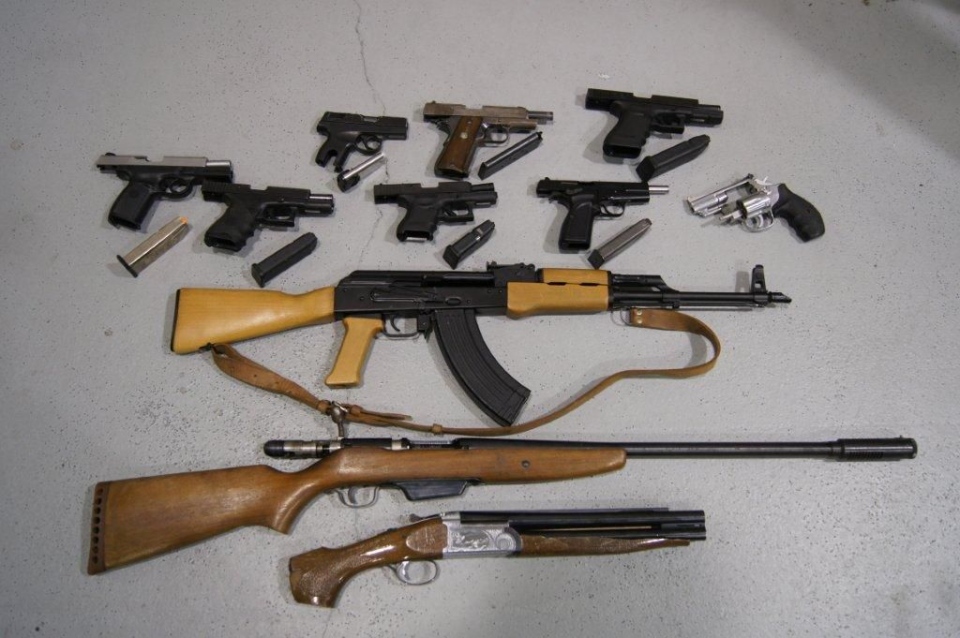
A selection of weapons (mostly restricted or prohibited in the hands of most Canadians) displayed by Toronto police after confiscation.
Screencap from a CTV News report in 2018.
The Mass Casualty Commission’s firearm recommendations were, rightly, overlooked in the initial phase after the report’s release. They have become relevant these past weeks as gun control groups, the NDP, the Bloc, and the Liberals used them to advocate for sweeping changes to Bill C-21, the government’s controversial gun-control proposals. The Liberals have thus far declined to adopt the MCC’s recommendations, at least in whole, and that’s encouraging. Our lawmakers should be careful. The Mass Casualty Commission’s concluding recommendations on guns and homicide share a problem common to any data analysis. If you use the wrong data, you get a bad output.
Or, to be blunt: garbage in, garbage out.
R. Blake Brown, a professor who contributed a commissioned report to the MCC, suggested that the MCC got all the best research together and simply found the arguments made by gun control groups to be more convincing.
He’s wrong. While the MCC could have been a completely neutral panel objectively weighing the evidence before it, the nakedly selective choice of data inputs and slanted interpretation meant that no unbiased outcome was possible. Indeed, the MCC inputs seem heavily weighed to advance a pro-control agenda, and do so in such an obvious way that the resulting flaws should be immediately clear to those with even a passing knowledge of the study of firearms and firearm homicide.
[…]
Dr. Caillin Langmann is a well-known name in Canadian firearms research, and by far the most prolific author using rigorous statistical methods to examine the effects of gun control on Canadian firearm mortality. No serious analysis of Canadian firearm mortality is possible without his work, and yet his work does not appear on its own and is not cited in the Negin Report. Indeed, his and other critical research does not seem to have informed the final Commission report or recommendations at all.
I asked Dr. Langmann about his exclusion. He told me he offered to appear to present his research but the Commission declined.
It may not be a coincidence that the exclusion of Langmann and other researchers without explicit gun-control agendas was due to the fact — the fact — that the Canadian and comparable research substantively contradicts the Negin Report and the MCC recommendations on firearms. An examination of already-implemented Canadian gun laws including various factors such as prohibition of “paramilitary style” rifles and magazine capacity restrictions all found no impact on mass shootings or mass homicide overall in Canada or on associated fatalities. Instead, mass homicide by both firearm and non-firearm causes gradually declined on its own. The lack of association between gun control and decreased mortality is replicated multiple times in Canadian research.
Guess what? It is also replicated in a detailed statistical analysis of Australian data not mentioned by the Negin Report.
The core research inputs to the Mass Casualty Commission were commissioned from parties with well-established and acknowledged positions on firearms. Written by literal gun control advocates without substantial input from other sources, the contrary research is either ignored or not treated with due academic respect. This damages the credibility of the Commission findings, giving the perception that they were gathering conclusions in search of evidence.
Again, it must be made clear that this wouldn’t have been a problem if the MCC had treated the Negin Report as just one part of the firearm policy research puzzle. It was their failure to do so and the consequent lack of neutrality, lack of engagement with solid research, and complete disregard for engagement with different academic perspectives despite obvious relevant expertise, that taints the Mass Casualty Commission firearm recommendations and severely limits any useful policy conclusions we can gather from their report.
Comments Off on Garbage data informs the Canadian government’s approach to gun control issues
Arming God’s Battalions: a Papal States Rolling Block
Forgotten Weapons
Published 13 Feb 2023The Remington Rolling Block was a very popular rifle in the 1860s and 1870s, and probably would have been a better choice than the Trapdoor Springfield for the US military. But among the nations that did adopt is were the Papal States. While Vatican City is a tiny sovereign enclave today in Rome, in the 1800s the Pope directly controlled a much larger area, roughly the size of Switzerland early in the 1800s.
Three different models of Rolling Block were adopted by the Papal States in the effort to rebuild their military after a serious defeat in 1860 — rifles, carbines, and musketoons — the latter being what we have today. All three were made by the Nagant Brothers in Liege and can be identified by the Papal crest (the crossed keys of St Peter) on the top of the barrel. Westley Richards in the UK also produced 5,000 rolling block rifles, but these had serious quality problems.
The Nagant Brothers rifles began to arrive in the fall of 1868. They saw service for only a few years, as the departure of French forces in the fall of 1870 (to take part in the Franco-Prussian War) allowed the Italian Army to seize Vatican City without much difficulty. A few survived in the hands of the Pope’s personal guard, but most of these rolling blocks were taken into Italian Army service. They would serve until being replaced by Vetterli rifles, and were eventually sent to Ethiopia as military aid to Emperor Menelik II in the 1880s.
(more…)
Comments Off on Arming God’s Battalions: a Papal States Rolling Block
May 11, 2023
Bechowiec: Polish Teenager Makes a Resistance SMG
Forgotten Weapons
Published 25 Jan 2023The Bechowiec (or Beha) is a fascinating SMG produced in small numbers in southern Poland under German occupation during World War Two. It was made for use by the Bataliony Chłopskie (Peasant Battalions) by a young man named Henryk Strąpoć.
Henryk built his first (quite illegal) gun at the age of 15 in 1937, and was promptly arrested for it. He avoided prison only on account of being a minor, and promised not to do it again. Well, at least he promised not to get caught again — he built three more guns (two semiauto pistols and a revolver) by the time Germany invaded Poland in 1939. During the occupation he joined the the resistance and set to work doing what he must have fantasized about; building clandestine small arms.
Being more or less familiar with pistols but having never handled a submachine gun, he made some creative design choices. His SMG is basically a scaled-up Ruby-type action — chambered for 9x19mm with a simple blowback slide, it is hammer fired from a closed bolt. He designed a complex but effective selective-fire trigger system, complete with a correct auto sear. The first gun was ready in the spring of 1943, and he had a makeshift production going by early 1944. A total of 11 of the guns were made by July 1944, some in 9mm (using bored-out WW1 Mauser barrels) and some in 7.62x25mm Tokarev (using Mosin Nagant barrels).
Only one example survives today, and it is housed in the Polish Army Museum (and sadly, deactivated). Many thanks to the Museum for giving me access to film it for you! Check them out at: http://www.muzeumwp.pl/?language=EN
(more…)
Comments Off on Bechowiec: Polish Teenager Makes a Resistance SMG


