
The Tank Museum
Published 5 May 2023Welcome to this episode of Anti-Tank Chats. Today, Chris will be discussing the variations of a lesser-known weapon, the British Army’s B.A.T. (Battalion Anti-Tank Gun).
(more…)
August 10, 2023
MOBAT, WOMBAT, CONBAT | Anti-Tank Chats
Comments Off on MOBAT, WOMBAT, CONBAT | Anti-Tank Chats
August 9, 2023
Russian 1895 Nagant Revolver
Forgotten Weapons
Published 20 May 2013One of the mechanically interesting guns that is really widely available in the US for a great price (or was until very recently, it seems) is the Russian M1895 Nagant revolver. It was adopted by the Imperial Russian government in 1895 (replacing the Smith & Wesson No.3 as service revolver), and would serve all the way through World War II in the hands of the Red Army.
As with its other standard-issue arms, the Russian government intended to manufacture the M1895 revolvers domestically. However, when the Nagant was officially adopted the major Russian arsenals were already working at capacity to make the relatively new M1891 rifle, so the first 20,000 revolvers were made by Nagant in Liege, Belgium. In 1898 space had been freed up to start production at the Tula arsenal, where they would be made until 1945 (Ishevsk put the Nagant revolver into production as well during WWII).
The common version available in the US today is a 7-shot, double action revolver chambered for 7.62x38mm. That cartridge is a very long case with the bullet sunk down well below the case mouth. The cylinder of the Nagant cams forward upon firing, allowing the case mount to protrude into the barrel and seal the cylinder gap, thus increasing muzzle velocity slightly. This also allows the Nagant to be used effectively with a suppressor, unlike almost all other revolvers (in which gas leaking from the cylinder gap defeats the purpose of a suppressor).
The Nagant’s 7.62x38mm cartridge pushes a 108 grain jacketed flat-nose projectile at approximately 850 fps (I believe a lighter 85-grain load was also used by the military later, but I haven’t fired any of it), which puts it roughly between .32 ACP and .32-20 ballistics. Not a hand cannon by any stretch, but fairly typical for the era (the 8mm Nambu and 8mm French revolver cartridges were both pretty similar in performance to the 7.62mm Nagant).
As far as being a shooter, the Nagant is mediocre, but reliable. The grip and sights are acceptable (but not great), and the cylinder loads and unloads one round at a time. The low pressure round doesn’t stick in the cylinder, at least. The worst part for a recreational shooter is the trigger, which is very heavy in double action. Single action is also heavy, but very crisp. Recoil is mild, and not uncomfortable at all. The design was simple and effective, and really a good fit for the Red Army and WWII fighting conditions.
Comments Off on Russian 1895 Nagant Revolver
August 6, 2023
Chaffee Reece Model 1882: A Good Idea on Paper …
Forgotten Weapons
Published 29 Aug 2017Patented in 1879 by Reuben Chaffee and General James Reece, the Chaffee-Reece rifle is an excellent example of how an idea that seems good on paper can easily become untenable in a fielded rifle. The main design premise of the rifle was to have a tubular magazine in the buttstock which held the cartridges out of contact with each other, as opposed to being pressed together by a magazine spring as in a conventional design. This would notionally prevent any possibility of recoil or other forces causing the bullet of our round to impact the primer of another and cause a detonation in the magazine.
In initial testing by the Army in 1882, the prototypes were appealing, and a field trial of 750 rifles was requested. Chaffee and Reece were unable to find a commercial manufacturer willing to take on the production (except Colt, which offered to make just 200, and at the cost of $150 etc), and they ultimately turned to the government-operated Springfield Arsenal to build the guns. A total of 753 rifles were made by Springfield in 1883 and 1884 (interestingly, not serial numbered) and delivered for testing.
That testing went quite badly. The magazine was a very complex system, using two sets of basically reciprocating racks to shuttle cartridges up the magazine as the bolt was cycled, without allowing them to contact each other. It proved very prone to jamming and breakage, and was both extremely difficult to keep clean and very susceptible to, as they would have called it at the time, “derangement”. It was handily beaten by the Winchester Hotchkiss 1885 pattern rifles (among others) in field trials, and that was the end of its potential for adoption. The rifles were eventually sold as surplus, and bought by the Bannerman company, where they remained in stock and available for purchase until at least 1907.
(more…)
Comments Off on Chaffee Reece Model 1882: A Good Idea on Paper …
August 3, 2023
Webley 1905
Forgotten Weapons
Published 12 Jun 2016William Whiting was an engineer who spent his entire adult career with the Webley company, and was responsible for all of their in-house self-loading pistol designs. This work initially focused on a behemoth of a pistol, the Model 1904 intended for military contracts. The gun proved insufficiently attractive to the British military though, leaving Webley with a large R&D outlay with nothing to show for it. The solution was to scale the system way down and look to the civilian market with a pocket automatic in .32ACP.
The first version of this commercial pocket pistol was this model 1905 design. It proved to be a popular concept, and the gun was revised to address a few shortcomings and opportunities for simplification. In its final version, the Model 1908 would prove to be Webley’s best-selling automatic pistol, and it is still a relatively easy gun to find today. However, its 1905 predecessor is far scarcer, and it is interesting to examine the changes made between the two models.
Comments Off on Webley 1905
July 31, 2023
RSC 1917: France’s WW1 Semiauto Rifle
Forgotten Weapons
Published 17 Nov 2015Did you know that the French Army issued more than 80,000 semiautomatic rifles during WWI? They had been experimenting with a great many semiauto designs before the war, and in 1916 finalized a design for a rotating bolt, long stroke gas piston rifle (with more than few similarities to the M1 Garand, actually) which would see field service beginning in 1917. An improved version was put into production in 1918, but too late to see any significant combat use.
The RSC 1917 was not a perfect design, but it was good enough and the only true semiauto infantry rifle fielded by anyone in significant numbers during the war.
Comments Off on RSC 1917: France’s WW1 Semiauto Rifle
July 28, 2023
Merwin & Hulbert Revolvers
Forgotten Weapons
Published 21 Aug 2015The Merwin & Hulbert company was a short-lived firearms manufacturing partnership between designer Joseph Merwin and the Hulbert brothers as financiers. Merwin wanted to design a particularly strong and high-quality revolver, and he succeeded — his guns are arguably some of the best revolvers of the frontier era. The company made a wide variety of designs, but in this video I will be sticking to just the Frontier and Pocket Army models. Of particular note is the very clever unloading mechanism!
Comments Off on Merwin & Hulbert Revolvers
July 24, 2023
Lorenzoni Repeating Flintlock Pistol
Forgotten Weapons
Published 13 Aug 2012Today we have one of the oldest guns we’ve looked at, a Lorenzoni repeating flintlock pistol. The system was designed by an Italian gunmaker in Florence name Michele Lorenzoni. They were made in very small numbers, and the workmanship is stunning, especially considering that they were first manufactured in the 1680s.
Instead of using a revolving cylinder pre-loaded with multiple shots, the Lorenzoni system utilizes powder and ball magazines in the frame of the gun and a rotating breechblock much like a powder throw tool used today for reloading ammunition.
(more…)
Comments Off on Lorenzoni Repeating Flintlock Pistol
July 21, 2023
Country music world (and legacy media) convulsed by country song that isn’t woke
There’s been a lot of wailing by the usual suspects about a recent video released by Jason Aldean for his song “Try That in a Small Town”, alleging all sorts of horrible things including promotion of lynching, outright racism, and inciting violence:
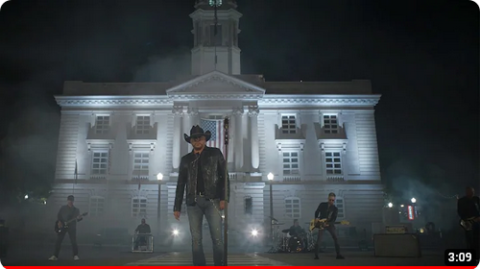
… writer Zachary Faria notes that the left is rabidly protective of Black Lives Matter. In fact, they’re so protective of it that they’ll take issue with criticism of literally anything that ever even happened at a Black Lives Matter protest.
Entire neighborhoods were burned to the ground? A small price to pay for social justice, at least in their minds.
So the idea of people standing up to them — warning them to try that in a small town — is despicable.
Remember that these are the same people who continue to accuse Kyle Rittenhouse of murder despite having been acquitted of the crime. These are the same people who call the kid a racist despite him having shot three white dudes. They say he acted unprovoked despite one trying to take his gun from him, another hitting him in the head with a blunt object, and a third literally pointing a gun at him.
Through it all, they act like Rittenhouse should have just rolled over and allowed his murder to happen, all because the cause of Black Lives Matter cannot be criticized.
Where Aldean sinned is because he, too, thinks ill of the riots that engulfed every major city in this nation.
He’s harkening back to a time when communities were full of people protecting one another. That’s a very good thing, and I’m someone who would love to see that happen again.
Instead, the people claiming that Aldean’s song is about lynching are telling on themselves.
There doesn’t seem to be any part of the song that says a thing about black people or anything like that. In fact, most of the people involved in the riots, at least as I saw them, seemed to be white. But the fact that this is where the leftists went tells us plenty. It tells us they think the only kind of person who would cross that line is a black person.
Comments Off on Country music world (and legacy media) convulsed by country song that isn’t woke
Belgian Gendarmerie FAL w/ DSA Receiver
Forgotten Weapons
Published 24 Apr 2023A few months ago FN America was able to import 400 parts sets from original Belgian Gendarmerie FAL rifles. I got one of them, and had it completed by DSA. They made receivers with Gendarmerie markings, as well as the barrel and other parts not included with the kit. So today we’ll take a look at the finished rifle and the work that went into completing it.
(more…)
Comments Off on Belgian Gendarmerie FAL w/ DSA Receiver
July 18, 2023
Manville Gas Gun
Forgotten Weapons
Published 29 Oct 2012Charles Manville developed this weapon in the 1930s as a riot control tool, and they were built in 12ga, 25mm, and 37mm. We should point out that the 12ga version was for tear gas rounds only (like today’s 12ga flare launchers) and not safe to use with high-pressure ammunition. Anyway, it was intended for use by prison guards and riot police, offering a much greater ammunition capacity than any other contemporary launcher.
During World War II, Manville tried to sell the military on a high-pressure version to fire 37mm explosive rounds, but was unsuccessful. Instead, the Manville company spent the was making parts for the Oerlikon 20mm AA guns, and the tooling for the gas launcher was all destroyed.
(more…)
Comments Off on Manville Gas Gun
July 14, 2023
MG-3: Germany Modernizes the Classic MG-42
Forgotten Weapons
Published 7 Apr 2023When the Bundeswehr was formed, it chose to simply continue using the MG42 as its standard GPMG. This was initially done by converting older MG42s to 7.62x51mm NATO as the MG1 (adopted in 1958), but progressed to production of a brand new version of the gun by Rheinmetall (adopted in 1968). The MG3 included improvements to the belt feed system, added integral antiaircraft sights, and allowed a rate of fire between 700 and 1300 rpm depending on the choice in bolt, buffer and booster. It was the standard German MG until finally being replaced by the MG5 in 2012 — and it is/was in use by nearly 4 dozen other countries as well. Today we are going to compare this transferrable, C&R MG3 to an original MG42 to see the improvements that were made.
(more…)
Comments Off on MG-3: Germany Modernizes the Classic MG-42
July 10, 2023
Remington-Lee Model 1885
Forgotten Weapons
Published 5 Sept 2015The model of 1885 (a modern collector designation; Remington called these the “Remington Magazine Rifle” and did not differentiate between the different versions) was the final iteration of James Paris Lee’s bolt action rifle made by Remington. It incorporated a number of improvements from the earlier versions, including a relocated bolt handle, improved bolt head, and a magazine that could now hold cartridges securely without the use of a sliding catch at the nose.
These rifles were made in .45-70 caliber for US use and in .43 Spanish for export sales. The US Navy purchased most of the .45-70 guns that were made, and this particular rifle is one of those Navy guns. By the time these rifles were actually in production, Great Britain had also decided to adopt the Lee system in 1888, which would go through several iterations and ultimately become the iconic SMLE that would be the mainstay of British infantry during the First World War.
(more…)
Comments Off on Remington-Lee Model 1885
July 7, 2023
Prototype Silenced Sten for Paratroops: the Mk4(S)
Forgotten Weapons
Published 24 Mar 2023The Sten Mk4 was developed experimentally in 1943 for use by British paratroops. It used a remarkably awful folding stock along with a shortened receiver and barrel to make a very compact package — albeit one that must have been very uncomfortable to shoot. Several different models were made, with this one being a Mk4a(S) — the suppressed version. The suppressor is essentially the same system as used on the MkII(S), but with the rear endcap and barrel being permanently fixed to the receiver of the gun.
Only a small number (allegedly 2000) Mk4 guns were originally made, and they were used for testing only — never for field service. Virtually all were destroyed after the war, with a few remaining examples in British museums. This one was amnesty registered in 1968, and is almost certainly the only one in private hands in the US (and possible the only privately owned one in the world).
The Mk4 was dropped in favor of the Mk5, which was a much more effective gun and was used by the British paratroopers in the late days of World War Two.
(more…)
Comments Off on Prototype Silenced Sten for Paratroops: the Mk4(S)
July 4, 2023
From the American Revolution: Short Land Pattern Brown Bess
Forgotten Weapons
Published 22 Mar 2023The standard weapon of the British Army in the American War of Independence was the “Brown Bess”, and today we are looking at a 1769 Short Land Pattern example of the Brown Bess. This was a smoothbore .75 caliber, 10.2 pound flintlock with a whopping 42 inch barrel (the Long Land Pattern it superseded had a 46” barrel). Adopted in 1769, it would serve as the British standard infantry arm until 1797.
This particular example was issued to the 53rd Infantry Regiment, otherwise known as the King’s Shropshire Light Infantry. This regiment arrived in Quebec City in May 1776 and participated in the fighting at Ticonderoga and Saratoga, where several of its companies were captured and interned until the end of the war.
(more…)
Comments Off on From the American Revolution: Short Land Pattern Brown Bess
June 30, 2023
QotD: Changing patterns of combat on the Great Plains
The popular image of the Great Plains Native America is unarmored, of course, but that image fundamentally formed in the late 19th century, when – after centuries of the development of gunpowder weapons – everyone was unarmored. A longer view shows that Plains Native Americans were perfectly capable of both developing or adopting defensive measures which worked. And to get a full sense of that, we need to outline the major phases of the changing warfare on the Great Plains.
F.R. Secoy (op. cit.) essentially breaks warfare into four phases, which happen at different times in different places, based on if they have horses, guns, both or neither. Because horses entered the Great Plains from the South (via the Spanish) but firearms entered the region from the North (via the British and the French, the Spanish having prohibited gun-sales to Native Americans) and spread out from there, for a brief time many of these systems were active on the Plains at once, as both guns and horses diffused through the region.
In the pre-horse, pre-gun phase (described by McGinnis as well, op. cit., 8-9), battles consisted of long-range missile exchanges between warriors who stood behind large shields which protected their whole bodies. Native American warriors in this system also wore armor, heavy leather coats, laminated in multiple layers using thick hide with glue that was sometimes mixed with sand or gravel (one more example of how “leather armor” is almost always hardened leather armor, not modern clothing-leather). Some of this armor may have been effectively quilted leather as well. Clearly, there was plenty of concern about survivability here.
Both guns and horses were apt to disrupt this system. Horses allowed attackers to rapidly close the distance between the two opposing lines of shield-protected foot-missile-warriors, causing the shield-lines to drop away (though smaller shields, used on horseback to ward off arrows and blows were still used) and for both sides to seek instead the mobility of mounted fighting. That was not the end for armor though, because contact with a supply of horses meant contact with the Spanish, and the Apache at least swiftly adopted some of the Spanish methods of making leather “buff coats” into their own armor tradition and copied the shape and pattern of the buff coat itself (while often still making the material using their own tradition). As Secoy notes (op. cit., 18-20), our sources are quite clear that these forms of armor (both original and Spanish-influenced Native armors) were quite effective at resisting the archery fire that dominated both the pre-horse, pre-gun system and the post-horse, pre-gun system.
Meanwhile on the Northern Plains, while the horse had not yet arrived, firearms had, and these had different effects. Firearms spelled the end of the armor once they became common enough, since there was no protection which could resist bullets; some shield use survived, since arrows remained fairly common as well. But this didn’t lead to suicidal warfare. Instead – as had happened on the East Coast as well, Native Americans adapted their warfare to the increased lethality of firearms (on this, note Lee, op. cit. above) by mostly avoiding pitched battles as they became too lethal (which, by the by, the relatively low lethality of pitched battles pre-gunpowder is often taken to mean that Native North American warfare in general was low-lethality; this is wrong. As with most forms of non-state warfare, most of the killing happened in surprise raids and ambushes, which could be extremely lethal and were still quite common).
Once the horse and the firearm were both in wide use in an area, warfare shifted again. War parties became smaller, faster moving and more reliant on surprise (essentially an extension of the raiding-focus of the pre-horse, post-gun system to the high mobility horses supplied). Infantry battle dropped away entirely because it was too lethal and resulted in casualties that low-population density nomads could not sustain (the contrast with the much higher population-density agrarian United States, which was self-immolating in massively costly massed-infantry engagements during the American Civil War, 1861-1865, at exactly this time is striking). These are fairly big, noticeable changes in warfare patterns!
In short, the tactics used in all four of these systems were conditions by casualty aversion, which makes a lot of sense in the context of a low-population density society which simply cannot afford massive losses.
Bret Devereaux, “Collections: That Dothraki Horde, Part IV: Screamers and Howlers”, A Collection of Unmitigated Pedantry, 2021-01-08.
Comments Off on QotD: Changing patterns of combat on the Great Plains


