
CAN – do I possess (to a reasonable certainty) the necessary equipment, skills, and mindset to accomplish the task (i.e., WIN)? This element should be addressed objectively, long before the moment-of-decision presents. Common sense in “equipment” selection, and repeated training and practice are essential. Being physically fit is definitely part of this element. Have you done all you can to be truly prepared to respond in a deadly force encounter? By the way, which is paramount — equipment, skill, or mindset? Always?
MAY – is the use of deadly force within the law (and in policy for the sworn acting in official capacity and/or within the scope of employment)? This element is also addressed objectively, long before the moment-of-decision presents. There are good books and lectures around for general information, and some for state specific analysis. The latter is very, very important. The legal concepts are not always the same for the LEO and non-sworn. When deadly force is used other than in defense of self, the legal issues become more complicated. Have you considered the legal and moral imperatives for having less-lethal equipment and skills? What about advance decision-making for the “aftermath”?
SHOULD – are the “rewards” significantly greater than the “risks”? Everything you are/have and ever will be/have are at stake. This element introduces subjectivity. Many firearms and “personal defense” trainers include this topic (one way or another) in their preset curriculum or address it by responding to questions and hypothetical scenarios. That’s fine, but their analysis cannot definitively answer much for you — you must have thought about and through “it” in advance. I stray away from providing others guidance on the SHOULD, other than to, in somewhat knee-jerk fashion, say sheepishly, “mind your own business”. But, I will note I am not the arbiter of what “your business” is, you are. Except, when something else is in play … or maybe not. Bottom line: It is your gunfight, your life, your future, etc., not the trainer’s. No matter how you stack up on the CAN, success in a deadly force encounter often includes some luck. A well-executed spin of the wheel can still produce varied results. Maybe it’s just a “crap shoot?”
MUST – will you or someone you cannot live without die or suffer great bodily injury unless deadly force is applied? This element calls for application of objective and subjective reasoning, grounded in your knowledge bases of the CAN and MAY. You will be second guessed … by those who were not present and have not had a similar experience. Does that really matter? Pardon me for asking, but do you know what constitutes great bodily harm and what “weapons” can cause it? The applicable legal definition of deadly force?
What about the interrelationship of the elements? Something well north of most of the time, a green light on the CAN and MAY doesn’t compel a green on the SHOULD. (Never lose perspective, especially just because there is a stand your ground law applicable). Similarly, a green on the MAY and SHOULD doesn’t mean the MUST is invoked. There are alternatives to the use of deadly force: Avoidance, disengagement, de-escalation, non-deadly force. Does it “go without saying” that noble intention, green lights on the MAY and SHOULD, and application of the MUST, may not matter a whit if you don’t possess the CAN?
Steven Harris, “The Deadly Force Paradigm Revisited: Can – May – Should – Must”, Modern Service Weapons, 2015-04-28.
May 10, 2023
QotD: The Deadly Force Paradigm
May 8, 2023
Inkunzi Strike 20mm Grenade MG
Forgotten Weapons
Published 20 Jan 2023Tony Neophytou developed this for Denel Land Systems, which has completely fallen apart as a company and left it now as his own independent design, with no manufacturer. I filmed this video in 2018, to show the prototype version of the Strike, which has since been improved and further developed. Perhaps some day it can find a manufacturer?
(more…)
May 3, 2023
Finland’s High Power Rig
Forgotten Weapons
Published 6 Jan 2023Finland used a variety of FN pistols prior to WW2, and had already evaluated the High Power when Russian invaded and the Winter War began. With an urgent need for more arms, Finland ordered a batch of High Power pistols, which FN was happy to include with the other arms orders already being delivered to Finland. In total, the Finns bought 2,400 of them, with 900 delivered in February 1940 and 1,500 in March 1940. All of them were bought as rigs with leather holsters riveted to flat board shoulder stocks (note that a Finnish pistol with a Finnish-contract original stock is exempted form the NFA in the US, and need not be registered as a short-barreled rifle).
This delivery schedule meant that only a few were available in time to be used in the Winter War, and they saw much greater use in the Continuation War. They were particularly appreciated by the Finnish Air Force as survival weapons. This is often misinterpreted to mean that they were exclusively used by the Air Force; in fact the quantity of Finnish aircraft was small enough that only a small fraction of the pistols were issued to pilots.
Finnish contract pistols have serial numbers falling between 11,000 and 15,000 (and not all guns in that range are Finnish). The stocks were marked in large numbers with the serial number of the gun, although matching rigs are quite scarce today. Some, but not all, were later marked “SA” by the Finnish Army. During the continuation War some of the holsters were separated from the stocks, and some of the pistols had new square front sights put on (a common Finnish preference, done to Lugers as well).
About 40% of the High Powers were lost or rendered unserviceable by the end of the Continuation War. The remainder were kept in service until the 1980s, when they were replaced by the Browning Double Action and slowly sold as surplus.
(more…)
April 30, 2023
North Korean Type 70 Pistol
Forgotten Weapons
Published 8 Apr 2015The “Hermit Kingdom” of North Korea has a number of somewhat unusual military firearms that are not quite direct copies of anything else, but we very rarely get to see examples of them up close. The Type 70 was intended for high-ranking officers, replacing the Type 64 (which was a copy of the Browning 1900). The Type 70 shows features from the PPK and Makarov, as well as other elements not taken directly from existing designs. The hammer is an exposed single-action type, and the muzzle profile is very reminiscent of the Makarov. The action is simple blowback (in .32 ACP, despite the 7.62mm marking on the slide), but the barrel is set in the side and easily removed, instead of being fixed to the frame as is typical of blowback pistols. The safety is a cross-bolt button which doubles as the block holding the barrel in place. The Type 70 is quite comfortable in the hand, and probably nice to shoot given its .32ACP chambering.
April 27, 2023
M1908 Mondragon Semiauto Rifle
Forgotten Weapons
Published 24 Nov 2014The M1908 Mondragon is widely acknowledged to have been the first self-loading rifle adopted as a standard infantry arm by a national military force. There are a couple of earlier designs used by military forces, but the Mondragon was the first really mass-produced example and deserves its place in firearms history.
Designed by Mexican general Manuel Mondragon (who had a number of other arms development successes under his belt by this time), the rifles were manufactured by SIG in Switzerland. They are very high quality guns, if a bit clunky in their handling.
The design used a long-action gas piston and a rotating bolt to lock. Interestingly, the bolt had two full sets of locking lugs; one at the front and one at the rear as well as two set of cams for the operating rod and bolt handle to rotate the bolt with. The standard rifle used a 10-round internal magazine fed by stripper clips, but they were also adapted for larger detachable magazines and drums.
Unfortunately, the rifle required relatively high-quality ammunition to function reliably, and Mexico’s domestic production was not up to par. This led to the rifles having many problems in Mexican service, and Mexico refused to pay for them after the first thousand of their 4,000-unit order arrived. The remaining guns were kept by SIG, and ultimately sold to Germany for use as aircraft observer weapons.
(more…)
April 24, 2023
Pedersen Selfloading Rifle
Forgotten Weapons
Published 17 Nov 2014When the US military decided to seriously look at replacing the 1903 Springfield with a semiautomatic service rifle, two designers showed themselves to have the potential to design an effective and practical rifle. One was John Garand, and the other was John Pedersen. Pedersen was an experienced and well-respected gun designer, with previous work including the WWI “Pedersen Device” that converted a 1903 into a pistol-caliber semiauto carbine and the Remington Model 51 pistol, among others.
Pedersen’s rifle concept used a toggle locking mechanism similar in concept to the Borchardt and Luger pistols, but designed to handle the much higher pressure of a rifle cartridge. Specifically, the .276 Pedersen cartridge, which pushed a 125 grain bullet at about 2700 fps. Both Pedersen’s rifle and the contemporary prototypes of the Garand rifle used 10-round en bloc clips of this ammunition.
Ultimately, Pedersen lost out to Garand. Among the major reasons why was that his toggle action was really a delayed blowback mechanism, and required lubricated cartridges to operate reliably. Pedersen developed a hard, thin wax coating process for his cartridge cases which worked well and was not prone to the problems of other oil-based cartridge lubricating systems, but Ordnance officers still disliked the requirement. This combined with other factors led to the adoption of the Garand rifle.
After losing out in US military trials, Pedersen still had significant world-wide interest in his rifle, and the Vickers company in England tooled up to produce them in hopes of garnering contracts with one or more other military forces. About 250 rifles were made by Vickers, but they failed to win any contracts and production ceased — making them extremely rare weapons today.
Pedersen lived until 1951, and was well regarded for his sporting arms development with Remington — none other than John Moses Browning described him as “the greatest gun designer in the world”.
(more…)
April 15, 2023
Type 68 North Korean Tokarev/High Power Hybrid
Forgotten Weapons
Published 18 May 2020The Type 68 is a North Korean hybrid of the Tokarev and the High Power, used as a military service pistol until replaced by the Beak-Du-San copy of the CZ75. The general outline of the gun is a copy of the Tokarev, with a modular removable fire control group, lack of manual safety, and tall thin sights. It is chambered for 7.62x25mm, and uses a magazine identical to the standard Tokarev except for not having a magazine catch cut, as the Type 68 has a heel magazine release.
Internally, the High Power elements include a detent-retained barrel pin, use of a solid barrel cam instead of a 1911/Tokarev swinging link, and a fixed barrel bushing. Two patterns of markings exist, one with a date and North Korean marking, and one (like this example) with only a serial number.
North Korean guns of all types are very rare in the United States. A very small number of Type 68s have come into the US, generally through Central America (probably via Cuba) and South Africa (via Rhodesia/Zimbabwe).
Update: It appears that the original design work for these was done by an independent engineering firm in Yugoslavia. The design (a TT33 with High Power type locking and angled slide serrations) was not completed in time for the trials that would lead to adoption of the Yugoslav M57, and the drawings were transferred to “another country” — probably North Korea.
(more…)
April 11, 2023
LeMat Centerfire Pistol and Carbine
Forgotten Weapons
Published 27 Nov 2014Colonel LeMat is best known for his 9-shot muzzleloading .42 caliber revolver with its 20 gauge shot barrel acting as cylinder axis pin — several thousand of these revolvers were imported and used in the field by Confederate officers during the US Civil War (and modern reproductions are available as well). What are less well-known are the pinfire and centerfire versions of LeMat’s revolver, and the carbine variants as well.
In this video I’m taking a look at a centerfire LeMat revolver and a centerfire LeMat carbine, both extremely rare guns. They use the same basic principles as the early muzzleloading guns, but look quite different. In these guns, the shotgun remains 20 gauge but uses a self-contained shell loaded from the rear, and the 9 rifles shots are designed for an 11mm (.44 caliber) cartridge very similar to that used in the French 1873 service revolver.
(more…)
QotD: Being the target of a death threat
[…]
And about that security plan: carrying a firearm is nearly useless without very specific kinds of mental preparation. It’s not just that you have to think through large ethical issues about when to draw and when to fire (equivalently, when to threaten lethal force and when to use it). You also need good defensive habits of mind. Carrying a firearm is no good if an adversary wins the engagement before you have time to draw.
The most basic good habit of mind is maintaining awareness of your tactical environment. From what directions could you be attacked? Is there a way for an assailant to come up behind you for a hand-to-hand assault, or to line up a shooting position from beyond hand-to-hand range where you couldn’t see it? Are you exposed through nearby windows?
One advantage I had going in was reading Robert Heinlein as a child. This meant I soaked up some basic tactical doctrine through my pores. Like: when you go to a restaurant, sit with your back to a wall, preferably in a corner, in a place with good sightlines but not near a window. When you sit down, think about possible threat axes and which direction to bail out in if you have to.
Advice I’ve gotten from people with counterterrorism training includes this lesson: watch your environment and trust your instincts. Terrorists, criminals, and crazies don’t tend to blend in well even when they’re trying. If someone nearby looks or feels out of place in your surroundings, or behaves in a way not appropriate to the setting, pay attention to that; check your escape routes and make sure you can reach your weapons quickly.
How careful you have to be depends on the threat model you’re planning against. I’m not going to talk about mine in detail, because that might compromise my security by telling bad guys what expectations to game against. But I will say that it assigns a vanishingly small probability to professionals with scoped rifles; the background culture of both Iranian terrorists and their Arab proxies makes it extremely difficult for them to train or recruit snipers, and I am reliably informed that the Iranians couldn’t run professional hit teams in the U.S. anyway – too difficult to exfiltrate them, among other problems.
This, along with some other aspects of the threat model I won’t discuss, narrows the range of plausible threats to something an armed and trained individual with good backup from law enforcement has a reasonable hope to be able to counter. And the good backup from law enforcement is not a trivial detail; real life is not a Soldier of Fortune story or a running-man thriller, and a sane security plan uses all the resources available from your connections to the society around you.
Eric S. Raymond, “Fourteen months of carrying”, Armed and Dangerous, 2010-09-21.
April 8, 2023
Błyskawica: The Polish Home Army’s Clandestine SMG
Forgotten Weapons
Published 23 Dec 2022The Błyskawica (“Lightning”) is an SMG developed in occupied Poland to be issued out to Home Army units during Operation Tempest: the liberation uprisings planned for the advance of the Red Army into Poland.
The gun was developed starting in September 1942 by two engineers, Wacław Zawrotny and Seweryn Wielanier. Both were smart and talented, but neither had previous experience in arms design. The design they created is both innovative in some areas and inferior in others as a result, with major inspiration coming from the Sten and the MP40. Production was undertaken in the harshest conditions of occupied Warsaw, where just possession of cutting tools required German military permission.* It is a credit to the skill and dedication of the Home Army team that some 750 Błyskawica guns were made; the largest mass production of any underground weapon that I am aware of.
Ultimately, Operation Tempest did not come to full fruition, as the NKVD’s treatment of Polish fighters as collaborators destroyed Home Army interest in cooperation. The Błyskawica guns were never issued as planned, with only the few dozen last made being used in the Warsaw Uprising. The remaining 700-odd examples have never been found — perhaps they remain in long-forgotten caches still to this day?
For the full story of the Błyskawica, see Leszek Erenfeicht’s excellent article:
https://www.forgottenweapons.com/subm…Many thanks to the Polish Army Museum for giving me access to film this exceptionally rare item for you! Check them out at: http://www.muzeumwp.pl/?language=EN
* This created some interesting situations in which a shop might take a contract to make material for the Wehrmacht as a way to get access to the tools needed for Błyskawica component production. To those who did not know the whole story, such a shop was collaborationist.
April 7, 2023
Political demands without proper definitions
Chris Bray identifies an all-too-common pattern from the people who demand change, but can’t seem to adequately explain what they’re so all-fired passionate about:
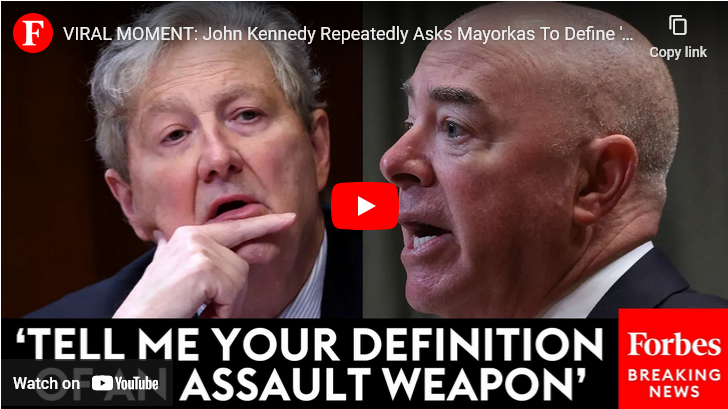
There’s an exchange I’ve seen a dozen times in the last few months, and it’s always more or less the same. The faces and the names change, but the structure of the discussion is consistent. It happened last week between Senator John Kennedy and Homeland Security Secretary Alejandro Mayorkas (video is time-stamped to 1:55 or so, when the discussion begins, but Substack sometimes eats the timestamp, so fast-forward if necessary):
I won’t quote from it, because it’s so casually bizarre and unsettling you should just watch it to see for yourself, but Kennedy notes that Mayorkas has recently and very publicly demanded a federal ban on assault weapons — and then he asks Mayorkas to define “assault weapons”. You want to ban X, so what is X? What is the thing you intend to ban?
Mayorkas responds with all known forms of rhetorical deflection short of diving under the table: “I defer to the experts,” do it for the children, it is no longer acceptable to do nothing as people die, the children the children the children. But he will not propose a definition for the term. He wants to ban something, but he refuses to say what he wants to ban. Kennedy keeps asking; Mayorkas keeps right on with not ever saying. The closest he ever comes to an answer is that at one point he tentatively upspeaks a firm maybe, saying that possibly assault weapons are kind of … military style? But then he won’t say what that means, either.
Not noticing himself, Mayorkas just comes right out and says one of the things that fatally undermines his own claim that he lacks the expertise to participate in the discussion, noting that he worked as both an assistant U.S. attorney and as the U.S. Attorney for the Central District of California while the last federal assault weapons ban was on the books. So he’s been a federal prosecutor, and has led federal prosecutors, during a period when federal prosecutors went to court to enforce an assault weapons ban, but he can’t possibly discuss a legal definition of the term “assault weapon,” because he’s not an expert in a question that was central to his professional identity for years. I don’t know nothin’ about all this giraffe anatomy, says local zoo veterinarian.
So this is the structure of the exchange:
Very Senior Government Official: I demand that we do X, because X is very important.
Questioner: Okay, what is X?
Very Senior Government Official: I have no idea.
[…]
Over and over and over again, prominent members of the political class argue for things by throwing their givens around the room, and that’s all they can do. I feel very strongly that we need common sense solutions, in the sense that the solutions we need are very common sense things that we can all agree are very common sense. If you try to penetrate the half-millimeter of topsoil to find out what’s underneath, you see that there isn’t anything down there. You can ask them to explain their underlying premises, or to explain by logical steps how they reached their policy conclusions, but you’re just being charitable. They don’t have any of that, and wouldn’t admit it if they did. They simply feel, senator, that we must protect the children. With bipartisan solutions. That are common sense.
Yes, this is sometimes a tactic, and they know what they mean. But the brittle crust at the top edge of the discourse increasingly seems to not be characterized by the sneaky maneuver. There’s often nothing to probe for. There’s no debate to be had by opening a space for the discussion. Remarkable numbers of “leaders” read what’s on the index card — and then look up, finished with the statement, waiting for a treat like a golden retriever.
I am for [symbol]!
Mister Secretary, what do you mean by [symbol]?
I am for [symbol], I am for [symbol]! (Long pause.) I am for [symbol!]
So it seems to me that the first fact about our political discourse is that it’s increasingly about nothing, populated by people who don’t mean anything and can’t think about anything. There’s often no possibility of an exchange that leads to a deepened understanding, because there’s nothing in there. We must fight inflation by passing the Inflation Reduction Act! The public sphere has been emptied; its where we go to pass null sets back and forth.
April 6, 2023
Tikka T3x Arctic / Canadian Rangers C19 Rifle, 7.62 / .308 Win
Bloke on the Range
Published 29 Mar 2019Bloke unboxes and takes a first look at the Tikka T3x Arctic rifle, adopted as the C19 rifle for the Canadian Rangers in 7.62 NATO / .308 Winchester. Is the hype real? Oh yes! Yes, it really is!
(more…)
April 5, 2023
PTRS 41: The Soviet Semiauto Antitank Rifle (aka an SKS on Steroids)
Forgotten Weapons
Published 14 Dec 2022Prior to World War Two, the Soviet Union had a rather lackluster interest in antitank rifles — a series of guns were developed, but slowly and without all that much success. The Barbarossa invasion gave a very immediate need for just this sort of weapon, however, to give Soviet infantry units an organic anti-armor capability. Two star Soviet designers were tasked with designing AT rifles, Degtyarev and Simonov. The cartridge they were to use was the new 14.5x114mm, a high-velocity monster using a tungsten carbine cored projectile.
After a shockingly fast development period, the guns from both design bureaus were accepted. The Degtyarev became the PTRD-41, a single-shot auto-ejecting design that was extremely cheap and fast to produce. The Simonov design became the PTRS-41, a 5-shot semiauto offering more firepower but also taking longer to produce. The Degtyarev entered service first, with the first substantial deliveries of PTRS rifles arriving in 1942.
Both designs would serve through the war, with hundreds of thousands being made. Many were put into storage in 1945, and they are still seen today in Ukraine periodically. The PTRS would go on to be the basis for Simonov’s 7.62x39mm infantry rifle, adopted as the SKS.
(more…)
April 2, 2023
Vektor Mini-SS: South Africa’s Answer to the FN Minimi
Forgotten Weapons
Published 9 Dec 2022While under international embargo and at war in the late 1970s, South Africa needed a new 7.62mm GPMG. The answer was Vektor’s SS77, a design which would replace the FN MAG in South African service in the 1980s. The gun had really substantial problems for many years, and took a lot of work to revise and improve until it was finally fit for service. However, that work did result in a really excellent gun. With the US adoption of the FN Minimi as a Squad Automatic Weapon, interest developed in a 5.56mm version of the SS77.
Named the Mini-SS, this was initially envisioned as a conversion of the SS77, but that never actually came to pass. Instead, the Mini-SS was built from the ground up as a 5.56mm SAW, with a number of changes to reduce its weight (like a simple fixed polymer stock, fixed gas port, and the removal of tripod attachment points). Coming into service in the early 1990s, the Mini-SS has developed an excellent reputation.
Mechanically, both of the Vektor designs are unusual for the use of an asymmetric side-tilting bolt (like the ZH-29 and only a few other production guns). It is a very simply gun to disassemble, and has a lot of quite clever design features.
(more…)
March 30, 2023
FN’s Millionth Pistol: Presented to John Browning; Saved by a Belgian Cop
Forgotten Weapons
Published 28 Nov 2022Fabrique Nationale was formed as a consortium of small gunmakers to produce Mauser rifles for the Belgian Army, and when that work was complete the company basically had nothing else to do … until they met John Browning. Browning had a new pistol design and needed a manufacturer — and FN happened to be a manufacturer in need of a new design. The resulting partnership would last until Browning’s death decades later, and essentially created the modern FN that we know today.
FN produced its one millionth Browning pistol on July 15th, 1912 and decided to throw a huge party in recognition of the achievement. It would take 18 months to get everything arranged, and the gala was held on January 31st, 1914. John Browning attended, along with his son Val, several Belgian government ministers, and FN’s international sales agents. As part of the festivities, a number of Baby Browning pistols marked “Un Million” were presented to VIPs, and Browning himself was given this Model 1900 with a gold engraved serial number “1,000,000”. It’s worth noting that FN did not actually make a million Model 1899/1900 pistols — those only reached about 725,000. The one million number included production of later models, like the Baby Browning and FN 1910.
Browning was not particularly interested in commemorative guns, and gave the pistol to his notary in Bruges when he left to return to the US. It remained with that man until his death, when it because his widow’s property. When the Belgian government passed a gun registration law in 1945, she duly registered it — and that record remains. It was registered again in 1985 in the new computerized Belgian system (listed as a revolver; gun registries are always notoriously full of errors). In 2006 Belgian gun laws changed again, and many guns had to be surrendered to the police. This pistol was one of them; handed in for destruction to a local police office. Fortunately, the officer who received it recognized that it was a historically significant piece, and was able to arrange its preservation.
(more…)


