Quotulatiousness

May 30, 2024

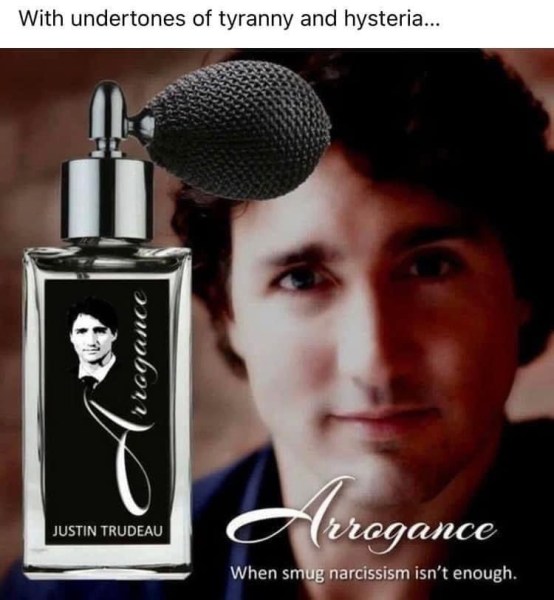
The Liberal Party of Canada, a wholly-owned subsidiary of Trudeau, Inc.

Filed under: Cancon, Politics — Tags: , , , — Nicholas @ 03:00

In The Line, Stefan Klietsch ponders the idea that a lot of the problems the Trudeau Liberals are encountering in the run-up to the next federal election are direct or indirect effects of the constitutional changes Trudeau pushed through at the first party general meeting after he became Prime Minister:

With the ongoing and persistent slump of Justin Trudeau’s party in the polls, some observers have looked back at what caused the Sunny Ways team to lose its lustre in their years of governing. Some would point to the prime minister’s harassment of Judy-Wilson Raybould in the SNC-Lavalin scandal, an episode in which the prime minister clearly lost the battle for public opinion. One personal grievance of mine is the cynical promise that the prime minister had made of the 2015 election being the last such election under the existing electoral system. Others just point to post-pandemic economic conditions, especially higher interest rates.

But looking back to the very beginning of the Trudeau era, the Liberal leader arguably planted the seeds of his inevitable downfall quite quickly after winning his majority in the 2015 election. I speak here of the constitutional package that Trudeau pushed the Liberal Party of Canada to adopt at its 2016 Biannual General Meeting.

It is a recurring theme in Canadian politics that party leaders who form government tend to become more distant and isolated from their grassroots. But whereas most prime ministers and premiers would be content to delegate management of constitutional party debates to their submissive sycophants, a sitting prime minister took it upon himself to invest his personal brand in an appeal to the party’s convention floor to pass an omnibus “modernizing” constitutional package. Since the prime minister did not again participate in the party’s constitutional debates after 2016, he evidently got everything that he wanted all in one go, and with minimal resistance.

Trudeau’s cynicism here is worthy of mockery. Imagine thinking to yourself, “Just months ago, the rejuvenated grassroots institutions of the Liberal party swept me to power and ended the decade of Liberal decline. Better fix what ain’t broke!” The changes, which included slashing of the influence of Electoral District Associations and of policy conventions, were obviously not intended as some grand exercise in democracy empowerment, but rather were intended to protect an incumbent government from any inconvenient messages and influences from a potentially unruly party grassroots.

Yet it was the same independent party grassroots that had helped bring Trudeau to power in the first place. In the 2015 campaign the Liberals had run on what columnist Andrew Coyne called a “daring” platform, a platform crafted with more input and insight than can be offered by only pollsters and political operatives. The then Liberal platform was obviously a factor in the Liberals’ poaching of supporters from the NDP, which had at times held a lead in the polls. From cannabis legalization to electoral reform to the Canada Child Benefit, where did all the big new Liberal ideas come from? The party grassroots and institutions, of course.

May 28, 2024

Rishi Sunak’s big-brained election-winning strategy: bring back the draft

Filed under: Britain, Media, Military, Politics — Tags: , , , , — Nicholas @ 04:00

Embattled British Conservative leader Rishi Sunak has had another of his patented brainstorms for a policy that will absolutely win his party huge numbers of “gammon” votes in the July 4th general election:

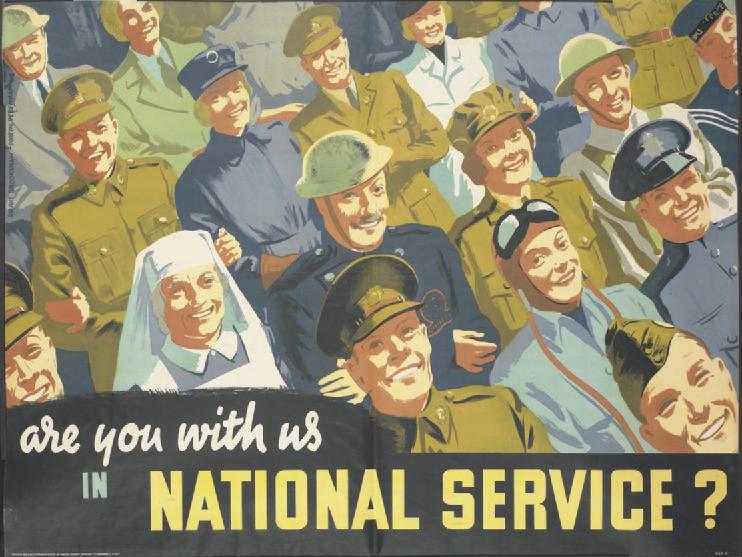
I thought the misty nostalgia for postwar “National Service” had died out long ago …

Here we go: straight off, let’s get the youth to do some indentured servitude, sorry, National Service.

The Sunday Times reports:

    Every 18-year-old will be required by law to sign up for a year of National Service under plans unveiled by the Conservatives this weekend.

    Rishi Sunak’s first manifesto commitment would see youngsters given the choice between a full-time course (for 12 months) or spending one weekend a month volunteering in their community. There will be sanctions for teenagers who do not take part. Up to 30,000 full-time positions will be created either in the armed forces or in cybersecurity training. The weekend placements could be with the fire or police service, the NHS or charities tackling loneliness and supporting older, isolated people.

    The Tories have pledged to set up a royal commission to design the £2.5billion programme and establish details such as how the cybertraining would be delivered. A pilot will start next year and by the end of the parliament legislation will be passed making it mandatory for all 18-year-olds.

[…]

The Prime Minister says: “This new, mandatory National Service will provide life-changing opportunities for our young people, offering them the chance to learn real-world skills, do new things and contribute to their community and our country.” I doubt very much it will do this. The youth could learn real world skills in a weekend job that they’d actually get paid for but under Tory Rule they must become an indentured servant of the State instead.

It was floated that “the weekend placements could be with the fire or police service, the NHS or charities tackling loneliness and supporting older, isolated people”. Really? The fire and police service having to babysit some surly 17-year-old teenager glued to a mobile phone? Is this really what a police officer wants?

No doubt the vast majority of the youth will be dumped in some NHS hospital to do goodness knows what, or indeed a nursing home. And what about all the people who are currently off work and on anti-depressants “because of mental health”. Will they be forced to volunteer, or let off the requirement?

May 27, 2024

Visual metaphors in the British general election

Filed under: Britain, Media, Politics — Tags: , , , , , — Nicholas @ 03:00

When British PM Rishi Sunak decided to drop the writ for a general election, he must have thought he was boldly seizing the initiative but his timing was characteristically bad:

If your pitch to voters is that Britain needs protection in dangerous and uncertain times, it’s probably best to first show the voters that you can protect yourself.

For example, if it’s raining, you might want to consider demonstrating the good sense to wear a raincoat. Or carry an umbrella. Or if, say, you are the prime minister of an entire country, with an events team at your disposal, you might want to consider erecting a tent of some sort, something that can keep you dry without ruining your visuals.

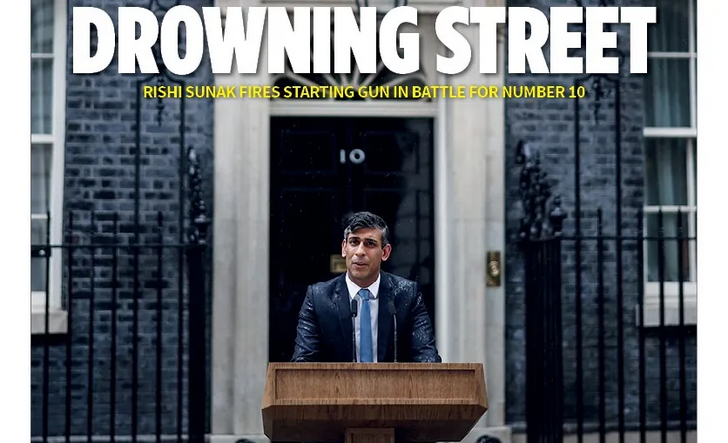
Or you can be Rishi Sunak, the beleaguered British prime minister, and stand out in the pouring rain, unprotected, and get drenched as you state your case for more time to be the country’s leader, evading the storm only when re-entering the house you will surely be vacating after voters have their say on July the 4th.

To be fair to Sunak, it’s not easy to predict the weather in London. Nor can you always control the timing of events. But when it rains all of the time where you live and you do absolutely control the timing of events, as a British prime minister does when calling an election, it’s unforgivable to be unprepared. There’s a reason most Brits keep an umbrella nailed to their hips, and it’s not style.

And if you think this is to make a mountain out of a molehill, you should check out the front pages of the U.K. papers on the morning after the election call. “Drown & out”, blared The Mirror. “Drowning Street”, chortled another broadsheet. “How long will (Sunak) rain over us,” chirped in a key regional title. Each headline was accompanied by a grim looking Sunak soaked to his whippet-like core. The presentational details matter, especially when you’re putting yourself in the shop window.

Then again, to expect anything more from a Conservative movement that is running on fumes after 14 turbulent years in power is to put hope over experience. It’s been a draining (nearly) decade and a half. There was the austerity and economic uncertainty of the coalition years. The referenda — Scottish and EU — that choked off most debate on other issues in the middle part of the last decade. And then came the double act of COVID and Ukraine, a compounding whammy that hammered supply chains and put up energy and other prices, prompting the worst cost-of-living crisis in generations. It would have been enough to test any leader’s mettle, which is probably why the Conservatives have had five prime ministers during their stretch in government, including three in 2022 alone.

May 26, 2024

Will Rishi Sunak be the British Kim Campbell?

Filed under: Britain, Media, Politics — Tags: , , , , , — Nicholas @ 05:00

The British election is now underway and if the polls are accurate, Rishi Sunak’s Conservatives are in for one heck of a thrashing. If he’s particularly unlucky, he could come close to former Canadian Prime Minister Kim Campbell’s electoral shipwreck in 1993 (losing a Parliamentary majority and being reduced to two seats in the Commons), but perhaps Labour leader Sir Keir Starmer isn’t quite the <sarc>charismatic juggernaut</sarc> that Canada’s Jean Chrétien was:

Rishi Sunak shortly after becoming Chancellor of the Exchequer in 2020.

I’m old enough to remember the sense of optimism, hope and promise felt when Tony Blair was elected back in 1997; not by me, obviously, but I could at least appreciate that other people felt that ‘things can only get better’.

Whether you think they did or not, Blair transformed the country in his own image, just as his predecessor Margaret Thatcher had done during her similarly long reign. No one could say the same of the recent fourteen years of Tory-led governments, a period that has been marked by a continual drift away from conservatism both within civil society and in many ways driven by the administration itself.

As I have said one or two times before, you could have woken up from a long coma and had no idea who had been in charge the whole time. It’s an indication of how far the Overton Window has shifted that proposals to limit student-led immigration are considered way out there despite being mainstream only a decade ago – proposals which the Prime Minister backed out of. One of the benefits of being in government should be the ability to shift the terms of debate, but whereas the rest of Europe is mostly turning Right, Britain under the Tories has gone the other way.

In retrospect, and I have definitely said this more than once or twice, the post-Brexit immigration policy was their biggest mistake. It meant the worst of both worlds for the country and for Tory coalition building, alienating both a large section of cautious voters over leaving the EU, and the many cultural conservatives they picked up in 2019 who saw the referendum as a vote on immigration.

In a parallel universe where the government reduced net migration to five figures, there may well have been immediate pain: struggles to fill vacancies, inflationary pressure caused by rising wages, and universities which now cannot survive without using the immigration system as a funding mechanism. But the Tories would have been on 30% rather than 20%; that they aren’t aware enough to understand this is strange, but then they aren’t an ideological party.

Rishi Sunak’s decision to hold the election early is very curious. Perhaps he was worried that enough letters would be handed in triggering a leadership contest; perhaps he feared that Nigel Farage would reappear and make the Reform Party even more of a problem. Perhaps he’s just impetuous and has had enough, but the announcement itself, in pouring rain and drowned out by a New Labour anthem played by a public nuisance, was fitting.

The prime minister is very unpopular, and the Tories are currently polling at catastrophic levels, but there is little enthusiasm for Labour and more people think the country will get worse than better after they are elected.

May 24, 2024

“Great Britain is not yet a basket case. But we do a rather good impression of a failing state.”

Christopher Gage considers the plight of modern day Britain in the context of Rishi Sunak’s political suicide note election call:

Rishi Sunak shortly after becoming Chancellor of the Exchequer in 2020.

The ambition for things to get better is a bar so low it’s a carpet. A favoured genre of meme here centres on the dysfunction and general farce of a country with “Great” in its name. That lofty adjective edges perilously close to hilarity, akin to those countries prefixed by “People’s Democratic Republic”. The excitable kind with an AK-47 printed on its flag.

Call the doctor’s surgery at 8 a.m. An automated voice will reveal you are number 49 in the queue. When you eventually wade through, a soft-centred receptionist assures you in therapeutic tones that there’re no appointments left today. Sorry.

Book a same-day train ticket from London to Newcastle. Without a hint of contrition, the train company demands £786.80. That’s a week or two in warmer, healthier, saner Sevilla or three hours and eleven minutes on a train in Great Britain.

House prices and rents are akin to the board game Monopoly, in which your coked-up crypto-addled mate has lined up hotels on Mayfair.

Go to the supermarket. Olive oil, a civilising elixir which once threatened to heave the primitive British palate out of the Mesolithic era, is prohibitively expensive. If modern Britain were a film scene, it would be that of Ray Liotta in Goodfellas: Fuck you. Pay me.

This all-encompassing one-footed waltz feels like the finale of a political satire. Since the 1980s, we’ve parodied America. We’ve nailed the social pathology but not the prosperity. Essentially, Great Britain is an advertising agency with a nuclear submarine.


This election pits two tribes against each other. One tribe pines for 1997. The other yearns for 1979.

For a sizeable swathe of the population, everything is awful, and nothing will ever change. And thank God for that.

Here, a natural law dictates that anyone under 45 who dares suggest things could be better is to be consumed by a radioactive flood of sadistic nostalgia. The mere whiff of dissent conjures through the pavement a battalion of nostalgians who lament the end of Polio.

“You don’t remember the Seventies!” warn those who yearn for the Seventies. ‘Bodies uncollected! Rubbish piled up in the streets!’. In that fateful decade, striking union workers allowed garbage to pile up in the streets. To this hazy memory, the rest of us are serfs to economic juju.


Whenever I point out that a first-time buyer in London must save for 31 years just for a house deposit, a familiar chorus of denial debunks the theory of free will. “You waste your money on flat whites and trips to Rome!” goes the wearisome riposte.

During the 1970s, that prelapsarian idyll when rubbish piled in the streets, when adults caned children at random, and when Bullseye was on the telly, the average house cost four times the average wage. Today, it’s twelve to one.

To point out mathematical reality invokes spasms of uniquely British nostalgia. It’s a negative nostalgia which glories in just how bad everything was.

Churchill was right. The British people are the only people who like to be told how bad things are, who like to be told the worst. Memory-mongers paint postcards of perfect penury. Back then, children didn’t talk back. There were no phones or elbows on the table. Back then, that famed sense of community slapped any ribbon of dissent out of those who dared dream bigger than the suffocating confines of community life. The past is a foreign country in which children could count their ribs but they was happy.

Such nostalgia serves two purposes. The first indulges one’s triumph over wistfully disfigured adversity. The other bleaches the parlous state of modern Britain with a mop soaked in a very British version of nostalgie de la boue. Nostalgia, truth be told, is a polite form of dementia.

May 16, 2024

The Thüringen Project – “where our greatest legal minds are at this very moment brainstorming ways to defend Thuringian democracy from the grave threat of ordinary people expressing their political preferences via voting”

Filed under: Germany, Media, Politics — Tags: , , , , — Nicholas @ 04:00

eugyppius on the brave defenders of German democracy in Thuringia (and Brandenburg and Saxony) who are doing everything they can to ensure that the unwashed masses don’t disturb the stately progress toward their long-dreamed-of utopia:

“German flag” by fdecomite is licensed under CC BY 2.0 .

To live in Germany in 2024 is to be lectured constantly about democracy. An endless parade of doubtful personalities – pundits, experts and a lot of very shrill women – appear on the television every night to tell you which parties are democratic, which people are democratic and therefore who enjoys democratic legitimacy. As we have seen, however, the whole concept of democracy is very confusing. Those people and organisations who want to mute free expression and ban political parties are all held to be extremely democratic, while those parties that demand more direct democracy and talk constantly about respecting the popular will are the direct modern equivalent of illiberal antidemocratic fascists.

To make all of this even harder, we are told that the upcoming September elections in Thüringen, Brandenburg and Saxony present a grave threat to democracy. To counteract this threat we have things like the Thüringen Project, where our greatest legal minds are at this very moment brainstorming ways to defend Thuringian democracy from the political preferences of actual voters. Crucially, the very existence of the Thüringen Project means that democracy must still reign supreme in Thüringen. Otherwise, there would be nothing for the democratic police of the Thüringen Project to defend. We therefore need only study Thuringian politics in their present state to gain a better idea of what this mysterious, shape-shifting, elusive phenomenon we call German democracy might be.

We will start at the top. The current Minister President (i.e., governor) of Thüringen is a highly democratic man named Bodo Ramelow:

Ramelow is a member of Die Linke, or the Left Party, which is the direct successor of the Socialist Unity Party (or SED) that used to govern the DDR. That might seem baffling, as the SED and the DDR were anything but democratic. Still more baffling is the fact that the constitutional protectors suspected Ramelow of antidemocratic tendencies and even surveilled him for many years. But democracy as we have learned is extremely complicated, and whatever antidemocratic essence Ramelow may have harboured in the past, he is a stalwart democratic politician today. He is also a huge fan of the mobile game Candy Crush, which he enjoys playing during government meetings. That at least seems unambiguously democratic, and perhaps it is even enough to overcome Ramelow’s political unreliability in other respects.

[…]

In summary: A constitutional protector who owes his office to a Minister President who was appointed to a second term via the anti-constitutional interventions of outsiders is now vowing to use his office to forestall political developments that may deprive his Minister President of power in the future. It is almost like “democracy” in Thüringen is synonymous with left-wing government. Elections which threaten to deprive Bodo Ramelow of office or his left-wing coalition of power are by definition anti-democratic, deplorable and perhaps even illegal.

Thuringians can vote for whichever party they want, but their votes are only democratic if they are cast for those specific parties. If Kramer has his way, Thuringia will soon achieve the democratic end-state – one in which the sad reality of popular sovereignty in practice will be replaced with a theoretical popular sovereignty that exists entirely in an ideal, Platonic form, unchanging and as it ought to be, now and forever.

May 5, 2024

The protests “will help Trump get an Electoral College landslide, just as the new left handily elected Nixon in 1968 and 1972”

Andrew Sullivan, the very model of a never-Trumper, sees the ongoing student protests feeding into a repeat of the 1968 and 1972 US Presidential elections:

“Patriotic students hung up an American Flag at George Washington University after pro-Palestine protesters trashed the campus, defaced the statue of George Washington, and removed an American Flag.”
Twitter image posted by Chaya Raichik – https://twitter.com/ChayaRaichik10/status/1786504098746958103/photo/1

As readers know, I’m deeply sympathetic to the argument that Israel has over-reached, over-bombed, and over-reacted in its near-unhinged overkill of Palestinian civilians, especially children, in the wake of 10/7’s horrors. It has been truly horrifying. I begrudge no one demonstrating passionately to protest this. But as I watch the rhetoric and tactics of many — but not all — of these students, I’m struck by how this humane concern is less prominent than the rank illiberalism and ideological extremism among many.

Preventing students from attending classes, taking exams, or even walking around their own campus freely is not a protest; it’s a crime. So is the destruction of property, and the use of physical intimidation and violence against dissenting students. The use of masks to conceal identity is reminiscent of the Klan, and antithetical to non-violent civil disobedience. It’s a way for outsiders to easily infiltrate and a way to escape responsibility for thuggishness. It’s menacing, ugly and cowardly.

It did not have to be this way. Imagine if students simply demonstrated peacefully for a cease-fire, placed the victims and hostages at the forefront of the narrative, and allowed themselves to be arrested proudly on camera and face legal consequences for their actions, as the civil rights movement did. Imagine if they were emphatically non-violent and always open to debate.

But they aren’t, because they are not the inheritors of the Christian, universalist civil rights movement but its illiberal, blood-and-soil nemesis, long curated in the Ivy League. The key group behind the protests, Students For Justice in Palestine, doesn’t mince words. It celebrated the explicitly genocidal murder of Jews on October 7:

    National liberation is near — glory to our resistance, to our martyrs, and to our steadfast people! … Resistance comes in all forms — armed struggle, general strikes, and popular demonstrations. All of it is legitimate, and all of it is necessary.

The “our” is interesting. If you think these protests are only about Gaza — and not America — you’re missing the deeper context. Here’s a masked, keffiyeh-wearing spokeswoman for the UCLA protest:

    Given the fact that the University of California is founded on colonialism, it’s inherently a violent institution. There needs to be an addressment of US imperialism and its ties to the UC system and how it perpetuates war and violence aboard — not only abroad, but also here, locally.

So violence is justified in response. Here’s a keffiyeh-clad spokesman at CUNY:

    This revolution, which includes the mass demonstrations and encampments, are not just exclusively for students. It is for the masses. … It is for the free people of the world who are able to resist however you can — whether it be with a rock and other tools of liberation.

These are not fringe figures; they have been chosen to speak to the public. They believe in violence because there is nothing in their worldview that could prohibit it against certain “oppressor” races of people. As one of the “queer” leaders of the Columbia protest has said: “Zionists don’t deserve to live”, and “Be grateful that I’m not just going out and murdering Zionists”. He took his classes in decolonization seriously, even if he is now backtracking from their logical conclusion.

The illiberalism is deep and endemic. The civil rights movement was desperate for the press to show up; these thugs follow observers menacingly around, holding up barriers to prevent even fellow students from filming them. The civil rights movement ended physical borders between groups of human beings; these thugs create borders and police dissent. The civil rights movement asked America to live up to its ideals; the woke believe America is a source of evil in the world, and needs to be “decolonized”. “I love Osama [bin Laden]”, one pro-Palestinian demonstrator in New York City said. “I want to suck his dick”. That mix of evil and scatology is a woke trademark.

And these protests are clearly as much about the abolition of the Jewish state as they are the horror of Gaza. They are driven by the neoracist idea that “white-people-are-bad-but-black-and-brown-people-are-good”; they are about a blood-and-soil “anti-imperialism” that requires the abolition of any state not reflective of ancient indigenous populations. (The SJP refers to the US as “Turtle Island”, an allegedly indigenous name.) They are against “cultural appropriation” but prance around in keffiyehs. They glibly use the word “genocide” to trigger and re-traumatize Jews, while ignoring the genocidal goals of Hamas; and chants of “There Is Only One Solution: Intifada Revolution!” ring with echoes of Nazism.

And they will help Trump get an Electoral College landslide, just as the new left handily elected Nixon in 1968 and 1972.

It tells you something when even Al Sharpton is rattled by these violent fanatics. “How do the Democrats — how do all of us on that side — say January 6th was wrong if you can have the same pictures going on on college campuses?” he asked on MSNBC. It feels like 2020 again. Replacing Old Glory with the Palestinian flag or defacing a statue of George Washington (see above), is not how you win over the country. But the more you know about these fanatics the more you realize they don’t want to win over the country; they want to destroy it as mindlessly as the pro-Trump fringe. And they’d welcome the even deeper polarization he’d bring.

May 4, 2024

QotD: Why Donald Trump beat Hillary Clinton

Filed under: Humour, Media, Politics, Quotations, USA — Tags: , , , , — Nicholas @ 01:00

Eight years ago, with the American election reaching fever pitch, no one truly believed that Donald Trump would defeat Hillary Clinton. I certainly didn’t. But then the Clinton team decided to publish her playlist –

(I’m embarrassed just to type that). In one flash, I knew that Trump would win. Not because Clinton’s playlist was lame, obvious, safe, uninspiring … I’m not judging her taste in music, or lack thereof, nor would I count myself qualified to do so. I knew instantly she would lose because it was so clear that no one on earth would ever want to see her playlist. Let alone listen to it. No one on earth would want to know that such a playlist existed, much less care a raspberry fuck what was in it, what genre, what generation, what anything. For all the negative feelings I may have entertained concerning Trump’s personality, moral and ethical nature, honesty, decency etc., etc., I had to confess that I was fascinated to know what might be in his playlist. For all I knew, it could be polka music, soft rock, clawhammer bluegrass, death metal, light classical, Nu-folk, Tesco1, psychedelic funk, Tijuana brass. It didn’t matter. What mattered was that I was interested. And I knew with a certainty that might be regarded as deeply arrogant that my belief – that a Hillary Clinton playlist was among the least interesting ideas ever proposed – would be a belief shared by most people, whatever their political leanings. It’s not fair on Hillary Clinton that this should be the case, but the case is what it is. We smell it at once. Hillary Clinton’s playlist? No. Therefore, somehow, Hillary no.

Statistics and group theory can take us a long way, but smell takes us further.

Stephen Fry, “The One and the Many”, The Fry Corner, 2024-02-02.


    1. Tesco, as a branch of dance music, does, or at last briefly did, exist. It’s a blend of techno and disco. You knew that.

April 30, 2024

The CDU’s “five-point plan to protect German democracy from … the free and open internet”

Filed under: Germany, Law, Liberty, Media, Politics — Tags: , , , , , — Nicholas @ 04:00

German mainstream politicians are struggling to keep extreme right populist anti-democratic voices from being heard by innocent and trusting German voters, so the leader of the CDU in Thuringia has a master plan:

The duel between our leading Thuringian politicians was all but unwatchable, as indeed almost all political debates turn out to be. While [AfD leader Björn] Höcke could’ve acquitted himself better, [CDU leader Mario] Voigt’s performance was flat, uninspired and profoundly banal. Among other things, the man suffers from a peculiar rodentine aspect; he bites his way stiffly through bland preformulated arguments like a squirrel chewing a stale nut or a beaver gnawing through saplings. After the event, the CDU took to the press to declare victory, but polls showed that viewers found Höcke on balance more persuasive, which is of course the real reason that everybody told Voigt to avoid the confrontation. Voigt is intensely democratic and therefore extremely right about everything, but somehow – and this is very awkward to discuss – his being eminently righteous and correct in all things does not manifest in an ability to defeat the very wrong and evil arguments of his opponents. It’s very weird how that works, perhaps somebody should look into it.

Stung by this failure, Voigt has set off to find other means of defending democracy. This week, in the Thüringen state parliament, he gave an amazing speech outlining a five-point plan to protect German democracy from that other great menace, the free and open internet:

    So how do we protect democracy in the area of social media? There are five approaches:

    Ideally, we should agree to ban bots and to make the use of fake profiles a criminal offence.

    There is also the matter of requiring people to use their real names, because freedom of expression should not be hidden behind pseudonyms.

    Then there’s the question of whether we should create revocable social media licences for every user, so that dangerous people have no place online.

    We need to consider how we can regulate algorithms so that we can revitalise the diversity of opinions in social networks.

    And we also have to improve media skills.

For all that Björn Höcke is supposed to be a “populist authoritarian” opposed to representative government, I’ve never heard him say anything this crazy. Voigt, meanwhile, is a leading politician for the officially “democratic” Christian Democratic Union (you know they are democratic because the word is in their name), and he’s actually dreaming of requiring Germans to obtain state-issued licenses for permission to post their thoughts to the internet.

Because Voigt’s regulatory regime would entirely abolish online “freedom of expression”, it is unclear how banning bots and pseudonymity could ever defend it. Generally speaking, for a thing to be defended, it must first exist. Equally curious is Voigt’s belief that any “diversity of opinion” will survive his social media license scheme to benefit from the regulation of social media algorithms.

April 24, 2024

Alternative für Deutschland is gifted a blueprint for governing by their entrenched opponents

Filed under: Germany, Media, Politics — Tags: , , , , , , — Nicholas @ 03:00

Was it Napoleon who said to never interrupt your enemy when they’re making a mistake? If so, the German populist Alternative für Deutschland leaders must be congratulated for not interrupting the latest mistake by the statists they want to replace:

Every day I encounter yet another hamfisted pseudoacademic propaganda operation eagerly churning out oceans of text to shore up the German political establishment. The idea seems to be that with just enough whitepapers, bursting with just enough words, the situation might still be saved.

There are just so many of these outfits, they grow like weeds in the fertile soil of government funding. This Sunday, it has been my dubious pleasure to stumble across the “academic and journalistic open access forum of debate on topical events and developments in constitutional law and politics” billing itself as the Verfassungsblog (the “Constitution Blog”). This factory of tedious prose and political special pleading that nobody will ever read is not just the eccentric side project of a very socially concerned lawyer named Maximilian Steinbeis, oh no. It is funded by the WZB Berlin Social Science Center (and therefore, indirectly, by the German taxpayer) and also by the Max Planck Institute for Comparative Public Law and International Law. We would do well to take these people seriously, in other words, and you should keep that in mind, because things are about to get very ridiculous.

Last year, our state-funded Verfassungbloggers realised that elections were approaching in Saxony, Thüringen and Brandenburg. This worried them terribly, because Alternative für Deutschland dominates polling in all three states. They feared that this “authoritarian populist party” might seize control of one or more state governments, just as other authoritarian populist parties have seized control “in Poland and Hungary, in Florida and Texas”. These parties are very bad, because they “use … power … so that they no longer have to relinquish it”. They “manipulate electoral law” and “stifle opposition” and “pack the administration and judiciary with their own people”. As if that were not bad enough, they also “make the media, scientific and cultural institutions dependent on their will”. Of course, the Federal Republic is presently ruled by a party cartel system that is already doing all of that, but the difference is that none of the parties involved are “authoritarian” or “populist”. The priests of democracy get to do whatever they want, and whatever they do is by definition democratic.

In this spirit, our Verfassungsbloggers launched the “Thüringen Project”. Their aim is to identify how the forces for humanitarian pluralism might manipulate the law, stifle the opposition and pack the administration and judiciary in even more extreme ways than have yet been imagined, all to subvert the will of east German voters and more effectively blunt the power of the AfD when they become the strongest party in the Thuringian Landtag.

[…]

All of this iterative looping has culminated in an overproduced, 36-page .pdf file bearing the characteristically cumbersome title “Strengthening the resilience of the rule of law in Thüringen: Action recommendations from the scenario analysis of the Thüringen Project“. No syllable can be spared in our campaign to defend democracy. In the pages of this plan, they finally define what “authoritarian populist parties” are. These are parties that “use the narrative of a natural, ‘true’ people in opposition to ‘corrupt elites’, for the purpose of delegitimising pluralistic democracy and establishing an authoritarian regime”. The AfD are of course “a clear example of such a party”. The more panicked all of these people get, the closer they come to saying plainly what they’re really afraid of, namely the growing hostility of native Germans to an increasingly isolated political elite, which plainly does not care much about “authoritarianism” (they are responsible for plenty of that themselves) as much as they are terrified of losing their hold on power.

April 20, 2024

How much of your language do you have to destroy to avoid the taint of historical fascist usage?

Filed under: Germany, History, Law, Liberty, Media, Politics — Tags: , , , , — Nicholas @ 05:00

For understandable reasons, German governments since the end of World War 2 have been twitchy about any symbols, songs, words and phrases that were used by Hitler’s various fascist organizations … to the point of making many things illegal. eugyppius outlines one particular case where the use of a simple German phrase by an AfD politician has landed him in court, facing a possible three-year prison sentence even though he denies that he knew the phrase had such connotations:

Today, the leader of the Alternative für Deutschland faction in the Thuringian state parliament, Björn Höcke, appeared before the district court in Halle for the first day of his long-awaited speech trial. He stands accused of having used a forbidden Nazi slogan favoured by the Sturmabteilung at a political rally in Merseburg on 29 May 2021. Höcke pleads that he used the three-word phrase in a moment of spontaneous elaboration at the end of his speech, without knowing its National Socialist associations. Out of an abundance of caution, I won’t quote the phrase here, even in translation, but I’ll provide it in context below; it begins with the words “Everything for” (“Alles für“) and concludes with the name of the Federal Republic. As slogans go, it is so seemingly banal that before the trial many Germans would have been surprised to know it had any Nazi associations at all.

For the moment, not much has happened. Höcke’s lawyers filed a variety of requests, among them that the Federal Constitutional Court answer a question surrounding the court’s jurisdiction. In consequence, it’s unclear whether the trial will continue as scheduled next week or whether it will have to be substantially delayed. The state prosecutor’s position is that Höcke’s background as a history teacher makes his claims of ignorance implausible. The prosecutors’ office have also added an additional charge for Höcke’s defiance at a rally in Gera last December, where he shouted the first two words of the slogan at the crowd, and invited them to supply the last one. I fear that this was a grave mistake, because as we will see, the original case against Höcke is laughably weak.

If found guilty, Höcke could be fined or sentenced to prison for up to three years. It is also conceivable that his right to vote and run for office could be suspended. Whatever you think of Höcke or his politics, the political dimensions of this trial are undeniable, as it is occurring mere months ahead of the Thuringian state elections, and as Alternative für Deutschland commands a solid plurality of polling numbers in that state.

[…]

That Höcke deliberately used the SA slogan as a subtle enticement to the extreme right is more than doubtful; that he also did so in hopes that he would be prosecuted and profit politically from his victimisation is so ridiculous, I can’t imagine that even Hillje really believes this. This obnoxious thesis nevertheless recurs whenever the German press report on the harassment of AfD politicians; it is somehow their fault, because they are held to benefit from it.

Der Spiegel, always a source of unintentional amusement, ran a headline today mocking Höcke as a “history teacher with no knowledge of history“. “He claims not to know it was an SA slogan”, they report, “but there are doubts about this”. Alas, the very same news magazine last September accidentally used the forbidden phrase to headline an approving article on Olaf Scholz’s proposed “Germany Pact”. They rapidly changed the headline, appending this brief and embarrassing correction to the bottom:

    An earlier version of the article was headed with a line that was used by the SA as a slogan. This was not intended by the author and editors and has now been changed.

March 21, 2024

“That is a catastrophic miscalculation for the NDP, and it’s the single best thing that happened to Poilievre”

In The Line, Matt Gurney reflects on what he got wrong about Pierre Poilievre and why he misread the situation leading up to Poilievre becoming Conservative leader:

Pierre and Ana Poilievre at a Conservative leadership rally, 21 April, 2022.
Photo by Wikipageedittor099 via Wikimedia Commons.

“Think of Trudeau in late 2019,” he told me from the bar. “India trip. SNC-Lavalin. ‘Thank you for your donation.’ Black and brown face. Canadians were souring on him. They were starting to think he was a fake, and maybe a bit of an asshole. His disapproval ratings were soaring. Then COVID hits, and he’s doing his smiling, reassuring press conferences every day outside his house. His disapprovals tank. Canadians are reminded of 2015 Trudeau. But then pandemic ends, and we’ve got some Trudeau missteps. ‘Unacceptable people’, COVID-era wedges. He’s going back to his 2019 position: people don’t like him.”

“And then,” he told me, “just as Canadians are starting to think the PM is an asshole again, the NDP decides to sign an agreement with him. [NDP leader] Jagmeet [Singh] could not have screwed up more. This is a historical, books-to-be-written-about-it screw up. Because just as Canadians are remembering that they don’t like the PM, Singh is giving those voters no reason to go to the NDP.”

Normally when the Liberal vote collapses, he continued, those voters disperse across all the parties. But CASA, my source told me, was like a funnel, forcing all the voters the Liberals were losing to go to the Conservatives instead of going everywhere. “If you’re angry at Trudeau, if you don’t like him, if you’re sick of him, you can only go Conservative this time. Singh did that. That is a catastrophic miscalculation for the NDP, and it’s the single best thing that happened to Poilievre. None of us saw that coming.”

He had other thoughts, as did others I spoke to. The People’s Party having been neutered as a threat was something I heard repeatedly, which matters, but not in the way that you think. “The PPC wasn’t a huge draw on our voters,” a senior Tory told me. “People still think the PPC was just our most-right-wing fringe. Wrong. It was drawing voters from everywhere, including typical non-voters. So the problem wasn’t that we were losing votes. The problem was that the fear of the PPC gave too many of our western MPs licence to get away with anything or oppose anything. ‘If we do/don’t do this, Maxime Bernier is going to kill us!’ Guess what? Portage-Lisgar was Bernier’s best possible shot and we annihilated him. No one is afraid of the PPC anymore. No one can use the PPC as leverage against the leader.”

I asked about that — Poilievre’s hold over his own party. In my 2021 column, I had noted that O’Toole never really had full control. Every Conservative I spoke to agreed: Poilievre has the most control over his caucus of any CPC leader they can remember. Better than O’Toole, better than Andrew Scheer, and as good, at least, as Stephen Harper. Not all the MPs were thrilled when O’Toole was replaced, but the smell of impending victory has a way of winning over new friends.

I talked with the source at the bar for a long time, and we covered a lot of ground. A lot has gone right for Poilievre, he said. Some of it is luck, some of it is timing, but some of it is entirely to Poilievre’s credit. My source isn’t one of Poilievre’s guys, so to speak. He’s just long-time CPCer, who served all four leaders of the modern era. He has never hesitated to critique the current leader in our chats, but he gave credit where he felt it due. “Poilievre was talking cost of living and inflation back when the PM was taking time at press conferences to tell everyone he doesn’t care about monetary policy, and when the finance minister and the governor of the Bank of Canada were telling everyone there was nothing to worry about, and when all the economists on Twitter were saying that deflation was the worry. Poilievre was right. In public, loudly, right. About the issue that was about to completely take over Canadian political conversation. He called it. Trudeau, Macklem and Freeland were wrong. People may not remember the details, but they remember that.”

March 11, 2024

The ever-increasing risk that they’ll destroy the US political system to “save our democracy”

Filed under: Government, Law, Media, Politics, USA — Tags: , , , , , , , — Nicholas @ 04:00

David Friedman outlines not only the threat of a re-elected Donald Trump, but the threat of what his opponents are clearly willing to do to stop him:

    I’ve run into a surprising number of progressives who apparently genuinely believe that if Donald Trump wins the 2024 election, that will be the last free and fair election that America ever has. These people believe that if Trump wins, then by the 2026 midterms, if not by the 2025 gubernatorial elections, Trump and his acolytes will have figured out a way to rig the elections, or disenfranchise large number of Democrats, or hack the voting machines, or some other nefarious plot that will end self-government. The irony is that these people are the mirror image of the Trump fans who insist that the 2020 election was stolen, and that Democrats (or the Deep State, or whomever) rigged the elections, hacked the voting machines, etc. (Jim Geraghty in National Review, “A Reality Check on the Trump-as-Dictator Prophecies“)

Trump is a competent demagogue but an incompetent administrator. Having won the election and become president, he did very little with his power. The most important thing he accomplished was getting three conservatives onto the Supreme Court, something that a more conventional Republican could probably have done as well.

He did, however, succeed in scaring the center left establishment, parts of the conservative establishment as well. He had no respect for the political, academic, media elite, for Hilary Clinton, Harvard professors, the New York Times or National Review. He was an outsider in a sense in which previous Republican presidents were not, with enough political support to raise the frightening possibility of a government, nation, world no longer going in what they saw as the right direction.

Responses included:

Russiagate, the attempt to claim that Trump was a Russian asset.

The attempt to discredit the information in Hunter Biden’s laptop, which included a bunch of former intelligence leaders implying, on no evidence, that it was a Russian plant, Twitter blocking links to the New York Post‘s article on the laptop.

After the 2020 election, with the federal government back in Democratic hands, attacks have mostly involved weaponizing the legal system to punish Trump and his supporters. The strongest of the cases against him, for deliberately holding classified documents after the end of his term, clearly illegal, looked less unbiased after it became clear that Biden had knowingly retained classified documents from his time as Vice President and knowingly revealed them (although, unlike Trump, he returned the documents once his retention of them became public) and was not being prosecuted. The weakest of the cases was a prosecution for an offense, falsifying business records, on which the statute of limitations had run — on the grounds that the expenditure being concealed had been intended to protect his image and so counted as a falsified campaign expenditure on which the statute had not run. That and prosecuting him for optimistic claims for the value of properties used as collateral for loans — all of which were repaid in full — and finding him liable for hundreds of millions of dollars in damages were based not on legal necessity but on the predictable bias of a judge or jury in New York City, where the 2020 electorate voted against Trump by more than three to one.

My previous post described a tactic by which, if Trump won the 2024 election, Democrats might have tried to prevent him from taking office. The recent Supreme Court decision makes that particular tactic unworkable but it is clear from the Atlantic article published before that decision that some Democratic politicians were willing to take the idea seriously. Arguable the three liberal justices took it seriously enough to object to the majority preventing it, although there are other possible explanations of their dissent from that part of the decision. The Colorado Supreme Court took seriously, indeed endorsed, the idea of defeating Trump by keeping him off the ballot. It is far from clear that if there is another opportunity to defeat Trump’s campaign in the courts instead of the voting booth it will not be taken. If, after all, the survival of American democracy is at stake …

Trump has been charged with both federal and state offenses. If he wins the election he can use the pardon power to free himself from conviction for a federal offense but not a state offence. James Curley spent five months of his term as mayor of Boston in prison for mail fraud, until President Truman commuted his sentence. Georgia’s Republican governor does not have the power to give pardons even if he wanted to; the State Board of Pardons and Paroles does but only after a convicted felon has served five years of his term. The governor of New York has the pardon power but is a Democrat unlikely to use it on Trump’s behalf. If Trump wins the election but loses at least one of the state criminal cases, does the state get to lock up the President?

Suppose that, despite any legal tactics of the opposition, Trump ends up in the White House, in control of both the federal legal apparatus and, through his supporters, those of multiple states. After the repeated use of lawfare against him by his opponents it is hard to imagine Trump refraining from responding in kind or his supporters expecting him to.

March 2, 2024

Get your new election narratives! Hot off the press!

Filed under: Books, Media, Politics, USA — Tags: , , , , , — Nicholas @ 05:00

Chris Bray isn’t impressed with two new political books hitting the bookstores at the moment:

It’s an election year, so get ready. Two astonishingly dullwitted books arrived in bookstores this week, on the same day, as their dreadful authors hit the airwaves to promote them. One was White Rage: The Threat to American Democracy, about the breathtaking stupidity and backwardness of rural whites, who are destroying America. Taking care to be subtle, the publisher gave the book a cover that features a pick-up truck with an American flag and a Trump sign, leaving out only the weird kid with the banjo and the dude who shouts, “Squeal, boy! Squeal like a pig!”

And then there’s the wonderfully nuanced title Attack from Within: How Disinformation is Sabotaging America, by Obama-era US Attorney Barbara McQuade, who is now a law school professor after being asked to resign by Orange Hitler — though apparently a law school professor who is unfamiliar with the text of the 6th Amendment, thinking it exists to confer a right upon the public to have people put on trial right away.

[…]

The cover of McQuade’s book is somehow more obnoxious than the cover of White Rage:

See, it’s a giant clenched fist rising out of Middle America. Get it? Get it? It may take a moment.

These books: If, one day, by some bizarre chain of weird accidents, these are the only remnants of our civilization, no one will have the slightest idea what actually happened while we were alive. They’re miscategorized fiction. Every paragraph is full of obtuse faked reality; if you hold it up to the real world, it doesn’t even sort of match. Go click on the Amazon preview for McQuade’s book, if you’d like to see this for yourself […]

Onward: “Much of the American right glamorizes assault weapons, based on the absurd claim that the Second Amendment protects not only the right to bear arms but also the right to overthrow our government.”

My goodness, where would anyone get the claim that a founding-era American document meant to describe citizens as having a right to overthrow their government?

The Declaration of Independence, the literal founding statement of the nation that gave McQuade a government job:

    We hold these truths to be self-evident, that all men are created equal, that they are endowed by their Creator with certain unalienable Rights, that among these are Life, Liberty and the pursuit of Happiness. — That to secure these rights, Governments are instituted among Men, deriving their just powers from the consent of the governed, — That whenever any Form of Government becomes destructive of these ends, it is the Right of the People to alter or to abolish it, and to institute new Government … But when a long train of abuses and usurpations, pursuing invariably the same Object evinces a design to reduce them under absolute Despotism, it is their right, it is their duty, to throw off such Government, and to provide new Guards for their future security.

Thomas Jefferson thought Americans had a right to “throw off” their government; Barbara McQuade finds it an “absurd claim”. Which one do you think understood the topic?

February 24, 2024

Justin Trudeau is his own Messiah

Filed under: Cancon, Economics, Media, Politics — Tags: , , , , — Nicholas @ 04:00

In The Line, Jen Gerson gets up a full head of steam (to borrow Matt Gurney’s phrase) over the Prime Minstrel’s brief visit to Alberta and what he revealed about his worldview and his sense of his own importance in an interview with a non-mainstream journalist:

Watching Prime Minister Justin Trudeau give an extended interview to Alberta’s Ryan Jespersen is the first time I’ve ever felt visceral concern about the man leading this country.

I genuinely don’t mean this in any mean or partisan sense. What I mean is that this interview raised serious concerns about Trudeau’s headspace, his judgment, and whether or not this man in particular should be leading the country right now.

The interview wasn’t a disaster: Trudeau brought up fair points that deserve more consideration in Alberta, and I will discuss them here.

But on the whole, what I see here is a man who has wildly inflated his own policy achievements while in office. What I see is a man who cannot accept responsibility for his shortcomings, nor for the real decline in both state capacity and quality of life now affecting Canadians. What I see is a man who won’t take accountability for his own unpopularity.

And, most concerning, what I see is a man who thinks of himself as a messianic figure; a man blind to his own partisan ideology and bad behaviour, but hyper attuned to the same in others. A man who divides the world between black hats and white, and cannot admit the possibility of a legitimate alternative viewpoint — and can, in fact, only explain the very existence of such viewpoints by resorting to the belief that all of his critics have been fooled. Fooled. A word he uses over and over and over again, without realizing the contempt this word betrays of his own feelings toward his audience.

This is a prime minister who cannot see the beam in his own eye; who exemplifies the trait — best summed up by National Post columnist Chris Selley and cited often here at The Line — that Liberals are the sort of people who are sincerely convinced they would never do the sorts of things they routinely do, or are in fact currently doing.

Let’s start with the quotes.

Trudeau starts out by noting that right-wing politicians create wedge issues. “A lot of what the right is doing is about stoking up anger without offering any solutions.” And insisting that right-wing politicians have “realized it’s easy to instrumentalize anger and outrage to get people to vote in a way that is not necessarily in their best interests”.

The last two elections called, Mr. Trudeau. They would like to discuss guns, abortion, vaccine mandates, and pretty much every single other ballot question the Liberals have abused to squeak out minority victories by maximizing vote efficiency in crucial central Canadian ridings.

Of course, it doesn’t count when Liberals court disinformation, or stoke irrational fear about their opponents, because when they do it, they have Canadians’ best interests at heart. They’re the good people, you see.

For when you’re on the side of the angels, on a mission to preserve democracy itself from the manipulative wiles of right-wing politicians out to fool people from holding wrong opinions, what means are not justified?

I would also point out that in the same way that it would be insulting and inappropriate for me to delegitimize Trudeau’s authority by arguing that he obtained two weak majorities by fooling Canadians via manufactured outrage on wedge issues, so too is he required to show some deference to the will of the voters of Alberta. One does not have to agree with everything Premier Danielle Smith does or says or proposes to demonstrate respect for the fact that she is the elected leader of the province, a role she secured in a free and fair election. But, alas.

Donna LaFramboise also reacted to the Ryan Jesperson’s interview of Justin Trudeau, saying that he’s like the Borg from Star Trek:

While visiting Alberta this week, Justin Trudeau was interviewed live by Ryan Jespersen, a former Edmonton morning show host whose podcasts are available on YouTube and elsewhere. That’s when our Prime Minister said the following:

    There is, out there, a deliberate undermining of mainstream media. There are the conspiracy theorists, there are the social media drivers who are trying to do everything they can to … prevent people from actually agreeing on a common set of facts — the way CBC and CTV, when they were our only sources of news (and Global) used to project across the country at least a common understanding of things.

Screen capture from a YouTube compilation – “The Borg Collective Speaks”

Mr Trudeau referred to “people on the fringes” who eschew the “mainstream view”. He said his government’s trying to “make sure Canadians understand the importance of not being fooled by misinformation, by disinformation”. Earlier in the interview, he said Albertans were being “fooled by right-wing politicians” and that oil sands workers have “been fooled” by energy companies.

Mr Trudeau is the Borg from Star Trek. He doesn’t respect alternative views. He has zero interest in listening or negotiating. If your analysis conflicts with his, you’re the problem. Renounce the fringe. Fall into line like the other Borg drones. Adopt the common understanding of things being fed to you by the government funded mainstream media.

« Newer PostsOlder Posts »

Powered by WordPress