Quotulatiousness

May 4, 2025

One Fine Day in the British Empire 100 years ago

Filed under: Books, Britain, History — Tags: , , , , — Nicholas @ 03:00

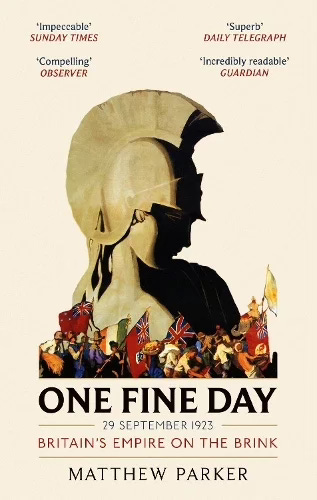
Nigel Biggar discusses One Fine Day by Matthew Parker, which looks at the state of the British Empire in the mid-1920s with a moderately jaundiced eye (as you’d expect for a modern popular history about the empire):

The approach is imaginative: to present a snapshot of the British Empire a century ago, five years after its victory in the First World War, when its territory was most extensive and at what must have seemed its zenith. The result is a display of the Empire in all its ad hoc variety, from the white-majority settler “dominion” of Australia to the non-settler “protectorate” of Uganda. The reader meets colonial officials who were sympathetic and conscientious in their dealings with those they ruled, as well as some who were brutally arrogant and dismissive. He also hears from native people who appreciated the benefits of imperial rule, as well as those who felt humiliated by Western dominance. And he learns that, if the British were late in introducing democracy to India, they were the very first to do so, for its like had never been seen before. To its great credit, no one can read this book and conclude that the British Empire was a morally simple thing.

However, it seems that our snap-shooter was fascinated mainly by the Empire in the east and grew tired as he travelled westward. Of the thirty-seven chapters, he devotes twenty-two to Australasia, the Pacific, South-East Asia, and India. There is very little mention of the Empire in South Africa, almost nothing on the Middle East (Egypt, Palestine, and Iraq) and hardly a reference to Canada. In addition, the publisher appears to have become alarmed at the length, since readers wanting to consult the notes or bibliography are directed to the author’s website.

What is more, the synchronic approach suffers from myopia, relegating major imperial achievements to walk-on parts. We do hear about the Empire’s humanitarian suppression of slavery, but only incidentally. The reader is not told that Britain (along with France and Denmark) was among the first states in the history of the world to repudiate slave-trading and slavery in the early 1800s and that it used its imperial power throughout the second half of its life to abolish slavery from Brazil across Africa to India and New Zealand. And in ending his book by reporting the 1923 cession of Rwanda to Belgium and Jubaland to Italy as tokens of imminent imperial dissolution — “Very soon, of course, the trickle became a flood” is the very last sentence — the author allows the reader to overlook the extraordinary, heroic contribution that the British Empire went on to make in the Second World War, when, between the Fall of France in May 1940 and the German invasion of Russia in June 1941, it offered the only military resistance to the massively murderous, racist regime in Nazi Berlin, with the sole exception of Greece.

While our imperial tourist is a generally an honest reporter, presenting the good as well as the bad elements of the Empire, his account is not innocent of unfairly negative bias.

The problem first manifests itself in the decision to open his account with the story of the mining ruination of a tiny Pacific territory by the British Phosphate Company. He then returns to this in the book’s closing pages, where describes it as a tale of “extractive colonialism at its most literal”. While an attentive reader of the pages in between will notice that the Empire sometimes brought native people economic opportunities and benefits, the lasting impression given by this bookending is that it was — as neo-Marxists have always claimed — basically exploitative. And yet Rudolf von Albertini, whose work was based “on exhaustive examination of the literature on most parts of the colonial world to 1940” (according to the eminent imperial economic historian, David Fieldhouse) judged “that colonial economics cannot be understood through concepts such as plunder economics and exploitation”.1

Parker’s negative bias appears most strongly in his crude, unreflective understanding of the racial attitudes of the imperial British. While he does bring onto the stage colonial Britons who express a range of views of other peoples, including sympathy and benevolence (albeit usually “paternalistic”), he nevertheless tells us that “ideas of white supremacy remained a guiding structural principle of the empire. This racist ideology was a coping stone of empire” (p. 8). What he has in mind is specifically the idea of a fixed “hierarchy of races”, with whites permanently established at the top — “what we would now call white supremacism” (p. 65). Such a view could claim the authority of natural science, since at the turn of the twentieth century “European scientists all still agreed that human beings were naturally unequal … and that there was a hierarchy of races” (p. 138).


    1. D.K. Fieldhouse, The West and the Third World (Oxford: Blackwell, 1999), p. 168; R. von Albertini with Albert Wirz, European Colonial Rule, 1880–1940: The Impact of the West on India, Southeast Asia, and Africa, trans. John G. Williamson (Oxford: Clio, 1982), p. 507.

April 10, 2025

Late onset Trump Derangement Syndrome

Filed under: Media, Politics, USA — Tags: , , , , — Nicholas @ 05:00

Ed West diagnoses himself with a raging case of late onset TDS:

What has caused this late-onset TDS, however, is not Trump’s behaviour, but the relative silence of his critics. During Trump’s first term, everyone in the American establishment seemed to be calling him the next Hitler, and this included not just the usual academics and journalists but many major corporations; companies like Nike, Heineken and Airbnb were at the forefront of the “resistance” against the president, a trend labelled “CEO Activism”. It was quite obviously self-interested and performative, because if everyone in your country is calling its leader a fascist dictator, then you probably don’t live in a fascist dictatorship.

I have no idea where I saw this meme, but it makes me laugh

That is not the case this time around, and that is more troubling. I recall from my time volunteering for first aid training that, when you arrive at the scene of an accident, you don’t go to the person screaming in pain, but the individual lying on the ground in stony silence. Similarly, the fact that people working for large corporations now keep quiet about Trump, even as he embarks on the most reckless economic policy in recent years, should probably concern us. The reason they keep quiet — and this is something I have heard from the horse’s mouth — is because they feel that there is a real risk of punitive action if they speak out.

One of the things more moderate folks used to warn the far left activists about using any and all tools to “get” their enemies is that it can — and in this case has — unleashed exactly the same kind of retribution when their former target now has the power to do so. “Muh norms!” indeed.

The constant evocation of fascism is not just mistaken in my view, but neurotic. Western civilisation is emotionally scarred by the violent racial supremacism of the Nazi regime and in particular the Holocaust, the worst crime in history, yet people have a tendency to fight the last war and this isn’t the danger that Trump represents. He is not a white supremacist and not especially motivated by ethnic nationalism. He is, however, authoritarian in nature, prone to be vengeful to those who cross him while also surrounding himself with yes-men, and he does seem to have territorial ambitions, even if they concern a frozen wasteland. Those things are all bad enough in themselves.

Rather than being a new Hitler, a more realistic concern is that Trump represents the 19th century spectre of Caesarism, a man who uses democracy in order to establish himself as an imperial figure. The fear of a Caesar always haunted the founders of the Republic, obsessed with Roman history as they were and sceptical of democracy and mobs.

Trump as a modern Louis Napoleon? A case could certainly be made for it.

Caesars do not come out of nowhere, and the progressivism of the last few years has been deeply illiberal, hostile to freedom of speech and even more so to freedom of association. Jonathan Haidt talked of “decentralized totalitarianism” and it was the chaotic nature of woke progressivism that made it so disconcerting and caused many people, including those same corporate leaders, to stay silent.

Many of the things Trump is now doing are not entirely dissimilar to what radical progressives did when the opportunity arose, in particular the determination that institutions are cleared of their opponents. It is bitterly ironic, for instance, to have the Left accuse Trump of “rewriting history” for ideological reasons (gosh, imagine!). Yet there is something quite different about people scared of online mobs and being scared of the government. Activists, though loud and hysterical, could be ignored if people only had the courage to face them (which they usually didn’t); the state can make your life very difficult indeed. Already the Trump regime has punished law firms which oppose their leader; foreign nationals who’ve expressed criticism of the regime have been detained. These are not good signs.

I’ve sneered at the American critics who worked themselves up into hysterical rages about Trump, not just because of their puritanical piety but because of the lack of awareness about their own behaviour, in particular the conspiracies about Russia and the dishonest, partisan nature of American journalism (Trump is probably the most dishonest president in US history, but it may also be true that he is the most lied about). In the modern liberal imagination, in part because so many people read far more fiction than history, Trumpian figures tend to be opposed by a courageous “resistance”, whereas in reality most dictatorial leaders arise because there are no moderate alternatives, and the opposition is similarly extreme and unpalatable. There were no real goodies in the Spanish Civil War, nor in Syria, nor even in much of central-eastern Europe in the mid-20th century, where fascists fought communists for control of the streets.

Too much free speech is bad for German democracy

Filed under: Germany, Government, Liberty, Media, Politics — Tags: , , , , , — Nicholas @ 04:00

eugyppius notes that criticizing German politicians for their lack of commitment to the principles of free speech can land you in prison if you’re not careful:

David Bendels, the chief editor of the AfD-adjacent Deutschland Kurier, has been threatened with prison time and sentenced to seven months of probation for a Twitter meme. It is the harshest sentence ever handed down to a journalist for a speech crime in the Federal Republic of Germany.

This is the illegal tweet, which Bendels posted via the official Deutschland Kurier X account on 28 February 2024:

It shows German Interior Minister Nancy Faeser holding a sign that has been manipulated to read “I hate freedom of speech!” Bendels posted the image to satirise Faeser’s disturbing plans to restrict the speech, travel and economic activity of political dissidents in Germany, which she had announced at a press conference a few weeks earlier.

Faeser personally filed criminal charges against Bendels for defamation after Bamberg police brought the meme to her attention. Last November, the Bamberg District Court summarily ordered Bendels to pay an enormous fine for this speech crime “against a person in political life”. This is yet another prosecution that proceeds from our lèse-majesté statute, or section 188 of the German Criminal Code, which provides stiffened penalties for those who slander or insult politicians, because politicians are special people and more important than the rest of us.

The same Bamberg prosecutor’s office and the same Bamberg District Court had previously pursued the German pensioner Stefan Neihoff for the crime of posting another meme implying that German Economics Minister Robert Habeck might be a moron. That case, too, seems to have been brought to Habeck’s attention by Bamberg police, who requested that Habeck file charges. The Bamberg police apparently have very little to do beyond trawling the internet for political memes and protecting democracy by suppressing democratic freedoms.

Bendels appealed his summary penalty, and so the Bamberg District Court put him on trial. Yesterday the judges found him guilty and sentenced him to seven months in prison, which they suspended in favour of probation. The judges claimed that Bendels was guilty because he had distributed a “factual claim about the Minister of the Interior, Ms Faeser … that was not recognisably … inauthentic”, and judged that his meme was “likely to significantly impair [Faeser’s] public image”. The presiding judge demanded that Bendels submit a written apology to the Interior Minister for having so egregiously slandered her.

April 7, 2025

Those brave, rare contrarians willing to risk everything by … criticizing Trump?

Filed under: Books, Government, Media, Politics, USA — Tags: , , , , , — Nicholas @ 05:00

Chris Bray is deeply concerned that a free society seems unable to produce even a mild array of differing political opinions these days:

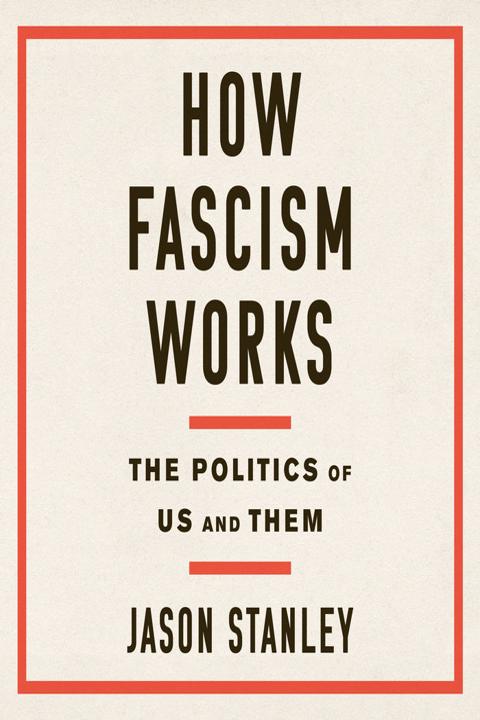
I was at a small independent bookstore today, the exact kind of place that’s supposed to curate a culture of argument and criticism. The prominently displayed books about politics and current events were Timothy Snyder’s book about the terrifying rise of American fascism under that monster Trump, Jason Stanley’s book about the terrifying rise of American fascism under that monster Trump, Anne Applebaum’s book about the terrifying rise of American fascism under that monster Trump, and a bunch of other books by prominent journalists and professors about … okay, try to guess.

On the other side of that exchange, the books by public intellectuals offering a favorable or even neutral view of Trump and the Trump era were … not there? Maybe I just missed them. So every prominent figure moving to the cultural foreground from academia and “mainstream” journalism — every brave contrarian, every freethinking intellectual warrior rising against the prevailing fascist sentiment of the age to speak in his own voice as a free person — thinks and says the same things, the same ways, with the same evidence and the same framing and the same tone and in the same state of mind. They’re so free and brave and iconoclastic that they’re essentially identical, chanting in intellectual unison.

Forget Trump for a moment and answer this question in general: If you’re living through an era in which every prominent journalist and academic and artist says exactly the same fucking thing all the time, what kind of moment are you living in? Would you call people who all chant in unison the resistance?

Any engagement with these books reveals their emptiness. Snyder, Stanley, Applebaum, whatever: pick a book, then pick a page. See if it makes sense. Here, I spent a few nauseating minutes today with brave Jason Stanley’s book How Fascism Works: The Politics of Us and Them. Here’s a paragraph from the introduction to the paperback edition:

ICE is novel: It was created after 9/11, by the same law that created a bureau tasked with border protection: a “special force, created in an anti-democratic moment”.

I can’t calibrate the degree to which this person is a fool or a liar, but let’s go with both. The Border Patrol was created in 1924, and was itself the successor agency to a different organization that was created in 1904. You can read that history here. The post-9/11 organization that supposedly created this novel American institution merely reorganized a century-old American institution, making it not the least bit novel. Before ICE, we had INS. Yes, we had a border before 2003, and we policed it. This isn’t a novel concept at all, as it has operated in any form of practice.

You can go through that single amazing paragraph sentence by sentence and tear every last bit of it apart, at the lowest, simplest factual level. The argument isn’t wrong: all of it is wrong, every layer of fact and interpretation. This man is an absolutely enormous jackass. And he’s … important. An important public intellectual, you see.

March 30, 2025

Dies the Fire and the Founder Effect

Filed under: Books, Economics, USA — Tags: , , , , , , , — Nicholas @ 02:00

Feral Historian
Published 15 Nov 2024

The first book in S.M. Stirling’s Emberverse series, Dies The Fire yanks modern technology out of the world and sets the stage for a multi-faceted exploration of how distinct cultures emerge from small isolated groups and the profound effect individuals can have the societies that coalesce around them.

00:00 Intro
01:28 Founders
03:37 Desperation
04:51 Flawed Assumptions
07:05 Composites and Rhymes
(more…)

March 25, 2025

Analyzing the structure of Tim Walz’s “joke”

Filed under: Humour, Media, Politics, USA — Tags: , , — Nicholas @ 03:00

On his Substack, Jim Treacher shares his deep knowledge of the cultural and linguistic complexities of the humour of Minnesota Governor Tim Walz:

Tim Walz as a standup comedian
Fake image generated with Grok

A joke is a delicate thing.

Let’s say you write a joke and then tell it to some people. The joke might “kill” (get a big laugh) with one audience, but then it might “die” (be met with stony silence or outright anger) with another audience.

Maybe you don’t get the wording quite right: “Why did the chicken cross the street? Wait, no …” Maybe the crowd doesn’t understand a reference you’re making. Maybe it’s just not your day. It can take a lot of work to perfect a joke, and any number of things can still go wrong. You’ll fail at least as often as you succeed, and past performance does not guarantee future results.

I’ve never done stand-up comedy because it would require me to leave the house, but I do have a bit of experience writing jokes for television. And sometimes, a joke I thought was funny when I wrote it in the morning just doesn’t land with that evening’s audience. It’s a crummy feeling, but that’s showbiz.

So, I know just how Tim Walz feels these days!

Last week he made a really funny joke, but a lot of people weren’t smart enough to get it because they’re not Democrats […]

    I was saying, on my phone, some of you know this, on the iPhone they’ve got that little stock app? I added Tesla to it to give me a little boost during the day. 225 and dropping!

    And if you own one, we’re not blaming you. You can take dental floss and pull the Tesla thing off, you know.

Ha ha ha ha ha! [SLAP KNEE, BUST GUT, ETC.]

I will now analyze this brilliant joke, using my hard-won comedy experience, and explain why you’re misguided for not laughing.

You’re welcome.

Now, to the uninitiated, it might sound like Tim Walz is celebrating the misfortune of an opponent. “Ha-ha, your stock is dropping. It’s funny because I don’t like you!” The humor of the bully. Trying to out-Trump Trump.

You might think the audience laughed because they hate Elon Musk so much that they’re happy when he fails, even when it hurts a lot of other people. Maybe even themselves.

But here’s the big twist: That’s not it at all!

See, Governor Walz was being self-deprecating.

When he made that really, really good joke, he already knew that his own state holds 1.6 million shares of Tesla stock in its retirement fund. He was well aware that he was celebrating the misfortune of his own constituents.

But his stage persona didn’t know that.

March 15, 2025

Firefly – We Didn’t Know How Good We Had It

Filed under: Media — Tags: , , , — Nicholas @ 04:00

The Critical Drinker
Published 14 Mar 2025

It was overlooked in its own time, never finding the audience it deserved, but Firefly has gone on to become a cult classic with the most dedicated on fanbases. And now that I’ve finally arrived to the party 20 years late, I wanted to share my thoughts on Joss Whedon’s Firefly.

March 12, 2025

Free speech in Canada takes yet another hit, as Palestinian activists granted special protections

In the National Post, Tristin Hopper outlines the jaw-dropping contents of the Guide to Understanding and Combatting Islamophobia published by the federal government recently:

The federal government has dropped a new guide that, according to critics, deems it “racist” to criticize Palestinian advocacy or extremism.

The guide also defines both “sharia” and “jihad” as benign terms that are misrepresented by Westerners, with sharia defined as a means “to establish justice and peace in society”.

It’s contained in “The Canadian Guide to Understanding and Combatting Islamophobia“, a document published last week by the Department of Canadian Heritage.

The report endorses the idea of “anti-Palestinian racism”, an activist term with such a broad definition that it technically deems any criticism of Palestinians or “their narratives” to be racist.

“Public discourse often unfairly associates Palestinian and Muslim identities with terrorism,” reads the guide.

The new guide specifically links to a definition of the term circulated by the Arab Canadian Lawyers Association. Their 99-word definition says that it’s racist to link the Palestinian cause to terrorism, to describe it as “inherently antisemitic” or to say that Palestinians are not “an Indigenous people”.

The term is broad enough that merely acknowledging the existence of Israel could fall under its rubric. The definition describes the Jewish state as “occupied and historic Palestine”, and its creation as “the Nakba” (catastrophe). “Denying the Nakba” is specifically cited as one of the markers of “anti-Palestinian racism”.

In a March 4 statement criticizing the new federal report, the Centre for Israel and Jewish Affairs (CIJA) said that the term is so vague that “denouncing Hamas – the terrorists behind the October 7 massacre – could be portrayed as an act of racism”.

The new report was praised, meanwhile, by the vocally anti-Israel Centre for Justice and Peace in the Middle East, which called Ottawa’s embrace of the term anti-Palestinian racism “groundbreaking.”

“We are extremely pleased that Canada, through this guide, finally recognizes the unique racism that Palestinians experience daily,” said the group’s acting president Michael Bueckert.

The federal government’s new guide writes that Canada’s “understanding of anti-Palestinian racism” is growing, and directs readers to a 2022 report on the phenomenon by the Arab Canadian Lawyers Association.

March 2, 2025

QotD: Chardonnay

Filed under: Humour, Quotations, Wine — Tags: , — Nicholas @ 01:00

When my editor told me that I could write about anything I wanted in my first column so long as it was Chardonnay, I thought briefly about killing her. In the years since Chardonnay has become a virtual brand name I’ve grown sick to death of hearing my waiter say, “We have a nice Chardonnay”. The “house” chard in most restaurants usually tastes like some laboratory synthesis of lemon and sugar. If on the other hand, you order off the top of the list, you may get something that tastes like five pounds of melted butter churned in fresh-cut oak.

Jay McInerney, Bacchus & Me: Adventures in the Wine Cellar, 2002.

February 9, 2025

A “certain niche Canadian’s” prophetic look at Western demography

Filed under: Books, Government, Politics, USA — Tags: , , , , , — Nicholas @ 03:00

Mark Steyn reminds us that it’s twenty years since he published America Alone: The End of the World as We Know It, which has become more and more accurate every year:

~As some readers may be aware, next year marks the twentieth anniversary of a certain “niche Canadian”‘s boffo international bestseller on demography. So the other day I was musing on whether it was too soon to mark the occasion — only to find I’d been beaten to the punch by the Nigerian media bigfoot Azu Ishiekwene:

    It’s nearly 20 years since Mark Steyn wrote a non-fiction book, America Alone: The End of the World as We Know It.

    Steyn, a Canadian newspaper columnist, could not have known that the kicker of this book title, which extolled America as the last bastion of civilisation as we know it, would become the metaphor for a wrecking ball.

    Steyn thought demographic shifts, cultural decline, and Islam would ruin Western civilisation. The only redeeming grace was American exceptionalism. Nineteen years after his book, America Alone is remembered not for the threats Steyn feared or the grace of American exceptionalism but for an erratic president almost alone in his insanity.

    The joke is on Steyn.

Oh, well. It was good while it lasted — which wasn’t as long as it should have, thanks to the dirty stinkin’ rotten corrupt American “justice” system (see below).

~But I thank Mr Ishiekwene for reminding me of the twin theses of my book: on the one hand, “demographic shifts, cultural decline, and Islam” and, on the other, “American exceptionalism”. The first half is undeniable: At one point last year, there were no Anglo-Celtic heads of government anywhere in the British Isles except for Northern Ireland. Nobody even talks about “demographic shifts”, with even “conservative” politicians preferring to focus on “British values” or “French values” or “[Your Country Here] values”, even as those “values”, not least freedom of speech, are remorselessly surrendered. The UK’s “Deputy Prime Minister”, Angela Rayner, is proposing as the state’s reaction to the Southport stabbings, about which the most intemperate Tweeters were less inaccurate than the state propaganda, to restrict free expression even further. Islam? In Britain, Germany, France, the Netherlands, we would rather our children be stabbed and gang-raped than do anything about it, especially if it risks being damned as “Islamophobic”. The delightful Ms Rayner, who once boasted about flashing her soi-disant “ginger growler” across the Commons to Boris Johnson at Question Time, will be keeping it under wraps in the years ahead.

~As for the second part of my book’s arguments — “American exceptionalism” — well, it’s been a rough twenty years. But, to cast Azu Mr Ishiekwene’s contempt for an “an erratic president almost alone in his insanity” in a more generous light, the last three weeks have been a useful reminder that America is still different — or, at any rate, retains the capacity to be different. In his first days in office Trump 47 yanked the US from the World “Health” Organisation and the Paris “climate” accord and the UN “Human Rights” Council. If I have been insufficient in my praise for this energy, it is only because I held out hopes that a man “alone in his insanity” might have simply nuked the WHO. But, such disappointments aside, in Britain (and in the EU it has yet to leave in any meaningful sense), no such decisive acts in the here-and-now can even be contemplated.

And just because I’ve been including a fair bit of USAID-related stuff this week, he comments on Elon Musk’s epic sidequests investigations into US government waste and corruption:

~That’s the good news — and it’s very heartening. The bad news is that almost everything the national government (it is no longer really “federal”) of the United States touches is a racket.

The United States Agency for International Development is so-called in order that gullible rubes who listen to NPR think that it’s something to do with helping starving children in Africa. The cynical rubes who follow Conservative Inc think it’s something to do with helping African dictators’ Swiss bank accounts and endlessly regurgitate the old line about “international aid” taking money from poor people in rich countries to give to rich people in poor countries. But this is the cynicism of the terminally naïve and does a great injustice to the average blood-drenched Somali warlord. As Elon Musk has pointed out, ninety per cent of USAid funds are disbursed in the Washington, DC area. Opponents of that line say, ah, yes, but that’s misleading because some of it then gets passed on outside the Beltway eventually to reach some emaciated Congolese laddie.

Well, I would doubt it. There is no legitimate reason for Bill Kristol and Mona Charen to be receiving any funds from an agency for “international development” — and they surely know it. The least we should expect from them is that they come by their Never Trumpery honestly.

But I wouldn’t be surprised to learn that that 90-10 ratio is pretty standard. The US armed forces account for forty per cent of the planet’s total military spending. Does ninety per cent of that also get disbursed in the District of Columbia? On Thoroughly Modern Milley’s ribbon budget? It’s as good an explanation as any for the failure to win anything since VJ Day. The rube right’s antipathy to foreigners shouldn’t blind us to the fact that the overwhelming majority of the corruption is domestic — and it’s a very bipartisan sewer.

So I wish Trump, Musk et al the best of luck. But, notwithstanding that every rinky-dink District Court judge seems to be labouring under the misapprehension that he’s head of the executive branch of government, Trump has spent the last three weeks doing things. There is no sign that that is even possible in the rest of the west, where the Dutch model seems to prevail: Geert Wilders wins the election, but then gets neutered.

So, in a sense, Azu Ishiekwene is right. There is a yawning chasm between Trump and the poseur attitude-flaunting rest of the west. And yet Mr Ishiekwene is wrong on this: an erratic president is not almost alone in his insanity. In case you haven’t noticed, Panama won’t be renewing its Chinese deal on the Belt & Road Initiative, and El Salvador is happy to gaol anybody Trump sends them. It turns out that the quickest way to solve any international dispute is to threaten the recalcitrant with twenty-five per cent tariffs starting at midnight. If the forty-seventh president doesn’t seem interested in “winning hearts and minds”, it’s because he’s found something more effective.


QotD: Rosé Wine

Filed under: Quotations, Wine — Tags: , — Nicholas @ 01:00

Anyone who starts analyzing the taste of a rosé in public should be thrown into the pool immediately. Since I am safe in a locked office at this moment, though, let me propose a few guidelines. A good rosé should be drier than Kool-Aid and sweeter than Amstel Light. I should be enlivened by a thin wire of acidity, to zap the taste buds, and it should have a middle core of fruit that is just pronounced enough to suggest the grape varietal (or varietals) from which it was made. Pinot Noir, being delicate to begin with, tends to make delicate rosés. Cabernet, with its astringency, does not. Some pleasingly hearty pink wines are made from the red grapes indigenous to the Rhône and southern France, such as Grenache, Mourvèdre, and Cinsault. Regardless of the varietal, rosé is best drunk within a couple of years of vintage.

Jay McInerney, Bacchus & Me: Adventures in the Wine Cellar, 2002.

January 30, 2025

QotD: Michael Moore

Filed under: Media, Politics, Quotations, USA — Tags: , , , — Nicholas @ 01:00

Bowling for Columbine is the latest documentary from Michael Moore, the leftwing multi-millionaire provocateur in his usual cunning disguise as an all-American lardbutt loser — baseball cap, unkempt hair, untucked shirt. This time, the nominal subject is American violence, but, by now, connoisseurs of Roger and Me and Moore’s TV work know that, whatever the subject, the routine never varies: he turns up at company headquarters unannounced and demands to see the chairman. The receptionist says he’s not available, and Moore merrily films the stand-off before moving on to some other target. If he showed up to see me without making an appointment, I’d tell him to piss off and then fire a warning shot. If I showed up to see him unannounced and accompanied by a camera crew, his people would do the same to me.

But most folks are nicer than that.

And so you can’t help noticing that, for a champion of the little guy, he goes to an awful lot of time and effort to make the little guy look like a chump. Moore has no interest in digging deep into his subjects when all the fun’s to be had on the surface of American life — the squeaky receptionists, the bored security guards, the bland PR women, the squaresville company guy in the suit, the State Police trooper with the infelicitous phrasing, the bozo in the pool hall … His vision of America as a wasteland of gun kooks, conspiracy theorists and perky brain-fried mall clerks will doubtless have them rolling in the aisles in Paris this weekend. In my corner of New Hampshire, there were only four other moviegoers in the theater. But Moore, a great favorite with the BBC, now does his shtick with an eye to the non-American market.

Mark Steyn, “Bowling for Columbine”, Steyn Online, 2002-11-30.

January 18, 2025

QotD: On Auguste Rodin’s Fallen Caryatid

Filed under: Architecture, Books, Quotations — Tags: , , — Nicholas @ 01:00

“For three thousand years architects designed buildings with columns shaped as female figures. At last Rodin pointed out that this was work too heavy for a girl. He didn’t say, ‘Look, you jerks, if you must do this, make it a brawny male figure’. No, he showed it. This poor little caryatid has fallen under the load. She’s a good girl — look at her face. Serious, unhappy at her failure, not blaming anyone, not even the gods … and still trying to shoulder her load, after she’s crumpled under it.

“But she’s more than good art denouncing bad art; she’s a symbol for every woman who ever shouldered a load too heavy. But not alone women — this symbol means every man and woman who ever sweated out life in uncomplaining fortitude, until they crumpled under their loads. It’s courage, […] and victory.”

“‘Victory’?”

“Victory in defeat; there is none higher. She didn’t give up […] she’s still trying to lift that stone after it has crushed her. She’s a father working while cancer eats away his insides, to bring home one more pay check. She’s a twelve-year old trying to mother her brothers and sisters because Mama had to go to Heaven. She’s a switchboard operator sticking to her post while smoke chokes her and fire cuts off her escape. She’s all the unsung heroes who couldn’t make it but never quit.

Robert A. Heinlein, Stranger in a Strange Land, 1961.

January 13, 2025

The “Thucydides Trap”

Filed under: Books, China, History, Military, USA — Tags: , , , , , , — Nicholas @ 03:00

At History Does You, Secretary of Defense Rock provides a handy explanation of the term “the Thucydides Trap”:

In the world of international relations, few concepts have captured as much attention — and sparked as much debate — as the “Thucydides Trap”. Brought to prominence by Harvard political scientist Graham Allison, the term suggests that conflict is almost inevitable when a rising power threatens to displace an established one, a dynamic often invoked to frame the strategic rivalry between the United States and China. Lauded as a National Bestseller and praised by figures like Henry Kissinger and Joe Biden, Allison’s Destined for War: Can America and China Escape Thucydides’s Trap? has become a staple of policy discussions and academic syllabi. Yet beneath the widespread acclaim lies a deeply flawed analysis, one that risks oversimplifying history and perpetuating a fatalistic narrative that could shape policy in dangerous ways. Far from an inescapable destiny, the lessons of history and the nuances of modern geopolitics suggest that the so-called “trap” may be more myth than inevitability.

The term “Thucydides Trap” is derived from a passage in the ancient Greek historian Thucydides’ work History of the Peloponnesian War, where he explained the causes of the conflict between Athens (the rising power) and Sparta (the ruling power) in the 4th century BC. Thucydides famously wrote

    It was the rise of Athens and the fear that this instilled in Sparta that made war inevitable.

Allison defines the “Thucydides Trap” as “the severe structural stress caused when a rising power threatens to upend a ruling one”.1 More articles by Allison using this term previously appeared in Foreign Policy and The Atlantic. The book, published in 2017, was a huge hit, being named a notable book of the year by the New York Times and Financial Times while also receiving widespread bipartisan acclaim from current and past policymakers. Historian Niall Ferguson described it as a “must-read in Washington and Beijing”.2 Senator Sam Nunn wrote, “If any book can stop a World War, it is this one”.3 A brief search on Google Scholar reveals the term “Thucydides Trap” has been cited or used nearly 19,000 times. In 2015, Australian Prime Minister Malcolm Turnbull even publicly urged President Xi and Chinese Premier Li Keqiang to avoid “falling into the Thucydides Trap”.4 One analyst observed that the term had become the “new cachet as a sage of U.S.-China relations”.5 The term has become so prominent that it is almost guaranteed to appear in any introductory international politics course when discussing U.S.-China relations.

Allison wrote in his essay “The Thucydides Trap: Are the U.S. and China Headed for War?” in The Atlantic published in 2015, “On the current trajectory, war between the United States and China in the decades ahead is not just possible, but much more likely than recognized at the moment” forewarning, “judging by the historical record, war is more likely than not”.6 A straightforward analysis of the 16 cases in the book and previous essays might indicate that, based on historical precedent, there is approximately a 75 percent likelihood of the United States and China engaging in war within the next several decades. Adding the additional cases from the Thucydides Trap Website would still leave a 66 percent chance, more likely than not, that two nuclear-armed superpowers will go to war with one another, a horrifying and unprecedented proposition.7

With such alarm, it’s no surprise that the concept gained such widespread attention. The term is simple to understand and in under 300 pages, Allison delivers a sweeping historical narrative, drawing striking parallels between events from ancient Greece to the present day.8 International Relations as a field often struggles to break through in the public discourse, but Destined for War broke through, making a broad impact on academic and popular discourse.


    1. Graham Allison, Destined For War: Can America and China Escape Thucydides’s Trap? (Boston: Houghton Mifflin Harcourt, 2017), 29.

    2. Ibid., iii.

    3. Ibid., vi.

    4. Quoted by Alan Greeley Misenheimer, Thucydides’ Other “Traps”: The United States, China, and the Prospect of “Inevitable” War (Washington: National Defense University, 2019), 8.

    5. Misenheiemer, 1.

    6. “Thucydides’s Trap Case File” Belfer Center for Science and International Affairs, Harvard Kennedy School, accessed December 31, 2024

    7. Graham Allison, “The Thucydides Trap: Are the U.S. and China Headed for War?” The Atlantic, September 24, 2015.

    8. Misenheimer details what Thucydides actually said about the origins of the Peloponnesian War, 10-17.

January 5, 2025

German democracy hanging by a thread after vicious attacks by Elon Musk

Filed under: Germany, Media, Politics — Tags: , , , , , — Nicholas @ 03:00

German politicians are growing ever more desperate as evildoers like Elon Musk continue to undermine the political stage by calling for antidemocratic things like free speech:

Alice Weidel, the federal leader of Germany’s “far-right” AfD, has approximately the same policy prescriptions as Donald Trump. Chiefly they are to return to the bourgeois habits that used to make free market states prosperous. But she subscribes to these in mainland Europe, which has been easily spooked since the Nazis offered policies that were not bourgeois.

“Humankind cannot bear very much reality,” as the far-right poet, T. S. Eliot, wrote in Burnt Norton, now the better part of a century ago. (He was arguably plagiarizing the far-right German poet, Johann Wolfgang von Goethe.)

One could recommend that my readers look her up on YouBoob, or better search for print, and form their own opinion on this Frau Weidel. (Who speaks English, and Chinese, fluently.)

Compare her, for instance, to the British prime minister, Keir Starmer, who rose to power as the prosecutor protecting Muslim “grooming gangs”, and now puts people in gaol who protest on behalf of their rape and murder victims. The idea that Mr Starmer should have a rôle in the government of a civilized country, is as absurd as the idea that the 14-year-old narcissist who has ruled Canada, or the 82-year-old senescent who has ruled the United States, are respectable members of the human race.

And closer to the scene of crisis, eugyppius reports on the latest Muskian outrage against peace-loving German politicians:

For days, the German establishment have been in an absolute uproar over Elon Musk’s profoundly antidemocratic election interference. You cannot turn on the television or open any newspaper without enduring all manner of wailing about the grave danger Musk poses to German democracy.

The naive and the simpleminded will say that all of this is crazy and that the Federal Republic has become an open-air insane asylum – a strange playground of political hysterics the likes of which the Western world has never seen before. That is because they don’t understand what’s at stake here. Musk did not just say the odd nice thing about Alternative für Deutschland, oh no. He also said various German politicians were fools and traitors, he called for resignations and he published an untoward newspaper editorial. It is amazing the German democracy has not yet collapsed in the face of this unrelenting campaign, and still the absolute madman shows no signs of stopping.

Elon Musk’s frontal assault on the German constitution began on 7 November, when he tweeted four antidemocratic words – “Olaf ist ein Narr” (“Olaf [Scholz] is a fool”) – in response to news that the German government had collapsed. Three days later, he tweeted the same thing about Green Economics Minister and chancellor candidate Robert Habeck, after Habeck gave a speech calling for widespread internet censorship.

Thereafter, all was quiet for a time. German democrats allowed themselves to hope these were but isolated indiscretions and that Musk would allow them to get back to their arcane business of promoting feminism abroad, changing the weather and eliminating “the extreme right”. Lamentably, the peace turned out to be a false one. Musk renewed his campaign against democracy with a vengeance on 20 December, tweeting in the wake of the Magdeburg Christmas market attack that “Scholz should resign immediately” and that he is an “incompetent fool”. That very same day, Musk tweeted for the first time that “Only the AfD can save Germany”, a sentiment he repeated also on 21 December and on 22 December, delighted at the nationwide freakout his casual remarks had incited.

In the course of this freakout, German President Frank-Walter Steinmeier hinted darkly that “outside influence” constitutes “a danger for democracy”:

    Outside influence is a danger for democracy – whether it is covert, as was recently apparent in the elections in Romania, or open and blatant, as is currently being practised with particular intensity on the platform X. I strongly oppose all external attempts at influence. The decision on the election is made solely by the eligible citizens in Germany.

The indefatigable Naomi Seibt, who appears to be Musk’s primary informant about German politics, brought these remarks to the evil fascist billionaire’s attention, and he promptly responded that “Steinmeier is an anti-democratic tyrant”. Musk then delivered his coup-de-grace the next day, with an editorial in Welt am Sonntag – the most devastating piece of political prose that Germany has witnessed since Hitler penned Mein Kampf.

By my count, Musk may have directed as many as 700 words against the noble if surprisingly rickety edifice of German democracy – an assault few political systems could withstand. The self-appointed guardians of our liberal order accordingly declared a five-alarm fire, and they have betaken themselves to their keyboards to defend what remains of our free and eminently democratic political system, where anybody can say anything he likes and vote for any party he wishes, so long as what he likes and those for whom he votes have nothing to do with major political parties supported by millions of Germans like Alternative für Deutschland.

« Newer PostsOlder Posts »

Powered by WordPress