Quotulatiousness

November 26, 2011

Incentives matter, especially in policing

Filed under: Law, Liberty, USA — Tags: , , , , — Nicholas @ 10:31

Radley Balko looks at how federal government incentives to local police departments are encouraging them to concentrate on minor drug offenders instead of helping the victims of violent crime:

Arresting people for assaults, beatings and robberies doesn’t bring money back to police departments, but drug cases do in a couple of ways. First, police departments across the country compete for a pool of federal anti-drug grants. The more arrests and drug seizures a department can claim, the stronger its application for those grants.

“The availability of huge federal anti-drug grants incentivizes departments to pay for SWAT team armor and weapons, and leads our police officers to abandon real crime victims in our communities in favor of ratcheting up their drug arrest stats,” said former Los Angeles Deputy Chief of Police Stephen Downing. Downing is now a member of Law Enforcement Against Prohibition, an advocacy group of cops and prosecutors who are calling for an end to the drug war.

“When our cops are focused on executing large-scale, constitutionally questionable raids at the slightest hint that a small-time pot dealer is at work, real police work preventing and investigating crimes like robberies and rapes falls by the wayside,” Downing said.

[. . .]

Several NYPD officers have alleged that in some precincts, police officers are asked to meet quotas for drug arrests. Former NYPD narcotics detective Stephen Anderson recently testified in court that it’s common for cops in the department to plant drugs on innocent people to meet those quotas — a practice for which Anderson himself was then on trial.

At the same time, there’s increasing evidence that the NYPD is paying less attention to violent crime. In an explosive Village Voice series last year, current and former NYPD officers told the publication that supervising officers encouraged them to either downgrade or not even bother to file reports for assault, robbery and even sexual assault. The theory is that the department faces political pressure to produce statistics showing that violent crime continues to drop. Since then, other New Yorkers have told the Voice that they have been rebuffed by NYPD when trying to report a crime.

November 24, 2011

US to be crushed by Oriental economic juggernaut, film at 11

Filed under: China, Economics, Japan, Media — Tags: , , , — Nicholas @ 09:27

Do any of these statements sound familiar?

  • “I don’t mean to be an alarmist, but I get the uneasy feeling that America is history”
  • “The power behind the [. . .] juggernaut is much greater than most Americans suspect, and the juggernaut cannot stop of its own volition, for [it] has created a kind of automatic wealth machine, perhaps the first since King Midas.”

This kind of statement can be found in all the prestigious newspapers, opinion journals, and magazines . . . in the late 1970s through the late 1980s. The economic juggernaut of the day was Japan. It was poised to crush the feeble remnants of American capitalism with the all-powerful keiretsu, Japan’s corporate conglomerate organizations. The strong would smash the weak, leaving America (and the rest of the Anglosphere) in the dust. Just in case you didn’t follow economic history, it didn’t happen.

Today, the economic bogeyman is China:

“We are getting our clock cleaned by Chinese state capitalism,” wrote Robert Kuttner, now editor of The American Prospect, earlier this year at The Huffington Post. Massachusetts Institute of Technology economist Simon Johnson piled on at the annual conference of the American Economic Association, declaring, “The age of American predominance is over. The [Chinese] Yuan will be the world’s reserve currency within two decades.” The conservative Citizens Against Government Waste even aired a television commercial featuring a Beijing economics class in 2030 in which a professor explains how America became indebted to China. The professor concludes, “So now they work for us.” The class chuckles knowingly.

This gloomy message of American decline relative to China appears to be seeping into popular consciousness. An April 2011 poll by Xavier University found that “a stunning 63 percent believe that the Chinese economy is more powerful than the US economy.”

“The U.S. could lose its status as the world’s biggest economic power within five years,” reported The Daily Mail in April. The Mail article was based on calculations released by the International Monetary Fund projecting that total Chinese GDP, adjusted for purchasing power, will surpass U.S. GDP by 2016.

Can that be? Let’s do the math: China’s total GDP is around $6 trillion today. Assuming 10 percent GDP growth for the next 20 years, China’s GDP would rise to $40 trillion. If the U.S. economy grew at, say, 3 percent a year, total GDP would be $27 trillion. Back in 2007, before the financial crisis, the investment bank Goldman Sachs issued a report projecting that Chinese GDP would be $26 trillion in 2030, compared to $23 trillion for the U.S. It bears noting that current Chinese purchasing power per capita is about $6,000, compared to $46,000 for Americans.

That’s not to say that it’s impossible — the longer the US government struggles to avoid cutting back, the more likely it is that the US will enter a long economic decline — but China has economic problems a-plenty.

October 31, 2011

China’s increased output of scientific papers masks deeper problems

Filed under: China, Media, Science — Tags: , , , — Nicholas @ 12:01

Colby Cosh linked to an interesting press release from the Chinese Academy of Sciences, which shows a surge in published papers from China, but a significant drop in the rate at which those papers are cited:

Chinese researchers published more than 1.2 million papers from 2006 to 2010 — second only to the United States but well ahead of Britain, Germany and Japan, according to data recently published by Elsevier, a leading international scientific publisher and data provider. This figure represents a 14 percent increase over the period from 2005 to 2009.

The number of published academic papers in science and technology is often seen as a gauge of national scientific prowess.

But these impressive numbers mask an uncomfortable fact: most of these papers are of low quality or have little impact. Citation per article (CPA) measures the quality and impact of papers. China’s CPA is 1.47, the lowest figure among the top 20 publishing countries, according to Elsevier’s Scopus citation database.

China’s CPA dropped from 1.72 for the period from 2005 to 2009, and is now below emerging countries such as India and Brazil. Among papers lead-authored by Chinese researchers, most citations were by domestic peers and, in many cases, were self-citations.

Being published is very important for sharing discoveries and advancing the careers of the scientists, but it’s more important that those publications be read and referenced by other scientists. Self-citations are akin to self-published works: it doesn’t guarantee that the work is useless, but it increases the chances that it is.

Perhaps worse than merely useless publication is the culture of corruption that has grown up around the scientific community:

In China, the avid pursuit of publishing sometimes gives rise to scientific fraud. In the most high-profile case in recent years, two lecturers from central China’s Jinggangshan University were sacked in 2010 after a journal that published their work admitted 70 papers they wrote over two years had been falsified.

[. . .]

A study done by researchers at Wuhan University in 2010 says more than 100 million U.S. dollars changes hands in China every year for ghost-written academic papers. The market in buying and selling scientific papers has grown five-fold in the past three years.

The study says Chinese academics and students often buy and sell scientific papers to swell publication lists and many of the purported authors never write the papers they sign. Some master’s or doctoral students are making a living by churning out papers for others. Others mass-produce scientific papers in order to get monetary rewards from their institutions.

October 21, 2011

Incentives matter, police edition

Jonathan Blanks explains that the incentives provided to police officers clearly do influence their behaviour:

Last week, former undercover police officer Stephen Anderson told the New York State Supreme Court that planting drugs on innocent people was so common that it didn’t even register emotionally to him. The story is starting to get traction in the media as an egregious example of police corruption, but it’s notable only because of the admission to the practice in open court. Each year, there are hundreds of cases in which police officers are caught stealing, using, selling, or planting drugs or pocketing the proceeds from drug busts. Despite the obligatory PR protestations that any given instance of corruption is an isolated case, the systemic, legal, social, and economic incentives in every law enforcement agency in America combine to make police corruption virtually inevitable. And with no other category of crimes are these incentives stronger than with drug crimes.

Anderson testified that drugs would be seized from suspects at a given bust, divided, and then used again as evidence against other people on site (or at a time later) who had nothing to do with the initial arrest. This was, in part, due to established drug arrest quotas the officers needed to meet. As public servants, police departments face the same budgetary pressures as any other government entity and thus their officers are required to meet certain benchmarks set by the powers that be. Added to the normal budgetary justification, however, many police officers are in the position to confiscate cash and property that can be sold at auction thanks to civil asset forfeiture laws. Many departments across the country keep a percentage or the entirety of forfeiture proceeds, so pressure to maintain a certain level of drug arrests is something straight out of Public Choice: 101.

September 20, 2011

China’s local and regional governments may be sitting on massive hidden debts

Filed under: China, Economics, Government, Law — Tags: , , — Nicholas @ 12:13

As with the US or Canadian government’s debt, not all debt is held at the federal level. It may take some digging to discover what the actual debt levels might be, but it’s possible. In China, however, as local governments are forbidden to issue bonds or to borrow from banks, they’ve had to become extremely creative in finding ways to borrow money for their pet projects. Not just creative — at least in some cases — legally dubious:

About 85% of Liaoning province’s 184 financing companies defaulted on debt service payments in 2010 according to a report from the province’s Audit Office. The report also noted that 120 of these borrowers, de facto government agencies, operated at a loss last year.

Since 1994, provinces and lower-tier governments have not been permitted to issue bonds or borrow from banks. Despite the strict prohibition, their debt has skyrocketed as local officials incurred obligations through LGFVs, local government finance vehicles. The central government’s National Audit Office said these companies, at the end of last year, had taken on 10.7 trillion yuan of debt. No one, however, knows the true amount of LGFV indebtedness, and some have calculated the real amount to be more than double the official figure.

Why the disagreement as to the amount of debt? Local governments have gone out of their way to hide borrowings, perhaps in part because of their doubtful legality. As famed economic journalist Hu Shuli points out, new local officials sometimes do not know the extent of obligations left by their predecessors. There have been a number of stratagems employed, from the issuance of illegal government guarantees to the transfer of funds in roundabout routes.

H/T to Jon, my former virtual landlord, for the link.

September 12, 2011

Is the People’s Liberation Army a paper tiger?

Filed under: China, Economics, Military, Weapons — Tags: , , , — Nicholas @ 09:36

An interesting article at Strategy Page looks at the myth and reality of China’s army and navy:

You don’t see much in the media about the poor training of Chinese military personnel. You don’t hear much about the poor leadership and low readiness for combat. But all of this is common knowledge in China. There, the military is not walled off from everyone else. Cell phone cameras and the Internet make it easy to pass around evidence (often in the form of “hey, this one is hilarious”). The government tries to play up how modern and efficient the military is, but most Chinese know better, and don’t really care. China is winning victories on the economic front, and that what really counts to the average Chinese.

Meanwhile, U.S. military leaders and defense industries are looking for a sufficiently impressive foe to help scare more money out of Congress. The Chinese Navy (or, more correctly, the Chinese Peoples’ Liberation Army Navy) is now the favorite candidate, for navy and defense industry analysts, to become the new Big Bad. Just how dangerous are these Chinese sailors and their ships? It turns out that, on closer inspection, not very.

This is the sort of thing that what went on during the Cold War. Russian military prowess was hyped by the American military, and their defense suppliers, to justify further increases in defense spending. When the Cold War ended, it was revealed how the Russian military, and defense manufacturers, played the same game. It also revealed that Russian military capabilities were far less than the hype indicated.

The basic weapon for this sort of thing is FUD (Fear, Uncertainty and Doubt). Works every time, although it is difficult to pitch the Chinese navy as a crack force. Most of their ships are elderly, poorly designed and rarely used. Their nuclear subs are worse than the first generation of Russian nukes back in the 1960s. The most modern Chinese ships are Russian made, Cold War era models. Chinese ships don’t go to sea much, not just because it’s expensive, but because Chinese ships tend to get involved in nasty incidents. Like the submarine that killed its crew when the boat submerged (and the diesel engines did not shut down when the batteries kicked in, thus using up all the oxygen.) Breakdowns are more common, as well as a lot of accidents you don’t hear about (weapons and equipment malfunctions that kill and maim.) Nevertheless, the Chinese are working to change this. Ships are going to sea more each year, and troops are getting more training. But unless the corruption is curbed, this could all be wasted.

Of course, if China isn’t the big military threat to the rest of the world, how will the Pentagon get Congress to go along with its perpetual demands for more funding?

July 28, 2011

Signalling failure blamed for high speed rail crash

Filed under: China, Media, Technology — Tags: , , , — Nicholas @ 08:32

This sounds a bit fishy, as this kind of error has been known in railway signal systems for over 100 years: signals that fail to show stop as a default whenever power is lost:

After it was struck by lightning, the signaling device at the Wenzhou South railway station malfunctioned and failed to turn from green to red, An Lusheng, chief of the Shanghai Railway Bureau, told the news agency. He also said workers on duty were inadequately trained and failed to notice the malfunction.

Xinhua’s report, the first official explanation of the cause of the crash, raised further questions about China’s high-speed rail system, one of the world’s largest and most costly public works projects. The accident occurred when one high-speed train rear-ended another that had stalled on the tracks near Wenzhou in Zhejiang Province. High-speed rail has an excellent safety record elsewhere, especially in Japan, which has never had a fatality.

Chinese have flooded microblogging sites with furious complaints about breakneck development without heed to safety. Many also expressed fears of a cover-up, especially after reports that one train car was buried at the site despite the ongoing investigation and only later excavated.

July 26, 2011

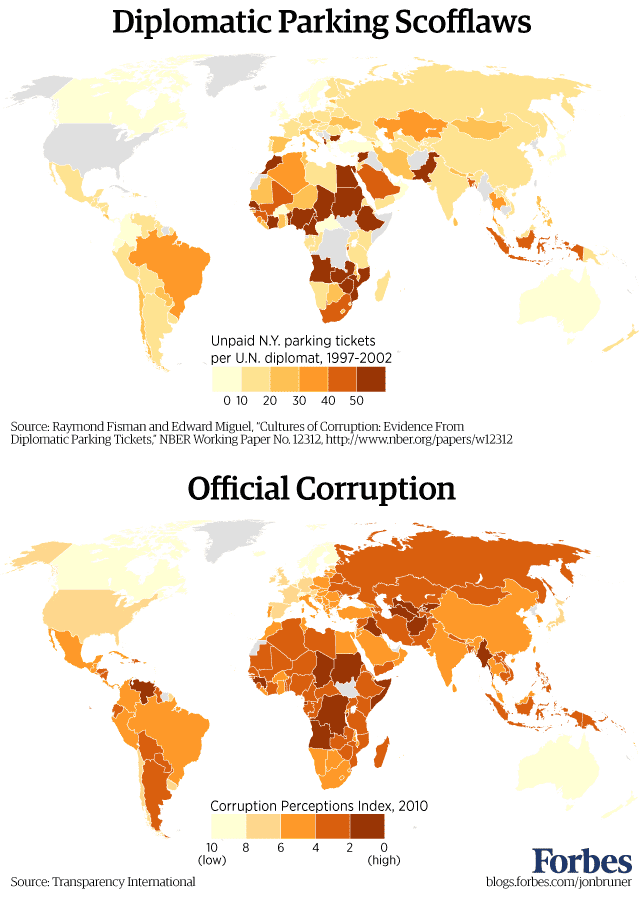
The implied relationship between traffic tickets and corruption

Filed under: Economics, Law, Liberty — Tags: , , , — Nicholas @ 09:11

Tim Harford linked to this Forbes graphic showing an interesting correlation:

This nicely illustrates what he wrote in 2006:

An alternative view, popular among the common-sense crowd, is that corruption is a problem in Indonesia because Indonesians are crooks by nature; poor countries are poor because they are full of people who are lazy or stupid or dishonest. I disagree out of faith, rather than because the evidence is compelling. But then, what evidence could there be? You would need to take people from every culture, put them somewhere where they could ignore the law with impunity, and see who cheated and who was honest.

That sounds like a tall order for any research strategy, but the economists Ray Fisman and Edward Miguel have realised that diplomats in New York city were, in fact, the perfect guinea pigs. Diplomatic immunity meant that parking tickets issued to diplomats could not be enforced, and so parking legally was essentially a matter of personal ethics.

Fisman and Miguel found support for the common-sense view. Countries with corrupt systems, as measured by Transparency International, also sent diplomats who parked illegally. From 1997-2005, the Scandinavians committed only 12 unpaid parking violations, and most of them were by a single criminal mastermind from Finland. Chad and Bangladesh, regularly at the top of corruption tables, produced more than 2,500 violations between them. Perhaps poor countries are poor because they are full of corrupt people, after all.

Chinese government announces safety review after high speed rail crash

Filed under: Bureaucracy, China, Media, Technology — Tags: , , , , — Nicholas @ 09:01

In the wake of the deadly collision between two high speed trains, China announced a safety review of the high speed railway system:

Mr Sheng said railway officials would be deployed at frontline rail operations across the country to overhaul maintenance standards and checks on power connections to pre-empt outages.

All local railway bureaux were to draw lessons from the accident, a statement on the railways department website said.

Public fury and scepticism have been expressed in China’s blogosphere, both about the death toll of 39 people — suggesting it is too low — and the safety of China’s rail network.

State newspapers have also expressed concern. The Global Times ran a headline: Anger mounts at lack of answers.

“As the world is experiencing globalisation and integration, why can’t China provide the same safety to its people?” an editorial read.

July 25, 2011

More on that Chinese rail crash

Filed under: China, Government, Media, Technology — Tags: , , , — Nicholas @ 12:49

The official story has changed a few times since the accident, and at least some Chinese feel they are entitled to the truth about the accident:

Internet users attacked the government’s response to the disaster after authorities muzzled media coverage and urged reporters to focus on rescue efforts. “We have the right to know the truth!” wrote one microblogger called kangfu xiaodingdang. “That’s our basic right!”

Leaked propaganda directives ordered journalists not to investigate the causes and footage emerged of bulldozers shovelling dirt over carriages.

Wang, the railways spokesman, said no one could or would bury the story. He said a colleague told him the wreckage was needed to fill in a muddy ditch to make rescue efforts easier.

But Hong Kong University’s China Media Project said propaganda authorities have ordered media not to send reporters to the scene, not to report too frequently and not to link the story to high-speed rail development. “There must be no seeking after the causes [of the accident], rather, statements from authoritative departments must be followed,” said one directive. Another ordered: “No calling into doubt, no development [of further issues], no speculation, and no dissemination [of such things] on personal microblogs!”

July 24, 2011

No, that’s not suspicious at all . . .

Filed under: China, Government, Technology — Tags: , , , , , — Nicholas @ 11:39

. . . when you use backhoes to bury the wreckage before determining the cause of the high speed rail crash:

The wreck on Saturday night killed 35 and injured 210 after a high-speed train lost power for more than 20 minutes and then was rear-ended by another train, according to the Xinhua news agency. Six cars derailed and two fell off a viaduct near the city of Wenzhou.

[. . .]

Photos on the popular Weibo microblogging service showed backhoes burying the wrecked train near the site. Critics said the wreckage needed to be carefully examined for causes of the malfunction, but the railway ministry said that the trains contain valuable national technology and could not be left in the open in case it fell into the wrong hands.

Foreign companies maintain that some crucial technology was stolen from their imported trains. But more importantly to domestic audiences is the perception of a coverup. Initial reports of how the accident occurred are already being partly contradicted by reports in the official media.

July 19, 2011

Murdochphobia

Filed under: Britain, Media, Politics — Tags: , , — Nicholas @ 10:06

Brendan O’Neill says that the current Murdoch-bashing spree appears to be the only game in town for politicians and journalists right now:

Judging from recent comments made by politicians and journalists, you could be forgiven for thinking that Britain had liberated itself from foreign occupation. ‘Like political prisoners after a tyrant has been condemned to death by a people’s tribunal, [our politicians] are at last free’, gushed one commentator. A Lib Dem spokesman described MPs emerging ‘into the sunlight like the freed prisoners in Beethoven’s opera, Fidelio’. Labour leader Ed Miliband says the whole ‘psyche of British politics has changed’.

Wow. Was a secret Nazi cabal exposed and expelled? Did a brave Mili-band of brothers see off an invading army at Dover? Not quite. What happened is that some journalists and the Twittertariat had a pop at Rupert Murdoch. And, under intense pressure, Murdoch closed his Sunday tabloid, the News of the World, and sacked some people. That’s about it. The ‘people’s tribunal’ is actually the Guardian editorial board, and the ‘political tyrant’ who was ‘condemned to death’ is an octogenarian Aussie who was forced to give up his BSkyB bid. Britain freed from tyranny? Sticking with the wartime rhetoric: never in the history of mankind has so much BS been spouted by so many journos.

The notion that the cultural harrying of Murdoch has made British politicians ‘free at last’ — thank God almighty, free at last! — is based on two problematic ideas. First, that British politics was, until last week, dominated by Murdoch. And second, that the muddying of Murdoch’s name will allow our politicians finally to speak honestly and with conviction once more. Neither of these things is true. The fact that so many commentators believe they are reveals a great deal about the parlous state of public debate.

June 29, 2011

Corruption as a catalyst for rebellion?

Filed under: Bureaucracy, Germany, Government, Politics, Russia — Tags: , , , — Nicholas @ 07:26

Austin Bay points out that better communications have been important elements in the “Arab Spring” and other populist protests in the world right now, but there’s another element joining them together:

What links the Arab Spring rebellions with political agitation in China and at least another five dozen simmering or emerging crises?

If your answer is “the Internet,” you have identified one of the key information technologies that spread the flames. However, the common human fire in these disparate struggles is intense disgust with embedded corruption.

Tyrants maintain control by isolating and intimidating their subjects. However, since the advent of the printing press and increasing public literacy, preserving tyrannical isolation has become a bit more difficult.

Over time, subjects become aware of social, cultural, economic and political alternatives to the despot’s rule, despite the despot’s propaganda. Just how deeply West German television influenced East German resistance to communism is debatable, but the Iron Curtain could not hide the overwhelming evidence of Western affluence and the West’s ability to occasionally remove corrupt leaders.

Communist elite corruption amidst systemic economic failure certainly influenced resistance throughout Eastern Europe and the Soviet Union. The special stores and vacation homes enjoyed by Communist Party favorites infuriated workers denied similar access. East European workers knew that they were industrialized serfs in handcuffed societies falling further and further behind Western European nations. In 1989, when the Russians concluded the Eastern European security forces could not — or would not — shoot everyone, the Berlin Wall cracked.

June 21, 2011

Chinese high speed trains to run slower than planned

Filed under: China, Technology — Tags: , , , , — Nicholas @ 13:02

They’ll still qualify as high speed trains, but they’ll only travel at speeds up to 250kph instead of the 385kph they were designed to achieve. The problem is safety concerns:

The Chinese government has announced a significant lowering in the top speed its hallmark Beijing-to-Shanghai high-speed train will be allowed to run at when it opens later this month after a review of safety, shoddy workmanship and corruption.

The new service halving the 10-hour rail travel time between China’s political and business centres was meant to be the flagship project of a massive $400-billion program to give the country the most extensive bullet train network anywhere.

But the announcement last week by the Railway Ministry that trains on the new line will only be permitted to run at about 250 kilometres per hour instead of the projected 380 km/h has taken the bloom off the opening.

The restriction follows a review by officials stemming from the sacking in February of the railway minister, Liu Zhijun, and the deputy chief engineer of the department, Zhang Shuguang.

The concerns about safety are not at all unwarranted:

Contractors are said to have skimped on using expensive hardening agents when making the concrete for the rail bases. These ties are predicted to crumble within a few years. And there is said to have been a similar shortage of strengthening ingredients included in the concrete used to build bridges and their supporting columns.

A high speed train requires the right-of-way to be engineered to a much higher standard than ordinary passenger or freight rail lines. If too many corners have been cut in this construction, it would be insane to allow the trains to run at full speed until the entire line has been inspected, tested, and problems addressed. If there were even greater “economies” taken during construction, it might not be safe to run the trains at any speed.

And what’s a story like this without a bit of trash-talking from a rival high speed railway operator:

“The difference between China and Japan is that in Japan, if one passenger is injured or killed, the cost is prohibitively high,” he said. “It’s very serious. But China is a country where 10,000 passengers could die every year and no one would make a fuss.”

That’s a quote from the chairman of Central Japan Railway, which runs the Tokyo-Osaka Shinkansen service.

June 9, 2011

Whistleblowers must take a number and wait to be served

Filed under: Bureaucracy, Economics, Law, USA — Tags: , , , — Nicholas @ 09:21

Edward Siedle, foolish man, takes the Securities and Exchange Commission at their word:

Last Friday afternoon I got it into my head that I should try to contact the head of the SEC’s new whistleblower office and discuss a money manager scam I’d uncovered. Surely, I figured, in this post-Madoff era the SEC must be rolling out the red carpet for those looking to clue it in on financial shenanigans.

On the SEC’s home page, at www. sec.gov I found a new button that says “Questions, Tips and Complaints Whistleblower Provisions.” The bureaucrats behind this nifty new feature were so prescient that they even included a picture of a whistle for the convenience of illiterate snitches.

But he’s in a hurry, and doesn’t want to just fax or email the information — he wants to talk to a human being. That’s where it gets amusing/alarming depending on your view of government:

I got the number of the SEC’s media office from the folks at Forbes and called it. I asked the person who answered for the number of the SEC’s new office of the whistleblower.

“There is no new office of the whistleblower,” I was told.

“Can l please have the number of the head of the office then,” I asked.

“There is no new head of the office and there is no office,” the woman told me in a tone that she appeared to have honed while humoring morons.

“Now wait a minute,” I said, “I read an article about the new guy who is running it. He’s a former tobacco lawyer or something. I know his name … it’s McKessy or something like that.”

My handler laughed and said, “So you believe everything you read?”

H/T to Tim Harford, who linked to this article saying “Adapt emphasises whistleblowing as a way of uncovering hidden problems in fragile systems. Therefore: HEADDESK”.

Adapt, of course, is Harford’s latest book, which I quite enjoyed reading and recommend to your attention.

« Newer PostsOlder Posts »

Powered by WordPress