Quotulatiousness

June 28, 2022

Pierre Poilievre … not the Canadian Trump?

Allan Stratton points out to sheltered central Canadian urban voters that populism has a long history in Canadian politics, and didn’t need to be imported from the US:

Conservative MP Pierre Poilievre at a Manning Centre event, 1 March 2014.
Manning Centre photo via Wikimedia Commons.

Conservative leadership candidate Pierre Poilievre is oft accused of importing divisive American right-wing populism to our politics. His endorsement of the trucker protest against vaccine mandates — though not the legal violations of its organizers — has been portrayed as a play for Christian nationalists, racists and fascists. Likewise, his attacks on Davos and the World Economic Forum are said to welcome Trumpian conspiracy theorists, anti-Semites and Great Replacement nativists.

Common wisdom suggests that this strategy may win Poilievre the Conservative party leadership, but will render his party toxic to respectable, mainstream Canadian voters.

There’s a lot of smoke and at least some fire to this critique: The People’s Party of Canada will find it hard to tag Poilievre as a centrist squish.

But thanks to our constitution, the Supreme Court and our general political culture, all more liberal than their American counterparts, social conservative attacks on abortion and LGBT rights seem off the table.

Further, far from a Trumpian nativist, Poilievre is in favour of immigration and wants to cut the red tape that blocks immigrants from employment in their fields, something the current federal government has failed to accomplish into its third mandate.

My fear, as someone who shares many concerns about the prospect of a Poilievre government, is that commentators are misreading the broad appeal of his populism, leading Liberals to unwarranted overconfidence.

Sure, Poilievre’s strategy shares some Trumpian elements, but it’s equally rooted in a progressive Canadian tradition that dates back to the early 19th century and was prominent in the last half of the 20th.

If the Liberals don’t course correct, they may discover that while they are attacking Poilievre as a far-right extremist, he is eating their traditional liberal, working-class lunch.

In broad strokes, I imagine Poilievre channelling Louis-Joseph Papineau and William Lyon Mackenzie during the Rebellions of 1837-38. Instead of the Château Clique and the Family Compact, I see him fighting the Laurentian Consensus, another powerful, unelected group, this time composed of academics, bureaucrats, media apparatchiks and Central Canada think-tankers who dominate our culture and financial establishment — and who arrogate to themselves the right to determine Canadian values and the ways in which we are allowed to describe and think about ourselves as a nation.

For those of us who grew up on the left under Mike Pearson, Tommy Douglas, Pierre Trudeau and David Lewis, it is hard to stomach the recent illiberal turn in elite liberal discourse. It once assumed the importance of free speech, understanding that censorship has always been used by the powerful to suppress the powerless. Yet today, in academia and the arts, free speech has been recast as “hate speech”, and our Liberal government is passing C-11, which seeks to regulate what we read and how we express ourselves online.

June 9, 2022

Moving Sprinting to the extremes

Filed under: Media, Politics, USA — Tags: , , , , — Nicholas @ 05:00

Scott Alexander considers the passion-provoking question, “which US political party has moved further/faster to the extreme end of the spectrum?”

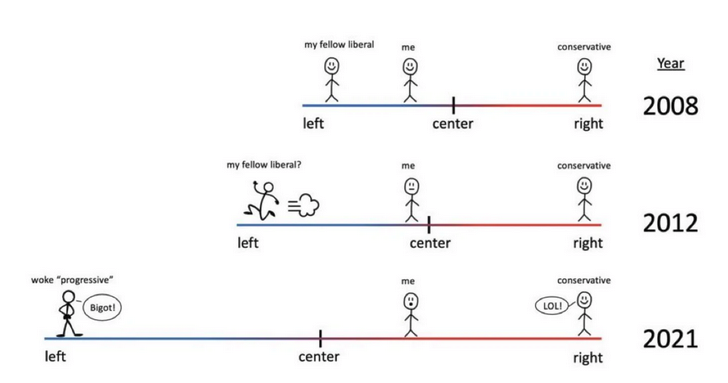
Matt Yglesias has written a couple of posts […] on the subject of this meme (originally by Colin Wright, recently signal-boosted by Elon Musk):

He concludes that, contra the image where the Right stays in the same place and the Left moves, both Republicans and Democrats have “changed a lot” since 2008. He wisely avoids speculating on whether one party has moved further or faster than the other.

I’m less wise, so I’ve been trying to look into this question. My conclusion is: man, people really have strong emotions on this.

I think a lot of the disagreement happens because this is more than one question. You can operationalize it a couple different ways:

  • Which party’s policy positions have changed more in their preferred direction (ie gotten further left for the Democrats, or further right for the Republicans) since 2008 — or 1990, or 1950, or some other year when people feel like things weren’t so partisan?
  • Which party has diverged further from ordinary Americans?
  • Which party has become more ideologically pure faster than the others (ie its members all agree and don’t tolerate dissent)?
  • Which party has become crazier in terms of worldview and messaging, in a way orthogonal to specific policy proposals? That is, suppose one party wants 20% lower taxes, and plans to convene a meeting of economists to make sure this is a good idea. The other party wants 10% higher taxes, and says a conspiracy of Jews and lizardmen is holding them back, and asks its members to riot and bring down the government until they get the tax policy they want. The first party has a more extreme policy position (20% is more than 10%), but the second party seems crazier.

I think these subquestions are easier to get clear answers on and will hopefully start less of a fight, starting with …

May 30, 2022

The Line on Pierre Poilievre’s campaign for Conservative leader

Filed under: Cancon, Media, Politics — Tags: , , , — Nicholas @ 05:00

I honestly haven’t been paying much attention to the never-ending leadership contest the federal Conservatives have been running for what feels like years at this point. If I had to choose, Pierre Poilievre would probably be my choice — since Mad Max won’t go back to the party that stabbed him in the back — and he appears to be the one to beat as the contest enters its third decade. In the abbreviated-for-nonpaying-cheapskates weekly post from The Line, the editors have concerns about Poilievre and how he may operate first as the leader of the Official Opposition and then potentially as Prime Minister:

Conservative MP Pierre Poilievre at a Manning Centre event, 1 March 2014.
Manning Centre photo via Wikimedia Commons.

We at The Line are going to preface this little blurb about CPC leadership contender Pierre Poilievre with the following two points; firstly, we suspect he’s going to win the leadership race. Secondly, we suspect he’s probably on a trajectory to become prime minister. The usual caveats apply: campaigns matter, polls can be wrong, it’s a long time to go and anything can happen. Of course, of course. But at this godforsaken moment, PP’s got the mo. The gatekeepers are down at heel, and the populists are on the march. We don’t have to agree with any of this, or even like it, to acknowledge that we can feel the current of the wind.

So take these critiques with those expectations in mind. Still: Skippy had a bad week.

Look, the general assumption of the Canadian punditocracy to date has been that Pierre Poilievre is not only dangerous and corrosive — but that he’s also full of shit, that he’s disingenuously stoking populist anger in order to win the leadership of the CPC. Most — who happen to think he’s too smart to actually fall for any of his own rhetoric — genuinely believe he’ll slip back to some kind of sensible, slightly more tribal, but still broadly sane centrist form of conservatism after he scores the leadership mandate. Win from the right, govern from the centre: this is generally a winning formula for Conservatives.

We have a different take.

What if Poilievre is 100 per cent genuine in his beliefs about bitcoin, central bankers, the WEF, banning foreign oil, the lot of it? We’ve said it here at The Line before: COVID has driven everybody a little bit nuts. What if this week, we really just started to see the mask slip?

Because if that’s the case, this is what we could be looking at by 2025, or sooner: a prime minister who probably doesn’t respect imperfect institutions well enough to leave them alone, whether those institutions be the central bank or the Supreme Court. We’d have a prime minister more inclined to take his financial cues from Robert Breedlove than Tiff Macklem; we’d have a prime minister who seems to genuinely believe that the World Economic Forum is some kind of sinister cabal of (((globalists))) led by Klaus Schwab, and is pulling the strings of government because the forum bestowed ego-stoking titles like “Young Global Leaders” on a bunch of up-and-coming Canadian politicians — including Conservative politicians. And it means we’re looking at a prime minister who thinks that banning the import of foreign oil, potentially cutting ourselves off from the global market and forcing western producers to supply energy resources to Canadians first, sounds like a dandy idea. (Does the term: “integrated North American Energy Market” hold any sway, here? You know how much a refinery costs? Just don’t call it a National Energy Program, we guess.)

Look, we think that Pierre is ahead for a reason. On the general sweep of the state of politics, we suspect he’s got the best grasp of his electorate. He’s young, he’s smart, and he’s willing to litigate serious problems and entertain novel ideas to solve them. We’re heading into a period of increased inflation, war, and potentially global famine, and Poilievre could use his considerable intellect to identify Canada’s crucial problems, and steer us in a credible direction.

But not if he’s acting like a goddamn lunatic. Because nothing says “conservatism” like protectionist economic policies, conspiracy theories, and railing against norms and institutions, right?

So Poilievre, Jenni, if you’re listening (are you listening?) don’t make the mistake that Jason Kenney did in Alberta. Don’t win on promises you can’t deliver on and by talking about problems you only half understand. Don’t insulate yourself with people who don’t challenge you intellectually. If you’re going to actually be prime minister, you’re going to need to work with the very experts and gatekeepers that you hold in such obvious contempt. You’re going to need to network with major global leaders — perhaps even at major global conferences hosted to discuss economic and geopolitical issues — without being beholden to said fora’s attendees and organizers. You’re going to need to be able to determine fact from fantasy and critique from conspiracy.

We don’t doubt Poilievre’s ability to win. Rather, we’re getting awfully nervous about his ability to govern once/if he does.

May 17, 2022

Mary Whitehouse, “The avenging angel of Middle England”

Filed under: Britain, History, Media, Politics — Tags: , , , , , , , , — Nicholas @ 05:00

At First Things, Jonathon Van Maren considers the legacy of Mary Whitehouse, the often mocked champion of public decency and crusader against pornography and blasphemy in the media from the mid-60s onwards:

I was surprised to find few public domain images of Mary Whitehouse available, so here is a selection of thumbnails (hopefully this won’t violate any copyright restrictions)

We have reached the point where our post-Christian elites, having safely enshrined the sexual revolution in law, can afford the luxury of occasionally admitting that their opponents were right. Exhibit A is the new BBC documentary Banned! The Mary Whitehouse Story, which details the life of Great Britain’s most infamous morality campaigner. Beginning with a crusade to keep smut and blasphemy off TV in 1964, Whitehouse rallied hundreds of thousands of women (and ordinary Britons) to her campaigns against “the permissive society”, culminating in her war against the porn industry. Alas, she lost most of her battles — but her warnings proved prophetic.

Mary Whitehouse was born in Warwickshire in 1910. She first started organizing in the 1960s because she — and millions of other mothers — did not like what her children were seeing on TV. A committed traditional Christian, she watched with dismay as the country she loved began to change around her. The metropolitan elites she faced off with thought she was “a provincial Birmingham housewife”. They didn’t underestimate her for long. She hosted her first mass meeting in 1964, and her organizing skills soon highlighted the subterranean power of Britain’s women. Whitehouse tapped into the gardening associations, the mothers’ unions, and other grassroots community organizations filled with folks who cared deeply about their children and the moral fabric of their nation. She brought them together, and when she spoke, it was with the voices of legions of little people. Her nickname summed it up: “The avenging angel of Middle England”.

Whitehouse’s first major campaign was to “Clean Up TV”, and her parliamentary petition to that end garnered around 500,000 signatures. In 1971, Whitehouse began organizing against sex ed in schools, triggered by an “educational” video she saw that was filled with pornographic scenes. Whitehouse was accused of hysteria — but Banned! features a pornographer admitting that, by using sex ed, “we gradually pushed back the barriers”, much as Whitehouse warned they would. Now that they’ve won, they can admit they were lying.

Whitehouse and others appalled by attempts to corrupt their children were accused of being “horrified by sex”. In reality, they were horrified by the version of sex presented by sex educators — in much the same way an art lover would be appalled to see vandals approaching a great masterpiece with cans of spray-paint and lewd laughter. Progressives never understood this, and consequently Whitehouse has been almost entirely defined by what she fought against rather than what she fought for.

Whitehouse’s lobbying resulted in several pieces of legislation, including the 1981 Indecent Displays Act, which sought to restrain sex shops and the display of porn, as well as the 1984 Video Recordings Act, intended to limit the sale of extreme video content. Unfortunately, these acts were rendered moot by the internet. But her greatest achievement was the 1978 Protection of Children Act, which criminalized child pornography. It seems remarkable that such a law did not already exist, but in the ’70s the Paedophile Information Exchange (PIE) was operating openly in Britain; it was supported by some British elites who believed that sex with children was the natural next step in sexual liberation.

May 13, 2022

Womp-womp – “Probably you didn’t watch the debate. Probably you read that last paragraph and thought, well, Wells has finally lost his mind, it had to happen eventually.”

Filed under: Cancon, Media, Politics — Tags: , , , — Nicholas @ 05:00

Paul Wells watched the most recent Conservative leadership debate so none of the rest of us had to. Let’s take a bit of time to appreciate the sacrifice Mr. Wells made on our undeserving behalf:

Well, that was a national disgrace.

What is it about the last two years that made the Conservative Party of Canada’s Leadership Election Organizing Committee decide Canadians are yearning for shorter conversations about sillier questions?

Who came out of last week’s thoughtful debate at the Canada Strong and Free conference — at least, the questions and the format permitted thoughtfulness, although candidates varied in their ability or willingness to deliver it — thinking there weren’t enough questions about TV viewing habits?

Who surveyed the issue landscape that will face Justin Trudeau on Thursday and would face his successor — war in Europe, inflation, labour shortages, stark conflict between climate targets and natural-resource export imperatives, long-cheated and still-difficult Indigenous reconciliation, exiting from COVID — and thought, “Keep the answers short. We want time to hear them out on what’s on their playlists”?

As a mechanism for allowing Canadians to weigh the judgment of six people, one of whom might, after all, be the next prime minister, the evening was a write-off. We learned that Leslyn Lewis likes “Coltrane” and was eager not to be asked to name a second musician, that Jean Charest likes Charles Aznavour and doesn’t know how to pronounce Pat Metheny, that moderator Tom Clark isn’t sure how to pronounce Roman Baber, and that Charest and Scott Aitchison were reckless enough to trigger the dreaded sad-trombone sound effect for the sin of mentioning the prime minister of Canada by name during a political debate.

Probably you didn’t watch the debate. Probably you read that last paragraph and thought, well, Wells has finally lost his mind, it had to happen eventually. But no, this is a faithful record of … of … of whatever that was that just happened in Edmonton. Sorry, I’m stuck with the material. There is no way I could make this stuff up. If I were making something up, it would be funnier.

Clearly the organizers fell prey to two of the most fashionable current temptations in debate design: “Keep it snappy” and “Let’s get to know these candidates as people.” As though the decline of modern government were caused by excessive reflection and insufficient attention to our leaders’ public image.

May 9, 2022

Canada has no abortion law on the books: this is extremely convenient for the federal Liberals

Filed under: Cancon, Government, Health, Law, Media, Politics, USA — Tags: , , , — Nicholas @ 05:00

In the free-to-cheapskate-freeloading readers portion of The Line‘s weekly dispatch, the editors explain why we should expect exactly zero change to Canadian law on the abortion issue regardless of what happens in the United States in the wake of a leaked US Supreme Court draft decision that has agitated and carbonated the debate there all over again:

Parliament Hill in Ottawa.
Photo by S Nameirakpam via Wikimedia Commons.

… given the extent to which Canadian media and politics has become thoroughly Americanized in the past few years, it was inevitable that the draft ruling immediately took over the front pages of our national papers and became the dominant topic of debate in the House of Commons. And while we are loath to contribute to what we see as a very unhelpful trend, there are some Canada-relevant aspects of this that at least one of your editors thinks are worth discussing.

The first is the obvious glee with which the Liberal party greeted the leak. Of course they all acted appalled, with a parade of cabinet ministers taking to Twitter to talk about the “concerning” news out of the U.S. and to make it clear that they would never allow anything like this to happen in Canada.

But for all their bluster, the Liberals long ago perfected a curious little two-step here. On the one hand, they never tire of asserting that the debate over abortion is “settled”, and that the pro-choice position is and will always be the law of the land. Yet on the other hand, Liberals are constantly acting as if we’re just one private member’s bill away from Canada becoming the Republic of Gilead. But as Chris Selley pointed out in a recent column, if abortion rights are so fragile and tenuous, why haven’t the Liberals done anything about it? Perhaps the imminent overthrow of Roe v. Wade in the U.S. might provide the government with the perfect occasion to finally put abortion rights on Canada on a proper legislative footing. Or, at the very least, define and defend the status quo.

That will never happen, for two reasons.

The first reason the Liberals won’t move to do something has to do with a philosophical equivocation at the heart of Canada’s pro-choice movement. In some guises, the pro-choice position is framed as a harm reduction policy, not completely dissimilar to needle exchange programs or safe injection sites for drug users. That is, while we may legitimately debate and disagree over the moral worth of the activity itself, there is no question that it is something that is going to happen regardless. Given that, the best thing for the state to do is make sure that the circumstances under which it takes place are as safe and accessible as possible, while withholding moral judgment.

But there’s another position, which holds that abortion is akin to a victimless crime: the fetus simply deserves no moral standing, so getting an abortion is no more morally controversial than getting your appendix removed.

The advantage to the status quo is that it allows the government, as well as pro-choice supporters, to remain formally agnostic on this question. There is no law, so the law needs to take no position. But any attempt to put a legal framework around abortion would probably require that the fetus be given some status at some point in development. And that opens a huge can of worms, not least for someone like Justin Trudeau who, at times, has claimed to be personally opposed to abortion but a pro-choice practicing Catholic. Why would he be against abortion personally, unless he believed that it was, at some level, wrong?

This brings us to our second point. In his column, Selley called on Trudeau to “grow up” and defend the status quo on its principles. But why would he do that? The Liberals benefit enormously from the status quo, including the lack of clarity around it. Abortion is legal (in the sense that there is nothing in the criminal code forbidding it), and reasonably accessible, depending on which part of the country you live in. But it’s also tenuous, which means the Liberals get to spend a good part of every election campaign wedging the ever-loving crap out of the Conservatives, whose benches are chock full of people who are anti-abortion, or at least, anti-the-status-quo on abortion.

Given how successful this strategy has been, there is no reason for the Liberals to change it, since for them the tenuous status of abortion is a feature of the current regime, not a bug.

May 7, 2022

“Urban conservative” has become a modern oxymoron

Filed under: Britain, History, Politics — Tags: , , , — Nicholas @ 03:00

Ed West on the increasingly rare creature known as the city or urban conservative (he’s primarily talking about the UK, but it applies equally well in Canada and the United States):

20 Fenchurch Street in London has been nicknamed the “Walkie-Talkie” due to its distinctive design.
Image by Toa Heftiba via Wikimedia Commons.

It’s largely forgotten now, but political polarisation is written into the very fabric of London. In the 18th century, when rivalries between Whigs and Tories were at their most intense, different West End squares were built so that the two groups could live among their own kind.

Hanover Square in Mayfair was built for Whigs to live cosily while, further south, St James’s Square was a home for Tories. This was close to the Cocoa Tree coffee house in Pall Mall, their unofficial meeting place, where in the 20th century workmen found a bolt hole so that they could make a quick escape if the authorities turned up.

At the time the Whigs were the party of London merchants, and the Tories that of the country, where they enjoyed widespread support from the rural population. They had once been seen as dangerously close to the old Jacobite dynasty, hence their fear of being arrested, but as that issue receded their popularity in the country at large become stronger. The Whigs were an out-of-touch metropolitan elite, sipping on their fancy “coffee”, but this didn’t stop them ruling the country for decades, nor shaping its political and historical narrative.

Two or three political realignments later, we have arrived to where we started again. As of today the City of Westminster, home of those fashionable West End squares as well as the seat of government itself, is no longer controlled by the Conservatives, as seismic an event in the great realignment as the loss of Kensington was in the 2017 election.

In fact the whole of London is emptying of Conservatives, the party losing Wandsworth and holding onto just three boroughs. It’s not just London: the Tories have no councillors in most large cities now.

As with many social patterns, in this we are following the United States, where Bill Bishop coined the phrase “The Big Sort” to describe how Americans were becoming more polarised by geography, and which Will Wilkinson described as the formation of “communities of psychologically/ideologically similar people”.

This has resulted in cities becoming one-party enclaves, as progressive values become the norm, and conservative-minded people leave. My own parliamentary constituency, in north London, was from its formation in 1983 a suburban Tory seat but shifted between three different parties during the 80s and 90s; at the last election Labour had a 20,000 majority. Labour has now run my borough, Haringey, for 51 years, and the last time the Tories won it, back in 1968, they also took Hackney, Lambeth, Lewisham and in total 28 of London’s 32 boroughs. Truly a different world. Today they do not even fully-field candidates in some wards.

April 22, 2022

Pierre Poilievre’s social media campaign is going well

Filed under: Cancon, Media, Politics, USA — Tags: , , , — Nicholas @ 03:00

In The Line, Rahim Mohamed wonders if Poilievre’s campaign for the leadership of the federal Conservatives might follow a similar path to the flash-in-the-pan that was the Andrew Yang campaign:

Conservative MP Pierre Poilievre at a Manning Centre event, 1 March 2014.
Manning Centre photo via Wikimedia Commons.

It may be hard to believe, but the race to crown the next leader of the Conservative Party of Canada is now well into its third month. If there is one clear takeaway that can be drawn from the campaign so far, it’s that one candidate, frontrunner Pierre Poilievre, has dominated social media.

By any metric, Poilievre’s social media presence dwarfs that of the other candidates in the race. He boasts nearly 340,000 followers on Twitter and more than half-a-million on Facebook. By comparison, none of his opponents has cracked six-figures on either platform. Poilievre’s personal YouTube page, which houses a growing library of hundreds of videos, has garnered over 39 million views since it was launched in 2011. As digital advocacy guru Cole Hogan tweeted earlier this month, “if you’ve watched Canadian political content on YouTube, you’ve seen Pierre Poilievre”.

And Poilievre has not just lapped his opponents in terms of quantity. The contrast between the polished, professional content that his digital team consistently puts out and the amateurish social media fare offered by the other candidates could not be more stark. Earlier this week, the Poilievre campaign released this excellent five-minute video targeting housing affordability, filmed on-location in Vancouver (the world’s third most unaffordable housing market). The video drew praise from unlikely corners of the Twittersphere. For instance, left-leaning Washington Post Canadian politics correspondent David Moscrop quote-tweeted the video, adding; “God I hope you lose but you’re onto something here.”

Poilievre has strategically highlighted issues that appeal disproportionately to the “very online”. For instance, housing policy is a preferred topic of conversation among the aging millennials who dominate YIMBY Twitter — many, ironically, tweeting from their parents’ basements. He has also embraced cryptocurrency; promising to make Canada the “blockchain capital of the world” and purchasing a shawarma with Bitcoin at a recent campaign stop in London, Ontario.

But before he uncorks the champagne, Poilievre would be prudent to take heed of lessons learned the hard way by another social media darling: failed New York City mayoral candidate Andrew Yang.

April 4, 2022

Reconsidering the legacy of conservative activist Mary Whitehouse

Filed under: Britain, History, Media, Politics — Tags: , , , , , , , — Nicholas @ 03:00

Mary Whitehouse was a figure of mockery and abuse for much of her time on the public stage, a one-woman British equivalent to the American “Moral Majority” in the 1980s, without the performative religious connections. Even those who agreed with her concerns were careful to distance themselves from her, yet Alexander Larman wonders if she wasn’t more right than wrong after all:

I was surprised to find few public domain images of Mary Whitehouse available, so here is a selection of thumbnails (hopefully this won’t violate any copyright restrictions)

“The Queen of Clean”. “The Archangel of Anti-Smut”. Whatever you thought of the campaigner and activist Mary Whitehouse, she was hard to ignore. From her heyday in the 60s until her gradual decline in both relevance and physical faculties in the late 80s, she became the physical embodiment of social conservatism, loudly demanding that “family values” be placed at the heart of the national conversation, and that national evils (including pornography, abortion, swearing, homosexuality and the BBC in general) should be either tamed or dispensed with altogether.

Whitehouse died in 2001, and the obituaries trod a fine line between acknowledging her impact — even, at times, her importance — and denigrating her as someone who was almost driven insane by her campaign to clean up Britain’s screens. The Daily Telegraph, a newspaper that one might have assumed was a natural ally, sighed “[she was] seemingly as concerned to eliminate the occasional ‘damn’ or ‘bloody’ as to prevent the worst excesses of pornography or violence” and the Guardian, a long-standing and probably inevitable bête noire, marked her passing by calling her “a self-appointed and much-derided guardian of public morals”, sneered at her “simplistic and nannyish” views and approvingly cited Ned Sherrin’s comment that “If she had been ignored for the last 30 years the world would have been a better place”.

It also, with some reluctance, admitted that “it was possible for many middle-of-the-roaders to think she was just possibly right”. The debate continues as to whether Whitehouse was an oddly prurient figure, whose apparently endless campaigning was dictated by some sort of strange mental imbalance (she boasted about her “direct line to God”, as if the Almighty were responsible for guiding her attempts to rail against the likes of Dennis Potter) or an ahead-of-her-time master of both media relations and social understanding. And now, for some reason, Whitehouse has once again returned to our screens and airwaves, two decades after her death.

The journalist Samira Ahmed recently presented a Radio 4 documentary, Disgusted, Mary Whitehouse, that attempted to ask whether Whitehouse had somehow anticipated the rise of the internet, social media and society’s concomitant, and doomed, attempts to preserve the nation’s innocence amidst the ready availability of virtually every human depravity imaginable at the jab of an eager finger. This was followed by another two-part documentary on television, Banned! The Mary Whitehouse Story, in which various luminaries debated whether Whitehouse was simply a bigot who should best be forgotten about, or if she had a salient point that has, if anything, become more relevant since her death.

On the one hand, there is little doubt that Whitehouse was a proudly ignorant and even destructive figure when it came to arts and culture. She refused to watch most of the programmes that she organised campaigns against, announcing, “I have too much respect for my mind,” and declined to consider such things as artistic merit, creative intentions or context. For her, nudity, violence and sex were things that had no place in British public life, and she was happy to roll up her sleeves and lead well-organised campaigns against things that she disapproved of. It was partly because of her that Kubrick withdrew A Clockwork Orange from exhibition in Britain for two decades, and her private prosecutions of Gay News and the director Michael Bogdanov for, respectively, blasphemous libel and staging a homosexual rape scene in The Romans in Britain, were vindictive and viciously closed-minded. The first was successful, the second was not, and its failure in 1983 saw the beginning of her decline from public relevance.

January 21, 2022

Conservatives versus the “Blob”

Filed under: Britain, Bureaucracy, Education, Government, Politics — Tags: , , , — Nicholas @ 03:00

Sam Ashworth-Hayes is writing here about the British Conservative party, but just swap out the names and it’s equally applicable to the Canadian equivalent, and very likely true for the rest of the western world:

The Conservative party is trapped in a nightmare of its own making. Number 10 is rocked by scandals, support in the polls is plummeting, the Northern Ireland Protocol (Chekhov’s car bomb) waits patiently for its return to the newscycle. As with every good nightmare, there is the sense of unease that something remains undone.

That something would be “conserving”. Set aside economic policy, where the Conservatives and Labour are still just about separable — although the new interest in higher taxes, spending and regulation is rapidly eroding this gap — and judge the period on the social axis: same-sex marriage, net migration at record highs, the march of progressive ideas through academia, business and press and into government speeches. You could be forgiven for thinking that Labour won the 2010 election, and every bout subsequent.

Why is that the Conservative party governs in such a fundamentally unconservative way? Part of the issue is that the average Conservative MP is, on social issues, basically indistinguishable from the average Labour voter, while the average Labour MP is to the left even of this. The centre of gravity in Parliament is well to the left of the general population.

A second part of the answer — and a partial cause of the first — is that the infrastructure of British politics is not designed for the right. When Michael Gove and his then-Special Advisor Dominic Cummings attempted to shake up the English education system in 2014, they found themselves publicly at war with what they termed “the Blob”: an amorphous conglomerate of civil servants, academics and unions that acted to gum up change and ensure stasis in the interests of its members. Rightwards reform is received as violent revolution, whilst the constant leftwards drift goes unremarked and unchallenged.

When Cummings made his way to Number 10, so did the concept of the Blob, expanded to include the BBC, various quangos, much of Whitehall and what is sometimes called “civil society”. The example of hate crime policy is illustrative of the general idea. The concept is not dissimilar to Curtis Yarvin’s “Cathedral”, or the Trumpian “deep state”. Critics of such accusations point out, not unreasonably, that coordinating so many constituent parts would be almost impossible — but this misses the point entirely. The purpose of a system is what it does, and individual elements responding to an ecosystem of incentives that produce given results can act in a remarkably coordinated way, when those incentives point in the same direction.

January 17, 2022

QotD: The British ruling class reaction to fascism and communism

They could not struggle against Nazism or Fascism, because they could not understand them. Neither could they have struggled against Communism, if Communism had been a serious force in western Europe. To understand Fascism they would have had to study the theory of Socialism, which would have forced them to realize that the economic system by which they lived was unjust, inefficient and out of date. But it was exactly this fact that they had trained themselves never to face. They dealt with Fascism as the cavalry generals of 1914 dealt with the machine gun – by ignoring it. After years of aggression and massacres, they had grasped only one fact, that Hitler and Mussolini were hostile to Communism. Therefore, it was argued, they must be friendly to the British dividend-drawer. Hence the truly frightening spectacle of Conservative M.P.s wildly cheering the news that British ships, bringing food to the Spanish Republican government, had been bombed by Italian aeroplanes. Even when they had begun to grasp that Fascism was dangerous, its essentially revolutionary nature, the huge military effort it was capable of making, the sort of tactics it would use, were quite beyond their comprehension. At the time of the Spanish Civil War, anyone with as much political knowledge as can be acquired from a sixpenny pamphlet on Socialism knew that, if Franco won, the result would be strategically disastrous for England; and yet generals and admirals who had given their lives to the study of war were unable to grasp this fact. This vein of political ignorance runs right through English official life, through Cabinet ministers, ambassadors, consuls, judges, magistrates, policemen. The policeman who arrests the “Red” does not understand the theories the “Red” is preaching; if he did, his own position as bodyguard of the monied class might seem less pleasant to him. There is reason to think that even military espionage is hopelessly hampered by ignorance of the new economic doctrines and the ramifications of the underground parties.

The British ruling class were not altogether wrong in thinking that Fascism was on their side. It is a fact that any rich man, unless he is a Jew, has less to fear from Fascism than from either Communism or democratic Socialism. One ought never to forget this, for nearly the whole of German and Italian propaganda is designed to cover it up. The natural instinct of men like Simon, Hoare, Chamberlain, etc. was to come to an agreement with Hitler. But – and here the peculiar feature of English life that I have spoken of, the deep sense of national solidarity, comes in – they could only do so by breaking up the Empire and selling their own people into semi-slavery. A truly corrupt class would have done this without hesitation, as in France. But things had not gone that distance in England. Politicians who would make cringing speeches about “the duty of loyalty to our conquerors” are hardly to be found in English public life. Tossed to and fro between their incomes and their principles, it was impossible that men like Chamberlain should do anything but make the worst of both worlds.

One thing that has always shown that the English ruling class are morally fairly sound, is that in time of war they are ready enough to get themselves killed. Several dukes, earls and what-not were killed in the recent campaign in Flanders. That could not happen if these people were the cynical scoundrels that they are sometimes declared to be. It is important not to misunderstand their motives, or one cannot predict their actions. What is to be expected of them is not treachery or physical cowardice, but stupidity, unconscious sabotage, an infallible instinct for doing the wrong thing. They are not wicked, or not altogether wicked; they are merely unteachable. Only when their money and power are gone will the younger among them begin to grasp what century they are living in.

George Orwell, “The Lion And The Unicorn: Socialism and the English Genius”, 1941-02-19.

January 3, 2022

QotD: The Sisyphean quest of conservatives looking for progressive approval

Filed under: Media, Politics, Quotations, USA — Tags: , , , — Nicholas @ 01:00

When will Republicans stop trying to kick the Lucy’s football that is liberal approval? It’s never going to happen – no matter how soft, pliable, milquetoast, and Mitty you are, you’re always going to be trying to re-enslave black Americans, toss old people off cliffs, or destroy our democracy. But there is a solution to this problem.

Stop caring what liberals and their media toadies say. Be a conservative and make them pay.

It’s simple, effective, and much more satisfying than trying to get people who hate you to stop hating you.

It’s also more dignified. Look at Chimpy McBu$Hitlerburton. That was what they called George W. Bush back in the day. He was hardly hardcore – the guy was softer than a My Pillow and about 1 percent as based. But they hated him anyway, trashed him, slandered him, and even toobined to their assassination fantasies about him. But he was too gentlemanly to defend himself. Yet, once he retired to paint tacky pictures and began sucking up to the elite, he suddenly became a respected elder statesman. Now you have the Democrats positively orgasmic over his upcoming fundraiser for the doomed reelection bid of the Beltway Cowgirl Liz Cheney, who has likewise earned the temporary reprieve from the hate-tsunami by utterly betraying her fellow Republicans.

So, you can buy yourself some time. The price is your dignity, but if you crawl around on your belly and lick the toes of your vinyl-clad leftist dominatrix – oops, I assumed xis gender! – you’ll get a little less hatred for a little while.

These indisputable facts completely dispel the argument that the problem with conservatives is that they are too scary, that they must be bland and moderate and bipartisan and not upset the erotically-forgone wine women of the suburbs who channel their sexual frustrations into liberal politics. The idea that we will win these people over by not standing up for anything is just silly; how many times do you have to have a plan fail before you admit it’s a failure, GOP?

Kurt Schlichter, “Every Republican Is ‘Literally Hitler’, So Stop Caring What Libs Say”, TownHall.com, 2021-09-29.

December 10, 2021

Shovel-ready infrastructure we’re already busy working on … the superhighway to serfdom

Jacob T. Levy considers the warning about authoritarian solutions to societal problems given by Friedrich A. Hayek in The Road to Serfdom and shows just how little we heeded his concerns:

It is well-known that the classical liberal economist F.A. Hayek dedicated The Road to Serfdom to “socialists of all parties”, and wrote the book “as a warning to the socialist intelligentsia of England.” I suspect we now understate the importance of these facts. After decades of the Cold War and self-conscious conservative-libertarian “fusionism” in both the U.S. and Britain, what sticks in our memory of The Road to Serfdom is its defense of liberal open markets against economic planning and regulation of the sort advocated on the left. That is of course how it was wielded in the post-2008 surge in interest in it, in the wake of the financial crisis and the subsequent bailouts and stimulus packages: as a weapon of the right.

But if Hayek’s argument characterized socialist planning and regulation as a slippery slope, the slope did not only slope down toward the left. Fascist Italy and Germany figure even more prominently than the USSR in the book’s image of the despotism being risked:

    It is necessary now to state the unpalatable truth that it is Germany whose fate we are now in some danger of repeating … students of the current of ideas can hardly fail to see that there is more than a superficial similarity between the trend of thought in Germany during and after [World War I] and the present current of ideas in the democracies … And at least nine out of every ten of the lessons which our most vociferous reformers are so anxious we should learn from this war are precisely lessons which the Germans did learn from the last war and which have done so much to produce the Nazi system … [A]t an interval of fifteen to twenty-five years we seem to follow the example of Germany.

In the face of resurgent right-wing populist and nationalist authoritarianism in the world, it is worth reconsidering the legacy of The Road to Serfdom and of Hayek’s work to bolster liberalism.

Hayek warned of centralizing and authoritarian urges of both the left and the right, but it’s in the “permanent” government — the civil servants who remain in office regardless of electoral outcomes — that much of the danger to individual liberty lies:

Throughout Hayek is concerned for constitutional parliamentary government and the rule of law, and their protection against arbitrary government. The idea that freedom requires clear and general rules of conduct anonymously applicable to all — that government run by ad hoc edict is oppressive — was to be the major theme of his subsequent works in political theory, The Constitution of Liberty and Law, Legislation, and Liberty; but it is central to the argument of Road to Serfdom as well.

In the preface to the 1956 edition, Hayek described the postwar Labour government as having created a bureaucratic “despotism exercised by a thoroughly conscientious and honest bureaucracy for what they sincerely believe is the good of the country. But it is nevertheless an arbitrary government, in practice free from parliamentary control; and its machinery would be as effective for any other than the beneficent purposes for which it is now used.”

Here one hears a predecessor of the widespread classical liberal “we told you so” after the election, blaming the Obama administration for increasing the presidential power that the Trump administration would now inherit. But it is worth emphasizing that Hayek still called the purposes pursued by the left-wing bureaucratic state “beneficent”.

The tone Hayek adopts here is not the schadenfreude of contemporary whataboutism. Now that “hot socialism is probably a thing of the past” (hardly what one would expect Hayek to say were he the determinist caricature sometimes embraced by fans as well as critics), the welfare state calls for “careful sorting out” in the pursuit of its “practical and laudable” aims. He calls for the welfare state and social insurance to be implemented through general rules and fiscal policy rather than administrative coercion, nationalization, and direct economic planning, because the latter instruments “are not compatible with the preservation of a free society.”

H/T to Tamara Keel for the link.

October 15, 2021

“… a preliminary Conservative estimate is that the PPC rise cost them between four and nine seats”

Filed under: Cancon, Media, Politics — Tags: , , , , — Nicholas @ 03:00

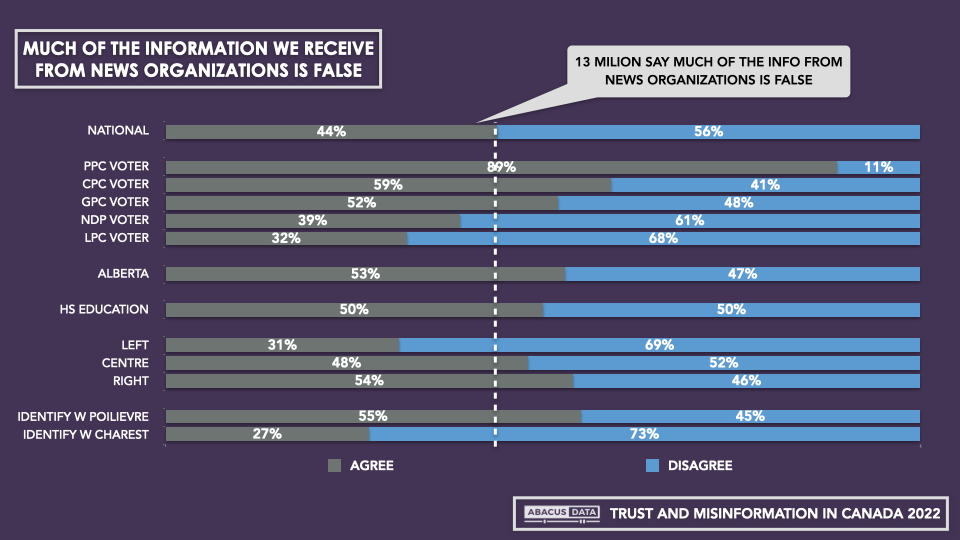
Matt Gurney looks at the federal Conservatives’ efforts in the September election and tries to assess how much the rise of the People’s Party of Canada impacted Conservative fortunes:

O’Toole planned to shift the CPC slightly toward the moderate centre on the assumption that the party’s traditionally lopsided wins in western Canada meant that it could lose a little on the right to flip some close seats in the east. This didn’t work. The Tories did shed support on the right, which might explain some measure of the PPC’s rise, but the CPC didn’t make up enough ground in eastern ridings to flip seats.

However, the election-night results are somewhat deceiving. O’Toole’s strategy was more effective than the final outcome suggests. In Ontario, in particular, the Conservatives materially cut into the Liberals’ advantage in the popular vote, effectively halving it, relative to 2019. This meant that the Liberals were extremely reliant on vote efficiency: a one-per cent swing of voters from the LPC to the CPC could have flipped dozens of seats, setting up a scenario where O’Toole could have been prime minister today. (These flips would not have come from the Greater Toronto Area, interestingly, where the Liberals continue to run up some lopsided victories of their own, but from other parts of Ontario and random seats all across the country. The election was closer than people realize.)

But back to the PPC. Did giving them room to grow on the right end up costing the CPC seats? If so, while that wouldn’t necessarily discredit the notion of moving the CPC toward the centre, it absolutely complicates it. If the Conservatives can’t take their right flank for granted, their lives get a lot more difficult. In a recent feature in the Toronto Star, Althia Raj, who apparently spoke to every insider on the planet, wrote that a preliminary Conservative estimate is that the PPC rise cost them between four and nine seats.

That sounds about right, and it doesn’t sound like much. Indeed, if anything, there’s reason to believe that that is overly generous to the PPC.

[…]

In aggregate terms, the author found that while you could conclude that a handful of ridings were possibly but not certainly lost due to a PPC surge, you couldn’t definitively conclude that any were lost because the Conservatives gave up ground on the right. This gets us to the low-end figure cited by Raj, but looking at this report, I don’t know where the rest could possibly have come from.

Every additional seat would have been good news for O’Toole. And the rise in the PPC vote share is worth studying on its own merits — The Line continues to work with John Wright to firm up our understanding of the PPC, both as a political and social movement.

But as an electoral force that hurt O’Toole in the last election, while we can certainly say it didn’t help, it also didn’t seem to hurt much.

Having met dozens of eager PPC supporters over the last two election campaigns, I have to believe that at most one third of them are former Tory voters … a lot of the people I met were not habitual voters for any party before the PPC came along. At one meeting I attended in 2019, there were more former Libertarian voters than Conservative voters around the table, but neither group was a majority. A lot of them were fans of Maxime Bernier personally — and note that this meeting was literally in the heart of Erin O’Toole’s own riding, a couple of blocks away from his constituency office.

September 29, 2021

The federal Conservatives, post-election

Filed under: Cancon, Economics, Media, Politics — Tags: , — Nicholas @ 03:00

As Erin O’Toole ably demonstrated in the September 20th federal election, when you deliberately exclude the SoCons, the libertarians, the gun-owners, the free speech advocates, and the fiscal conservatives, what you have left is a party that doesn’t have a lot to differentiate itself from the Liberals. Ben Woodfinden offers some thoughts on the Conservative Party’s immediate post-election phases:

I don’t want to spend long on this point because I find this kind of Conservative infighting (the tory syndrome), which is often about a combination of both ideology mixed in with personal feuds and rivalries, extremely frustrating. I think O’Toole deserves a second shot for a few reasons. I thought there was a lot to like in the platform, because O’Toole himself performed fairly well during the campaign for the most part, and the Conservatives are on the path to form government. I also think another leadership election is a bad idea and this habit of dumping leaders after single election results is extremely shortsighted. Changes are needed, but I don’t think replacing O’Toole is one of them.

Before some of you send furious responses about how I’ve “sold out” or how O’Toole sold out and therefore needs to go, I absolutely do think that portions of the base have every right to be angry. As I wrote in the Post column, what has angered many is not simply the campaign O’Toole ran, it was that he won the leadership running as a “true blue” and then pivoted to something else.

The Conservative Party is not a party of one. O’Toole needs to show some humility and work to rebuild some trust with these parts of the base (and caucus) who are upset and angry over this. The Conservative Party is very much a coalition of different groups who disagree on all sorts of things. Keeping these groups together is a delicate and at times challenging task. […]

Anyways, to summarize where I stand on this, and I have no plans of getting dragged into this too much – there needs to be some efforts on behalf of O’Toole to restore some trust with the various factions within the party that are unhappy, but I think overall some of the shifts that are being made are worthwhile ones. It would improve the discourse on conservatism in Canada if we moved beyond the red versus blue tory, liberal lite versus true blue framing that serves us poorly. While we need to wait for a full post-mortem and analysis of the results, there also seem to me to have been some positive signs that this realignment/blue collar shift can work. Matt Gurney interviewed an anonymous senior campaign official after the election for TVO, and something the official said intrigued me:

    Gurney: Whoa, hang on. That sounds like something we just shouldn’t blow past! What was the old Conservative coalition, and what happened to it?

    Conservative: [Laughs] Okay, obviously it varies by place, but think of it this way: our three legs were big business and corporate, rural and farmers, and a swing component. That third one was tricky. Mulroney brought the Quebec nationalists. Harper, we got them with ethno-community suburban outreach. But I think the Liberals are beating us on big business, and we need to accept that and pivot to small business, working-class, things like that. We just started doing that, and it’s already working. We did shockingly well in Hamilton. And look at northern Ontario. These places are in play for us now. Northern Ontario is going to get very interesting. But if I’m being honest, the question of who the new Canadian Conservative voter isn’t one we’ve fully answered yet. We’re winning the popular vote, but we still need to grow, and I think that needs more time.

I went and did some digging myself and what this anonymous official is saying here appears to check out, and if you combine this with the gains made in Atlantic Canada I think there are real reasons for optimism on this front. This election could be comparable to what happened with the Conservatives in 2017 in the UK, but in a positive way. Hear me out here. In that election Theresa May came close, but just fell short, on breakthroughs across the board that would have fully inaugurated her as the champion of this realignment conservatism. While it didn’t materialize in 2017, it did in 2019. The progress is there, and I really think Conservatives should give this another shot next chance they get, it really could pay off. The party needs to break through in suburban seats, and I think this “thoughtful populism” as John Ibbitson described it can absolutely do that in the next election.

« Newer PostsOlder Posts »

Powered by WordPress