
TimeGhost History
Published 14 Dec 2025In the mid-1950s, what Paris insists on calling a “police operation” in Algeria, steadily sparks into a full-scale war that exposes the fragility of the French Republic itself. As the FLN launches coordinated attacks, the army responds with mass arrests, torture, and collective punishment, drawing the military deeper into politics. The Battle of Algiers becomes a laboratory of counterinsurgency, even as public opinion fractures at home and successive governments collapse under the strain. By the decade’s end, the conflict has eroded faith in France’s imperial mission and helped trigger the fall of the Fourth Republic, proving that Algeria was not just a colonial war, but a crisis of the French state.
(more…)
December 16, 2025
The Battle of Algiers: France’s “Victory” That Lost the War – W2W 057
Swedish Paratrooper Prototype: AK Fm/57
Forgotten Weapons
Published 30 Jul 2025As Sweden was looking to adopt a new self-loading infantry rifle in the 1950s, one of the contenders was a modernized version of the Ljungman. The Fm/57 is one of the last iterations of that project. It is chambered for 6.5x55mm but uses the short-stroke gas piston conversion that we previously saw on the 7.62mm NATO conversions of the Ljungman. It also uses a more refined lower receiver than its Fm/54 predecessor, with a nose-in-rock-back 20 round magazine and a folding stock. It was entered into formal trials against the GRAM-63 (another domestic Swedish design), the M14, G3, SIG 510, FAL, and AR10 … which it lost.
(more…)
December 11, 2025
Britain’s Top 10 UGLIEST Aircraft
Rex’s Hangar
Published 13 Aug 2022Today we take a look at the top 10 ugliest aircraft every to grace the skies of the United Kingdom. Some were failures, some were hugely successful, but all were lacking in the good looks department, lets check out these ugly planes!
(more…)
December 10, 2025
The Korean War Week 77: The Korean Winter Bites Hard – December 9, 1951
The Korean War by Indy Neidell
Published 9 Dec 2025Now that they’ve agreed on a Demarcation Line, the talk this week at the Panmunjom peace talks has turned to whether there will be restrictions or not after the signing of an armistice. Also, how would inspections work to make sure the other side is complying with the armistice terms? Perhaps a group of representatives from neutral nations? Meanwhile the troops are digging in to their winter defenses, as the frozen Korean winter descends upon them.
Chapters
00:00 Intro
00:48 Recap
01:16 Two New Points
08:42 Korean Winter
11:47 Communist Defenses
13:20 Summary
13:33 Conclusion
14:28 Call to Action
(more…)
December 8, 2025
Hungary 1956: The Day Hope Met Soviet Steel – W2W 056
TimeGhost History
Published 7 Dec 2025Here we trace how, only eleven years into Soviet rule, Hungary’s brief hope after Stalin’s death ignites into demands for reform, free speech, and withdrawal of Soviet troops. Students mass in Budapest, the secret police fire on demonstrators, and the uprising spreads as workers’ councils seize factories and crowds pull down Stalin’s statue. Imre Nagy promises neutrality and multi-party politics, but Moscow wavers, then sends in overwhelming force. As tanks return to Budapest, street fighting erupts, radios broadcast desperate pleas, and the revolution is crushed, leaving thousands dead and a generation convinced that the thaw was an illusion.
(more…)
December 6, 2025
G150: Swiss Silenced Guerrilla Anti-Materiel Rifle
Forgotten Weapons
Published 21 Jul 2025The G150 is a rifle specifically assembled by and for the Swiss P-26 organization: a very secretive stay-behind group intended to fight foreign occupiers of Switzerland. It was one of a series of such organizations that began with a concern during World War Two the Germany might invade, and continued during the Cold War with the threat of Soviet occupation in the aftermath of nuclear war. The P-26 group specifically was formed in 1981, and disbanded in 1991 under a cloud of controversy over its political leanings.
P-26 was armed with an assortment of weapons ideal for guerrilla warfare, including P210 pistols and suppressed MP5 submachine guns. The G150 rifle was intended to be a very quiet rifle for destroying enemy materiel like radar systems, fuel tanks, parked aircraft, and the like. About 250 were made using commercial JP Sauer actions, SIG 540 like pistol grips and folding stocks, and very large two-part suppressors. They were chambered for the .41 Remington Magnum revolver cartridge, loaded with a 408-grain subsonic bullet. The scopes were adjustable from 4-6 power (yes, 4-6: it;s a weird choice) and had BDC elevation turrets adjustable out to 200 meters.
Only three G150 rifles are known today, although the remainder may still be in some deep military storage in Switzerland. Many thanks to the anonymous viewer who arranged access to this one for me to film! To see another perspective on one of the other known examples, I recommend Bloke on the Range’s video:
• BotR Exclusive! Swiss 10.4mm G150 subsonic…
(more…)
December 4, 2025
M103: The Tank With No Name
The Tank Museum
Published 1 Aug 2025In 1950, the USA was facing a tank crisis … and the M103 was supposed to be part of the solution. But it would hardly ever be used.
After the Second World War, the USA made massive cuts to their conventional forces – declaring the majority of their tanks obsolete, with those left coming to the end of their service life. And the appearance of the Soviet IS-3 meant that the pressure was on. The US Army and the US Marine Corps wanted new tanks – and they wanted them fast. And the appearance of the Soviet IS-3 meant that the pressure was on. The USA declared a “Tank Crisis”.
The T-43 heavy tank was intended to be the response to new Soviet armour. But vehicles were being built before the bugs had been ironed out – and the delays began to mount up. Whilst the Army began to question the need for a heavy tank, the Marines went all in on the concept – ordering over 200 for their forces. But the T-43 was nowhere near ready to enter service, and the vehicles went into storage with 114 improvements needed.
Changes were made and eventually the Marines got their heavy tank – now named the M103. But its effectiveness was limited, and the M103 was only operationally deployed once. The Marines rejected replacement M60s in favour of the Future Main Battle Tank – a project that would end up being cancelled. Their existing M103AA1s were modernised using M60 parts, creating the M103A2 – which The Tank Museum has an example of in its running fleet.
The M103 is a heck of a tank: powerful, capable and incredibly imposing to be around. But did the Americans really need it? Was it the ultimate panic buy?
This is the story of the M103 Heavy Tank – and the panic that produced it.
00:00 | Introduction
00:30 | Meet the M103
03:06 | T-43 and the Tank Crisis
06:21 | Unfit for Service?
11:33 | In Service
15:26 | M103 In Retrospect
December 3, 2025
The Korean War Week 76: Is America Favouring The Communists? – December 2, 1951
The Korean War by Indy Neidell
Published 2 Dec 2025This week at the Panmunjom Peace Talks the two sides agree on a Demarcation Line for an armistice based on the current battle lines, provided the other items on the agenda have been dealt with within 30 days — or else it is invalid. There is still a huge issue, though concerning rotation and replenishment of force during an armistice, and also the right of inspection. The two sides are very far apart on all that. And 8th Army Commander Jim van Fleet issues orders which are misconstrued in the global press and lead to some embarrassment for Washington.
#KoreanWar #peacetalks #Korea #history #militaryhistory #Ridgway
Chapters
00:00 Intro
01:02 Recap
01:44 Item Three
05:08 Inspections After Armistice?
07:53 Ridgway’s Concerns
09:54 The POW Issue
11:45 Van Fleet’s Instructions
13:51 Summary
14:26 Conclusion
16:36 Call to Action
(more…)
December 1, 2025
Why Uncle Sam entered the Vietnam War – W2W 055
TimeGhost History
Published 30 Nov 2025The Vietnam War didn’t begin with American boots on the ground. It began with a promise — and a break. After the French defeat at Dien Bien Phu in 1954, the Geneva Accords split Vietnam at the 17th parallel. Ho Chi Minh led the North. In the South, Ngo Dinh Diem struggled to hold a fragile new state together while armed sects, crime syndicates, and political rivals challenged his rule. Washington saw Vietnam as the next battleground of the Cold War, and threw its support behind Diem — believing he could stop the spread of communism in Southeast Asia.
But as elections for reunification approached, tensions rose. Diem refused the vote. The North rebuilt. The South descended into repression, unrest, and quiet rebellion. Former Viet Minh fighters slipped into the shadows. Secret networks formed. Targeted killings began. By 1958, the storm clouds of a new war gathered — one the United States could no longer afford to ignore.
This episode explores how the U.S. found itself pulled into Vietnam, how Diem rose to power, why the reunification election collapsed, how American aid reshaped the South, and how the first sparks of insurgency ignited a conflict that would define a generation.
Join us as we trace the origins of a war long before the Marines landed at Da Nang — to understand why Uncle Sam entered the Vietnam War in the first place.
(more…)
November 29, 2025
The Manhattan Project (1986 film) and Deterrence
Feral Historian
Published 8 Sept 2023This film reminds me of several topics from nuclear deterrence to the impact of social media to that kid I went to high school with who tried to build a reactor in his mom’s shed. Yeah, this is a rambly one.
00:00 Intro
01:02 Summary
02:25 Social Media
04:35 Deterrence
06:51 Radioactive Boy Scout
09:50 Modern Security State🔹 Patreon | patreon.com/FeralHistorian
🔹 Ko-Fi | ko-fi.com/feralhistorian
November 28, 2025
CZ247: Experimental Swivel-Action SMG
Forgotten Weapons
Published 16 Jul 2025The CZ247 was developed for Czechoslovakia’s post-war submachine gun trials, where it was pitted against the ZB47. It was a simple blowback 9x19mm SMG with a number of interesting elements, most notably the ability to fire with the magazine either vertical or horizontal. In theory, this made the gun more compact for use in a jungle sort of environment (vertical) or to allow a shooter to get much lower to the ground when shooting prone (horizontal). In practice, it really isn’t very important, and requires a bit of extra complexity in the gun’s design. The CZ247 also has a neat safety mechanism for preventing unintended firing and a stripper clip guide built into the stock (both of which would be incorporated in the vz.48 SMG that was eventually adopted).
When the CZ247 failed to win the military trials, CZ got government permission to sell it on the export market. A contract for 10,000 guns was quickly obtained from Egypt, but before the guns could be shipped the export permission was cancelled by the government. Czechoslovakia opted to support Israel in its declaration of independence in 1948, and the government decided to not send weapons to Egypt which might be used against Israel. This left the guns sitting in CZ warehouses, and the basically all stayed there for a few decades. Eventually most were sold to Nigeria in 1967 and Ethiopian in 1977 — and as a result they show up occasionally in African and Middle Eastern conflict zones to this day.
Thanks to CZ for giving me the opportunity to take this example out to film and also to shoot for you!
(more…)
November 27, 2025
Lack of talent is no obstacle to music success … even before Auto-Tune
One of the reasons I like Ted Gioia’s Substack is that even when I’m not overly interested in the topic of any particular post, I usually learn something:
I’ve tried to identify the turning point — the moment when the rules changed. By my measure it happened one night in 1958.
Let’s revisit that fateful day …
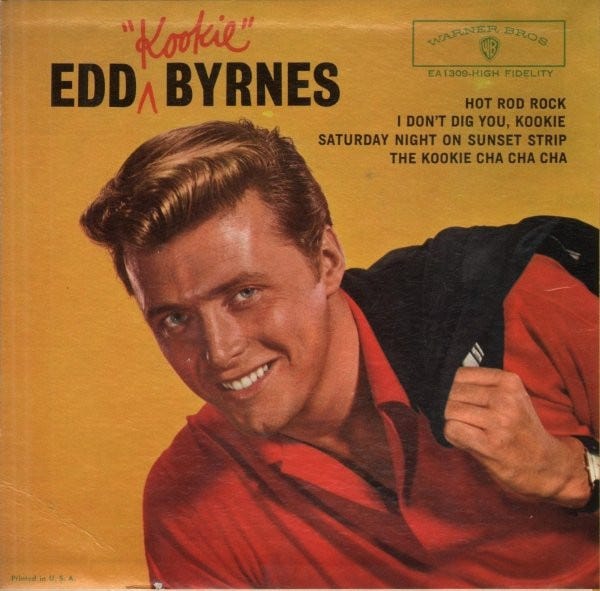
One Friday evening in 1958, record producer George Avakian sat down in front of his TV set, and watched an episode of the popular detective show 77 Sunset Strip. This chance incident would have surprising ramifications in the music business for decades to come.
A few minutes into the episode, the record producer decided that one of the actors on the show looked and talked like a rock star. His name was Edd Byrnes and he played a hipster character named Kookie.
Kookie parked cars at a Hollywood nightclub in the show, and acted very cool. He had the right look and said witty hipster-ish things. The TV audience loved him, especially younger viewers.
Check Kookie out and decide for yourself.
There was just one tiny problem. Byrnes wasn’t a musician.
But Avakian didn’t worry about this. “I was sure that kids would like his talk and his looks, especially a way he had of looking out of the corner of his eye,” he later recalled. “And — the real clincher for his popularity with kids — parents would loathe him.”
They didn’t have Auto-Tune back then, but studio engineers had a few tricks to fix vocal imperfections. They knew how to splice together different takes, or make slight alterations in tape speed.
But when Byrnes did an audition for the label, it was bad. It was scary bad. This promising rock star had no sense of pitch. He had no range. He couldn’t even stay in rhythm with his accompanist.
No technology could fix this mess.
Record producer Avakian was no fool. During an illustrious career, he worked with Louis Armstrong, Duke Ellington, Miles Davis, Dave Brubeck, Sonny Rollins, and Keith Jarrett, among others. He had collaborated with genius, and now he had someone on the opposite end of the spectrum.
Maybe this situation is commonplace nowadays, but back in 1958 the record business believed in something called musical talent. Avakian’s bold decision to ignore that variable marks a historic moment in our culture.
Anybody else would have walked away from this looming disaster. They would have feared not just commercial failure but a tainted reputation. You don’t want to be the exec to greenlight a recording by somebody with zero musical ability.
But in a moment of brilliant insight, Avakian decided that Kookie didn’t need to sing, he could just rap. Of course, rapping wasn’t even a concept back in those days. But it sorta existed without a name. Deejays at radio stations often introduced a song by speaking in a hip tone of voice over the intro to a song.
Kookie would do the same. He would speak or rap his part, while somebody else did the actual singing. Connie Stevens, another Hollywood talent with the right look — and a slightly better voice — could handle the actual vocals.
November 25, 2025
Roller Delay in France: The H&K 33F (Trials & Export Models)
Forgotten Weapons
Published 14 Jul 2025When France was looking to replace the MAS 49/56 rifle for military service in the 1970s, it tested all of the major rifle options available. These included the Colt M16, FN CAL, and HK33. The HK required some modification to meet French military requirements, specifically the capability to launch rifle grenades. The model 33F was developed specifically to meet these requirements — first as a modified standard HK33, and later as a factory production run. The modifications made include a reinforced magazine well, 4-position fire control gourd (including 3-round burst), a reinforced stock attachment, grenade range rings on the barrel, and a mounting bracket for a rifle grenade sight.
Apparently the HK33F performed very well in trials, but it was ultimately deemed politically unacceptable to adopt a German rifle for the French Army (a policy which has changed now, 50 years later …). Instead, the domestic FAMAS was chosen, along with the SIG-Manurhin 540 purchased in limited numbers for the Foreign Legion.
A second type of 33F came about from the program, however. Berlin police wanted HK33 rifles, but treaty prohibited West German arms from entering Berlin in East Germany. The loophole found was to send the parts to MAS in France, where they were assembled and marked HK33F, thus making them French origin gun which could be sent to Berlin. These rifles had none of the French grenade launching adaptations, and were completely standard HK33s except for the use of heavy barrels. MAS eventually added the G3, HK33, and MP5 to its export catalog in the late 1970s and sold quantities to a number of small countries in the French sphere of influence (including Haiti, Burkina Faso, Lebanon, and others).
Many thanks to the IRCGN (Institut de Recherche Criminelle de la Gendarmerie Nationale) for allowing me access to film these rather rare HK variants for you!
(more…)
November 24, 2025
Algeria: France’s War It Refused to Name – W2W 054
TimeGhost History
Published 23 Nov 2025This episode tracks how the doctrine “Algeria is France” — departments, settler power, and forced assimilation — breeds dispossession, mass violence, and a new Algerian nationalism: from conquest and the Sétif massacres to the FLN’s launch in 1954 and Philippeville in 1955. As Paris doubles its forces and passes Special Powers, Suez intertwines with the war, bombings in Algiers begin, and Lacoste hands police powers to General Massu — opening the Battle of Algiers and a system of torture.
(more…)
November 21, 2025
The EU (with NATO) as a substitute empire
On his Substack, Lorenzo Warby discusses the European Union (and its essential military support, NATO) as an imperial subsitute in a post-imperial age:

Historian Timothy Snyder makes an argument in various lectures and on his Substack that what became the EU was a replacement for empire. I think he is right, but not in the way he suggests. Prof. Snyder holds that what became the EU is an economic replacement because he appears to believe that empire was economically beneficial to their metropole economies.
This seems clearly wrong. Every maritime imperial metropole got richer after it lost its empire. This is true whether they were part of what became the EU or not: the obvious example of the latter being Japan and its dramatic postwar economic success after being stripped of its empire and devastated by American bombing. For the economies of all the former maritime-empire states, access to the US market, and the US-led maritime order, was much more valuable, and way cheaper, than empire.
It is not clear that even Britain made a “profit” from its Empire, once you consider military and administrative costs. Portugal had the largest maritime empire — relative to the size of its metropole — for longest and is the poorest country in Western Europe. Compare that to rather wealthier land-locked Switzerland, which never had an empire.
Empires are what states do.1 It is foolish to presume that any particular state action is beneficial to those that a state rules. Having an empire increases the power of state, and the opportunities within the state apparat. That is more than enough to motivate territorial imperialism, whether by land or by sea.
Conspicuous absences
A conspicuous absence from Prof. Snyder’s analysis of what-became-the-EU is NATO. There are a lot of regional economic cooperation organisations around the word. None of them are remotely as integrated as the EU because none of them have the equivalent of NATO.
In order to pool sovereignty within the EU, states first have to have their territorial sovereignty guaranteed. This guarantee is precisely what NATO provides.
The post-Versailles European order of 1919-1939 was unstable because it interspersed between Germany and the Soviet Union a series of small states that the victors of 1914-1918 could not readily reach. NATO has two huge advantages that the nation-states of Eastern Europe did not have in the 1919-1939 period — NATO is a geographically contiguous alliance and it includes the United States. The purpose of NATO, in the famous words of its first Secretary-General, being:
to keep the Soviet Union out, the Americans in, and the Germans down.
In other words, the purpose of NATO was to provide a comprehensive solution to the structural weakness of the 1919-1939 Versailles order. A solution that the countries of Eastern Europe availed themselves of as soon as they could.2
The other conspicuous absence from Prof. Snyder’s analysis of the EU as a substitute to empire is Oceania. His analysis is deeply “(North) Atlantic”. It looks much less impressive from a Pacific perspective.
Japan was a maritime empire which lost the Second World War. It did not join anything like the EU. Australia gave up its (small) maritime empire. It also did not join anything like the EU. Both are very much postwar economic success stories. Participating in the maritime order with good internal institutional structures was enough: no other substitute for empire was needed for economic success.
- The Conquistadors were a mixture of private adventurers and state agents, but their conquests were incorporated by the imperial Spanish state. The use of corporations as instruments of imperial expansion — most famously the Dutch and British East India Companies — was an unusual feature of European imperialism, but such companies were licensed by their state and their territorial holdings were eventually fully incorporated as state possessions.
- For all sorts of reasons, we should distinguish between the postwar order of 1945-1991 and the post Cold War order of after 1991. So much of contemporary madness only really got underway in the 1990s.


