
The Tank Museum
Published 10 Oct 2025M46, M47, M48 and M60. They saw action in Korea, Vietnam, The Gulf and held the line in the Cold War. For almost 40 years the US produced a succession of good tanks — but they never seemed to be good enough for the top brass.
Time after time, designers sought a perfection that seemed to lay out of reach until the arrival of the step-changing M1 Abrams.
Up till then, you have what can be called “The Patton” family: a series of closely related tanks that are only intended to be temporary until the next big thing arrived …
This is the story of the “Patton” family of tanks; tanks that the US tried and failed to replace time after time, yet which despite this ended up becoming the armoured backbone of the Free World during the Cold War.
In this film, Tank Museum Historian, James Donaldson, walks us through the progression of US tanks from the M26 Pershing right up to the M1 Abrams. Commonly known as The Patton Family, this group of tanks were good… but never quite good enough. Always meant to be a stopgap, the Pattons persisted where their prospective replacements failed, leading them to become the vehicles that endured the Cold War around the globe.
00:00 | Introduction
00:58 | From Pershing to Patton
03:50 | Replacing the M46
06:25 | A Third Patton
10:01 | Yet Another Stopgap
12:44 | Irreplaceable?
(more…)
February 9, 2026
Keeping Up with the Pattons
February 4, 2026
The Korean War Week 85: Futilely Pounding North Korea? – February 3, 1952
The Korean War by Indy Neidell
Published 3 Feb 2026The UN forces are by now having trouble just keeping their planes in the skies, thanks to shortages of spare parts, so for long can they maintain aerial supremacy over Korea? And though the aerial campaign to destroy North Korean infrastructure has been stepped up, so too has the enemy’s ability to quickly rebuild. And at the armistice talks, the big issue this week is which countries will form inspection teams after an armistice, and who might be out of the question. The Soviets?
00:00 Intro
01:06 Recap
01:30 The POW Lists
07:12 The Soviets
10:25 Communist Manpower
12:01 Air Force Supply Issues
13:21 Summary
13:34 Conclusion
14:17 Call to Action
(more…)
January 28, 2026
The Korean War Week 84: Inside Truman’s Diary – January 27, 1952
The Korean War by Indy Neidell
Published 27 Jan 2026Things heat up in the Panmunjom Peace Talks, which each side arguing that the other side’s proposals violate the Geneva Convention, but by the end of the week they talks are in recess. Naval aircraft pound the North Korean infrastructure all week long, though, and US President Harry Truman has a few things to say about the Soviet Union that the world may wish to hear.
00:00 Intro
00:51 Recap
01:29 Repatriation and Parole
05:29 Airfields
07:22 Naval Aircraft Get Busy
10:36 Truman’s Diary
11:42 Summary
(more…)
January 21, 2026
The Korean War Week 83: The Medics’ War! – January 20, 1952
The Korean War by Indy Neidell
Published 20 Jan 2026There’s discussion — and disagreement — in UN Command and Washington about whether or not to poll all the POWs the UN side holds to see where they would like to go should they be released. There are arguments for and against this, and it brings up a couple different interpretations of the Geneva Convention. This week we also talk a lot about recent medical advances in field medicine in Korea, and the development of the “Medics’ War”.
00:00 Intro
00:44 Recap
01:14 Poll the POWS
04:52 UN Decleration
08:19 52nd Medical Battalion
10:56 Cho-Do Island
11:45 Summary
12:06 Conclusion
12:49 Memorial
(more…)
January 14, 2026
The Korean War Week 82: Ridgway’s Nuclear Warning! – January 13, 1952
The Korean War by Indy Neidell
Published Jan 13, 2026Operation Strangle, to destroy enemy logistical capability with air power, has been in progress for months now, and yet the enemy is still able to bring up men and supplies, and even slowly stockpile them for possible future offensives. The UN position now is that should there be an armistice, and should the other side break its terms, retaliation would be broader and would include actions against Communist China, but will the UN have the force to do such retaliation? That is the question.
00:00 Intro
00:44 Recap
01:09 POW Issues
03:30 The Airfields
08:29 UN Declaration
10:15 Operation Strangle
14:13 Summary
14:35 Conclusion
15:25 Call To Action
(more…)
January 13, 2026
The History of SPAM
Tasting History with Max Miller
Published 22 Jul 2025Sliced SPAM layered with cream cheese filling, sliced and served with potato salad and tomatoes
City/Region: United States of America
Time Period: 1951SPAM. The iconic canned meat product. Beloved by some, reviled by others, SPAM was buoyed by a very successful marketing blitz by the Hormel company starting in the 1930s. There were radio and magazine ads, The Hormel Girls (a singing group), and recipes.
I’m not the biggest fan of SPAM, and this recipe turned out way too salty for me. If you want to make the historical recipe, go ahead and follow it, but I would personally opt for the reduced sodium SPAM and cut out the salt in the cream cheese mixture. If you like SPAM, definitely try this out! It’s super flavorful, but it’s just not to my taste.
Tender, pure-pork SPAM joins with a zesty cream cheese mixture for memorable eating. Serve for supper or lunch — or as a noteworthy appetizer.
SPAM ‘n’ Cheese Ribbon Loaf
Cut in 8 slices……1 whole SPAM
Mix together……1 (3-oz.) package cream cheese (softened with a little milk)
1 tsp. lemon juice
1 tsp. grated onion
1 tbsp. minced parsley
1/4 tsp. salt
Spread between……slices of SPAM
Chill……4 hours (or longer; overnight if desired). Slice and serve. Good with deviled eggs or potato salad.Economical all-meat buy! No bone, no waste. SPAM is all meat … juicy pork shoulder and mild, tender ham, with Hormel’s unequalled seasonings.
— Hormel advertisement, 1951
January 7, 2026
The Korean War Week 81: Ridgway Admits the UN is Little Threat! – January 6, 1952
The Korean War by Indy Neidell
Published 6 Jan 2026The year may have changed, familiar faces come and go, but some things remain the same. The POW issue continues to dominate and frustrate armistice talks, the fear of an expanded war in Asia re-emerges, and the snow remains cold. The war found no end and no pause in either 1950 or 1951, but third time’s the charm, surely?
00:00 Intro
00:29 Recap
01:24 Britain and the US
06:49 The US Proposal
10:57 The Slave Trade?
12:12 Summary
13:35 Conclusion
(more…)
January 6, 2026
Woodworking was WORK. What happened?
Rex Krueger
Published 5 Jan 2026Patrons saw this video early: / rexkrueger
Join the Mailing List: http://eepurl.com/g3rkmv
Take a course: https://www.rexkrueger.com/courses
Compass Rose Toolworks: https://www.compassrosetools.com/
Get my woodturning book: http://www.rexkrueger.com/book
Get My Book, Everyday Woodworking: https://amzn.to/3oyjC0E
Follow me on Instagram: @rexkrueger
QotD: John Foster Dulles
According to [Governor Harold] Stassen, “My best summary of Dulles is that he always knew he was absolutely right. Further, he knew that anyone who disagreed with him was, of logical necessity, always wrong. And finally, he could not understand how anyone could dare question the fact that he was always right.” It wasn’t just Stassen who had a problem with the priggish Dulles, though. As Supreme Court Justice William O. Douglas once said, “I’m not sure I want to go to heaven. I’m afraid I might meet John Foster Dulles there”. Some U.S. allies had misgivings about Dulles as well. Harold Wilson, a British member of Parliament and future prime minister, once mocked Dulles’s propensity to try to be everywhere all the time: “I heard they are inventing an airplane that can fly without Dulles! They hope soon to get it into production.” Winston Churchill himself once famously mocked Dulles via declension: “Dull, Duller, Dulles”.
Tevi Troy, Fight Club: Rivalries in the White House from Truman to Trump, 2020.
January 2, 2026
Nukes Put Man in Space – W2W 060
TimeGhost History
Published 31 Dec 2025In the 1950s, as the Cold War escalated, the same rockets designed to deliver nuclear annihilation across continents became powerful enough to break Earth’s gravity. Missiles built to destroy cities turned into launch vehicles that carried humanity into orbit.
This episode explores the dark origins of space travel — from intercontinental ballistic missiles and nuclear deterrence to Sputnik, the Space Race, and the moment the sky stopped being a safe boundary. At the center of the story stands Sergei Korolev, a Gulag survivor forced to build weapons for the Soviet regime, who nonetheless pushed humanity’s first steps into space.
Sputnik shocked the world, ignited fears of a “missile gap”, reshaped global politics, and triggered massive investments in science, education, and technology — on both sides of the Iron Curtain. The same systems built for global destruction would ultimately give us satellites, navigation, communication, and the modern world we rely on every day.
This is the paradox of the Space Age: Weapons first. Wonder second.
– Nuclear weapons and rocket technology
– The Cold War and the birth of ICBMs
– Sergei Korolev vs. Wernher von Braun
– Sputnik and the global shock of 1957
– The myth of the missile gap
– How fear reshaped science, education, and space exploration
(more…)
December 25, 2025
Bing Crosby’s “White Christmas” is still the best-selling single of all time
I knew Bing Crosby was big with my parents’ generation (including my father, unusually, who generally had little time for American singers), but I didn’t know that Bing’s recording of “White Christmas” is still, after all these years, the top single. Ted Gioia has more:
Pop culture devours its own. The destiny of all bestsellers is to fall off the charts. Even the stars in Hollywood, like those in outer space, eventually stop shining — and it happens a lot sooner.
Consider the case of Bing Crosby. Some of my readers might not even recognize the name. But a few people still alive today can recall when Crosby was both the biggest pop singer in the world and the hottest movie star in Hollywood.
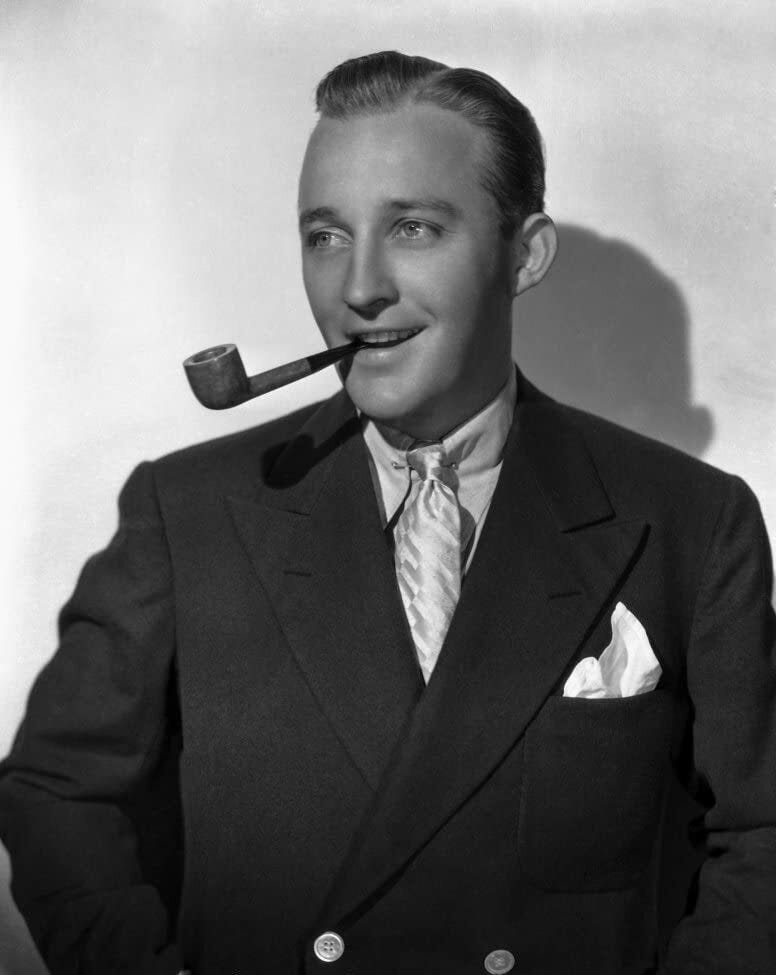
Bing Crosby publicity photo from the 1930s via The Honest Broker
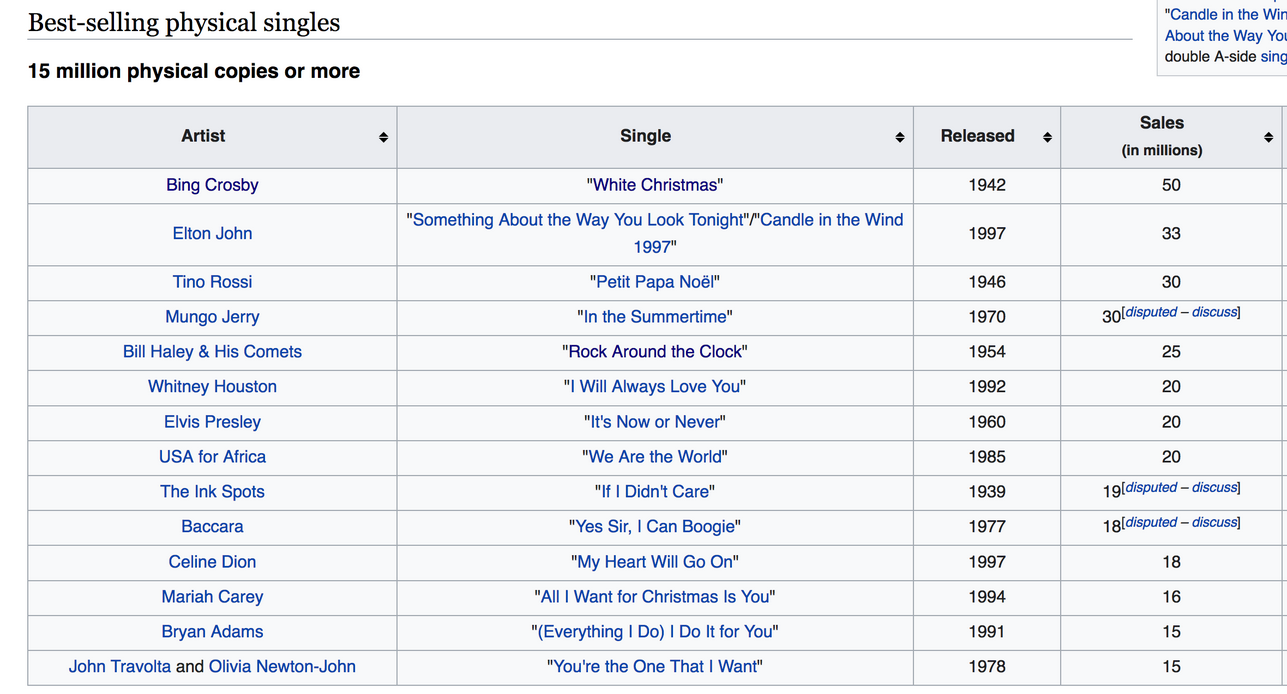
If he’s remembered nowadays, it’s only during December, when his version of “White Christmas” briefly returns to heavy rotation. Even today, it ranks as the bestselling single of all time. There aren’t many records that last eighty years, and least of all in the record business, but Crosby still sits atop this chart.
Here it is (courtesy of Wikipedia):
I’ve written about Crosby before, and will again. But today I want share four of my favorite (and very different) perspectives on Bing.
December 24, 2025
The Korean War Week 79: Soviet Technology Surpasses the USA – December 23, 1951
The Korean War by Indy Neidell
Published 23 Dec 2025Both sides finally release POW information to each other, as required by the Geneva Convention, but neither side is happy with the information, charging it either wildly incomplete or grossly mischaracterized. The Communists also refuse to allow the Red Cross in and the UN doesn’t want compulsory repatriation of POWs, but both are required under Geneva. And away from the truce tables, the Communist air power menace continues to grow, but should there be an armistice will they be allowed to rebuild air bases in North Korea?
00:00 Intro
00:38 Recap
00:58 POW Lists
05:02 Repatriation
07:52 Geoje-Do
09:01 Ambush Program
09:54 Airfields or Armistice
12:00 Communist Air Power
13:23 Summary
13:32 Conclusion
14:50 Call to Action
(more…)
December 23, 2025
How Black WWII Veterans Ignited the Civil Rights Movement – W2W 058
TimeGhost History
Published 22 Dec 2025Decades before the words Black Lives Matter existed, Black American veterans were already fighting the same battle at home. After World War II, hundreds of thousands of Black soldiers returned from the frontlines of Europe and Asia believing they had earned the rights they had defended abroad. Instead, they were met with segregation, voter suppression, police violence, and terror under Jim Crow laws.
This episode explores how Black WWII veterans became a driving force behind the early Civil Rights Movement — joining the NAACP, challenging segregation in court, organizing protests, and refusing to accept second-class citizenship in the nation they had fought to protect.
From the brutal blinding of veteran Isaac Woodard Jr., to landmark legal battles led by Thurgood Marshall, from the Journey of Reconciliation to Brown v. Board of Education, this is the story of how the fight for freedom moved from foreign battlefields to American streets, courtrooms, buses, and classrooms.
We follow the rise of mass nonviolent resistance through figures like Rosa Parks and Martin Luther King Jr., the Montgomery Bus Boycott, and the creation of the SCLC — while also confronting the violent backlash, political resistance, and human cost that defined the struggle.
This is not just the history of civil rights legislation. It is the story of veterans who refused to stop fighting — and a reminder that equality in the United States has never been automatic, inevitable, or finished.
(more…)
December 19, 2025
Pick One: G1 (FAL) vs G3 (H&K) w/ John Keene
Forgotten Weapons
Published 2 Aug 2025If you had to pick one, would you take a G1 (FAL) or a G3 (H&K)? Both are 7.62mm NATO rifles adopted by Germany. The G1 has more features and capabilities, like the carry handle, bipod, multiple muzzle devices, and adjustable gas system. The G3, on the other hand, is simpler, without things to change for better or worse. So which would you take?
(more…)
December 17, 2025
“The ‘liberal international order’ – a technocratic oligarchy sustained by tightly interlocked institutions”
Last week, Len D. Pozeram wrote about how the real (but mostly unacknowledged) American empire is facing unprecedented challenges and may indeed be in serious decline:
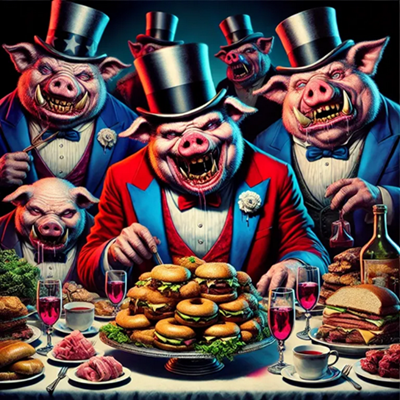
“The Empire’s Mask is Slipping”, The Libertarian Alliance
For generations, Americans were sold a saccharine myth: that our nation’s vast global presence — its military bases on every continent, its endless wars, its economic interventions — was all done in the name of “freedom” and “human rights”. This was the sales pitch. Washington, we were told, was the benevolent policeman of a dangerous world, upholding a Pax Americana designed to uplift humanity.
But for those willing to look beyond the rhetoric, the truth was never hidden — only ignored. This narrative was never more than a sophisticated marketing campaign, engineered to pacify a domestic public and legitimize imperial conquest abroad. From the very beginning, the post-WWII global order was not about freedom, but about power — and who would control it after the collapse of the old European empires.
With the fall of the British Empire, America did not merely “step up” to defend the West — it seized control of the imperial machinery and rebranded it. The British financial aristocracy gave way to a new though related American elite, its nucleus formed around Wall Street banks, the military-industrial complex, Big Oil cartels, and, increasingly, a rising Zionist lobby with ambitions stretching far beyond Tel Aviv.
Under the guise of “containing communism” or “defending democracy”, this new managerial class waged a quiet war against genuine national independence movements across the globe. Countries seeking to control their own resources, chart their own destinies, or resist Western financial domination were systematically targeted for destabilization or outright annihilation.
Guatemala in 1954. Iran in 1953. Indonesia in 1965. The Congo. Chile. Nicaragua. Greece. Even Australia, whose 1975 constitutional crisis remains a textbook case of covert Anglo-American regime change. The public, of course, was kept in the dark. History books were rewritten. Journalists who strayed from the script were destroyed or silenced. CIA fingerprints are now visible in dozens of these cases — operations sanctioned not to spread freedom, but to preserve a system of elite extraction and control.
This system — often referred to in polite company as the “liberal international order” — is, in fact, a technocratic oligarchy. It is sustained by tightly interlocked institutions: the Federal Reserve, the IMF, the World Bank, NATO, and a sprawling Intelligence Community whose true loyalties lie not with the American public, but with transnational networks of finance, energy, and geopolitical strategy. To the extent that ideology plays a role, it is the convergence of evangelical apocalypticism and messianic Zionism — two religious currents that have dangerously informed U.S. foreign policy since the Reagan era.
Yet today, this system is beginning to eat itself. The ideology of endless war, and top-down control has run up against hard limits: financial, and political. The de-dollarization trend in the Global South, the rise of multipolar alliances like BRICS, and the exposure of elite criminality — from Epstein to the endless intelligence scandals — are all symptoms of imperial overstretch and rot.
We are watching the slow collapse of an empire built not on democratic values but on lies, coercion, and institutionalized greed.
From a slightly different viewpoint, Spaceman Spiff maintains that the narratives that have been used to direct and control political thought in the west are in the process of collapsing:
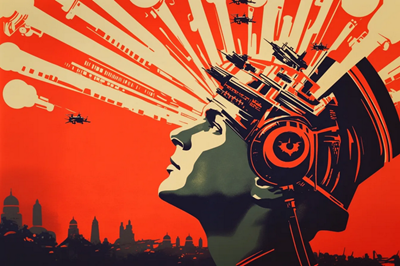
Image from Postcards from the Abyss
As reality intrudes the naivety behind many sacred cows is exposed. The emperor is naked and his supporters look equally naked. The narratives driving their fantasies are failing.
The big three issues common in the West illustrate why people are noticing.
Diversity and immigration
The promotion of diversity as a strength is a consequence of blank slate thinking, a belief disparate populations are substantially the same with most observable differences due to environment only.
This is at odds with what we observe, the significant range in ability and proficiency between distinct groups that becomes apparent when we interact. So artificial variety is sold as a positive in an attempt to downplay the homogeneity that gets better results.
The consequence of this is quotas, where arbitrary rules are enforced to ensure a diverse outcome.
This destroys competency even if we ignore the potential for conflict when foreigners are imported in large numbers.
The main effect of pushing this absurd policy seems to be the rise of ethnic awareness among those who must step aside to accommodate it. How could it not? When people are excluded because of their ethnicity it becomes important to them.
This is not what advocates of diversity intended but is already happening.
Climate
Climate and energy policy is based on anti-scientific magical thinking. With the current emphasis on carbon dioxide we are told a tiny portion of our atmosphere is responsible for most of the future changes that will cause widespread harm. There is no evidence for such claims.
The reality of climate is different from the narrative. It is resilient, as many things are. Our obsession is arrogance. A belief we matter more than we do.
Intellectuals are prone to get lost in their theories of how the world ought to work. Activists then latch on to their utopian ideas to gain some sense of meaning in their lives.
Society also has people lacking conscience who will profit from anything no matter how much damage it causes. Combining these two, dreamers with schemers, is often lethal. Seemingly opposing forces, left-wing activists and capitalist profiteers, can cooperate even if they embrace distinct beliefs.
As many memes remind us, if you have corporate sponsorship you are not the resistance. This is precisely what we see.
Narratives begin to collapse as we witness ruthless corporations promote feelgood nonsense about climate while fleecing taxpayers in the background. Many are noticing.
And the effects of suicidal climate goals are difficult to hide. Every closed factory or power station kills another element of credibility.
Socialism
Socialism is based on the idea an educated elite can make decisions for us all while simultaneously conditioning us to be better versions of ourselves. It ignores all of history and everything we have learned of human psychology to embrace a literal fantasy utopia that no one has even come close to realizing.
Nothing sums up the bankruptcy of our intellectuals more than their inability to reject this failed ideology.
But it also shows us the Anglo-Saxon instinct to restrict others’ control over us is the only way to counter it.
It teaches us of the wisdom of documents like Magna Carta or the Bill of Rights, designed to constrain the powerful regardless of their motives, ambitions or mental state. Rare moments of historical sanity that remind us what effective countermeasures can look like.
It would seem this lesson must be relearned every few generations. But we are learning it. Real life is reminding us why we must limit government and its agents no matter how inconvenient.
Bad ideas are inevitable. It is the ability of activists and the powerful to enact them many are now waking up to as narratives visibly fail.


