
Real Time History
Published 24 Oct 2025Christmas 1979. Soviet armor pours across the Afghan border towards Kabul as helicopters secure the mountain passes through the Hindu Kush mountains. In Moscow, the Politburo has decided to save Afghanistan’s communist government from collapse. Afghan rebels have taken up arms against the unpopular regime and control most of the countryside. But the Red Army leadership doubts it can pacify the country – so why did the Soviet Union invade Afghanistan?
(more…)
March 16, 2026
Soviet Invasion of Afghanistan 1979
Comments Off on Soviet Invasion of Afghanistan 1979
March 7, 2026
ASh-78: Albania Makes the Worst AK
Forgotten Weapons
Published 11 Oct 2025Albanian AKs are both pretty scarce to find outside Albania, and also a bit unusual in the AK field. Where most countries followed Russian AK development, Albania instead patterned theirs on the Chinese Type 56. China had Russian assistance in producing the original milled-receiver AK, but the milled AKM came after the Sino-Soviet split and so China had to create their own stamped receiver design independently. We see those features in the Albanian ASh-78, in elements like the offset front trunnion rivet, gas vent holes, stock and grip style, single trigger guard rivets, and lack of a rate reducing mechanism in the FCG.
In 1960 China began providing military aid to Albania. The first rifle production there was a version of the SKS, which are made into the early 1970s. In 1974 the Albanian state arsenal began setting up AK production with Chinese help as well. Relations between the two countries broke down shortly thereafter, and by the time production began in 1978 the Albanians were working entirely independently. They added an underfolding model (the ASh-82) in 1982, and production continued past the end of the Cold War. Total production numbers are not known, as military information was pretty tightly controlled.
(more…)
Comments Off on ASh-78: Albania Makes the Worst AK
March 6, 2026
How Not to Build a Plane – TSR2 vs F-111
HardThrasher
Published 5 Mar 2026In the late Cold War, Britain and the United States tried to build the ultimate low-level supersonic strike aircraft. The result was two of the most ambitious aviation programmes ever attempted: the BAC TSR-2 and the General Dynamics F-111 Aardvark. Both aircraft were designed to solve the same terrifying problem. Soviet surface-to-air missiles had made high-altitude bombing almost suicidal. The next generation of bombers would have to fly low and fast, automatically following the terrain, navigating using primitive onboard computers, and delivering nuclear or conventional weapons deep inside enemy territory. In theory, these aircraft would be revolutionary.
In practice … things went wrong.
The TSR2 programme became one of the most controversial cancellations in British aviation history. Plagued by spiralling costs, technical ambition far beyond the computers of the era, and a labyrinth of government bureaucracy, the aircraft was cancelled in 1965 after only a handful of test flights. Meanwhile the American F-111 survived the same technological challenges and political battles — but only just. Development disasters, crashes, exploding engines, and staggering cost overruns nearly killed the programme multiple times before the aircraft finally entered service.
In this video we explore:
• Why the TSR-2 was so technologically ambitious
• How terrain-following radar and early flight computers nearly broke both projects
• The political battles inside Whitehall and Washington
• Why the F-111 Aardvark survived when TSR2 did not
• And what these aircraft reveal about Cold War military technology and procurement
The TSR2 and F-111 weren’t just aircraft. They were early attempts at something closer to a flying computer, built decades before modern electronics made such systems reliable. And that ambition nearly destroyed both programmes.
(more…)
Comments Off on How Not to Build a Plane – TSR2 vs F-111
March 5, 2026
“Britain’s ‘Scrap Iron Armada'” | Tonight (1962)
BBC Archive
Published 10 Nov 2025“A ship that’s built to withstand shell fire is no pushover in the breaker’s yard.”
Alan Whicker reports on the fate of obsolete naval warships, which are lying in bays around the country waiting to be scrapped or sold. Among this “scrap iron armada” is the Leviathan (R97) — a mammoth £6 million aircraft carrier — that has never sailed. It was abandoned, approximately 80 percent complete, in 1946 after the war ended.
Clip taken from Tonight, originally broadcast on BBC Television, 19 March, 1962.
Comments Off on “Britain’s ‘Scrap Iron Armada'” | Tonight (1962)
March 4, 2026
Larry Thorne Biography Part 2: Green Berets in Vietnam
Forgotten Weapons
Published 4 Oct 2025Welcome back to Part II of our biography on Lauri Törni / Larry Thorne with author and researcher Kari Kallonen. Today we are covering Thorne’s life and exploits after emigrating to the United States. He joined the US Army, then 10th Special Forces Group in Germany, and was one of the original Green Berets in Vietnam until his death in a helicopter crash in October 1965. His remains were only recovered in 1999, and Mr. Kallonen was part of the team that traveled to Vietnam for the recovery effort.
(more…)
Comments Off on Larry Thorne Biography Part 2: Green Berets in Vietnam
March 1, 2026
Demythologizing the Windrush story
The Empire Windrush was a British ship that brought the first batch of many, many Caribbean people to Britain in 1948. This has been hailed as the foundation of a modern, multicultural Britain by many pop historians and, weirdly, also the moral equivalent of the Jim Crow era of US racial relations. It’s a Two-fer, allowing progressives to celebrate the multicultural aspects and also to declaim and performatively protest against the racist aspects. Celina101 discusses the Windrush myths:
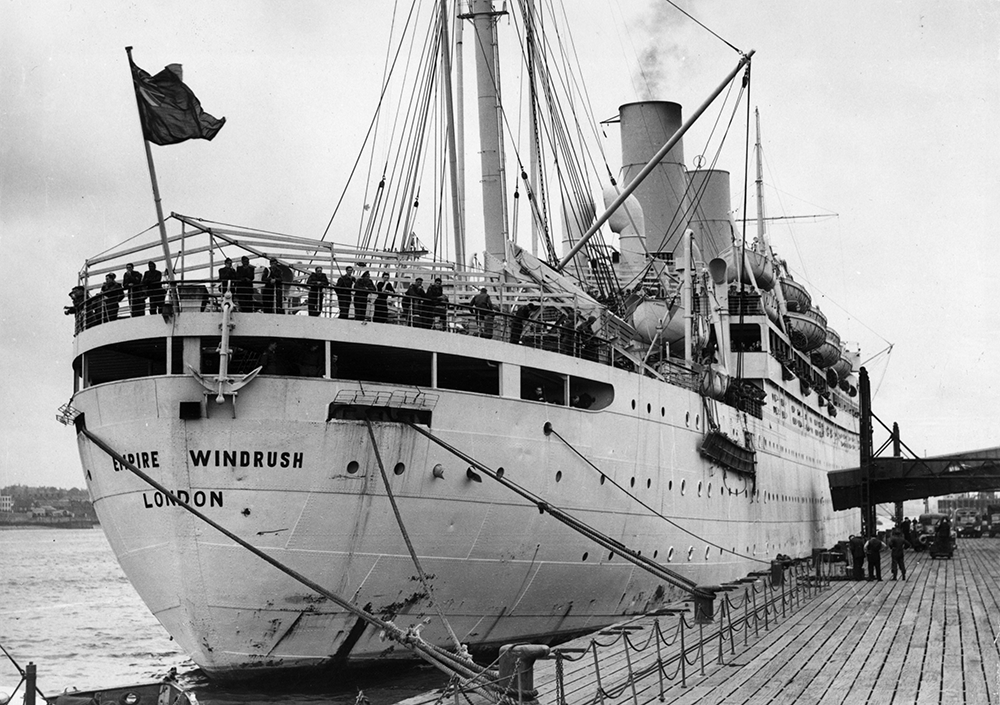
HMT Empire Windrush in harbour. Originally launched as the Hamburg Süd line’s Monte Rosa in 1930, seized for use as a British troopship in 1947 after WW2. She was lost after an engine room explosion and catastrophic fire in 1954 and sank in the Mediterranean.
In June 1948 the HMT Empire Windrush arrived at Tilbury carrying over 800 Caribbean passengers. Today this moment is often hailed beginning of modern multicultural Britain, the founding “origin story” of a tolerant, diverse cosmopolitan nation. Yet a deep dive into the archives shows a very different picture. The British Nationality Act of 1948 (passed just weeks after Windrush set sail) did create a universal status (“Citizen of the UK and Colonies”) that legally allowed colonial subjects to live in Britain. But as one colonial minister emphasised, this was meant to reaffirm an older imperial principle, that a subject could declare Civis Britannicus sum (“I am a British citizen”) regardless of colour and was not expected to trigger mass non-white immigration.1 In fact, Attlee’s government and senior civil servants were privately anxious about non-white migration, seeing Windrush as an “incursion” to be managed. Contemporary cabinet papers and correspondence reveal that Windrush was essentially an accident of imperial law and circumstance.
Imperial Citizenship and the 1948 Act
The post-war British state’s conception of citizenship was still shaped by empire. In theory, as Lord Palmerston had put it, every British subject “in whatever land he may be” could count on England’s protection.2 The 1948 British Nationality Act (BNA) codified this idea by creating two categories: Citizens of the UK & Colonies (CUKC) for the “non white” Commonwealth and Citizens of Independent Commonwealth Countries (CICC) for the white Dominions. As a Home Office historian notes, the Act was largely a reaction to Canada’s new Citizenship Act and was intended to preserve loyalty to the Crown and the Commonwealth.3 In practice, BNA 1948 did not fundamentally alter migration rules: colonial subjects remained British subjects with the right to enter the UK, as they had before. Critics at the time even pointed out that this laid the groundwork for subjects of a newly independent non-white India, Pakistan and African colonies to become CUKCs, but that eventuality was not central to the legislators’ intent.4 As David Olusoga and others have observed, no one in 1948 “imagined that black and brown people from Asia, Africa and the West Indies would use their rights under this act to come and settle in Britain”. The law was conceived primarily for white Commonwealth citizens like the populations of Canada and Australia, with the assumption that the British Empire’s non-white subjects, without the resources or need would not make the journey.5 In short, the legal framework of imperial citizenship was nominally open, but the political expectation was that few colonials would exercise the right to relocate.
[…]
Inventing the Myth: Windrush in National Memory
How, then, did Windrush attain the status of a proud national genesis myth? Over the ensuing decades the episode was reimagined and commemorated in ways that the original participants surely did not anticipate. As historian Simon Peplow notes, “the arrival of the Empire Windrush in 1948 has been cemented as a mythical central symbol for immigration in histories of modern Britain”.6 Newspaper narratives and politics in the 21st century cast the Windrush as the symbolic genesis of multicultural Britain. For example, literature and media (like Andrea Levy’s Small Island, 2004) linked the founding of a “shared history” to 1948, treating the Windrush landing as the first wave of a mass migration that made Britain what it is today.7 Over time this narrative was bolstered by public ceremonies: 50th- and 60th-anniversary events, the 1998 renaming of Brixton’s Windrush Square, and in 2018 the formal creation of a national Windrush Day (22 June) to “pay tribute” to the generation. Politicians and curriculum materials alike have repeated the line that Windrush marked the inception of modern Britain’s diversity.8
This retrospective framing treats the Windrush episode as a foundational myth, an origin story, and invoked to legitimise contemporary values of tolerance and diversity. In this constructed memory, loyal Caribbean war veterans returned to Mother Country to rebuild Britain, and British society (in hindsight) embraced them with open arms. Newsreel footage from 1948, often screened today, reinforces this sentimental image, the smiling Windrush passengers, calypso music, and patriotic commentary suggest an organised welcome.9 The reality was much, much more ambivalent.
- https://www.gov.uk/government/publications/the-historical-roots-of-the-windrush-scandal/the-historical-roots-of-the-windrush-scandal-independent-research-report-accessible#about-this-report
- Ibid
- Ibid
- Ibid
- https://www.theguardian.com/tv-and-radio/2019/jun/24/the-unwanted-the-secret-windrush-files-review-who-could-feel-proud-of-britain-after-this
- https://wrap.warwick.ac.uk/id/eprint/139720/1/WRAP-1997-Windrush-newspapers-Peplow-2020.pdf#:~:text=Abstract%3A%20The%20arrival%20of%20the,the%20manufactured%20centrality%20of%20this
- Ibid
- Ibid
- https://www.theguardian.com/commentisfree/2018/apr/22/windrush-story-not-a-rosy-one-even-before-ship-arrived
Comments Off on Demythologizing the Windrush story
February 28, 2026
QotD: The “Balance of Terror” in the missile age
The advance of missile and rocket technology in the late 1950s started to change the strategic picture; the significance of Sputnik (launched in 1957) was always that if the USSR could orbit a small satellite around the Earth, they could do the same with a nuclear weapon. By 1959, both the USA and the USSR had mounted nuclear warheads on intercontinental ballistic missiles (ICBMs), fulfilling Brodie’s prophecy that nuclear weapons would accelerate the development of longer-range and harder to intercept platforms: now the platforms had effectively infinite range and were effectively impossible to intercept.
This also meant that a devastating nuclear “first strike” could now be delivered before an opponent would know it was coming, or at least on extremely short notice. A nuclear power could no longer count on having enough warning to get its nuclear weapons off before the enemy’s nuclear strike had arrived. Bernard Brodie grappled with these problems in Strategy in the Missile Age (1959) but let’s focus on a different theorist, Albert Wohlstetter, also with the RAND Corporation, who wrote The Delicate Balance of Terror (1958) the year prior.
Wohlstetter argued that deterrence was not assured, but was in fact fragile: any development which allowed one party to break the other’s nuclear strike capability (e.g. the ability to deliver your strike so powerfully that the enemy’s retaliation was impossible) would encourage that power to strike in the window of vulnerability. Wohstetter, writing in the post-Sputnik shock, saw the likelihood that the USSR’s momentary advantage in missile technology would create such a moment of vulnerability for the United States.
Like Brodie, Wohlstetter concluded that the only way to avoid being the victim of a nuclear first strike (that having the enemy hit you with their nukes) was being able to credibly deliver a second strike. This is an important distinction that is often misunderstood; there is a tendency to read these theorists (Dr. Strangelove does this to a degree and influences public perception on this point) as planning for a “winnable” nuclear war (and some did, just not these fellows here), but indeed the point is quite the opposite: they assume nuclear war is fundamentally unwinnable and to be avoided, but that the only way to avoid it successfully is through deterrence and deterrence can only be maintained if the second strike (that is, your retaliation after your opponent’s nuclear weapons have already gone off) can be assured. Consequently, planning for nuclear war is the only way to avoid nuclear war – a point we’ll come back to.
Wohlstetter identifies six hurdles that must be overcome in order to provide a durable, credible second strike system – and remember, it is the perception of the system, not its reality that matters (though reality may be the best way to create perception). Such systems need to be stable in peacetime (and Wohlstetter notes that stability is both in the sense of being able to work in the event after a period of peace, but also such that they do not cause unintended escalation; he thus warns against, for instance, just keeping lots of nuclear-armed bombers in the air all of the time), they must be able to survive the enemy’s initial nuclear strikes, it must be possible to decide to retaliate and communicate that to the units with the nuclear weapons, then they must be able to reach enemy territory, then they have to penetrate enemy defenses, and finally they have to be powerful enough to guarantee that whatever fraction do penetrate those defenses are powerful enough to inflict irrecoverable damage.
You can think of these hurdles as a series of filters. You start a conflict with a certain number of systems and then each hurdle filters some of them out. Some may not work in the event, some may be destroyed by the enemy attack, some may be out of communication, some may be intercepted by enemy defenses. You need enough at the end to do so much damage that it would never be worth it to sustain such damage.
This is the logic behind the otherwise preposterously large nuclear arsenals of the United States and the Russian Federation (inherited from the USSR). In order to sustain your nuclear deterrent, you need more weapons than you would need in the event because you are planning for scenarios in which some large number of weapons are lost in the enemy’s first strike. At the same time, as you overbuild nuclear weapons to counter this, you both look more like you are planning a first strike and your opponent has to estimate that a larger portion of their nuclear arsenal may be destroyed in that (theoretical) first strike, which means they too need more missiles.
What I want to note about this logic is that it neatly explains why nuclear disarmament is so hard: nuclear weapons are, in a deterrence scenario, both necessary and useless. Necessary, because your nuclear arsenal is the only thing which can deter an enemy with nuclear weapons, but that very deterrence renders the weapons useless in the sense that you are trying to avoid any scenario in which you use them. If one side unilaterally disarmed, nuclear weapons would suddenly become useful – if only one side has them, well, they are the “absolute” weapon, able to make up for essentially any deficiency in conventional strength – and once useful, they would be used. Humanity has never once developed a useful weapon they would not use in extremis; and war is the land of in extremis.
Thus the absurd-sounding conclusion to fairly solid chain of logic: to avoid the use of nuclear weapons, you have to build so many nuclear weapons that it is impossible for a nuclear-armed opponent to destroy them all in a first strike, ensuring your second-strike lands. You build extra missiles for the purpose of not having to fire them.
(I should note here that these concerns were not the only things driving the US and USSR’s buildup of nuclear weapons. Often politics and a lack of clear information contributed as well. In the 1960s, US fears of a “missile gap” – which were unfounded and which many of the politicians pushing them knew were unfounded – were used to push for more investment in the US’s nuclear arsenal despite the United States already having at that time a stronger position in terms of nuclear weapons. In the 1970s and 1980s, the push for the development of precision guidance systems – partly driven by inter-agency rivalry in the USA and not designed to make a first strike possible – played a role in the massive Soviet nuclear buildup in that period; the USSR feared that precision systems might be designed for a “counter-force” first strike (that is a first strike targeting Soviet nuclear weapons themselves) and so built up to try to have enough missiles to ensure survivable second strike capability. This buildup, driven by concerns beyond even deterrence did lead to absurdities: when the SIOP (“Single Integrated Operational Plan”) for a nuclear war was assessed by General George Lee Butler in 1991, he declared it, “the single most absurd and irresponsible document I had ever reviewed in my life”. Having more warheads than targets had lead to the assignment of absurd amounts of nuclear firepower on increasingly trivial targets.)
All of this theory eventually filtered into American policy making in the form of “mutually assured destruction” (initially phrased as “assured destruction” by Secretary of Defense Robert McNamara in 1964). The idea here was, as we have laid out, that US nuclear forces would be designed to withstand a first nuclear strike still able to launch a retaliatory second strike of such scale that the attacker would be utterly destroyed; by doing so it was hoped that one would avoid nuclear war in general. Because different kinds of systems would have different survivability capabilities, it also led to procurement focused on a nuclear “triad” with nuclear systems split between land-based ICBMs in hardened silos, forward-deployed long-range bombers operating from bases in Europe and nuclear-armed missiles launched from submarines which could lurk off an enemy coast undetected. The idea here is that with a triad it would be impossible for an enemy to assure themselves that they could neutralize all of these systems, which assures the second strike, which assures the destruction, which deters the nuclear war you don’t want to have in the first place.
It is worth noting that while the United States and the USSR both developed such a nuclear triad, other nuclear powers have often seen this sort of secure, absolute second-strike capability as not being essential to create deterrence. The People’s Republic of China, for instance, has generally focused their resources on a fewer number of systems, confident that even with a smaller number of bombs, the risk of any of them striking an enemy city (typically an American city) would be enough to deter an enemy. As I’ve heard it phrased informally by one western observer, a strategy of, “one bomb and we’ll be sure to get it to L.A.” though of course that requires more than one bomb and one doubts the PRC phrases their doctrine so glibly (note that China is, in theory committed to developing a triad, they just haven’t bothered to actually really do so).
Bret Devereaux, “Collections: Nuclear Deterrence 101”, A Collection of Unmitigated Pedantry, 2022-03-11.
Comments Off on QotD: The “Balance of Terror” in the missile age
February 25, 2026
The Korean War Week 88: Riot or Revolution? – February 24, 1952
The Korean War by Indy Neidell
Published 24 Feb 2026The tensions at Koje-do POW camp explode this week, ending in heavy bloodshed as UN forces desperately try to wrestle control of the situation. Changes will need to be made to counter the growing threat of disorder, and fast. Elsewhere, the Communist forces are on the attack this week, both in the field and through diplomatic channels, as a naval invasion of Yang-do launches and accusations of biological weapons ramp up.
00:00 Intro
00:44 Recap
01:13 Compound 62
04:44 Yang-do Island
07:45 Biological Warfare
09:55 Supervisory Committee
12:22 Notes
13:16 Summary
13:27 Conclusion
14:13 Call to Action
(more…)
Comments Off on The Korean War Week 88: Riot or Revolution? – February 24, 1952
February 21, 2026
Canada’s Only Mass-Production Fighter Jet – Avro Canada CF-100 Canuck
Ruairidh MacVeigh
Published 18 Oct 2025During the 1940s and 50s, with World War II rapidly transitioning into the Cold War, Canada, as a major ally of the NATO nations and with large swathes of remote countryside that could easily be penetrated by Soviet fighters and bombers, created the CF-100 Canuck, one of the earliest production jet fighters in the world an a machine that, despite some early flaws, would go on to prove itself rugged and robust for patrolling the turbulent weather of the frozen Canadian north.
At the same time, though, the CF-100 was very much a product of its time, and despite its exceptional rigidity, by the middle of the 1950s it was very much obsolete as swept-wing and delta fighters rapidly became the norm for both Communist and Capitalist factions alike, and through its initial success would lay the groundwork for even more ambitious projects that sadly would not continue Canada’s major involvement in cutting edge military aerospace design.
Chapters:
0:00 – Preamble
0:49 – Facing a New Kind of War
4:28 – Ups and Downs
7:12 – Reworking the Design
10:36 – The CF-103 Project
15:51 – The Canuck Career
19:06 – Later Years
20:30 – Conclusion
(more…)
Comments Off on Canada’s Only Mass-Production Fighter Jet – Avro Canada CF-100 Canuck
February 18, 2026
The Korean War Week 87: What’s Going On In Compound 62? – February 17, 1952
The Korean War by Indy Neidell
Published 17 Feb 2026UN forces kick off this week with an operation to ensnare and capture North Korean and Chinese patrols, as significant progress is made elsewhere at the armistice talks. Prisoners really do seem to be the focus of the week, as rumblings of discontent continue to build at the POW camp on Koje-do island as UN control of the camp slips a little more each day. Just what is happening inside Compound 62 there? And do UN forces have a hope to stop it?
00:00 Intro
00:48 Recap
01:17 Clam Up
01:50 Repatriation
05:02 Item 5 Agreed Upon
07:35 Troop Rotation
09:47 Coastal Waters and Islands
11:02 Compound 62
13:45 The Bigger Picture
14:31 Summary
14:45 Conclusion
(more…)
Comments Off on The Korean War Week 87: What’s Going On In Compound 62? – February 17, 1952
February 16, 2026
QotD: How nuclear weapons were viewed right after WW2
At the same time, US strategists (particularly associated with the RAND Corporation) were beginning to puzzle out the long term strategic implications of nuclear weapons. In 1946, Bernard Brodie published The Absolute Weapon which set out the basic outlines of deterrence theory; he did this, to be clear, three years before the USSR successfully tested its first nuclear weapon in 1949 (far earlier than anyone expected because the USSR had spies in the Manhattan Project). Brodie is thus predicting what the strategic situation will be like when the USSR developed nuclear weapons; his predictions proved startlingly accurate, in the event.
Brodie’s argument proceeds as a series of propositions (paraphrased):
- The power of a nuclear bomb is such that any city can be destroyed by less than ten bombs.
- No adequate defense against the bomb exists and the possibilities of such are very unlikely.
- Nuclear weapons will motivate the development of newer, longer range and harder to stop delivery systems.
- Superiority in the air is not going to be enough to stop sufficient nuclear weapons getting through.
- Superiority in nuclear arms also cannot guarantee meaningful strategic superiority. It does not matter that you had more bombs if all of your cities are rubble.
- Within five to ten years (of 1946), other powers will have nuclear weapons. [This happened in just three years.]
All of which, in the following years were shown to be true. Consequently, Brodie notes that while nuclear weapons are “the apotheosis of aggressive instruments”, any attacker who used them would fear retaliation with their enemy’s nuclear weapons which would in turn also be so destructive such that “no victory, even if guaranteed in advance – which it never is – would be worth the price”. Crucially, it is not the fact of retaliation, but the fear of it, which matters and “the threat of retaliation does not have to be 100 per cent certain; it is sufficient if there is a good chance of it, or if there is a belief that there is a good chance of it. The prediction is more important than the fact.” [emphasis mine]
This does not “make war impossible” by any means, but rather turns strategy towards focusing on making sure that nuclear weapons are not used, by making it clear to any potential aggressor that nuclear weapons would be used against them. And that leads to Brodie’s final, key conclusion:
Thus, the first and most vital step in any American security program for the age of atomic bombs is to take measures to guarantee to ourselves in case of attack the possibility of retaliation in kind. The writer in making that statement is not for the moment concerned about who will win the next war in which atomic bombs are used. Thus far the chief purpose of our military establishment has been to win wars. From now on its chief purpose must be to avert them. It can have almost no other useful purpose.
To sum that up, because both the United States and its key enemies will have nuclear weapons and because their destructive power is effectively absolute (so high as to make any “victory” meaningless) and because there is no effective defense against such weapons, consequently the only rational response is to avoid the use of nuclear weapons and the only way to do that is to be able to credibly threaten to retaliate with nuclear weapons in the event of war (since if you cannot so retaliate, your opponent could use their nuclear weapons without fear).
That thinking actually took a while to take hold in actual American policy and instead during the 1940s and 1950s, the United States focused resources on bomber fleets with the assumption that they would match Soviet superiority in conventional arms in Europe with American nuclear superiority, striking military and industrial targets (“precision attacks with an area weapon”, a notion that is as preposterous as it feels) to immediately cripple the USSR in the event of war, or else aim to “win” a “limited” nuclear exchange.
Bret Devereaux, “Collections: Nuclear Deterrence 101”, A Collection of Unmitigated Pedantry, 2022-03-11.
Comments Off on QotD: How nuclear weapons were viewed right after WW2
February 14, 2026
QotD: Canada and its military – a history of neglect
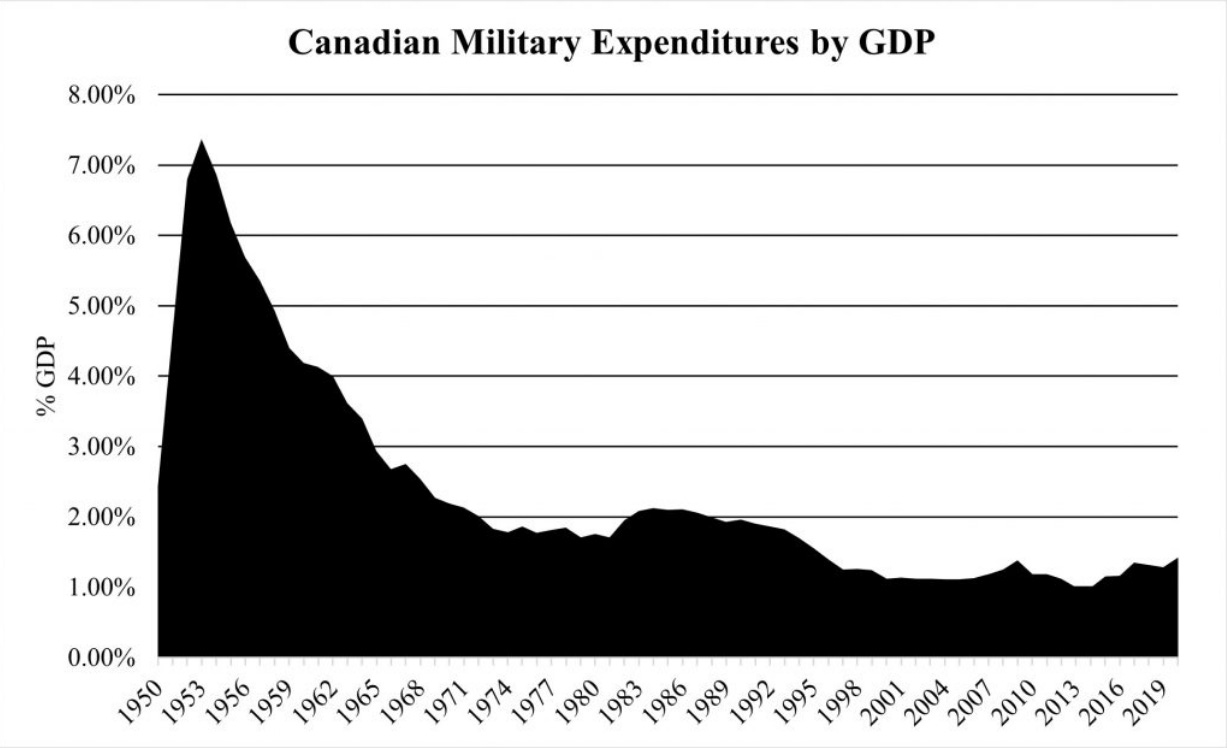
Canada’s military was not always a punchline. At the end of World War II Canada had the world’s third-largest navy, complete with our own aircraft carrier, and over a million men under arms. Since then military spending has steadily declined, from a high of around 7% of GDP in the early 50s to around 1% today, where it’s hovered since the end of the Cold War.
Canada is protected to its east and west by the Atlantic and Pacific oceans, both of which are patrolled by the powerful navy of the friendly superpower to the south, the only country with which Canada shares a land border, which we have long bragged is the longest undefended frontier in the world. Our only other neighbouring country is Russia, and while Russia is a decidedly unfriendly superpower, in practice Canada’s populated south is separated from the Russian Federation by thousands of kilometres of howling arctic wastes which provide an even better natural defence than the oceans.
Cozy and secure in our continental cocoon, Canada has allowed its military to atrophy into a vestigial appendage akin to the stubby wings of flightless birds on isolated Pacific islands, useful only for emotive displays. So far as the Liberal Party is concerned, “emotive display” is, indeed, the only real purpose of the military. Ever since Lester B. Pearson1 was awarded the Nobel Peace Prize for inventing the concept of “peacekeeping” to de-escalate the Suez Crisis (thereby helping to drive the final nail into the coffin of the British Empire), the Canadian military’s primary purpose has been to conduct third-world relief missions. Peacekeeping carries no particular benefit to Canada, but it is of great benefit to politicians, who get to preen in front of the camera as important humanitarian statesmen. The purpose of the Canadian military isn’t to win wars, to defend the country, or to conquer distant lands: it’s to make Liberal Party politicians feel good about themselves.
When the CAF fails to live up to its making-liberals-feel-good mission, Canada’s liberal establishment reacts like a frustrated child taking out her vindictive cruelty by throwing her dolls against the wall. The Somalia Affair is probably the best example of this dynamic. The Canadian Airborne Regiment, an elite commando unit whose core competencies were jumping out of airplanes to break things and kill people, was deployed in Somalia with the contradictory goal of keeping a non-existent peace, a mission to which they were singularly ill-suited. Somalis being Somalis, the Airborne base was immediately subjected to continuous infiltration and theft. A handful of the violent lunatics in the regiment reacted by capturing thieves and torturing them to death, which they had the poor sense to document with photographic evidence; later, photographs emerged of one of the airborne troopers wearing a moustache man t-shirt while raising his arm at a prohibited angle, which wasn’t criminal exactly but was very bad PR. Instead of punishing the guilty troops individually, for instance with field courts martial followed by summary hanging, the Liberal Party flew into a rage and disbanded the regiment for having committed the unforgivable sin of making them look bad. This dragged on in the media for years, sullying the honour of not only the Airborne Regiment but of the entire military. The Somalia affair unfolded over thirty years ago, but the liberal establishment holds it over the heads of the CAF to this day.
In addition to providing politicians with regular hits of the pleasantly addictive buzz of telescopic philanthropy, peacekeeping also has the great advantage of being cheap. Not only does peacekeeping not require all that many troops, you don’t even need tanks, fighter jets, destroyers, or aircraft carriers to distribute aid packages to refugees. Therefore the Canadian military essentially does not have these things. The CAF has a grand total of 112 forty-six-year-old Leopard II main battle tanks (of which roughly half are down for maintenance at any given time), a whole 138 forty-two-year-old CF-18 Hornet fighter jets (of which 89 are operational), twelve Halifax class frigates (of which about half are in drydock at any given time), an intimidating four Victoria class diesel-electric submarines (which are forty-five years old, and all but one of which is out of commission), and zero bombers, zero attack helicopters, zero destroyers, zero troop transports, zero battleships, and zero aircraft carriers. The pathetic size of the Royal Canadian Navy is particularly embarrassing given that Canada has the longest coastline in the world, at 243,042 kilometres, essentially all of which Ottawa expects Washington to defend on its behalf. Airlift capacity is so limited that the CAF essentially cannot deploy overseas without allied logistical assistance.
By contrast with its decrepit armaments, the CAF has 145 generals: it has more generals than it does tanks. This top-heavy general staff is only about a third the size of the US military’s, despite the American military being 20x larger by personnel and 32x larger by budget.
From the perspective of the Laurentian elite, a weak military is actually a political advantage. If Canada effectively does not have the ability to project military force, Ottawa can simply plead lack of capacity when America asks for assistance. It enables Canada to duck out of involvement in America’s various imperial wars, letting Washington shoulder the burden of the Pax Americana while chirping from the sidelines about how the big bad bible-thumbing American bully is so mean, and how peaceful, ethical, liberal, humanitarian Canada is so nice because Canada spends its money on healthcare instead of bombs. It isn’t a morally superior position, of course: it’s simply shameless dependence and shameful parasitism.
John Carter, “The Canadian Political Class is Ideologically Incapable of Rebuilding the Military”, Postcards From Barsoom, 2025-11-13.
- The man who, as prime minister, replaced the red ensign’s ethnic heraldry with the maple leaf’s corporate logo.
Comments Off on QotD: Canada and its military – a history of neglect
February 13, 2026
Hovea M44: Husqvarna Makes a Submachine Gun
Forgotten Weapons
Published 22 Sept 2025The Hovea M44 was tested by the Danish and Swedish militaries in 1945, competing against the Carl Gustaf M45. It was designed and produced by Husqvarna (yes, the chainsaw company) and just 10 of them were made for testing. It was designed around the Suomi quad-stack magazine, which was also originally a Swedish design. Sweden chose the Carl Gustaf, but Denmark preferred the Hovea — but with a couple modifications. Specifically, they wanted the grip and stock from the Carl Gustaf, and that ended up becoming the Hovea M49 which was adopted into Danish service.
Hovea M49 video: • Denmark’s Post-WW2 SMG: the Hovea m/49
(more…)
Comments Off on Hovea M44: Husqvarna Makes a Submachine Gun
February 11, 2026
The Korean War Week 86: Koje-do: A Simmering Cauldron – February 10, 1952
The Korean War by Indy Neidell
Published 10 Feb 2026An astonishing accusation about chemical weapons by Soviet diplomat Yakov Malik dominates headlines this week, as the POW issue continues to plague ceasefire negotiations. But those are far from the only developments this week. Elsewhere, overcrowding, poor conditions, and lack of firm control escalate tensions at the UN’s Koje-do POW camp, perhaps beginning to precipitate unpredictable and dangerous results …
00:00 Intro
00:47 Recap
01:29 Item 5
06:05 NK Ingenuity
07:03 Poison Gas
08:37 Screening POWs
10:17 Koje-Do
11:47 Operation Clam-up
13:21 Summary
14:29 Conclusion
15:03 Call to Action
(more…)
Comments Off on The Korean War Week 86: Koje-do: A Simmering Cauldron – February 10, 1952
February 10, 2026
FAMAS G1: Simplified for Export
Forgotten Weapons
Published 17 Sept 2025The FAMAS G1 was developed as a lower-cost option for FAMAS export sales. The original F1 model had been offered for international sale, but it attracted little interest largely because of its high price. In response, GIAT created the G1 with many of the extra features left optional. This allowed them to reduce the price by up to 40%. Specific feature reductions included:
- Omitting the bipod legs
- Omitting the grenade launching sights and barrel fittings
- Omitting the night sights
- Omitting the burst fire mechanism
- Replacing the trigger guard with a molded whole-hand trigger guard
The mechanism stayed the same, and all of the omitted features could be included as options. This still failed to generate any export sales, in part because GIAT came under ownership of FN, and FN’s competing assault rifle options were more profitable than the FAMAS.
The G1 did contribute elements like the whole-hand trigger guard to the mid-1990s G2 model adopted by the French Navy, however.
(more…)
Comments Off on FAMAS G1: Simplified for Export


