Quotulatiousness

September 21, 2020

QotD: Prohibition and the Temperance movement

Filed under: History, Politics, Quotations, Religion, USA — Tags: , , , , — Nicholas @ 01:00

Prohibition was the culmination of nearly a century’s worth of propaganda, and repeated failed attempts to get such laws to work at the local and state level. Read J.C. Furnas’ The Life and Times of the Late Demon Rum for an overview of the pre-1919 Temperance/Prohibition movement.

… [T]he original Temperance movement started out with the very best of intentions, and was trying to deal with a real problem. In colonial and early-19th-century America, people (men, women and OH HORRORS even children!) drank enough that by modern standards we’d call them alcoholics. Modern Russians drink more, but if they were transported back to that time and place, they’d fit right on in. Part of it was because water was often not safe to drink (tea and coffee were often expensive and hard to get, while beer and other alcoholic drinks were made just about everywhere), part of it was snobbery (only really poor people drank water!) and part of it was because people back then believed that alcohol strengthened and warmed the body.

Two of the good side effects of the Temperance/Prohibition movement were the provision of safe, clean drinking water in American cities and towns, and the modern fruit-juice industry (as a lot of churches went hot-Prohibition, they got uneasy about serving wine at Communion, so they went to work and came up with non-alcoholic substitutes.) Welch’s Grape Juice was started by a pastor who wanted non-alcoholic “wine” for Communion, and caught on, real big.

Eric Oppen, posting to the Lois McMaster Bujold mailing list, 2020-06-18.

September 13, 2020

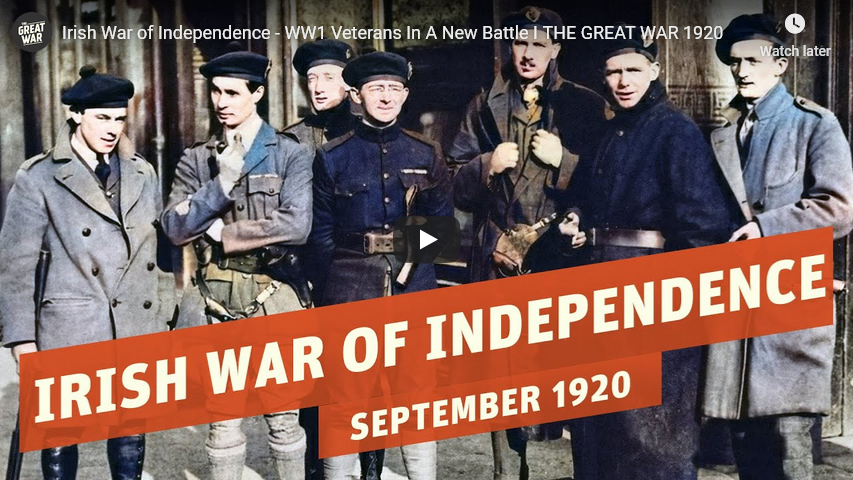
Irish War of Independence – WW1 Veterans In A New Battle I THE GREAT WAR 1920

The Great War
Published 12 Sep 2020

Sign up for Curiosity Stream and get Nebula bundled in: https://curiositystream.com/thegreatwar

The conflict between the Irish independence movement and the UK government had been heating up since 1919. The summer of 1920 brought a new level of escalation with the arrival of the the Auxiliary Division of the Royal Irish Constabulary. Former veterans of the First World War were brought in to quell the rebellion and get hold of the strongholds controlled by the IRA.

» SUPPORT THE CHANNEL
Patreon: https://www.patreon.com/thegreatwar

» OUR PODCAST
https://realtimehistory.net/podcast – interviews with World War 1 historians and background info for the show.

» BUY OUR SOURCES IN OUR AMAZON STORES
https://realtimehistory.net/amazon *
*Buying via this link supports The Great War (Affiliate-Link)

» SOURCES
Hart, Peter: The IRA and Its Enemies (Oxford: Oxford University Press, 1998)

Harvey, A.D: “Who Were the Auxiliaries?” The Historical Journal, Vol. 35, No. 3 (Sep. 1992)

Hopkinson, Michael: The Irish War of Independence (Montreal & Kingston: McGill-Queen’s University Press, 2002)

Leeson, David: The Black and Tans: British Police and Auxiliaries in the Irish War of Independence, 1920-1921 (Oxford: Oxford University Press, 2011)

McMahon, Sean: The War of Independence (Cork: Mercier Press, 2019)

O’Brien, Paul: Havoc: The Auxiliaries in Ireland’s War of Independence (Cork: Collins Press, 2017)

Riddell, George: Lord Riddell’s Intimate Diary of the Peace Conference and After: 1918-1923 (London: Victor Gollancz Ltd, 1933)

Roxbourgh, Ian: “The Military: The Mutual Determination of Strategy in Ireland, 1912-1921” in Duyvendak, Jan Willem & Jasper, James M. (eds) Breaking Down the State: Protesters Engaged (Amsterdam: Amsterdam University Press, 2015)

Townshend, Charles: The Republic: The Fight for Irish Independence 1918-1923 (London: Penguin Books, 2014)

“Tubbercurry”, Manchester Guardian, 4 October 1920.

Hugh Martin: “‘Black and Tan’ Force a Failure”, Daily News, 4 October 1920.

» MORE THE GREAT WAR
Website: https://realtimehistory.net
Instagram: https://instagram.com/the_great_war
Twitter: https://twitter.com/WW1_Series
Reddit: https://reddit.com/r/TheGreatWarChannel

»CREDITS
Presented by: Jesse Alexander
Written by: Jesse Alexander
Director: Toni Steller & Florian Wittig
Director of Photography: Toni Steller
Sound: Toni Steller
Editing: Toni Steller
Motion Design: Philipp Appelt
Mixing, Mastering & Sound Design: http://above-zero.com
Maps: Daniel Kogosov (https://www.patreon.com/Zalezsky)
Research by: Jesse Alexander
Fact checking: Florian Wittig

Channel Design: Alexander Clark
Original Logo: David van Stephold

Contains licensed material by getty images
All rights reserved – Real Time History GmbH 2020

September 7, 2020

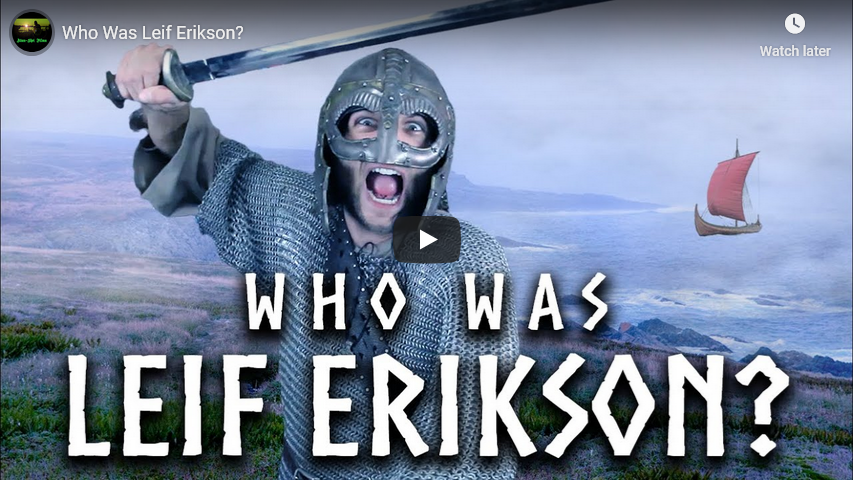
Who Was Leif Erikson?

Atun-Shei Films
Published 9 Oct 2019

Happy Leif Erikson Day! Allow me to regale you with the saga of the daring Viking who sailed to North America five hundred years before Columbus (that hack) and called it Vinland. We all know his name and his famous deeds – but what sort of man was Leif Erikson?

Support Atun-Shei Films on Patreon ► https://www.patreon.com/atunsheifilms

#LeifErikson #Viking #History

Watch our film ALIEN, BABY! free with Prime ► http://a.co/d/3QjqOWv
Reddit ► https://www.reddit.com/r/atunsheifilms
Twitter ► https://twitter.com/alienbabymovie
Instagram ► https://www.instagram.com/atunsheifilms
Merch ► https://atun-sheifilms.bandcamp.com

September 5, 2020

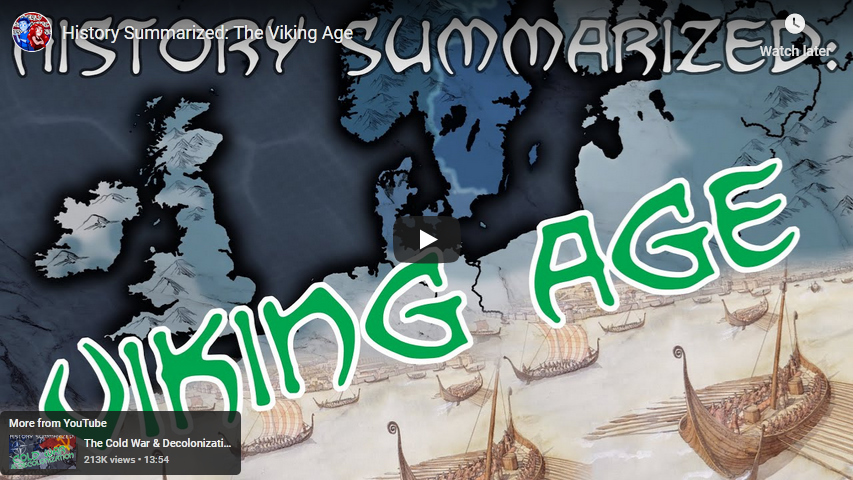
History Summarized: The Viking Age

Overly Sarcastic Productions
Published 4 Sep 2020

The Vikings are enjoying a new wave of enthusiasm in popular culture, but these seafaring Norsemen are still quite clearly a misunderstood force in medieval European history. So let’s take a wide look at the European world during The Viking Age!

Check out Yellow’s livestreams over at https://Twitch.tv/LudoHistory

SOURCES & Further Reading: The Vikings by Walaker Nordeide and Edwards, Vikings: A Very Short Introduction by Richards, Age of the Vikings and The Conversion of Scandinavia by Winroth, The Vikings By Harl via The Great Courses, The Viking World by Graham-Campbell, The Viking Way by Price.

This video was edited by Sophia Ricciardi AKA “Indigo”. https://www.sophiakricci.com/

Our content is intended for teenage audiences and up.

DISCORD: https://discord.gg/kguuvvq

PATREON: https://www.Patreon.com/OSP

MERCH LINKS: https://www.redbubble.com/people/OSPY…

OUR WEBSITE: https://www.OverlySarcasticProductions.com
Find us on Twitter https://www.Twitter.com/OSPYouTube
Find us on Reddit https://www.Reddit.com/r/OSP/

From the comments:

Ludohistory
23 hours ago (edited)
Thanks so much for having me on and letting me help out! It was a lot of fun (even if I talked a little too fast sometimes)! To clarify a piece that I know I did cover too briefly — missionary trips to Scandinavia occurred in Denmark around 823, on the orders of Louis the Pious, and in Sweden in 829, when Ansgar, a Frankish monk, traveled to the town of Birka, where he found a very small Christian community, probably mostly enslaved or formerly enslaved people, and converted a couple of Norse people, including the town prefect. (The graveyard for that town, incidentally, is where the 10th century “female warrior” that made waves a few years ago was buried).

There’s a lot we didn’t get a chance to talk about about the diaspora and its ending, so if there’s anything you all are curious on or find unclear, let me know here or on twitter 🙂

Finally, if you liked this, all the VODs for my personal streams (where I try to ramble about history in games) can be found by clicking on my name, and tomorrow I’ll be streaming CKIII on twitch (link in the description)!

August 20, 2020

Thomas Becket, Archbishop of Canterbury 1162-1170

Filed under: Britain, History, Religion — Tags: , , , — Nicholas @ 05:00

Reverend Steve Morris tries to show why St. Thomas of Canterbury needs a “reboot” for modern eyes:

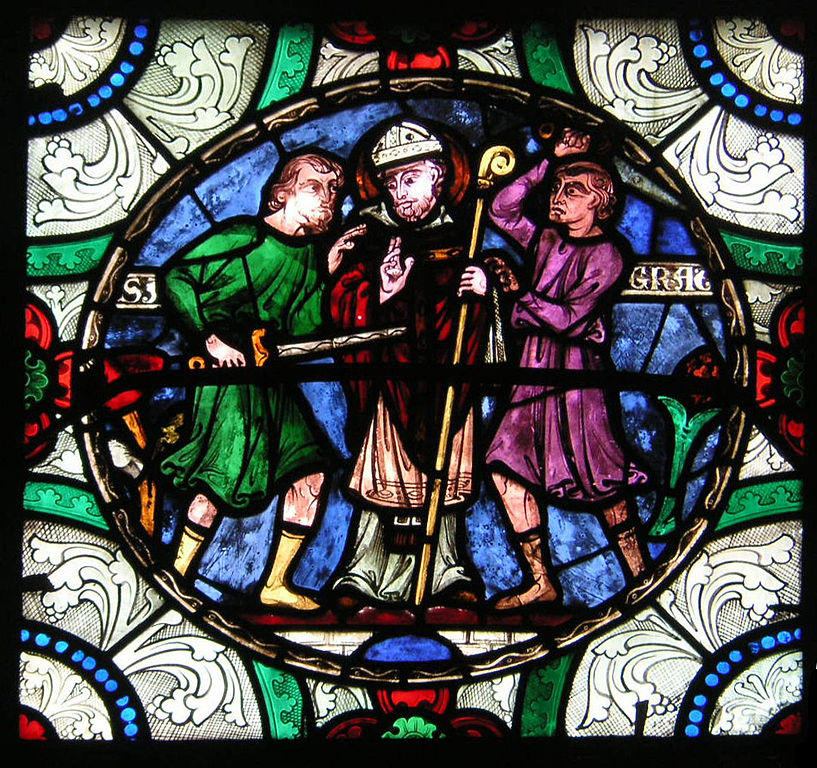
Stained glass showing the murder of St. Thomas at Canterbury on 29 December, 1170.
Wikimedia Commons.

It’s 850 years since that night when four knights murdered the Archbishop of Canterbury. It’s been a rocky old road for Thomas Becket despite hundreds of years as the poster-boy of the cult of saints which swept medieval England. His reputation, his legacy and his conduct have been filleted over the last few centuries and we are left with just a ghost of the man who, once upon a time, stood for all that was good.

It is a cautionary tale of historical revisionism, measuring yesterdays’ saints by today’s “standards” and assembling a set of half-truths to trash the reputation of England’s great, perhaps greatest, saint. It is high time he made a comeback – especially in these political times. After all, Becket was perhaps the greatest political martyr we have. Of course, there is always truth in just about any criticism. And Becket lays himself open. He was, to say the least, stubborn. He was a contrarian and he was reckless with his own safety. In an age of kingly power, it doesn’t do to embarrass the monarch.

The charge sheet does quickly stack up. Becket was a canny careerist (although you’d be hard pushed to find anyone of influence at the time who wasn’t). He seemed to have a death wish, or at least refused to listen to perfectly sensible advice on taking a more circumspect path. And his cause, seen through a certain lens, seems off-beam for modern times. He has been painted as standing for the ancient legal power of the church against a reforming king who began to kick-start Common Law. But of course, it’s never as simple as this.

But none of this was the real problem and none of it was what caused our great saint to be consigned to the historical dustbin. As is often the way, the problem comes down to background and class. Becket was born to only modestly well-off parents in London (he has always been London’s saint). His father was middle-class, and a merchant. Becket was “trade” by background and it was something he couldn’t shake off. But his rise was an astounding feat of defying gravity.

In an era of complex geopolitics and conflicts between pope and state Thomas rose through the ranks and became Archbishop of Canterbury. At first, he seemed like the king’s man, but relations soured. Becket and the king were entangled in a fight to the death, with the archbishop excommunicating various opponents and generally throwing his weight around.

His death was gruesome. Four knights ambushed him. He could have run or barricaded himself in the cathedral, but he told his followers that God’s house should not be made a fortress. He pushed one of his attackers. What followed was a flurry of sword-strokes to the head – one of which took his tonsured skull right off. The contemporaneous reports paint a ghastly picture of brain fluid and blood mixing freely on the cathedral floor. But it didn’t end there.

August 17, 2020

Dateline Ayodhya, Uttar Pradesh, 5 August 2020

Filed under: History, India, Religion — Tags: , , , , — Nicholas @ 03:00

That’s a significant date, as Tom Holland explains at UnHerd:

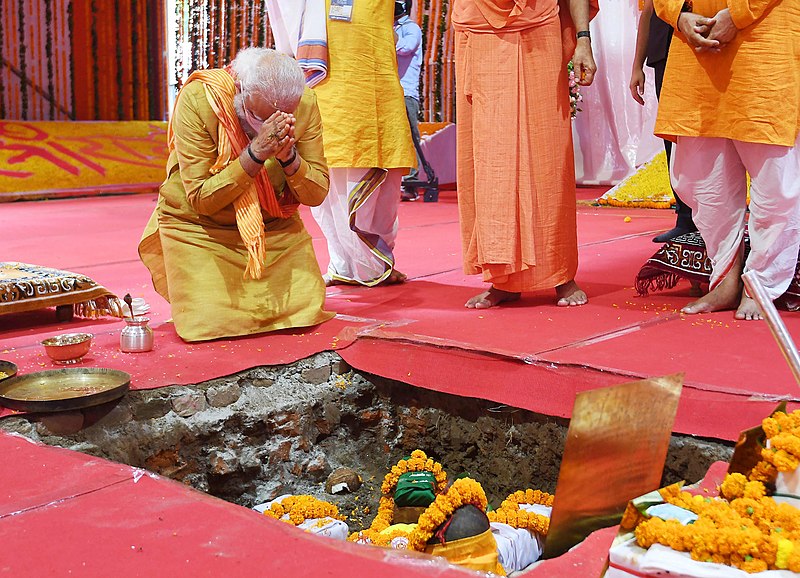
Indian Prime Minister Narendra Modi performing Bhoomi Pujan at Shree Ram Janmabhoomi Mandir, in Ayodhya, Uttar Pradesh on August 05, 2020.
Photo released by the Press Information Bureau on behalf of the Prime Minister’s Office, (ID 90071) via Wikimedia Commons.

Last week, on 5 August, the Prime Minister of India laid a foundation stone and helped bury a distinctive period in global history. Narendra Modi had travelled to Ayodhya, a city long identified by Hindus with one of their most beloved gods. Lord Rama — avatar of Vishnu and hero of the Sanskrit epic, the Ramayana — was said to have ruled within its walls as the very model of those who uphold truth and justice. Like Camelot, the court of Rama glimmers tantalisingly in the imaginings of those who fall beneath its spell: the reminder of a vanished golden age, the hope that it might come again.

In recent decades, the mingled regret and yearning that the memory of Rama’s capital can inspire among Hindus had come to be focused on one particular location in the modern city of Ayodhya: the Ram Janmabhoomi, the “birthplace of Rama”. At the moment, nothing serves to mark the sacred spot. But soon enough that will change. A great complex of buildings will rise. As Modi, officially declaring the process of construction begun, put it: “A great temple will now be built for our Lord Rama.”

A fortnight earlier, the President of Turkey had celebrated a similar reconsecration. In 1453, when the Christian capital of Constantinople fell to the Ottomans, its most stupefying building, the great cathedral of Hagia Sophia, had been converted into a mosque, and duly served for almost half a millennium as a monument to the triumph of Islam over a defeated and superceded order. Then, in 1935, a decade and more after the collapse of the Ottoman Empire and its replacement within its heartlands by a Turkish republic, the mosque of Ayasofya was turned into a museum. So, for decades, it remained. Then, this summer, the museum once again became a mosque. On 24 July, Hagia Sophia opened for Friday prayers. “It is breaking away from its chains of captivity,” President Erdogan declared rhapsodically. “It was the greatest dream of our youth. It was the yearning of our people and it has been accomplished.”

The synchronicity between Modi’s trip to Ayodhya and Erdogan’s to Hagia Sophia is striking, and only flimsily obscured by the fact that the Prime Minister of India is trampling the legacy of an Islamic empire much as the President of Turkey has trampled the legacy of a Christian one. In the early sixteenth century, shortly after the Moghul conquest of the lands that once, so Hindus believed, had constituted the Ram Rajya, the “realm of Rama”, a mosque was built in Ayodhya. By the twentieth century, large numbers of Hindus had come to believe that this same mosque, the Babri Masjid, stood directly on the site of the Ram Janmabhoomi. In the 1980s, the BJP — the party to which Modi belongs — began a campaign to demolish it. In 1992 a mob duly tore it down. Communal riots exploded. Thousands died.

Last November, even as the site was formally granted to Hindus, the Supreme Court of India condemned the demolition of the mosque as a crime. But a crime by whose standards? Not, it would seem, by Modi’s. Just as Erdogan justified the conversion of Hagia Sophia to a mosque by “right of conquest”, so the Prime Minister of India, hailing the opportunity to build a temple on the site where the Babri Masjid had stood, invoked the ancient traditions of his country. It was, he declared, “a unique gift from law-abiding India to truth, non-violence, faith and sacrifice.” History as well as justice stood on his side.

QotD: Orwell and faith

Filed under: Quotations, Religion — Tags: , — Nicholas @ 01:00

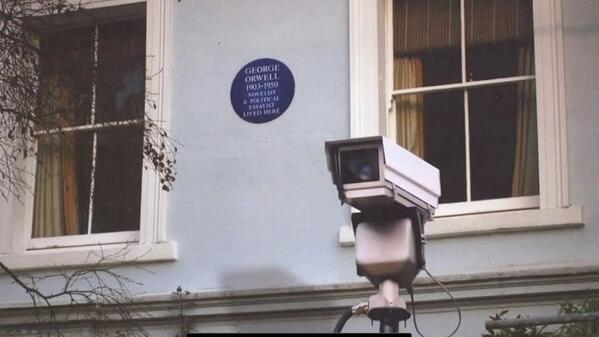
I spent a day with Orwell just before he died. I sat on his sanatorium bed, tried to smoke the frightful cigarettes he insisted on making for himself. I heard him say: “The problem of the world is this: Can we get men to behave decently to each other if they no longer believe in God?”

Charles Curran, “Orwell: The man behind 1984 — and all that”, Daily Mirror, 1954-12-14.

August 15, 2020

Miscellaneous Myths: The Book Of Invasions

Filed under: Books, Europe, History, Humour, Religion — Tags: , , , , — Nicholas @ 04:00

Overly Sarcastic Productions
Published 14 Aug 2020

The quintessential Irish mythological text, and … it’s about getting steamrolled by invaders. Now that’s what I call brand consistency!

Our content is intended for teenage audiences and up.

PATREON: https://www.Patreon.com/OSP

DISCORD: https://discord.gg/kguuvvq

MERCH LINKS: https://www.redbubble.com/people/OSPY…

OUR WEBSITE: https://www.OverlySarcasticProductions.com
Find us on Twitter https://www.Twitter.com/OSPYouTube
Find us on Reddit https://www.Reddit.com/r/OSP/

August 14, 2020

From protests to riots to …

Filed under: History, Media, Politics, Religion, USA — Tags: , , , , , , — Nicholas @ 03:00

In the Claremount Review of Books, Angelo M. Codevilla looks at historical patterns that may prefigure what is going on in major urban areas today:

Hagia Sophia in the Faith district of Istanbul, 18 November 2004.
Photo by Robert Raderschatt via Wikimedia Commons.

The Americans who confess other people’s racism absolve themselves inexpensively by a moral mechanism common to humanity: the more I profess to hate evil, the more I showcase my own goodness. Such confessions, however, have a particular history of tragedy in Christian civilization. Again and again over the centuries, persons who have imagined themselves cleansed by ritual confessions have believed themselves elevated above the rest of humanity and, hence, entitled to oppress or even annihilate those around them. Today’s self-purifiers, arms outstretched in supine submission, who then countenance violence against persons, property, and cultural symbols, are mostly unwitting protagonists in yet another chapter of a hoary history.

Although Judeo-Christianity teaches that perfection is not of this world, nevertheless the Old Testament (see the Book of Daniel) and the New (Revelation, chapter 20) refer tangentially to a final state in human affairs in which all evil will have been defeated and the virtuous will have triumphed over their enemies. In the Book of Revelation, this final stage is to last for a thousand years. Jesus Christ’s warnings notwithstanding, people have hearkened periodically to “false prophets” who brandish the prospect of ultimate vengeance over evil. Between the 11th and 16th centuries, any number of movements of this sort used ritual confessions to cleanse themselves, and energized the mobs that waged Europe’s bloodiest wars of that age. Thereafter, though such movements secularized their terms, they fit into the same moral and intellectual categories. Now as ever, they are about destroying civilization in the name of altering the human condition.

But whereas revolutionary movements from the Middle Ages to roughly the middle of the 20th century opposed the ruling classes wholeheartedly and found no friends among them, this generation’s movements have intense, problematic relations with those classes, about which more below.

Today we see scenes of monuments which had stood for decades, now destroyed and defaced, as well as the forceful cancellation of names from circulation. Smashing others’ idols was, and remains, a staple of tribal warfare. The Old Testament recalls the divine command to destroy idols, and the clashes between Christian and Muslim armies always aimed as much at symbols as at people. The Song of Roland contains a lyrical account of Charlemagne’s iconoclasm in his campaign against the Saracens. In the 6th century, Emperor Justinian made Constantinople’s Hagia Sophia cathedral the Christian world’s biggest and most important church. The Muslims who added that city to the Ottoman Empire in 1453 killed its priests, toppled its statues, and made it into the principal mosque of the Muslim caliphate at war with Christendom. In 1923, Kemal Atatürk, Turkey’s modernizer, turned the building into a museum in order to end that war. But in July 2020 Turkey’s Islamist president Recep Erdogan, consistent with his hostility to Judeo-Christian civilization, turned it into a mosque again and began covering up what remain of the Christian frescoes on its walls. Destroying symbols, however, has had no place within Christian civilization. As the equivalent of torturing dead men, it has always been the work of cowards likelier to run from living enemies. On the other hand, war against statues, paintings, books, biographies, etc., has been a defining feature of civilization’s revolutionary enemies, consistent with their chosen identities as alien tribes.

What follows is a glance at the bloody history of this little-known flaw. It is a tale whose cautionary moral Aleksandr Solzhenitsyn best expressed: the line between good and evil runs not between persons — never mind between parties, classes, or races — but down the middle of every human heart. That is central to our civilization.

H/T to David Warren for the link.

August 7, 2020

QotD: Celibacy and chastity

Filed under: History, Quotations, Religion — Tags: , , , , — Nicholas @ 01:00

Despite the common misunderstanding of the word, “celibate” does not refer to someone who abstains from sex. “Celibate” refers to someone who forgoes marriage — the part about not having sex is implied, at least in the Christian world, give or take an Alexander VI or two. “Chaste,” at the same time, doesn’t quite mean what people think it does: It refers principally to the abstention from extramarital sex, which in the case of the celibate means abstention from sex categorically. But chastity is part of marriage, too, describing a reverent attitude toward sex. In the Christian view (which is to say, in the view of Western civilization until ten minutes ago), the procreative act is the means by which men and women in union with one another participate in God’s creative work. “Chastity” means a lot more than mere abstinence. Chastity isn’t some kind of genital veganism.

There has been some pretty elevated stuff written on that subject, and if you want to take that particular high road, then Professor Robert George of Princeton is your guy. But consider the low road, too. There’s another conclusion, maybe a little bit cynical, that could be drawn from this: If you are a sexually frustrated young man, the smart play would be to join a church.

Kevin D. Williamson, “Advice for Incels”, National Review, 2018-05-10.

August 6, 2020

Rhodes: A Short History

History Time
Published 2 Mar 2017

*****This was one of the first videos I ever made.
******Subscribe for much better narration on the newer videos and tons more historical awesomeness*****

Situated at a crossroads between East and West, in a strategic location between the Aegean and the Mediterranean, Rhodes has long been fought over by the surrounding powers. As a result, Rhodes is one of the most historic sites on Earth.

If you liked this video and have as little as a dollar to spare then please consider supporting me on Patreon for more and better content in the future:- http://www.patreon.com/historytimeUK

Are you a budding artist, illustrator, cartographer, or music producer? Send me a message! No matter how professional you are or even if you’re just starting out, I can always use new music and images in my videos. Get in touch! I’d love to hear from you.

I’ve also compiled a reading list of my favourite history books via the Amazon influencer program. If you do choose to purchase any of these incredible sources of information, many of which form the basis of my videos, then Amazon will send me a tiny fraction of the earnings (as long as you do it through the link) (this means more and better content in the future) I’ll keep adding to and updating the list as time goes on:-
https://www.amazon.com/shop/historytime

I try to use copyright free images at all times. However if I have used any of your artwork or maps then please don’t hesitate to contact me and I’ll be more than happy to give the appropriate credit.

—Join the History Time community on social media:-
Instagram:-
https://www.instagram.com/historytime…
Twitter:-
https://twitter.com/HistoryTimePete

August 5, 2020

QotD: Responsibility

Filed under: Britain, Law, Liberty, Politics, Quotations — Tags: , , , — Nicholas @ 01:00

I have always been deeply suspicious of the word “responsibility”. It has again and again sounded like someone else telling me that I must do what he wants me to do rather than what I want to do. If he is paying my wages, then fair enough. But if he is explaining why I should vote for him, and support everything he does once he has got the job he is seeking, not so fair.

The sort of thing I mean is when a British Conservative Party politician says, perhaps to a room full of people who, like me, take the idea of personal liberty very seriously: Yes, I believe, passionately, in personal liberty. The politician maybe then expands upon this idea, often with regard to how commercial life works far better if people engaged in commerce are able to make their own decisions about which projects they will undertake and which risks they will walk towards and which risks they will avoid. If business is all coerced, it won’t be nearly so beneficial. We will all get poorer. Yay freedom.

But.

But … “responsibility”. We should all have freedom, yes, but we also have, or should have, “responsibility”. Sometimes there then follows a list of things that we should do or should refrain from doing, for each of which alleged responsibility there is a law which he favours and which we must obey. At other times, such a list is merely implied. So, freedom, but not freedom.

The problem with politicians talking about responsibility is that their particular concern is and should be the law, law being organised compulsion. And too often, their talk of responsibility serves only to drag into prominence yet more laws about what people must and must not do with their lives. But because the word “responsibility” sounds so virtuous, this list of anti-freedom laws becomes hard to argue against, even inside one’s own head. Am I opposed to “responsibility”? Increasingly, I have found myself saying: To hell with it. Yes.

I have often been similarly resistant to the language of Christianity, of the sort that dominates what is being said in churches around the world today. How many times in history have acts of tyranny been justified by the tyrant saying something like: We must all bear our crosses in life, and here, this cross is yours. “God is on my side. Obey my orders.” The truth about the potential of life to inflict pain becomes the excuse to inflict further pain.

Brian Micklethwait, “Jordan Peterson on responsibility – and on why it is important that he is not a politician”, Samizdata, 2018-03-30.

July 27, 2020

H.L. Mencken

Filed under: Books, History, Liberty, USA — Tags: , , , , , , — Nicholas @ 03:00

In the latest Libertarian Enterprise, Eric Oppen (with whom I’ve had a few brief email conversations) discusses the work of the “Sage of Baltimore”:

H.L. Mencken in 1928.
Photo by Ben Pinchot for Theatre Magazine, August 1928.

I would say that, on the whole, Mencken is still quite readable and enjoyable, and many of his observations on the American scene are still as valid as when he made them. He has his weaknesses. He’s not much of an historian, which limits him when he takes up historical subjects. He never got over what he saw as the unfair treatment the German cause got in the American press between 1914 and the entry of the US into World War One. He also often identifies people as Jewish or black when it’s not really relevant to what he’s saying, but this was more a custom of his time than out-and-out bigotry. While he often has uncomplimentary things to say about Jews, and blacks, his greatest scorn is reserved for “the lintheads” — his term for the poor whites of the South. He regarded them as barely worthy of human status.

[…] his views on most subjects were quite compatible with libertarian positions. He was an inveterate opponent of government overreaching (which was behind a lot of his ferocious opposition to Prohibition) and while I don’t think he’d approve of drug use, he’d see our War on (Some Unpopular) Drugs as the assault on the Constitution that it is. While he was by no means hostile to blacks, and went out of his way to promote black writers (many of the figures in the “Harlem Renaissance” owed a lot to his support), he’d also denounce affirmative action and our current frenzy of “anti-racism” in scathing terms. His views on the Civil Rights Act of 1964 and how it has been turned into an alternate, and superior, Constitution would probably scorch the paint off the walls.

Mencken’s views on people’s private lives would have infuriated many of his contemporaries. While he disapproved of homosexuality, referring to it negatively in entries in his private diaries, he was by no means a howling “homophobe.” His writings on the travails of Oscar Wilde are very sympathetic to Wilde’s sufferings, which Mencken thought were wholly disproportionate to what he was known to have done. Mencken referred to Lord Alfred Douglas, in a review of Douglas’ book about Wilde, as a Tartuffe — that is to say, a posturing hypocrite.

Having been a reporter for years in Baltimore, back when reporters were very like the old film noir view of them, Mencken was very much a man of the world, and inclined to great tolerance on others’ sex lives. When he wrote of prostitutes, he refrained from the sort of pious moralizing that was expected in his time. He said that prostitutes often actively preferred their profession to other work available to them, and that most of them ended up respectably married. He kept his own love life very private, and was a faithful husband to his wife throughout their brief marriage, but he does mention, here and there, having had other lovers, whom he does not name even in writings designated to come to light only long after everybody involved was dead. By his own account in his Diary, he lost his virginity at age fourteen to a girl of his own age, who had already had other experiences before him. He felt that such experiences, unless pregnancy happened, did no one any harm.

While he was an atheist, Mencken had no particular hostility to religion per se, no matter what the Fundamentalists of his day thought. His book Treatise on the Gods makes interesting reading, although it is marred, in my view, by Mencken’s lack of knowledge of languages. He praises Christianity for having “the most gorgeous poetry,” but as far as I know, he could not read Hebrew, Aramaic or Greek, and was thinking in terms of the King James Bible and the Book of Common Prayer. However, the book is still worth reading, although a serious student of the subject would find it limited.

If you’ve been a regular visitor to the blog, you’ll know I have a huge regard for H.L. Mencken’s work and there are many Mencken quotes that have done duty as QotD entries over the years.

July 26, 2020

Hagia Sophia

Lars Brownworth (author of the excellent Lost to the West: The Forgotten Byzantine Empire That Rescued Western Civilization) on the building of the Hagia Sophia by Eastern Roman Emperor Justinian in Constantinople:

Illustration of the Hagia Sophia from European History: An outline of its development by George Burton Adams, 1899.
Wikimedia Commons

The Hagia Sophia was the brainchild of a unique figure in history. At birth, Justinian was a nobody among nobodies in a grindingly poor part of what is today North Macedonia. By his mid-40s, he was a Byzantine emperor. His appetites were large, his dreams larger. The man who knew what it was like to have nothing gave new meaning to the idea of luxury. For one memorable celebration, he spent almost two tons of gold on decorations.

Justinian had no time for small things. By the second year of his reign, he had decided to codify all of Roman law, founded several new cities, and had started construction on at least eight new churches.

The money for all these projects inevitably came from the public. And by the fifth year of his reign, his subjects had had enough. Already upset by rampant corruption, an inefficient bureaucracy, and crushing taxes, they hit the boiling point when Justinian severely restricted public games. A mob tore through the streets, overwhelming the unprepared police forces. Several stores were set on fire, and the wind quickly spread the flames to a nearby hospital, which burned down with its patients inside. An inferno raged. For five long days, Constantinople burned.

By the time Justinian reasserted control, more than 30,000 citizens were dead, and perhaps a third of the city was a blackened shell. It looked as if some barbarian horde had sacked the capital. The fact that its own people had inflicted such a wound hovered like a black cloud over the streets.

Characteristically, Justinian saw a perfect opportunity within the ashes. This was a blank canvas on which to create a new city in his image. The transformation would begin with the cathedral. The original building, known simply as the Magna Ecclesia — the Great Church — had been built by a son of Constantine the Great in the fourth century, but had burned down a few decades later. Since it was a standard Roman basilica — a large hall with square walls and angled wooden roof — it had been fairly easy to rebuild along the same lines.

But of course, Justinian had no intention of following the tired plans of an earlier age. This was a chance to remake the cathedral on a new scale, something worthy of the ages. It was to be nothing short of a revolution, equal parts art and architecture, the enduring grandeur of the emperor himself frozen in physical form.

Everything about this project was audacious, including his selection of architects. Instead of choosing a traditional builder, he picked two teachers who — like himself — had more vision than practical experience. This was a lifelong pattern with Justinian. He had a habit of plucking genius out of the common crush; his wife was a reformed prostitute, and his greatest generals were an elderly eunuch and a former bodyguard.

The emperor’s instructions to Isidore of Miletus, a physics teacher, and Anthemius of Tralles, a mathematician, should have terrified them. They merely had to design and successfully build a church unlike anything else the world had seen. Sheer scale wasn’t enough — the empire was full of grand monuments and immense sculpture. This had to be something different, something fitting for the new golden age that was dawning. Expense wasn’t an issue, but speed was. Justinian was already in his 50s, and he didn’t intend to have some successor apply the final coat of paint and claim the project as his own.

Hagia Sophia in the Faith district of Istanbul, 18 November 2004.
Photo by Robert Raderschatt via Wikimedia Commons.

July 22, 2020

Glorious Revolution | 3 Minute History

Filed under: Britain, France, History, Military, Religion — Tags: , , , , , — Nicholas @ 02:00

Jabzy
Published 21 Jul 2015

Sorry about the delay I’ve been without internet while I’ve moved apartment. And thanks for the 9,000 subs

Thanks to Xios, Alan Haskayne, Lachlan Lindenmayer, William Crabb, Derpvic, Seth Reeves and all my other Patrons. If you want to help out – https://www.patreon.com/Jabzy?ty=h

Please let me know if I’ve forgot to mention you, I’m a little disorganized without internet.

« Newer PostsOlder Posts »

Powered by WordPress