
The “brushes with anti-Semitism” lie in Lamb’s portrayal of the Jewish merchants of the time [Wikipedia]. They sell the Cossacks clothes, weapons, food, and gunpowder and turn the freebooters’ loot into cash. They are depicted as avaricious, cowardly, mean, and quite willing to toady to the warriors and princes they serve. How are we to interpret this in light of Lamb’s sympathetic portrayals of a dozen other races and cultures?
Of course it’s possible Lamb was simply replaying anti-Semitic attitudes he had absorbed somewhere. But in reading these stories I had another moment like the one in which I understood that [Edgar Rice] Burroughs [Wikipedia] was using “white” as culturist code for “civilized”. It was this: the behavior of Lamb’s Jewish merchants made adaptive sense. Maybe they were really like that!
Consider: The Jews of Lamb’s milieu lived under Christian and Islamic rulers who forbade them from carrying weapons, who despised them, who taxed and persecuted them with a heavy hand. If you were a Jew in that time and place, exhibiting courage and the warrior virtues that Lamb was so ready to recognize in a Mongol or an Afghani was likely to earn you a swift and ugly death.
Under those conditions, I’m thinking that being cowardly and avaricious and toadying would have been completely sensible; after all, what other options than flattering the authorities and getting rich enough to buy themselves out of trouble did Jews actually have?
Lamb seems to have have mined the historical sources pretty assiduously in his portrayals of other cultures and races. Rather than dismissing Lamb’s Jews as creatures of his prejudices, I think we need to at least consider the possibility that he was mostly replaying period beliefs about Jewish merchants, and that those beliefs were in fact fairly accurate. He certainly seems to have tried to do something similar with the other flavors of human being in his books.
Nowadays we tend to interpret Lamb’s Jewish merchants through assumptions that read something like this: (1) All racial labels are indications of racist thinking, and (2) all race-associated stereotypes are necessarily false, and (3) all racial labels and race-related stereotypes are malicious. But it seems to me that, at least as I read Burroughs and Lamb, all these assumptions are highly questionable. As long as you hold them, you can’t notice what “whiteness” in Burroughs really means, or account for the genuine multiculturalism of Lamb’s books.
Eric S. Raymond, “Reading racism into pulp fiction”, Armed and Dangerous, 2010-01-18.
March 1, 2021
QotD: Anti-semitism in Harold Lamb’s novels
January 23, 2021
History Summarized: Atlantic Exploration
Overly Sarcastic Productions
Published 22 Jan 2021So you just conquered Iberia, and you’re wondering where to go from here? It’s a more common conundrum than you might think. Consider: a big wooden floaty house that goes splish-splash in the Atlantic Ocean. Anyway, this is a video about Portuguese and Spanish (erm, Castilian) exploration in the Atlantic during the 1400s. Please note my deliberate decision to Nope on out at the turn of the 1500s.
This topic was requested by our longtime patron Antonio Juarez! Thank you Antonio for supporting our work and helping to provide entertaining educational content.
SOURCES & Further Reading: Ornament of the World by Maria Rosa Menocal; lectures from Great Courses Plus “1571: Spain, Portugal Encircle the Globe” by Donald J. Harreld, “Renaissance and Exploration: New Horizons” by Jennifer McNabb, “Portugal’s Great Leap Forward” by “Vejas Gabriel Liulevicius”
TRACKLIST: “Scheming Weasel (faster version),” “Monkeys Spinning Monkeys”, “Local Forecast – Elevator” Kevin MacLeod (incompetech.com)
Licensed under Creative Commons: By Attribution 4.0 License
http://creativecommons.org/licenses/b…Our content is intended for teenage audiences and up.
PATREON: https://www.Patreon.com/OSP
PODCAST: https://overlysarcasticpodcast.transi…
DISCORD: https://discord.gg/osp
MERCH LINKS: http://rdbl.co/osp
OUR WEBSITE: https://www.OverlySarcasticProductions.com
Find us on Twitter https://www.Twitter.com/OSPYouTube
Find us on Reddit https://www.Reddit.com/r/OSP/

January 16, 2021
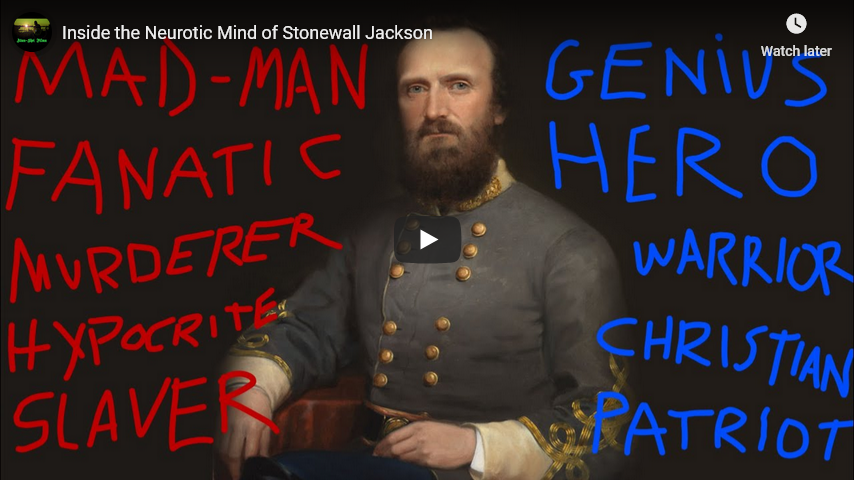
Inside the Neurotic Mind of Stonewall Jackson
Atun-Shei Films
Published 15 Jan 2021Let’s gossip about a man who’s been dead for 158 years.
Support Atun-Shei Films on Patreon ► https://www.patreon.com/atunsheifilms
Leave a Tip via Paypal ► https://www.paypal.me/atunsheifilms
Buy Merch ► teespring.com/stores/atun-shei-films
#ThomasJJackson #CivilWar #AmericanHistory
Original Music by Dillon DeRosa ► http://dillonderosa.com/
Reddit ► https://www.reddit.com/r/atunsheifilms
Twitter ► https://twitter.com/atun_shei
~REFERENCES~[1] Wallace Hettle. Inventing Stonewall Jackson: A Civil War Hero in History and Memory (2011). LSU Press, Page 3-9
[2] Hettle, Page 13-17
[3] Charles Royster. The Destructive War: William Tecumseh Sherman, Stonewall Jackson, and the Americans (1991). Vintage Books, Page 41-46
[4] Royster, Page 52-53
[5] Hettle, Page 20-21
[6] Royster, Page 65-67
[7] Chris Graham. “Myths and Misunderstandings: Stonewall Jackson’s Sunday School” (2017). The American Civil War Museum https://acwm.org/blog/myths-misunders…
[8] Royster, Page 63-65
[9] Royster, Page 60
[10] Royster, Page 49-51
[11] Mary Anna Jackson. Memoirs of Stonewall Jackson by his Widow, Marry Anna Jackson (1895). Prentice Press, Page 108
[12] Jackson, Page 120-121
[13] Hettle, Page 13-15
[14] Royster, Page 202
December 27, 2020
QotD: Charles Dickens
They “protest” things that, indirectly, they learnt to protest from the kind-hearted Dickens; subjective hysterias about the world being unfair. Of course it is unfair, as it has always been, and to everyone who has been living in it. But unfairness is a whim, compared to sound moral judgements, and the reticence that should accompany them. We cannot make the world “more fair” by rioting. Dickens, incidentally, agrees with me on that.
He was among the writers (and artists generally) who contributed subtly to our post-Christian worldview, based on emotion, not remorseless thought. Who made, say, Christmas about giving presents to little children, rather than centrally about the birth of Christ. That doesn’t mean his works should be suppressed. On the contrary, they should be read and enjoyed, with this thought in mind. He moralizes, but in a way that may actually subvert morality, by substituting “feelings” for the hard truths, which are to die for.
David Warren, “Retractiones”, Essays in Idleness, 2020-07-29.
December 25, 2020
Bonus QotD: Modern services in church
Back then, you could still visit an average (Protestant) church and hear a pastor actually teach real doctrine and share authentic insights. You could hear his thoughts on how to live an upright Christian life, or on why bad things might happen to good people, or how Christian marriages might be improved. And you could hear it all supported by actual Bible passages.
After the sermon, you could hear the congregation sing hymns affirming the importance of obedience, humility, faith, courage, or some other Christian virtue. They were something, the old hymns: bold, clear, impactful, sometimes even militant, like “Onward, Christian Soldiers” or “God of Our Fathers, Whose Almighty Hand”, or particularly thoughtful, like “How Great Thou Art”.
Things are different now. Wander into a typical Christian church these days, and, far from hearing a sermon challenging you to live an upright life, you’re more likely to hear an unsuccessful attempt at a Jeff Foxworthy-style stand-up comedy routine, Hallmark-style stories of dubious veracity, and utterly vacuous “praise songs” which all sound like U2 album rejects from 1986. (They even feature the thumping eighth-note bass parts, echo-drenched guitar, and melodramatic vocal performances.)
Oh, and I forgot: At some point, you’re also going to see the pastor dutifully hand the mic over to his overly-assertive, overly-eager, overly-made-up wife (presumably on pain of divorce, or possibly even death), who will then speak loudly and rapturously — all about herself — for the next half hour.
Not all Christian churches are like this, of course. The problem is, too many are. As the years roll by, contemporary Christian churches increasingly abnegate their scripturally-prescribed role as fortified beacons of divine truth, and instead transform themselves into vehicles for a social justice pseudo-gospel completely incompatible with Christian (or Jewish, for that matter) scriptural teachings.
Tal Bachman, “Christians, Come Back”, Steyn Online, 2020-09-03.
December 24, 2020
Why Christmas Should Be ILLEGAL
Atun-Shei Films
Published 23 Dec 2019The Witchfinder General of the Colony of Massachusetts Bay in New-England preaches against the heathenry of the Pagan Carnival known as Christmas, and exhorts Good Christians to Ban it by Law; together with, a Testimony against the Authors of that most vile and deplorable Pamphlet, r/christmas, and irrefutable Judgments upon them, drawing from the Word of God, and the Puritan Laws of this fair Commonwealth.
Support Atun-Shei Films on Patreon ► https://www.patreon.com/atunsheifilms
#Puritan #Christmas #WitchfinderGeneral
Watch our film ALIEN, BABY! free with Prime ► http://a.co/d/3QjqOWv
Reddit ► https://www.reddit.com/r/atunsheifilms
Twitter ► https://twitter.com/atun_shei
Instagram ► https://www.instagram.com/atunsheifilms
Merch ► https://atun-sheifilms.bandcamp.com

December 23, 2020
Repost – “Merry Christmas” versus “Happy Holidays” versus “Happy Midwinter Break”
L. Neil Smith on the joy-sucking use of terms like “Happy Midwinter Break” to avoid antagonizing the non-religious among us at this time of year:

Original infographic from Treetopia – https://www.treetopia.com/Merry-Christmas-vs-Happy-Holidays-a/304.htm
Conservatives have long whimpered about corporate and government policies forbidding employees who make contact with the public to wish said members “Merry Christmas!” at the appropriate time of the year, out of a moronic and purely irrational fear of offending members of the public who don’t happen to be Christian, but are Jewish, Muslim, Hindu, Buddhist, Sikh, Jain, Rastafarian, Ba’hai, Cthuluites, Wiccans, worshippers of the Flying Spaghetti Monster, or None of the Above. The politically correct benediction, these employees are instructed, is “Happy Holidays”.
Feh.
As a lifelong atheist, I never take “Merry Christmas” as anything but a cheerful and sincere desire to share the spirit of the happiest time of the year. I enjoy Christmas as the ultimate capitalist celebration. It’s a multiple-usage occasion and has been so since the dawn of history. I wish them “Merry Christmas” right back, and I mean it.
Unless I wish them a “Happy Zagmuk”, sharing the oldest midwinter festival in our culture I can find any trace of. It’s Babylonian, and celebrates the victory of the god-king Marduk over the forces of Chaos.
But as anybody with the merest understanding of history and human nature could have predicted, if you give the Political Correctness Zombies (Good King Marduk needs to get back to work again) an Angstrom unit, they’ll demand a parsec. It now appears that for the past couple of years, as soon as the Merry Christmases and Happy Holidayses start getting slung around, a certain professor (not of Liberal Arts, so he should know better) at a nearby university (to remain unnamed) sends out what he hopes are intimidating e-mails, scolding careless well-wishers, and asserting that these are not holidays (“holy days”) to everyone, and that the only politically acceptable greeting is “Happy Midwinter Break”. He signs this exercise in stupidity “A Jewish Faculty Member”.
Double feh.
Two responses come immediately to mind, both of them derived from good, basic Anglo-Saxon, which is not originally a Christian language. As soon as the almost overwhelming temptation to use them has been successfully resisted, there are some other matters for profound consideration…
December 22, 2020
QotD: The foundational weirdness of Judeo/Christian/Islamic religions
The shortest summary is “No!” The less short answer is: “No, because religious moral codes are epiphenomenal.” And it is on point to add that the question reveals serious ignorance of the actual traits of most religions over most of history.
I’ll address the historical point first. The commenter’s question was framed from within the assumptions of one particular family of religions: the Judeo/Christian/Islamic tradition, which are more succinctly describable as the bastard offspring of Zoroastrian dualism. In this family, “religion” bundles cosmology, theology, and morality into a single total system designed primarily to enforce norms by programming the believer with an internalized guilt machine.
Because the dominant religions of the modern West are all derived from this group, it is difficult for Westerners to understand how bizarre and exceptional these religions are in a broader context. Most religions are not total systems. Most religions do not tie morality to cosmology. In fact, most religions have very little to say about morality at all!
Consider, for example, an Altaic shaman. It’s not his job to pronounce on who should sleep with who, or to tell people that theft is wrong. It’s not even his job to tell people that they must worship Tengri or Kara-han; dealing with the gods is his specialty, thank you. His job combines aspects of psychologist and medic with a bit of divination. The closest analog of “morality”, in his culture, is a set of inherited customs and taboos which is reinforced by explanatory myths but not generated by them and not really dependent on them. The closest equivalent of religious structures about right and wrong is an elaborate set of rules about ritual purity and impurity. In the jargon of the field, his religion is an orthopraxy rather than an orthodoxy.
Over most human cultures in most human history, “religion” has been much more like Altaic shamanism than like Christianity, Judaism, or Islam. Er, so why didn’t these cultures “collapse in a heap of nihilism”? The same question actually applies to modern religions outside the post-Zoroastrian family. Buddhism and Hinduism, for example, are almost completely unconcerned with “morality”. Hinduism is organized around ritual purity and impurity; Buddhism’s quest for merit is about liberation of the self from attachments, not about duties one owes to God or others.
Eric S. Raymond, “If God is dead, is anything permissible?”, Armed and Dangerous, 2010-02-10.
December 15, 2020
History Summarized: Spread of Christianity
Overly Sarcastic Productions
Published 10 Jan 2017Things I learned when making this video: 1) when your script goes beyond 4 single-spaced pages, you’re heading into the danger zone 2) Gregorian Chants are awesome and you should totally listen to them, 3) editing always takes longer than you’d hope 4) self care is huffing frankincense for breakfast lunch and dinner and single-handedly sacking a levantine city!
Have a question about something I mentioned, or maybe something I might have left out? Leave it down below and I’ll do my best to respond!
PATREON: https://www.patreon.com/OSP
MERCH LINKS:
Shirts – https://overlysarcasticproducts.threa…
All the other stuff – http://www.cafepress.com/OverlySarcas…Find us on Twitter @OSPYouTube!
twitter.com/OSPyoutube
December 13, 2020
How the Romans Stole Silk Production Secrets from China
Kings and Generals
Published 31 Jan 2019Go to https://www.wix.com/KingsAndGenerals to get started on your website today!
Check out our new website at http://kingsandgenerals.orgSilk production was one of the biggest secrets of China and one of the most lucrative industries of the age. So it is not a surprise that the Roman emperor Justinian was eager to learn this secret. In this video we will discuss the start of the silk production, its importance and the story of how Justinian managed one of the first industrial thefts in history
Support us on Patreon: http://www.patreon.com/KingsandGenerals or Paypal: http://paypal.me/kingsandgenerals
Check out our Merch Store: teespring.com/stores/kingsandgenerals
We are grateful to our patrons and youtube members, who made this video possible: https://drive.google.com/open?id=1Xa-…
The video was made by our friend Cogito
This video was narrated by Officially Devin (https://www.youtube.com/user/Official…)
✔ Merch store ► teespring.com/stores/kingsandgenerals
✔ Podcast ► Google Play: http://bit.ly/2QDF7y0 iTunes: https://apple.co/2QTuMNG
✔ Twitter ► https://twitter.com/KingsGenerals
✔ Instagram ► http://www.instagram.com/Kings_GeneralsProduction Music courtesy of Epidemic Sound: http://www.epidemicsound.com
#Documentary #Justinian #Silk

November 30, 2020
Cultural Marxism or cultural leftism?
In the most recent Libertarian Enterprise, Sean Gabb discusses what British Conservatives have been warned against describing as “Cultural Marxism”:
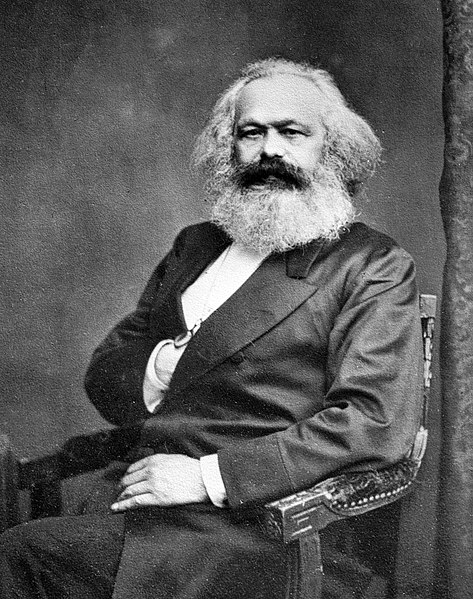
So far as I understand him — and I write as an outsider to any school of Marxist ideology — Marx made five essential points. First, there have been, since the French Revolution, two classes — the bourgeoisie and the proletariat. Second, the bourgeoisie owns the means of production and exploits the proletariat through the extraction of surplus value. Third, this is an unstable parasitism, as the reinvestment of surplus value leads to periodic crises of over-production. Fourth, these crises concentrate wealth in fewer hands and expand and immiserise the proletariat. Fifth, there will be an inevitable revolution, in which the expropriators will be expropriated and a communist society will emerge. A further and perhaps optional sixth point is that the inevitable revolution can be hurried by the defection of informed bourgeois intellectuals to radicalise and form a vanguard for the proletariat.
Now, where is any of this in the present mix of climate alarmism and obsession with the alleged oppression of racial and sexual minorities? How is capitalism supposed to be overthrown by getting Sainsbury to fill its advertisements with pictures of black people eating Christmas dinner? Ditto boycotts of Israeli pharmaceuticals? Ditto arguing with or against radical feminists over the exact status of men who change sex?
The answer, of course, is the Cultural Marxist hypothesis — that the present culture wars are a product of the writings of Antonio Gramsci and the Frankfurt School. These men took the Marxian concept of “false consciousness” — that the bourgeoisie keeps the workers quiet by making them believe that all is for the best — and enlarged it into a project for achieving a counter-hegemony by taking over the means of cultural reproduction.
There is some truth in this answer, so far as these writings are prescribed in most university humanities departments, and many advocates of the new totalitarianism have at some time called themselves Marxists. It is, even, so a weak answer. Before about 60 AD, most Christians were Jews, and Christianity ever since has retained some Jewish religious writings among its core texts. But nothing is achieved by describing Christianity as “Gentile Judaism.” The differences between the two faiths are too essential to define either by reference to the other. In the same way, the present totalitarianism has nothing to do with the essential claims of Marxism. It lacks any interest in the analysis of surplus value, and its belief in the instability of unregulated markets derives mainly from a reading of Keynes and the welfare economists of the Cambridge School.
I prefer the term “cultural leftism.” I prefer this because the present totalitarianism is based on belief in an appearance of equality mediated by the State. It therefore has elements of socialism as reasonably defined. But it is in no sense Marxist. Its revealed preference is for a ruling class that is a coalition of politicians, administrators, policemen, lawyers, educators, plus media and business interests. So far as individuals move freely between them, these groups are mutually permeable. If they disagree over incidentals, they preside collectively over a mass of the ruled who are mostly well-nourished, but who are too atomised and intimidated by often meaningless words to combine in opposition.
Indeed, if I prefer my chosen term, I see little point in arguing against what it describes. Undoubtedly, this must be explained and opposed. But too much analysis of particulars can risk an overlooking of the much more important generality. This is that, in every time and place, there have been those who want to get on with their lives and those who want to control others. These latter will take up whatever body of ideas is most likely within the prevailing assumptions of their age to legitimise their urges.
November 24, 2020
Ten Minute History – The Thirty Years’ War
History Matters
Published 30 Sep 2018Twitter: https://twitter.com/Tenminhistory
Patreon: https://www.patreon.com/user?u=4973164Special Thanks to the following Patrons for their support on Patreon:
Chris Fatta
Joshua
Mitchell Wildoer
Mason Cox
William Foster
Thomas Mitchell
Perry Gagne
Shaun Pullin
Anon
Spencer Smith
Matt M
RbjThis episode of Ten Minute History (like a documentary, only shorter) covers the outbreak of the Bohemian Revolt which was what would eventually spiral out of control into the Thirty Years’ War. The revolt was crushed fairly quickly but sparked intervention by Denmark, who didn’t do too well, and later Sweden who did very well. Both of these were aided by France who decided to get directly involved in 1635. By 1648 the Holy Roman Empire lay in ruins, with Austria and Spain struggling to pay for the war and rebuild the Habsburg Empire. This war saw the rise of Sweden and France but most importantly saw the foundations of modern diplomacy built.
Recommended books:
Mark Greengrass – Christendom Destroyed: Europe 1517-1648. Does a great job of outlying the theological currents in Europe at the time and how all of the religious changes led to the Thirty Years’ War.
Peter H. Wilson – Europe’s Tragedy: A New History of the Thirty Years’ War. The go-to text for the war; incredibly detailed and honestly can’t be beat for the topic. 100% recommend.

November 21, 2020
QotD: Using a “wokescreen”
It is, essentially, a new iteration of an old rule: the one stating that the person commonly to be found complaining most vociferously about a particular vice is the one disproportionately likely to be guilty of said vice.
Through decades past, this rule applied to people who were literally in the clerical class. It was, for instance (see the late Cardinal Keith O’Brien), the priest or bishop who denounced homosexuality in the most vociferous terms who would turn out to have their own peculiar interpretation of “the laying on of hands”, tending to revolve around the knees of young male seminarians.
And there is sense in this of course. Through overt displays of moral opprobrium, the petitioner imagines that everyone’s attention will be diverted. Through stressing their virtue overmuch, however, such people raise a perceptible flag to anyone with an eye for human hypocrisy.
Today, of course, the clerical class is not the clergy. It is generally a rich, massively protected, metropolitan and often corporate or corporate-backed class which poses as the defender and then enforcer of all the easiest, least-controversial causes of the time. These shift, naturally, but today a person who wishes to cloak themselves in virtue will talk up their “anti-racism” credentials; will talk about “feminism” as though women’s rights have only just occurred to them; they will stress their green credentials; and of course they will rush to the defence of anyone who claims to identify as a tree or a hedgerow and assert that said person’s right to so identify is not just ancient and long-established but biologically incontrovertible. All give off immense warning-signs.
Douglas Murray, “Do you know what a wokescreen is?”, UnHerd, 2020-08-13.
November 14, 2020
The Decline of the Great Library of Alexandria
The History Guy: History Deserves to Be Remembered
Published 27 Mar 2019Presented by Ms History. The Great Library was a center of knowledge. Its decline was not the single cataclysmic event that may seem to think, but its slow decline is perhaps, even more tragic. It is history that deserves to be remembered.
This is original content based on research by The History Guy. Images in the Public Domain are carefully selected and provide illustration. As images of actual events are sometimes not available, images of similar objects and events are used for illustration.
All events are portrayed in historical context and for educational purposes. No images or content are primarily intended to shock and disgust. Those who do not learn from history are doomed to repeat it. Non censuram.
Ms. History Guy is an avid reader and former reference librarian, and reviews around 100 books per year. Feel free to follow her progress or befriend her on Goodreads where she goes by the name “Heidi the Reader”: https://www.goodreads.com/MsHistory
Patreon: https://www.patreon.com/TheHistoryGuy
The History Guy: History Deserves to Be Remembered is the place to find short snippets of forgotten history from five to fifteen minutes long. If you like history too, this is the channel for you.
Awesome The History Guy merchandise is available at:
teespring.com/stores/the-history-guyScript by JCG
#history #thehistoryguy #library

QotD: “Modern” liberalism
My second was to find that he was now brainwashed by ideologies and slogans; that it was impossible to argue with him from reason or fact; that faced with any difficulty he would present himself as the helpless victim of forces he would not even try to define coherently.
My third was the discovery that he was now, instinctively, on the side of the criminal; that he identified with the lawless; that he admired “the transgressive,” trespass, violation. Without acknowledging it to himself, he now had a conception of “human rights” which consistently excused the wrongdoer, and consistently ignored the consequences to those who had done nothing wrong.
This “modern” liberalism, I came to understand, was the development — not over months and years but over centuries — of a mortal flaw in the “classical” liberal worldview. It was avoiding God. The liberal mind was persuaded that humans must “make their own beds.” Its great strength was that it took responsibility; its great weakness was that it had no reason to do so. Faith and reason are mutually dependent; when one goes the other eventually goes, too.
Or put this another way: the Devil gets in when we make room for him.
David Warren, “Crime without punishment”, Essays in idleness, 2018-08-03.


