Quotulatiousness

May 15, 2020

Protecting the Innocent – Kids Evacuations – On the Homefront 003

Filed under: Britain, Germany, History, Military, WW2 — Tags: , , , , , — Nicholas @ 06:00

World War Two
Published 14 May 2020

The European powers may be at war but there’s now thing they can agree on: their young must be protected. So, before the first RAF or Luftwaffe bombs were even dropped on cities, countries are drawing up plans to save as many lives of their youth as they possibly can.

Join us on Patreon: https://www.patreon.com/TimeGhostHistory
Or join The TimeGhost Army directly at: https://timeghost.tv

Follow WW2 day by day on Instagram @World_war_two_realtime https://www.instagram.com/world_war_t…
Between 2 Wars: https://www.youtube.com/playlist?list…
Source list: http://bit.ly/WW2sources

Hosted by: Anna Deinhard
Written by: Isabel Wilson and Spartacus Olsson
Director: Astrid Deinhard
Producers: Astrid Deinhard and Spartacus Olsson
Executive Producers: Astrid Deinhard, Indy Neidell, Spartacus Olsson, Bodo Rittenauer
Creative Producer: Joram Appel
Post-Production Director: Wieke Kapteijns
Research by: Isabel Wilson
Edited by: Mikołaj Cackowski
Sound design: Marek Kamiński
Map animations: Eastory (https://www.youtube.com/c/eastory)

Sources:
USHMM
Bundesarchiv
IWM LN 6194, HU 36871, D 2238, D 10457, D 2592, D 5081, D 24903, IWM D 15530, D 2045, HU 3323, Art.IWM PST 3095, Art.IWM PST 13854, Art.IWM PST 15100, D 9211, D 824, D 257, D 5665, D 2224, D 1939A, F 4422
Portrait of John Anderson, courtesy Yousuf Karsh, Dutch National Archives
from the Noun Project: students by Piotrek Chuchla, mother by Mr. Minuvi, Pregnant by Wojciech Zasina, bag by Nabilauzwa, Gas Mask by Nico Ilk from the Noun Project, Underwear by The Icon Z, baby clothes by Llisole, espadrilles shoes by Edwin PM, socks by Анна Пасечная, Toothbrush by amantaka, Comb by Randall Barriga, towel by Pixelz Studio, handkerchief by Vectors Market, soap by Jae Deasigner, coat by Ilham Juliandi, Food by Atif Arshad

Soundtracks from the Epidemic Sound:
Reynard Seidel – “Deflection”
Johannes Bornlof – “The Inspector 4”
Johannes Bornlof – “Deviation In Time”
Farell Wooten – “Blunt Object”
Jo Wandrini – “Puzzle Of Complexity”
Gavin Luke – “Drifting Emotions 3”
Howard Harper-Barnes – “Prescient”
Fabien Tell – “Last Point of Safe Return”
Andreas Jamsheree – “Guilty Shadows 4”

Archive by Screenocean/Reuters https://www.screenocean.com.

A TimeGhost chronological documentary produced by OnLion Entertainment GmbH.

From the comments:

World War Two
5 hours ago (edited)
Welcome back to another episode of On the Homefront! Researching this episode about evacuations was a fun one to dive to because in the UK, we learn about about children evacuees during the war but of course what we’re not taught is the mass scale of this operation. For each of the millions of children displaced during the war, they each came away with it with their own story and I hope I’ve captured that here. Looking forward to reading your comments! Be sure to follow us over on instagram at https://www.instagram.com/world_war_two_realtime/ and let us know what other aspects of life on the homefront you’d like to hear about!

Cheers,
Izzy

Wuhan Coronavirus muzzles mandated by “politicians who are completely-fall-down-drunk on Chateau d’House Arrest”

Filed under: Government, Health, Liberty, Science — Tags: , , , — Nicholas @ 05:00

Laura Rosen Cohen at Steyn Online:

Hello again, and welcome to week eleventy billion gazillion of CCP-Style Lockdown in the Allegedly Free World.

Another week of hypocrisy from the politicians who are completely-fall-down-drunk on Chateau d’House Arrest.

And another week of me feeling like I look rather like this penguin when attempting to articulate how disgusted I am with the governments of western countries – my own country and province in particular.

I don’t want any more “we’re all in this together” e-mails. I don’t want to hear “Covid-19” uttered in a morose, yet sadistically gleeful, tone with odd, demonic-like smiles. I don’t want to see any more playgrounds taped up. I don’t want to see any more “Stay Home” notices. And I most certainly will refuse the “new normal” being offered to us by the power-drunk politicians and nanny-craving, safe space lunatic multitudes.

I was talking to my wonderful and brilliant partner-in-crime Kathy Shaidle about why we hate masks. (Oh go on, just admit it, you hate them as well). First of all, like with the WuFlu, we have no exact science about them, and the reasons for wearing or not wearing keep changing, just like the reasons for continued lockdown. For a while now, I’ve been looking at them as a kind of pandemic virtue signalling device. Like a Health & Safety Boy Scout badge. But I couldn’t articulate exactly what else was bothering me about them. She sent me this:

and said ‘leave it to a Hitchens to articulate it’. Bingo.

I replied to my dear Kathy that they are indeed like a burkah, something that anonymizes you and that renders normal civil discourse and interaction, like smiles, conversation and flirtation impossible. She added that they are also a kind of affront, a dare to others who you imply are inferior for not wearing yours. Then I saw this: indeed it is, the Corona Niqab. Nuts to that. And if you think I’m pissed, I urge you to listen to this interview with novelist Lionel Shriver who puts it better than I ever could. Shriver delivers the outstanding righteous fury we need to hear, a level of outrage matched and raised to a new level each day by my gracious and prophetic host himself.

“Fields of Verdun” II – The Guns of Verdun – Sabaton History 067 [Official]

Filed under: France, History, Media, Military, WW1 — Tags: , , , , — Nicholas @ 04:00

Sabaton History
Published 14 May 2020

The Meat-Grinder. Dead Man’s Hill. The Bone-Mill. Verdun has many names, as it went down into history as a place of death and destruction. Never before did so many light and heavy artillery guns fire on such a small battlefield. It was the end of the classical field battle and instead turned into a 10 month siege that was fought not by flesh and blood, but by steel and chemistry.

We would like to thank the World of Tanks team for their contribution and help with the video filming. If you’re not yet a World of Tanks player, join the game and get your hands on cool in-game stuff for free via the link: https://redir.wargaming.net/w7fwclmx/…

Support Sabaton History on Patreon: https://www.patreon.com/sabatonhistory

Listen to “Fields of Verdun” on the album The Great War
CD: http://nblast.de/SabatonTheGreatWar
Spotify: https://sabat.one/TheGreatWarSpotify
Apple Music: https://sabat.one/TheGreatWarAppleMusic
iTunes: https://sabat.one/TheGreatWarItunes
Amazon: https://sabat.one/TheGreatWarAmazon
Google Play: https://sabat.one/TheGreatWarGooglePlay

Watch the Official Video of Fields of Verdun here:
https://youtu.be/xP8G-LwWNn0

Check out the trailer for Sabaton’s new album The Great War right here: https://www.youtube.com/watch?v=HCZP1…

Listen to Sabaton on Spotify: http://smarturl.it/SabatonSpotify
Official Sabaton Merchandise Shop: http://bit.ly/SabatonOfficialShop

Hosted by: Indy Neidell
Written by: Markus Linke and Indy Neidell
Directed by: Astrid Deinhard and Wieke Kapteijns
Produced by: Pär Sundström, Astrid Deinhard and Spartacus Olsson
Creative Producer: Joram Appel
Executive Producers: Pär Sundström, Joakim Broden, Tomas Sunmo, Indy Neidell, Astrid Deinhard, and Spartacus Olsson
Post-Production Director: Wieke Kapteijns
Edited by: Iryna Dulka
Sound Editing by: Marek Kaminski
Maps by: Eastory – https://www.youtube.com/c/eastory

Archive by: Reuters/Screenocean https://www.screenocean.com
Music by Sabaton.

Sources:
– Imperial War Museum: Q 23892, Q 87441, Q 23760, Q 88017, Q 78041, Art.IWM BUTE 290, Q 27526, Q 108345, Q 56987, Q 58386, Q 87945, Q 56546, Q 69971
– Bibliothèque nationale de France

An OnLion Entertainment GmbH and Raging Beaver Publishing AB co-Production.

© Raging Beaver Publishing AB, 2019 – all rights reserved.

Canada’s weird election laws

Filed under: Cancon, Law, Liberty, Politics — Tags: , — Nicholas @ 03:00

Chris Selley points out some of the oddities of the federal Elections Act:

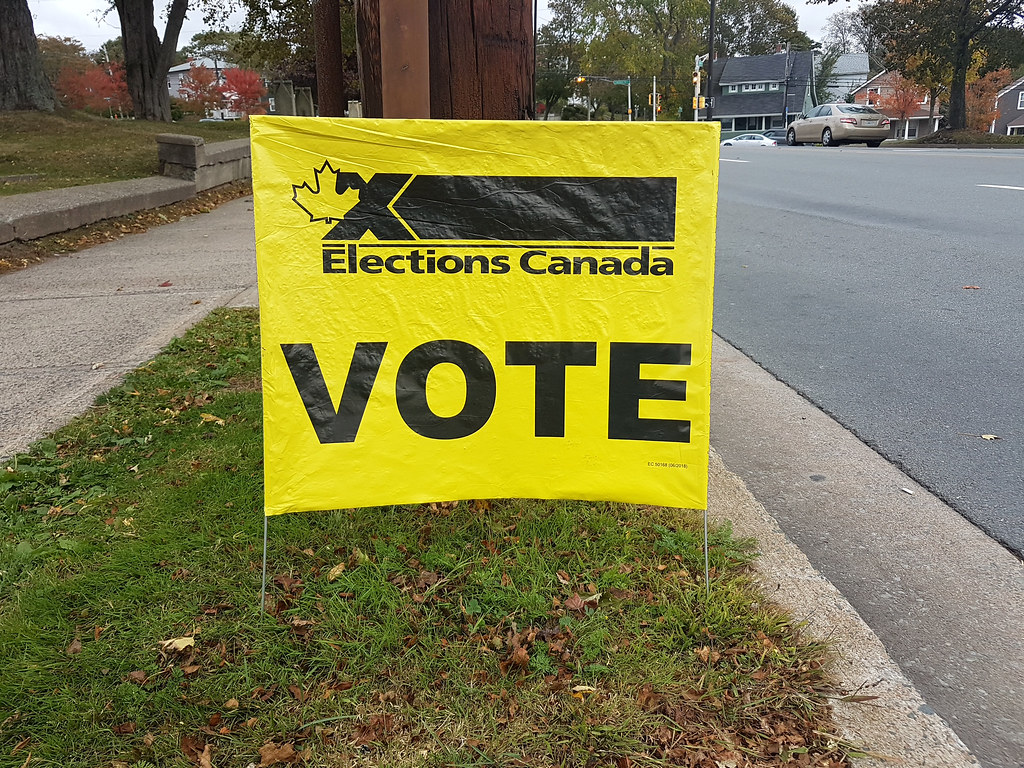
“2019 Canadian federal election – VOTE” by Indrid__Cold is licensed under CC BY-SA 2.0

It seems like about a hundred years ago, but one of the disquieting revelations of last year’s federal election campaign was that the Elections Act’s rules covering third-party spending are completely bananas.

Readers may recall Elections Canada warning environmental groups that they couldn’t just go on spending money in the fight against climate change without registering as third parties, with all the paperwork and bureaucracy that entails, all because People’s Party leader Maxime Bernier had supposedly made it a “partisan issue.” Now we have another bunch of overripe bananas on our hands: As the National Post first reported, the Commissioner of Canada Elections is investigating an anti-abortion organization called RightNow for having allegedly “recruited, trained and coordinated volunteers that were directed to over 50 campaigns” during the 2019 campaign.

RightNow’s mission is to identify pro-life candidates with a chance of winning, and connect them with volunteers eager to help them with their nomination and election campaigns. Readers may not find this particularly controversial. Members and supporters of all manner of groups, most famously and numerously labour unions, campaign alongside political candidates all the time. A quick rummage around Facebook from last year’s campaign finds both Toronto NDP MP Andrew Cash (who was eventually defeated) and Nova Scotia Liberal candidate Bernadette Jordan (who is now federal fisheries minister) thanking Unifor members wearing “Unifor Votes” t-shirts for their canvassing help. Photos on Unifor’s own Facebook page chronicle an October 5th event in Winnipeg called “Politics and Pancakes event plus canvassing for (NDP MP) Daniel Blaikie.”

[…]

At first blush, there doesn’t seem to be anything legally untoward with this — or indeed what RightNow was doing on a much smaller scale. (USW claimed $1.1 million in third-party expenses, PSAC $345,000, CUPE $161,000. RightNow splashed out a whopping $8,255.71.) “Volunteer labour” is explicitly exempt from the Elections Act prohibition against third parties donating to political parties or candidates, either in cash or in kind. But in an April 22nd letter to Albertos Polizogopoulos, RightNow’s legal counsel, the commissioner’s director of investigations, Mylène Gigou, argued that “the recruiting, training and coordinating of volunteers are core political activities of a political campaign” — and in performing those activities, RightNow may have “circumvented” the third-party donation prohibition.

This is, of course, preposterous. On what principle would we allow members or supporters of third parties to volunteer in election campaigns — as any healthy democracy ought to — while prohibiting spending so much as a dime to recruit said volunteers? “Training” or “coordinating” could be defined as narrowly as telling people what sorts of things to say on people’s doorsteps and what sorts of things not to. You don’t just turn people loose with your campaign materials, like sheep on a grassy meadow, and hope for the best.

The Largest Aircraft Ever Built By Britain: The Bristol Brabazon

Filed under: Britain, History, Technology — Tags: , — Nicholas @ 02:00

Mustard
Published 23 Jun 2018

With a wingspan greater than a Boeing 747, the Bristol Brabazon was the largest aircraft ever built by Britain. More a flying oceanliner than plane, it featured sleeping cabins, a dining room, a cocktail bar and lounge, and even a 23-seat movie theater.

The Brabazon was also fitted with cutting edge innovations. A fully pressurized, air conditioned cabin. Electric engine controls, and high-pressure hydraulics to operate its massive control surfaces. Its enormous wing housed more than 16 thousand gallons of fuel, and eight of the most powerful piston engines available. While the first Brabazon used piston engines, later Brabazons were to use turboprop engines that were being developed by Bristol.

The Bristol Brabazon would have true transatlantic capability. Able to fly non-stop from London to New York against prevailing eastern winds. In the 1940s, this would have been quite the feat. Transatlantic flights were almost always done in stages to allow for refueling.

Despite introducing new innovations, many of which influenced the future of aviation, the Brabazon’s driving philosophy was outdated. The Brabazon’s mission was to compete with ocean liners for ultra-wealthy passengers. But this lumbering, super-sized airliner would have been introduced with airlines for 1950s, right when the first jet airliners, like the De Havilland Comet, were taking to the skies. Aircraft like the Dash 80, which would become the 707, were also just around the corner, and would bring a transatlantic crossing down to as little as 7 hours.

After a massive design and development effort, Britain found itself stuck with a plane nobody actually wanted, designed for an era that no longer existed.The program was cancelled and the Brabazon, and its half finished turboprop successor were sold for their weight in scrap.

#BristolBrabazon #BritishAviation #WhiteElephant #Airplanes

For an authoritative resource on the Bristol Brabazon visit:
http://www.historynet.com/bristol-bra…

Special thanks to niltondc for helping to model the Bristol Brabazon:
https://www.youtube.com/user/niltondc

Like the the aviation industry posters found in this video? Visit The Aviation Ancestry Database, containing over 80,000 high-quality examples: http://www.aviationancestry.co.uk/

Special thanks to Nick Arehart for helping clean up our audio:
https://twitter.com/airhrt_

Special thanks to: Coby Tang, Christian Altenhofen and Razvan Caliman for supporting us on Patreon and helping Mustard grow: https://www.patreon.com/MustardChannel

Music (reproduced under license):

Intro & Extro: “Wells Street” – https://www.pond5.com/stock-music/730…

Main Song #1: “Worrying Clock Cycle” – https://www.pond5.com/stock-music/767…

Main Song #2: “The Funk Kit” – https://audiojungle.net/item/the-funk…

QotD: Gandhi and the rise of Hitler

Filed under: Britain, Europe, Germany, History, India, Military, Quotations, WW2 — Tags: , , , , , — Nicholas @ 01:00

Gandhi’s views on the European crisis were not entirely consistent. He vigorously opposed Munich, distrusting Chamberlain. “Europe has sold her soul for the sake of a seven days’ earthly existence,” he declared. “The peace that Europe gained at Munich is a triumph of violence.” But when the Germans moved into the Bohemian heartland, he was back to urging nonviolent resistance, exhorting the Czechs to go forth, unarmed, against the Wehrmacht, perishing gloriously — collective suicide again. He had Madeleine Slade draw up two letters to President Eduard Beneš of Czechoslovakia, instructing him on the proper conduct of Czechoslovak satyagrahi when facing the Nazis.

When Hitler attacked Poland, however, Gandhi suddenly endorsed the Polish army’s military resistance, calling it “almost nonviolent.” (If this sounds like double-talk, I can only urge readers to read Gandhi.) He seemed at this point to have a rather low opinion of Hitler, but when Germany’s panzer divisions turned west, Allied armies collapsed under the ferocious onslaught, and British ships were streaming across the Straits of Dover from Dunkirk, he wrote furiously to the Viceroy of India: “This manslaughter must be stopped. You are losing; if you persist, it will only result in greater bloodshed. Hitler is not a bad man …”

Gandhi also wrote an open letter to the British people, passionately urging them to surrender and accept whatever fate Hitler had prepared for them. “Let them take possession of your beautiful island with your many beautiful buildings. You will give all these, but neither your souls, nor your minds.” Since none of this had the intended effect, Gandhi, the following year, addressed an open letter to the prince of darkness himself, Adolf Hitler.

The scene must be pictured. In late December 1941, Hitler stood at the pinnacle of his might. His armies, undefeated — anywhere — ruled Europe from the English Channel to the Volga. Rommel had entered Egypt. The Japanese had reached Singapore. The U.S. Pacific Fleet lay at the bottom of Pearl Harbor. At this superbly chosen moment, Mahatma Gandhi attempted to convert Adolf Hitler to the ways of nonviolence. “Dear Friend,” the letter begins, and proceeds to a heartfelt appeal to the Führer to embrace all mankind “irrespective of race, color, or creed.” Every admirer of the film Gandhi should be compelled to read this letter. Surprisingly, it is not known to have had any deep impact on Hitler. Gandhi was no doubt disappointed. He moped about, really quite depressed, but still knew he was right. When the Japanese, having cut their way through Burma, threatened India, Gandhi’s strategy was to let them occupy as much of India as they liked and then to “make them feel unwanted.” His way of helping his British “friends” was, at one of the worst points of the war, to launch massive civil-disobedience campaigns against them, paralyzing some of their efforts to defend India from the Japanese.

Here, then, is your leader, O followers of Gandhi: a man who thought Hitler’s heart would be melted by an appeal to forget race, color, and creed, and who was sure the feelings of the Japanese would be hurt if they sensed themselves unwanted. As world-class statesmen go, it is not a very good record. Madeleine Slade was right, I suppose. The world certainly didn’t listen to Gandhi. Nor, for that matter, has the modern government of India listened to Gandhi. Although all Indian politicians of all political parties claim to be Gandhians, India has blithely fought three wars against Pakistan, one against China, and even invaded and seized tiny, helpless Goa, and all without a whisper of a shadow of a thought of ahimsa. And of course India now has atomic weapons, a satyagraha technique if ever there was one.

Richard Grenier, “The Gandhi Nobody Knows”, Commentary, 1983-03-01.

May 14, 2020

Make these sturdy cabinet doors with handtools in ONE DAY

Filed under: Tools, Woodworking — Tags: , , — Nicholas @ 06:00

Rex Krueger
Published 13 May 2020

Add fast, strong doors to your cabinet projects with this simple, traditional method.

More video and exclusive content: http://www.patreon.com/rexkrueger
(more…)

1948: The Dutch vs. the USA – 2nd Police Actions | The Indonesian War of Independence Part 4

TimeGhost History
Published 13 May 2020

The international community forces the Dutch to end their first colonial offensive with the Renville Agreement. However, as the Dutch, the Indonesian Republicans and the multiple other groups continue fighting, an impasse devolops.

Join us on Patreon: https://www.patreon.com/TimeGhostHistory

Hosted by: Indy Neidell
Written by: Joram Appel
Director: Astrid Deinhard
Producers: Astrid Deinhard and Spartacus Olsson
Executive Producers: Astrid Deinhard, Indy Neidell, Spartacus Olsson, Bodo Rittenauer
Creative Producer: Joram Appel
Post-Production Director: Wieke Kapteijns
Research by: Joram Appel and Isabel Wilson
Edited by: Karolina Dołęga
Sound design: Marek Kamiński

Colorizations:
Dememorabilia – https://www.instagram.com/dememorabilia/
Carlos Ortega Pereira (BlauColorizations – https://www.instagram.com/blaucoloriz…
Jaris Almazani (Artistic Man) – https://instagram.com/artistic.man?

Research Sources: https://bit.ly/IndoSources

Visual Sources:
Nationaal Archief
National Archives NARA
Tropenmuseum, part of the National Museum of World Cultures

Icons from the Noun Project by Wonmo Kang, Creative Mania & Claudia Revalina

Archive by Screenocean/Reuters https://www.screenocean.com.

Music:
“Other Sides of Glory” – Fabien Tell
“Remembrance” – Fabien Tell
“Sailing for Gold” – Howard Harper-Barnes
“Last Point of Safe Return” – Fabien Tell
“It’s Not a Game” – Philip Ayers
“Moving to Disturbia” – Experia
“March Of The Brave 10” – Rannar Sillard
“March Of The Brave 9” – Rannar Sillard

A TimeGhost chronological documentary produced by OnLion Entertainment GmbH.

Three reasons the Western allies fail to fully acknowledge the efforts of the Soviets in WW2

Filed under: Germany, History, Military, Russia, WW2 — Tags: , , , , , — Nicholas @ 03:00

Arthur Chrenkoff suggests three major reasons for why many Russians and other Soviet-nostalgics feel the west is wrongly denying the Soviet Union full credit for the defeat of Nazi Germany:

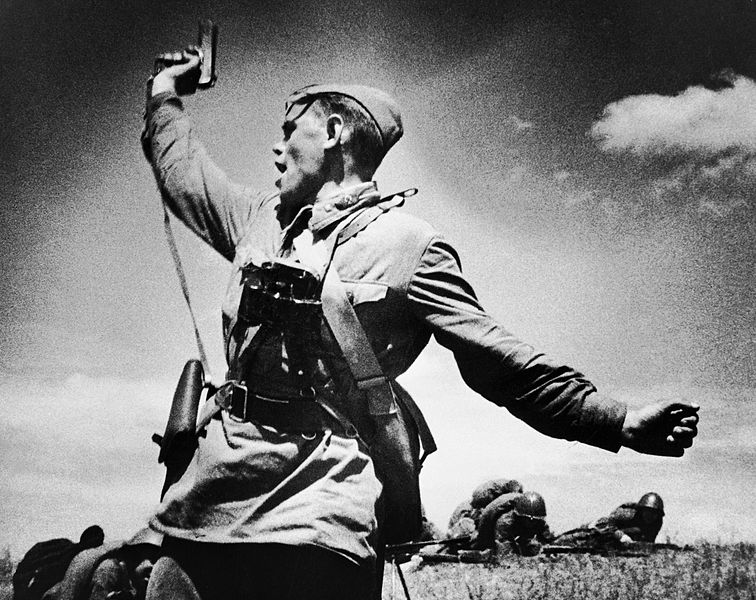
Kombat (Russian: Комбат, lit. “battalion commander”) is a black-and-white photograph by the Soviet photographer Max Alpert. It depicts a Soviet military officer armed with a TT pistol who is raising his unit for an attack during World War II. This work is regarded as one of the most iconic Soviet World War II photographs, yet neither the date nor the subject is known with certainty. According to the most widely accepted version, the photograph depicts junior politruk (political officer) Aleksei Gordeyevich Yeryomenko, minutes before his death on 12 July 1942, in Voroshilovgrad Oblast, Ukraine.
Wikimedia Commons.

But while the Russian – or, more correctly, Soviet – role in defeating Hitler is beyond question and deserves wider attention and recognition, there are several reasons why the Western acknowledgement of the eastern front will always remain qualified and somewhat ambiguous.

Firstly, while Russia continues to variously deny, downplay or excuse the fact, the Soviet Union was the initial co-aggressor in World War Two and for the first two years a Nazi ally and collaborator. Stalin might have had legitimate realpolitik reasons for the Ribbentrop-Molotov pact, in effect sacrificing Europe to win more time to prepare for the inevitable war with Germany (nice in theory, the gambit in any case did not work out in practice), but the fact remains that in concert with Hitler, Stalin invaded Poland and was rewarded with its eastern half, subsequently also helping himself to Bessarbia, annexing the Baltic states and invading Finland. In turn, the fact that Hitler assured himself he would not be facing a war on two fronts, which doomed Germany in World War One, allowed him to successively snatch Poland, Norway, Denmark, the Netherlands, Belgium, France, Yugoslavia and Greece, giving Germany a complete dominance over the continental Europe from the Atlantic to the Bug river and the Arctic Circle to Crete. And while Great Britain stood alone against Germany for a year from mid-1940 to mid-1941, Soviet resources and produce kept flowing in, feeding and arming the Nazi monster. This makes Stalin’s subsequent anger over the Allied delay in launching the Second Front in the West quite hypocritical – where was the Second Front in the East while Luftwaffe was blitzing Britain and its troops were battling Italians and Rommel in north Africa?

Secondly, without in any way diminishing the German barbarity in the east, a significant proportion of the Soviet military and civilian casualties were unnecessary and resulted from the communist government’s complete and utter disregard for the lives and well-being of its subjects. Stalin fought the war as he fought the peace at home. The man who prior to 1941 had managed to send somewhere upwards of 15 million of his own people to an early grave, clearly wasn’t going to spare the long suffering population when faced with an external existential threat. The Soviet Union might not have (at least initially) had much else, but it certainly had people, and they were sacrificed in obscene numbers by the man in the Kremlin and his minions on the ground. For most of the war, several Red Army soldiers were dying for every one German, while obeying absurd orders to stand ground or frontally attack in total disregard for the local circumstances or for that matter any reasonable tactical and strategic consideration. When Eisenhower and Zhukov caught up some time later in the war and the conversation turned to the best method of clearing mine fields, the Russian astonished the Allied Commander-in-Chief when he nominated simply sending the infantry through as the easiest and the cheapest method. This wasn’t a joke either; it was the way the Red Army fought from the first days of Barbarossa all the way to Berlin, even though the eventual overwhelming material superiority did save many an Ivan’s life in the later stages of the conflict. Not enough, however, to wipe out the entire generation of men born in the mid-1920s.

Thirdly, while the Red Army did indeed end the brutal Nazi occupation of the Central and the Eastern Europe, it did not bring freedom in any meaningful sense of the word, except perhaps (in most cases) freedom from sudden death. Debates about similarities and differences between the two totalitarian systems will no doubt continue well into the future. Unquestionably, for an average Slav, the Soviet domination was a better option that the Nazi one. Nazis, by and large, considered Slavs to be subhuman (though making some allowances, often quite significant, for their Slavic allies, like the Slovaks, the Croats or the Bulgarians), fit only to be initially enslaved and eventually exterminated. This was the far deadlier and much more ideological continuation of Germany’s 1000-year “drang nach osten” or the “civilising” mission to expand into the fertile east. Particular hatred was reserved for the Poles, who stood as a barrier for most of that millennium, preventing the dream of lebensraum from being realised. Russia was a much more recent enemy, having overlaid its Slavic barbarity with a Bolshevik malignancy. Even the initial Nazi plans called for starving between 25-30 million Belorussians, Ukrainians and Russians in order to free up food and resources for Germany. Communists could be deadly too, of course, and both the Reds and the Blacks were fond of decimating the local elites and intelligencia, but the Soviets at least did not see their Slavic brethren as subhumans but as proletarian masses to be converted to the glories of Marxism-Leninism.

Be that as it may, the Soviet liberation did not bring liberty or independence to the people of Eastern Europe. That had to wait until 1989-91.

Farquhar Hill: Britain’s WW1 Semiauto Rifle

Filed under: Britain, History, Military, Weapons, WW1 — Tags: , , — Nicholas @ 02:00

Forgotten Weapons
Published 20 Feb 2017

The Farquhar-Hill was a semiauto rifle developed in Britain prior to World War 1. It was the idea of Birmingham gunsmith Arthur Hill, and financed by Aberdeen industrialist Mowbray Farquhar. The design began as a long-recoil system, but that was replaced with a unique spring-buffered gas operated mechanism before production began.

Basically, a gas port in the barrel taps gas off to a piston, which moved about 3 inches rearward and was then caught and held by a latch. At that point, the other end of the spring would be released to move backward, pushing on the bolt and bolt carrier, unlocking and cycling the action. This gave the rifle a very light felt recoil impulse, and also buffered the bolt from potential over-pressure cartridges.

The Farquhar-Hill was chambered for the .303 British cartridge, and in its military form fed from 19-round drum magazines. A large order for 100,000 rifles was placed by the British military, but cancelled when WW1 ended. A small number of the rifles were sold in the military pattern as well as in box magazine-fed sporting patterns, but Farquhar was more interested in pursuing military contracts, and would continue to work with machine gun designs going into the 1920s.

Thanks to the Institute of Military Technology for giving me access to these two rifles: http://www.instmiltech.com
http://www.patreon.com/ForgottenWeapons

Cool Forgotten Weapons merch! http://shop.bbtv.com/collections/forg…
If you enjoy Forgotten Weapons, check out its sister channel, InRangeTV! http://www.youtube.com/InRangeTVShow

QotD: Anti-dumping laws

Filed under: Business, Economics, Government, Quotations — Tags: , , — Nicholas @ 01:00

The antidumping law is defended as a remedy for market distortions caused by foreign government policies. Yet in actual practice, the methods of determining dumping under the law fail, repeatedly and at multiple levels, to distinguish between normal commercial pricing practices and those that reflect market-distorting government policies.

As a result, antidumping law as it currently exists routinely punishes normal competitive business practices — practices commonly engaged in by American companies at home and abroad. It is therefore not the case that the law guarantees a level playing field for American companies and their foreign competitors. On the contrary, it actively discriminates against foreign goods by subjecting them to requirements not applicable to American products.

Brink Lindsey and Dan Ikenson, Antidumping Exposed: The Devilish Details of Unfair Trade Laws, 2003.

May 13, 2020

Finland’s Continuation War in a Nutshell #WW2

Filed under: Europe, Germany, History, Military, Russia, WW2 — Tags: , , , , — Nicholas @ 06:00

TIK
Published 12 May 2020

BlackJackSwagger asked – What the hell happened on the “Continuation War” front? I’d love to hear your take, in short, on what happened during that part of the (larger) conflict. How did Finland mount an offensive against the Soviet Union? Did they receive tactical/material assistance from Nazi Germany? How did they utilize that material and how did their standing military leadership interact or deal with their Allies during the conflict?

Want to ask a question? Please consider supporting me on either Patreon or SubscribeStar and help make more videos like this possible. For $5 or more you can ask questions which I will answer in future Q&A videos. Thank you to my current Patrons! You’re AWESOME! https://www.patreon.com/TIKhistory or https://www.subscribestar.com/tikhistory

Videos EVERY Monday at 5pm GMT (depending on season, check for British Summer Time).

– – – – –

BIBLIOGRAPHY / SOURCES

Full list of all my sources https://docs.google.com/spreadsheets/…

– – – – –

ABOUT TIK

History isn’t as boring as some people think, and my goal is to get people talking about it. I also want to dispel the myths and distortions that ruin our perception of the past by asking a simple question – “But is this really the case?”. I have a 2:1 Degree in History and a passion for early 20th Century conflicts (mainly WW2). I’m therefore approaching this like I would an academic essay. Lots of sources, quotes, references and so on. Only the truth will do.

This video is discussing events or concepts that are academic, educational and historical in nature. This video is for informational purposes and was created so we may better understand the past and learn from the mistakes others have made.

Okay, I’ll be careful not to call this “deceptive advertising” in future

Filed under: Business, Technology — Tags: , , — Nicholas @ 05:00

At View from the Porch, Tam explains why digital camera terminology sometimes seems to be deliberately deceptive:

The disconnect comes when you run into the “luxury” or “enthusiast” end of the compact camera market, where the physical size of the 1″ sensor in cameras like Sony’s RX100 line or the Canon PowerShot G7/G9 is touted as a selling point.

Because the sensor itself is not physically an inch in any dimension. For that matter, a tiny 1/2.5″ sensor isn’t two fifths of an inch in any dimension either.

Small CCD/CMOS video sensors are labeled based on the size of video tube they replace. These tubes had a rectilinear imaging surface inside the cylindrical glass vacuum tube. Inside a 1″ tube would be an imaging surface measuring 16mm diagonally, or a little less. When solid state sensors started replacing tubes forty years ago, they were labeled according to the tube they’d replace.

So to this day, a sensor 16mm (or a bit less) diagonally is still called a 1″ sensor.

For that matter, “35mm” film is only 35mm if you measure from edge-to-edge, sprocket holes and all. “Full Frame/35mm” sensors are only about 29mm diagonally; there aren’t any digital sprocket holes.

Just like we still “dial” and “hang up” our cell phones, even though phones with dials and handsets that you hang on the wall are a vanishing memory, digital imaging technology is still named after the analog technologies it supplanted.

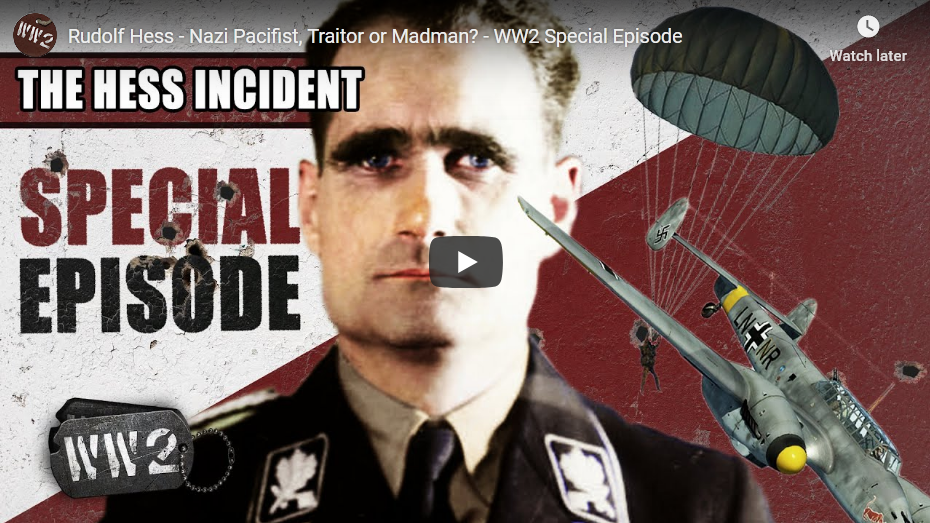
Rudolf Hess – Nazi Pacifist, Traitor or Madman? – WW2 Special Episode

Filed under: Britain, Germany, History, Military, WW2 — Tags: , , , , — Nicholas @ 04:00

World War Two
Published 12 May 2020

In a series of events, Hitler’s second in command Rudolf Hess decides to fly to Britain to enter peace negotiations with the Allies. But the true reasons behind and effects of his action remain ambiguous at best.

Join us on Patreon: https://www.patreon.com/TimeGhostHistory
Or join The TimeGhost Army directly at: https://timeghost.tv

Follow WW2 day by day on Instagram @World_war_two_realtime https://www.instagram.com/world_war_t…
Between 2 Wars: https://www.youtube.com/playlist?list…
Source list: http://bit.ly/WW2sources

Hosted by: Indy Neidell
Written by: Joram Appel
Director: Astrid Deinhard
Producers: Astrid Deinhard and Spartacus Olsson
Executive Producers: Astrid Deinhard, Indy Neidell, Spartacus Olsson, Bodo Rittenauer
Creative Producer: Joram Appel
Post-Production Director: Wieke Kapteijns
Research by: Joram Appel
Edited by: Mikołaj Cackowski
Sound design: Marek Kamiński
Map animations: Eastory (https://www.youtube.com/c/eastory)

Colorizations by:
Norman Stewart, https://oldtimesincolor.blogspot.com/
Carlos Ortega Pereira, BlauColorizations, https://www.instagram.com/blaucoloriz…
Jaris Almazani (Artistic Man), https://instagram.com/artistic.man?ig…
Olga Shirnina, https://klimbim2014.wordpress.com
Adrien Fillon, https://www.instagram.com/adrien.colo…

Bibliography:
– Balfour, Michael, Propaganda in War, 1939–45: Organizations, Policies, and Publics in Britain and Germany (London, 1979).
– Fox, Jo. “Propaganda and the Flight of Rudolf Hess, 1941-45”. In: The Journal of Modern History 83:1 (March 2011) 78-110.
– Gorodetsky, Gabriel, “The Hess Affair and Anglo-Soviet Relations on the Eve of ‘Barbarossa'”. In: The English Historical Review 101:399 (Apr 1986) 405-420.
– Görtemaker, Manfred, “The Bizarre Mission: Rudolf Hess in Britain,” in Britain and Germany in the 20th Century, ed. M. Görtemaker (Oxford, 2006), 75–101.
– Heiden, Konrad, “Hitler’s Better Half”. In: Foreign Affairs 20:1 (Oct 1941) 73-86.
– Kettenacker, Lothar, “Mishandling a Spectacular Event: The Rudolf Hess Affair,” in Flight from Reality: Rudolf Hess and His Mission to Scotland, ed. David Stafford (London, 2002) 19–38.
– Schmidt, Rainer, “The Marketing of Rudolf Hess: A Key to the ‘Preventative War Debate’?” War in History 5 (1998) 62-83.

Sources:
Bundesarchiv
Portraits of Douglas Douglas-Hamilton, duke of Hamilton and Duff Cooper, MP, courtesy National Portrait Gallery
Narodowe Archiwum Cyfrowe
Zentralbibliothek Zürich
Portrait of Max Aitken, Lord Beaverbrook, courtesy Nationaal Archief
IWM D 8987

Soundtracks from the Epidemic Sound:
Rannar Sillard – “March Of The Brave 4”
Reynard Seidel – “Deflection”
Andreas Jamsheree – “Guilty Shadows 4”
Johannes Bornlof – “The Inspector 4”
Johannes Bornlof – “Deviation In Time”

Archive by Screenocean/Reuters https://www.screenocean.com.

A TimeGhost chronological documentary produced by OnLion Entertainment GmbH.

“Why are you so upset at the gun ban? You don’t even have handguns or assault rifles”

Filed under: Cancon, Law, Liberty, Weapons — Tags: , , , — Nicholas @ 03:00

In BC Outdoors Magazine, Steve Hamilton explains why he’s so upset about the Trudeau government’s rush to punish law-abiding gun owners for the actions of criminals:

There are a few reasons – some that should upset non-gun owners, and some that should upset Canadians as a whole. Let us take a walk, shall we?

First, it is directed at the wrong people. Gun owners know that this will not address the real issues. There is a lack of severe punishment for criminals, and an unfortunate mental health crisis. We need to fix those first and foremost – direct the money there. No more revolving door. Lock repeat criminals up and throw away the key and dramatically increase programs and support mechanisms to help those affected with mental illness.

Multiple premiers and police chiefs have said the same thing. This ban will do nothing to lower gun crime. Gun owners know the statistics and that criminals will continue to run rampant. Criminals will not turn in their guns, we know that. This new law means nothing to them.

This ban will not take illegal guns off the street, just legal ones out of the hands of lawful owners. The sound bite of, “No one needs an AR-15 to take down a deer,” is truthful. However, the part they left out is that it has been illegal to do so in Canada since 1977 when the AR became restricted class, which means it is only allowed on approved ranges. Strictly to and from, and for nothing except target shooting. It was designed as a deer rifle in the 1960s and has never been used in a military application in its current configuration, as it was found unsuitable.

[…]

“Assault rifle.” That very term makes me cringe. Select-fire and military capable is the definition of assault rifle. To have a rifle approved for sale and imported, it needs to be verified by the RCMP, who confirms that converting it to select fire or automatic is impossible. So, by definition, every single one in Canada is not capable by any means of being turned into the class of firearm they have banned.

Let us toss the firearm argument aside for a second. Every Canadian citizen should be outraged at how this was done. It was pushed through on the heels of a tragedy. The very foundation of our government is supposed to be about democratic debate and input. There was none. Your opposition had zero say against this, and no matter if you are for or against the ban, when your side cannot be heard, that goes against what we should stand for as Canadians. They also used an Order in Council to change the class of a firearm, something that is normally used to change ministerial appointments or expenses. This should not have been done without debate in the House.

Now on to how it is written. That is what is scary about this “assault rifle” situation. There is so much ambiguous wording in this order. Clearly it was rushed through and poorly considered. It is very unclear to the point multiple firearms expert lawyers have said that some shotguns are banned. Minister Blair issued a statement saying that was not the intent; however, the law is written already. A defense in court of, “The minister said on social media that this wasn’t the intent,” will obviously not stand up. Good luck if you try that. Please let us know how that goes.

« Newer PostsOlder Posts »

Powered by WordPress