
The French have this wonderful word, amour-propre, so much better than our English “self-love.” It comes, with its edge, from La Rochefoucauld, his urbane and scintillating Maxims in the seventeenth century. It is the arch-flatterer, “more artful than the most artful of mankind.” In parallel, it comes from Blaise Pascal, who observes that Christianity is the only cure. Then it comes again through Jean-Jacques Rousseau, in the “enlightened” eighteenth century, who thought the primitive savages incapable of amour-propre, because they lacked the gilt-framed mirrors of sophisticated society, in which their pride might be reflected. He imagines it the source of all corruption; and with some authority, for he was himself among the most corrupt of men — this Rousseau who taught us all to “blame society.”
Really there is nothing new under the sun, and the concept comes much earlier from Saint Augustine of Hippo who in his City of God calls it in Latin, amor sui, and puts it about the centre of his review of human tawdriness. That, in turn, is how it came to Pascal: via the French Augustinians, with whom Pascal was in thick, about the time he was writing his Lettres provinciales. One might add, contre Rousseau (and perhaps with Joseph de Maistre) that it goes back farther, to Adam and Eve.
Ye devill appeals to Eve’s amour-propre. She then appeals to Adam’s. That’s how this whole wretched mess got started. Note that this couple predeceased all Rousseau’s noble savages, and that the field anthropologists have since discovered that the primitive tribal types are a lot like us. Which is to say, bad, in many colourful ways, and quite invariably self-regarding.
David Warren, “Amour-propre”, Essays in Idleness, 2016-06-01.
May 19, 2020
QotD: Amour-propre
May 18, 2020
Miscellaneous Myths: Loki’s Wager
Overly Sarcastic Productions
Published 15 May 2020Loki, Loki, Loki. When will you learn that your actions have consequences?
Alternate title: HAIRCUT PRANK GONE WRONG (I ALMOST DIED! NOT CLICKBAIT)
Our content is intended for teenage audiences and up.
PATREON: https://www.Patreon.com/OSP
MERCH LINKS: https://www.redbubble.com/people/OSPY…
OUR WEBSITE: https://www.OverlySarcasticProductions.com
Find us on Twitter https://www.Twitter.com/OSPYouTube
Find us on Reddit https://www.Reddit.com/r/OSP/

Safetyism

Safetyism is a disposition that has been gaining strength for decades and is having a triumphal moment just now because of the virus. Public health, one of many institutions that speak on behalf of safety, has claimed authority to sweep aside whole domains of human activity as reckless, and therefore illegitimate.
I suspect the ease with which we have lately accepted the authority of health experts to reshape the contours of our common life is due to the fact that safetyism has largely displaced other moral sensibilities that might offer some resistance. At the level of sentiment, there appears to be a feedback loop wherein the safer we become, the more intolerable any remaining risk appears. At the level of bureaucratic grasping, we can note that emergency powers are seldom relinquished once the emergency has passed. Together, these dynamics make up a kind of ratchet mechanism that moves in only one direction, tightening against the human spirit.
Acquiescence in this appears to be most prevalent among the meritocrats who staff the managerial layer of society. Deferring to expert authority is a habit inculcated in the “knowledge economy”, naturally enough; the basic currency of this economy is epistemic prestige.
Among those who work in the economy of things, on the other hand, you see greater skepticism toward experts (whether they make their claim on epistemic or moral grounds) and less readiness to accept the adjustment of social norms by fiat – whether that means using new pronouns or wearing surgical masks. I am regularly in welding supply stores, auto parts stores and other light-industry venues. Nobody is wearing masks in these places. They are very small businesses: an environment largely free of the moral fashions and corresponding knowledge claims that set the tone in large organisations. There is no HR in a welding shop.
A pandemic is a deadly serious business. But we would do well to remember that bureaucracies have their own interests, quite apart from the public interest that is their official brief and warrant. They are very much in the business of tending and feeding the narratives that justify their existence. Further, given the way bureaucracies must compete for funding from the legislature, each must make a maximal case for the urgency of its mission, hence the necessity of its expansion, like a shark that must keep moving or die. It is clearer now than it was a few months ago that this imperative of expansion puts government authority in symbiosis with the morality of safetyism, which similarly admits no limit to its expanding imperium. The result is a moral-epistemic apparatus in which experts are to rule over citizens conceived as fragile incompetents.
But what if this apparatus were revealed to be not very serious about safety, the very ideal that underwrites its authority? What then?
The British Tank Meme
Potential History
Published 1 Dec 2018A look at British tanks and why they are what they are.
Music Used: https://www.youtube.com/watch?v=WSo_d…
https://www.youtube.com/watch?v=PGrxH…End Song: https://www.youtube.com/watch?v=99LRv…
P.O.Box:
Potential History
P.O. Box
524 Beech Grove, IN,
46107Patreon: https://www.patreon.com/potentialhistory
Twitter: https://twitter.com/Tank_Memes
QotD: Science, evidence and “cognitive creationism”
What can we do about this problem? First, we must acknowledge that for most issues most conservatives and liberals are pro-science. Recent surveys show that over 90 percent of both Republicans and Democrats in the U.S., for example, agreed that “science and technology give more opportunities” and that “science makes our lives better.” In other words, anti-science attitudes are formed in very narrow cognitive windows — those in which science appears to oppose certain political or religious views. Knowledge of a subject helps a little. For example, those who know more about climate science are slightly more likely to accept that global warming is real and human-caused than those who know less on the subject. But that modest effect is not only erased when political ideology is factored in, it has an opposite effect on one end of the political spectrum. For Republicans, the more knowledge they have about climate science the less likely they are to accept the theory of anthropogenic global warming (while Democrats’ confidence goes up).
In another Scientific American column I wrote about this “backfire” effect, in which the more information you give someone that contradicts a cherished belief, the less likely they are to change their mind; in fact, they double-down on the belief. But this only applies to important political, religious, or ideological beliefs.
If you don’t have a dog in the fight then the facts can change your mind. But the cognitive dissonance created by facts counter to beliefs by which you define yourself will almost always be resolved by spin-doctoring the facts, not by changing your mind. Thus, when I engage in debate or conversation with creationists, for example, I don’t give them the choice between Darwin and Jesus, because I know who’s going to lose that one. Instead, I try to convince them that evolution was God’s way of creation, just like people in Newton’s time and after came to believe that gravity was God’s way of creating solar systems. I don’t believe that myself, of course, but the point is to get people to embrace science, not to win an argument. With climate deniers, I know from research and personal experience that when they hear “global warming” they think “anti-capitalism,” “anti-freedom,” “anti-American way of life.” So I take that off the table by showing them how investing in green technology is going to be one of the most lucrative enterprises in the history of capitalism. I call this the Elon Musk Model.
Michael Shermer, interviewed by Claire Lehmann, “The Skeptical Optimist: Interview with Michael Shermer”, Quillette, 2018-02-24.
May 17, 2020
Nazi Nuts Trading Places & Victory for the Commonwealth – WW2 – 090 – May 16, 1941
World War Two
Published 16 May 2020In the week that Rudolf Hess makes his flight to Britain, the Luftwaffe prepares for theirs to Crete. The British utilise their code-breaking methods and prepare for defence.
Join us on Patreon: https://www.patreon.com/TimeGhostHistory
Or join The TimeGhost Army directly at: https://timeghost.tvFollow WW2 day by day on Instagram @World_war_two_realtime https://www.instagram.com/world_war_t…
Between 2 Wars: https://www.youtube.com/playlist?list…
Source list: http://bit.ly/WW2sourcesWritten and Hosted by: Indy Neidell
Director: Astrid Deinhard
Producers: Astrid Deinhard and Spartacus Olsson
Executive Producers: Astrid Deinhard, Indy Neidell, Spartacus Olsson, Bodo Rittenauer
Creative Producer: Joram Appel
Post-Production Director: Wieke Kapteijns
Edited by: Iryna Dulka
Sound design: Marek Kamiński
Map animations: Eastory (https://www.youtube.com/c/eastory)Colorizations by:
– Norman Stewart – https://oldtimesincolor.blogspot.com/
– Olga Shirnina, a.k.a. Klimbim – https://klimbim2014.wordpress.com/
– Daniel Weiss
– Carlos Ortega Pereira, BlauColorizations – https://www.instagram.com/blaucoloriz…
– Dememorabilia – https://www.instagram.com/dememorabilia/Sources:
– Imperial War Museum: E2623, E 3222, E 3237, E 3233, E 3238, E 3228,
– Bundesarchiv, CC-BY-SA 3.0: Bild 183-R14128A, B 145 Bild-F016230-00007, Bild 141-0864, Bild 183-L19017
– National Portrait Gallery
– Artillery by Creative Mania from the Noun Project
– Oil barrel by Musmellow from the Noun Project
– Narodowe Archiwum Cyfrowe
– Photo from Bletchley Park, Sourse: Bletchley Park Trust
– Photo of Battista Volpini courtesy La StampaArchive by Screenocean/Reuters https://www.screenocean.com.
A TimeGhost chronological documentary produced by OnLion Entertainment GmbH.

Cicero’s Finest Hour (44 to 43 B.C.E.)
Historia Civilis
Published 16 May 2020Patreon | http://patreon.com/HistoriaCivilis
Donate | http://www.paypal.com/cgi-bin/webscr?…
Merch | teespring.com/stores/historiacivilis
Twitter | http://twitter.com/HistoriaCivilis
Website | http://historiacivilis.comSources:
Cicero, “Letters to Atticus” | https://amzn.to/3b8EQby
Cicero, “The Philippics” | https://amzn.to/35EHcOe
Suetonius, “The Life of Julius Caesar” | https://amzn.to/2xJesHH
Plutarch, “The Life of Julius Caesar” | https://amzn.to/35DG6lZ
Plutarch, “The Life of Cicero” | https://amzn.to/2Laca7w
Plutarch, “The Life of Brutus” | https://amzn.to/2SLaWUC
Nicolaus of Damascus, “The Life of Augustus” | https://amzn.to/3dlQeCg
Appian, “The Civil Wars: Book 3” | https://amzn.to/2WbJXU4
Cassius Dio, “Roman History: Book 44” | https://amzn.to/35HC4ce
Cassius Dio, “Roman History: Book 45” | https://amzn.to/35HC4ce
Cassius Dio, “Roman History: Book 46” | https://amzn.to/2WDNIka
—
Barry Strauss, “The Death of Caesar: The Story of History’s Most Famous Assassination” | https://amzn.to/2WAUxTD
Tom Holland, “Dynasty: The Rise and Fall of the House of Caesar” | https://amzn.to/2zjG4n4
Adrian Goldsworthy, “Antony and Cleopatra” | https://amzn.to/2L8MQ1F
Anthony Everitt, “Cicero: The Life and Times of Rome’s Greatest Politician” | https://amzn.to/3bbrKKM
Tom Holland, “Rubicon” | https://amzn.to/3dombKn
Adrian Goldsworthy, “Augustus” | https://amzn.to/3fAInmD
Anthony Everitt, “Augustus: The Life of Rome’s First Emperor” | https://amzn.to/2Wf9CLH
Adrian Goldsworthy, “Caesar: Life of a Colossus” | https://amzn.to/3cfFQvUMusic:
“Moving Forward,” by Adi Goldstein
“Blonde,” by Nctrnm
“Heliograph,” by Chris Zabriskie
“The House Glows (With Almost No Help),” by Chris Zabriskie
“Hallon,” by Christian BjoerklundWe are a participant in the Amazon Services LLC Associates Program, an affiliate advertising program designed to provide a means for us to earn fees by linking to Amazon.com and affiliated sites.

China sees their public image damaged in the wake of the Wuhan Coronavirus
Arthur Chrenkoff on the ways other countries regard China after the epidemic spread beyond their borders and the Chinese Communist Party’s antics on the world stage:
Welcome to the political chaos theory – or, should we say, fact: a bat flapping its wings in China produces a hurricane… pretty much everywhere around the world. It seems likely that three decades’ worth of good PR painstakingly build up by the Chinese authorities after the downer of the Tiananmien Massacre have all been undone in a few short months of domestic and international missteps, from initially covering up the truth about COVID, through gifting or selling faulty personal safety and medical goods around the world, to now retaliating against countries like Australia which are asking some uncomfortable questions about the origins of the virus.
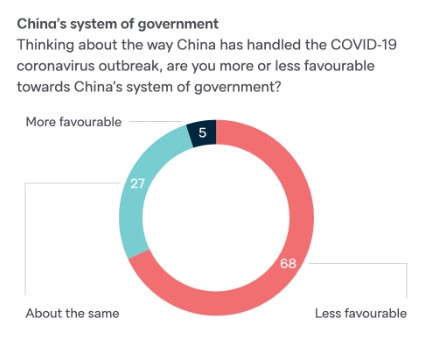
Earlier today, Australia’s Lowy Institute has released the results of its COVID poll on public attitudes about the Corona pandemic. Of particular interest, the perception of China’s rulers:
At the same time, 37 per cent of Australians think that China will emerge more powerful after the dust (or the viral load) settles, while 36 per cent believe in no change, and only 27 per cent think China will be weaker in the aftermath. By contrast, a majority of 53 per cent and a plurality of 48 per cent believe that the United States and Europe respectively will be less powerful in the post-pandemic future. Reading the two sets of figures together it seems that the prospect of China’s rebound to international power is viewed more with apprehension rather than enthusiasm.
As Lowy’s Natasha Kassam observed, the public trust in China has been already declining, falling dramatically from 52 to 32 per cent in just one year between 2018 and 2019. It will be interesting to see the figure for this year. It’s unlikely that the behaviour of the communist government so far in 2020 would have improved the perception.
Such findings mirror similar public opinion research elsewhere. Pew Research Center’s polling last month showed that the negative view of China in the United States has risen from 47 per cent in 2017 to 66 per cent this year. Seventy-one per cent have no confidence in China’s President for Life Xi and 61 per cent view China’s power and influence as a major threat.
British World War One SMLE Sniper Rifle
Forgotten Weapons
Published 17 Nov 2018https://www.forgottenweapons.com/brit…
http://www.patreon.com/ForgottenWeapons
Cool Forgotten Weapons merch! http://shop.bbtv.com/collections/forg…
The British started World War One without a sniper program, but were quick to develop one once faced with the threat of well-trained German snipers. The initial equipment used by the British was a motley collection of commercial hunting rifles, but by 1915 the government was issuing contract to mount mostly 3x and 4x telescopes on SMLE and Pattern 1914 rifles. About 10,000 scoped sniper rifles were issued in total during the war using a variety of scopes and mount types (a standardized pattern would not be adopted until 1918). The example we have here today is the most common type; an SMLE with an offset Periscopic Prism Company scope using a 5-screw mount assembled by the same company. Later in the war the offset mounts would slowly fall out of favor to the center-mounted scopes, which allowed better shooting at the cost of being able to use stripper clips.
Contact:
Forgotten Weapons
PO Box 87647
Tucson, AZ 85754

QotD: The egalitarian model of bias
Bo Winegard, “‘Equalitarianism’ and Progressive Bias”, Quillette, 2018-02-07.
May 16, 2020
Polish-Soviet War – First Phase 1919 – May 1920 I THE GREAT WAR 1920
The Great War
Published 15 May 2020Sign up for Curiosity Stream and Nebula – and get 40% off annual plans right now: https://curiositystream.com/thegreatwar
The Polish-Soviet War was one of the biggest conflicts after the armistice of 1918 and the culmination point of the many sub-conflicts that made up the Western Front of the Russian Civil War. The question about the Polish-Russian border was decided with armored trains, cavalry charges and also on the negotiating table.
» SUPPORT THE CHANNEL
Patreon: https://www.patreon.com/thegreatwar
Merchandise: https://shop.spreadshirt.de/thegreatwar/» SOURCES
Centek, Jarosław: “Polish-Soviet War 1920-1921”, in: 1914-1918-online. International Encyclopedia of the First World War, ed. by Ute Daniel, Peter Gatrell, Oliver Janz, Heather Jones, Jennifer Keene, Alan Kramer, and Bill Nasson, issued by Freie Universität Berlin, Berlin 2014-10-08Leonhard, Jörn. Der überforderte Frieden. Versailles und die Welt 1918-1923 (CH Beck, 2018).
Borzecki, Jerzy. The Polish-Soviet Peace of 1921 and the Creation of Interwar Europe (New Haven and London: Yale University Press, 2008)
Engelstein, Laura. Russia in Flames (Oxford University Press, 2017).
Smele, Jonathan. The “Russian” Civil Wars 1916-1926 (London: Hurst, 2015).
Davies, Norman. White Eagle Red Star (Random House, 2003 (1972))
Böhler, Jochen. Civil War in Central Europe, 1918-1921 (Oxford University Press, 2019)
Timothy Snyder. The Reconstruction of Nations. (New Haven: Yale University Press, 2003)
» SOCIAL MEDIA
Instagram: https://instagram.com/the_great_war
Twitter: https://twitter.com/WW1_Series
Reddit: https://reddit.com/r/TheGreatWarChannel»CREDITS
Presented by: Jesse Alexander
Written by: Jesse Alexander
Director: Toni Steller & Florian Wittig
Director of Photography: Toni Steller
Sound: Toni Steller
Editing: Toni Steller
Mixing, Mastering & Sound Design: http://above-zero.com
Maps: Daniel Kogosov (https://www.patreon.com/Zalezsky)
Research by: Jesse Alexander
Fact checking: Florian WittigChannel Design: Alexander Clark
Original Logo: David van StepholdA Mediakraft Networks Original Channel
Contains licensed material by getty images
All rights reserved – Real Time History GmbH 2020

Remy: “Surfin’ USA” (Beach Boys Lockdown Parody)
ReasonTV
Published 15 May 2020Remy discovers the dangers of exercising alone.
Written and performed by Remy. Music tracks, mastering, and background vocals by Ben Karlstrom. Video produced by Meredith and Austin Bragg.
LYRICS:
If you go out on the ocean
Across the USA
And you’re wearing a swim shirt
‘Cuz of your scrawny weight (it’s for the sun, I swear)Well, uh, you just might notice
The police in your wake
Cuz it’s illegal to be surfing
In the USAThey’re catching them out paddle boarding
Letting their children play
While they’re releasing this guy
A logical checkmateYou’re out in nature alone now
No one in six-foot range?
Well it’s illegal to be surfing
In the USAIf only you had flashed some children
It’d be your release date!
But you’re going to jail for surfing
In the USAYou’ve been distancing for months now
To keep the spread rate down
The only places you’ve been going
Are where there are no crowdsYou’re making sacrifices
For your community
Now put your hands on your head because you are surfing
In the USAHe’s helping the flattening the curve now
He’s exercising alone
Rocking a super baggy swim shirt
To hide his muscle tone (I said it’s for the sun)If only you had flashed some children
It’d be your release date!
But you’re going to jail for surfing
In the USA
The Wuhan Coronavirus, the excuse for an emergency without end
Mark Steyn on the seven-hundred-and-fifty-third day of our captivity:

Emergency without end is the staple of almost every futuristic dystopia — and that’s true for real life, too. So Americans shuffle shoeless through the airports for twenty years while their governments negotiate with the very organization that enabled those attacks — the Taliban — to restore them to power. Is a culture that cannot see off goatherds with fertilizer really going to rouse itself to decouple from a global superpower that supplies everything from its crappy “These Colors Don’t Run” T-shirts to its surgical masks and pharmacy medications?
~For my own part, I have been reading ancient accounts from Occupied France and Vichy for tips on finding workarounds for restraints on the citizenry. As wily and innovative as the French Resistance were, I wonder if their efforts would even be possible in an age when cheap Chinese-made drones can hover unseen and monitor every conversation.
[…]
Even without governors terrorizing those tavern-keepers or hairdressers who defy them, the lockdown has exaggerated the contradictions: The state wants open borders for “migrants” but a security perimeter around the homes of its citizens. Maybe the absurdities become so obvious that there is widespread rejection of them. Or maybe, one by one, the poor put-upon over-surveilled citizenry take a cue from their undocumented non-brethren. Perhaps I should just mug an illegal immigrant and steal his fake ID…
~The emergency is already feeling permanent. It starts with the social norms: Dr Fauci tells us the handshake is gone for good. That’s not a small loss. I don’t care for the suggested replacements, like the lame-o hand-on-heart gesture. I bow from the neck to the Queen — and just last year I did so to her Canadian vicereine, Mme Payette. Her Excellency then stepped forward and gave me a hug. But I don’t suppose she’s doing that anymore…
People ask me why I haven’t been on TV lately. Well, I mainly like going on TV to behave like a person who’s on TV. So, if you notice, on the “Fox & Friends” live-audience shows, I come bounding in like Tigger and do a lot of gladhanding with those on the aisle (including the odd hug), and then I give Steve and Brian manly handshakes and do a little light kissy-kissy with Ainsley. And all that — the basic language of telly for seventy years — is gone, apparently forever.
[…]
The WHO, the Beijing public relations firm whose pronouncements the BBC, The New York Times et al insist on taking as gospel, now says Covid-19 is here to stay — like HIV. With HIV, it wasn’t that difficult to avoid catching it, because it required the exchange of bodily fluids, which is a fairly intense and specific degree of intimacy. With Covid, we are rolling a protective condom down over every routine social intercourse.
A contributor at the Continental Telegraph explains why he no longer supports the lockdown:
First, it turns out that the drastic steps we were taking were based on one model. That no one outside the team using it was allowed to review. We were even told that we couldn’t check the coding because it was so old & patched together that it’s too hard to follow. That’s like saying you can’t check the brakes because you won’t be able to see all the duct tape and Velcro we’re using. Further, we’re told that this software doesn’t provide the same results from one run to the next.
Next, I heard about Dr. Ferguson’s history of wildly overestimating the fatalities from mad cow disease and bird flu (50k compared to <200, 200 million versus <500 respectively). Also, the CDC’s estimate of Ebola deaths in Sierra Leone (1.4 million compared to 8k). And let’s not forget the U.S. Public Health Service’s overshoot on the number of AIDS infections in 1993 (450k versus 17k). At this point I gave more thought to the issue of modeling – prior to retiring I was an actuary and modeling was what I did for a living. A few points about how modeling works: The more complex a system is, the more difficult it is to build a good model. And, more importantly, the more difficult it becomes to test your model and confirm that it accurately mirrors the real world. And this looks like one of the most complex systems to model I’ve ever heard of. How can you test this against reality? I don’t think you can. You can run simulations and confirm it looks like you expected, but that doesn’t mean the virus behaves like your model. Another point about modeling is that the results are extremely dependent on the assumptions you’re using. And in this case two critical assumptions are how infectious the virus is and how lethal it is. We still have a poor understanding of these variables months after we started Lockdown. Then a lot of us noticed that the goal shifted from “flattening the curve” to avoid a catastrophic overflow at hospitals to Lockdown until “fill in the blank” (in some states a vaccine, in others no deaths for 14 days, etc.). And the lockdown rules are inconsistent and illogical – in Michigan you can’t buy plant seeds but you can buy lottery tickets. To add insult to injury, many of the people with their foot on our necks violate the rules (the mayors of Chicago and New York, Dr. Ferguson, etc.). I’m stunned and angry at how little attention the human costs of the Lockdown receive. We know that this will lead to increased suicides, homicides and drug overdoses. Let’s not forget more child abuse, domestic violence, depression, drug and alcohol abuse, the list of miseries goes on a very, very long way (I may write up an article just on this, the Lockdown harpies should have to admit to all the harm they’re so enthusiastically spreading).
How It’s Made – Utility Poles
How Its Made
Published 12 Jul 2016How It’s Made season 26
Utility Poles

QotD: Division of labour in the modern world
In another example — the making of a woollen coat — Smith emphasises that the division of labour allows us to use machines, even “that very simple machine, the shears with which the shepherd clips the wool”.
The shepherd has the perfect tool for a focused task. That tool needs countless other focused specialists: the bricklayer who built the foundry; the collier who mined fuel; the smith who forged the blades. It is a reinforcing spiral: the division of labour lets us build new machines, while machines work best when jobs have been divided into one small task after another.
The rise of the computer complicates this story. Computers can certainly continue the process of specialisation, parcelling out jobs into repetitive chunks, but fundamentally they are general purpose devices, and by running software such as Microsoft Office they are turning many of us into generalists.
In a modern office there are no specialist typists; we all need to be able to pick our way around a keyboard. PowerPoint has made amateur slide designers of everyone. Once a slide would be produced by a professional, because no one else had the necessary equipment or training. Now anyone can have a go — and they do.
Well-paid middle managers with no design skills take far too long to produce ugly slides that nobody wants to look at. They also file their own expenses, book their own travel and, for that matter, do their own shopping in the supermarket. On a bill-by-the-minute basis none of this makes sense.
Why do we behave like this? It is partly a matter of pride: since everyone has the tools to build a website or lay out a book, it feels a little feeble to hand the job over to a professional. And it is partly bad organisational design: sacking the administrative assistants and telling senior staff to do their own expenses can look, superficially, like a cost saving.
Tim Harford, “Why Microsoft Office is a bigger productivity drain than Candy Crush Saga”, The Undercover Economist, 2018-02-02.


