
[William F.] Buckley’s touching a nerve because he’s forcing attention on the Catholic Church’s belief in the redemptive power of suffering, something most people are aware of at a general level but don’t recognize as being absolutely central to Catholicism. I suspect I’m not the only one who was taught as a callow youth that literally any pain you endure — even down to jamming your toe — can be “offered up to God” as a good work of sorts. Just as mortification of the flesh has passed out of fashion in the West, it’s hard for secular Americans to respect the idea that it’s good for the Pope to be suffering like this, not because it shows his strength or tests his character but because suffering, in and of itself, is good.
Same thing with Lenten sacrifices, which get misinterpreted as a device to remind you that the life of the spirit is superior to the life of the body — both a cultural error and a theological one, since in fact your soul and glorified body will be reunited on the Last Day. Giving something up for Lent is solely about deprivation; that’s why you’re specifically advised not just to give up smoking or eating sweets or anything else you’d give up as a New Year’s resolution, but to give up something that you will miss and that isn’t harmful to you. (Harmful stuff like yanking it you’re supposed to have permanently given up anyway.)
Tim Cavanaugh, “Don’t Cry. It’s a Waste of Good Suffering”, Reason Hit and Run, 2005-02-15.
June 17, 2020
QotD: The theological role of suffering in Catholicism
June 16, 2020
Plague and the Bronze Age Collapse ~ Dr. Louise Hitchcock
The Study of Antiquity and the Middle Ages
Published 16 May 2020Ladies and Gentlemen, welcome to the series NAUE II SWORDS, GERMS, & IRON brought to us by none other than Dr. Louise Hitchcock and this episode is going to be about plague and the Bronze Age collapse. This episode will also be drawing on modern parallels such as “What Covid-19 Can Tell Us About the Bronze Age (12th cent) Collapse?”
It will dive into the Bronze Age and discuss was plague a contributing factor in decline of the Bronze Age and the birth of the Iron Age? How familiar were the ancient peoples with plague and epidemics and what do the ancient literary sources tell us? From discussing plague in ancient Mesopotamia to the Philistine Plague to a Hittite King who falls prey to a deadly disease we explore new thoughts, theories and research involving a period that we all love and a subject that could not be more relevant and that is plague.
Check out the awesome work of Dr. Hitchcock at these links below!
Academia profile where you can access her work that is free to the public. https://unimelb.academia.edu/LouiseHi…
Get her books here!
Aegean Art and Architecture: https://global.oup.com/ukhe/product/a…
Minoan Architecture: A Contextual Analysis: http://www.astromeditions.com/books/b…
Theory for Classics: https://www.routledge.com/Theory-for-…
DAIS: The Aegean Feast https://www.peeters-leuven.be/detail….
Tell It In Gath: Studies in the History and Archaeology of Israel. Essays in Honor of Aren M. Maeir on the Occasion of his Sixtieth Birthday https://www.zaphon.de/epages/83179382…Follow her on Twitter: https://twitter.com/ashlarblocks
To support the channel, become a patron and make history matter!
Patreon: https://www.patreon.com/the_study_of_…
Donate directly to paypal: https://paypal.me/nickbarksdale
Enjoy history merchandise? Check out our affiliate link to spqr emporium! http://spqr-emporium.com?aff=3
*disclaimer, the link above is an affiliate link which means we will earn a generous commission from your magnificent purchase, just another way to help out the channel! join our community!twitter: https://twitter.com/nickbarksdale
instagram: https://www.instagram.com/study_of_an…Image credits: Manna Nader, Gabana Studios Cairo
Hittite 3D City and intro footage credits: 3D reconstruction of Imperial Hittite Karkemish by Giampaolo Luglio, Turco-Italian Archaeological Expedition to Karkemish directed by Nicolò Marchetti (University of Boologna)
KARKEMISH (Carchemish) 1300 BC (3D) – The Southern Capital of the Empire Hittite https://youtu.be/RsTdoY__F4U
Music Attribution: Herknungr – Megaliths | Dark Neolithic Meditive Shamanic Ambient Music https://youtu.be/oc8FQwNjPu0
Footage of Ugarit Credit goes to Ruptly. Video Title : Syria: Ancient city of Ugarit freed from Islamic State control https://youtu.be/XKzbk0PFvg0
Andrew Sullivan on Puritanism in the Current Year
Andrew Sullivan wonders if there’s any room for debate any more:
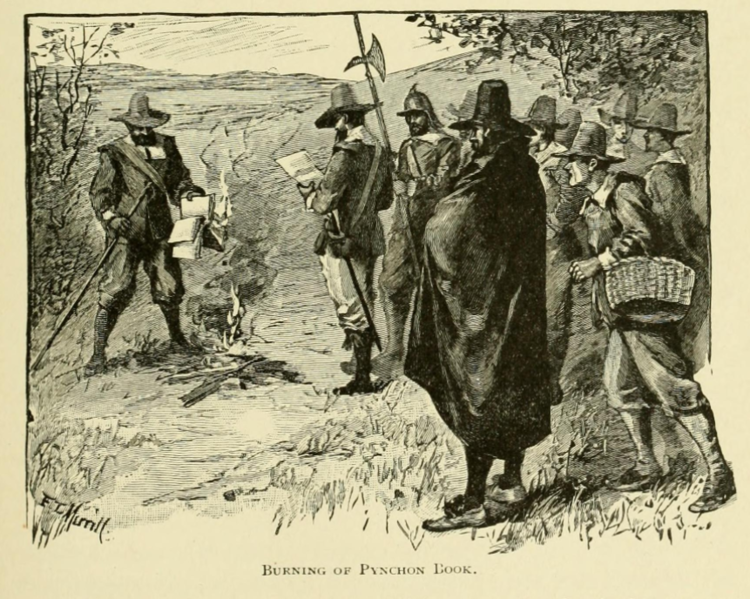
Portrayal of the burning of copies of William Pynchon’s book The Meritous Price of Our Redemption by early colonists of the Massachusetts Bay Colony, who saw his book as heresy; it was the first-ever banned book in the New World and only 4 original copies are known to survive today.
Engraving by F.T. Merrill in The History of Springfield for the Young by Charles Barrows, 1921.
In the last couple of weeks, as the purges of alleged racists have intensified in every sphere, and as so many corporations, associations, and all manner of civic institutions have openly pledged allegiance to anti-racism, with all the workshops, books, and lectures that come with it, I’m reminded of a Václav Havel essay, “The Power of the Powerless.”
It’s about the dilemma of living in a world where adherence to a particular ideology becomes mandatory. In Communist Czechoslovakia, this orthodoxy, with its tired slogans, and abuse of language, had to be enforced brutally by the state, its spies, and its informers. In America, of course, with the First Amendment, this is impossible. But perhaps for that very reason, Americans have always been good at policing uniformity by and among themselves. The puritanical streak of shaming and stigmatizing and threatening runs deep. This is the country of extraordinary political and cultural freedom, but it is also the country of religious fanaticism, moral panics, and crusades against vice. It’s the country of The Scarlet Letter and Prohibition and the Hollywood blacklist and the Lavender Scare. The kind of stifling, suffocating, and nerve-racking atmosphere that Havel evokes is chillingly recognizable in American history and increasingly in the American present.
The new orthodoxy — what the writer Wesley Yang has described as the “successor ideology” to liberalism — seems to be rooted in what journalist Wesley Lowery calls “moral clarity.” He told Times media columnist Ben Smith this week that journalism needs to be rebuilt around that moral clarity, which means ending its attempt to see all sides of a story, when there is only one, and dropping even an attempt at objectivity (however unattainable that ideal might be). And what is the foundational belief of such moral clarity? That America is systemically racist, and a white-supremacist project from the start, that, as Lowery put it in The Atlantic, “the justice system — in fact, the entire American experiment — was from its inception designed to perpetuate racial inequality.” (Wesley Lowery objected to this characterization of his beliefs — read his Twitter thread about it here.)
This is an argument that deserves to be aired openly in a liberal society, especially one with such racial terror and darkness in its past and inequality in the present. But it is an argument that equally deserves to be engaged, challenged, questioned, interrogated. There is truth in it, truth that it’s incumbent on us to understand more deeply and empathize with more thoroughly. But there is also an awful amount of truth it ignores or elides or simply denies.
It sees America as in its essence not about freedom but oppression. It argues, in fact, that all the ideals about individual liberty, religious freedom, limited government, and the equality of all human beings were always a falsehood to cover for and justify and entrench the enslavement of human beings under the fiction of race. It wasn’t that these values competed with the poison of slavery, and eventually overcame it, in an epic, bloody civil war whose casualties were overwhelmingly white. It’s that the liberal system is itself a form of white supremacy — which is why racial inequality endures and why liberalism’s core values and institutions cannot be reformed and can only be dismantled.
This view of the world certainly has “moral clarity.” What it lacks is moral complexity. No country can be so reduced to one single prism and damned because of it. American society has far more complexity and history has far more contingency than can be jammed into this rubric. No racial group is homogeneous, and every individual has agency. No one is entirely a victim or entirely privileged. And we are not defined by black and white any longer; we are home to every race and ethnicity, from Asia through Africa to Europe and South America.
Legends Summarized: The Journey To The West (Part VI)
Overly Sarcastic Productions
Published 14 Dec 2018JOURNEY TO THE WEST KAI, EPISODE 3: FAMILY FEUD!
Action! Excitement! Faces from the past! Kuan Yin discovers an exciting new acupuncture technique! Pigsy is unexpectedly skilled at CPR!
PATREON: https://www.patreon.com/user?u=4664797
MERCH LINKS:
Shirts – https://overlysarcasticproducts.threa…
All the other stuff – http://www.cafepress.com/OverlySarcas…Find us on Twitter @OSPYouTube!

QotD: A thumbnail history of the English language
English doesn’t just borrow words; it lifts whole phrases and grammatical ideas from other languages without so much as a by-your-leave. With the coming of the Saxons to Britain, Germanic languages crashed headlong into Brythonic and became Old English. Then the Vikings went for a multi-century beer run starting in the late 700s and left behind a bunch of Norse words, because who doesn’t invent a new language every time they go out carousing? In 1066, William the Bastard decided he didn’t like his name, and brought Norman French with him when he went to the town clerk’s office to have his name legally changed to William the Conqueror.
For the next two hundred years, the English upper classes spoke French and the lower classes spoke a zillion dialects of Middle English (travel was difficult for poor people, so regional variations survived). All legal business was done in French, which was often translated on the spot into Latin for the official records. A person couldn’t even submit a legal plea in English until 1362. But with the start of the Hundred Years’ War in 1337, Edward III decided that speaking French was très passé, and began encouraging English as a spoken and written language, with a little French thrown in, just to keep things interesting. And ever since, English has been debating how sophisticated it wants to be, while making rude gestures across the Channel at France and grumbling when the French sneer northwards.
Blake Smith, “A Brief History of English and Why it Matters”, Mad Genius Club, 2018-03-07.
June 15, 2020
African History Disproves Guns Germs and Steel by Jared Diamond
The Cynical Historian
Published 26 Oct 2019There’s a question in the history profession that if sufficiently answered could not only reshape how we conceive ourselves, but reveal the best course of action for politics around the world. What makes the West strong? While there are many answers, the most popular of these has been Jared Diamond’s Guns Germs and Steel. You’ll see his argument all over the place, including a NatGeo documentary. But of course it has its detractors, to the point that some historians consider it pseudo-history. Now I think that’s going too far, but there are enough problems with his thesis that we can’t take it as the final answer to these questions. So let’s talk about that.
————————————————————
errata
10:32 – not “Blaut’s theory” but “Diamond’s theory” (thx PunkSci)
————————————————————references:
James M. Blaut, Eight Eurocentric Historians: The Colonizer’s Model of the World, Volume Two (New York: The Guilford Press, 2000), 149-172. https://amzn.to/2YFt0iQMichael C. Campbell and Sarah A. Tishkoff, “African Genetic Diversity: Implications for Human Demographic History, Modern Human Origins, and Complex Disease Mapping,” Annual Review of Genomics and Human Genetics 9 (22 September 2008): 403-433.
Jared Diamond, Guns Germs and Steel: The Fates of Human Societies (New York: WW Norton, 1997). https://amzn.to/2GK6AqI
Martin W. Lewis and Karen E. Wigen, The Myth of Continents: A Critique of Metageography (Berkeley: University of California Press, 1997). https://amzn.to/2H0ylv7
Richard York and Philip Mancus, “Diamond in the Rough: Reflections on Guns, Germs, and Steel,” Human Ecology Review 14, no. 2 (2007): 157-162.
https://thetruesize.com
————————————————————
Support the channel through PATREON: https://www.patreon.com/CynicalHistorianLET’S CONNECT:
Subreddit: https://www.reddit.com/r/CynicalHistory/
Discord: https://discord.gg/Ukthk4U
Twitter: https://twitter.com/Cynical_History

Wokepocalypse Now
In Spiked, Andrew Doyle takes a very brief moment to say “I told you so” about Antifa and the other woke entities haunting the headlines these days:
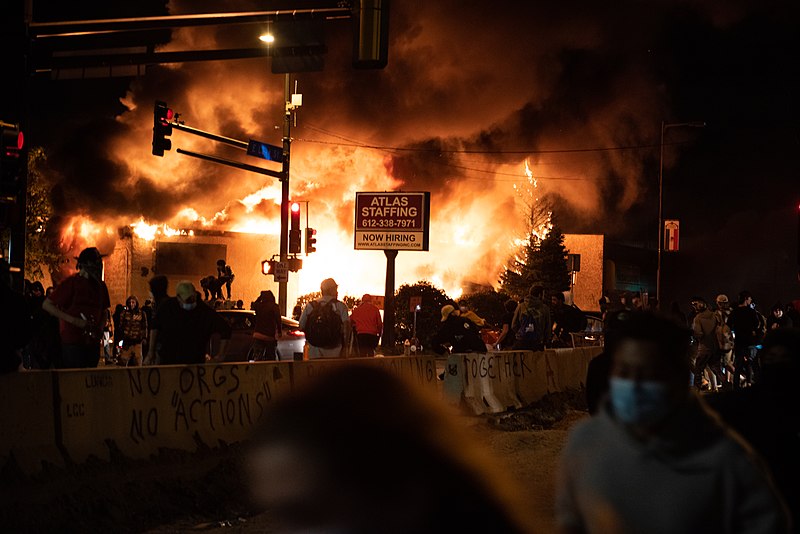
A building burning in Minneapolis following the death of George Floyd.
Photo by Hungryogrephotos via Wikipedia.
Those of us who have urged vigilance when it comes to the rise of identity politics and the cult of Social Justice have now been fully vindicated. For years we have warned about the ways in which the culture war had the potential to infect all public and political discourse. But we were dismissed as railing against niche politics confined to campus common rooms and the dark recesses of the internet. Now the culture war has exploded on to the streets of the UK. If that sounds like a fancy way to say “I told you so”, then so be it.
If we are to have any chance of preserving the liberal values upon which our society depends, we need to find a way to navigate the binary thinking that comes with ideologically driven movements. The first step is to acknowledge common ground. In all my life I have never met a single person who would not agree with the proposition that “black lives matter”, so that seems like a good place to start. It’s been many years since racism has been in any way tolerated by polite society, one of the undeniably positive outcomes of the political-correctness campaigns of the 1980s and 1990s. A further point on which we can surely all agree is that racism exists and should be resisted wherever it occurs. This may seem obvious, but since any opposition to the cult of Social Justice is automatically taken as a denial of the fact of racism, it is worth making the point explicitly.
Those who would deny the existence of racism, or do not agree that black lives matter, or do not accept that racism is an evil that must always be confronted, are already beyond the scope of rational adult conversation. The vast majority of the population believe in our shared values of equality and fairness, although many Social Justice activists prefer to ignore this reality in favour of a fantasy Britain awash with fascists. We saw this in the way that Brexit voters were consistently smeared as xenophobic, even though such a label could only possibly apply to a tiny minority. We saw this in the myth that those who voted Leave were nostalgic for a colonial past, a virtually non-existent mindset that was assumed to be commonplace on the basis of no evidence at all. These kinds of prejudices, largely levelled against working-class people by bourgeois commentators, in turn generated the kind of resentment that almost certainly tipped the scales in favour of Brexit and ultimately led to the collapse of Labour’s “red wall”. These outcomes were in themselves taken as proof of Britain’s inherent racism, and so we find ourselves caught in this perpetual square dance of straw men.
All of which has been a boon for the intersectional, identity-based Social Justice movement, which is sustained on a view of society that bears little resemblance to reality. The latest protests have been infiltrated, and often stoked, by the presence of various groups who unite under the banner of “Antifa”. Like “Black Lives Matter”, these groups rely on the good nature of a public who are likely to interpret their name literally. After all, only a fascist would complain about anti-fascism. Even Mara Liasson, national political correspondent for NPR, fell for this basic rhetorical trick when she described the Normandy landing of more than 150,000 Allied troops as the “biggest Antifa rally in history”. Activist singer Billy Bragg posted an image of Winston Churchill captioned simply with “ANTIFA”. That protesters this week defaced the statue of Churchill in Parliament Square and branded him a “racist” shows the incoherence of much of what is going on.
To return to our common ground: not only is fascism vanishingly rare in the UK, but you would be hard pushed to find anyone who isn’t wholeheartedly opposed to fascism. We are all anti-fascist, which makes Antifa’s claim to be resisting a popular tyrannous force seem about 80 years out of date. The difference is that most of us understand that pepper-spraying a Trump supporter, or striking a UKIP voter over the head with a bike lock, doesn’t put us in the same bracket as those who fought actual fascists at Cable Street in 1936.
As I have argued in Standpoint, our failure to instil critical thinking in our educational systems has led to many of the problems we face in today’s society. To make the case for measured and reasonable discussion of these sensitive issues is to open oneself up to entirely unfounded charges of racism. In such circumstances, most people would rather acquiesce for the sake of an easy life. We have even seen those who have raised questions about the wisdom of permitting mobs to destroy public landmarks being accused of endorsing the slave trade. “How you feel about that statue is how you feel about slavery”, tweeted LBC presenter James O’Brien. “Don’t let anyone pretend otherwise”, he said. But the chances of finding anyone in the UK who would defend slavery are infinitesimal, and it is surely inconceivable that anyone making these allegations sincerely believes otherwise.
The Battle that Saved an Army | Arras 1940 | The Tank Museum
The Tank Museum
Published 17 May 2020Encircled by the Germans in North-West France, the Battle of Arras, 21st May 1940, was a successful Allied counter-attack which allowed French and British troops to be evacuated at Dunkirk. Curator David Willey, presents his talk on the WW2 Battle of Arras from home.
For more on the Blitzkrieg see David’s Tank Story Hall tour https://www.youtube.com/watch?v=eysQa…
Support the work of The Tank Museum on Patreon: ► https://www.patreon.com/tankmuseum
Visit The Tank Museum SHOP & become a Friend: ► https://tankmuseumshop.org/Twitter: ► https://twitter.com/TankMuseum
Instagram: ► https://www.instagram.com/tankmuseum/
Tiger Tank Blog: ► http://blog.tiger-tank.com/
Tank 100 First World War Centenary Blog: ► http://tank100.com/

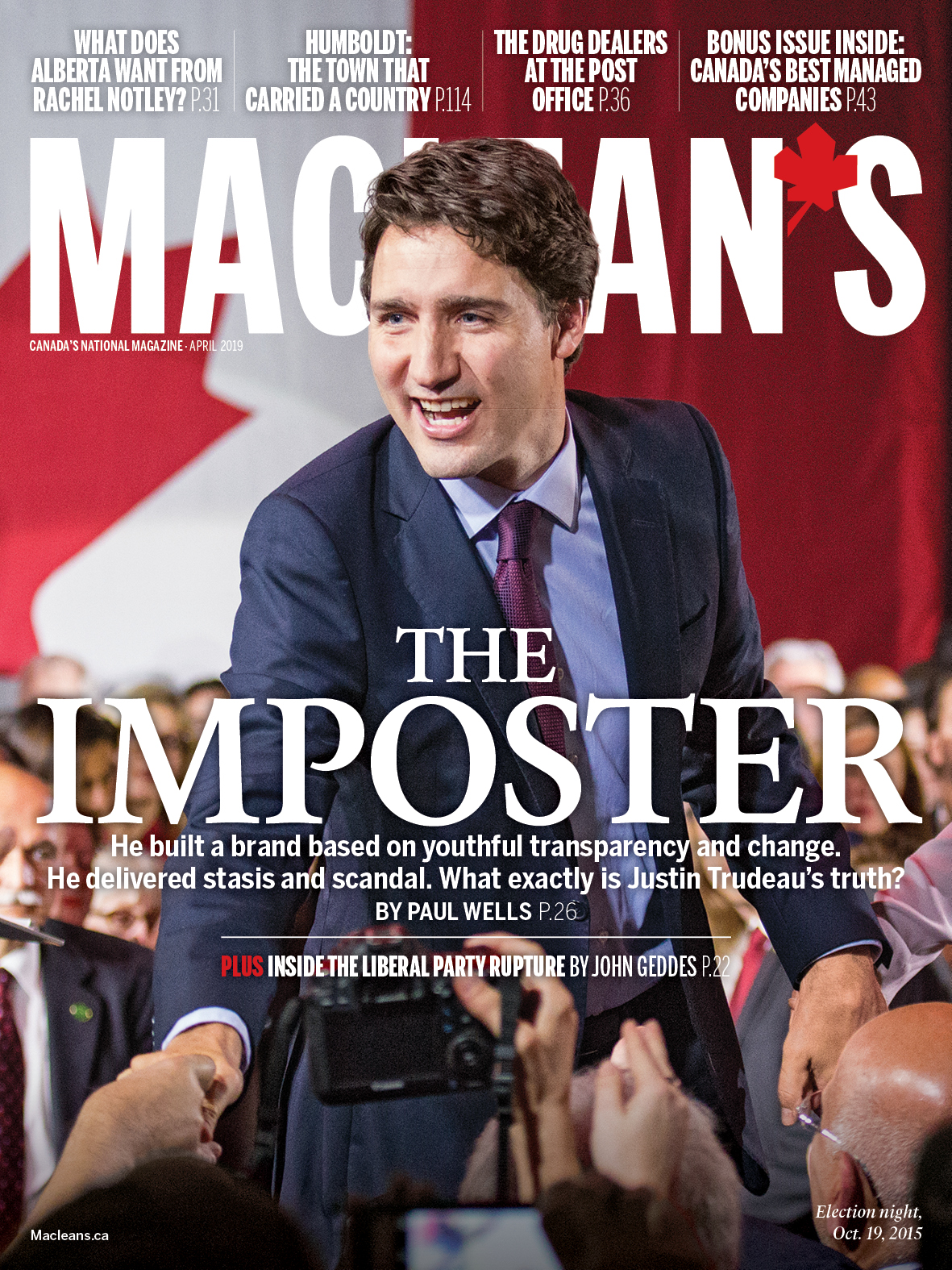
Canada’s ongoing experiment with Justin Trudeau’s “basic dictatorship”
Ted Campbell outlines the development of the concept of “rights” from Saxon England through Magna Carta and how a bad king finally triggered a rebellion that forced him to grant the Great Charter which still acts as a foundation for British (and Canadian) law. Justin Trudeau may be the modern day version of the bad king:
A few hundred years later, one of liberalism‘s and democracy’s greatest voices told us that we have three absolutely fundamental, natural rights: to life, to liberty and to property. These rights were not and still are not unlimited. There were and are ways to lawfully and properly deprive a person of his property and his liberty and, in some countries, even his life. A few centuries after John Locke another philosopher wanted to do away with the right to property: “From each according to his ability, to each according to his need,” Karl Marx wrote, and many, far too many, believed. The only real problem with Marx’s notion is that it requires that humans are perfect … and most of us know how rare that is. Here in Canada, especially since the early years of the 20th century, we have had far too much Marx and far too little Locke.
Now, in 2020, we even have a new version of King John: a vain and foolish prime minister who seems to believe that he has been sent to rule over us. Justin Trudeau is profoundly ignorant about both liberalism and democracy. He is, actually, more of a puppet than a ruler but it is less easy than it should be to determine just who is pulling on which strings. He does not appear to have the mental capacity to pull more than a couple of ideas together at any one time.
Because we have been panicked by the coronavirus pandemic we have
decidedaccepted that more government is thebestleast bad answer. To give us more and more government, Justin Trudeau’s handlers suspended parliament until September … they wanted to have that “basic dictatorship” thing.Democracy is in peril in Canada … it’s not because Justin Trudeau is an evil dictator, it’s because we, as a people, are too complacent. We have come to believe that democracy is, somehow, automatic, that it is natural. It’s not. It needed to be carefully built, brick-by-brick, over many centuries. We needed to fight for democracy: we needed to win it and then defend it, too. It doesn’t renew itself, it is not the natural order of things, and, In Canada, in 2020, it is in peril. Parliament needs to be recalled, soon, before September. Parliament needs to tend to its ancient rights, duties and powers. The Trudeau regime needs to be called to account and then replaced by a new, better, government.
How Shaker Furniture is constructed – What makes a quality piece?
Stumpy Nubs
Published 3 Dec 2015SUBSCRIBE TO STUMPY NUBS WOODWORKING JOURNAL► http://www.stumpynubs.com
PART ONE OF TWO: We investigate a very old piece of Shaker furniture to determine if it was made by the Shakers themselves.

QotD: The very first “road trip”
By 1888, he had a working prototype, which had successfully driven down a road. The now-patented Motorwagen had no gears and could not go up hills, but it worked. One morning, Benz’s wife Bertha decided to take the car on its first extended road trip. With her two sons, she pushed the car out of the garage, until it was far enough from the house that they could get it started without waking her husband.
Bertha Benz had a destination in mind — her parents’ house in Pforzheim, about 65 miles from her home. Following roads meant for wagons, she and her sons started the drive — the first recorded road trip in a car.
There were challenges. A pipe clogged; Benz cleaned it with her hat pin. A wire shorted; she insulated it with her garter. They needed more fuel; she convinced a pharmacist to sell her an unusually large amount of the gas the car used. When the brakes started wearing out, she had them shod with leather at a cobbler. When she reached a hill, she had the boys push (along with local help).
By the end of the day, the Benzes had reached Pforzheim, where Bertha telegraphed her husband that they were safe. After a few days’ visit, they drove back home to Mannheim.
Ten years ago, Germany created an official Bertha Benz Memorial Route, marking her historic road trip. Part of Bertha Benz’s motivation was to sell potential customers on the advantage of automobiles; although it took another decade or so, people eventually bought into this transportation revolution.
Sarah Laskow, “An 1888 Road Trip Sparked Germany’s Romance With Cars”, Atlas Obscura, 2018-02-28.
June 14, 2020
Finland and France Join Hitler – WW2 – 094 – June 13 1941
World War Two
Published 13 Jun 2020Germany, Romania and Finland prepare for a gigantic invasion of the Soviet Union, whose own military is in a dire state. The Allies invade Vichy French Syria and prepare to relieve the Australians besieged at Tobruk.
Join us on Patreon: https://www.patreon.com/TimeGhostHistory
Or join The TimeGhost Army directly at: https://timeghost.tvFollow WW2 day by day on Instagram @World_war_two_realtime https://www.instagram.com/world_war_t…
Between 2 Wars: https://www.youtube.com/playlist?list…
Source list: http://bit.ly/WW2sourcesWritten and Hosted by: Indy Neidell
Director: Astrid Deinhard
Producers: Astrid Deinhard and Spartacus Olsson
Executive Producers: Astrid Deinhard, Indy Neidell, Spartacus Olsson, Bodo Rittenauer
Creative Producer: Joram Appel
Post-Production Director: Wieke Kapteijns
Edited by: Iryna Dulka
Sound design: Marek Kamiński
Map animations: Eastory (https://www.youtube.com/c/eastory)Colorizations by:
– Norman Stewart – https://oldtimesincolor.blogspot.com/
– Olga Shirnina, a.k.a. Klimbim – https://klimbim2014.wordpress.com/
– Daniel Weiss
– Carlos Ortega Pereira, BlauColorizations – https://www.instagram.com/blaucoloriz…
– Julius Jääskeläinen – https://www.facebook.com/JJcolorization/Sources:
– Imperial War Museum: E 7070, E 15182, IND 3143
– Mil.ru
– spbarchives.ru
– IDF Spokesperson’s Unit
– Bundesarchiv, CC-BY-SA 3.0: Bild_101I-443-1599-20Archive by Screenocean/Reuters https://www.screenocean.com.
A TimeGhost chronological documentary produced by OnLion Entertainment GmbH.
The cat’s in the bag … once. Twice is a different matter altogether
David Warren discusses some specific cats and bags:
A building burning in Minneapolis following the death of George Floyd.
Photo by Hungryogrephotos via Wikipedia.
You can get a cat into a bag twice, as someone said (I think it was me); but the second time it has to be dead. This would be the reasoning behind my prediction that a second general lockdown will not even be attempted; but it must be qualified. For many of the people who imposed the first one were demonstrably insane, and they haven’t yet been removed from public office.
The same could be said about our impending “summer of love,” or hot season of race riots, already endured a half-century ago. That cat has been put into that bag before. This time is bound to be a different story.
It is fairly strictly a party question, now. The “theory” behind the lockdowns — to avoid overloading the hospitals in Manhattan — proved a crock, but there is a more cogent alternative theory. The Democrats in Natted States Merica guessed that destroying the “Trump economy,” and encouraging “peaceful” riots in the cities, was the only way they could defeat Trump, having tried other methods to remove him. And for a party of convinced abortionists, defeating Trump takes priority over mere human lives. We’ll see in November whether their Caracas strategy is the final winner.
To be fair, as they say at Instapundit, the Repubs have historically played along with this, and agreed to take responsibility and blame for almost purely Democrat measures. A good example is race, where the party of slavery, the Ku Klux Klan, eugenic birth control to reduce the black population, and Jim Crow laws, presents itself to captive media as the champion of the black man against “systemic racism”; while the party of Lincoln apologizes for itself. That the devil is at large in American politics is, to my mind, an irresistible hypothesis.
The refusal of this Trump fellow to play this game, as his predecessors did, drives Democrats berserk. He actually fights back, to their consternation. It didn’t help that they were so proximate to berserk already.
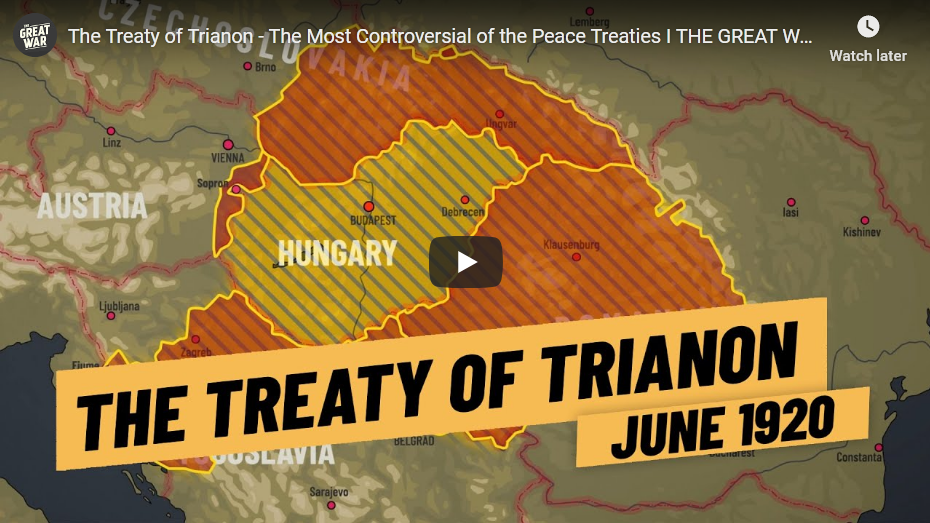
The Treaty of Trianon – The Most Controversial of the Peace Treaties I THE GREAT WAR 1920
The Great War
Published 13 Jun 2020Sign up for Curiosity Stream and get Nebula bundled in: https://curiositystream.com/thegreatwar
The last of the big peace treaties signed in Paris that finalized the borders in Europe was the Treaty of Trianon. Even at the time, Hungarians considered it a historic injustice while nations such as Czechoslovakia, Romania and Yugoslavia were quite happy with the result. We examine how the treaty was signed and negotiated.
» SUPPORT THE CHANNEL
Patreon: https://www.patreon.com/thegreatwar
Merchandise: https://shop.spreadshirt.de/thegreatwar/» SOURCES
Isaiah Bowman, The New World-Problems in Political Geography, (Yonkers-on-Hudson: World Book Company, 1921)Francis Deák & Dezsó Ujváry, Paper and Documents Relating to the Foreign Relations of Hungary, Volume 1; 1919-1920, (Budapest: Royal Hungarian Ministry of Foreign Affairs, 1939)
Conan Fischer, Europe between democracy and dictatorship, 1900-1945, (Chichester: Malden, MA: Wiley-Blackwell, 2011)
Mike Gyula (ed.), Magyar Statisztikai Zsebkönyv, 1940 [Hungarian Statistical Pocket Book 1940], (Központi Statisztikai Hivatal: Budapest, 1940)
Róbert Győri & Charles W.J. Withers, “Trianon and its aftermath: British geography and
the ‘dismemberment’ of Hungary, c.1915-c.1922”, Scottish Geographical Journal, 135:1-2 (2019)Michael Károlyi, Memoirs of Michael Károlyi: Faith Without Illusion (London: Jonathan Cape, 1956)
Jörn Leonhard, Der überforderte Frieden: Versailles und die Welt 1918-1923, (Bonn: bpp, Bundeszentrale für Politische Bildung, 2019)
C.A. Macartney, Hungary and her successors: the treaty of Trianon and its consequences 1919-1937, (London: Oxford University Press, 1937)
Margaret MacMillan, Paris 1919: Six Months That Changed the World, (London: Macmillan, 2019)
Arnold Suppan, The Imperialist Peace Order in Central Europe: Saint-Germain and Trianon, 1919–1920, (Vienna: Austrian Academy of Sciences Press, 2019)
Miklós Zeidler; Thomas J. DeKornfeld; Helen DeKornfeld, “Ideas on Territorial Revision in Hungary, 1920-1945”, East European Monographs, 717, (2010)
Miklós Zeidler, Trianon, (Budapest, Osiris, 2003.)» SOCIAL MEDIA
Instagram: https://instagram.com/the_great_war
Twitter: https://twitter.com/WW1_Series
Reddit: https://reddit.com/r/TheGreatWarChannel»CREDITS
Presented by: Jesse Alexander
Written by: Jesse Alexander
Director: Toni Steller & Florian Wittig
Director of Photography: Toni Steller
Sound: Toni Steller
Editing: Toni Steller
Mixing, Mastering & Sound Design: http://above-zero.com
Maps: Daniel Kogosov (https://www.patreon.com/Zalezsky)
Research by: Jesse Alexander
Fact checking: Florian WittigChannel Design: Alexander Clark
Original Logo: David van StepholdA Mediakraft Networks Original Channel
Contains licensed material by getty images
All rights reserved – Real Time History GmbH 2020
Healthcare is a provincial responsibility … thank goodness
Chris Selley reminds us that despite all the attention the media pays to every twitch of the federal government, it’s the provinces that are actually responsible for the healthcare systems in their territory:

Front view of Toronto General Hospital.
Photo via Wikimedia Commons.
Here in Canada, however, astonishing scenes continue. On Thursday the Toronto Transit Commission announced it intends to make masks mandatory for riders — no word of a lie — in three weeks, on July 2. That’s assuming the commission approves the measure … next Wednesday. TTC CEO Rick Leary was at pains to stress the rule would never be enforced.
Meanwhile Theresa Tam, Canada’s chief public health officer, could not appear more reluctant to endorse mask wearing unless she advised against wearing them altogether — which was, famously, her original position. On Wednesday, she unveiled a four-bullet-point plan for getting safely back to semi-normal under the moniker “out smart.” The word “masks” does not appear. Supplementary text only concedes they “can be used … when you can’t maintain physical distance of two metres.”
This is a strange qualification: The official federal advice stresses you shouldn’t touch your mask except to take it off at home and immediately wash your hands. You shouldn’t be taking it on and off while you’re out and about, when social distancing suddenly becomes impossible. But it’s not as strange as the qualification Tam offered on her Twitter account, where she offered a link to an instructional video but only “if it is safe for you to wear a non-medical mask or face covering (not everyone can).”
It is true that some people with asthma or severe allergies have trouble wearing masks. Presumably they know who they are, and would not risk suffocating themselves when mask-wearing isn’t even strongly recommended, let alone mandatory. Blind people will struggle to keep two metres’ distance from others. People with aquagenic urticaria can’t wash their hands with water. People without arms can’t cough into their sleeves. Those “out smart” recommendations aren’t qualified, because that would be silly — as is the qualification on masks.
I would be lying if I said I had any idea what the hell is going on. But this never-ending weirdness is doing us a favour, in a way. The fact is, we have been paying far too much attention to the feds throughout this ordeal. Canada’s COVID-19 experience was always much too different from region to region to justify everyone taking their cues from a single public health agency — let alone one that comprehensively botched something as simple as issuing self-isolation advice to returning foreign travellers.
Canada is a federation by design, not by accident, and thank goodness for that: Far better that most provinces’ authorities did a good job knocking down COVID-19 than that a single one screwed it up for the whole country. It’s something Liberals and New Democrats should bear in mind next time they find themselves demanding yet another “national strategy” in a provincial jurisdiction.


