
Dylan’s Travel Reports
Published 4 Dec 2020An amazing day out on West Coast Railways’ iconic Jacobite steam train from Fort William to Mallaig and back, part of the stunning West Highland Line!
Date of Travel: 21 October 2020
Class of Travel: First Class
Rolling Stock: LMS Stanier Class 5 4-6-0/Mk1
Cost of Ticket: £133.75 ($176.10, €150; price for 2 people)
Origin: Fort William, United Kingdom (Scotland)
Destination: Mallaig, United Kingdom (Scotland)
*Currency conversions correct as of 09/11/2020 to nearest $/€0.05
(more…)
September 6, 2022
Scotland’s AMAZING Jacobite Steam Train
Comments Off on Scotland’s AMAZING Jacobite Steam Train
QotD: The fitness club
Yesterday we looked at what happens when a cult becomes a movement. I said there are two fundamental, structural problems that arise. The first is that the leadership’s goals start diverging from, and eventually run counter to, the cult’s dogma. That’s where the eco-scam finds itself these days. It doesn’t bother the Green True Believers that their leadership flies around in private jets — see yesterday’s discussion of disconfirmation — but it does put a damper on recruiting. We’re a stupid, spoiled, star-struck generation, but even we expect our leaders to walk the walk for a mile or two every now and again.
The second problem, though, is: What to do with the True Believers?
Let’s return to the metaphor of the
gymfitness club. As we noted yesterday, the real money isn’t in the hardcore people who actually do the exercising. It’s in all the lardasses who sign up, and keep paying the membership fee, but never actually go. This leads to the perverse-seeming conclusion that the best gym, from the gym-owner’s perspective, is one that stands empty — gleaming, never-used equipment that just sits there, one mute inglorious depreciation tax writeoff, un-maintained by no paid staff. See what I mean? The whole point of owning a gym — the cult dogma, as it were — is to get people in shape, but the optimal gym from the cult leader’s perspective is a group of perpetual fatasses, buying themselves workout indulgences at $75 a month.I trust that the analogues in the eco-scam are obvious, so let’s move on. Even the most optimal-for-the-owner gym, though, is going to have a few True Believers who are in there day after day, grinding out sets and jogging on treadmills and doing whatever those CrossFit freaks do.* If you let them, they’ll take over everything. Ever been in a gym and seen a piece of equipment designed to isolate one muscle that you’d never think could be worked out in the first place? Congrats, your gym’s got a True Believer. Just stake out the Urethra-cizer for a few hours; you’ll see her; she’s unmistakable. She’s pushing 50 but has the body of a 20-year old, except made out of beef jerky …
… anyway, the point is, savvy gym owners know how to handle True Believers. You don’t buy ’em off with new equipment; you buy ’em off with new exercises. P90X is for pussies. Do Ultra-Kegels, and in just 60 days you’ll be able to lift an entire can of paint with your …
* Obviously I can’t write about gyms and cults without taking a cheap shot at CrossFit. They’re probably chock full of lessons on how to business-optimize your cult without letting it go mainstream, but I’m too terrified to look. Honest to God, there are some days where the only exercise I get is dodging and weaving away from the CrossFit cultists at the office.
Severian, “If the UFO Actually Comes, Part II”, Rotten Chestnuts, 2019-09-26.
Comments Off on QotD: The fitness club
September 5, 2022
We’ve somehow moved from “women who want to have it all” to “the servant problem” in less than a generation
In Ed West’s weekly round-up post, he links to this article by Helen Andrews about the cultural shift for women since the sexual revolution:

People are always more likely to believe a lie if it’s plausible. The lie that women can have it all has as many adherents today as it does because it’s not obvious why it should be a lie. Have a career and a family: why not? There are enough hours in the day. The challenge of refuting the lie that women can have it all — that is, that they can prioritize career and family equally — lies in the fact that the trade-offs that make it impossible are hidden, not obvious, because mathematically it’s not something that should be impossible.
If only employers would do more to accommodate working women, if alternatives could be found to fulfill duties at home that mothers used to do for themselves, like childcare and housework. But the more you start thinking about those accommodations and thinking not just about what it means for any one woman to have it all, but for society to be restructured around women having it all, the more impossible those trade-offs start to seem.
Obviously there are women today in America who are trying to have it all, and many appear to be doing so successfully, at least insofar as they have both demanding careers and children. But look more closely at those households, and almost invariably you’ll see that behind every woman who is balancing work and family, there is an army of low-paid labor, immigrant cleaning ladies, nannies who are paid cash under the table, Door Dash delivery men who deliver the meals that mom never had time to cook. It’s no coincidence that the vast increase in female workforce participation has coincided with the reappearance of something that the more egalitarian America of the early 20th century did not have, and that is a servant class.
America today is more prosperous than it was 70 years ago, and yet it is no longer possible for an ordinary worker to support a middle-class family on a single income. The story of how that happened is bound up into a lie that has become gospel today, which is the lie that women can have it all. Undergirding that lie is a further lie that the Republican Party can have it all. The GOP has very much hitched itself to the idea that it can be the party of stay-at-home moms and girl bosses equally. Again, superficially this seems like it ought to be possible. Live and let live, it’s a free country. But this bargain is unsustainable in practice. We only have to look at the last 30 years to understand why.
The official position of the Republican Party today is that the government’s job is to make it possible for everyone to make the right choice for their family. This rhetoric of maximizing choice requires politicians to talk as if some women will choose to be moms and some will choose to be girl bosses, and it’s really 50/50 which one you end up being. You know, both are equally valid. Who’s to say one is better? But that’s just false, and it’s false according to women’s own preferences. The number of women who say they do not want to have children is very low, in the single digits, around 5% — and that’s just the number who will tell surveys that they predict they won’t have kids when their childbearing years are over. The number of women who actually reach old age and feel satisfied with their life, being just a girl boss with no children to keep them company, is even lower.
Squaring away all this family happiness is and ought to be a higher priority than maximizing women’s career success. It is also a more urgent priority. A woman cannot simply wake up at age 35 and decide she wants to have a family. Everyone says that the sexual revolution was brought about by the advent of the contraceptive pill, which was supposedly ushered in at an amazing new age of a new human experience thanks to science. But it actually changed a lot less than we think. We’ve gotten quite good at not having children when we don’t want to have them, but the science that gave us the pill has not made us very much better at making children arrive when we do.
Comments Off on We’ve somehow moved from “women who want to have it all” to “the servant problem” in less than a generation
Amon Göth: The Super Nazi – WAH 076 – September 4, 1943
World War Two
Published 4 Sep 2022While the Allies give up on the first Battle of Berlin, Amon Göth goes on a murderous rampage in the Tarnow Ghetto.
(more…)
Comments Off on Amon Göth: The Super Nazi – WAH 076 – September 4, 1943
“In this version of the story, the little boy points out that the naked emperor has no soul, and the people begin to notice”
Chris Bray uses the example of a new Disney show featuring the literal daughter of Satan — for the LULs — to illustrate just how unhinged our culture has become:
Give me a minute, and let me show you something without framing or a narrative. Then I’ll talk about it, but first just notice it. The company founded by Walt Disney has a new show about a middle school girl who has an awkward dilemma: She’s the Antichrist (as her mom reveals to her one day, after a weird day at school), and her Cool Dad is Satan, who has lots of funny lines about what a wild guy he is. Funny teen girl dilemmas follow, like this one time her parents show up to a party — which, like, super bummer and everything, but it’s even funnier when your dad is actually, literally Satan.
[…]
But no lines are being crossed, because there are no lines. Satan is a television character; immorality is impossible in a culture without morality, without a moral framework and moral anchors. Lacking principles, no one in power can violate any. They’re completely adrift, completely free, and completely ruined. They can go anywhere, and they often do. You can’t sin when nothing is a sin. Well, except for using the wrong pronouns, but more or less.
Now: There are people who are not adrift, who have moral reference points. I continue to believe they’re the majority, geographically prevalent and often thick on the ground, morally attuned as communities and families in a global and national milieu of amoral disconnectedness.
So we have people who see no lines, traveling freely across discarded boundaries, watched by people who are appalled by line-crossing that the line-crossers don’t perceive at all.
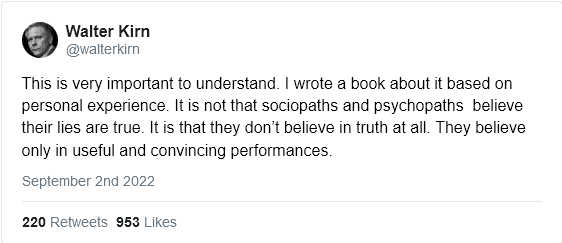
See also this essay from Dr. Robert Yoho, “Guess Who Passes the Psychopath Test?”
Psychopathic lying is successful because normal people do not believe that anyone lies as a routine. Debates with sociopaths are useless. No matter what we say, no matter how much evidence is given, it has no meaning for them. Their sole goal is to fool us into classifying them as normal so they can continue to deceive, control, and use us …
When major positions of power in business, government, industry, and society are filled by sociopaths, a downward spiral begins. The normal people eventually recognize what their leaders are and devise survival strategies.
We’re there, though it’s hard to place “there” on a map. We can see that a significant share of power and status — in politics, in economics, and in culture — belongs to people who have no perception of social rules or moral limits at all. And we see that some lines need to be reimposed, urgently and firmly.
After a few years of, “but these are the experts, right?” it feels like the beginning of the phase in which everybody finally knows the game and the stakes. In this version of the story, the little boy points out that the naked emperor has no soul, and the people begin to notice. And then?
Comments Off on “In this version of the story, the little boy points out that the naked emperor has no soul, and the people begin to notice”
The Tragic Life of Rudyard Kipling
The History Guy: History Deserves to Be Remembered
Published 14 Aug 2019The life of the youngest-ever winner of the Nobel Prize for literature, Rudyard Kipling, was filled with tragedy. He survived a difficult childhood to go on to become one of the most celebrated authors of his day, penning such classics as The Jungle Book and Just So Stories. But only one of his children would survive him and his legacy has been tied to some of his out-dated political beliefs. The History Guy remembers the tragic life of Rudyard Kipling.
(more…)
Comments Off on The Tragic Life of Rudyard Kipling
QotD: Why bureaucracies are inherently slow
The great economist Ludwig von Mises analyzed these tendencies and incentives in his 1944 book Bureaucracy.
In that book, Mises identified “slowness and slackness” as among the inherent features of government bureaucracy that no reform can remove.
We have all experienced the “slowness and slackness” of government bureaucracy: with the post office, the DMV, the public school system, etc. That’s why the animated movie Zootopia had sloths working at the DMV and everyone got the joke. And police bureaucracies are no exception to this reputation.
Why is this so? In part, it is due to another indelible feature of bureaucracy: that it is, as Mises wrote, “bound to comply with detailed rules and regulations fixed by the authority of a superior body. The task of the bureaucrat is to perform what these rules and regulations order him to do. His discretion to act according to his own best conviction is seriously restricted by them.”
Sometimes a delay is simply due to the fact that the government employee is too tied up in red tape to respond in a timely manner. The timely response may be outright prohibited by the rules. Or the delay may be owing to Kafkaesque procedural mazes that first must be navigated or chains of command that must be climbed for permission.
[…]
Again, Mises considered such features of bureaucracy to be unreformable. Why? He argued that it is the only way that a government bureaucracy can be made at all accountable to the public. A bureaucrat with a free hand is even more dangerous than a bureaucrat with his hands tied.
“If one assigns to the authorities the power to imprison or even to kill people,” Mises wrote, “one must restrict and clearly circumscribe this power. Otherwise the officeholder or judge would turn into an irresponsible despot.”
Dan Sanchez, “How Bureaucracy May Have Cost Lives in Uvalde”, Foundation for Economic Education, 2022-05-31.
Comments Off on QotD: Why bureaucracies are inherently slow
September 4, 2022
Extreme Ultra-MAGA terrorist Trump voters are endangering “our” democracy!!!1!
Perhaps I exaggerate a tiny bit in my headline … but events here in Clown World metastasize so quickly that parodists and satirists are becoming an endangered species because it’s nearly impossible to come up with more incredibly stupid stuff than the political class do for real:

Over the past couple of weeks, it seems that the Regime has really been ramping up its rhetoric against its political and ideological enemies. In a coordinated rollout, talking heads across the media have been stating that “MAGA Trump voters” are “threats to democracy”, “trying to take away our freedoms”, “stochastic terrorists”, and so forth. This all has been timed to culminate with the pResident himself going on national television to explicitly state that the entire half of the country that didn’t vote for him are mortal enemies of the state. This takes on a somewhat more ominous tone when we remember that just a few days previous, this same pResident essentially threatened to use F-15s to bomb patriotic Americans who believe in the Constitution.
While these could be dismissed as the senile ramblings of a doddering old dementia patient, the thing to keep in mind is that Biden himself is merely a sock puppet. What he says reflects the words put into his mouth by the progressive theatre kids who staff his administration, as well as other elements within the Regime. Indeed, all of the huffinpuffery about how “your hillbilly AR-15 can’t take on tanks and fighter jets hurr durr!!” is basically the sort of thing you’d have heard on Reddit for years. But the fact that official channels are now openly talking about using the military against their own people for mere ideological purposes suggests that there is an acceleration going on in the Left’s subversion of this country.
I’ve said it before and I’ll say it again — if there is to be an open civil war in the USA, it will almost assuredly be instigated and started by the Left. However, it is not one that they are likely to win, for a number of reasons that I will elaborate briefly below. They are ones that I suspect the Regime itself knows, which makes the current trajectory they seem to be setting appear all the more desperate. Common sense would dictate that they should try to keep the repression at just a high enough level to intimidate the citizenry into compliance without actually provoking a broad response, even if not a violent one. Yet, the Left is dynamiting what is left of the social contract because once they’ve got started down this path there’s no stopping.
So briefly, let’s talk about why the Regime would not win a war against Red America, despite the hopes and expectations of thousands of redditards across the country. First and foremost there is the unreliability (from the Regime’s perspective) of the current military. Simply put, most military personnel below the O-4 or O-5 levels are not ideologically indoctrinated into woke progressivism and are unlikely to be willing to wage war on their own countrymen. They’re especially not likely to go along with wokester fever dreams of bombing Red cities into oblivion and turning the heartland into ashes just to stick it to those Trumpsters. So there would be deep fractures, mutinies, fragging incidents galore.
Of course, that’s why the Regime is trying to wokify the military to be more ideologically compatible with the Left. In a sense, for the Left the drastic recruiting shortfall that the military is currently experiencing is a feature, not a bug, since it provides them with the justification to make up the difference by recruiting foreigners with no connexion to the American people (and thus no compunctions about shooting at them). Which then introduces a further competency factor in that when you recruit a third world army, you … have a third world army, so you’re sacrificing competency for reliability. Nevertheless, as it currently stands most enlisted men and lower-level officers are not going to be inclined to incinerate their buddy’s parents for believing in the second amendment.
As Severian posted right after the “Triumph of the Shrill” speech by Biden:
I’d like to address the “they’re going in for the kill” argument, eloquently argued by MBlanc46 and others. I agree, there is exactly as much, if not more, evidence for this thesis then there is for my “they’re panicking” thesis. And whatever else they thought Brandon was doing last night, there’s definitely a “throw down the gauntlet” aspect to it.
The reason I favor “panic” over “going in for the kill” is that as hard as it is to believe, the Left always see themselves as the heroic underdog, struggling against a rigged system. Even when they’re throwing you into boxcars, they’re bewailing the fact — and in what passes for their minds it IS a fact — that you forced them to do it.
They cry out in pain as they strike you, as another demented shitbag collectivist said about a different group in an eerily similar context.
What all this — Biden’s big “My Struggle” speech (hereafter to be known, as Mmack put it, as “the Triumph of the Shrill”), the hiring of a zillion new IRS agents, the works — is designed to do is: provoke a reaction. To put it bluntly, there is no “domestic extremism”. Of course there really are some retards out there doing retard shit, but as we all know, the typical “Klan” meeting is an ATF agent trying to entrap a DEA agent who’s trying to entrap an FBI agent who is trying to entrap his own informant. Hello, fellow patriots!
But they keep failing to do roll-the-tanks-level shit. Which is a problem for the Apparat, because the ATF agent can’t get permission from the DEA to provide enough guns to the FBI agent to really kick things off (not least because he’s going to be foiled by the other undercover FBI agent who’s trying to entrap the other DEA agent and so on).
So they just keep upping the ante, hoping that maybe this time, finally, somebody will do a terrorism.
If they’re confident enough to put Brandon in a Darth Vader suit on national TV, in other words, they long ago passed the point where anyone not crippled by the psychological compulsion to see himself as a victim would’ve said “fuck it, drop the hammer”. We wore diapers on our faces for two fucking years, for Christ’s sake, and shot ourselves up with mystery goop because the same evil little goblin who turned AIDS from an easily containable plague of deviants into a legit public health crisis told us to.
Comments Off on Extreme Ultra-MAGA terrorist Trump voters are endangering “our” democracy!!!1!
The War is Four Years Old this week – WW2 – 210 – September 2, 1943
World War Two
Published 3 Sep 2022Four years of war and no real end in sight, but as the week ends the Allies land their first troops on Italy, actively committing themselves to a front in Western Europe. In the USSR the Soviets are taking heavy casualties but still pushing back the enemy with big partisan help and in Pacific plans are made for offensive against yet more Japanese held islands.
(more…)
Comments Off on The War is Four Years Old this week – WW2 – 210 – September 2, 1943
Who was reading during Plague Year Two, and what format did they prefer?
In the latest edition of the SHuSH newsletter, Kenneth Whyte summarizes some of the findings of the most recent Booknet survey:

H/T to Marc Adkins who shared this meme at the perfect moment for me to steal it, file off the serial number and repost it here.
A few months ago, BookNet Canada, which does a lot of valuable research into the book market, released the 2021 edition of its annual survey of Canadian leisure and reading habits. It’s always an interesting study. I was slow getting to it this year because there’s been so much else going on. Here are the ten most interesting findings.
- Canadians have had plenty of time on their hands: 81 per cent report having enough or more than enough leisure. Pre-COVID, about 25 per cent of respondents said they had more-than-enough; during COVID, that jumped to about 35 per cent. The pandemic wasn’t all bad.
- Canadians read books more than they listen to radio or play video games but less than they shop or cook; 42 per cent of us (led by 58 per cent of the 65-plus crowd) read books daily; 35 per cent of the 18-29 age group read daily and 57 per cent of that cohort read at least once a week. Young people are no more likely to read books less than once a month than any other under-65 segment, which bodes well for the future of the industry.
- The statement “books are for enjoyment, entertainment, or leisure” received a ‘yes’ from 62 per cent of respondents, and a ‘sometimes’ from 34 per cent; the statement “books are for learning or education” received a ‘yes’ from 41 per cent of respondents and a ‘sometimes’ from 50 per cent.
- The top reasons for selecting a book to read are the author (40 per cent), the book’s description (30 per cent), recommendations (25 per cent), the main character or the series (20 per cent), its bestselling status (14 per cent), and reference needs (13 per cent). “Recommendations and the impact of bestseller lists have trended down from 2019 to 2021.”
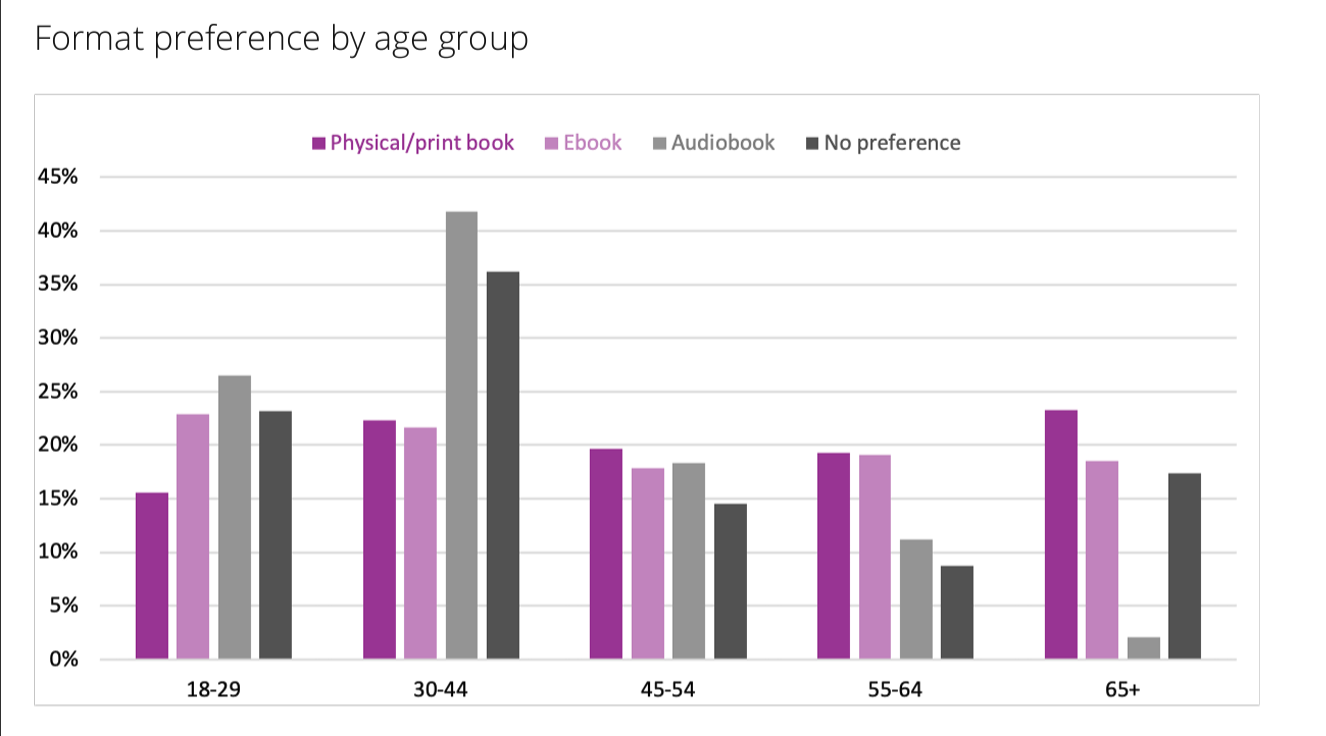
- The love affair with print continues with 68 per cent of readers citing hard copies as their preferred format. Ebooks came in at 16 per cent and audiobooks at 10 per cent Interestingly, readers had a marked preference for paperbacks over hardcovers. Format preferences differ from age group to age group, with some evidence that the kids might not be keen on physical books:
I was interested in that apparent rejection of physical books by the 18-29 cohort so I looked back at the last two years of the survey […] The results are quite different, suggesting a methodological shortcoming (the survey sample is 1,282 adults so the margin of error will be large when you eliminate those who don’t read a given format, those without format preferences, and break the remainder down into five age groups).
Comments Off on Who was reading during Plague Year Two, and what format did they prefer?
Experimental Primer-Actuated Semiauto Springfield 1903
Forgotten Weapons
Published 3 Sep 2016During the 1920s, a lot of experimental rifle development work was being done in the US. The military was interested in finding a semi-automatic rifle, and plenty of inventors were eager to get that valuable military contract. One particular item of interest to the military was the possibility of being able to convert large existing stockpiles of bolt-action 1903 Springfield rifles into semi-automatics, and that is what this particular example was an attempt at.
This rifle is built with a barrel and receiver made in 1921 (it was not uncommon for the government to provide parts to inventors working in this area), and uses an operating system which is pretty much unheard of today: primer actuation. In this system, the primer pushes back out of the cartridge case (intentionally) upon firing, acting as a small piston. This pushes the firing pin backwards (as well as the bolt face in this rifle), which begins the process of unlocking and cycling. It is a system that saw some popularity for a brief time in the 20s, as it allowed semi-automatic action without the need for a drilled gas port or a moving barrel — several of John Garand’s early prototypes operated this way. However, substandard performance and the need for special ammunition (most military ammunition had primers solidly crimped in place) led to its abandonment.
(more…)
Comments Off on Experimental Primer-Actuated Semiauto Springfield 1903
QotD: Sparta’s fatal problem – oliganthropia
This is is the problem of oliganthropia (“people-shortage” – literally “too-few-people-ness”) in Sparta: the decline of the spartiate population. This is a huge and contentious area of scholarship – no surprise, since it directly concerns the decline of one of the more powerful states in Classical Greece – with a fair bit of debate to it (there’s a decent rundown by Figueira of the demography behind it available online here). What I want to note here is that a phrase like “oliganthropia” makes it sound like there was an absolute decline in population, but the evidence argues against that. At two junctures in the third century, under Agis IV and then later Cleomenes III (so around 241 and 227) attempts were made to revive Sparta by pulling thousands of members of the underclass back up into the spartiates (the first effort fails and the second effort was around a century too late to matter). That, of course, means that there were thousands of individuals – presumably mostly hypomeiones, but perhaps some mothakes or perioikoi – around to be so considered.
Xenophon says as much with Cinadon’s observation about the market at Sparta. Now obviously, we can’t take that statement as a demographic survey, but as a general sense, 40 homoioi, plus a handful of higher figures, in a crowd of 4,000 speaks volumes about the growth of Sparta’s underclass. And that is in Laconia, the region of the Spartan state (in contrast to Messenia, the other half of Sparta’s territory), where the Spartans live and where the density of helots is lowest.
This isn’t a decline in the population of Sparta, merely a decline in the population of spartiates – the tiny, closed class of citizen-elites at the top.
So we come back to the standard assertion about Sparta: its system lasted a long time, maintaining very high cohesion – at least among the citizens class and its descendants. This is a terribly low bar – a society cohesive only among its tiny aristocracy. And yet, as low of a bar as this is, Sparta still manages to slink below it. Economic cohesion was a mirage created by the exclusion of any individual who fell below it. Sparta maintained the illusion of cohesion by systematically removing anyone who was not wealthy from the citizen body.
If we really want to gauge this society’s cohesion, we ought to track households, one generation after the next, regardless of changes in status. If we do that, what do we find? A society with an increasingly tiny elite – and a majority which, I will again quote Xenophon, “would eat them raw“. Hardly a model of social cohesion.
Moreover, this system wasn’t that stable. The core labor force – the enslaved helots – are brutally subjugated by Sparta no earlier than 680 (even this is overly generous – the consolidation process in Messenia seems to have continued into the 500s). The austerity which supposedly underlined cohesion among the spartiates by banishing overt displays of wealth is only visible archaeologically beginning in 550, which may mark the real beginning of the Spartan system as a complete unit with all of its parts functioning. And by 464 – scarcely a century later – terminal and irreversible decline had set in. Spartan power at last breaks permanently and irretrievably in 371 when Messenia is lost to them […]
This is a system that at the most generous possible reading, lasted three centuries. In practice, we are probably better in saying it lasts just 170 or so – from c. 550 (the completion of the consolidation of Messenia, and the beginning of both the Peloponnesian League and the famed Spartan austerity) to 371.
To modern ears, 170 years still sounds impressive. Compared to the remarkably unstable internal politics of Greek poleis, it probably seemed so. But we are not ancient Greeks – we have a wider frame of reference. The Roman Republic ticked on, making one compromise after another, for four centuries (509 to 133; Roman enthusiasts will note that I have cut that ending date quite early) before it even began its spiral into violence. Carthage’s republic was about as long lived as Rome. We might date constitutional monarchy in Britain as beginning in 1688 or perhaps 1721 – that system has managed around 300 years.
While we’re here – although it was interrupted briefly, the bracket dates for the notoriously unstable Athenian democracy, usually dated from the Cleisthenic reforms 508/7 to the suppresion of the fourth-century democracy in 322, are actually longer, 185 years, give or take, with just two major breaks, consisting of just four months and one year. Sparta had more years with major, active helot revolts controlling significant territory than Athens had oligarchic coups. And yet Athens – rightly, I’d argue – has a reputation for chronic instability, while Sparta has a reputation for placid regularity. Might I suggest that stable regimes do not suffer repeated, existential slave revolts?
In short, the Spartan social system ought not be described as cohesive, and while it was relatively stable by Greek standards (not a high bar!) it is hardly exceptionally stable and certainly not uniquely so. So much for cohesion and stability.
Bret Devereaux, “Collections: This. Isn’t. Sparta. Part IV: Spartan Wealth”, A Collection of Unmitigated Pedantry, 2019-08-29.
Comments Off on QotD: Sparta’s fatal problem – oliganthropia
September 3, 2022
Theodore Dalrymple on snobbery
In the New English Review, Theodore Dalrymple considers the various forms of snobbery:
“Snob” by Oldmaison is licensed under CC BY-SA 2.0 

 .
.
Snobbery is the feeling of social superiority on the grounds of some quality over which the person believed to be inferior has little or no personal control, such as birthplace or parenthood. If this feeling is conspicuously displayed rather than merely felt, it is likely to provoke furious resentment, far more so than actual injustice. Disdain causes the rawest of wounds, which seldom heal. That is why people who triumph over snobbery in practice nevertheless often retain within themselves a strong core of resentment toward those of the type (not necessarily the actual individuals) who formerly disdained them. And this resentment often impels them to do seemingly self-destructive things.
In human affairs, it is seldom that there are clear-cut boundaries, so that it is not surprising that snobbery can shade into justified disdain or condemnation, at least for certain kinds of behavior if not for the human beings who display it. Those kinds of behavior are not equally distributed in all social groups, so that it is easy to transfer the disdain from the behavior to the social group itself, and assume that a member of that group will, ex officio, behave in the reprehended fashion.
It is probable that intellectual and aesthetic snobbery are now more prevalent than the more traditional forms that attach to place of birth and parentage. Many of us are appalled by the tastes and interests of others and secretly, and not so secretly, congratulate ourselves on our superiority to them. I am far from immune myself from such feelings. I have to control myself not so much in my outer behavior—that is a relatively easy thing to do — but in my inner feeling, that is to say to limit my own feelings of superiority to the people whose tastes I despise. After all, there is more to people than their tastes or enthusiasms, and I have never talked to anybody who struck me as anything other than an individual. Just as we are enjoined to hate the sin but not the sinner, so we have to try to dislike the bad taste but not the person who displays it. This requires the overriding of emotion by conscious thought and self-control.
The fear of appearing snobbish also has its deformations, as does inverted snobbery. The latter is harmful because it undermines aspiration to anything better or higher than that which the inverted snob already knows or likes. Inverted snobs sneer at what they sense instinctively to be above them, calling it pretentious and elitist. Incidentally, the word elitist is often misused or elided with social exclusivity. Not even the most anti-elitist of persons objects to the elitist selection of sports teams on the basis of superior performance and ability of players, nor does anyone object to being operated on by the best surgeon available, so that only if sport, and to a lesser extent surgery, is of such importance that it is an exception to the necessary suppression of elitism can this exception be justified.
Fear of appearing snobbish is harmful because it threatens the willingness to make judgments between the better and worse; and since the worse is always easier to produce, it contributes to a general decline in the quality of whatever is produced. This fear of appearing snobbish and therefore undemocratic is now very strong and pervades even universities (so I am told), in which one might have supposed that elitism, in the sense of a striving for the best that has been said and thought, would be de rigueur.
One of the forms that snobbery now commonly takes is disdain of simple, repetitive, and unskilled jobs (which are generally ill-paid as well). The educated can imagine no worse fate than to be employed in such a job, no matter how necessary or socially useful it might be — the person at the supermarket checkout (increasingly redundant, of course) being the emblematic example. With a singular lack of imagination and sense of reality about their fellow creatures, they simply put themselves in the place of these people and imagine thereby that they are being empathic. But of course there are people for whom such jobs are not unpleasant and are even rewarding. Not everyone wants to be, or is capable of being, a master of the universe.
Comments Off on Theodore Dalrymple on snobbery
The Byzantine Empire: Part 1 – Beginnings
seangabb
Published 1 Oct 2021Between 330 AD and 1453, Constantinople (modern Istanbul) was the capital of the Roman Empire, otherwise known as the Later Roman Empire, the Eastern Roman Empire, the Mediaeval Roman Empire, or The Byzantine Empire. For most of this time, it was the largest and richest city in Christendom. The territories of which it was the central capital enjoyed better protections of life, liberty and property, and a higher standard of living, than any other Christian territory, and usually compared favourably with the neighbouring and rival Islamic empires.
The purpose of this course is to give an overview of Byzantine history, from the refoundation of the City by Constantine the Great to its final capture by the Turks.
Here is a series of lectures given by Sean Gabb in late 2021, in which he discusses and tries to explain the history of Byzantium. For reasons of politeness and data protection, all student contributions have been removed.
(more…)
Comments Off on The Byzantine Empire: Part 1 – Beginnings
The impact of the first wave of globalization
In the latest Age of Invention newsletter, Anton Howes considers the world in terms of trade before and after the transportation revolution which changed long-distance trade from primarily luxury goods to commodities for the mass market:

Long-distance trade has of course been common since ancient times. Archaeologists often find Byzantine-made glassware from the sixth century all the way out in India, China, and even Japan. Or beads from seventh-century Southeast Asia all the way out in Libya, Spain, and even Britain. Yet such long-distance trades often involved goods that were entirely unique to particular areas — gems, spices, indigo, coffee, tea — or were sufficiently valuable to make the high costs of transportation worthwhile, such as expert-made glassware, silks, and muslin cloths with impossibly high thread counts. Long-distance trade may have been ancient but was restricted to luxuries. It did not involve the everyday goods of life.
That all changed, however, when the innovations of the sixteenth to the nineteenth centuries caused transportation costs to dramatically fall. With better sailing ships, canals, and navigational techniques, followed by better roads, railways, refrigeration, steam power, and dynamite (which meant railways could cross mountain ranges, canals could link oceans, and new deep-water ports could be dug), it was soon profitable to transport even the cheapest and bulkiest of goods over vast distances — goods like meat, coal, and grain.
The entire world was brought into a single market, in which even the bulkiest commodities of each continent were suddenly in direct competition with one another. The decisions of farmers in Ukraine, for example, in the nineteenth century came to affect the farmers in America, China, India, or even Australia, and all of them vice versa. The prices of commodities all over the world thus converged to similar levels, falling in some places, but rising in the economies that had previously been too distant from the ready markets of the industrialised nations.
The result was what economic historians call a terms-of-trade boom, with the more agrarian economies’ commodity exports becoming more valuable relative to manufactured imports. Thus, their grain, raw fibres, minerals, and ores suddenly bought many more foreign manufactures like textiles. Countries that specialised in commodities thus specialised even further, devoting even more of their workers, resources and capital to extracting them. They were incentivised to extend their frontiers — to put more of the wilderness under pasture or plough, and to dig deeper for the mineral wealth beneath their feet.
Meanwhile, for the industrial economies, the opposite happened. By gaining access to many more and cheaper sources of raw resources and food, they were able to make their own manufactured exports cheaper too. And this, in turn, further exacerbated the terms-of-trade boom among their newly globalised commodity suppliers. As the great Saint-Lucian economist Sir W. Arthur Lewis put it, the world in the late nineteenth century separated into an increasingly industrialised “core”, fed by an increasingly farming- and mining-focused “periphery”.
Much has changed in the century that followed, and some of the old core/periphery distinctions have moved or entirely broken down. But the world has remained globalised. Even in periods of higher tariffs, like between the world wars, no amount of protectionism was able to counteract or undo the effects of the dramatic drop in global transportation costs. With the advent of telegraphs, telephones, fax machines, and now the Internet, even many services are becoming globalised as well — a process likely sped up by the pandemic. Those who can easily work from home will increasingly, like nineteenth-century workers the world over, find themselves either the victims or beneficiaries of global price convergence. (Incidentally, I’m not convinced that the very services-heavy economies of Europe or North America are even remotely prepared for this, to the extent that they can prepare at all for what is the economic equivalent of a planetary-scale force of nature.)
Comments Off on The impact of the first wave of globalization


