
Epic History TV
Published 28 Sep 2018Napoleon brings his war against Russia and Prussia to an end with victory at Friedland, leading to the famous Tilsit conference, after which Napoleon stood at the peak of his power.
(more…)
September 3, 2022
Napoleon Defeats Russia: Friedland 1807
Comments Off on Napoleon Defeats Russia: Friedland 1807
QotD: The Severian Corollary to Hanlon’s Razor
Y’all are doubtless familiar with “Hanlon’s Razor”:
Never attribute to malice that which is adequately explained by stupidity.
A while back I wrote that this needs an update, and being a humble guy, I named it the “Severian Corollary”:
There’s a level of stupidity so profound, you actually hope it’s malice.
Severian, “Quick Take: The Severian Corollary”, Rotten Chestnuts, 2019-07-31.
Comments Off on QotD: The Severian Corollary to Hanlon’s Razor
September 2, 2022
The winner in 1932 campaigned against high taxes, big government, and more debt. Then he turned all those up to 11
At the Foundation for Economic Education, Lawrence W. Reed notes that we often get the opposite of what we vote for, and perhaps the best example of that was the 1932 presidential campaign between high-taxing, big-spending, government-expanding Republican Herbert Hoover and Franklin Delano Roosevelt, who ran against all of Hoover’s excesses … until inauguration day, anyway:
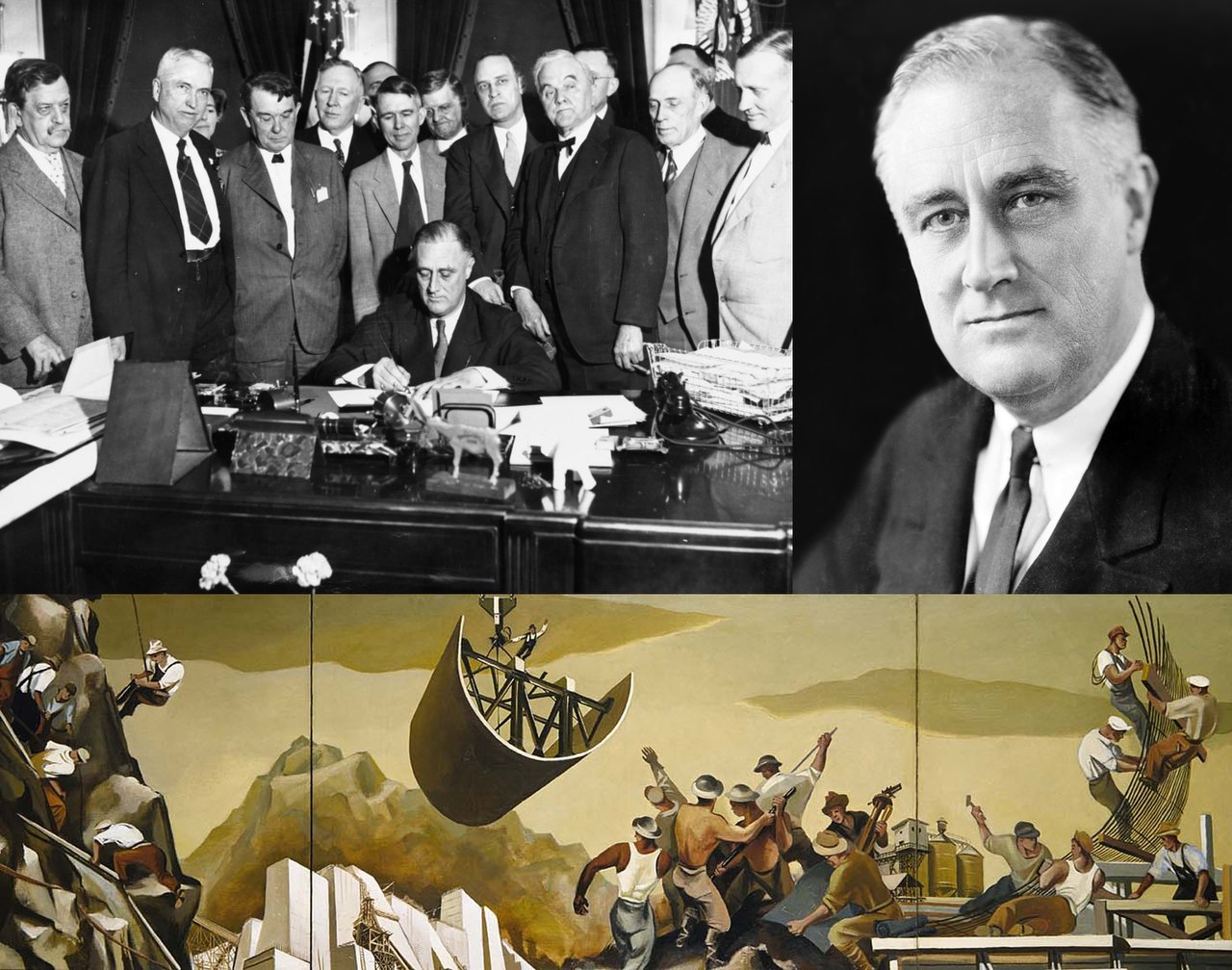
Top left: The Tennessee Valley Authority, part of the New Deal, being signed into law in 1933.
Top right: FDR (President Franklin Delano Roosevelt) was responsible for the New Deal.
Bottom: A public mural from one of the artists employed by the New Deal’s WPA program.
Wikimedia Commons.
If you were a socialist (or a modern “liberal” or “progressive”) in 1932, you faced an embarrassment of riches at the ballot box. You could go for Norman Thomas. Or perhaps Verne Reynolds of the Socialist Labor Party. Or William Foster of the Communist Party. Maybe Jacob Coxey of the Farmer-Labor Party or even William Upshaw of the Prohibition Party. You could have voted for Hoover who, after all, had delivered sky-high tax rates, big deficits, lots of debt, higher spending, and trade-choking tariffs in his four-year term. Roosevelt’s own running mate, John Nance Garner of Texas, declared that Republican Hoover was “taking the country down the path to socialism”.
Journalist H.L. Mencken famously noted that “Every election is a sort of advance auction sale of stolen goods.” If you agreed with Mencken and preferred a non-socialist candidate who promised to get government off your back and out of your pocket in 1932, Franklin Roosevelt was your man — that is, until March 1933 when he assumed office and took a sharp turn in the other direction.
The platform on which Roosevelt ran that year denounced the incumbent administration for its reckless growth of government. The Democrats promised no less than a 25 percent reduction in federal spending if elected.
Roosevelt accused Hoover of governing as though, in FDR’s words, “we ought to center control of everything in Washington as rapidly as possible.” On September 29 in Iowa, the Democrat presidential nominee blasted Hooverism in these terms:
I accuse the present Administration of being the greatest spending Administration in peace times in all our history. It is an Administration that has piled bureau on bureau, commission on commission, and has failed to anticipate the dire needs and the reduced earning power of the people. Bureaus and bureaucrats, commissions and commissioners have been retained at the expense of the taxpayer.
Now, I read in the past few days in the newspapers that the President is at work on a plan to consolidate and simplify the Federal bureaucracy. My friends, four long years ago, in the campaign of 1928, he, as a candidate, proposed to do this same thing. And today, once more a candidate, he is still proposing, and I leave you to draw your own inferences. And on my part, I ask you very simply to assign to me the task of reducing the annual operating expenses of your national government.
Once in the White House, he did no such thing. He doubled federal spending in his first term. New “alphabet agencies” were added to the bureaucracy. Nothing of any consequence in the budget was either cut or made more efficient. He gave us our booze back by ending Prohibition, but then embarked upon a spending spree that any drunk with your wallet would envy. Taxes went up in FDR’s administration, not down as he had promised.
Don’t take my word for it. It’s all a matter of public record even if your teacher or professor never told you any of this. For details, I recommend these books: Burton Folsom’s New Deal or Raw Deal; Murray Rothbard’s America’s Great Depression; my own Great Myths of the Great Depression; and the two I want to tell you about now, John T. Flynn’s As We Go Marching and The Roosevelt Myth.
For every thousand books written, perhaps one may come to enjoy the appellation “classic”. That label is reserved for a volume that through the force of its originality and thoroughness, shifts paradigms and serves as a timeless, indispensable source of insight.
Such a book is The Roosevelt Myth. First published in 1948, Flynn’s definitive analysis of America’s 32nd president is arguably the best and most thoroughly documented chronicle of the person and politics of Franklin Delano Roosevelt. Flynn’s 1944 book, As We Go Marching, focuses on the fascist-style economic planning during World War II and is very illuminating as well.
Comments Off on The winner in 1932 campaigned against high taxes, big government, and more debt. Then he turned all those up to 11
Alliance For Peace (1951) North Atlantic Treaty Organization Promo Film
PeriscopeFilm
Published 14 May 202sProduced by NATO and the Signal Photographic Service of the U.S. Army, this black & white film is about the formation of NATO and its importance in the defense of the free world. Copyright 1951. The film features a score by William Alwyn. The film dates from the time when Gen. Dwight Eisenhower was supreme commander of NATO (1950-52), a post he left in order to run for President of the United States.
(more…)
Comments Off on Alliance For Peace (1951) North Atlantic Treaty Organization Promo Film
US Navy to get its very own Zampolit cadre
CDR Salamander reports on the latest politically correct doings at the US Naval Academy, which he points out always filter down to the active duty fleet, both good and bad … and I don’t think he considers this particular initiative to be a good one:

The quasi-woke religion as promoted by the CNO provided all the supporting fires they needed and the commissariat decided to make hay while the sun shines.
You know the drill.
Do you want Political Officers, USNA’s own Zampolit? You’ll get them.
Want blue and gold Red Guards? You’re going to have them.
You want red in tooth and claw racism, quotas, and different standards based on self-identified racial groups? You’re going to have more of it.
First let’s pull some nice bits from the governing document; COMDTMIDNINST 1500.5, the “Diversity Education Program” from February of this year. You can read it at the link, or below the pull quotes;
BEHOLD!
1. Purpose. To provide guidance and designate responsibilities for implementation of the Diversity Peer Educator (DPE) Program.
…
b. DPEs support moral development at USNA by facilitating small group conversations that educate and inform midshipmen, faculty, and staff and foster a culture of inclusion across the Yard, resulting in cohesive teams ready to exert maximal performance and win the Naval service’s battles.
I’m not sure you could get more Orwellian … but they’re going to try;
4. Responsibilities
a. USNA Chief Diversity Officer. The Chief Diversity Officer is the final approving authority for all matters pertaining to the DPE Program and will ensure the program is in line with Department of the Navy and Superintendent’s guidance in reference (a).
a. DPE Program Manager. The program manager for DPE is an active-duty officer appointed by the Chief Diversity Officer. Faculty/staff from the Stockdale Center for Ethical Leadership, the Naval Academy Athletic Association (NAAA), or other cost-centers on the Yard will aid the program manager.
Yes, the football booster organization will “help” the Zampolits. Huh. You see that, yes? Pull that thread …
c. Brigade Dignity and Respect Officer. Reference (c) delineates the roles and responsibilities of the Brigade Dignity and Respect Officer (BDRO) who is accountable for the training, development, and qualification of the DPEs. However, the DPEs are organized and managed by the Midshipman DPE Lead.
d. Midshipmen DPE Lead. A midshipman selected annually by the DPE Program Manager and confirmed by the USNA Chief Diversity Officer. The Midshipmen DPE Lead is typically a First Class Midshipman. Responsibilities include:
(1) Work with the DPE Program Manager to ensure the mission of the program is met.
(2) Provide feedback and keep the DPE Program Manager informed regarding anything that may impact the DPE program.
(3) Serve as the senior DPE, and as the program representative to the BDRO.
(4) Lead and provide guidance to the DPE Midshipmen.
(5) Appoint and manage DPE leads in each battalion, company, varsity athletic team and club sport team.I’ll let you do the math on how many bodies “each” means. That is a lot of Zampolits. I guess MIDN have a lot of extra time.
Again, I want you to ponder the opportunity cost of this across USNA and how it relates to professional development.
Comments Off on US Navy to get its very own Zampolit cadre
The Paras Last Drop – Gamil Airfield 1956
Mark Felton Productions
Published 18 Apr 2020The last time the Parachute Regiment dropped into combat was during the 1956 Suez Crisis when 3 PARA landed on El Gamil Airfield outside Port Said, Egypt.
(more…)
Comments Off on The Paras Last Drop – Gamil Airfield 1956
QotD: Historical parallels between the British and American empires
England was colonised by the Norman Empire (a tribe that spread across France, Britain, Italy, and the Middle East can be referred to as an empire I believe), in 1066. After some initial fierce resistance, they settled well, integrated with the local economy, and started developing a more advanced economic society.
North America was colonised by the British Empire (and Spanish and French of course), in the sixteenth century. After some initial fierce resistance, they settled well, integrated with the local economy, and started developing a more advanced economic society.
Norman England spent the next few centuries gradually taking out its neighbours. Wales, Ireland, and eventually Scotland (though the fact that the Scottish King James I & VI actually inherited England confuses this concept a bit). The process was fairly violent.
The North American “English” colonies spent the next few centuries taking out their neighbours. Indian tribes, Dutch, Spanish and French colonists, etc. The process was fairly violent.
England fought a number of wars over peripheral areas, particularly the Hundred Years war over claims to lands in France.
The North American colonies enthusiastically joined (if not blatantly incited) the early world wars, with the desire of taking over nearby French and Spanish colonies
The English fought a civil war in the 1640s to 50s over the issue of how to share power between the executive government, the oligarchs, and the commons. It appears that the oligarchs incited the commons (which was not very common in those days anyway). It was extremely bloody, and those on the periphery — particularly the Scots and Irish — came out badly (and with a long term bad taste for their over-mighty neighbour).
The Colonies fought their first civil war over the issue of how to share power between the executive, the oligarchs and the commons in the 1770s to 80s. It is clear that the oligarchs incited the commons (who in the US were still not very common — every male except those Yellow, Red or Black. An improvement? Certainly not considering the theoretical philosophical base of the so-called Revolution!). It was not really so bloody, but those on the periphery — particularly the Indians and slaves (both of which were pro-British), and the Loyalists and Canadians — came out badly. (60-100,000 “citizens” were expelled or forced to flee for being “loyalists”, let alone Indians and ex-slaves). Naturally the Canadians and their new refugee citizens developed a long term bad taste for their over-mighty neighbour — who attempted to attack them at the drop of a hat thereafter.
The British spent the next century and a half accumulating bits of empire — the Dominions, the Crown Colonies, and the Protectorates — in a haphazard fashion. Usually, but not always, troops followed traders and settlers.
The United States spent the next century and a half accumulating bits of empire — conquests from the Indians, purchases from France and Russia, conquests from Mexico and Spain, annexations of places like Hawaii, etc. — in a haphazard fashion. Usually, but not always, troops followed traders and settlers.
Nigel Davies, “The Empires of Britain and the United States – Toying with Historical Analogy”, rethinking history, 2009-01-10.
Comments Off on QotD: Historical parallels between the British and American empires
September 1, 2022
“This rise of non-profits is reminiscent of feudal times, when the rich and powerful donated to the Church to ensure that its message wouldn’t threaten their power”
At UnHerd, Joel Kotkin considers the parallels between Oedipus Rex and the wider political/cultural situation we face in much of the western world:

Amazon’s Jeff Bezos, Microsoft’s Bill Gates, and Berkshire Hathaway’s Warren Buffet.
Fox Business.
As in Sophocles’s tragedy Oedipus Rex, we are witnessing a generational drama in which inheritors kill their proverbial father to marry their mother, in this case Mother Earth. The psychology behind this pattern is above my pay grade, but many of the richest people on the planet, and their heirs, now seem anxious to disparage the economic system that created their fortunes. With few exceptions, the new rich, and particularly their children and ex-wives, embrace a racial, gender and environmental agenda that, while undermining merit and economic growth, still leaves them on top of the heap.
The ideology of the mega-rich will shape our society for the next generation, in large part through philanthropy. The non-profit sector, the primary vehicle for inherited wealth to be laundered into political influence, has been growing rapidly; in the US, non-profits’ assets have grown nine-fold since 1980. In 2020, non-profits brought in $2.62 trillion in revenues, constituting over 5.6% of the US economy. Increasingly, much this money came from the new tech elite: among the most prolific donors were Jeff Bezos and his ex-wife, Mackenzie Scott; Bill Gates and his now-discarded wife, Melinda French Gates; Mark Zuckerberg and his wife, Priscilla Chan; and Laureen Powell Jobs, the Left-leaning publisher of the Atlantic and the widow of Apple’s founder.
This rise of non-profits is reminiscent of feudal times, when the rich and powerful donated to the Church to ensure that its message wouldn’t threaten their power. Indeed, our society is becoming more like the Middle Ages all the time, with entrepreneurial success becoming more difficult and property and wealth becoming ever more concentrated. “Inherited wealth”, notes Thomas Piketty, is making a “comeback”. In the US, according to the consulting firm Accenture, the Silent Generation and Baby Boomers will gift their heirs up to $30 trillion by 2030 and $75 trillion by 2060.
Of course, the use of inherited wealth to push Left-wing causes is nothing new. As Heather Mac Donald demonstrated in 1996, big-money foundations in the US have been bankrolling far-Left politics for several generations. But the rise of the tech oligarchy seems likely to accelerate this move to the gentrified Left. Many of these billionaires are still in their 30s and 40s but have accumulated more cash than anyone since the Gilded Age. And unlike their early 20th-century counterparts, today’s robber-barons — with a few notable exceptions, such as Peter Thiel — are decisively aligned with the Left. In 2020, five of the top eight donors to Joe Biden came from people tied to tech firms.
This is partly explained by Trump’s toxicity, which engendered something of an oligarchical jihad to overthrow a man who was both needlessly crass and potentially threatening to their monopolies. Particularly critical in the 2020 election was the weaponising of the Chan-Zuckerberg Initiative, which poured over $300 million into state and local election administration to stoke turnout. Conservatives claim, with some justification, that these efforts were concentrated in highly Democratic areas of swing states, and therefore may have tilted the outcome. But what is beyond question is that Zuckerberg and the others participated in what Time — owned by yet another oligarch, Marc Benioff, co-founder of Salesforce.com — gleefully described as “a conspiracy unfolding behind the scenes”.
Comments Off on “This rise of non-profits is reminiscent of feudal times, when the rich and powerful donated to the Church to ensure that its message wouldn’t threaten their power”
The Royal Marines at War: Commando – The Story of the Green Beret (1945)
Royal Marines
Published 31 Aug 2012Commando, made for the Admiralty in 1945, is a drama-documentary covering Commando training in Wrexham, Anchnacarry and St. Ives. Fascinating archive footage shows wartime Commando units on amphibious assault exercises, perfecting cliff-top assaults and practicing both armed and unarmed combat techniques.
Comments Off on The Royal Marines at War: Commando – The Story of the Green Beret (1945)
Rotherham Borough Council proudly announces they will be the first “Children’s Capital of Culture”
Honest to God, you can’t parody the real world harder than it parodies itself:

The news that the South Yorkshire market town of Rotherham would be the world’s first “Children’s Capital of Culture” in 2025 has been greeted by many as some kind of sick joke.
Rotherham is at the heart of England’s group-based child sexual exploitation crisis. In 2012, The Times revealed that a confidential 2010 police report had warned that vast numbers of underaged girls were being sexually exploited in South Yorkshire each year by organised networks of men “largely of Pakistani heritage”. South Yorkshire Police and local child-protection agencies were shown to have knowledge of widespread, organised child sexual abuse — but failed to act on this on-the-ground intelligence.
Rotherham borough council, South Yorkshire Police and other public agencies responded by setting up a team of specialists to investigate the reports. In 2013, an independent inquiry spearheaded by Professor Alexis Jay was launched. Her subsequent report into child sexual exploitation in Rotherham, published in 2014, made for awfully grim reading. It found that at least 1,400 children had been subjected to appalling forms of group-based sexual exploitation between 1997 and 2013. The report detailed how girls as young as eleven years of age — either in Year 6 or Year 7 of school — had been intimidated, trafficked, abducted, beaten and raped by men predominantly of Pakistani heritage.
Jay was also deeply critical of the institutional failures that had allowed organised child sexual abuse to flourish in Rotherham. The report concluded that there had been “blatant” collective failures on the part, firstly, of the local council, which consistently downplayed the scale of the problem; and secondly, on the part of South Yorkshire Police, which failed to prioritise investigating the abuse allegations. Indeed, the Jay Report found that the police had “regarded many child victims with contempt”. The inquiry discovered cases involving “children who had been doused in petrol and threatened with being set alight, threatened with guns, made to witness brutally violent rapes and threatened they would be next if they told anyone”. One young person told the inquiry that gang rape was a normal part of growing up in Rotherham. Just let that sink in — groups of adult-male rapists preying on vulnerable girls was normalised in an English minster town.
The Jay Report also took the local authorities to task for elevating concerns about racial sensitivities over the protection of the children in their care — an all-too-familiar element of the nationwide grooming-gangs scandal in England. As the Jay Report put it: “Several [council] staff described their nervousness about identifying the ethnic origins of perpetrators for fear of being thought as racist; others remembered clear direction from their managers not to do so”.
The safety and protection of the most vulnerable girls in society was sacrificed on the altar of state-backed multiculturalism and diversity politics. A recent report published after a series of investigations carried out by the Independent Office for Police Conduct (IOPC) under “Operation Linden”, found there were “systemic problems” within South Yorkshire Police that meant “like other agencies in Rotherham … it was simply not equipped to deal with the abuse and organised grooming of young girls on the scale we encountered”. South Yorkshire Police recently landed itself in further hot water after it was revealed by The Times that the police force was failing to routinely record the ethnic background of suspected child sexual abusers. For Rotherham, suspect ethnicity was missing for two in three cases.
Comments Off on Rotherham Borough Council proudly announces they will be the first “Children’s Capital of Culture”
Rheinmetall MG42/59: The Slow-Fire Commercial MG42
Forgotten Weapons
Published 4 May 2022After World War Two, when West Germany was allowed to reconstitute its army and join NATO, it needed small arms. The new Bundeswehr chose the MG42 as its standard GPMG, and the Rheinmetall firm undertook the project of recreating the technical data package to build them. The work was completed in 1958, and the company began making new MG42s in 7.62 NATO for the commercial export market as well as for the Bundeswehr (which designated the gun the MG1). Rheinmetall made a number of iterative improvements to the design, including nearly doubling the bolt weight (from 550g/1.2lb to 950g/2.1lb) for their MG42/59 model to bring the rate of fire down to a reasonable 700-900 rpm. The bolt (and its associated heavy buffer) was not adopted by the Bundeswehr, but was bought by other clients.
The MG42/59 also includes many of the other upgrades that would be implemented on the final MG3 version adopted by the military. These include:
– Top cover hinge that holds the cover in a raised position
– Feed tray to mount modern belt boxes and prevent belts from falling out when opened
– Integrated AA rear sight
– New muzzle booster designThis particular one is a beautiful example made in 1964 and brought to the US early enough to be a registered, transferrable, C&R piece.
(more…)
Comments Off on Rheinmetall MG42/59: The Slow-Fire Commercial MG42
QotD: The origins of the Bloody Mary
All the best bars serve Bloody Marys. But the best Bloody Mary is served in The Grenadier, the one-time officers’ mess of the Foot Guards and the long-time public house in Wilton Row, Belgravia. Pass beneath the low lintel of this tiny tavern, pick your way through the crowded tap room and press up against the burr mahogany bar to order the world’s premier pick-me-up.
[…]
The Grenadier is rightly proud of its reputation for restorative remedies and particularly this one. Into the glass go vodka, and a sizeable slug (preferably Stolichnaya), a stirrup of sherry (the secret weapon), tomato juice, then spices (Tabasco and Worcestershire sauce), citron (lemon or lime) and salt to personal taste. The addition of a celery stick is entirely superfluous but for those in search of their hair of the dog, a little light salad I suppose is a help — of sorts.
Yet this pub, though an historic watering hole, cannot claim to be the home of the Mary. That right is retained across the Channel in Paris by Harry’s New York Bar. There exactly a century ago in the City of Light, Fernand Petiot, perfected his “bucket of blood”. The name was soon changed to something a little less Madame la Guillotine and the Mary as we know it was born.
Christopher Pincher, “Hail Mary”, The Critic, 2022-05-30.
Comments Off on QotD: The origins of the Bloody Mary
August 31, 2022
Tank Chats #153 | Jagdpanther | The Tank Museum
The Tank Museum
Published 6 May 2022Discover the origins of Jagdpanther with Curator David Willey and learn more about this German tank destroyer.
(more…)
Comments Off on Tank Chats #153 | Jagdpanther | The Tank Museum
QotD: John Keegan’s The Face of Battle
Keegan’s first battle is Agincourt (1415). While famous for the place of the English longbow in it, at Agincourt the French advance (both mounted and dismounted) did reach the English lines; of this the sources for the battle are quite clear. And so the terror we are discussing is the terror of shock; not shock in the sense of a sudden shock or in the sense of a jolt of electricity, rather shock as the opposite of fire. Shock combat is the combat when two bodies of soldiers press into each other in mass hand-to-hand combat (which is, contrary to Hollywood, not so much a disorganized melee as a series of combats along the line of contact where the two formations meet). The advancing French had to will themselves forward into a terrifying shock encounter, while the English had to (like our hoplites above) hold themselves in place while watching the terrifying prospect of a shock engagement walk steadily towards them.
There is actually quite a bit of evidence that the terror of a shock engagement is something different from the other terrors of war (to be clear, not “better” or “worse”, merely different in important ways). There are numerous examples of units which could stand for extend periods under fire but which collapsed almost immediately at the potential of a shock engagement. To draw a much more recent example, at Bai Beche in 2001, a force of Taliban withstood two days of heavy bombing and had repulsed an infantry assault besides, but collapsed almost immediately when successfully surprised by a cavalry charge (yes, in 2001) in their rear (an incident noted in S. Biddle, “Afghanistan and the Future of Warfare”, Foreign Affairs 82.2 (2003)).
And so our sources for state-on-state pre-gunpowder warfare (which is where you tend to find more fully “shock” oriented combat systems) stress similar sequences of fear: the dread inspired by the sight of the enemy army drawing up before you (Greek literature is particularly replete with descriptions of teeth-chattering and trembling in those moments and it is not hard to imagine why), followed by the steady dread-anticipation as the armies advanced, each step bringing that moment of collision closer. Often in such engagements one side might break before contact as the fear not of what was happening, but what was about to happen built up. And only then the long anticipated not-so-sudden shock of the formations coming together – rarely for long given the overpowering human urge not to be near an enemy trying to stab you with a sharp stick. There is something, I think, quite fundamental in the human psyche that understands another human with a sharp point, or a huge horse rapidly closing on a deeper level than it understands bullets or arrows.
Which brings us to Keegan’s second battle, Waterloo (1815), defined in part by the ability of the British to manage to hold firm under extended fire from artillery and infantry. The French artillery in an 80-gun grand battery opened fire at 11:50am and kept it up for hours until the French cavalry advanced (hoping that the British troops were suitably “softened” by the guns to be dislodged) at 4pm. In contrast to Agincourt (or a hoplite battle) which may have ended in just a couple of hours and consisted mostly of grim anticipation, soldiers (on both sides) at Waterloo were forced to experience a rather different sort of terror: forced to stand in active harm for hours on end, as bullets and cannon shot whizzed overhead.
The difference of this is perhaps most clearly extreme if we move still forward to the Somme (1916) and bombardment. The British had prepared for their assault with a week long artillery barrage, in which British guns fired 1.5 million shells (that is about 148 shells fired a minute, every minute for a week). At the first sound of guns, soldiers (in this case, the Germans, but it had been the French’s turn just that February to be on the receiving end of a bombardment at Verdun) rushed into their dug-out bomb shelters at the base of their trench and then waited. Unlike the British at Waterloo, who might content themselves that, one way or another, the terror of fire would not last a day, the soldier of WWI had no way of knowing when the barrage would cease and the battle proper begin. Indeed, they could not see the battlefield at all, only sit under the ground as it shook around them and try to be ready, at any moment when the barrage stopped to rush back up to the lip of the trench to set up the machine guns – because if they were late to do it, they’d arrive to find British grenades and bayonets instead.
We will get into wounds, both physical and mental, next week, but it is striking to me that repeatedly there are reports after such barrages of soldiers so mentally broken by the strain of it that they wandered as if dazed or mindless, apparently driven mad by the bombardment. Reports of such immediate combat trauma are vanishingly rare in the pre-modern corpus (Hdt. 6.117 being the rare example). And it is not hard to see why the constant threat of sudden, unavoidable death hanging over you, day and night, for days or in some cases weeks on end produces a wholly different kind of terror.
And yet, to extend beyond Keegan’s three studies, in talking to contemporary veterans, it seems to me this terror of fire – being forced to stand (or hide) under long continuous fire – is not always quite the same as the terror of the modern battlefield. Of course I can only speak to this second hand (but what else can a historian generally do?), but there seems to be something different about a battlefield where everything might seem peaceful and fine and even a bit boring until suddenly the mortar siren sounds or a roadside IED goes off and the peril is immediate. The experience of such fear sometimes expresses itself in a sort of hypervigilance which seems entirely unknown to Greek or Roman writers (who in most cases could hardly have needed such vigilance; true surprise attacks were quite rare as it is extremely hard to sneak one entire army up on another) and doesn’t seem particularly prominent in the descriptions of “shell-shock” (which today we’d call PTSD) from the First World War, compared to the prominence of intense fatigue, the thousand-yard-stare and raw emotional exhaustion. I do wonder though if we might find something quite analogous looking into the trauma of having a village raided by surprise under the first system of war.
Bret Devereaux, “Collections: The Universal Warrior, Part IIa: The Many Faces of Battle”, A Collection of Unmitigated Pedantry, 2021-02-05.
Comments Off on QotD: John Keegan’s The Face of Battle
August 30, 2022
A cynical (or realistic) view of the fighting in Ukraine
Severian put up a guest post at Founding Questions from “Pickle Rick” analyzing a recent article in the Marine Corps Gazette on the Russo-Ukrainian War so far:
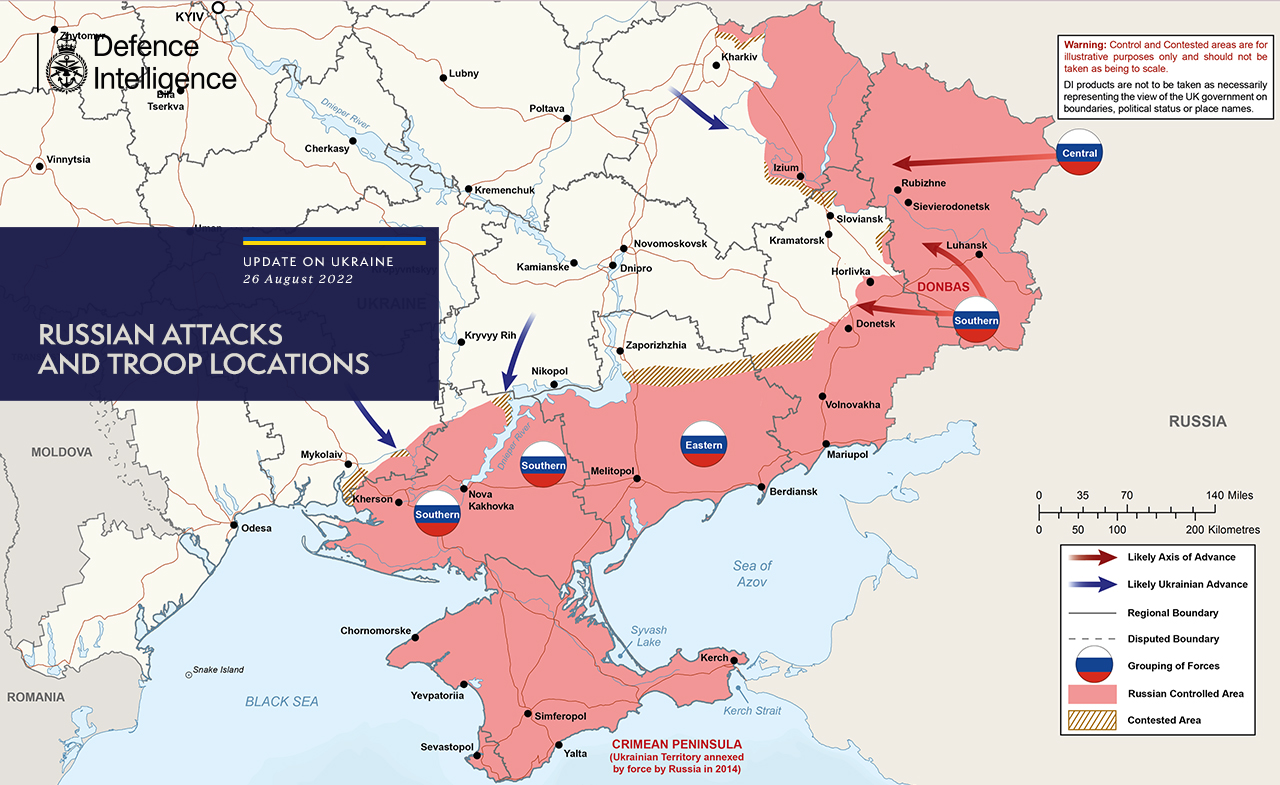
Marinus divides Russian operations, and operational goals, thus tactics, into three discrete geographic parts. Northern Raiding and feints realized through mobile warfare, Southern Occupation through clear and hold, and Central Attrition operations through artillery firepower.
1. Northern operation. Marinus’s central thesis is that the Northern operation was a giant raid, intended to fix Ukrainian commanders’ attention on the threat to Kiev, and prevent them from reinforcing their defenses in the south. In this, mobile warfare, using the battalion tactical group, was the main strategy used. Marinus posits that taking and holding Kiev was never a goal in this operation. Left unsaid in his assessment were two key points that go beyond his narrower operational focus.
First, I’m sure that the Ukrainian Army’s top command was likely not in complete control of defensive strategy or deployment. Zelensky, the Ukrainian Auto Parts King — (“I make politics for the Ukrainian working man, because that’s who I am, and that’s who I care about!”), and his American “advisors” were. Note that we have no idea who Ukrainian General Marshall is, who his Supreme Commander Eisenhower is, or his battlefield Patton is, even if one existed. I mean, we got fawning coverage of President Comedian, looking tough in his cammies on TV, a lot — by which I mean every fucking day, a mythical fighter ace, the “Ghost of Keeeeeev”, but nobody wanted to manufacture a real hero Uke general, steadfastly leading his troops with steely eyed resolve from the front?
C’mon, that’s Propaganda 101. Shit, even Big Red let Marshal Zhukov ride a white horse at the Victory Parade.
I don’t think that is inadvertent. The goons at State and the Clown Intelligence Agency, having engineered one coup, sure as fuck don’t want an actual no shit popular hero, ethnically Ukrainian general to be a viable political alternative to the UAPK they handpicked and installed after this clown folds the Big Top. (Francisco Franco, Kemal Ataturk, or Wladislaw Sikorski say hi from history!). To hear it from the Ministry of Propaganda, Zelensky is commanding the troops himself, and that’s for once likely not far from the truth. It’s Zelensky being “advised” by whatever retards from [Washington DC] who are actually commanding the Ukes, which brings me neatly into my next point — Putin and his generals initiated this feint to Kiev precisely because they correctly predicted that Zelensky and his American masters would expect it and react to it as they did, regardless of anything the Ukrainian generals said.
Why is that, you might ask? Because that is the only strategy that AINO’s Very Clever Boys, Girls and Trannies can conceive of, and the only way they conduct war. Send in the Air Force to blow up everything in an enemy capital, launch a blitzkrieg style invasion aimed at cutting off the enemy army, encircling it, forcing the unmotivated piss poor enemy conscripts to surrender in place or die trying to pull back, and driving on to the capital to pull down the statues of the recently deceased or deposed Dear Leader who was The Next Hitler, declare victory, then institute Regime Change and Operation Endless Occupation. Putin and the rest of his generals are just stupid vodka fueled gopnik Ivans, and couldn’t possibly be headfaking us and outsmarting us. We went to West Point and Harvard, and are automatically the Best and Brightest. Remember when the MoP and the Fistagon were squeeing like little girls at those incompetent Ivans floundering about within artillery range of Keeeev, and the 100 mile long convoy that everyone saw “stuck” on the road to the Sacred Capital, that was so visible and obvious you could see the fucker from space, that just sort of disappeared, along with the great and decisive Battle of Keeeeev that was going to be a bloody defeat for the evil Russians?
You’ll never hear anyone ever admit it, but they just got posterized because their hubris and arrogance was exactly the thing [Putin] used against them.
маскировка (Maskirovka), you stupid fucks, is a Russian MILITARY CONCEPT, and you forgot it. Check yo self before you wreck yo self, as von Clausewitz wrote. Master P didn’t fight your war, he fought a modern Kabinettskreige and that is fought for an entirely different set of objectives, as we will see below.
2.Southern operation. This is the forgotten stepchild of the war so far, but quietly could be the one front with the longest lasting strategic effects. Marinus disposes of this front relatively quickly, noting that it really is operationally the bread and butter of traditional warfare, take ground and hold ground, move on to the next objective. Strategically, this is different from ground taken in the northern front or even parts in the central, however.
The object here is permanent occupation and Russification to deny the rump state of Ukraine any coastline and landlock it. This, unlike territory in the north or even in the Donbass, is not a bargaining chip on the table at the peace talks. Denying this to the Ukrainians after the war prevents them from ever “inviting” any US Navy ships into the Black Sea to base themselves at a Ukrainian port and serve as a potential casus belli, hamstrings Ukraine from seaborne economic activity with Turkey across the Black Sea, thus making sure whatever left of Ukraine is unable to function without massive land route economic as well as military aid, making it a drain, not an asset, to Globohomo and AINO.
[…]
3. Central operation. Marinus here details the real decisive front in the war, calling it “Stalingrad in the East” (Clunky, since Stalingrad was a very different kind of battle, but it has name recognition as a byword for the Eastern Front and the Russian way of war). Honestly, it is far more like a giant Battle of Verdun, but only for one side.
Here is where I’m going to proclaim how happy my artilleryman’s heart is […] because Marinus says that in the Russian way of winning wars, you can’t spell PARTY without ARTY. Not Special Operations Operating Operationally, not drone warfare “fought” by fatass pimply nerds in some air conditioned room half a world out of danger, not bombs away from 30,000 feet, or armored divisions imitating Rommel. Fucking old school howitzers, chucking metric tons of high explosive on infantry, dropping regimental sized TOT and Shake and Bake when they get in the open. I predicted that here in the beginning of the war and a lot of you can look that shit up if you don’t believe me. Guess we ain’t obsolete anymore, assholes.
Everything the Russians are doing in the Donbass and Central front, operationally and tactically, hinges around artillery as the decisive arm, the fulcrum that the other arms orbit around, which is very, very different than the American way of war. Again, as in the north, the Americans “advising” the Ukes had never, literally never in living memory, faced an enemy with air superiority and firepower superiority, much less both combined. They have absolutely no answer for it.
Comments Off on A cynical (or realistic) view of the fighting in Ukraine


