
Forgotten Weapons
Published 5 Aug 2022The story of the conversion of the Lee Enfield to 7.62mm NATO would not be complete without the L39A1. This is essentially the civilian competition version of what would become the L42A1. It was actually in British service as a target rifle — not intended for combat. It followed the L8 (the first British military attempts at a 7.62mm precision version of the Enfield) and the L42A1. It was basically a copy of the conversions done by civilian competition shooters in the British NRA.
Sights were made by several different companies, as the rifles were not issued with sights — they were obtained by the unit they went to, whatever particular model that unit preferred. This example has Parker Hale diopter sights. The L39A1 also used a .303 caliber magazine, as they were intended for slow-fire, single-loaded competition but the magazine was used as a loading tray. The .303 magazine will not reliably hold 7.62mm cartridges, but 7.62mm conversion magazines can be put in the L39A1 and will then work just fine. They also sometimes are fitted with .303 extractors. The stock here has a semi-pistol grip a bit less substantial than the L8 .22 rifle, although most had standard No4 stocks.
The original sights were removed, and remarked as L39A1. They were made in 1969, 1970, and 1972, with a single serial number range used for the L39A1, the pretrial trials examples of the L39, and the “7.62 Conv” rifles. A total of 1,213 L39A1 rifles were made, with the other types accounting for about 28 additional rifles.
(more…)
December 4, 2022
L39A1: British Service Target Rifle Before the L42A1
QotD: In praise of mediocrity
There is much to be said in favor of mediocrity, of course. Without mediocrity, there could be no excellence. We cannot always be living on the heights of Mount Olympus, and surely even the most fastidiously intellectual person has found pleasure or relief in curling up with a second-rate detective story (Wittgenstein did so, besides which there is something to be learned from every book ever written). I have derived much comfort from mediocrity, my own included, and it is my experience that, for a variety of reasons, the greatest experts in their field may make poor witnesses. A person of mediocre accomplishment is often better.
Mediocrity is not a problem in itself; it is inevitable. Indeed the world needs many mediocrities, that is to say mediocrities who know themselves, and are perfectly content, to be such (complacency is as much an underestimated quality as rebelliousness is an overestimated one). The problem with mediocrity begins when it is allied to overweening ambition, as it seems so often to be the case nowadays.
Ambition is likewise a quality that is excellent when it attaches to something worthwhile in itself, but which is dreadful when it does not. And the rapid and phenomenal spread of education has increased the spread of ambition with it, much of it inevitably of the apparatchik type, that is to say the determination to climb some bureaucratic career ladder detached from any purpose except survival and, if possible, self-aggrandizement. To climb such a ladder you have to be both ruthless and submissive at the same time. You have to be egotistically prepared to stab people in the back in the scramble for advancement, while at the same time being prepared to suppress your own personality by uttering other people’s clichés at the expense of your own thoughts. Unpreparedness to do this, either through lack of training or moral scruple, unfits you for a career in the organization, any organization. You have to learn to lie with clichés, and do so with a straight face.
Theodore Dalrymple, “In Defense of Mediocrity”, Taki’s Magazine, 2018-02-17.
December 3, 2022
“The Valley of Death” – The Battles of Doiran – Sabaton History 115
Sabaton History
Published 1 Dec 2022The Bulgarian defenses in the Lake Doiran region were pretty much the best defenses any country had anywhere in the Great War, which the Entente forces discovered as they tried time and again and failed time and again — to break the front.
(more…)
The end of the old “WASP” upper class
Scott Alexander is reading Bobos in Paradise by David Brooks and summarized the first sixth of the book:

The daring thesis: a 1950s change in Harvard admissions policy destroyed one American aristocracy and created another. Everything else is downstream of the aristocracy, so this changed the whole character of the US.
The pre-1950s aristocracy went by various names; the Episcopacy, the Old Establishment, Boston Brahmins. David Brooks calls them WASPs, which is evocative but ambiguous. He doesn’t just mean Americans who happen to be white, Anglo-Saxon, and Protestant — there are tens of millions of those! He means old-money blue-blooded Great-Gatsby-villain WASPs who live in Connecticut, go sailing, play lacrosse, belong to country clubs, and have names like Thomas R. Newbury-Broxham III. Everyone in their family has gone to Yale for eight generations; if someone in the ninth generation got rejected, the family patriarch would invite the Chancellor of Yale to a nice game of golf and mention it in a very subtle way, and the Chancellor would very subtly apologize and say that of course a Newbury-Broxham must go to Yale, and whoever is responsible shall be very subtly fired forthwith.
The old-money WASPs were mostly descendants of people who made their fortunes in colonial times (or at worst the 1800s); they were a merchant aristocracy. As the descendants of merchants, they acted as standard-bearers for the bourgeois virtues: punctuality, hard work, self-sufficiency, rationality, pragmatism, conformity, ruthlessness, whatever made your factory out-earn its competitors.
By the 1950s they were several generations removed from any actual hustling entrepreneur. Still, at their best the seed ran strong and they continued to embody some of these principles. Brooks tentatively admires the WASP aristocracy for their ethos of noblesse oblige — many become competent administrators, politicians, and generals. George H. W. Bush, scion of a rich WASP family, served with distinction in World War II — the modern equivalent would be Bill Gates’ or Charles Koch’s kids volunteering as front-line troops in Afghanistan.
At their worst, they mostly held ultra-expensive parties, drifted into alcoholism, and participated in endless “my money is older than your money” dick-measuring contests. And they were jocks — certainly good at lacrosse and crew, but their kids would be much less likely than modern elites’ to become a scientist, professor, doctor, or lawyer. Not only that, they were boring jocks — they stuck to a few standard rich people hobbies (yachting, horseback riding) and distrusted creativity or (God forbid) quirkiness. Their career choices were limited to the family business (probably a boring factory with a name like Newbury-Broxham Goods), becoming a competent civil service administrator, or other things along those lines.
The heart of the WASP aristocracy was the Ivy League. I don’t think there are good statistics, but until the early 1900s many (most?) Ivy League students were WASP aristocrats from a few well-known families. Around 1920 the Jews started doing really well on standardized tests, and the Ivies suspended standardized tests in favor of “holistic admissions” to keep them out and preserve the WASPishness of the elite. All the sons (and later, daughters) of the WASPs met each other in college, played lacrosse together, and forged the sort of bonds that make a well-connected and self-aware aristocracy.
Around 1955 (Brooks writes, building on an earlier book by Nicholas Lemann) Harvard changed their admission policy. Why? Partly a personal decision by Harvard presidents James Conant, and Nathan Pusey, who sincerely believed in meritocracy. And partly because Harvard’s Jewish quota was becoming unpopular, as increased awareness of the Holocaust made anti-Semitism déclassé. Conant and Pusey decided to admit based on academic merit (measured mostly by SAT scores). The thing where Harvard would always admit WASP aristocrats because that was the whole point of Harvard was relegated to occasional “legacy admissions”, a new term for something which was now the exception and not the rule. Other Ivies quickly followed.
Brooks on the consequences:
In 1952, most freshmen at Harvard were products of … the prep schools of New England (Andover and Exeter alone contributed 10% of the class), the East side of Manhattan, the Main Line of Philadelphia, Shaker Heights in Ohio, the Gold Coast of Chicago, Grosse Pointe of Detroit, Nob Hill in San Francisco, and so on. Two-thirds of all applicants were admitted. Applicants whose fathers had gone to Harvard had a 90% admission rate. The average verbal SAT score for the incoming men was 583, good but not stratospheric. The average score across the Ivy League was closer to 500 at the time.
Then came the change. By 1960 the average verbal SAT score for incoming freshman at Harvard was 678, and the math score was 695 — these are stratospheric scores. The average Harvard freshman in 1952 would have placed in the bottom 10% of the Harvard freshman class of 1960. Moreover, the 1960 class was drawn from a much wider socioeconomic pool. Smart kids from Queens or Iowa or California, who wouldn’t have thought of applying to Harvard a decade earlier, were applying and getting accepted … and this transformation was replicated in almost all elite schools. At Princeton in 1962, for example, only 10 members of the 62-man football team had attended private prep schools. Three decades earlier every member of the Princeton team was a prep school boy.
There was a one-or-two generation interregnum where the new meritocrats silently battled the old WASP aristocracy. This wasn’t a political or economic battle; as a war to occupy the highest position in the class hierarchy, it could only be won through cultural prestige. What was cool? What was out of bounds? What would get printed in the New York Times — previously the WASP aristocracy’s mouthpiece, but now increasingly infiltrated by the more educated newcomers?
This Is What A British Sailor Ate In Nelson’s Royal Navy!
History Hit
Published 23 Oct 2021‘This Is What A British Sailor Ate In Nelson’s Royal Navy!’
200 years ago, Britain’s Royal Navy was the most technologically advanced and supremely efficient force in the history of naval warfare.
But what was it like to live and work on board these ships? What did the men eat? How did the ships sail? What were the weapons they used?
In our latest documentary on History Hit TV, to commemorate the Battle of Trafalgar, Dan Snow explores what life would have been like for those whose served in the Nelson’s Navy.
(more…)
QotD: Mantetsu and the Kwantung Army
Thus the South Manchuria Railway Corporation, originally contracted to develop a defunct line in a disputed territory, soon developed into a full-spectrum enterprise. Pretty much all heavy industry in the Japanese areas of Manchuria were divisions of Mantetsu. But since all the heavy industry depended on mines, and transportation, and food and housing for workers, and banks, and schools for the workers’ children, etc., pretty soon Mantetsu ran all of that, too. By the late 1920s, you could argue that Mantetsu was almost its own country.
It even had its own army, and that’s where things get really interesting.
The Kwantung Army was the security force assigned to the South Manchuria Railway Zone. The Japanese weren’t stupid; they knew the perils of independent commands far from home, and they rotated units through with some regularity. Nonetheless, the command staff remained fairly stable over the years … and so did Mantetsu’s.
The Japanese weren’t stupid, but they were people, and people being people, soon enough the lines between the Kwantung Army and Mantetsu began to blur. And since the lines between Mantetsu, the Imperial Army, and the government were already pretty blurry, pretty soon the concerns of one became the concern of all. (Nor was the Navy left out, though I’m not discussing them in order to keep it simple. They were up to their eyeballs in Mantetsu, too, because warships need lots of steel and steel comes from Manchuria).
A small but highly committed and totally ideologized faction developed inside the Kwantung Army. Several, in fact, and one of them (the Imperial Way faction) attempted an actual coup d’etat in 1936. It was put down, and the Imperial Way faction dissolved (in theory), but the problem of an intensely ideologized officer corps remained. Long story short, you had a small group of highly ideologized officers garrisoning a remote province pulling the entire Empire into big, unwinnable wars.
One could make the case that World War II in the Pacific was ultimately caused by about fifteen or twenty guys in the Kwantung Army.
That’s overly reductionist, but it highlights the huge problem with organizations slipping the leash. In theory, there was a clear chain of command, and even the head of the Kwantung Army was a down it a ways — he was subordinate to the Army Council, which was subordinate to the War Minister, who was subordinate to the Parliament, who were subordinate to the Emperor. In theory, lots of people could’ve sacked Gen. Araki, or his mini-me Ishiwara Kanji (a lieutenant colonel through most of it). Equally in theory, Mantetsu had no say in any of it — the Kwantung Army was a formation of the Imperial Japanese Army, not Mantetsu’s private security force.
But in reality, Mantetsu was so wired in to the Japanese government that in a lot of cases, it was the government. But not always, because the same could be said about the Army, and the Navy, both of which were also wired into Mantetsu up to the very top (or vice versa, your choice). And Mantetsu had their Media arm, of course, as did the Army and Navy …
What all this boiled down to, then, was a power vacuum. I know, that seems weird, but a skilled bureaucratic infighter like Ishiwara never lacked for groups to play against each other. The Army and Navy would oppose on principle any move that seemed to aggrandize the other, neither could go against Mantetsu (and neither could control it), and all had to pay at least lip service to the civilian government. Because of this, real power fell to whomever had the balls to grab it …
… which was the officer corps of the Kwantung Army. They assassinated at least two Manchurian warlords, staged a number of false flag attacks on their own positions, and generally got up to however you say “standard issue Juggalo fuckery” in Japanese, up to and including a full-scale war with China.
Severian, “Slipping the Leash”, Founding Questions, 2022-08-27.
December 2, 2022
Matt Taibbi – “This is not journalism. It’s political entertainment, and therefore unreliable.”
Matt Taibbi posted his opening remarks for the Munk Debate on the topic “Be it resolved: Do not trust the mainstream media”:
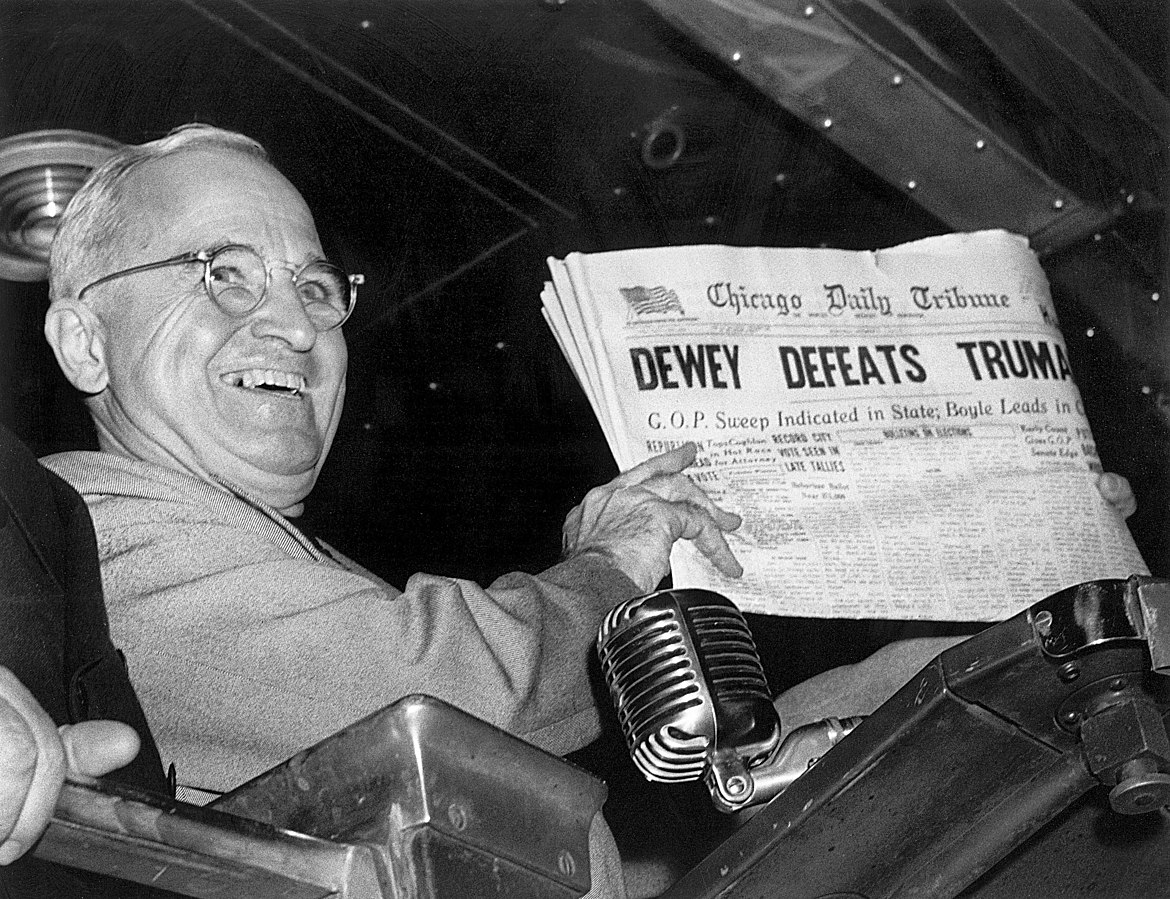
President Harry S. Truman holds up an election day edition of the Chicago Daily Tribune, which – based on early results – mistakenly announced “Dewey Defeats Truman.”
AP Photo/Byron Rollins from November 4, 1948, via Wikimedia Commons
I love the news business. It’s in my bones. But I mourn for it. It’s destroyed itself.
My father had a saying: “The story’s the boss.” In the American context, if the facts tell you the Republicans were the primary villains in this or that disaster, you write that story. If the facts point more at Democrats, you go that way. If it turns out they’re both culpable, as was often the case for me across nearly ten years of investigating Wall Street and the causes of the 2008 crash for Rolling Stone, you write that. We’re not supposed to nudge facts one way or another. Our job is to call things as we see them and leave the rest up to you.
We don’t do that now. The story is no longer the boss. Instead, we sell narrative, as part of a new business model that’s increasingly indifferent to fact.
When there were only a few channels, the commercial strategy of news companies was to aim for the whole audience. A TV news broadcast aired at dinnertime and was designed to be consumed by the whole family, from your crazy right-wing uncle to the sulking lefty teenager. This system had its flaws. However, making an effort to talk to everybody had benefits, too. For one, it inspired more trust. Gallup polls twice showed Walter Cronkite of CBS to be the most trusted person in America. That would never happen today.
[…]
Our colleagues on the other side tonight represent two once-great media organizations. Michelle, the Pew survey says the audience for your New York Times is now 91% comprised of Democrats. Malcolm, the last numbers I could find for the New Yorker were back in 2012, and even then, only 9% of the magazine’s readers were Republicans. I imagine that number is smaller now.
This bifurcated system is fundamentally untrustworthy. When you decide in advance to forego half of your potential audience, to fulfill the aim of catering to the other half, you’re choosing in advance which facts to emphasize and which to downplay. You’re also choosing which stories to cover, and which ones to avoid, based on considerations other than truth or newsworthiness.
This is not journalism. It’s political entertainment, and therefore unreliable.
With editors now more concerned with retaining audience than getting things right, the defining characteristic across the business — from right to left — is inaccuracy. We just get a lot of stuff wrong now. It’s now less important for reporters to be accurate than “directionally” correct, which in center-left “mainstream” media mostly comes down to having the right views, like opposing Donald Trump, or anti-vaxxers, or election-deniers, or protesting Canadian truckers, or any other people deemed wrongthinkers.
In the zeal to “hold Trump accountable”, or oppose figures like Vladimir Putin, ethical guardrails have been tossed out. Silent edits have become common. Serious accusations are made without calling people for comment. Reporters get too cozy with politicians, and as a result report information either without attribution at all or sourced to unnamed officials or “people familiar with the matter”. Like scientists, journalists should be able to reproduce each other’s work in the lab. With too many anonymous sources, this becomes impossible.
Bombing Berlin with Ed Murrow of CBS – War Against Humanity 089
World War Two
Published 1 Dec 2022Ed Murrow accompanies the RAF on a bombing raid on Berlin, and files one of his most iconic broadcasts with CBS. In Teheran, Winston Churchill walks out on a dinner with Joseph Stalin, after the USSR Premiere suggests mass murdering German officers.
(more…)
The whole music culture, it seems, is now under the sway of a chipmunk aesthetic
Ted Gioia explores the oddity of musical tastes on TikTok:
When I was a child, a band called Alvin and the Chipmunks enjoyed a brief taste of fame. Hot bands come and go, but this one had a bizarre back story.
First of all, it didn’t really exist. The band consisted of cartoon chipmunks. In this regard, Alvin and his rodent colleagues get credit for anticipating the anime pop stars of the current day.
Second, these singing chipmunks were more a brand than a band. Because these animals were make-believe, they couldn’t go on tour — but they could sell boatloads of merchandise, from lunch boxes to comic books. This, too, anticipated much of our current music industry — where the side deals often make more money than concerts and records.
But even stranger, this group aimed to imitate the sound of singing chipmunks by speeding up recordings of human vocalists. The end result was arguably the most annoying sound in 20th century music (a rare distinction, that). I can’t stand listening to these tracks, but they somehow won five Grammy Awards. Alvin and the Chipmunks actually enjoyed two number-one singles.
That’s two more than Bob Dylan can claim.
In all fairness, these same tracks sound even worse when slowed down. So maybe there’s something to be said for getting to the end of the song as fast as possible.
But here’s the most surprising part of the story. This sped-up sound also anticipated the contemporary music of our own time — it’s actually one of the hottest trends on TikTok.
The whole music culture, it seems, is now under the sway of a chipmunk aesthetic. This, to my way of thinking, is even more foreboding than all those people who want us to eat bugs and compost our deceased loved ones.
I’m starting to think that Alvin and the Chipmunks belong in the Rock and Roll Hall of Fame. Maybe I can’t stand listening to the stuff, but these cartoon critters clearly pointed the way to the future. A dark dystopian future, perhaps, but I guess that’s what happens when you treat rodents as role models.

Legends Summarized: The Trojan War
Overly Sarcastic Productions
Published 29 Jul 2022The grandest epic cycle this side of the Aegean! Today let’s talk about the tale of which The Iliad only makes up a tiny (if impressive) fraction!
Pst! Wanna know more about Quintus Smyrnaeus’s Posthomerica? Watch Blue’s Historymaker video about him HERE: https://www.youtube.com/watch?v=wfHGQ…
And if you want to know more about the historical, archaeological precedent that indicates some form of this story REALLY HAPPENED, watch Blue’s video on Mycenaean Greece HERE: https://www.youtube.com/watch?v=cki-9…
(more…)
QotD: Rome’s legions settle down to permanent fortresses
What absolutely does begin happening during the reign of Augustus and subsequently is that the Roman legions, which had spent the previous three centuries on the move outside of Italy, begin to settle down more permanently on Rome’s new frontiers, particularly along the Rhine/Danube frontier facing Central and Eastern Europe and the Syrian frontier facing the Parthian Empire. That in turn meant that Roman legions (and their supporting auxiliary cohorts) now settled into permanent forts.
The forts themselves, at least in the first two centuries, provide a fairly remarkably example of institutional inertia. While legionary forts of this early period typically replaced the earthwork-and-stakes wall (the agger and vallum) with stone walls and towers and the tents of the camp with permanent barracks, the basic form of the fort: its playing-card shape, encircling defensive ditches (now very often two or three ditches in sequence) remain. Of particular note, these early imperial legionary forts generally still feature towers which do not project outward from the wall, a stone version of the observation towers of the old Roman marching camp. Precisely because these fortifications are in stone they are often very archaeologically visible and so we have a fairly good sense of Roman forts in this period. In short then, put in permanent positions, Roman armies first constructed permanent versions of their temporary marching camps.
And that broadly seems to fit with how the Romans expected to fight their wars on these frontiers. The general superiority of Roman arms in pitched battle (the fancy term here is “escalation dominance” – that escalating to large scale warfare favored the heavier Roman armies) meant that the Romans typically planned to meet enemy armies in battle, not sit back to withstand sieges (this was less true on Rome’s eastern frontier since the Parthians were peer competitors who could rumble with the Romans on more-or-less even terms; it is striking that the major centers in the East like Jerusalem or Antioch did not get rid of their city walls, whereas by contrast the breakdown of Roman order in the third century AD and subsequently leads to a flurry of wall-building in the west where it is clear many cities had neglected their defensive walls for quite a long time). Consequently, the legionary forts are more bases than fortresses and so their fortifications are still designed to resist sudden raids, not large-scale sieges.
They were also now designed to support much larger fortification systems, which now gives us a chance to talk about a different kind of fortification network: border walls. The most famous of these Roman walls of course is Hadrian’s Wall, a mostly (but not entirely) stone wall which cuts across northern England, built starting in 122. Hadrian’s Wall is unusual in being substantially made out of stone, but it was of-a-piece with various Roman frontier fortification systems. Crucially, the purpose of this wall (and this is a trait it shares with China’s Great Wall) was never to actually prevent movement over the border or to block large-scale assaults. Taking Hadrian’s wall, it was generally manned by something around three legions (notionally; often at least one of the legions in Britain was deployed further south); even with auxiliary troops nowhere near enough to actually manage a thick defense along the entire wall. Instead, the wall’s purpose is slowing down hostile groups and channeling non-hostile groups (merchants, migrants, traders, travelers) towards controlled points of entry (valuable especially because import/export taxes were a key source of state revenue), while also allowing the soldiers on the wall good observation positions to see these moving groups. You can tell the defense here wasn’t prohibitive in part because the main legionary fortresses aren’t generally on the wall, but rather further south, often substantially further south, which makes a lot of sense if the plan is to have enemies slowed (but not stopped) by the wall, while news of their approach outraces them to those legionary forts so that the legions can form up and meet those incursions in an open battle after they have breached the wall itself. Remember: the Romans expect (and get) a very, very high success rate in open battles, so it makes sense to try to force that kind of confrontation.
This emphasis on controlling and channeling, rather than prohibiting, entry is even more visible in the Roman frontier defenses in North Africa and on the Rhine/Danube frontier. In North Africa, the frontier defense system was structured around watch-posts and the fossatum Africae, a network of ditches (fossa) separating the province of Africa (mostly modern day Tunisia) from non-Roman territory to its south. It isn’t a single ditch, but rather a system of at least four major segments (and possibly more), with watch-towers and smaller forts in a line-of-sight network (so they can communicate); the ditch itself varies in width and depth but typically not much more than 6m wide and 3m deep. Such an obstruction is obviously not an prohibitive defense but the difficulty of crossing is going to tend to channel travelers and raids to the intentional crossings or alternately slow them down as they have to navigate the trench (a real problem here where raiders are likely to be mounted and so need to get their horses and/or camels across).
On the Rhine and the Danube, the defense of the limes, the Roman frontier, included a border wall (earthwork and wood, rather than stone like Hadrian’s wall), similarly supported by legions stationed to the rear, with road networks positioned; once again, the focus is on observing threats, slowing them down and channeling them so that the legions can engage them in the field. This is a system based around observe-channel-respond, rather than an effort to block advances completely.
Bret Devereaux, “Collections: Fortification, Part II: Romans Playing Cards”, A Collection of Unmitigated Pedantry, 2021-11-12.
December 1, 2022
Crisis? Which crisis?
In The Line, Matt Gurney makes the case that was NATO (and western governments in general) needs is something called “deliverology”:

I couldn’t have asked for a more topical example of exactly what I’m talking about here: the lull between realization and reaction. There were no problems with “expectations” at the top of the federal government in February [during the Freedom Convoy 2022 protests]. Everyone in a position of authority was seized with the urgency of the situation and the need for rapid action. There wasn’t any denial, doubt or incomprehension, which are the usual enemies when I write about our expectations being a problem.
February was an example of a different issue: realizing there was a crisis but not really knowing what to do about it, or whose job it was to do it, and wasting a lot of precious time trying to figure it all out. When days and even hours count, governments can’t spend weeks or months figuring out what to do. But that’s what happened during the convoys, and during COVID, and other incidents I could rattle off. Does anyone think it won’t happen again next time, whatever that threat may be?
And some version of that concern came up over and over in Halifax [at the Halifax International Security Forum]. And not just among Canadians. The world is changing very quickly and even when we recognize a problem, we aren’t moving fast enough to keep up. So on top of our expectations, we’ve got another challenge: response times. They’re just too damned long.
I hope the readers will forgive me for being a little vague in this next section; some of the conversations I’m thinking of here were in off-the-record sessions. Rather than trying to splice together any specific quote or anecdote, I’ll just wrap it all up under the theme of “There are things we should be doing now that we weren’t, and things we should have been doing a long time ago that we only started on way too late.”
An obvious example? The rush to get Europe off of Russian fossil fuels and on to either locally generated renewables or energy imports from allies and friendly nations. (If only there was a “business case” for Canada doing more. Sigh.) Another fascinating example that came up was air defences. Two decades of post-Cold-War-style thinking among the allies has led to widespread neglect among the NATO countries of air-defence weapons. Why bother? The Taliban didn’t have an air force, right?
Most countries have fighter jets and inventories of air-to-air missiles suitable for their planes. However, across the alliance, there are very few ground-based air-defence systems suited to shooting down not just attacking aircraft, but incoming cruise missiles and drones.
Drones pose a particular challenge. They fly slow and low and are highly manoeuvrable, plus they are so cheap that they can be a true asymmetrical weapon: you’ll go broke real quick firing million-dollar missiles at a drone that costs your enemy $50,000 or so. And your enemy may send a few hundred at once in a swarm that simply overwhelms your defences. It’s not that drones are unbeatable. The opposite is true: drones are easily destroyed, if you have the right defences available.
We don’t, though. Oops.
The NATO powers actually had a preview of this element of the ongoing war between Ukraine and Russia during the 2020 conflict between Azerbaijan and Armenia, where drones were used to devastating effect. Every military affairs watcher I know sat up a bit straighter after watching what the Azeris did to Armenia, with shocking speed. Swarms of drones first killed Armenia’s air defences and then went to work on Armenian ground forces. The U.S. and NATO allies have been studying that conflict, and considering how to adapt our own strategies, for both offence and defence. But right now, nine months into the Ukraine war and two years after the conflict in the Caucasus, there still aren’t enough NATO systems available even for our own needs, let alone to share with Ukraine. Russia keeps hammering away at critical Ukrainian civilian infrastructure and the Ukrainians keep begging for help, but we have nothing to send. To be clear, a few systems have been sent to Ukraine, which include not just the weapons but the radars and computers necessary to detect and engage targets. But they can only be delivered as fast as they can be built. There is no real production pipeline here, and certainly no pre-stocked inventories in NATO armouries.
Medieval Table Manners
Tasting History with Max Miller
Published 19 Jul 2022
(more…)
QotD: Movie swordfighting
Most people don’t have that knowledge. So today I’m going to write about the quality of sword choreography in movies, and how that has changed over time, from the point of view of someone who is an experienced multi-style martial artist in both sword and empty hand. I think this illuminates a larger story about the place of martial arts in popular Western culture.
The first thing to know is this: with only rare exceptions, any Western swordfighting you see in older movies is going to be seriously anachronistic. It’s almost all derived from French high-line fencing, which is also the basis for Olympic sport fencing. French high-line is a very late style, not actually fully developed until early 1800s, that is adapted for very light thrusting weapons. These are not at all typical of the swords in use over most of recorded history.
In particular, the real-life inspirations for the Three Musketeers, in the 1620s, didn’t fight anything like their movie versions. They used rapiers – thrusting swords – all right, but their weapons were quite a bit longer and heavier than a 19th-century smallsword. Correspondingly, the tempo of a fight had to be slower, with more pauses as the fighters watched for an opening (a weakness in stance or balance, or a momentary loss of concentration). Normal guard position was lower and covered more of center line, not the point-it-straight-at-you of high line. You find all this out pretty quickly if you actually train with these weapons.
The thing is, real Three Musketeers fencing is less flashy and dramatic-looking than French high-line. So for decades there was never any real incentive for moviemakers to do the authentic thing. Even if there had been, audiences conditioned by those decades of of high-line would have thought it looked wrong!
Eric S. Raymond, “A martial artist looks at swordfighting in the movies”, Armed and Dangerous, 2019-01-13.


