
World War Two
Published 12 Sep 2023The imperial dreams of Germany and Japan are in tatters. But the expansionist beasts do their best to drag their enemies down with them. Across Europe the cycle of resistance and retaliation continues. Paris is free but Warsaw burns. V-1s rain down on innocent civilians in London. The Japanese cleanse West Borneo of opposition. The genocide of the Jews continues. For so many people, liberation is now so near yet so far away.
(more…)
September 13, 2023
At the end of the Axis’ Destiny – War Against Humanity 114
Comments Off on At the end of the Axis’ Destiny – War Against Humanity 114
“It is premature to write the epitaph for a politician that has defied gravity as many times as Justin Trudeau”
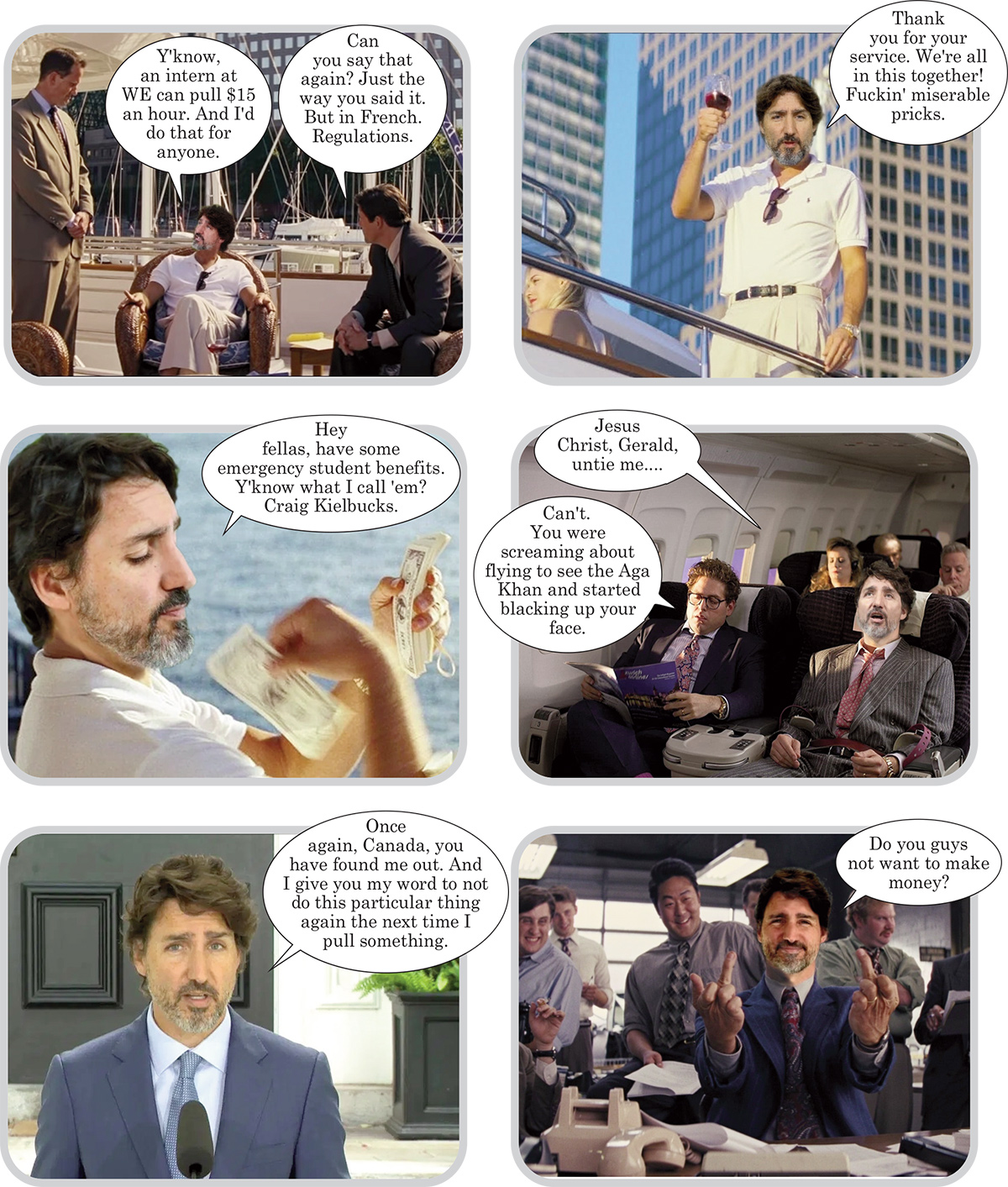
I have to admit that Justin Trudeau is a very talented political campaigner and Canadian politicians always need to take that into account in dealing with him. I’m very much not a fan, but he has accomplished something I didn’t think was possible — his efforts in office have persuaded me to move Pierre Trudeau down to second-place in my personal list of “Worst Prime Ministers of Canada”:
For the longest time, Justin Trudeau was the party’s best asset. It didn’t matter if the Liberals trailed the Conservatives by a few points, the prime minister was viewed by Canadians as the best choice to continue to lead the country when compared to the other party leaders.
That hope now lies in tatters. Trudeau now trails Pierre Poilievre by double digits for preferred prime minister. More importantly, Trudeau trails his party on the generic (“who would you vote for?”) ballot question by nine points. What this means in plain language is that a significant number of people are still willing to vote for the Liberals, even though they no longer believe that Justin Trudeau is the best candidate to be prime minister. In only one demographic — women over the age of 55 — does the prime minister lead Poilievre. More importantly for Trudeau, only 45 per cent of Liberals believe he would make the best prime minister; 77 per cent of Conservatives believe the same thing about Poilievre.
For the first time in his decade as leader, Justin Trudeau is a drag on the Liberal Party of Canada.
This has been wondered about for months. I have always believed that Trudeau gave the party a better chance of success in the critical places in which it absolutely must win (in Quebec, in the B.C. Lower Mainland and in the GTA) than any other hypothetical leader would. He is a uniquely talented political campaigner. He went from third to first in the campaign in 2015, he recovered from a blackface scandal that would have ended a lesser campaigner in 2019, and he almost-single-handedly saved a Liberal campaign in 2021 that fell flat out of the gate and needed almost three weeks to find anything that even remotely resembled a coherent message.
That was then, though, and today, this is the longest and most significant stretch of time since election night in 2015 where Trudeau has been a personal liability for Liberals. This is a massive change that I’m not sure the public, and even many Liberals, have fully appreciated.
There is still an argument to be made, even at this late stage, that Trudeau remains the sole unifying force for a party whose main objective is the pursuit of power. That he is the only leader capable of forging the fractured elements of the current Liberal coalition together. You could convince me of these arguments.
Comments Off on “It is premature to write the epitaph for a politician that has defied gravity as many times as Justin Trudeau”
Why Do People In Old Movies Talk Weird?
BrainStuff – HowStuffWorks
Published 25 Nov 2014It’s not quite British, and it’s not quite American – so what gives? Why do all those actors of yesteryear have such a distinct and strange accent?
If you’ve ever heard old movies or newsreels from the thirties or forties, then you’ve probably heard that weird old-timey voice.
It sounds a little like a blend between American English and a form of British English. So what is this cadence, exactly?
This type of pronunciation is called the Transatlantic, or Mid-Atlantic, accent. And it isn’t like most other accents – instead of naturally evolving, the Transatlantic accent was acquired. This means that people in the United States were taught to speak in this voice. Historically Transatlantic speech was the hallmark of aristocratic America and theatre. In upper-class boarding schools across New England, students learned the Transatlantic accent as an international norm for communication, similar to the way posh British society used Received Pronunciation – essentially, the way the Queen and aristocrats are taught to speak.
It has several quasi-British elements, such a lack of rhoticity. This means that Mid-Atlantic speakers dropped their “r’s” at the end of words like “winner” or “clear”. They’ll also use softer, British vowels – “dahnce” instead of “dance”, for instance. Another thing that stands out is the emphasis on clipped, sharp t’s. In American English we often pronounce the “t” in words like “writer” and “water” as d’s. Transatlantic speakers will hit that T like it stole something. “Writer”. “Water”.
But, again, this speech pattern isn’t completely British, nor completely American. Instead, it’s a form of English that’s hard to place … and that’s part of why Hollywood loved it.
There’s also a theory that technological constraints helped Mid-Atlantic’s popularity. According to Professor Jay O’Berski, this nasally, clipped pronunciation is a vestige from the early days of radio. Receivers had very little bass technology at the time, and it was very difficult – if not impossible – to hear bass tones on your home device. Now we live in an age where bass technology booms from the trunks of cars across America.
So what happened to this accent? Linguist William Labov notes that Mid-Atlantic speech fell out of favor after World War II, as fewer teachers continued teaching the pronunciation to their students. That’s one of the reasons this speech sounds so “old-timey” to us today: when people learn it, they’re usually learning it for acting purposes, rather than for everyday use. However, we can still hear the effects of Mid-Atlantic speech in recordings of everyone from Katherine Hepburn to Franklin D. Roosevelt and, of course, countless films, newsreels and radio shows from the 30s and 40s.
(more…)
Comments Off on Why Do People In Old Movies Talk Weird?
QotD: The social contract
… ideas like “representative government” are cracked, probably beyond repair. I’m going to argue that they always were cracked; that the “social contract” was a patchwork solution to a historically contingent problem; that, in effect, it sounded good, but was doomed to failure, because it rested on an obvious untruth. Hobbes’s version of “all men are created equal” was much closer to reality than Jefferson’s goofy hippie nonsense, but it was false for all that, and Hobbes himself most certainly knew it.
Put simply but not inaccurately, the American Founding was based on Montesquieu, who was based on Locke, who was based on Hobbes, who based his entire political theory around a “thought experiment”, which is also known as “a 3am dorm room bull session”, which is glaringly false, as anyone who has ever solved the world’s problems over a few righteous bong rips with his fellow freshmen knows.
But if I’d just said that, with no prep, I’d sound like a lunatic.
Having established (1) that the “social contract” fails theoretically, I want to argue (2) that it fails practically, too, since it rests on the consent of the governed, which a combination of (a) irreducible complexity, (b) instant communications, and (c) caloric surplus renders moot.
In other words: it would be impossible to know what you’re actually “consenting” to in the first place, even if you could consent, which you can’t.
Severian, “Anticipations and Objections (I)”, Founding Questions, 2020-12-16.B
Comments Off on QotD: The social contract
September 12, 2023
Justin Trudeau should just stay away from India … it’s an ill-omened place for him
Paul Wells on the latest subcontinental pratfall of Prime Minister Look-At-My-Socks:
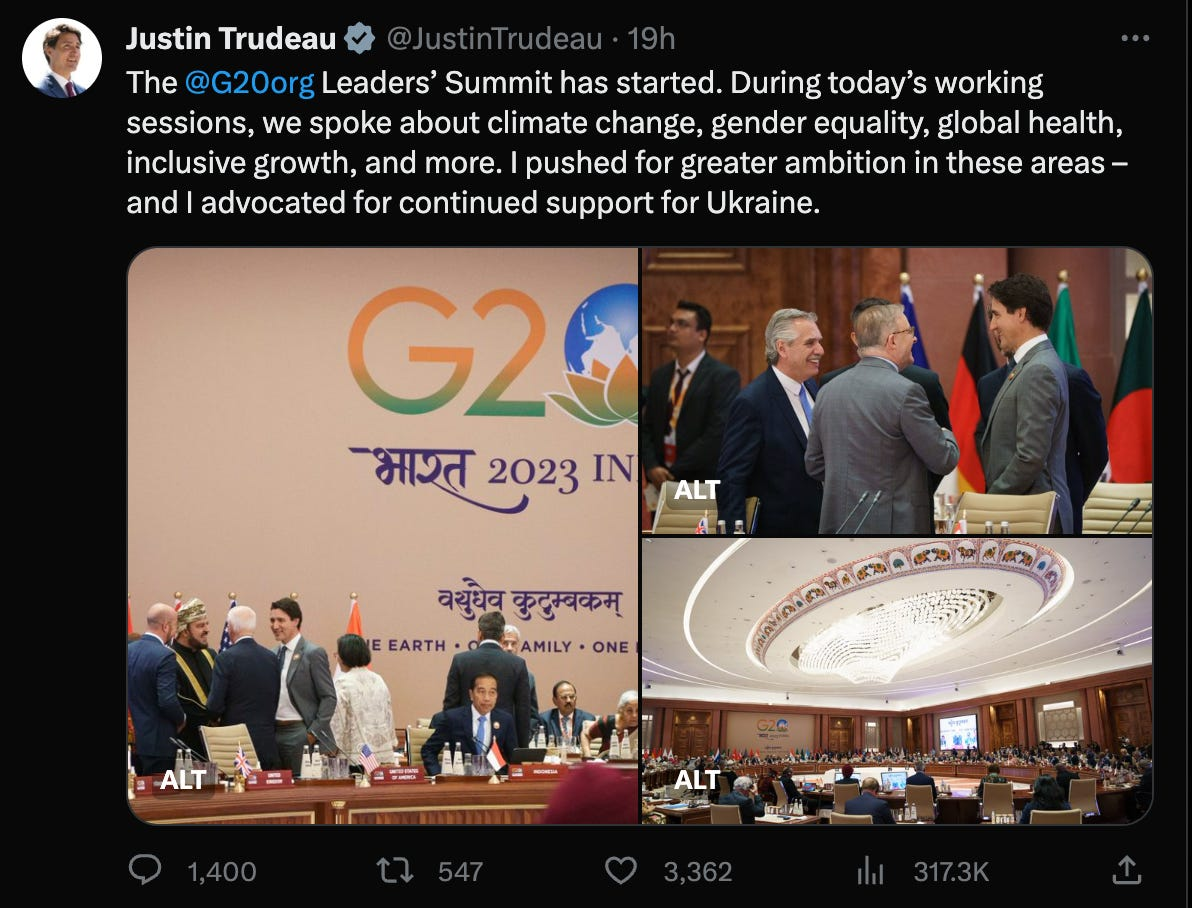
Later, word came from India that Justin Trudeau’s airplane had malfunctioned, stranding him, one hopes only briefly. It’s always a drag when a politician’s vehicle turns into a metaphor so obvious it begs to go right into the headline. As for the cause of the breakdown, I’m no mechanic, but I’m gonna bet $20 on “The gods decided to smite Trudeau for hubris”. Here’s what the PM tweeted or xeeted before things started falling off his ride home:
One can imagine the other world leaders’ glee whenever this guy shows up. “Oh, it’s Justin Trudeau, here to push for greater ambition!” Shall we peer into their briefing binders? Let’s look at Canada’s performance on every single issue Trudeau mentions, in order.
On climate change, Canada ranks 58th of 63 jurisdictions in the global Climate Change Performance Index. The country page for Canada uses the words “very low” three times in the first two sentences.
On gender equality, the World Economic Forum (!) ranks Canada 30th behind a bunch of other G-20 members.
On global health, this article in Britain’s BMJ journal calls Canada “a high income country that frames itself as a global health leader yet became one of the most prominent hoarders of the limited global covid-19 vaccine supply”.
On inclusive growth, the United Nations Conference on Trade and Development has a composite indicator called the Inclusive Growth Index. Canada’s value is 64.1, just behind the United States (!) and Australia, further behind most of Europe, stomped by Norway at 76.9%.
On support for Ukraine, the German Kiel Institute think tank ranks Canada fifth in the world, and third as a share of GDP, for financial support; and 8th in the world, or 21st as a share of GDP, for military support.
Almost all of these results are easy enough to understand. A small number are quite honourable. But none reads to me as any kind of license to wander around, administering lessons to other countries. I just finished reading John Williams’ luminous 1965 novel about university life, Stoner. A minor character in the book mocks the lectures and his fellow students, and eventually stands unmasked as a poser who hasn’t done even the basic reading in his discipline. I found the character strangely familiar. You’d think that after nearly a decade in power, after the fiascos of the UN Security Council bid, the first India trip, the collegiate attempt to impress a schoolgirl with fake trees, the prime minister would have figured out that fewer and fewer people, at home or abroad, are persuaded by his talk.
But this is part of the Liberals’ problem, isn’t it. They still think their moves work. They keep announcing stuff — Digital adoption program! Growth fund! Investment tax credits! Indo-Pacific strategy! Special rapporteur! — and telling themselves Canadians would miss this stuff if it went away. Whereas it’s closer to the truth to say we can’t miss it because its effect was imperceptible when it showed up.
In a moment I’ve mentioned before because it fascinates me, the Liberals called their play a year ago, as soon as they knew they’d be facing Pierre Poilievre. “We are going to see two competing visions,” Randy Boissonault said in reply to Poilievre’s first Question Period question as the Conservative leader. The events of the parliamentary year would spontaneously construct a massive contrast ad. It was the oldest play in the book, first articulated by Pierre Trudeau’s staff 50 years ago: Don’t compare me to the almighty, compare me to the alternative. It doesn’t work as well if people decide they prefer the alternative. It really doesn’t work if the team running the play think it means, “We’re the almighty”.
It’s funny how many of those “climate-change-caused” wildfires were actually set by arsonists
Elizabeth Nickson connects the dots on all the “natural” wildfires that have been so much in the news this summer:
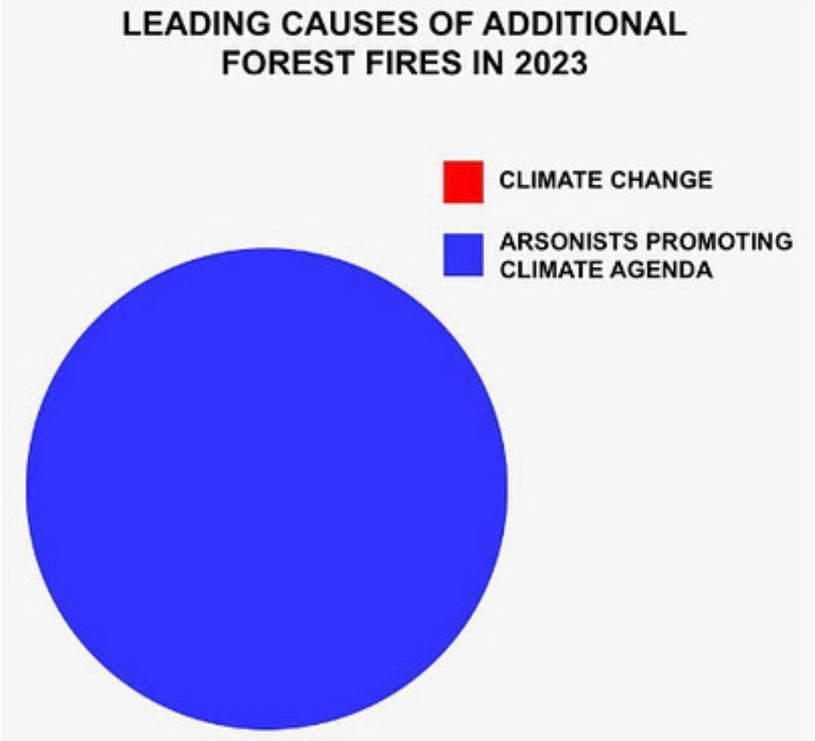
Covert geo-engineering has been used for decades and this summer was used to burn down forests and towns including Lahaina to scare people into the extreme behaviour modification required for Agenda 2030 and Net Zero.
How did everyone enjoy their trauma this August? Admit it was thoroughly engaging, a blockbuster, tragic and comic by turns, everyone’s favourite Maui town incinerated and 1,000 children and hundreds of elderly dying in the worst way imaginable. Add in the keystone cops incompetence of administrators, the carelessness, the heartlessness was psychopathic. No, I don’t think that not sounding the siren was a mistake. No, I don’t think One Hawaii’s Smart Water program of shutting off the water on that day, was a mistake. No, I don’t think it was an accident that schools were closed for the day. Yes, I think the firefighters were stood down on purpose. Yes, I think the celebrities hired private fire fighters. Yes, the “winds” were engineered. Yes, Maui has the largest space supercomputing research installation in the world and of course they have Direct Energy Weapons. Yes, I think they only burned the shops and houses of lower income Hawaiians in order to take the town and land and turn it into a ghastly Dubai-like pleasure palace for the rich, heedless and criminal.
That was one motive. The other is the big one. It is to scare enough Karens to force the commodification of carbon, a multi-trillion dollar business and pretty much the only growth industry available to the psychopaths in government and the plutocracy. Make us pay to breathe. De Sade would be proud.
Admit, cap and trade is the ideal globalist organizer. It is government control without borders or limits or even the fiction of democracy. There is zero balance of power. Government is the winner, big energy companies are winners. Why don’t the oil companies fight the climate change nonsense? The science isn’t close to settled, we have had scandal after scandal of misuse and mis-management of climate data. At that level of fraud, especially since it has not had even the wisp of rigorous analysis, it should be thrown out.
These oil companies hedge years down the road. They know they can make more money trading carbon than supplying energy.
The fires will continue until we give up and allow them to sell us carbon credits in order to leave the house. Your washing machine will be turned off mid-use if you use too much energy as now happens in Switzerland.
Why Mark Steyn stopped marking the 9/11 anniversary
His reasoning makes a lot of sense:

For most of the last two decades we have observed the anniversary of 9/11 by re-posting my columns from the first few days of the new era. We ceased to do so after September 11th 2017 when “a president who, on the campaign trail, mocked his predecessor’s inability to use the words ‘radical Islam’ himself eschewed all mention of the I-word” — and a defense secretary laughably hyped as Mad Dog Mattis turned out to be just another dribbler from the Washington Generals and retreated to the madrassah wing of the Pentagon to explain that it was all just a theological misunderstanding.
We shall not resume our anniversary observances today. The war is lost, at home and abroad. On the domestic front, we doubled the rate of Muslim immigration to the west and began assimilating ourselves with Islam’s strictures on freedom of expression and the like. The decade-and-a-half since the Danish Mohammed cartoons has been one long remorseless surrender on core western liberties. When a school teacher gets beheaded in the street, there is no outrage at the act, just a mild regret that he should have been foolish enough to provoke his own fate. Even the milder jests from the immediate post-9/11 era — the cartoon of the woman trying on new burqas in the changing room and wondering, “Does my bomb look big in this?” — would not be published today.
In the broader society, our rulers quickly determined that it was easier to punish us than our enemies. The post-9/11 security state surely helped soften up western populations for the ChiCom-19 lockdowns, in which entire nations have been reduced to TSA-administered airports.
As for the war overseas, it ended with a military that can do everything except win handing the keys to Afghanistan back to the guys who pulled off 9/11 — and apologizing for the two-decade inconvenience by gifting the mullahs with some of the most expensive infrastructure on the planet plus an air force, approximately five assault rifles for every Taliban fighter, and express check-in for the forty-seven per cent of the Afghan population that apparently served as US translators.
The position of the United States is far weaker than it was twenty years ago. Around the planet, the assumption of friends and enemies alike is that the American moment is over and the future belongs elsewhere. They are making their dispositions accordingly. It is not a question of wishing “the post-American world”, but of accepting the known facts.
Comments Off on Why Mark Steyn stopped marking the 9/11 anniversary
Mannlicher 1894
Forgotten Weapons
Published 26 Sept 2015The Mannlicher 1894 is one of a small number of firearms designed with a blow-forward action, and also the first of these guns. It was the creation of Ferdinand Mannlicher, a brilliant and prolific Austrian inventor who is also responsible for the en-bloc clip concept, very early experimental semi-automatic rifles, and a line of turnbolt and straight-pull rifles used widely throughout Europe.
The 1894 was made only in small numbers — about 100 each in 6.5mm and 7.8mm (this one is in 6.5mm). They were tested by the US military as well as other nations, but not adopted by anyone. While they were bleeding-edge new technology at the time, they were also really not better than traditional revolvers from a practical military perspective. That doesn’t prevent them from being a fascinating cul-de-sac of firearms development though!
Comments Off on Mannlicher 1894
QotD: The largest input for producing iron in pre-industrial societies
The reader may be pardoned for having gotten to this point expecting to begin with exciting furnaces, bellowing roaring flames and melting all and sundry. The thing is, all of that energy has to come from somewhere and that somewhere is, by and large, wood. Now it is absolutely true that there are other common fuels which were probably frequently experimented with and sometimes used, but don’t seem to have been used widely. Manure, used as cooking and heating fuel in many areas of the world where trees were scarce, doesn’t – to my understanding – reach sufficient temperatures for use in iron-working. Peat seems to have similar problems, although my understanding is it can be reduced to charcoal like wood; I haven’t seen any clear evidence this was often done, although one assumes it must have been tried.
Instead, the fuel I gather most people assume was used (to the point that it is what many video-game crafting systems set for) was coal. The problem with coal is that it has to go through a process of coking in order to create a pure mass of carbon (called “coke”) which is suitable for use. Without that conversion, the coal itself both does not burn hot enough, but also is apt to contain lots of sulfur, which will ruin the metal being made with it, as the iron will absorb the sulfur and produce an inferior alloy (sulfur makes the metal brittle, causing it to break rather than bend, and makes it harder to weld too). Indeed, the reason we know that the Romans in Britain experimented with using local coal this way is that analysis of iron produced at Wilderspool, Cheshire during the Roman period revealed the presence of sulfur in the metal which was likely from the coal on the site.
We have records of early experiments with methods of coking coal in Europe beginning in the late 1500s, but the first truly successful effort was that of Abraham Darby in 1709. Prior to that, it seems that the use of coal in iron-production in Europe was minimal (though coal might be used as a fuel for other things like cooking and home heating). In China, development was more rapid and there is evidence that iron-working was being done with coke as early as the eleventh century. But apart from that, by and large the fuel to create all of the heat we’re going to need is going to come from trees.
And, as we’ll see, really quite a lot of trees. Indeed, a staggering number of trees, if iron production is to be done on a major scale. The good news is we needn’t be too picky about what trees we use; ancient writers go on at length about the very specific best woods for ships, spears, shields, or pikes (fir, cornel, poplar or willow, and ash respectively, for the curious), but are far less picky about fuel-woods. Pinewood seems to have been a consistent preference, both Pliny (NH 33.30) and Theophrastus (HP 5.9.1-3) note it as the easiest to use and Buckwald (op cit.) notes its use in medieval Scandinavia as well. But we are also told that chestnut and fir also work well, and we see a fair bit of birch in the archaeological record. So we have our trees, more or less.
Bret Devereaux, “Iron, How Did They Make It? Part II, Trees for Blooms”, A Collection of Unmitigated Pedantry, 2020-09-25.
Comments Off on QotD: The largest input for producing iron in pre-industrial societies
September 11, 2023
Golda Meir
Michael Oren reviews Golda a new biopic on the life of Israeli Prime Minister Golda Meir:

Ever since the 1970s, the entrances to many American Jewish institutions have boasted a single bust. It is not of Theodore Herzl, founder of the Zionist movement, or of Israel’s preeminent leader, David Ben-Gurion, nor even of any prominent American Jew — Justice Louis Brandeis or Rabbi Abraham Joshua Heschel. The likeness is not flattering. Beneath tightly bunned hair, the face is unsmiling, its features decidedly bland. Their owner never graduated college, wrote a transformative book, or commanded an army. Still, that statue embodies an ideal to which most American Jews aspire: at once patriotic yet open-minded, liberal but muscular, courageous and caring. The bust, moreover, is of a woman and not just any woman. With an accent as flat as the Midwestern plains, four packs of unfiltered cigarettes a day and the omnipresent purse that held them, the clunky shoes and grandmotherly attire, she was Everywoman. Yet, in a rags-to-preeminence story so appealing to Americans, that woman rose to become the prime minister of Israel. She was Golda Meir — or, as she’s still colloquially known, simply, Golda.
Until my grandmother’s death at the age of 100, she claimed that the proudest day of her life was hosting Golda for a fundraising event in her Boston home. In 1973, and again in 1974, a Gallup poll named Golda “Woman of the Year”, the only non-American ever to achieve that title, garnering twice as many votes as the runner-up, Betty Ford. Though no feminist — Ben-Gurion once called her “the only man in the government” — she became a poster-child of women’s liberation, appearing under the banner, “But Can She Type?” She served as the subject of two Broadway plays, several documentaries, and a made-for-television movie. Golda characters appear in a variety of productions, from Steven Spielberg’s Munich to season 26, episode 1 of The Simpsons. No fewer than nine English-language biographies have been written about her, in addition to her own memoir, and the recollections of her son. She was — and to a large extent, has remained — an American icon.
Not so for Israelis. For 50 years, the name Golda has been associated with reckless hubris, with humiliation and trauma and the loss of an innocent Israel that can never be retrieved. Most bitterly, the name Golda evokes the memory of the 2,656 Israeli soldiers — 83 times the number, proportionally, of Americans lost on 9/11 — killed on her watch. Israel has no end of streets and facilities named for Ben-Gurion, for Prime Ministers Levi Eshkol, Yitzhak Rabin, and Menachem Begin, but there are few Golda Meir boulevards or university halls. New York has Golda Meir Square, complete with that unprepossessing bust, but not Tel Aviv or Jerusalem. Only among Israeli children, born long after her death, does Golda elicit any excitement as the name of a popular ice-cream chain.
Now, half-a-century after her purportedly disastrous performance during the 1973 Yom Kippur War, there are attempts to revisit Golda’s legacy, to examine it in the light of recently released documents, and to reflect on the complex human being behind the bust. Spotlighting these revisions is a bold and riveting new film by Academy Award-winning director Guy Nattiv, starring the incomparable Helen Mirren. After portraying Queens Elizabeth I and II and Catherine the Great, Mirren praised her latest character “one of the most extraordinary I’ve ever played.” That estimation is more than illustrated by the movie simply titled Golda.
[…]
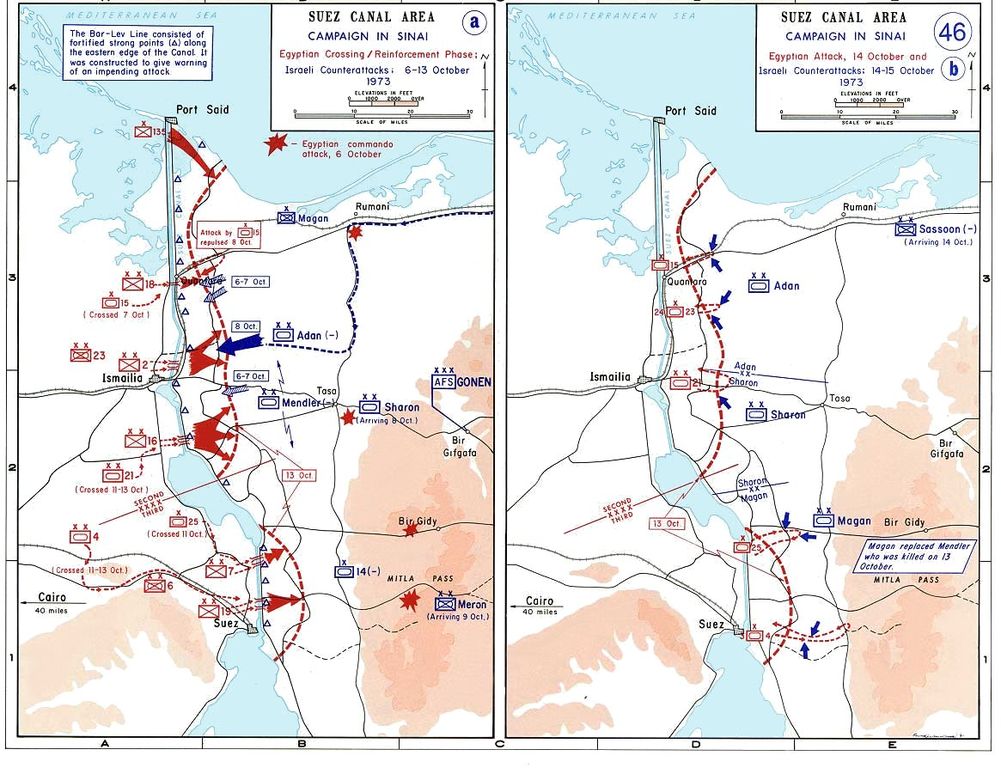
Yom Kippur War — Sinai front 6-15 October, 1973. (via Wikipedia)
Golda Meir remained in her post for another eight months while the people of Israel seethed. Though the Agranat Commission accepted her claim that she acted solely on the defense establishment’s advice and cleared her of any personal responsibility for the war, the population resented the blame placed almost solely on the army. The country, devastated emotionally and economically, was further traumatized by terrorist attacks that killed 52 civilians and wounded 150. Later that year, terrorist leader Yasser Arafat, a holster on his hip, received a standing ovation from the UN General Assembly, which went on to equate Zionism with racism. Succumbing to Arab pressure, 24 of the African countries with which Golda helped establish relations cut ties with Israel. In 1977, the degraded Mapai Party for the first time lost an election to Menachem Begin’s Likud, ending what many Israelis still regard as the state’s golden age.
Such painful events are barely touched upon in either of the Golda films, which prefer to conclude her story with Sadat’s historic visit to Israel in November 1977. The subsequent peace process resulted in the signing of the Egyptian-Israeli peace treaty in 1979, a year after Golda’s death.
Yet her legacy endures — especially now, on the 50th anniversary of the war. Though her standing remains highest in the United States — the Israel National Library reports more searches for her name in English than in Hebrew—in Israel, too, her record is being reconsidered. Here was a woman without military experience who had to rely on men whose expertise on military matters was above reproach. Here was a woman who, when many of those men buckled to pressure, remained clear-headed and strong. And here was a woman who, contrary to long-held wisdoms, repeatedly held out her hand for peace.
Some critics have been unkind to Golda. They take issue with the film’s concentration on her career’s least illustrious period and with the allegedly one-dimensional depiction of a personality known to be compassionate one minute but backbiting the next, alternately maternal and coarse. Most expressed discomfort with the director’s obsession with Golda’s cigarettes — they are practically actors — which earned the film a PG-13 rating for “pervasive smoking”. I, for one, would have liked to see more of Golda’s insecurities about her lack of higher education, military experience, and Hebrew eloquence. I would have welcomed more of the swift-witted Golda who once quipped to Kissinger, arriving in Tel Aviv after exchanging kisses with Egyptian and Syrian leaders, “Why, Mr. Secretary, I didn’t know that you kissed girls, too!”
Nevertheless, Golda must take its place alongside other outstanding portraits of leaders in crisis. Like Gary Oldman’s Churchill in Darkest Hour and Bruce Greenwood’s Kennedy in Thirteen Days, Helen Mirren’s Golda Meir offers a profile of greatness in the face of overwhelming adversity. These are films that, rather than merely report and redramatize facts, show us character. And Golda — the woman, not the myth — should continue to generate our interest as well as our respect. The Everywoman behind the bust should still be revered.
Comments Off on Golda Meir
How the Russian Army Collapsed
The Great War
Published 9 Sept 2023As 1917 began, the Russian army was larger and better-equipped than ever before. Within weeks, the Tsar and his dynasty were gone, and by the summer, the Russian army was disintegrating before the eyes of its generals — but how exactly did one of the most powerful armies in the world collapse?
(more…)
Comments Off on How the Russian Army Collapsed
The DOJ versus SpaceX
I was a bit boggled when the US Justice Department announced it was going after Elon Musk’s SpaceX for alleged discriminatory hiring practices:

Image from SpaceX website.
The Justice Department recently filed a lawsuit against SpaceX, the California-based spacecraft manufacturer and satellite communications company founded by Elon Musk.
In its lawsuit, the DOJ accused SpaceX of only hiring U.S. citizens and green-card holders, thereby discriminating against asylees and refugees in hiring, an alleged violation of the Immigration and Nationality Act.
Musk denied the allegations and accused the government of weaponizing “the DOJ for political purposes”.
“SpaceX was told repeatedly that hiring anyone who was not a permanent resident of the United States would violate international arms trafficking law, which would be a criminal offense,” Musk wrote on X, formerly known as Twitter.
It’s uncertain if the DOJ is actually targeting SpaceX (more on that in a minute), but George Mason University economist Alex Tabarrok quickly found a problem with the DOJ’s allegations.
“Do you know who else advertises that only US citizens can apply for a job?” Tabarrok asked. “The DOJ.”
Tabarrok even brought the receipts: a screenshot of the DOJ job website that explicitly states, “U.S. Citizenship is Required.”
So, if Musk is discriminating against non-U.S. citizens in his hiring practices, so is the DOJ.
This makes the lawsuit prima facie absurd on one level. However, one could also argue that there could be good reasons to discriminate in hiring. And as is usually the case, for better or worse, the government gets to decide when it’s OK to discriminate and when it’s not OK.
And that’s where things get hazy.
Musk and others claim that companies such as SpaceX are legally required to hire U.S. citizens because of International Traffic in Arms Regulations, a federal regulatory framework designed to safeguard military-related technologies.
The DOJ disagrees. So who is right? It’s difficult to say, Tabarrok pointed out.
“The distinction, as I understand it, rests on the difference between US Persons and US Citizens,” he wrote on Marginal Revolution, “but [SpaceX is] 100% correct that the DoD frowns on non-citizens working for military related ventures.”
In other words, SpaceX appears to have been trying to comply with Department of Defense regulations by not using non-citizens in military-related work, and in doing so, it may have run afoul of the DOJ.
Comments Off on The DOJ versus SpaceX
The tiny town that became a beacon of hope on 9/11
60 Minutes Australia
Published 12 Sept 2021The 20th anniversary of the September 11 attacks is understandably a time of deep sadness as the world remembers an act of evil that’s still hard to believe. But for some it’s also a chance to celebrate the opposite: kindness, compassion and the very best of humanity. In the mayhem of the day that saw terror raining from the skies, American airspace was shut down, and a tiny town in a remote part of north eastern Canada suddenly found itself the destination for commercial passenger aircraft ordered to land immediately. Seven thousand plane people with nowhere else to go were about to discover the delights of the wonderful community of Gander.
(more…)
Comments Off on The tiny town that became a beacon of hope on 9/11
QotD: The nature of human memory
One would not want a life of endless novelty, if only because that would mean a procession of superficial impressions and comparisons. Static, surprisingly, is impossible to compress without losing information, because its randomness makes prediction or interpolation impossible. Yet static is also meaningless. Too many random novelties, too fast, produces a lived experience not unlike static.
One of the virtues of experience is that it can attune us to subtle details and deep connections: “a world in a grain of sand, and a heaven in a wild flower”. (It may also allow us to draw out meaning from a brief allusion to a larger body of work.) But if repeated experience becomes humdrum, and we do not look for the depths, our days will be thin and forgettable.
So if you want a full life, rich with memories, keep searching for new experiences. That is far easier for the young than the old, but it should be possible for anyone. Surprising conversations are always there for the having and, while a holiday on the other side of the world is a costly (if reliable) source of vivid experiences, novelty is affordable for almost anyone in the form of new music, books, even walking an unfamiliar path through your own home town. It is always worth seeking out whatever is excellent — but for vivid memories, the same old excellence is not quite enough. Freshness matters, too.
Tim Harford, “Why going on holiday gives us more memories”, Financial Times, 2019-04-26.
Comments Off on QotD: The nature of human memory
September 10, 2023
Time for NFL running backs to set up their own union?
It’s been known for a few years, but has been brought into clear focus during this NFL offseason that the position of running back — historically one of the most important positions on the field after the quarterback — has been steadily devalued by NFL teams. Superbowl-hopeful teams no longer centre their game plan around a workhorse running back, with more and more plays being passes to wide receivers and tight ends rather than running the ball. During the 2023 offseason, several big-name running backs went public with their frustrations over new contracts. The NFL Players Association, the union for players to negotiate with the NFL’s owners, has not been as proactive for running back concerns so a break-away RB union is back under discussion:

… running backs — whose job includes receiving handoffs from the quarterback, catching passes, and blocking — are getting pummeled like never before by bigger, stronger, faster NFL players. Which means that when their contracts are up, running backs are more damaged than they used to be.
What’s more, the drama has shifted: running backs used to score a lot, but now the action revolves around quarterbacks and wide receivers.
That explains why team owners are increasingly hiring rookies to be their running backs and, instead of investing in them long-term, replacing those rookies with other rookies at the end of their first contract.
So, running backs — having suffered tons of concussions, ankle sprains, and other injuries — never see the big, second-contract payday other NFL players land. Like the Kansas City Chiefs’ quarterback Patrick Mahomes’ $450 million contract or the $120 million deal wide receiver Tyreek Hill signed with the Miami Dolphins.
All of which explains how Harris has become a leading advocate for a running-backs-only union — and the unlikely face of the new American labor movement.
“I agree with my running back brothers around the NFL — history will show that you need running backs to win — we set the tone every game and run through walls for our team,” Harris tweeted in July, after three of his fellow running backs failed to secure long-term deals with their teams.
The new union, which would be separate from the NFL Players Association, was first proposed in 2019, when the International Brotherhood of Professional Running Backs filed a petition with the National Labor Relations Board.
When Harris was asked in June what he thought of the idea, he said: “I’m open to it.”
He is joined by Tennessee Titans running back Derrick Henry, 29. Known as King Henry, he tweeted in July: “At this point, just take the RB position out the game then. The ones that want to be great & work as hard as they can to give their all to an organization, just seems like it don’t even matter. I’m with every RB that’s fighting to get what they deserve.”
Granted, professional running backs, with an average salary of $1.8 million, make a lot more than nurses, pilots, public school teachers, and everyone else in a union, but the money is declining, and they increasingly feel as though they’re being exploited by management at the same time the NFL is seeing record success. In 2023, the NFL secured $130 billion in new media deals. Of the top 100 network television broadcasts in the country last year, the league accounted for 82, and that figure is going up. On top of all that, game attendance is nearing an all-time high.
Comments Off on Time for NFL running backs to set up their own union?


