
Real Time History
Published 15 Sept 2023After the Second World War multiple French colonies were pushing towards independence, among them Indochina. The Viet Minh movement under Ho Chi Minh was clashing with French aspirations to save their crumbling Empire.
(more…)
September 16, 2023
France’s Vietnam War: Fighting Ho Chi Minh before the US
Comments Off on France’s Vietnam War: Fighting Ho Chi Minh before the US
Public health officials don’t seem to realize just how badly they’ve damaged their credibility
Chris Selley on the apparantly huge gap between how ordinary Canadians view their public health officials and how those officials think they’re viewed:

Throughout the pandemic, polls have shown a decline in confidence in public health: Researchers at McMaster University and Vox Pop Labs found that in March 2020, 59 per cent of Canadians had “a great deal of trust” in public health officials. Two years later that had plummeted to 37 per cent.
We have recently enjoyed months of being able to ignore COVID-19. Even the relentlessly, uniquely pessimistic Canadian media seemed to have exhausted themselves. So I found it a bit jarring to see Dr. Theresa Tam, Canada’s chief public health officer, suddenly back on the TV this week admonishing us to “get your mask ready” for fall and book yourself in for a booster. Dr. Kieran Moore, Tam’s counterpart at Queen’s Park, is due in the coming days to give Ontarians what will likely be a similar update.
If this year’s flu/RSV/COVID season is as bad as last, it will be fascinating to see how Canadians react. Perfervid opposition to masking and vaccination are minority positions: In the midst of last year’s autumn surge in childhood hospitalizations, a Nanos Research poll found 69 per cent of Canadians would support a return of mask mandates “if authorities deem(ed) it necessary”.
But are people ready to hear it, again, from the same public-health officials who have all-but destroyed their entire field in the last three years — seemingly without realizing it? It will be intriguing to see.
Tam’s original sins remain totally unexplained — at an official inquiry, for example, hint hint — never mind expiated. For days and weeks in early 2020, while our peer countries were closing borders and preparing for a pandemic, Tam assured us “the risk to Canada is low”. She lied that World Health Organization rules prohibited us from closing borders. She told us masks were worse than useless, and the only excuse anyone can offer is that she was fibbing to prevent Canadians from hoarding PPE. (I think she actually believed it. Either explanation is a firing offence.)
Remember the utterly incoherent advice the Public Health Agency of Canada provided to incoming travellers in the early days? Remember the built-to-fail, purely political quarantine hotels that Tam said weren’t necessary until they suddenly were — just as she said 14-day quarantine at home wasn’t necessary until it suddenly was? We were weeks if not months behind most of our peer countries. Regardless of your position on any given restriction, none of it made any sense.
The many, MANY failed VW Beetle Reboots!
Big Car
Published 22 Oct 2021I recently made a video on the many, many times British Leyland tried to update the Mini. The lack of an update helped to make the original Mini an iconic shape. The same has happened to many other iconic cars, and the Volkswagen Type 1 or Beetle falls into the same camp. Why did it take 36 years until the Beetle would get a replacement, and how did a car made as a Nazi show of strength end up in a Disney film?
(more…)
Comments Off on The many, MANY failed VW Beetle Reboots!
QotD: The Persian “Royal Roads”
The first thing worth clearing up about the Roman roads is that, contrary to a lot of popular belief, the Roman roads were not the first of their kind. And I mean that in a variety of ways: the construction of roadways with a solid, impermeable surface (that is, not just clearing and packing dirt) was not new with the Romans, but more importantly the concept of knitting together an empire with a system of roadways was not new.
The oldest road network that we have pretty good evidence for was the Persian Royal Road of the Achaemenids but these too were not the first (the Achaemenid dynasty ruling a vast empire from 559 to 330 BC; this is the Persian Empire of Xerxes and Darius III). Even before them the Assyrians (Middle and Neo-Assyrian Empires running from 1363 to 609 BC)1 had build roadways to hold together parts of their empire, though I confess I know very little of the extent of that road system except that we’re fairly sure it existed and like the later systems we’re going to talk about, it included not just the physical infrastructure of the roads but a sophisticated relay system to allow official messengers to move very rapidly over the network.
The modern perception of the Persian Royal Road is conditioned perhaps a bit too much by Herodotus who described the royal road – singular – as a single highway running from Susa to Sardis. Susa was one of several Achaemenid royal capitals and it sat at the edge of the Iranian plateau where it meets the lowland valley of Mesopotamia, essentially sitting right on the edge where the Persian “heartland” met the area of imperial conquests. Meanwhile, Sardis was the westernmost major Achaemenid administrative center, the regional capital, as it were, for Anatolia and the Aegean. So you can see the logic of that being an important route, but the road system was much larger. Indeed, here is a very rough sketch of how we might understand the whole system.
Compare the dashed line – the Royal Road as described by Herodotus – with the solid lines, the rest of the system we can glean from other sources or from archaeology and you can see that Herodotus hasn’t given us the whole story. For what it is worth, I don’t think Herodotus here is trying to lie – he has just described the largest and most important trunk road that leads to his part of the world.
This system doubtlessly emerged over time. Substantial parts of the road network almost certainly predated the Achaemenids and at least some elements were in place under the first two Achaemenid Great Kings (Cyrus II, r. 559-530 and Cambyses II, r. 530-22) but it seems clear that it is the third Achaemenid ruler, Darius I (r. 522-486; this is the fellow who dispatched the expedition defeated at Marathon, but his reign was far more important than that – he is the great organizer of the Persian Empire) who was responsible for the organization, formalization and expansion of the system. And in practice we can split that system into two parts, the physical infrastructure of roads and then the relay system built atop that system.
In terms of the physical infrastructure, as far as I can tell, the quality of Persian Royal Roads varied a lot. In some areas where the terrain was difficult, we see sections of road cut into the rock or built via causeways over ravines. Some areas were paved, but most – even most of the “royal” roads (as distinct from ancillary travel routes) were not.2 That said, maintenance seems to have been more regular on the royal roads, meaning they would be restored more rapidly after things like heavy rains that might wash an unpaved road out, making them more reliable transport routes for everyone. They also seem to have been quite a bit wider; Achaemenid armies could have long logistics tails and these roads had to accommodate those. Several excavated sections of royal roads are around 5m wide, but we ought to expect a lot of variation.
On top of the physical infrastructure, there was also a system of way-stations and stopover points along the road. These were not amenities for everyone but rather a system for moving state officials, messengers, soldiers, and property (like taxes). While anyone could, presumably, walk down the road, official travelers carried a sealed travel authorization issued by either a satrap (the Persian provincial governors) or the king himself. Such authorizations declared how many travelers there were, where they were going and what the way-stations, which stocked supplies, should give them. Of course that in turn meant that local satraps had to make sure that way-stations remained stocked up with food, fodder for animals, spare horses and so on. Fast messengers could also be sent who, with that same authorization, would change horses at each way-station, allowing them to move extremely fast over the system, with one estimate suggesting that a crucial message could make the trip from Sardis to Susa – a trip of approximately 2,500km (1,550 miles, give or take) in twelve days (by exchanging not only horses, but riders, as it moved).
All of which gives some pretty important clues to why royal roads were set up and maintained. Notice how the system specifically links together key administrative hubs, like the three main Achaemenid capitals (Susa, Ekbatana and Persepolis) and key administrative centers (Memphis, Sardis, Babylon, etc.) and that while anyone can use the roads, the roads serve as the basis for a system to handle the logistics of moving officials and state messages, which of course could also serve as the basis for moving armies. After all, you can send messengers down the royal roads, through the existing system set up for them, to instruct your satraps to gather local forces or more importantly to gather local food supplies and move them to the road in depots where the army can pick them up (and perhaps some local troops) as it moves through to a nearby trouble spot (while the nice, wide road allows you to bring lots of pack animals and carts with your army).
In short this is a large, expensive but effective system for managing the problem of distance in a large empire. Cutting down travel and message times reduces the independence of the satraps, allowing the Great King to keep an eye on them, while the roads provide the means to swiftly move armies from the core of the empire out to the periphery. We can actually see this play out with Alexander’s invasion. He crosses into Asia in 334 and defeats the local satrapal army at Granicus in 334. Moving into the Levant in 333, he’s met at Issus by Darius III with a massive army, collected from the central and western parts of the empire – which means that news of Alexander’s coming has reached Darius who has then marshaled all of those troops from his satrapies (and hired some mercenaries), presumably using his efficient message system to do it and then moved that force down the road system to meet Alexander. Alexander defeats that army, but is met by another huge army at Gaugamela in 331, this time gathered mostly from the eastern parts of the empire. While the Persian army fails in defeating Alexander, the exercise shows the power of the system in allowing the Great King, Darius III to coordinate the military efforts of an enormous empire.
So this is a system meant to enable the imperial center to control its periphery by enabling the court to keep tabs on the satraps, to get messages to and from them and move armies and officials (and taxes!) around. And doubtless it was also not lost on anyone that such a visible series of public works – even if the roads were not always paved and had to be repaired after heavy rains and such – was also an exercise in legitimacy building, both a visual demonstration of the Great King’s power and resources but also a display of his generosity and industry.
And I lead with all of that because the Roman road network works the same way, just on an even larger scale. Which isn’t to say the Romans were copying the Achaemenids (they don’t seem to have been) but rather that this is a common response to the problem of managing an uncommonly large empire.
Bret Devereaux, “Collections: Roman Roads”, A Collection of Unmitigated Pedantry, 2023-06-02.
1. The Middle Assyrian Empire and the Neo-Assyrian or New Assyrian Empires were, in fact, the same state. We split them up because of a severe contraction in Assyrian power during the Late Bronze Age Collapse.
2. On this, see Henkelman and Jacobs, 727-8
Comments Off on QotD: The Persian “Royal Roads”
September 15, 2023
Donald Trump as a political autoimmune condition
Kulak has a very interesting view on the role of Donald Trump within the American body politic:

People ask me why I’m so keen on Trump
Trump is not an exceptional political thinker, he’s a fairly awful organizer and a worse hirer of people (despite his claims otherwise)… Indeed one need only look at his choices for the Department of Justice, or his COVID response to see him consistently hiring the absolute worst enemies of his supporters and indeed himself…
He seemingly only hired people anyone on the 2008 Ron Paul campaign could have predicted would have betrayed him… and indeed would have been able to predict it in 2008.
(ex Bush people are loyal to the regime, hate their own base, and view ordinary Americans as the enemy? Who would have guessed!)
And yet little of that matters.
And to understand why, you have to understand Autoimmune disease.
Autoimmune diseases result when the immune system, the thing that is supposed to protect the body from outside threats… goes haywire and attacks the body, in response to something that is no threat at all.
All immune responses and most external disease treatments have some drawbacks … Minor immune responses like a fever or the mucus responses of the sinuses make physical exertion torturous for example … But as the response gets more extreme the more they threaten the patient itself … a medical response like Cemo might kill cancer, but its also a poison… potentially fatal to a patient if not measured precisely … Likewise, the body’s immune responses can be fatal: High Fevers can result in death or brain damage … and the Anaphylaxis response, a flood of chemicals and white blood cells meant to combat the most dangerous exposures … can and does kill people.
Of course, we are all familiar with allergies, where a harmless exposure such as certain pollens or nuts can provoke devastating and sometimes fatal Autoimmune responses.
Trump provokes such an autoimmune response in the regime.
He is not a Hitlerian master of oratory or political organizing and maneuvering, he’s not even the most impressive populist America has produced … And he’s certainly not a bloodthirsty ideological and military/political genius like Lenin or Mao (which sadly the Right-Libertarians have failed to produce, despite rivaling the communists in their output of theory and economics texts)
Yet Trump activates the class and ethnic disgust response of the regime so violently that the American regime might actually kill itself trying to reject him.
Trump should have been like Ronald Reagan, an aging artifact of an older generation, keen to compromise with the regime, easily appeased with deals that would make him at least look like he’s winning … and ultimately un-committed to combating Either the security state or the Civil Rights priesthood… the first of whom defeated JFK and the combo of whom took down Nixon.
And yet this man who showed up stating he wanted to make “big beautiful deals” and who was incapable of even hiring anyone who thought like his movement …
They went to DEFCON 1 and nearly destroyed the republic to stop him.
Because they hate his voters that much …
It’s a point Severian has made several times:
If they were capable of taking a “loss”, they [the Democrats] could’ve made Trump into the best friend they ever had. That guy was begging them to be allowed to “grow in office”. Had the Cloud People said a few nice things about him on Twitter, he would’ve done anything they wanted.
But their own convulsive reaction to the Trump insurgency made it impossible for them to do the clever thing, and their ongoing attempts to “get” Trump through any legal mechanism they can come up with has made him more politically powerful. They might have to put him up in front of a firing squad to get rid of him at the rate they’re going … but Trump as a martyr would be even more deadly to their plans than Trump as federal inmate 98722580.
Comments Off on Donald Trump as a political autoimmune condition
The old “war of the sexes” has been won decisively by women … and the aftermath won’t be pretty for any of us
I saw an article earlier today in The Free Press on the plight of young men in the dating scene these days (discussed earlier this month here and in July here). In short, men who don’t meet certain arbitrary minimums will have almost no chance with modern women in their age cohort. If you’re not at least six feet tall (males average 5’9″ worldwide), earn at least six figures (US men average under $60K per year), and have a penis at least six inches long (official estimates say American men average 5.1″ to 5.5″), you might as well give up on the dating scene.
Tom Knighton links all that from the Free Press article with some advice for young men on the off-chance they ever do have a date:

First, let’s look at this from Fox News, where a mother laments some of the issues at college with regard to Title IX and rape accusations.
If my two sons were starting college this Fall I would tell them this: be doubly sure you get consent — for her sake and yours. Maybe even record that consent (how romantic!). Your education and future may depend on it.
Under Biden’s proposed Title IX rules, if a college student is accused of sexual assault or harassment, he will no longer have the right to a live hearing, to cross-examine his accuser and witnesses, or to be represented by an attorney. Instead, a school administrator can decide to forgo a hearing and weigh the “credibility” of each party on his own, acting as investigator, judge, and jury in the case.
The standard for determining guilt will also be weakened from “clear and convincing” to a “preponderance of the evidence” — in other words, that there’s a 50.1 percent or greater chance an assault occurred. Not great odds in what are often “he said, she said” cases.
…
College students — mainly young men — should be worried. Biden’s Title IX changes are a reversal of rules implemented by the Trump administration in 2020, and a return to the “believe all women” attitude laid out in the Obama administration’s 2011 “Dear Colleague” letter.
This suggests a fraught landscape for young men, many of whom might just decide not to risk it.
As it is, our educational system actually favors women in many ways.
The primary, middle, and high school classrooms are constructed in a way that actually favors the way girls typically learn as opposed to how boys do. As a result, girls tend to get better grades and a leg up on getting into college.
Further, as a protected class, even before the recent Supreme Court ruling, women had a bit of an edge at being accepted to college under affirmative action guidelines, though race did tend to play a larger factor.
Now you’re favoring women’s position in a “he said/she said” environment of sexual assault allegation, even when there’s no other evidence. I say this because I’ve covered these stories off and on for years now. That’s how it happens in a surprising number of cases.
It’s a situation where young men are disfavored and operating at a disadvantage from day one, then it gets worse from there.
Schools often have all kinds of support services for female students on top of the support services open to all students. Guys, however, get no such help.
With all that in mind, it’s not surprising that women graduate college at a much higher rate than men.
The relationship between graduating university and earning a higher salary isn’t as robust as it used to be, but it’s still financially advantageous to have a degree in most careers. More and more women do and fewer and fewer men do. That means more higher-income women are competing for fewer high-status men. That tiny proportion of men benefit disproportionally from their increasing rarity in the dating pool.
Men aren’t graduating college at a similar rate to women? Well, who cares? At least women aren’t being kept out of education.
Men can’t find romantic partners and instead, turn to online porn? Well, who cares? At least women are empowered enough to be picky.
I’m not saying we should dictate anything to do with people’s personal choices, but we could at least start to realize that young men are in crisis mode and that we might want to do something about that before we have real problems.
Then we have the potential decrease in the population as fewer and fewer families are starting and I just don’t see good things happening going forward.
Large numbers of angry young men with no chance at forming relationships with women and generally under- or unemployed? This is not a scenario for a happy or stable future.
Comments Off on The old “war of the sexes” has been won decisively by women … and the aftermath won’t be pretty for any of us
Learning to handle mules to accompany Chindit columns in WW2
Robert Lyman posted some interesting details from veteran Philip Brownless of how British troops in India had to learn how to handle mules and abandon their motor transport in order to get Chindit columns into Japanese territory in Burma:
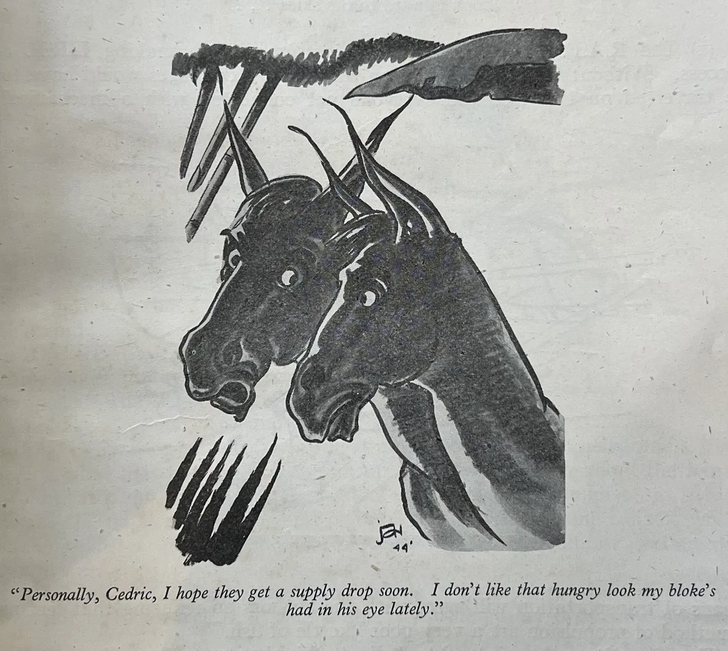
A fabulous drawing from Jungle, Jungle, Little Chindit (1944)
Soon after our return from the Arakan front in the autumn of 1943, we were in central India, and had been told that the whole division was to be handed over to General Wingate and trained to operate behind the Japanese lines. All our motor transport was to be taken away and we were to be entirely dependent upon mules for our transport.
The C.O. one evening looked round the mess and then said to me “You look more like a country bumpkin than anybody else. You will go on a veterinary course on Tuesday and when you come back you will take charge of 44 Column’s mules.”
I had never met one of these creatures before. On arriving at Ambala I reported to the Area Brigade Major who wasn’t expecting me and seemed to have no clue about anything. He said “You’d better go down to the Club and book in”. I reported to the Club, a comfortable looking establishment, and they seemed to have a vague idea that a few bodies like me might turn up on a course and were apologetic that I would have to sleep in a tent but otherwise could enjoy the full facilities of the Club. I was shown the tent, an EPIP tent or minor marquee, with a coloured red lining and golden fleur de lys all over it, (very Victorian) with a small office extension with table and chair in front and another extension at the back with bath, towel rail and a fully bricked floor. Having lived either in a tent or under the stars in both the desert and the Arakan for the last 2 years, this struck me as luxury indeed. Even better, I took on a magnificent bearer, with suitable references, whom I found later was some kind of Hindu priest. I soon got used to having my trouser legs held up for me to put my feet in, and being helped into the rest of my clothes. I had a comfortable 3 weeks learning all about mules.
I discovered all sorts of things like the veterinary term “balls”, which were massive pills which were given to the mule by – first of all grabbing his tongue and pulling it out sideways so he couldn’t shut his mouth on your arm, and then gently throwing the ball at his epiglottis and making sure it went down. Then you let go of his tongue and gave him a nice pat. One of our lecturers, an Indian warrant officer, knew his stuff well and was so pleased about it that when he asked a question he would give you the answer himself. He liked being dramatic and loved to finish a description of some fatal ailment by saying “Treatment, bullet”.
Many of the men in our battalion were East Enders; others came from all over Essex. A few were countrymen, two were Irish and knew all about horses, one sergeant had been in animal transport and one invaluable soldier had been an East End horse dealer. The large majority had had nothing to do with animals: however, the saving grace was that English soldiers seem to be naturally good with animals and soon learned to handle them well. I arranged to get some instruction from the nearby unit of Madras Sappers and Miners and we borrowed a handful of trained mules from them for the men to practise handling, tying on loads and learning to talk to them.
Then came the great day when we were to draw up our main complement of animals, about 70 mules and 12 ponies. We were dumped at a small railway station. It was all open ground and there was a team of Army Veterinary Surgeons to allocate fairly between the three battalions, the Essex, the Borders and the Duke of Wellington’s. Lieut. Jimmy Watt of the Borders was a pal of mine: he and I, with a squad of men were to march them back nearly 100 miles to our camp, sleeping each of the five nights under the stars. As soon as we arrived at the disembarkation site I got all our mule lines laid out, with shackles (used to tie mules fore and aft) and nosebags ready. I had also picked up the tip that the mules would be wild, having spent three days in the train, and almost impossible to hold, so I instructed our men to tie them together in threes before they got off the train. As all three pulled in different directions, one muleteer could hold them. Not everybody had learned this trick so the result was that wild mules were careering all over the place, impossible to catch. When our first handful of mules arrived, they were quickly secured in a straight line and fed. They were familiar with lines like this and cooled down at once, long ears relaxed and tails swishing amiably. When the wild mules careering round saw this line, they said to themselves “We’ve done this before” and came and stood in our lines. We shackled them and I picked out the moth-eaten ones and sent them back to the vets who kept sending polite messages of thanks to Mr. Brownless for catching them. We finished up with a very good set of mules. Jimmy Watt and I had a bit of a conscience about the Duke of Wellington’s so we picked them out a really good pony. We felt even worse a few weeks later when it was sent back to Remounts with a weak heart! The Brigade Transport Officer visited us the second evening so Jimmy Watt and I walked him round rather quickly, chatting hard, to approve the allocation of animals, and he agreed with our arrangement.
In a highly optimistic mood early on, I decided to practise a river crossing. We marched several miles out from camp to a typical wide sandy Indian river, 300 yards across, made our preparations, i.e. assembling the two assault boats, making floating bundles of our clothes and gear by wrapping them in groundsheets, unsaddling the animals, and assembling at the water’s edge. A good sized detachment of muleteers was posted on the opposite bank ready to catch the mules. The mules waded into the shallow water but no one could get them to move off. We tried all sorts of inducements in vain and then suddenly, one sturdy little grey animal decided to swim and the whole lot immediately followed. Calamity ensued! Mules are very short sighted and could only dimly see the opposite bank but downstream was a bright yellow sandy outcrop and they all made for this. The muleteers on the other bank, when they realised what was happening, ran through the scrub and jungle as fast as they could, but the mules arrived first and bolted off into the wilds of India. I swam my pony across with my arm across his withers and directing him by holding his head harness, the gear was ferried across and the mule platoon, with one pony, began the march back to camp. Deeply depressed, I wondered how to tell the C.O. I had lost all his mules and imagined the court martial which awaited me (or, serving under General Wingate, would I be shot out of hand?) An hour and a half later we came in sight of the camp and to my utter astonishment I could see the mules in their lines. When I arrived at the mule lines, the storeman met me and said that the whole lot had arrived at the double and had gone to their places. He had merely gone along the lines, shackling them and patted their noses. Salvation! I kept quiet for a bit but it got out and I was the butt of much merrymaking.
Comments Off on Learning to handle mules to accompany Chindit columns in WW2
Brun-Latrige Model 1900
Forgotten Weapons
Published 14 Apr 2016Patented in 1896, this is one of several models of unique pocket pistols designed by Paul Brun-Latrige. He was a manager of the Manufrance company located in St. Etienne France, a large mail-order catalog company that produced a wide variety of products. Early versions of this pistol used a ring trigger mechanism and a 5mm cartridge, while this one uses a folding trigger and is chambered for an 8mm round (the same ammunition used in Manufrance’s Gaulois palm pistols, I suspect).
Comments Off on Brun-Latrige Model 1900
QotD: Modernism into Post-Modernism
Gertrude Himmelfarb, On Looking into the Abyss, 1994.
Comments Off on QotD: Modernism into Post-Modernism
September 14, 2023
Scott Alexander reviews the (old) Elon Musk biography
It’s okay, he makes it clear from the start that he’s talking about Ashlee Vance’s earlier work, not the one that just hit the shelves this year:

Elon Musk at the 2015 Tesla Motors annual meeting.
Photo by Steve Jurvetson via Wikimedia Commons.
This isn’t the new Musk biography everyone’s talking about. This is the 2015 Musk biography by Ashlee Vance. I started reading it in July, before I knew there was a new one. It’s fine: Musk never changes. He’s always been exactly the same person he is now.1
I read the book to try to figure out who that was. Musk is a paradox. He spearheaded the creation of the world’s most advanced rockets, which suggests that he is smart. He’s the richest man on Earth, which suggests that he makes good business decisions. But we constantly see this smart, good-business-decision-making person make seemingly stupid business decisions. He picks unnecessary fights with regulators. Files junk lawsuits he can’t possibly win. Abuses indispensable employees. Renames one of the most recognizable brands ever.
Musk creates cognitive dissonance: how can someone be so smart and so dumb at the same time? To reduce the dissonance, people have spawned a whole industry of Musk-bashing, trying to explain away each of his accomplishments: Peter Thiel gets all the credit for PayPal, Martin Eberhard gets all the credit for Tesla, NASA cash keeps SpaceX afloat, something something blood emeralds. Others try to come up with reasons he’s wholly smart – a 4D chessmaster whose apparent drunken stumbles lead inexorably to victory.
Elon Musk: Tesla, SpaceX, And The Quest For A Fantastic Future delights in its refusal to resolve the dissonance. Musk has always been exactly the same person he is now, and exactly what he looks like. He is without deception, without subtlety, without unexpected depths.
The main answer to the paradox of “how does he succeed while making so many bad decisions?” is that he’s the most focused person in the world. When he decides to do something, he comes up with an absurdly optimistic timeline for how quickly it can happen if everything goes as well as the laws of physics allow. He – I think the book provides ample evidence for this – genuinely believes this timeline,2 or at least half-believingly wills for it to be true. Then, when things go less quickly than that, it’s like red-hot knives stabbing his brain. He gets obsessed, screams at everyone involved, puts in twenty hour days for months on end trying to try to get the project “back on track”. He comes up with absurd shortcuts nobody else would ever consider, trying to win back a few days or weeks. If a specific person stands in his way, he fires that person (if they are an employee), unleashes nonstop verbal abuse on them3 (if they will listen) or sues them (if they’re anyone else). The end result never quite reaches the original goal, but still happens faster than anyone except Elon thought possible. A Tesla employee described his style as demanding a car go from LA to NYC on a single charge, which is impossible, but he puts in such a strong effort that the car makes it to New Mexico.
This is the Musk Strategy For Business Success; the rest is just commentary.
1. Vance starts with the story of the biography itself. When Musk learned he was being profiled, he called Vance, threatened that he could “make [his] life very difficult”, and demanded the right to include footnotes wherever he wanted telling his side of the story. When Vance said that wasn’t how things worked, Elon invited him to dinner to talk about it. Elon arrived late, and spent the first few courses talking about the risk of artificial superintelligence. When Vance tried to redirect the conversation to the biography, Elon abruptly agreed, gave him unprecedented access to everyone, and won him over so thoroughly that the book ends with a prediction that Musk will succeed at everything and become the richest man in the world (a bold claim back in 2015).
I like this story but find myself dwelling on Musk’s request — why shouldn’t he be allowed to read his own biography before publication and include footnotes giving his side of the story where he disagrees? That sounds like it should be standard practice! If I ever write a post about any of you and you disagree with it, feel free to ask me to add a footnote giving your side of the story (or realistically I’ll put it in an Open Thread).
2. The book gives several examples of times Musk almost went bankrupt by underestimating how long a project would take, then got saved by an amazing stroke of luck at the last second. When Vance asked him about his original plan to get the Falcon 1 done in a year, he said:
“Reminded about the initial 2003 target date to fly the Falcon 1, Musk acted shocked. ‘Are you serious?’ he said. ‘We said that? Okay, that’s ridiculous. I think I just didn’t know what the hell I was talking about. The only thing I had prior experience in was software, and, yeah, you can write a bunch of software and launch a website in a year. No problem. This isn’t like software. It doesn’t work that way with rockets.”
But also, the employees who Vance interviewed admit that whenever Musk asks how long something will take, they give him a super-optimistic timeline, because otherwise he will yell at them.
3. I wondered whether Elon was self-aware. The answer seems to be yes. Here’s an email he wrote a friend:
“I am by nature obsessive compulsive. In terms of being an asshole or screwing up, I’m personally as guilty of that as anyone, and am somewhat thick-skinned in this regard due to large amounts of scar tissue. What matters to me is winning, and not in a small way. God knows why … it’s probably [rooted] in some very disturbing psychoanalytical black hole or neural short circuit.”
Comments Off on Scott Alexander reviews the (old) Elon Musk biography
I Built a FOOT POWERED Lathe (Most requested video)
Rex Krueger
Published 13 Sep 2023How to make a hand tool spring pole lathe. Almost.
(more…)
Comments Off on I Built a FOOT POWERED Lathe (Most requested video)
Canadians’ opinions have flipped on the immigration issue this summer
Tristin Hopper covers the rapid change in public opinion from majority in favour of the Liberal government’s expanded immigration targets to majority opposed in recent polling:

A billboard in Toronto in 2019, showing PPC leader Maxime Bernier and an official-looking PPC message.
Photo from The Province – https://theprovince.com/opinion/columnists/gunter-berniers-legitimate-position-on-immigration-taken-down-by-spineless-billboard-company/wcm/ecab071c-b57d-4d93-b78c-274de524434c
A majority of Canadians now seem to think that immigration is too high, according to a recent Nanos poll. Of respondents, 53 per cent said that the government’s plan to accept 465,000 new permanent residents was too high. It’s a sharp turnaround from just a few months prior, when a similar Nanos poll in March found that only 34 per cent of Canadians thought immigration was too high.
Canada has long been one of the most pro-immigration countries on earth, and since at least the 1990s the mainstream Canadian position on immigration levels was that they were just fine. On the eve of Justin Trudeau’s election as prime minister in 2015, an Environics poll found that a decisive 57 per cent of Canadians disagreed with any notion that there is “too much immigration in Canada.”
But if this sentiment is changing, it might be because Ottawa has recently dialled up immigration to the highest levels ever seen in Canadian history. Below, a quick guide to just how many people are entering Canada these days.
Immigration is nearly double what it was at the beginning of the Trudeau government (and way more when you count “non-permanent” immigrants)
In 2014 — the last full year before the election of Justin Trudeau — Canada brought in 260,404 new permanent residents. This was actually rather high for the time, with Statistics Canada noting it was “one of the highest levels in more than 100 years”.
But last year, immigration hit 437,180, and that’s not even accounting for the massive spike in “non-permanent” immigration. When the estimated 607,782 people in that category are accounted for, the Canadian population surged by more than one million people in a single calendar year. Representing a 2.7 per cent annual rise in population, it was more than enough to cancel out any per-capita benefits from Canada’s GDP rise for that year.
It’s about on par with the United States (a country which is eight to 10 times larger)
Proportionally, Canada has long maintained higher immigration than the United States. But in recent months immigration has gotten so high that Canada is even starting to rival the Americans in terms of the raw number of newcomers.
Last year, while Canada marked one million newcomers, the U.S. announced that its net international migration was about the same. Given the size of the U.S. (331 million vs. 40 million in Canada), this means that Canada is absorbing migrants at a rate more than eight times that of the Americans.
When these trends first began showing themselves in early 2022, CIBC deputy chief economist Benjamin Tal credited it with driving down Canadian wage growth. “The last time I checked, the U.S. is 10 times larger than we are,” he said.
Comments Off on Canadians’ opinions have flipped on the immigration issue this summer
Chip Carving with a Gouge | Paul Sellers
Paul Sellers
Published 5 May 2023Starting carving usually begins with a simple project, and this flower will get you started. Once you have done this, you can create a wide range of other decorative carvings and add them to your woodworking projects, pieces like box lids and picture frames. Enjoy!
——————–
(more…)
Comments Off on Chip Carving with a Gouge | Paul Sellers
QotD: Going to “the mall”
“Eh, it was dead,” you might say.
“What did you do?”
“Nothing.”
Neither was true. Every trip to the mall had a routine. You’d swing by the sausage and cheese store for samples. You’d go to the record store to leaf through the sheaves of albums, nodding at the rock gods’ pictures on the wall, content in the cocoon of your generation’s culture. Head over to Chess King to see if there was something stylish you could wear on a date, if you ever had one; saunter casually into Spencer Gifts to look at the posters in the back, snicker at the naughty gifts, marvel at some electronic thing that cast colored patterns on the wall. Then you’d find a place, maybe by the fountain in the center, and watch the world go past in that agreeably tranquilized state of mall shopping.
Dead? Hardly. Okay, maybe it was the afternoon, low traffic. No movie you really wanted to see, the same stuff in the stores you saw last week. Of course you’d go back tomorrow, because that’s what you did with your friends. You went to the mall.
A dead mall is something else today: a vast dark cavern strewn with trash, stripped of its glitter, its escalators frozen, waiting for the claws to take it apart. The internet abounds with photos taken by surreptitious spelunkers, documenting the last days of once-prosperous malls. We look at these pictures with fascination and sadness. No one said they’d last forever. But there wasn’t any reason to think they wouldn’t. Hanging out as teens, we never thought we’d outlive the mall.
James Lileks, “The Allure of Ruins”, Discourse, 2023-06-12.
Comments Off on QotD: Going to “the mall”
September 13, 2023
Michael Geist on the “relentless misinformation campaign that ignores the foundational principles of copyright law”
Michael Geist discusses a recent public statement from the Canadian Federation of Library Associations on how changes to copyright rules in Canada may seriously impact the public:

Assignments of copyrights photostat copies by mollyali (CC BY-NC 2.0) https://flic.kr/p/5JbsPE
Last month, the Canadian Federation of Library Associations released a much-needed statement that sought to counter the ongoing misinformation campaign from copyright lobby groups regarding the state of Canadian copyright and the extensive licensing by libraries and educational institutions. I had no involvement whatsoever with the statement, but was happy to tweet it out and was grateful for the effort to set the record straight on what has been a relentless misinformation campaign that ignores the foundational principles of copyright law. Lobby groups have for years tried to convince the government that 2012 copyright reforms are to blame for the diminished value of the Access Copyright licence that led Canadian educational institutions to seek other alternatives, most notably better licensing options that offer greater flexibility, access to materials, and usage rights. This is false, and when the CFLA dared to call it out, those same groups then expressed their “profound disappointment” in the library association.
Yet what has been disappointing is that despite repeated Supreme Court of Canada decisions that have eviscerated the foundation of those groups’ claims, they insist on running back the same failed strategy again and again. The reality of Canadian copyright isn’t complicated: libraries and the education community spend more than ever before on licences that provide the right to access and use materials for teaching, course materials, text and data mining, and a myriad of other purposes. When combined with the gradual disappearance of course packs, the emergence of open access materials, and a reasonable interpretation of fair dealing consistent with Canadian jurisprudence, education and libraries are fulfilling their mandate by responsibly using public dollars to maximize public access, enable student learning, and ensuring fair compensation for authors.
The lobbying efforts to convince government to restrict fair dealing by requiring unnecessary licences would increase student costs, make education less affordable, and render Canada less competitive. Further, it would mean less access to materials for Canadian students. Universities spend hundreds of millions of dollars on licences that grant both access to materials (purchasing physical books has declined dramatically) and the ability to use them. The outdated Access Copyright licences only grant rights to use already acquired works for a limited series of purposes. Reverting back to the unnecessary Access Copyright licence would mean access to fewer works and reduced investment by the education sector and libraries in new works.
I wrote a six-part series on these issues earlier the year including posts on setting the record straight, the shift to electronic licensing, transactional licences, the disappearance of course packs, the emergence of open text books, and a fair reading of fair dealing. Once you get past the rhetoric, the data leaves little doubt that education and libraries are still actively paying for copyright materials through licensing and the claims of mass illegal copying in education in 2023 is a fabrication unsupported by the evidence.
Comments Off on Michael Geist on the “relentless misinformation campaign that ignores the foundational principles of copyright law”


