
Class is everywhere in this election, invoked seemingly every time someone wants to put a sympathetic face on a policy proposal or make a point about being in touch with ordinary Canadians.
There’s the “middle class” that’s constantly prioritized, flattered and fetishized by every campaign and candidate; critiques of people who come from such a privileged class they can’t possibly understand the concerns of normal people; sometimes bizarre pitches aimed at those who want a better future for their kids and just need a boost (camping, anyone?); and leaders who come from hardscrabble backgrounds — except that maybe they don’t quite.
But if class is an ever-present anthem running through campaign 2019, it’s a tune no one seems to know the proper words to, or they’re deliberately mumbling nonsense lyrics and assuming no one else will notice.
[…]
Then there is the electorally beloved — and conveniently poorly defined — “middle class”. Given all the campaign trail hot air devoted to lauding the values and hard work of this population and lionizing their noble struggles, you would think that at some point, other corners of the electorate would get ticked off about being ignored by politicians in favour of these golden children.
But they don’t, because pretty much everyone thinks that’s them.
Shannon Proudfoot, “The ‘family shame’ of Canadian politics: class struggle”, Maclean’s, 2019-10-04.
August 4, 2024
QotD: Canada’s “middle class”
August 3, 2024
The Battle of Lepanto, 7 October 1571
Big Serge looks at the decisive battle between the “Holy League” (Spain, Venice, Genoa, Savoy, Tuscany, the Papal States and the Order of St. John) against the Ottoman navy in the Ionian Sea in 1571:
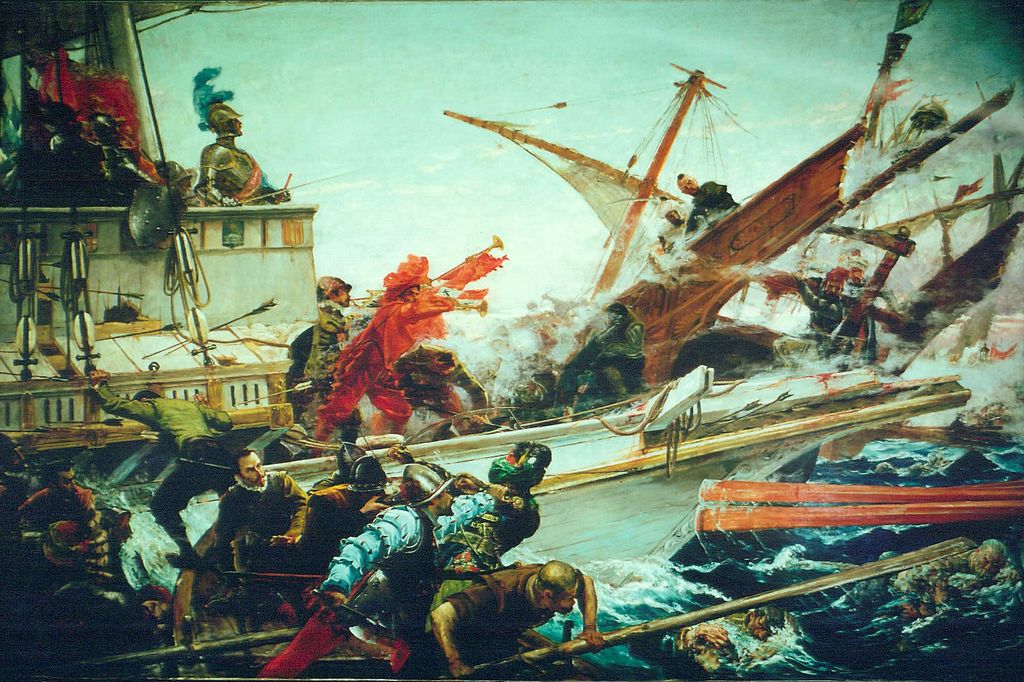
“The Battle of Lepanto”
Oil painting by Juan Luna, 1887. From the Senate of Spain collection via Wikimedia Commons.
Lepanto is a very famous battle, and one which means different things to different people. To a devout Roman Catholic like Chesterton, Lepanto takes on the romanticized and chivalrous form of a crusade — a war by the Holy League against the marauding Turk. At the time it was fought, to be sure, this was the way many in the Christian faction thought of their fight. Chesterton, for his part, writes that “the Pope has cast his arms abroad for agony and loss, and called the kings of Christendom for swords about the Cross”.
For historians, Lepanto is something like a requiem for the Mediterranean. Placed firmly in the early-modern period, fought between the Catholic powers of the inland sea and the Ottomans, then on the crest of their imperial rise, Lepanto marked a climactic ending to the long period of human history where the Mediterranean was the pivot of the western world. The coasts of Italy, Greece, the Levant, and Egypt — which for millennia had been the aquatic stomping grounds of empire — were treated to one more great battle before the Mediterranean world was permanently eclipsed by the rise of the Atlantic powers like the French and English. For those particular devotees of military history, Lepanto is very famous indeed as the last major European battle in which galleys — warships powered primarily by rowers — played the pivotal role.
There is some truth in all of this. The warring navies at Lepanto fought a sort of battle that the Mediterranean had seen many times before — battle lines of rowed warships clashing at close quarters in close proximity to the coast. A Roman, Greek, or Persian admiral may not have understood the swivel guns, arquebusiers, or religious symbols of the fleets, but from a distance they would have found the long lines of vessels frothing the waters with their oars to be intimately familiar. This was the last time that such a grand scene would unfold on the blue waters of the inner sea; afterwards the waters would more and more belong to sailing ships with broadside cannon.
Lepanto was all of these things: a symbolic religious clash, a final reprise of archaic galley combat, and the denouement of the ancient Mediterranean world. Rarely, however, is it fully understood or appreciated in its most innate terms, which is to say as a military engagement which was well planned and well fought by both sides. When Lepanto is discussed for its military qualities, stripped of its religious and historiographic significance, it is often dismissed as a bloody, unimaginative, and primitive affair — a mindless slugfest (the stereotypical “land battle at sea”) using an archaic sort of ship which had been relegated to obsolescence by the rise of sail and cannon.
Here we wish to give Lepanto, and the men who fought it, their proper due. The continued use of galleys well into the 16th century did not reflect some sort of primitiveness among the Mediterranean powers, but was instead an intelligent and sensible response to the particular conditions of war on that sea. While galleys would, of course, be abandoned eventually in favor of sailing ships, at Lepanto they remained potent weapons systems which fit the needs of the combatants. Far from being a mindless orgy of violence, Lepanto was a battle characterized by intelligent battle plans in which both the Turkish and Christian command sought to maximize their own advantages, and it was a close run and well fought affair. Lepanto was indeed a swan song for a very old form of Mediterranean naval combat, but it was a well conceived and well fought one, and Turkish and Christian fleets alike did justice to this venerable and ancient form of battle.
“Multiculturalism is when yummy food”
Fortissax pours scorn on the defenders of multiculturalism-at-all-costs for one of the most common arguments in favour:
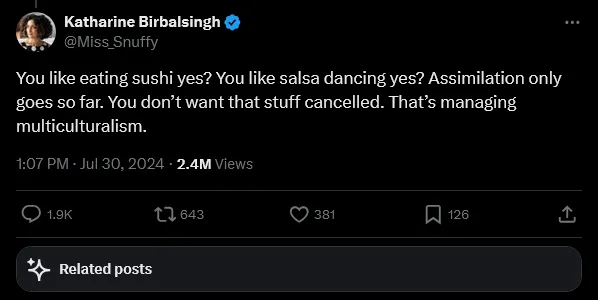
“Multiculturalism is when yummy food” is a real position people take. If you ask them what benefits of multiculturalism are, they’re going to say food and nothing else. Westerners don’t watch Bollywood films, they don’t listen to Desi music, they don’t watch cartoonishly bad Latin American dramas, usually for Hispanic abuelas still living in Mexico where every actor is suspiciously fairer-featured than everyone in their whole family. People can’t say “I love the food, the music, the culture” because they don’t engage in any of this. Salsa isn’t even popular; it hit its peak at the end of the 1990s because white boomer Americans approached an intensely Anglicised, sanitised form of Latin-American culture as introduced to them through the likes of Enrique Iglesias and other English-speaking Latin pop artists.
I don’t believe all leftists say this out of sincerity. It’s a knee-jerk reaction to any criticism of multiculturalism. They don’t put a lot of thought into it. The justification is usually related to how “bad” that “white people food” is. This follows the same thread of accusations that “white people can’t dance”, “white people can’t jump”, “white people can’t fight”, and “white people can’t fuck”. It’s another lib-coded tract to bash English-speaking white Americans over the head with, to justify demographic displacement by portraying them as boring, ugly, weird, or uncool. On some level, they probably know food isn’t worth human lives, but they have to reinforce their moral view or the whole thing collapses, and they have to admit fault for doing things and promoting ideas that are so destructive that people would want to unalive them. If they give up now, it’s over. It’s sunk cost fallacy.
For the rest who’re wholly sincere: it’s just straight up bullshit. Foreign restaurants serve you a Westernized version of their slop. Their bulk food suppliers are Western, the ingredients are Western-derived, but they sell it as “authentic” when it isn’t. That crab rangoon you just spent $40 on Doordash was bulk bought at Costco during a last ditch grocery run. They’re selling you the experience. A sampling of the real thing, deliberately fitted to your people’s general dietary preferences. All of these “ethnic”, “exotic” restaurants do this. Everyone knows about “secret menus” at Chinese or Indian restaurants. Anybody who works in culinary, hell, anybody whose watched the UK version of Hell’s Kitchen where Gordan Ramsay tries to rescue failing restaurants owned by small business owners can tell you most of these people aren’t using fresh or original ingredients. You go to any “Japanese” restaurant in North America, the staff are a random assortment of Asian, or sometimes Korean or Chinese, or maybe even Filipino but it doesn’t matter because they look Asian enough to boomers, correctly guessing people can’t tell the difference at a passing glance.
The Rise, Fall, And Revival Of Art Deco | A Style Is Born W/ @KazRowe
Wayfair
Published Jun 15, 2023Welcome to A Style is Born, hosted by YouTuber, cartoonist, and champion of under-represented history, Kaz Rowe!
Join us as we go down the rabbit hole and uncover the unique histories and origin stories behind your favorite design styles. In this first episode of Season 2, we delve into the history-rich Art Deco movement.
Chapters
Intro – 00:00
History – 00:45
Influences, Elements, & Materials – 04:58
1980s Art Deco Revival Via Memphis Group – 07:46
Conclusion – 09:13
(more…)
QotD: Grain farming and the rise of organized states
But you can tax grain farmers! You can assign them some land, and come back around harvest time, and there will be a bunch of grain just standing there for you to take ten percent of. If the grain farmer flees, you can take his grain without him. Then you can grind the grain up and have a nice homogenous, dense, easy-to-transport grain product that you can dole out in measured rations. Grain farming was a giant leap in oppressability.
In this model, the gradual drying-out of Sumeria in the 4th millennium BC caused a shift away from wetland foraging and toward grain farming. The advent of grain farming made oppression possible, and a new class of oppression-entrepreneurs arose to turn this possibility into a reality. They incentivized farmers to intensify grain production further at the expense of other foods, and this turned into a vicious cycle of stronger states = more grain = stronger states. Within a few centuries, Uruk and a few other cities developed the full model: tax collectors, to take the grain; scribes, to measure the grain; and priests, to write stories like The Debate Between Sheep And Grain, with immortal lines like:
From sunrise till sunset, may the name of Grain be praised. People should submit to the yoke of Grain. Whoever has silver, whoever has jewels, whoever has cattle, whoever has sheep shall take a seat at the gate of whoever has Grain, and pass his time there
And so the people were taught that growing grain was Correct and Right and The Will Of God and they shouldn’t do anything stupid like try to escape back to the very close and easily-escapable-to areas where everyone was still living in Edenic plenty.
… turns out lots of people in early states escaped to the very close and easily-escapable-to areas where everyone was still living in Edenic plenty. Early states were necessarily tiny; overland transportation of resources more than a few miles was cost-prohibitive; you could do a little better by having the state on a river and adding in water transport, but Uruk’s sphere of influence was still probably just a double-digit number of kilometers. Even in good times, peasants would be tempted to escape to the hills and wetlands; in bad times, it started seeming crazy not to try this. Scott suggests that ancient Uruk had a weaker distinction between “subject” and “slave” than we would expect. Although there were certainly literal slaves involved in mining and manufacturing, even the typical subject was a serf at best, bound to the land and monitored for flight risk.
Scott Alexander, “Book Review: Against The Grain“, Slate Star Codex, 2019-10-15.
August 2, 2024
Trudeau won’t – can’t – go voluntarily
In The Line, Michael Den Tandt explains why the Biden option isn’t a viable one for Justin Trudeau at this stage of the Canadian electoral cycle:
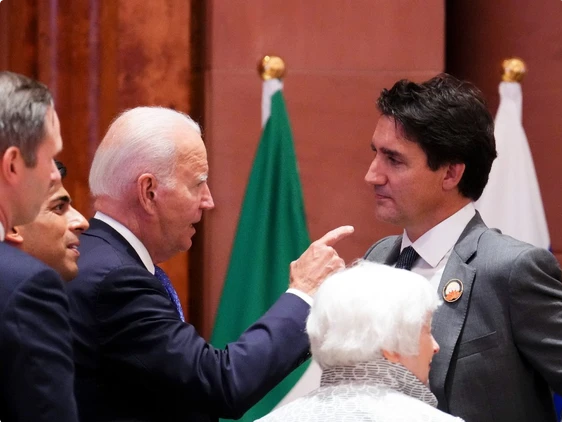
US President Joe Biden talks to Canadian Prime Minister Justin Trudeau, March 2023.
It’s a tough time to be a backbench Liberal MP in Canada, yes? The tone, emerging in anonymous leaks to reporters, is grumpy, surly, unhappy. This is unsurprising. We’re in year ten of a ten-year political cycle that feels stretched and road-beaten, by any standard.
Plus, to our south, there’s this shining model now of the transformative power of change. One day President Joe Biden is clinging by his fingernails to his party’s nomination, with the convicted felon Donald Trump seemingly headed for a big win in November. The next, Biden’s out, new hope Kamala Harris is raising tens of millions in campaign donations, and reporters are lasering in on Trump’s highly quotable running mate, J.D. Vance.
All in a week. So, couldn’t something similar happen in Ottawa? Couldn’t Prime Minister Justin Trudeau take a step back, hit the beach or the lecture circuit, make way for fresh blood, and at least give the Liberals a shot at survival in 2025? What’s he waiting for?
Anything is possible. But this scenario is unlikely. That’s because Justin Trudeau isn’t Joe Biden; Chrystia Freeland isn’t Kamala Harris, and Canada isn’t the United States.
Most obviously, the cycle: The cycle is everything. Individuals are all but powerless in its clutches. As it nears a decade it adds lead weights, like those a deep-sea diver might wear, to the feet of Canadian incumbents. Even the most promising of change agents — former prime minister and justice minister Kim Campbell is Exhibit A — will be brought low by its power.
The argument can be made made that the Progressive Conservative party’s obliteration in 1993 (reduced from majority status to two seats) was not just due to late-cycle fatigue, that Campbell herself had run a wobbly campaign. Some will note the deep weariness with the constitutional wrangling that dominated Canadian discourse during the Brian Mulroney years, or the hangover of Mulroney’s, at the time, keen personal unpopularity. Fair points.
But underlying those events was still the implacable cycle — as in 2006, when prime minister Paul Martin, having seen that Liberal government reduced to a minority in 2004 (despite his personal popularity at the time), lost power to a rising Stephen Harper. In the throes of the federal sponsorship scandal (I will spare you the details, but you can find them here if you’re interested in the arcana), Martin was described by gifted wordsmith Scott Reid, then his communications director, as “the wire brush” who would scrape away the stain of sponsorship. It was a bold attempt to rhetorically seize the change wave. But the wave was strong and Martin lost.
46-second beatdown in Paris – Olympic hypocrisy on full, disgusting display
On the social media site formerly known as Twitter, ESR reacts to the Olympic boxing travesty of a male boxer being in the ring with a female boxer:
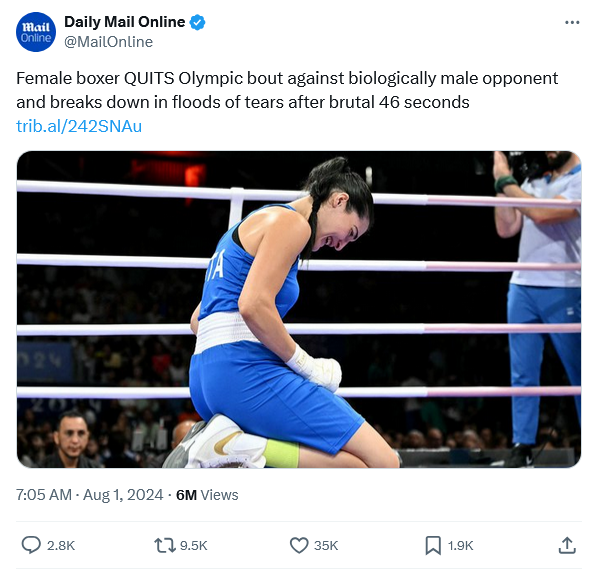
I have mixed feelings about the beatdown of Angela Carini at the Olympics and the feminists complaining that she should never have been put in the ring with a biological male.
On the one hand, yes, it’s disgusting that a man pretending to be a woman battered Carini to the point where she threw the match in justified fear of being killed in the ring.
On the other hand, this travesty seems like such an obvious consequence of feminist doctrine and the feminization of politics that I think most of the women (and “male feminist” allies) decrying it should shut the hell up until they seriously rethink their premises.
It wasn’t “the patriarchy” or defenders of traditional gender roles pushing for this. It was a consequence of decades of insistence that men and women are interchangeable, that gender roles are “socially constructed” – mutable at whim, and that people’s feelings about their own victimization and self-assigned identity trump objective facts.
Feminism and political correctness put Carini’s face in the path of Imane Kelif’s fists. It’s the same ideological cluster that has led to an epidemic of rapes by biological males in women’s prisons and homeless shelters.
Most women – and far too many weak-kneed men – said nothing for decades as this fantasy ideology of feelz laid waste to our cultural norms. And in news that I’m completely sure is utterly unrelated, over 50% of young women identifying as “liberal” have a diagnosed mental disorder.
Maybe, just maybe, feminists and postmodernists and critical theorists ought to stop punching Angela Carini’s face?
Why WW1 Turned Into Trench Warfare
The Great War
Published Apr 12, 2024Trench warfare is one of the lasting symbols of the First World War, especially on the Western Front. But when the war began, the German and French armies envisioned sweeping advances and defeating the enemy swiftly. So, how and why did the Western Front in 1914 turn into the trench system we associate with WW1?
(more…)
QotD: The essential target of ideological propaganda
The Third Reich didn’t last long enough to figure it out, but in their 70-odd years the Soviets learned that “the masses” can be more or less ignored. They’re no threat to the regime. Your average Soviet “citizen” — Ivan Sixpack — would follow pretty much any rule, so long as he had a steady and predictable life course. That’s no slander on Ivan; it’s just the way people are. If you want proof, go look around — if I’d told you, back in the summer of 2019, about all the masks and the social distancing and the lockdowns and everything else, you’d have laughed at me. “There will be blood in the streets! No one will stand for it!”
The reaction of “the masses” (a term I hate; it’s patronizing, but it’ll have to do) to COVID was instructive: They either did as they were told, with nary a peep of complaint, or they simply ignored it … with nary a peep of complaint. From the rulers’ perspective, either one was fine, because they’re functionally the same thing. We all know that whatever the ruling class thought they were going to get out of the Kung Flu panic — and it’s not at all clear; we’ll get there — “public health”, as in the actual health of real members of the public, was nowhere on the list. As with “climate change” and all their other “crises”, their highly visible behavior showed how seriously they took it — which was, of course, not at all.
Indeed, from the rulers’ perspective, it was actually better that some large fraction of the underclass didn’t comply — that way, the mental energy of the Karens was channeled down, not up. Karen could start complaining about Whitmer, Newsom, and the rest not living by their own rules, and had she done so, that might’ve posed a problem for the rulers. But thanks to the maskless proles (and, of course, asshole class traitors like me), Karen always had a bunch of much softer targets to hector.
That’s the function of “propaganda” in my sense. It’s designed to create a narrative, the purpose of which is to channel dissatisfaction down the social scale.
What the Soviets learned, and their SJWs successors have internalized, is that you really only need a small cadre of “middle class” (for lack of a better term) producers to keep things running. Those are the targets of narrative-reinforcing propaganda.
Indeed, it’s only a subset of that already small fraction that needs to be propagandized. As the Soviets quickly learned, true technical experts are more or less ideology-proof. That’s because their technical expertise takes up all their time; they’ve oriented their personalities around it. You could read a novel like Red Plenty to get the sense of it (Z Man has a review somewhere if you want it), but I suggest a much easier path: Watch the fun old movie Boiler Room, with Giovanni Ribisi, Vin Diesel, and in a brief but memorable scene, Ben Affleck. I’m sure that seems odd — it’s a movie about sell-at-all-costs stockbrokers, based loosely on Jordan Belfort’s Stratton Oakmont scam; what could be more explicitly capitalist?
But note how they live: They own ludicrous cars and live in huge mansions, but the cars hardly get driven, and the mansions are unfurnished. There’s a scene where they all get together in Vin Diesel’s living room to watch a movie (Wall Street, natch). There’s a huge tv and a couch, but everything else is boxed up, and they’re eating takeout pizza. Giovanni Ribisi says something like “did you just move in this weekend?” and the other guys say no, he’s been living here for years, he just never got around to unpacking his stuff. That’s the mindset of the true technical intelligentsia. Those stockbrokers think they’re doing it for the money, and so they have the outward trappings of rich people, but they’re really doing it because that’s who they are — they’d be just as deliriously happy competing for subway tokens or scraps of confetti, so long as they had one more scrap than the guy on the next phone.
Given that, the only group that really needs to be propagandized is — you guessed it — Karen. The entire narrative of COVID was very obviously designed by hormonal cat ladies, for hormonal cat ladies. Cards on the table: Though I thought Kung Flu was overblown and ridiculous from the beginning, since I know a little history, I didn’t base my conclusions on my reading in the medical journals. I didn’t read medical journals, and unless you’re a doctor I bet you didn’t, either. My opposition to the Kung Flu panic was entirely visceral: THIS IS MEAN GIRL SHIT.
Severian, “Narrative Collapse III: Magic Masks”, Rotten Chestnuts, 2021-07-07.
August 1, 2024
“There is nothing more worn out in natsec discussions coming from the Imperial City than ‘all elements of national power'”
CDR Salamander reads through a recent RAND report on the US National Defense Strategy and has thoughts:

[Click to open PDF document]
Were you aware this tasker was working its way through the system?
Congress established the Commission on the National Defense Strategy by statute to examine and make recommendations with respect to the National Defense Strategy.
Well, RAND has the goods,
As part of the Commission’s role, it conducted a review of the “assumptions, strategic objectives, priority missions, major investments in defense capabilities, force posture and structure, operational concepts, and strategic and military risks” associated with the 2022 National Defense Strategy (PDF). The Commission called on RAND to provide administrative and analytic support.
Did you catch this yummy little morsel?
The current National Defense Strategy (NDS), written in 2022, does not account for ongoing wars in Europe and the Middle East and the possibility of a larger war in Asia. Continuing with the current strategy, bureaucratic approach, and level of resources will weaken the United States’ relative position against the gathering, and partnering, threats it faces.
Remember this tasty nougat center for later:
… does not account for ongoing wars in Europe and the Middle East and the possibility of a larger war in Asia.
Basically, they’re reminding us that we have a nation’s security running on an obsolete autopilot. Bravo Zulu for putting that marker out early. In a fashion, the report could have ended there. Probably should have ended there, but alas … no.
As Noah Robertson noted in his reporting, this report was not due until the end of the year. However, the commissioners decided to deliver it early so it could be part of the election conversation.
This election cycle has different plans.
While I appreciate the move — one I would have encouraged — I’m not sure either party wants to engage on the topic as there is only so much bandwidth in an election year … and … will you look at what happened in the last month?
However, there is a mission to complete … and they completed it early. There is praise due for that.
[…]
I have … concerns in other foundational issues as well.
There is plenty to chew on and it is a meaty document, so I am just going to touch on a few things in the Summary that I hope will encourage you to dive in for yourself for the details. No one wants me to fisk a 100+ page report.
My primary concern came early when the Balrog of Beltway natsec theory appeared;
In its report, the Commission on the National Defense Strategy recommends a sharp break with the way the U.S. Department of Defense (DoD) does business and embraces an “all elements of national power” approach to national security. It recommends spending smarter and spending more across the national security agencies of government.
In the name of all that is holy. There is nothing more worn out in natsec discussions coming from the Imperial City than “all elements of national power“. The “whole of government” mating with the “interagency”. Yes, yes, yes, we know — the four walls of the food trough. This is not an insight, this is rice bowl protection.
Yawn.
That is just a tell that people were invited inside the tent were very concerned that DOD might get more money and the civilian part of the natsec bureaucracy wouldn’t get an equal plus up of funds. Requirements be damned, we have budget-pie ego issues that need to be addressed.
As the kids would say, “basic“.
Buddha forbid that DOD get $1 and at the same time we don’t give $1 to every other kid at the table. It really is one of the most unimaginative instincts of the established natsec nomenklatura.
As we’ll see again, this DC habit of holding defense spending hostage for “less icky” levers of power or petty domestic programs making everything unaffordable. People tasked with “hard decisions” decide the “hard decision” is to decide to say “yes” to every good-idea fairy that threatens to heavily pout if their #1 goal is not your #1 goal.
If your shields don’t go up, your wallet pushed deeper in your pocket, your eye twitch start, your children hidden, and you don’t instinctively reach for your side-arm when you see a Beltway entity mention, “spending smarter and spending more across the national security agencies of the government” then you have not paid attention the last quarter century.
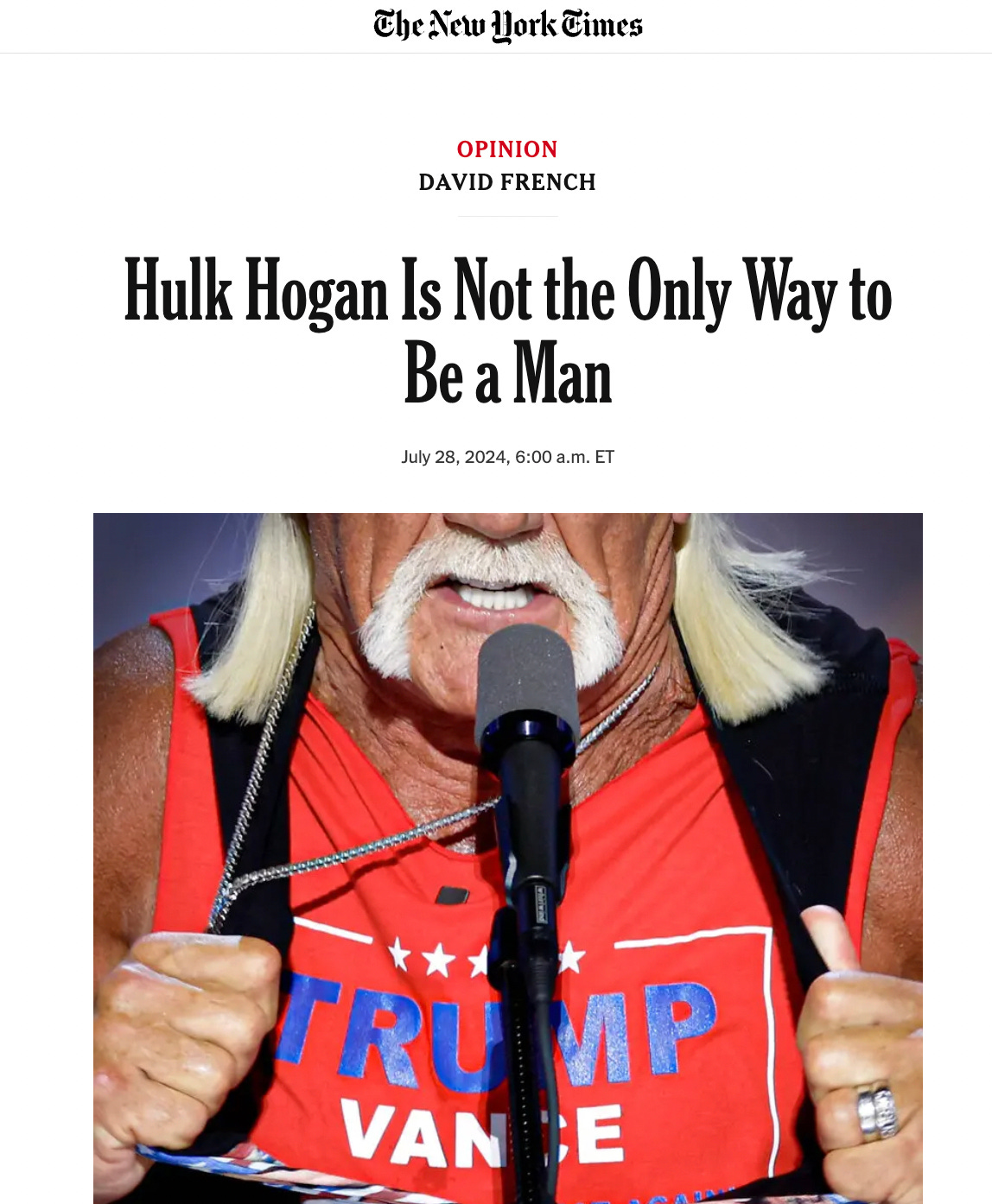
“Donald Trump isn’t a real man, because Hulk Hogan”
It’s always appropriate to criticize public figures — it goes with the job — but you actually should find things to criticize when you do it, otherwise it comes across as lazy bitching:
I’m a charter member of the “no one is above criticism” club. Everyone is fair game. People who run for office are really fair game. So I think it’s just fine to criticize Donald Trump, and to criticize JD Vance, and to criticize Trump/Vance 2024.
But what’s so obvious, over and over again, is that the people writing the most insistent criticism are playing critic. They know that they’re supposed to say that Donald Trump is very very very bad, so they … do that? A lot? But the substance of the criticism tends, with remarkable frequency, to be a set of non-sequiturs and self-refuting rhetorical dead-ends. They’re criticizing because they’re supposed to, not because they have criticisms to offer.
Take David French. Please. Here’s his latest: Donald Trump isn’t a real man, because Hulk Hogan.
The I-didn’t-think-this-through flavor of this piece can’t be exaggerated. It makes so little sense, so poorly, with such odd structure and framing, that it nears the level of Thomas Friedmanism. David French doesn’t know anything, or understand anything, but he really throws himself into it.
So.
Hulk Hogan, Kid Rock, and Dana White were at the Republican National Convention, French writes, so the Republicans are being macho, unlike Democrats, who are demonstrating a style of manhood that focuses on being kind, decent, and nurturing. Republican manhood is about complaints and empty rage; Democratic manhood is about building things and caring for others. Making the comparison concrete, French explicitly compares the macho grievance artist Trump to precisely four wonderfully gentle and caring men: Admiral William McRaven, the US Senator and former astronaut and fighter pilot Mark Kelly, “Mark Hertling, my former division commander in Iraq”, and the former Marine Corps General and Secretary of Defense James Mattis. Those four men are the model of a masculinity that nurtures, loves, and builds; Trump is the model of a masculinity that only destroys and tears down. David French hates machismo, so the list of men he admires is made up entirely of combat arms officers.
Do you … see the problem? Because David French doesn’t. At all. Donald Trump is a real estate developer, someone who spent his entire adult life actually building things:
It’s just fine to criticize Trump as a businessman, if you feel inclined to do that. But he’s a builder and a developer; that’s his actual background. He makes things. He spent his life making things. And his political message is about making things and protecting people who make things, whether you agree with the specifics of his policy arguments or not

The Rarest 1911: North American Arms Co
Forgotten Weapons
Published Apr 22, 2024In the summer of 1918, the US government wanted to increase production of M1911 pistols, but all current manufacturers were working at capacity. So they looked to issue new contracts, and someone realized that the Ross rifle factory was a potential option. Now, the Ross Rifle Company was bankrupt by this time, and its factory lay essentially abandoned. So in June of 1918, two Canadian lawyers by the names of James Denison and Edmond Ryckman incorporated the North American Arms Company Ltd in Quebec, signed a contract to manufacture 500,000 1911 pistols for the US, and then leased the Ross factory for a term of 18 months. Whether they would have been successful in producing pistols at scale is unknown, because their contract was cancelled on December 4, 1918 before any deliveries were made. With the end of the war, arms requirements plummeted, and pretty much all ongoing weapons contracts were cancelled, not just this one. However, parts for 100 pistols had been produced, and these were assembled and sold commercially after the contract was cancelled.
(more…)
QotD: Sex and dating in the internet dating age
In 1996, Helen Fielding’s Bridget Jones helped women realise that half the human race (men) might usefully be called “fuckwits” when it came to dating and romance. The dynamics of internet dating, with its illusion of graspable sexual paradise, has either created a new tsunami of apparent fuckwits, or it has made the sheer extent of them inescapable.
Meanwhile, the boredom and jadedness stitched into heavy use of apps (“nope”, “like”, “nope”, “nope”, “nope”, “like”) has produced a ubiquitous undercurrent of queasy unpleasantness. The result is that men, formerly seen as an alternating source of fun, trouble and heartbreak, become “men: ugh”. Women, once the promised land for many a Romeo, become bitches, gold-diggers, game-players, and, most significantly, for a depressing bloc known as “women: meh”.
This sexual stand-off, characterised by simmering distrust and putrid fatigue, oozes off internet dating portals. I’ve often found myself, after a night of binge-scrolling, surprised to remember that dating is filed under “romance”, which is supposed to be — at least at the start — a little about positive, fuzzy feelings or the potential to develop them.
Zoe Strimpel, “Why the young are falling out of love with sex”, UnHerd, 2019-11-25.
July 31, 2024
The Jasper wildfire – climate change or blatant government incompetence and neglect?
In The Line, Jen Gerson points out that the federal government had been given plenty of warning — literally years — about potentially serious problems near Jasper and had done nothing about them:

When Ken Hodges heard about the devastating wildfire that took out part of the historic mountain town of Jasper this week, he said he was “frustrated”.
“All I could say is that we tried to warn them that it was coming. We told them constantly. It’s not a matter of if, it’s a matter of when.”
The retired forester, along with his colleague Emile Begin, spent years repeatedly warning the parks service, the federal and provincial government, city council, and residents, that mis-management of the forests around Jasper had created a tinderbox that would inevitably spark a massive wildfire.
“I just feel so badly for the people who have lost their homes and their businesses. Could it have been prevented? I don’t know. If they had done everything they could have? Maybe. Something was going to happen over time, so it’s so frustrating and devastating.”
Hodges first spotted the problem almost a decade ago while skiing near Marmot Basin. From his years working in forestry in B.C. — a province that had previously been devastated by both wildfires and infestations of the Mountain Pine Beetle — Hodges was able to identify similar patterns of decay in the forests in Alberta.
“It was a hillside on the way up to Marmot that I looked up and thought ‘holy crap. The Mountain Pine Beetle is here.'” His experience told him exactly what would follow — fire.
Not just any fire. “It’s the intensity and the ferocity of the fire that can cause the problem. With climate change, that exacerbates the situation as well.”
Eventually Hodges connected with Begin. The two men between them had 40 years of experience in forestry in B.C. and Alberta, respectively. They feared the Parks service was not prepared for what the men had seen in B.C. — and told them so. Repeatedly. Vociferously. They also sent letters of warning to several ministers; they met with the local municipality. They were interviewed by the CBC for a story that was headlined “Jasper National Park not prepared for potential forest fire ‘catastrophe’, researchers say“.
That was in 2018.
Also in 2018, the pair issued an open letter that read: “The potential for a huge fire or mega fire is real. Fires of this type and magnitude generally occur in mid August to early September. With climate change it may occur earlier.”
The response?
“They just wrote us off,” Hodges told The Line this week.
The Korean War Week 006 – Stand or Die! – July 30, 1950
The Korean War by Indy Neidell
Published 30 Jul 2024The UN Forces have been pushed back ever further, but this week, US 8th Army Commander Walton Walker issues the order to “stand or die”; he sees no other options. American reinforcements are finally getting into the actual fight, though, and Britain has decided they will send in ground troops, so things might turn around … if they can hold out long enough for those troops to arrive, because a brilliant North Korean strategy might win the war and soon.
(more…)


