
Adrian Goldsworthy. Historian and Novelist
Published 2 Jul 2025Today we look at the death of Nero, then briefly cover the civil war that followed — the Year of Four Emperors — before dealing with the Flavian dynasty (AD 70-96) — Vespasian and his sons Titus and Domitian. How did their regime differ from that of the Julio-Claudians and what was going on in the wider empire?
November 7, 2025
The Flavians – Vespasian, Titus and Domitian – The Conquered and the Proud 18
Comments Off on The Flavians – Vespasian, Titus and Domitian – The Conquered and the Proud 18
QotD: The Boomer career path
I don’t know how many times I have to explain this: Boomers were all given free TVs to watch Howdy Doody who all transmitted them the secret code to grow their hair long after they watched the Beatles on Ed Sullivan, after which they went to college and took over the Dean’s Office. To get rid of them the Dean gave them free drugs and directions to Woodstock where they had sex in the mud to get Vietnam deferments.
After that they got bored and became Glam rockers, and then switched to Disco because it had a better beat. They used all their free money from Disco record deals to buy cocaine and Malibu real estate at $3 per acre. In 1980 they decided there was even more money in selling cocaine, so they all moved to Miami and drove around shooting machine guns from their Lamborghini Countachs to Giorgio Morodo synth music.
After Reagan’s re-election the Boomers decided greed was good and they all moved to NY where they became serial killer investment bankers and collected up all the Andy Warhol originals. That’s when all of their real estate holdings made them billionaires which they leveraged to get in on the bottom floor of the Internet bubble in the 90s while taking designer drugs.
Today those same Boomers are all driving around to orgies at The Villages in $500k luxury golf carts waving giant Trump flags, laughing it up while lighting doobies with their Social Security cash and executing Howdy Doody’s Final Plan: the secret Boomer Immortality Pill that will allow them to keep their money away from Millennials and Zoomers FOREVER
David Burge, The social media site formerly known as Twitter, 2025-07-30.
Comments Off on QotD: The Boomer career path
November 6, 2025
Mamdanimentum – NYC gets its very own Justin Trudeau clone
It’s been decades since I last visited New York City, so I don’t know if they really deserve what they’ve just voted for, but I guess we’ll all get to find out over the next few years. On the City Journal substack, Reihan Salam weighs in on the newly elected mayor and what to watch for:

New York State Assemblymember Zohran Mamdani photographed in Assembly District 36, 10 February 2024.
Photo by Kara McCurdy via Wikimedia Commons.
A year ago, not even the most perfervid Astoria leftist would have thought that Zohran Mamdani would soon be elected mayor of New York City. Back then, it was easier to imagine Eric Adams coasting to reelection on the strength of declining crime, or state attorney general Tish James, who came close to running for mayor in 2021, swooping in to unite a fractious Democratic coalition. With Adams badly damaged by a federal indictment and James anxious about what a mayoral bid would mean for her ongoing battle with President Donald Trump, however, the path was seemingly clear for Andrew Cuomo to make a dramatic comeback.
Though it was no secret that Cuomo had real weaknesses, thanks to his polarizing tenure as governor, his name recognition and formidable fundraising machine were enough to freeze out other serious contenders. As a result, the Democratic mayoral field was so bereft of talent that Mamdani — an obscure, hard-left state assemblymember with no legislative or professional accomplishments to speak of — was able to cut through, buoyed by surging anti-Israel sentiment and a series of half-baked pseudo-solutions to the city’s very real affordability crisis.
From one vantage point, then, Mamdani is best understood as an accidental mayor. If federal prosecutors had declined to prosecute Adams, if James had jumped in and Cuomo had stayed out, if Hamas had surrendered its hostages a few months sooner, if moderates and conservatives had consolidated behind a single candidate in the general election, or if any of a number of other possibilities had obtained — the outcome of New York City’s 2025 mayoral race would have been quite different.
In another sense, however, Mamdani’s victory represents the culmination of New York’s larger leftward turn. The shift started in 2018 with the dissolution, at Cuomo’s behest, of the state’s Independent Democratic Conference, an eight-member coalition of centrist Democratic senators who caucused with the Republicans. Their subsequent replacement heralded a broader takeover of Albany by progressives who — again, with Cuomo’s assent — passed a series of ideologically inflected bills: bail reform, the “most aggressive climate change legislation in the nation“, and a major overhaul of tenant protection statutes, to name only a few.
The Mamdani revolution was led by downwardly mobile elites — children of the professional class struggling to make ends meet and entranced by the promises of frozen rent and fare-free buses. They were fired by the same ideas that animated those Albany progressives: that some New Yorkers have been handed the short straw, that soak-the-rich policies can correct these imbalances, and that New York’s private sector was resilient enough to sustain a further ratcheting up of punitive taxation and regulation.
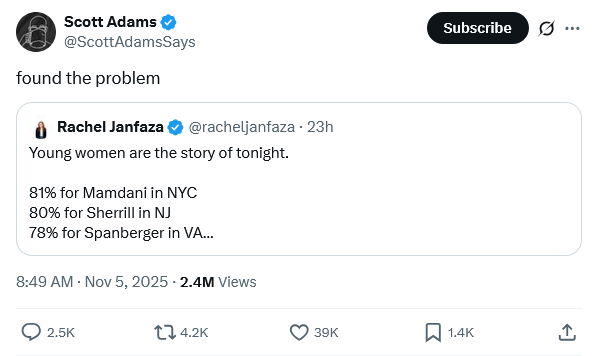
The voters of NYC are not the same demographic distribution as of old … among other things, the Jewish population has shrunk while the Muslim population has grown to nearly the same over the last 25 years, although Jewish women probably voted more similarly to women generally in this election:
Comments Off on Mamdanimentum – NYC gets its very own Justin Trudeau clone
Lines of Fire: Operation Market Garden Part 1 of 2 – WW2 in Animated Maps
TimeGhost Cartographic
Published 5 Nov, 2025September, 1944. Soviet forces push ever westwards, slicing their way through Poland en route to Berlin. In the west, the Allies have made great strides after the invasion of Normandy, but now face a winter of relative stagnation as supply issues threaten to undercut their momentum. At this time, British Field Marshal Bernard Montgomery believes has a plan to carve a corridor through occupied Netherlands and get his forces into Germany within days, striking at the heart of the German war economy, and maybe, just maybe, ending this war before 1945 dawns. In Part 1 of 2, we look over the plan, the forces involved, and the colossal effort required to make Monty’s vision a reality.
00:00 Intro
01:12 Background
04:40 Planning
07:07 Disposition of Forces
09:05 Geographic Overview
11:30 Conclusion
(more…)
Comments Off on Lines of Fire: Operation Market Garden Part 1 of 2 – WW2 in Animated Maps
Reactions to Tuesday’s budget announcement
Mark Carney’s government finally got around to releasing their 2025 budget and lots of folks have thoughts and concerns about what is in it and what isn’t in it. After all, it could be the best possible budget, but it would still not satisfy all concerns … and nobody is pretending that this is anything close to “best possible” territory. Sylvain Charlebois says that the budget ignores the food insecurity issues and grocery prices for ordinary Canadians:
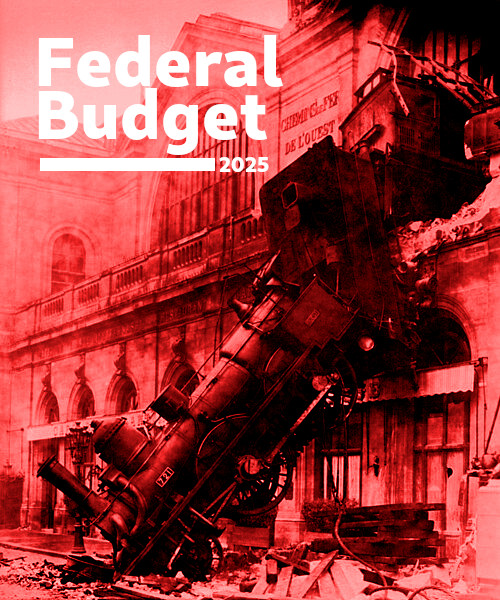
Graphic stolen from Small Dead Animals.
For a government that often talks about food affordability and insecurity, Budget 2025 offers surprisingly little that directly addresses either. There’s no bold food strategy, no affordability roadmap, and no new incentives for domestic food production. Yet, in between the lines, Ottawa has quietly set the stage for some indirect relief — not through grocery subsidies or consumer-facing policies, but through infrastructure, trade, and administrative reforms that could make the food system work a little more efficiently.
The largest signal comes from the government’s $115 billion infrastructure plan, one of its so-called “generational investments”. The new Trade Diversification Corridors Fund aims to modernize ports, railways, and airports — all chronic weak points in Canada’s food supply chain. When bottlenecks ease, goods move faster, and perishable products arrive fresher and cheaper. While no one in Ottawa framed this as a food-price measure, logistics efficiency has long been one of the most effective — and least visible — forms of price control.
[…]
Still, the absence of a broader vision for food affordability stands out. After years of grocery price volatility and public debate about “greedflation”, Canadians might have expected a more direct focus on food resilience — investments in innovation, local processing, or retail transparency. Instead, the government seems to have opted for a quieter, systemic approach: strengthen the arteries of trade and logistics, and trust that efficiency will trickle down to the dinner table.
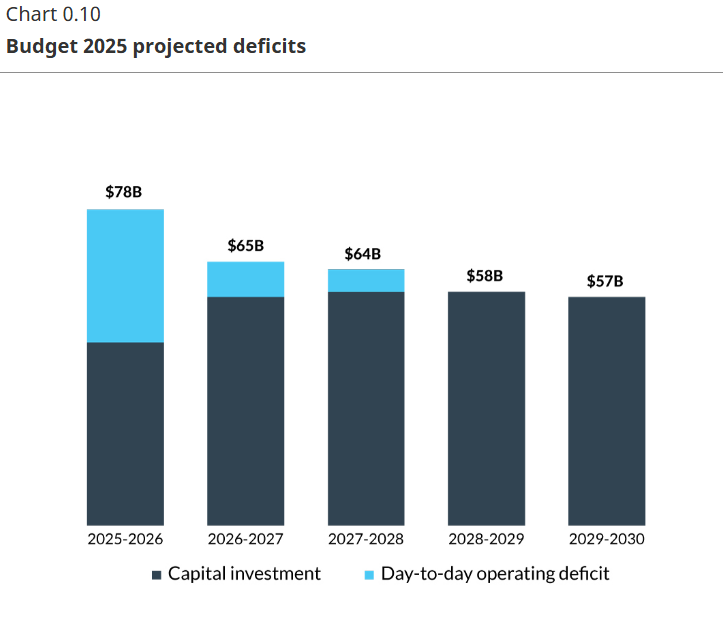
The budget forecasts a $78.3 billion deficit for the 2025-26 fiscal year, which is significantly higher than notorious spendthrift Justin Trudeau’s last budget number. This adds to an already staggering $1.27 trillion debt load, which is nearly double what it was just before the pandemic. In the lead-up to the budget release Mark Carney had hinted at major sacrifices to be made, and while there wasn’t a lot in the document directly corresponding to sacrifice, the need to service that long-term debt will do the job quite adequately.
In the National Post, John Robson says that the budget is “elbows up, IQs down”:
Since I was last propelled years ago into the purgatory known as “the lockup”, where journalists spend budget day, have either process or contents improved? No. Instead they now insert a false stolen-land “acknowledgement” before even getting to the same old same old labeled bold and new. Which is especially troubling at this supposedly critical juncture.
The document is the familiar brick, 406 paper pages and 493 digitally with no explanation for the discrepancy and no excuse for the length. (Or for being called “Canada Strong” with an inexplicable picture of a ship.) Especially as the Finance Minister gabbled “This is a budget that talks to everyday Canadians,” and its purpose is to state plainly how much the government intends to spend, where it hopes to get the money and how far short it already knows it will fall, you shouldn’t have to wade through 248 pages of sludge to find out.
As P.J. O’Rourke said, “beyond a certain point, complexity is fraud”. Though we “privileged” insiders search “Summary Statement of Transactions” and voila, submerged on p. 249 (all references digital) is a $78.3 billion deficit next year if all goes well, and the national debt increasing $80.5 billion so it already didn’t.
Much commentary, and special-interest attention, focuses on trivial fiddles. But what matters is that Leviathan is in hock up to its horns, with interest payments projected at $55.6 billion next year, soaring to $76.1 billion by 2029-30. If the Lord is willing and the creek don’t rise, both forlorn hopes. NDP MP Leah Gazan, who would jail you for “downplaying” residential schools, snarled about not supporting an “austerity budget” but she won’t get the chance.
Some may bleat that times are tough. Indeed the finance minister’s campaign-speech “Foreword, Budget” gasses “The world is changing, profoundly and in real time; we are no longer living in an era of calm, but of significant change”.
The projected deficits are clearly hallucinatory, as the Liberals never seem to get deficit spending to go down, running deficits every year since 2015:
However, on the ludicrous side, the feds want to spend money to “investigate” Canada taking part in the freaking Eurovision contest:

On the slightly less ludicrous side, Noah considers the military aspects of the budget:
Budget 2025 outlines the government’s generational investment to quote, “defend Canada’s people and values, secure its sovereignty, and position the nation as a strong, reliable partner to its allies“. This starts by initiating a process of rebuilding, rearming, and reinvesting in the DND, CCG, and CAF to provide everyone with the necessary tools and equipment to protect sovereignty and bolster security.
Budget 2025 starts by outlining the government’s previous commitment to accelerate investments to meet NATO’s 2 per cent defence-spending target this year, which is five years ahead of schedule.
Budget 2025 goes a step further by setting Canada on a path to meet NATO’s 5 per cent Defence Investment Pledge by 2035. This will be broken down into two categories, 3.5 per cent of GDP by 2035 in core military needs, including supporting the CAF, modernising equipment and technology, and building up defence industries, and 1.5 per cent on security-related infrastructure and investments.
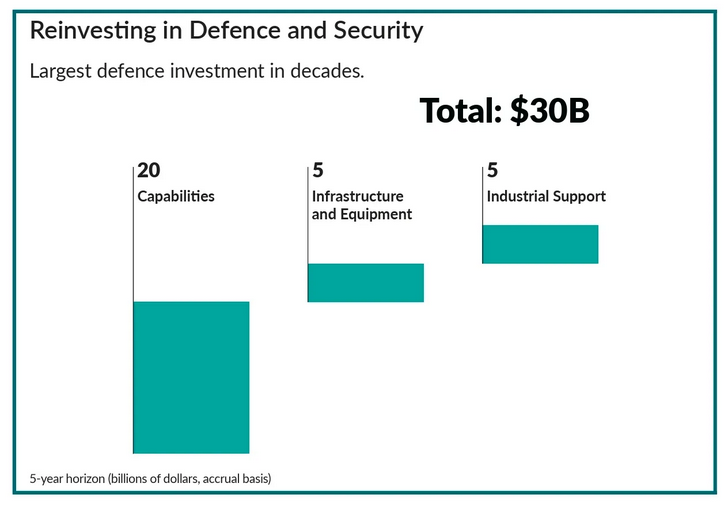
This reinvestment in defence and security is the largest in decades, totaling $30 billion over a five-year horizon on an accrual basis. This funding is allocated across three main pillars: $20 billion for capabilities, $5 billion for infrastructure and equipment, and $5 billion for industrial support.
On a cash basis, Budget 2025 proposes to provide $81.8 billion over five years, starting in 2025-26, to rebuild, rearm, and reinvest in the CAF. This figure includes over $9 billion in 2025-26 that was previously announced in June 2025. This is the funding previously set out for Canada to reach the 2 per cent NATO target.
Key investments from this $81.8 billion fund include $20.4 billion over five years to recruit and retain a strong fighting force, which incorporates the previously announced updates to pay and support for CAF health care.
An additional $19.0 billion over five years is allocated to repair and sustain CAF capabilities and invest in defence infrastructure, including the expansion of ammunition and training infrastructure. Upgrades to digital infrastructure for the Department of National Defence, CAF, and the Communications Security Establishment, particularly for cyber defence, are funded with $10.5 billion over five years.
Finally, $17.9 billion over five years is designated to expand Canada’s military capabilities, with investments in logistics, utility, and armoured vehicles, as well as counter-drone, long-range precision strike capabilities, and domestic ammunition production.
This is a serious chunk of change, although sadly, and as you will see, we don’t get a major breakdown of what this looks like. What we are left with are general piles of money, which isn’t always a bad thing. It’s also expected. The budget is set for a timeline before many critical capabilities will be delivered, so they won’t be included. Almost everything comes after 2030.
Comments Off on Reactions to Tuesday’s budget announcement
Galand de Guerre Model 1872: Too Good for the Military
Forgotten Weapons
Published 23 Jun 2025Charles François Galand is best known for his simultaneous-extraction Model 1868, but he also developed a very good solid-frame revolver. This was specifically for the French 1871 military trials, which specifically required a solid frame. The Galand was chambered for 12mm Galand (with its distinctive very thick rim), held 6 rounds, operated in either single or double action, required no tools to disassemble, and had very simple but durable lockwork. The gun was very good, and was a very tight competitor for the other trials finalist, the Chamelot-Delvigne. Ultimately, it lost out because it was the more expensive of the two options.
For more information on the Model 1873 Chamelot-Delvigne that won the French trials, I suggest the C&Rsenal video on that model:
• History of WWI Primer 061: French and Ital…
(more…)
Comments Off on Galand de Guerre Model 1872: Too Good for the Military
QotD: The Reformation
It’s easy to get lost in this stuff — I had a long bit about Cardinal Wolsey, Thomas Cromwell, the Supplication Against the Ordinaries, the Annates Bill, and so on here — but the upshot is, pulling the Church down in England revealed the massive scale of its corruption. I want to say that the Annates Bill alone doubled the King’s revenue, and the dissolution of the monasteries (well underway in Cardinal Wolsey’s time, incidentally) unlocked unimaginable wealth. But it also fatally undermined the regime, because now an attack on the existing Church structure was also an attack on the King … and vice versa.
What you got, in short, was a total social conflagration. The “Reformation” wasn’t really about theology. Nothing Luther said was particularly new. Jan Huss and John Wyclif said basically the same things 100 years earlier; hell, St. Augustine said them 1000 years before. There’s still an irreconcilable “Protestant” strain in Catholicism now — Cornelius Jansen was just a Catholic Luther, and in a lot of ways a much better one; he was declared a heretic because reasons, and “because reasons” was good enough in Jansen’s time (the very nastiest phase of the Thirty Years’ War), but since he’s just quoting St. Augustine …
The point is, the undeniable rottenness of the Catholic Church made it a convenient whipping boy for any conceivable beef against society as a whole. Because it wasn’t just the Church that was too decadent, depraved, and corrupt to go on — it was the entirety of Late Medieval society. Again, stop me if this sounds familiar, but Late Medieval society looks a lot like spoiled, histrionic children playing dress up. They look like kings, and they act like kings (popes, bishops, etc.), but it’s obvious it’s just an act — they know they’re supposed to do these things (put on tournaments, hold jubilees, preach sermons, fight wars, etc.) but they have no idea why.
Severian, “Reformation”, Founding Questions, 2022-03-07.
Comments Off on QotD: The Reformation
November 5, 2025
The Korean War Week 72: UN Censors as Communists Speak! – November 4, 1951
The Korean War by Indy Neidell
Published 4 Nov 2025The Panmunjom peace talks continue, but a real sticking point is Kaesong- both sides insist that they must have control of it. Frustration mounts among the Allied journalists, though, as they are allowed less access to what’s going on than their Communist counterparts. Despite the talks, there’s new action in the field this week, as the Chinese attack in force to try and retake Maryang-san, a commanding strategic position.
Chapters
00:00 Intro
00:40 Recap
00:59 The Kaesong Issue
03:24 Voluntary Repatriation
07:14 US Command’s Position
09:15 All For All Repatriation
10:35 UN Censorship
12:29 Maryang-San
13:35 Summary
13:37 Conclusion
14:39 CTA
(more…)
Comments Off on The Korean War Week 72: UN Censors as Communists Speak! – November 4, 1951
A minor gaming distraction
On the social media site formerly known as Twitter, Matt Gurney takes a few minutes while waiting for the impending catastrophe of the federal budget to be released to talk about a game I’m quite familiar with (and generally share his opinions on):
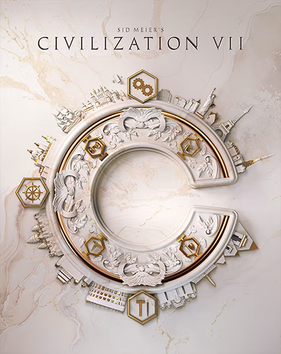
It’s budget day. My job is only going to get busy in the afternoon and evening. So now is a good time to inflict a non-news and non-political tweet on you. I want to talk to you all briefly about Civilization 7, which has had a troubled launch.
Some of you may follow me closely enough to know I’m a hardcore Civ fan. I’m a wannabe gamer. I love gaming. I could get really into gaming. But I don’t have the time. My preference is for games that are very deep and immersive and require hours of time for a single gaming experience. My life actually only enables me to basically do the opposite: a quick game on my phone that kills five or 10 minutes.
Civ is my guilty pleasure. I’ve played every major iteration of it since the first. And I was SUPER excited for the release of Civilization 7 earlier this year. The company that owns the rights, Firaxis, did a really interesting pre-release marketing job. They built a lot of buzz.
The game itself, which I obviously preordered and played on the day it released, was disappointing. It looked good, but it was very shallow. Every Civ iteration grapples with the challenge of needing to improve on/enhance the game experience compared to earlier releases, but also with the problem of complexity. If you just keep layering on new functions, you eventually make the game unplayable. So there’s a natural tension there. But 7 was still weirdly sparse. There were very basic user interface issues. Fonts were very small, colour choices led to a lot of struggle making out details. It all looked beautiful at a distance until you were actually trying to absorb any information, info necessary to effectively play the game, at a glance. It was impossible. Also, and this is a separate but related problem, some very basic functions and information necessary for gameplay simply wasn’t explained. You kind of had to intuit things.
There were big, structural changes to the gameplay as well. How the game works is very different from earlier iterations. These changes were very controversial — seemingly hated, to be honest. I didn’t actually hate them. I didn’t always love them, but I was pretty open minded to them and kind of liked some of the new mechanics.
But. Ahem. The game itself regressed in some key ways, compared to its predecessor, Civ 6. A small example: religious warfare. For non-players, in Civilization, you can control units for your empire and you move them around the map. Military units can fight other military units, and can seize and defend territory. Religious units were a totally different game mechanic that players would use to export their religion, and to prevent their own cities from being converted. It added a really fun and elegant layer to the game, and one that could be meaningful enough to swing outcomes in a big way.
Civ 7 just nerfed that. Religion is useless. Worse, it’s annoying.
The company has been very aggressive at rolling out updates to fix some of these issues. They’ve also been very open in communicating what they’re working on to the audience. I admire that. I really do. But the numbers don’t lie. Civ 7 is, today, drawing maybe 15-20% of the audience that Civ 6 did. (Using Steam Charts for those figures.) I don’t know if this is a flop for Firaxis, but it has to be a disappointment verging on a disaster.
They’re rolling out a lot of updates and new content to try and fix these issues. And I think they’re making strides. But, like, yikes. Every time they announce a new update, I’m shocked by how much of that stuff should have just been in the game in the first place.
I’m not a gaming expert, like I said. I wish. I’m also not an expert in gaming as a business. I’m just a guy who loves playing Civ. I’ve stuck with 7 since it was released and I’ve given every major update a fair chance. I’ve had fun playing the game. But I just can’t deny that 6 was much better, more playable, and more fun. And I don’t know how much more time the developer has before even hardcore fans like me just give up and go back to 6 permanently.
Anyway. This is what happens when all the news is due to come out later in a day.
Thank you for your attention to this matter!
Matt is more patient with Firaxis than I am, I have to admit. I downloaded and played Civilization VII on release day … played a few rounds of a couple of different civilization/leader combos … played one up to the new “change your entire civilization to a totally different one in a new age” mechanic, saved and quit the game. I’m sure I’ll play again at some point, but VII didn’t grab my attention and interest the way all the earlier iterations had done and I hate hate hate the swapping civilizations gimmick with a passion because it ruins my immersion in the civilization I’m trying to build. But I’m pretty far from being the target market for this game, so take my dissatisfaction with a shaker of salt.
Comments Off on A minor gaming distraction
Hands To Flying Stations (1975)
David Bober (Royal Navy Films)
Published 25 Jun 2013Official govt film uploaded as “fair use”. Naval Instructional Film A2690.
Royal Navy documentary from 1975 featuring aircraft carrier HMS Ark Royal (R09). The film details flight operations aboard the Ark. Aircraft in the film include the Phantom FG1, the Buccaneer S2, the Gannet AEW3, the Wessex HAS1 and the Sea King HAS2.
HMS Ark Royal (R09) was an Audacious-class aircraft carrier built by Cammell Laird, Birkenhead and commissioned into the Royal Navy on 25 February 1955. She was decommissioned on 14 February 1979 after 23-years service. She was the last operational RN aircraft carrier to use “cats and traps” (conventional catapult launch and arrested landing). The Ark featured in the 1976 BBC television series Sailor.
Comments Off on Hands To Flying Stations (1975)
QotD: Progressive anger
As they did so in this case, I could not help but think of the analogy with our present situation. We have a huge fund of very angry people buzzing about in mobs looking for somewhere on which their anger can settle. It seems an epoch ago that it landed on #MeToo and turned all men into Harvey Weinstein. Then, under the direction of little Greta, who somehow managed to combine an autistic manner with hysteria, opposing tendencies reconciled no doubt by the ineffable self-pity of the privileged, global warming provided a temporary resting place. However, with the killing of George Floyd, climate change seems as passé as Mussolini’s spats. (“Too many spats, too many spats!” someone once said of him.) But if no new thing is found after all the statues have been pulled down, the books burned, and the films withdrawn from circulation, climate change could return faute de mieux. On the other hand, free-floating anger is highly inventive as to the reasons for its existence: It can attach itself to almost anything, as flies can walk upside down on ceilings. Being no prophet myself, I have no idea what will be the next object of angry righteousness by people brought up to believe in moral relativism.
Theodore Dalrymple, “Bees With Degrees”, Taki’s Magazine, 2020-07-02.
Comments Off on QotD: Progressive anger
November 4, 2025
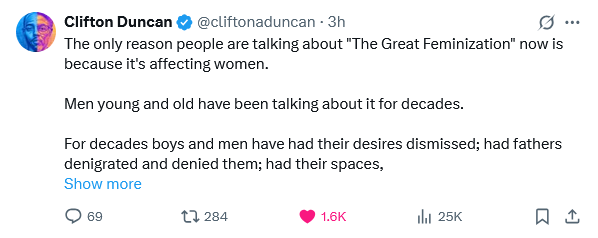
The Great Feminization isn’t catching on in the culture, despite its power in our institutions
Lorenzo Warby provides a bit of hopeful news that despite the ever-expanding march of feminization through our various organizations and institutions, the culture is displaying strong resistance and effective:
Western culture is not feminising. How can I tell? The travails of Disney. Disney spent billions buying male-centric franchises — Star Wars, the Marvel Cinematic Universe, Indiana Jones … It then proceeded to so alienate the fan bases of those franchises that it is now reduced to openly discussing how to appeal to male audiences that it spent billions acquiring and further billions alienating.
If Western culture was feminising, then Disney should have had no trouble with its feminised products. Clearly, it has had problems. Meanwhile, the Top Gun: Maverick sequel to a 1986 movie can do excellent box office ($1.5bn) precisely because it knows what it is about.
The question then becomes, how and why did Disney so alienate those male-dominated fanbases it spent billions acquiring entree to? A simple answer would be that Disney was a Princess-story factory and it turned its new acquisitions into Princess-stories — stories not necessarily with literal princesses, but with female protagonists.
There is certainly a fair bit of that. A recent study found that Disney has tended, over time, to feminise male characters in its animated movies.
For it was not only that the Disney turned those franchises into launch pads for new Princess stories. Yes, Rey in the Star Wars sequels is an obvious example of doing precisely that. Nevertheless, there was rather more going on.
We can tell this from the Mulan live-action remake. The original 1998 Disney animated Mulan — despite controversy at the time of its cinematic release — acquired some popularity in China. It was seen as an engaging adaptation of the original story: a story deeply familiar to Chinese audiences. Worldwide, the film was a box office success.
The 2020 live-action Mulan remake was not a box office success. It was not for many reasons, but it was also emblematic of the problems of what YouTube critic Critical Drinker calls our post-creativity era.
2020 Mulan turned a female-protagonist story into a “woke” great-because-girl female-protagonist story. It turned a story of filial piety — a girl disguising herself as a boy to train and become a soldier in place of her disabled father, and struggling to overcome the limitations inherent in that — into something rather different.
Animated Mulan becomes accepted into the team of soldiers and triumphs through cleverness and teamwork. What makes the story resonate so well is there is nothing special about Mulan. She takes what she has and works hard at becoming better and succeeds in, and through, doing so. There is no hint of great-because-girl: rather it is fine being girl. Being a girl imposes limitations on her that she has to deal with and overcome: which she does — but not without genuine struggles — by sheer persistence and being clever, a problem-solver.
The key difference between a traditional Disney Princess story and contemporary Disney “woke” Princess story is the injection of great-because-girl. Live-action Mulan is a prodigy warrior with extra qi (or chi) who can do what the boys can do, but better. This is a cinematic version of a classic failing of feminism — by taking a blank slate view of humans, turning what men do into the standard for women. Women are great because they can do everything men can do, but even better. Feminist antipathy for stay-at-home mothers expresses this valorisation of matching men.
Live action Mulan is also much more politically conformist, even retrograde, in its denounement of Mulan celebrating service to the Emperor and going off to be a soldier. Animated Mulan rejecting a job as imperial advisor, and returning to her beloved father, is much less deferential to public authority.
The live-action film virtue-signals at the expense of story and understanding. It sacrifices clever cultural engagement for much flatter message-signalling.
If you want to watch a story set in China about women warriors, then the recent Chinese drama (C-drama) hits of Legend of the Female General and Shadow Love are available. These are smart, character-driven stories with the pervasive professionalism and sense of beauty—anchored in the cultural confidence—that one expects from contemporary costumed C-dramas, which are very much not based on trashing cultural heritage or we-know-better disrespect for source material.
Costumed C-dramas regulary have strong female lead characters while also having strong male lead characters. (As it happens, the male lead characters in both the aforementioned dramas are played by Cheng Lei; the female leads by Zhou Ye and Song Yi respectively.)

Update, 5 November: Welcome, Instapundit readers! Please do have a look around at some of my other posts you may find of interest. I send out a daily summary of posts here through my Substack – https://substack.com/@nicholasrusson that you can subscribe to if you’d like to be informed of new posts in the future.
Making history the simple way
Rex Krueger
3 Nov 2025yLinks from this video:
History of Raised Panels: https://www.youtube.com/watch?v=M6iIqZY4gvc
Learn About Hardwoods: https://www.youtube.com/watch?v=_NmKfzc3g-I&t=229s
Find and fix up a Rabbet Plane: https://www.youtube.com/watch?v=NcJeu0qMvwc&t=184sGet behind the scenes and FREE plans: https://www.patreon.com/rexkrueger
Comments Off on Making history the simple way
Sir Arthur Currie, Canada’s best general in WW1
On the social media site formerly known as Twitter, InfantryDort gives a lesson in Canadian military history that your kids are unlikely to ever get in school:
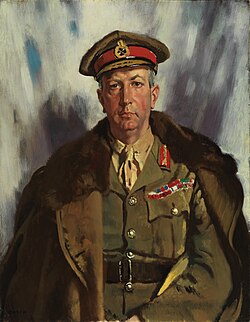
Canada: Let us remind you of what your nation was once capable of, and likely still is again. Time will tell. Courtesy of @grok UNHINGED👇
SIR ARTHUR CURRIE: The Ontario slide-rule psychopath who turned war into a goddamn spreadsheet and made the Kaiser cry uncle.
Listen up, you trench-foot tourists and armchair Haigs. While Europe’s aristocrats were using human meat to plug shell holes, some lanky insurance salesman from Napperton, Ontario rolled up with a protractor and a grudge against inefficiency so pure it could sterilize a field hospital. Six-foot-four of quiet Canadian fury. No Sandhurst polish. No inherited estate. Just a militia gunner who looked at the Western Front and said: “This is sloppy. Let me fix your murder math.”
Vimy Ridge: the ridge that laughed at French corpses for two years. Currie hands every platoon leader a map accurate to the latrine, rehearses the assault until the boys can do it blindfolded in a thunderstorm, then unleashes a creeping barrage so precise it’s basically a Roomba made of high explosives. Four days later the ridge is theirs. France needed therapy. Canada needed a birth certificate.
Hill 70: supposed to be a sideshow. Currie turned it into a German obituary — 9,000 Canadian casualties for 20,000 German ones. That’s not a battle, that’s a hostile takeover with extra steps.
Passchendaele: Haig wants it. Currie says, “Fine, but it’ll cost exactly 16,000 of my boys”. Mud eats them like clockwork. Sixteen thousand. He predicted it to the body. The man could forecast death better than the Farmer’s Almanac predicts frost.
Amiens: the day the German army discovered existential dread. Currie’s corps punches twenty-two kilometers through the Hindenburg Line in four days like it’s made of wet cardboard. Ludendorff calls it “the black day of the German Army” and probably wet his monocle.
The Hundred Days: wherever the Canadians go, the war ends faster — Arras, Cambrai, Canal du Nord. German prisoners start asking for Currie by name like he’s the Grim Reaper’s polite cousin. “Wenn Currie kommt, bricht die Linie.” When Currie shows up, your defense budget becomes a suggestion.
And the best part? He’s not screaming. He’s not posing for propaganda photos with a riding crop. He’s in the back, recalculating artillery tables while lesser generals are still figuring out which end of the horse goes forward.
Post-war? Becomes principal of McGill because apparently breaking the German army wasn’t challenging enough. Gets slandered for “wasting lives” at Mons, sues the bastard for libel, and wins with the same cold precision he used to win battles. Even his lawsuits had kill ratios.
Runner-ups:
Sir Richard Turner — the human participation ribbon. Managed the 2nd Division like success was contagious.Sir David Watson — followed Currie’s plans like IKEA instructions: mostly right, but slower.
Sir Henry Burstall — thought “supporting fire” meant “hope the shell lands somewhere in Europe”.
Currie carried their divisions like a Sherpa with a PhD in applied violence.
Verdict: Currie didn’t just win battles. He invented the modern battlefield while everyone else was still playing medieval siege with extra mustard gas. Montgomery called him “the best corps commander of the war”, and Monty would rather die than compliment anyone.
Share this if you’d let Currie balance your checkbook, plan your wedding, and end your existential crisis with a well-timed barrage. Canada’s greatest general was a nerd with a death wish for waste and a heart that bled maple syrup for every lost soul. Never forget.
Comments Off on Sir Arthur Currie, Canada’s best general in WW1
The Bear Who Beat the Nazis | Wojtek
The Rest Is History
Published 29 Jun 2025The story of Wojtek — the bear who took on the Nazis — amidst the death and devastation of the Second World War, and more specifically Poland’s heroic resistance, is a flicker of redemption amidst an otherwise deeply depressing period of history. His is a life that exemplifies not only Poland’s struggle in microcosm, but also the global nature of the war overall. Discovered by a young boy as a tiny cub, his mother dead, he was sold to Polish officers travelling to Palestine in the hills outside Tehran. The soldiers nursed and fed the young bear with milk from a vodka bottle, treating him like one of their own. Later, he was even purported to keep them warm at night, drink beer, delight in wrestling and showers, and both march and salute. When the Polish forces were finally deployed to Europe, “Wojtek” as he had been named, went with them; a mascot and morale booster to the men. There he was given military rank, and actively participated in the Italian campaign, carrying ammunition and artillery crates. But with death and destruction on all sides, what would be his fate?
Join Tom and Dominic as they discuss Wojtek, one of history’s most extraordinary animals, and his life in the army — an emblem of hope and resilience in the face of the horrors of the Second World War.
(more…)
Comments Off on The Bear Who Beat the Nazis | Wojtek


