
Tasting History with Max Miller
Published 3 Jun 2025Mashed potatoes over a corned beef and onion filling with gravy
City/Region: United Kingdom
Time Period: 1914Many of the young men headed to fight in World War I didn’t already know how to cook, so the British government set up army schools of cookery to teach some of them how to make the most of the rations they were given. Even that ancient army standby, hardtack (clack clack), is better when you can cook it into a stew or pudding.
This potato pie, kind of a simplified preserved meat version of shepherd’s pie, isn’t half bad. If I were to make changes, I would leave out the additional salt (canned corned beef is plenty salty on its own) and add some more onions. While relatively tasty as-is, if you have any HP Sauce lying around, it makes this pie delicious, and many troops would have had access to it during World War I. Delicious and historically accurate: a win-win!
Potato Pie.
16 1/2 lbs. meat, 20 lbs. potatoes, 1 lb. onions, 3 ozs. salt, 1/2 oz. of pepper.
Cut up and stew the onions with jelly from the meat added; boil or steam the potatoes; when cooked mash them. Line the sides of the dish with one-third of the mashed potatoes; place the meat and cooked onions in the centre; season with pepper and salt; cover over the remainder of the mashed potatoes, and bake till the potato cover is brown. As the mashed potatoes absorb the moisture of the meat and render it dry, about 2 pints of gravy prepared from the liquor in which the onions were cooked, should be poured into the pie before serving.
— Manual of Military Cooking. Prepared at the Army School of Cookery, 1914
November 10, 2025
Food in the Trenches of World War One
QotD: “Is it a boy or a girl?”
Even in our supposedly enlightened times, “Is it a boy or a girl?” is still the first question asked of nearly every newborn — and the answer continues to shape how the child is raised. Research shows that from infancy, boys and girls are touched, comforted, spoken to, and treated differently by parents and caregivers. These early experiences may reinforce sex-typical patterns of behavior that often persist into adulthood.
People are intrinsically fascinated by psychological sex differences — the average differences between men and women in personality, behavior, and preferences. Psychologists have studied this topic systematically for decades, beginning with landmark works like The Psychology of Sex Differences (1974) by Eleanor Maccoby and Carol Jacklin. That book helped spark a wave of research that continues to this day. Since then, increasingly sophisticated methods have enabled researchers to detect subtle but consistent differences in how men and women think, feel, and act.
Men and women use language and think about the world in broadly similar ways. They experience the same basic emotions. Both seek kind, intelligent, and attractive romantic partners, enjoy sex, get jealous, make sacrifices for their children, compete for status, and sometimes resort to aggression in pursuit of their interests. In the end, women and men are more alike than different. But they are not identical.
To be sure, sociocultural influences play a role in creating those differences. But environmental factors don’t act on blank slates. To understand young men and young women, we must consider not only cultural context but also evolved sex differences. We are, after all, biological creatures. Like other mammals, we share similar physiology and emotional systems, so it’s not surprising that meaningful differences exist between human males and females.
To understand why psychological and behavioral sex differences evolved, the key concept is parental investment theory, developed by evolutionary biologist Robert Trivers in 1972. The basic idea is straightforward: the sex that invests more in offspring tends to be more selective when choosing a mate. This selectivity follows basic evolutionary logic: those with more to lose are more cautious and risk-averse. To put the stakes in perspective: raising a child from birth to independence in a traditional, preindustrial society requires an estimated 10 million to 13 million calories — the equivalent of about 20,000 Big Macs. For women, reproduction is enormously expensive.
Men also incur reproductive costs, though of a different kind. On average, they have about 20 percent more active metabolic tissue — such as muscle — that fuels their efforts in competition, courtship, and provisioning. While pregnancy requires a large, immediate investment from women, men’s reproductive effort is more gradual, spread out over a lifetime. In evolutionary terms, both sexes pay a price for reproduction, but in different currencies — women through gestation and caregiving, men through physical competition and resource acquisition.
Yet while nature can inform our understanding of human behavior, it does not dictate how we ought to live. A clearer grasp of sex differences can help guide our decisions. It cannot define our values.
Rob Henderson, “Sex Differences Don’t Go Away Just Because You Want Them To”, Rob Henderson’s Newsletter, 2025-08-03.
November 9, 2025
Sir Arthur Currie, commander of the famous Canadian Corps in WW1
As a counterpoint to the OTT summary of Sir Arthur posted last week, here’s The Black Horse with part one of a two-part look at the man’s early career before joining the Canadian Expeditionary Force in Europe:
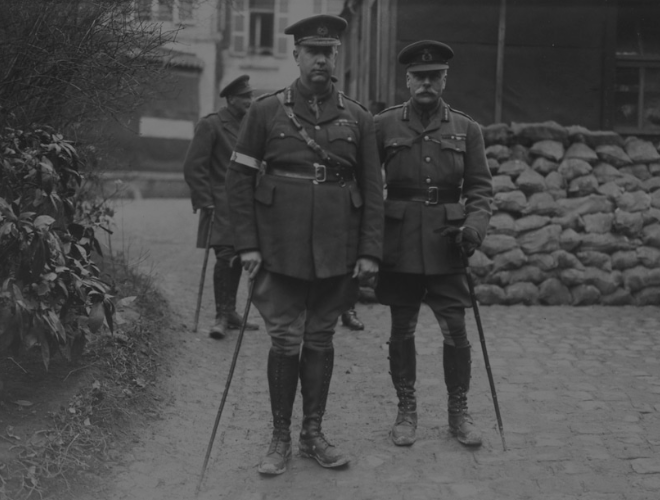
Sir Arthur Currie with Field Marshal Sir Douglas Haig, February 1918.
Libraries and Archives Canada item ID number 3404878.
The Red Ensign is a publication deeply interested in leadership; the good, the bad, and the ugly. For this reason, this Remembrance Day, I have chosen to draw the audience’s attention to the life and times of Sir Arthur Currie, the first Canadian commander of the Canadian Corps during the Great War. This presents an opportunity to both on honour and reflect upon the courage and sacrifice of the men who have fought under the flag of this great nation, but also offers the language to articulate the task facing any who would attempt to lead Canada today. As Currie’s war was defined by the challenge [of] leadership of Canadians in the context of the shifting priorities of the late British Empire, any who would seek to lead Canadians today face will struggle to harmonize efforts on behalf of the Canadian people and the priorities and policies of the American power block which he cannot eschew.
Dulce et decorum est pro patria mori; but when your country is an Imperial Dominion, who and what is “pro patria“, and how can one spend their life for them?
The Man Before the Great Man:
Arthur Currie was born in 1875 in Napperton, Ontario [50 km West of London], the third of eight children living on a homestead belonging to his grandfather. Raised with a the vigorous discipline of a Methodist home, Currie would remain a convicted Christian for his entire life, though he converted to Anglicanism as an adult. Currie was a good student, intending to pursue a career in law or medicine but dropped out of school twice, first temporarily because of the financial constraints brought on by the death of his father, and then for a second time at 19 because of a quarrel with one of his teachers. After leaving school he went West; after a string of failed efforts to establish himself via entrepreneurship and real-estate speculation he joined the Canadian militia as a gunner in 1897 in Victoria B.C. at the age of 23. A giant man (6’3″ at a time when the average Canadian height was 5’7″) with a noted eye for technical detail and, in the words of his son, a “tremendous command of profanity”, he quickly distinguished himself and was promoted to corporal before earning a commission as an officer in 1900. As an officer in peace time Currie was noted for his detailed inspections and his rapid transformation from “one of the boys”, into a rigid disciplinarian. This duality, an officer raised from the ranks, who could both embody the rigid tradition of the British military and who had an intimate familiarity with the life and ways of the enlisted men would become a defining feature of his career.
During Currie’s peace-time career as an officer he maintained a second career as a real-estate [agent]. After becoming head of Matson Insurance Firm 1904, he and the firm invested aggressively in the Victoria real-estate market. In 1913 Currie’s financial situation began to rapidly deteriorate as a consequence of price declines in the real-estate market. Currie’s financial problems nearly led him to refuse to stand up the 50th Regiment Gordon Highlanders of Canada in 1913. In July 1914 Curry used $10,833.34 of regimental funds intended for the purchase of uniforms and kit to pay his personal debts, and found himself facing forcible retirement just as the Canadian Army was being mobilized for war. At the intervention of one of his subordinates, Major Garnet Hughes, he instead accepted promotion as brigadier-general of the 2nd Brigade of the 1st Canadian Division, and ignored correspondence from the new commander of the 50th regiment, Major Cecil Roberts, about the missing funds until he was overseas.
Currie arrived at camp Valcartier on September 1st, 1914 to find himself charged with 10x as many men as he had ever led before, no staff, a shared tent as a command center, and the duty to prepare these men for one of the most difficult theatres of war the world has ever seen. The six months between taking command and the arrival of his brigade in the trenches near Ypres were marked by two mud besotted poorly supplied training camps, shoddy kit, rampant disease, and the company of a certain bear that was to become beloved by children around the world. Through this period Currie was well liked by the men, but known as a disciplinarian with an eye for technical detail. In March 1915 the brigade was deployed to what was expected to be a quiet part of the front with the intent of allowing the men to gain some experience with trench warfare before they were relied upon for action. Nobody anticipated what would happen next.
North Africa Ep. 7: Hitler says No! Rommel doesn’t care!
World War Two
Published 8 Nov 2025Rommel is called to Berlin, where he’s told to wait until May and settle for Benghazi, but he rejects that plan and decides to strike sooner. In Cairo, Wavell reads ULTRA decrypts and realizes the Luftwaffe is preparing something, while admitting he has almost nothing left to hold Cyrenaica. On the ground, the Australians storm Giarabub in a sandstorm, El Agheila is snatched after a botched British ambush, and Rommel orders preparations to hit Mersa Brega before the British can dig in.
(more…)
When “research shows” in a headline indicates “bullshit here”
At Science Is Not The Answer, William M. Briggs says we should never trust stories headlined with “research shows X” (although if you’re a regular reader, you probably already know this):

Research Shows headlines are generated from papers by academics, and these all have explicit or tacit claims of cause, all purporting to explain some set of observations (whether gathered in history, the world, or by experiment). To explain is to state or to tacitly point to a cause.
The problem is that the methods science has developed to affirm or claim cause are often wrong: they are not right; they are in error; they are incorrect; they are fallacious; they sometimes make the right decisions, but only accidentally. By which I mean, cause is arrived at not by the methods, but by other means, yet the methods are credited.
I hope it is clear when I say that these methods are not to be used.
But are.
The worst tool, and one whose use is always and every instance a fallacy, is the so-called hypothesis test. We have done (“wee Ps”) in Class so many times, we’re sick of it (or I am). But I want to prove to you “tests” are fallacious another way, using one familiar example and one common situation. And with no math!
The idea is simple: a researcher makes observations, runs a “test”, and makes a pronouncement the cause he thought of is the one correct explanation for the observations.
He might be right about this, but it will only be accidentally, and not because of the “test”. For that same “test” could be used in support of an infinite number of other possible causes. That is the proof against “tests”: that they can support anything.
This will always be the case. As in every time. As in it is inescapable.
Our familiar example comes from A Global Enlightenment: Western Progress and Chinese Science by Alexander Statman (his surname guaranteeing I would read the book). It is mostly a review of the 18th Century Jesuit mission to China, and those Jesuits’ interactions with major figures of the so-called Enlightenment.
An important observation Statman makes is man’s proclivity to look for wisdom in the past or the future. One believes those in the past had superior knowledge, knew more secrets and could communicate with God (or the gods) with greater ease and facility, yet somehow that knowledge was lost (possibly wiped away in the flood; China, having the oldest extant civilization was thought to hold vast repositories). Or one believes those to come will be better than we, will know more, and will lead easier and happier lives, if only they are not held back by those who look to that past (China was also by others thought to have stagnated and could only copy their betters).
Samopal vz 38: Czechoslovakia’s Interwar Drum-Fed SMG in .380
Forgotten Weapons
Published 25 Jun 2025Military interest in a submachine gun was late in Czechoslovakia, but by the late 1930s a development program was put into place. Interestingly, the main use case for an SMG was seen as being a replacement for a rifle-caliber LMG in fortification mounts. The thought process seems to have been that a large volume of fire was the necessary element to keep invaders away from border fortresses, and the ballistic power of the fire was not so important.
The vz38 was designed by František Myška, chambered for the 9x17mm (.380) cartridge used by the vz22/24 pistol then in service. It was tested against the ZB26 light machine gun. It proved reliable and effective, and its 96-round drum magazine (copied from the Finnish Suomi) was a particularly nice element. An initial order was placed and the gun was formally adopted into service, but production never began. Instead, German occupation of the country put an end to the project and only 20 preproduction examples were ever made.
Many thanks to the VHU — the Czech Military History Institute — for giving me access to this very rare example to film for you. The Army Museum Žižkov is a part of the Institute, and they have a three-story museum full of cool exhibits open to the public in Prague. If you have a chance to visit, it’s definitely worth the time! You can find all of their details (including their aviation and armor museums) here:
QotD: Historical training is not “spending 7 years memorizing dates”
James @TTJamesG
The fact that you spent 7 years memorizing dates and the culmination of that is arguing semantics on X is depressing. Is it too late for a refund? You wrote an entire thread addressing a point I never made, a point you intentionally misconstrued.Another thing that has come up a fair bit here recently is the idea that historical training consists of “spend[ing] 7 years memorizing dates” which is a severe misunderstanding of what historians do.
It confuses the job of reading history books for the job of writing them.
While any historian is going to end up knowing a lot of names and dates simply as a byproduct of teaching and working with their material, raw memorization is not a significant part of the PhD training process.
Instead, the focus is on research skills and analysis.
In practice, we can divide a lot of historical training into three components: the historical method, “theory”, and then field-specific training.
The historical method is the process and heuristics we use to assess historical sources.
While history students work from history books that are “pre-chewed” as it were, historians work with their evidence in its raw, unprocessed form: archives of documents, ancient texts, inscriptions, memoirs, archaeological remains and so on.
The historical method is how we approach that raw material: who produced it? What information would they have had (eyewitness? second hand?), what sources might they have had? What might their own aims have been?
And how can we most plausibly fill in gaps in our evidence?
Then there is historical theory. No good historian is a doctrinaire follower of a single theory of history — rather these are toolboxes of ideas we use to frame the research questions we’re asking.
But to use those ideas, you must know and understand them first.
So “critical theory” is interested in power relationships, while an Annales framework is interested in long-term structures and cultural assumptions, while a materialist framework focuses on material conditions and so on.
Each would imply different questions of the evidence.
Part of the point of learning theory, of course, is that each theory lens is, in and of itself, incomplete. Cultural structures matter, individual choices matter, material conditions matter, etc. etc.
You learn and think about a bunch of these to know the blindspots of each.
Finally, historians are going to learn a bunch of research skills specific to our period and place. For ancient Roman history, that’s Latin, Greek, epigraphy, paleography, some philology and a lot of archaeology.
For a more modern field, archive research methods are huge.
On top of that, you’re also going to develop knowledge in other disciplines — sciences, social sciences — that touch on your topic of interest. I work on the costs of warfare, so military science and theory, along with economics and a bit of demographics, matter to me.
What the historian is actually doing is taking that skillset to the raw evidence of the past — sometimes asking new questions of old material, frequently asking old questions of material no one has studied intensively before — to discover new information about the past.
Of course we also assemble a broad knowledge of the societies we study (like how Roman citizenship works), which we’d need to understand our sources and our evidence.
Roman citizenship, for instance, matters a lot for understanding the Roman army!
That broad knowledge is what we’re drawing on in teaching and for that we are relying on the work of our colleagues in the discipline: each historian is doing their own original discovering-the-past work, but also keeping up-to-date on our colleagues’ work.
The end result is both a steadily improving understanding of the past but also the ability, as our own conditions and interests change, to ask new questions, rather than simply endlessly rehash old questions and old (potentially flawed) answers.
“Online Rent-a-Sage” Bret Devereaux, Twitter, 2025-08-05.
November 8, 2025
All cultures are not equal, especially when it comes to crimes like rape
On the social media site formerly known as Twitter, Dr. Sydney Watson responds to a post on feminists blaming all men for the actions of some men from other cultures:
Jessica Pin @jess_ann_pin
It bothers me so much when some feminists act like men are just as misogynist and violent everywhere.
That’s not true. Men from some cultures are absolutely worse than others.
I’m not saying there is a genetic difference. But there are definitely cultural differences, and we need to be careful about who we let in.
[Full sized images in the linked post]
I don’t know how to explain this succinctly —
But, ages ago I watched this series about prisons around the world. There were a few episodes that focused on prisons in African countries – how the prisons ran, what people were charged with etc.
What stood out to me was that over 50% of the male prisoners were there for some sort of sex crime – rape, sexual assault, child sexual abuse etc.
What was even worse was that, when asked about why they committed these crimes, a lot of the men said things about how they were “teaching the woman a lesson” or raping her was some sort of “punishment.”
And I couldn’t help but think, “well, that checks out. Given how these men from these places come to Western countries and rape women.”
People might not like hearing that, and the less evolved among us chalk it up to “racism” (lol) but if someone comes from a culture that views rape as a form of punishment for unruly women, then why would that viewpoint suddenly change when their feet hit British/Swedish/Canadian soil?
If, culturally, you view women as barely people, why on earth would you suddenly start because you’re in a new place?
Point being – it’s utterly mad to put women and girls at risk because people don’t want to admit that some cultures are horrible. I’m tried of pretending that all cultures are equal when they’re so obviously not.

Update, 10 November: Welcome, Instapundit readers! Please do have a look around at some of my other posts you may find of interest. I send out a daily summary of posts here through my Substack – https://substack.com/@nicholasrusson that you can subscribe to if you’d like to be informed of new posts in the future.
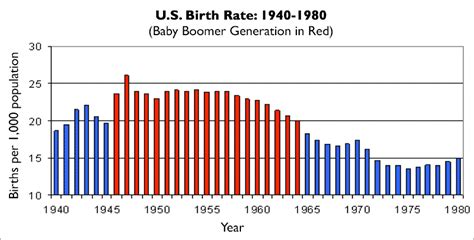
The Boomers didn’t do it, but they could have reversed it
On the social media site formerly known as Twitter, John Carter takes the entire Baby Boom generation out to the woodshed for a well-deserved talking-to:
toking-the-abacus @_toking
It’s amazing how catastrophically bad the current job market is in the US. No one wants to train anyone. They want 5-10 years experience in skills that you don’t get unless someone mentors you in a more junior role. Then you have rampant visa abuse.
Boomers mostly got paid to get trained on the job for their jobs.
Then they turned around and demanded college for everything. At a steep markup.
Then they rugpulled all the college grads by hiring foreigners to do the jobs people went into debt learning how to do.
Whole lotta incensed geriatrics in the replies saying “That wasn’t boomers, that was Griggs v Duke Power! Those judges were silent generation!”
Yes. And that was 1970. 55 years ago.
That’s kind of the point.
You were the largest generation in history, boomers. You could have reversed that insane decision. You could have ended the crazy practice of disparate impact. You could have ended the systemic bigotry of affirmative action, which discriminated not only against you, but against your own sons and, now, your grandsons. You could have used your institutional and electoral power to block DEI.
You could have done a lot of things.
But you didn’t.
At most you grumbled some, but not too loudly, because after all dad fought in the big war and you didn’t want to do a Hitler. A lot of you supported all of it wholeheartedly, because John Lennon had an imagination and MLK had a dream and remember Woodstock, man. Some of you profited from it handsomely. As a generation, as a group, whether by action or inaction, you entrenched it in every aspect of law and institutional culture.
You participated, each in your own way, in redesigning our entire society around women’s feelings, black self esteem, and sabotaging the minds, bodies, spirits, and lives of your white sons.
Don’t run from your part in this.
I’m not saying this to be mean.
I’m saying this because we fucking need you.
We need your votes, because as a direct result of the immigration policies of the last half century – which, again, yes, have their origin with Greatest and Silents, but whose most severe consequences unfolded on YOUR watch – we are absolutely, 100% screwed if we don’t deport an absolutely incredible, historically unprecedented number of people in a very short period of time. If that doesn’t happen it’s game over for America and, frankly, Western civilization. For now, for as long as you’re still breathing and capable of casting a ballot, whites are a bare majority. When you’re gone we’re outnumbered, the third world swallows the first, and it’s over.
We need you to confront the consequences of your actions and your complacency, to really feel what its done to your descendants, and to be filled with rage at the way you were misled by evil and selfish men, and an implacable determination to spend what remains to you of your lives doing whatever you can to reverse enough of the damage you allowed to be done to salvage something from this crumbling wreck of a society.
That is why we bully you.
Because we need you to see.
History Summarized: Greece… TWO (it’s in Italy)
Overly Sarcastic Productions
Published 4 Jul 2025From the Olympians who brought you “Greece” and “The Other Side of Greece” comes the bold, innovative, and way shinier “GREECE TWO”.
SOURCES & Further Reading:
The Greeks: A Global History by Roderick Beaton
Ancient Greece: The Definitive Visual History produced by DK & Smithsonian
The Complete Greek Temples by Tony Spawforth
Ancient Cities Brought To Life by Jean-Claude Golvin
“From Sicily to Syria – The Growth of Trade and Colonization” from Ancient Greek Civilization by Jeremy McInerney
“Magna Graecia: Taras and Syracuse” and “Cyrene, Leptis Magna, and Ancient Libya” from Great Tours: Ancient Cities of the Mediterranean by Darius Arya
Sicily: An Island at the Crossroads of History by John Julius Norwich
“The Greeks: An Illustrated History” by Diane Harris Cline for National Geographic
QotD: Singing in church
Note: I used to have a good singing voice, not quite commercial quality, IMHO, no, but quite good nonetheless. I loved to sing. I still do, the songs I can still handle, too.
Almost nobody sings reliably in my church. Oh, they can, but they generally do not. The exceptions are hymns everybody knows the tunes to, some of the responsorials, ditto, and, notably, last 4 July, “America the Beautiful”. And, at Christmas, the traditional Christmas songs.
So why those and not the others. Well, the typical hymn in the typical modern church was penned by a couple of nuns from the Order of the Discalced Sisters of Sappho, or priests from the Gay Jesuit Alliance, and printed in the hymnal largely as an exercise in flattery.
Okay, that’s not really true … or not entirely anyway. No, the real problem is that, and I cannot emphasize this enough, NOBODY KNOWS THE BLOODY TUNES, SO OF FREAKING COURSE THEY DON’T SING, WHILE THEY CHANGE THE HYMNS SO OFTEN — WEEKLY, AS A MATTER OF FACT — THAT NOBODY EVER HAS THE CHANCE TO LEARN THE TUNES.
So I propose the following: Pick five hymns — among my recommendations, “The Battle Hymn of the Republic”, “We Gather Together”, “Amazing Grace”, “How Great Thou Art”, “Abide with Me”; but I’m not a fanatic about it — and use only those five for however long it takes for 75% of the congregation to sing all of them. Then change ONE and keep at that until 75% will sing that. And keep doing that until you have a repertoire of 20-25 songs everybody knows and most everybody will sing.
“Make a joyful sound unto the Lord” and see if your parish doesn’t grow and if your parishioners aren’t a lot happier in mass.
Tom Kratman, The social media site formerly known as Twitter, 2025-07-03.
November 7, 2025
Milei – “If we don’t have [power], then the left will have it”
In Without Diminishment, Geoff Russ discusses Javier Milei’s recent podcast appearance and his demonstration that unlike a lot of theoretical libertarians, he understands the dynamics of political power:

There are many liberals, libertarians and anarcho-capitalists who are really useless because all they do is criticise, let’s say, those of us who want to lead the world toward the ideas of freedom. And what they don’t realise is that power is a zero-sum game, and if we don’t have it, then the left will have it. Therefore, if you level your harshest criticism at those in your own ranks, you end up being subservient.
Have truer words ever been spoken by an English-speaking politician?
Argentine President Javier Milei’s words on the Lex Fridman podcast were a blunt reminder of something that many conservatives, particularly those in Canada, have chosen to forget.
Politics is the pursuit of political power and the chance to use it before your opponents can. Debates can be won, superb essays published, and quotes recycled from deceased politicians. Without power, however, it all amounts to nothing more than a glorified brainstorming session.
The thoughtful ideas and proposals go to waste if they lie stagnant in perpetual bickering opposition.
On October 26, Milei won a resounding victory in the legislative elections. His party, Liberty Advances, gained forty-two seats and smashed the hard-left Peronists who have dominated Argentina’s politics for more than half a century.
Milei is a fanatical believer in libertarian ideas, and has never pretended to be a moderate or incrementalist. He famously brandishes a chainsaw to represent his willingness to destroy the broken socialist status quo of Argentina.
Javier Milei at CPAC in National Harbor, Maryland 20 February, 2025.
Photo by Gage Skidmore via Wikimedia Commons.The rise of Milei has been a cultural battle for the soul of the country, and he is not shy about it. Milei leads a fresh, winning anti-Peronist coalition of forgotten and angry Argentines who want permanent, radical change.
It may be tempting to view Milei’s success as a pure affirmation of the appeal of libertarian ideology, but he is hardly Argentina’s first advocate of economic freedom. He succeeds because he is the opposite of a polite, centre-right reformer. Milei unapologetically embraces his place as a culture warrior seeking to remake the nation.
One of his targets is the institutional decadence and incompetence of the Peronist political machine. By swearing to snuff it out, Milei swept through traditional Peronist strongholds, whose voters had never considered voting for the formerly toothless Argentine opposition.

In Reason, Peter Suderman considers some of the lessons North Americans can learn from Milei’s stunning election victory:

To understand why Democrats overperformed in this week’s elections, look to Argentina.
Last month, Argentinian president Javier Milei won an unexpectedly large electoral affirmation, as his party significantly outperformed expectations by more than doubling its congressional representation in what was widely seen as a referendum on his agenda.
Over the past two years, Milei, the world’s most libertarian national leader, has slashed spending, cut red tape, and made his top priority restoring economic order and prosperity to a country that has long been a socialist basket case. Critics warned that his policies would be destructive, destabilizing, and unpopular. But not only did he deliver the country’s first balanced budget in over a decade, he oversaw a radical decline in inflation — from 200 percent when he entered office down to 32 percent last month.
Despite warnings that the country would reject Milei’s brand of austerity, the country responded with a strong vindication of his policies. In a post-election analysis, The New York Times noted that Milei’s message was that only he offered a “path for a country that has undergone years of runaway inflation under high-spending populist governments”. The report pointed to Milei’s economic record to explain his party’s win: “Many Argentines had grown tired of prices swinging wildly from day to day and of a ruling class they considered to be corrupt and irresponsible”.
The same report said Milei’s outsized victory was “unexpected”. But perhaps it shouldn’t have been, because economic stability and low inflation are what voters the world over clearly want.
When voters swept President Donald Trump into office for the second time last fall, large majorities of his voters gave the economy poor marks and said their own family finances had worsened over the years. Under President Joe Biden, the American economy had been wracked by the biggest surge in inflation in forty years. American voters punished the party that was in power when that happened.
This was true all over the world. After the pandemic, inflation skyrocketed globally, and in election after election, voters rejected ruling parties.
Inflation and economic instability have long been political losers: Look at Ronald Reagan’s victory over Jimmy Carter in 1980, and his ensuing near-sweep of states in 1984 after taming a decade of out of control price hikes. The post-pandemic years have further reinforced this lesson.
Update: Undoctrination looks at Milei’s time in office so far.
Undoctrination
Published 6 Nov 2025Javier Milei just pulled off the impossible … again.
In Argentina”s 2025 “midterm” elections, Milei’s 4-year-old party, La Libertad Avanza, went from a tiny minority to the largest party in the lower house, ending socialist dominance in Congress. The election was widely viewed as a referendum on Milei’s shock therapy plan for Argentina. The results are in: Argentines want more freedom.
In this video we cover:
How Milei slashed inflation from 211% to 31.8% in just 2 years
The 34,000 government jobs cut, 10 agencies eliminated, and 672 deregulations that freed the economy during Milei’s first year in office
How the Buenos Aires rental market exploded after lifting controls
How Peronists lost their veto-proof majority — and what it means for the futureAnd we feature expert analysis from Marcos Falcone, Policy Analyst, Center for Global Liberal and Prosperity.
“BookTok on its own sounds innocent enough”
I’ve seen occasional references to BookTok on other platforms but as it seemed to be as female-coded as an online community can be, I’d never bothered to pay close attention to it. If Zoomertea is to be believed, it’s a weird and disturbing space for the unprepared to visit:

Image from “The Female Gooner Epidemic” at Zoomertea
If you’re smart enough to have never downloaded TikTok, then you’ve probably never heard of BookTok and the resulting epidemic of female gooners (a term borrowed from porn culture to describe obsessive arousal and fixation). BookTok on its own sounds innocent enough, women rediscovering the joys of reading, romanticising cozy nights in, or even joining a book club. In theory, what could be more wholesome? However, the reality is more concerning. It turns out the bookish girls have traded the likes of Pride and Prejudice for highly pornographic dark fantasy erotica, stories that make Fifty Shades of Grey seem tame.
Women have always enjoyed a flair for romance. Once it was the slow burn longing of Romeo & Juliet or Wuthering Heights – the stories weren’t explicit, yet still roused deep, passionate feelings. By the 2000s, romance had evolved into “chick lit” – breezy novels about friendship, love and self-discovery. Books like Bridget Jones and the Devil Wears Prada swapped tragic love for witty realism, capturing the struggles of modern women navigating careers, dating, and independence. It seems like in all aspects of modern culture, people have been pushing for the “reliability factor” – they wanted to see themselves in the characters and storylines. But somewhere along the way, the realism and reliability factor lost its appeal.
During the pandemic, while the virus spread and the world stayed home, TikTok spread too, surpassing 2 billion downloads by mid-2020. With endless free time, people picked up new hobbies: some tried Chloe Ting’s “Get Abs in 2 Weeks” workouts, others turned to BookTok and rediscovered their love for literature. Booktok isn’t just for explicit romantasy novels, however it’s become synonymous with women who obsessively consume dark romance. On BookTok, desire isn’t intimate anymore; it’s performed.
While Fifty Shades of Grey, a book very explicitly about sex, came almost ten years before BookTok, it wasn’t exposed to the algorithmic amplification loop we see today. Although its release did shock readers and spark feminist critiques about patriarchal relationships and sexual themes, it still felt more like a dirty secret. Its eroticism was discussed privately, even sheepishly. It was a book club secret, not a TikTok performance. Now, even the most unassuming women are flocking to BookTok and demanding books with a maximum “spice rating”, without an ounce of shame. But how did this happen?
Somewhere between the isolation and scrolling, the lines between fantasy and reality began to blur. The algorithm on TikTok can be very dangerous for enforcing unhealthy habits on its users. When a woman watches or likes just one “spicy book” video, even just out of curiosity, TikTok interprets it as interest in similar content. Without the user’s knowledge, suddenly their ForYou page is filled with similar videos, “books with a max spice rating”, “extreme taboo book recommendations” or “Top five dark romance recs”. The more they see, the more they engage, the more the algo pushes darker more extreme content. Essentially, the algorithm learns: You like desire, here’s more. Louder. Darker
Crossing the floor in Parliament
It’s not an everyday thing, but I saw someone mention on social media that there had been over 300 floor-crossings since Confederation. The latest Member of Parliament to switch parties … to literally walk across the floor in Parliament to join Carney’s Liberal party is Nova Scotia’s Chris d’Entremont:
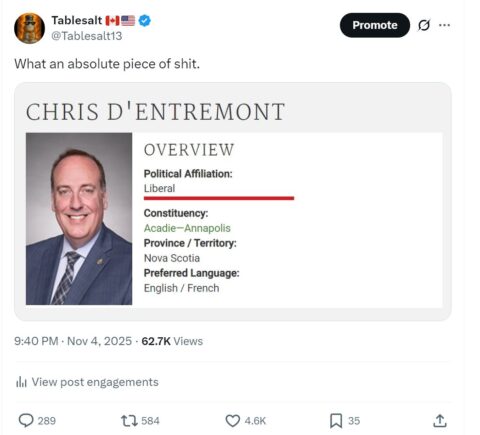
The speculation in Ottawa about floor crossers is getting silly, some of the names being pushed don’t make any sense. Which makes me think that this is really an attempt by the Liberals to try and destabilize the Conservatives.
Sorry, that would be “destablise” in Mark Carney’s new English but more on that shortly.
We have seen Liberals push name after name including Chris d’Entremont who did cross, but others who have said they have no interest in crossing. That was the case for Dominique Vien the Conservative MP from Quebec’s south shore who had to post a video after jerks like me published her name following weeks of speculation.
If you don’t speak French, let me summarize, or sumarise in Carney English. She says that she’s heard the rumours that she would be leaving the Conservative caucus to sit as a Liberal or an independent, but that’s not true. She states clearly that she is and will remain a Conservative and that she doesn’t like Mark Carney’s budget.
Meanwhile, Joël Godin, the MP for Portneuf—Jacques-Cartier a riding northwest of Quebec City, who has been named as a possible floor crosser declined to answer questions entering caucus on Wednesday. Does that mean he’s ready to cross or not just putting up with the BS?
Conservative insiders tell me that he won’t be changing teams anytime soon.
The rumour mill is insane, with Liberals pushing the idea that all kinds of Conservatives are looking to jump ship. I’ve had several Liberals tell me that Michael Chong has been looking to cross the floor, an idea that is so ridiculous that I didn’t even call Chong to ask him because anyone floating that doesn’t know the man or conservative politics.
After I mentioned that on 580 CFRA in Ottawa, Chong called me to assure me that he wasn’t crossing to the Liberals. Michael, I never doubted you.
It’s doubtful that other names Liberals are pushing will come to fruition.
What is clear is that Carney and the Liberals are reaching out to Conservative MPs and making them offers to switch parties. Are they making illegal offers? I’d really like to know what has been put forward.
Is a “comfy landing” being offered for those that will cross? It wouldn’t be the first time that kind of thing has been offered.
As to the particular motivations for d’Entremont decamping to the Liberal benches, discussions on the social media site formerly known as Twitter indicate that he just barely got elected this time around, that he’d been fired by Pierre Poilievre as Deputy Speaker, and he decided he had a better chance of getting back into Parliament as a Liberal in the next election. Quinn Patrick reports that the Liberals had been trying to get d’Entremont to join them for quite some time:
Industry Minister Mélanie Joly said the Liberals had been courting former Conservative MP Chris d’Entremont behind the scenes for five years before he ultimately crossed the aisle.
“We’ve been trying to recruit him for a long time,” Joly told reporters in French on Parliament Hill on Wednesday. “Finally, he saw the light.”
D’Entremont had served as a Conservative MP for six years, after first being elected in the 2019 election.
As several people pointed out, that conveniently meant he’s qualified for the platinum-plated MP pension plan … but I’m sure that’s not why he switched parties.
Liberal MP Kody Blois, who also represents a riding in Nova Scotia, confirmed that he and d’Entremont had been speaking “for a long time about the ways in which we can collaborate.”
“It’s great to see Mr. d’Entremont join. If there’s other members of Parliament feeling the same way, again, I think we’re always welcome to those conversations,” said Blois.
While Blois didn’t explicitly say he had been attempting to enlist d’Entremont, he said the Liberals are a big-tent party with room to accept more “moderate” conservatives.
When asked if the Carney government was actively trying to recruit more MPs, Blois said that “wouldn’t be a conversation I’m going to have right here in front of the media.”
The former Conservative MP met with Prime Minister Mark Carney at a post-budget media conference on Wednesday, saying he didn’t believe his values as a “red Tory” were being “represented.”
“I didn’t find I was represented there … my ideals of an easterner, of a red Tory and quite honestly of trying to find ways to find solutions and help the community rather than trying to oppose everything that’s happening,” said d’Entremont.
He also alluded to the possibility of other Conservative MPs “in the same boat” but stopped short of naming anyone specific, saying he would let them share their stories “if the time comes.”
However, he has been the only one to cross the aisle thus far.
Conservatives and their supporters have accused d’Entremont of betraying his constituents and his values in pursuit of his own ambitions.


