
Forgotten Weapons
Published 30 Dec 2024Today I am in Vlašim in the Czech Republic, where Sellier & Bellot has allowed me to film a tour of their ammunition plant. This is one of the largest ammo manufacturers in the world, and they start with basic raw material like lead, copper, and brass and ship out complete case ammunition. The machines involved in this process are really interesting — let’s have a look!
(more…)
April 30, 2025
April 26, 2025
The Fairey Battle – Light Bomber, Heavy Losses
Rex’s Hangar
Published 17 Nov 2021Originally conceived in the early 1930s, by the time the first prototype of the Fairey Battle flew in 1936 it was already becoming obsolete. However, the RAF desperately needed combat aircraft, and so the Battle was put into production. It would go on to fight in the Battle of France, where it would take exceptionally heavy losses due to its slow speed and poor defensive armament. After being retired from front-line duty, the Fairey Battle would go on to becoming a successful training aircraft for the RAF and Commonwealth forces, serving the needs of combat flight schools in Canada, South Africa, Australia and New Zealand.
****
Producing these videos is a hobby of mine. I have a passion for history, and personally own a large collection of books, journals and other texts, and endeavor to do as much research as possible. However if there are any mistakes, please don’t hesitate to reach out and correct anything 🙂
Comments Off on The Fairey Battle – Light Bomber, Heavy Losses
April 24, 2025
Modernizing Le Clairon: the FAMAS Valorisé
Forgotten Weapons
Published 25 Dec 2024The FAMAS was the best bullpup rifle of its era, but it was a difficult platform to modernize with optics. In 1995, the “FELIN” (Fantassin à Équipement et Liaisons INtégrés; Integrated Infantry Equipment and Communications) was commissioned to create a next-generation weapons platform for the French soldier. This used a computerized multi-function optic mounted to a lowered rails system and a control keypad on a new front grip on the rifle. Like the American Objective Force Warrior and other similar programs, FELIN was not successful — but the base rifle did have a future. By dropping the new keypad-integrated lower assembly for the original FAMAS F1 lower but keeping the lowered upper assembly with its Picatinny rail, the FAMAS Valorisé was created, allowing much improved optics mounting.
These new rifles still used the FAMAS 25-round magazine, but now had Beretta-made barrels with 1:9 rifling, suitable for M855 and other heavy 5.56mm loadings. The Valorisé also included a small piece of rail specifically for an IR laser and added pivot to the bipod (which remained free-floated from the barrel). A total of 18,500 rifles were converted, and in 2015 they were used to equip 17 French regiments — and they saw some combat use in Afghanistan. Had the FAMAS platform been retained, this would have been the basis for its further modernization — but with adoption of the H&K 416F instead, the Valorisé rifles are being decommissioned.
(more…)
Comments Off on Modernizing Le Clairon: the FAMAS Valorisé
QotD: The Phalanx
… we need to distinguish what sort of phalanx because this is not the older hoplite phalanx in two very important ways: first, it is equipped and fights differently, but second it has a very different place in the overall tactical system: the Macedonian phalanx may be the “backbone” of a Hellenistic army, but it is not the decisive arm of the system.
So let’s start with the equipment, formation and fighting style. The older hoplite phalanx was a shield wall, using the large, c. 90cm diameter aspis and a one-handed thrusting spear, the dory. Only the front rank in a formation like this engaged the enemy, with the rear ranks providing replacements should the front hoplites fall as well as a morale force of cohesion by their presence which allowed the formation to hold up under the intense mental stress of combat. But while hoplites notionally covered each other with their shields, they were mostly engaged in what were basically a series of individual combats. As we noted with our bit on shield walls, the spacing here seems to have been wide enough that while the aspis of your neighbor is protecting you in that it occupies physical space that enemy weapons cannot pass through, you are not necessarily hunkered down shoulder-to-shoulder hiding behind your neighbor’s shield.
The Macedonian or sarisa-phalanx evolves out of this type of combat, but ends up quite different indeed. And this is the point where what should be a sentence or two is going to turn into a long section. The easy version of this section goes like this: the standard Macedonian phalangite (that is, the soldier in the phalanx) carried a sarisa, a two-handed, 5.8m long (about 19ft) pike, along with an aspis, a round shield of c. 75cm carried with an arm and neck strap, a sword as a backup weapon, a helmet and a tube-and-yoke cuirass, probably made out of textile. Officers, who stood in the first rank (the hegemones) wore heavier armor, probably consisting of either a muscle cuirass or a metal reinforced (that is, it has metal scales over parts of it) tube-and-yoke cuirass. I am actually quite confident that sentence is basically right, but I’m going to have to explain every part of it, because in popular treatments, many outdated reconstructions of all of this equipment survive which are wrong. Bear witness, for instance, to the Wikipedia article on the sarisa which gets nearly all of this wrong.
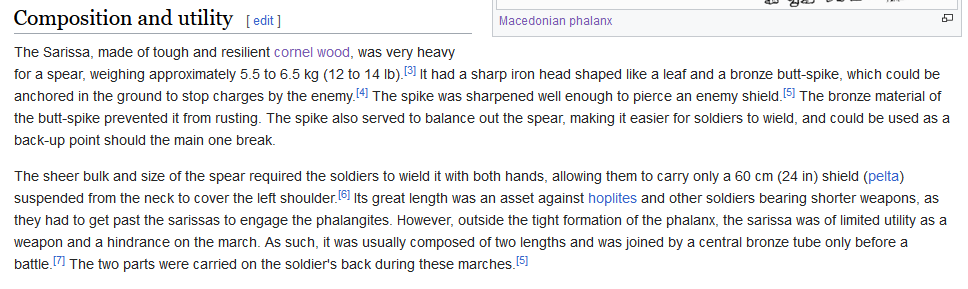
Wikipedia‘s article on the topic as of January, 2024. Let me point out the errors here.
1) The wrong wood, the correct wood is probably ash, not cornel – the one thing Connolly gets wrong on this weapon (but Sekunda, op. cit. gets right).
2) The wrong weight, entirely too heavy. The correct weight should be around 4kg, as Connolly shows.
3) Butt-spikes were not exclusively in bronze. The Vergina/Aigai spike is iron, though the Newcastle butt is bronze (but provenance, ????)
4) They could be anchored in the ground to stop cavalry. This pike is 5.8m long, its balance point (c. 1.6m from the back) held at waist height (c. 1m), so it would be angled up at something like 40 degrees, so anchoring the butt in the ground puts the head of the sarisa some 3.7m (12 feet) in the air – a might bit too high, I may suggest. The point could be brought down substantially if the man was kneeling, which might be workable. More to the point, the only source that suggests this is Lucian, a second century AD satirist (Dial Mort. 27), writing two centuries after this weapon and its formation had ceased to exist; skepticism is advised.
5) We’ll get to shield size, but assuming they all used the 60cm shield is wrong.
6) As noted, I don’t think these weapons were ever used in two parts joined by a tube and also the tube at Vergina/Aigai was in iron. Andronikos is really clear here, it is a talon en fer and a douille en fer. Not sure how that gets messed up.Sigh. So in detail we must go. Let us begin with the sarisa (or sarissa; Greek uses both spellings). This was the primary weapon of the phalanx, a long pike rather than the hoplite‘s one-handed spear (the dory). And we must discuss its structure, including length, because this is a case where a lot of the information in public-facing work on this is based on outdated scholarship, compounded by the fact that the initial reconstructions of the weapon, done by Minor Markle and Manolis Andronikos, were both entirely unworkable and, I think, quite clearly wrong. The key works to actually read are the articles by Peter Connolly and Nicholas Sekunda.1 If you are seeing things which are not working from Connolly and Sekunda, you may safely discard them.
Let’s start with length; one sees a very wide range of lengths for the sarisa, based in part on the ancient sources. Theophrastus (early third century BC) says it was 12 cubits long, Polybius (mid-second century) says it was 14 cubits, while Asclepiodotus (first century AD) says the shortest were 10 cubits, while Polyaenus (second century AD) says that the length was 16 cubits in the late fourth century.2 Two concerns come up immediately: the first is that the last two sources wrote long after no one was using this weapon and as a result are deeply suspect, whereas Theophrastus and Polybius saw it in use. However, the general progression of 12 to 14 to 16 – even though Polyaenus’ word on this point is almost worthless – has led to the suggestion that the sarisa got longer over time, often paired to notions that the Macedonian phalanx became less flexible. That naturally leads into the second question, “how much is a cubit?” which you will recall from our shield-wall article. Connolly, I think, has this clearly right: Polybius is using a military double-cubit that is arms-length (c. 417mm for a single cubit, 834mm for the double), while Theophrastus is certainly using the Athenian cubit (487mm), which means Theophrastus’ sarisa is 5.8m long and Polybius’ sarisa is … 5.8m long. The sarisa isn’t getting longer, these two fellows have given us the same measurement in slightly different units. This shaft is then tapered, thinner to the tip, thicker to the butt, to handle the weight; Connolly physically reconstructed these, armed a pike troupe with them, and had the weapon perform as described in the sources, which I why I am so definitively confident he is right. The end product is not the horribly heavy 6-8kg reconstructions of older scholars, but a manageable (but still quite heavy) c. 4kg weapon.
Of all of the things, the one thing we know for certain about the sarisa is that it worked.
Next are the metal components. Here the problem is that Manolis Andronikos, the archaeologist who discovered what remains our only complete set of sarisa-components in the Macedonian royal tombs at Vergina/Aigai managed to misidentify almost every single component (and then poor Minor Markle spent ages trying to figure out how to make the weapon work with the wrong bits in the wrong place; poor fellow). The tip of the weapon is actually tiny, an iron tip made with a hollow mid-ridge massing just 100g, because it is at the end of a very long lever and so must be very light, while the butt of the weapon is a large flanged iron butt (0.8-1.1kg) that provides a counter-weight. Finally, Andronikos proposed that a metal sleeve roughly 20cm in length might have been used to join two halves of wood, allowing the sarisa to be broken down for transport or storage; this subsequently gets reported as fact. But no ancient source reports this about the weapon and no ancient artwork shows a sarisa with a metal sleeve in the middle (and we have a decent amount of ancient artwork with sarisae in them), so I think not.3
Polybius is clear how the weapon was used, being held four cubits (c. 1.6m) from the rear (to provide balance), the points of the first five ranks could project beyond the front man, providing a lethal forward hedge of pike-points.4 As Connolly noted in his tests, while raised, you can maneuver quite well with this weapon, but once the tips are leveled down, the formation cannot readily turn, though it can advance. Connolly noted he was able to get a English Civil War re-enactment group, Sir Thomas Glemham’s Regiment of the Sealed Knot Society, not merely to do basic maneuvers but “after advancing in formation they broke into a run and charged”. This is not necessarily a laboriously slow formation – once the sarisae are leveled, it cannot turn, but it can move forward at speed.
The shield used by these formations is a modified form of the old hoplite aspis, a round, somewhat dished shield with a wooden core, generally faced in bronze.5 Whereas the hoplite aspis was around 90cm in diameter, the shield of the sarisa-phalanx was smaller. Greek tends to use two words for round shields, aspis and pelte, the former being bigger and the latter being smaller, but they shift over time in confusing ways, leading to mistakes like the one in the Wikipedia snippet above. In the classical period, the aspis was the large hoplite shield, while the pelte was the smaller shield of light, skirmishing troops (peltastai, “peltast troops”). In the Hellenistic period, it is clear that the shield of the sarisa-phalanx is called an “aspis” – these troops are leukaspides, chalkaspides, argyraspides (“white shields”, “bronze shields”, “silver shields” – note the aspides, pl. of aspis in there). This aspis is modestly smaller than the hoplite aspis, around 75cm or so in diameter; that’s still quite big, but not as big.
Then we have some elite units from this period which get called peltastai but have almost nothing to do with classical period peltastai. Those older peltasts were javelin-equipped light infantry skirmishers. But Hellenistic peltastai seem to be elite units within the phalanx who might carry the sarisa (but perhaps a shorter one) and use a smaller shield which gets called the pelte but is not the pelte of the classical period. Instead, it is built exactly like the Hellenistic aspis – complete with a strap-suspension system suspending it from the shoulder – but is smaller, only around 65cm in diameter. These sarisa-armed peltastai are a bit of a puzzle, though Asclepiodotus (1.2) in describing an ideal Hellenistic army notes that these guys are supposed to be heavier than “light” (psiloi) troops, but lighter than the main phalanx, carrying a smaller shield and a shorter sarisa, so we might understand them as an elite force of infantry perhaps intended to have a bit more mobility than the main body, but still be able to fight in a sarisa-phalanx. They may also have had less body-armor, contributing that the role as elite “medium” infantry with more mobility.6
Finally, our phalangites are armored, though how much and with what becomes really tricky, fast. We have an inscription from Amphipolis7 setting out military regulations for the Antigonid army which notes fines for failure to have the right equipment and requires officers (hegemones, these men would stand in the front rank in fighting formation) to wear either a thorax or a hemithorakion, and for regular soldiers where we might expect body armor, it specifies a kottybos. All of these words have tricky interpretations. A thorax is chest armor (literally just “a chest”), most often somewhat rigid armor like a muscle cuirass in bronze or a linothorax in textile (which we generally think means the tube-and-yoke cuirass), but the word is sometimes used of mail as well.8 A hemithorakion is clearly a half-thorax, but what that means is unclear; we have no ancient evidence for the kind of front-plate without back-plate configuration we get in the Middle Ages, so it probably isn’t that. And we just straight up don’t know what a kottybos is, although the etymology seems to suggest some sort of leather or textile object.9
In practice there are basically two working reconstructions out of that evidence. The “heavy” reconstruction10 assumes that what is meant by kottybos is a tube-and-yoke cuirass, and thus the thorax and hemithorakion must mean a muscle cuirass and a metal-reinforced tube-and-yoke cuirass respectively. So you have a metal-armored front line (but not entirely muscle cuirasses by any means) and a tube-and-yoke armored back set of ranks. I would argue the representational evidence tends to favor this; we most often see phalangites associated with tube-and-yoke cuirasses, rarely with muscle cuirasses (but sometimes!) and not often at all in situations where they have the rest of their battle kit (helmet, shield, sarisa) as required for the regular infantry by the inscription but no armor.
Then there is the “light” reconstruction11 which instead reads this to mean that only the front rank had any body armor at all and the back ranks only had what amounted to thick travel cloaks. Somewhat ironically, it would be really convenient for the arguments I make in scholarly venues if Sekunda was right about this … but I honestly don’t think he is. My judgment rebels against the notion that these formations were almost entirely unarmored and I think our other evidence cuts against it.12
Still, even if we take the “heavy” reconstruction here, when it comes to armor, we’re a touch less well armored compared to that older hoplite phalanx. The textile tube-and-yoke cuirass, as far as we can tell, was the cost-cutting “cheap” armor option for hoplites (as compared to more expensive bell- and later muscle-cuirasses in bronze). That actually dovetails with helmets: Hellenistic helmets are lighter and offer less coverage than Archaic and Classical helmets do as well. Now that’s by no means a light formation; the tube-and-yoke cuirass still offers good protection (though scholars currently differ on how to reconstruct it in terms of materials). But of course all of this makes sense: we don’t need to be as heavily armored, because we have our formation.
Bret Devereaux, “Collections: Phalanx’s Twilight, Legion’s Triumph, Part Ia: Heirs of Alexander”, A Collection of Unmitigated Pedantry, 2024-01-19.
1. So to be clear, that means the useful is P. Connolly, “Experiments with the sarissa” JRMES 11 (2000) and N. Sekunda, “The Sarissa” Acta Universitatis Lodziensis 23 (2001). The parade of outdated scholarship is Andronikos, “Sarissa” BCH 94 (1970); M. Markle, “The Macedonian sarissa” AJA 81 (1977) and “Macedonian arms and tactics” in Macedonia and Greece in Late Classical and Early Hellenistic Times, (1982), P.A. Manti, “The sarissa of the Macedonian infantry” Ancient World 23.2 (1992) and “The Macedonian sarissa again” Ancient World 25.2 (1994), J.R. Mixter, “The length of the Macedonian sarissa” Ancient World 23.2 (1992). These weren’t, to be clear, bad articles, but they are stages of development in our understanding, which are now past.
2. Theophrastus HP 3.12.2. Polyb. 18.29.2. Asclepiodotus Tact. 5.1; Polyaenus Strat. 2.29.2. Also Leo Tact. 6.39 and Aelian Tact. 14.2 use Polybius’ figure, probably quoting him.
3. Also, what very great fool wants his primary weapon, which is – again – a 5.8m long pike that masses around 4kg to be held together in combat entirely by the tension and friction of a c. 20cm metal sleeve?
4. Christopher Matthew, op. cit., argues that Polybius must be wrong because if the weapon is gripped four cubits from the rear, it will foul the rank behind. I find this objection unconvincing because, as noted above and below, Peter Connolly did field drills with a pike troupe using the weapon and it worked. Also, we should be slow to doubt Polybius who probably saw the weapon and its fighting system first hand.
5. What follows is drawn from K. Liampi, Makedonische Schild (1998), which is the best sustained study of Hellenistic period shields.
6. Sekunda reconstructs them this way, without body armor, in Macedonian Armies after Alexander, (2013). I think that’s plausible, but not certain.
7. Greek text is in Hatzopoulos, op. cit.
8. Polyb. 30.25.2. Also of scale, Hdt. 9.22, Paus. 1.21.6.
9. The derivation assumed to be from κοσύμβη or κόσσυμβος, which are a sort of shepherd’s heavy cloak.
10. Favored by Hatzopoulos, Everson and Connolly.
11. Favored by Sekunda and older scholarship, as well as E. Borza, In the Shadow of Olympus (1990), 204-5, 298-9.
12. Representational evidence, but also the report that when Alexander got fresh armor for his army, he burned 25,000 sets of old, worn out armor. Curtius 9.3.21; Diodorus 17.95.4. Alexander does not have 25,000 hegemones, this must be the armor of the general soldiery and if he’s burning it, it must be made of organic materials. I think the correct reading here is that Alexander’s soldiers mostly wore textile tube-and-yoke cuirasses.
Comments Off on QotD: The Phalanx
April 23, 2025
Germany’s extremely extreme extreme right AfD now the most popular party
Friedrich Merz, the leader of the “main” right-wing party in the Bundesrat seems to have a problem with math, as he keeps promising to cut the AfD support in half, yet ends up doubling it:
Many years ago – in 2018, to be precise – a man named Friedrich Merz was in the running to succeed Merkel as chairman of the CDU.
Merz said many interesting things back then. On 14 November 2018, for example, he gave an interview to BILD, in which he denounced Alternative für Deutschland as a party “that does not distance itself from the right” and said that “this makes them unsuitable for any coalition”. Merz pledged to win back all the CDU voters who had defected to the AfD over the years. “In the short term,” he said, “it will probably be impossible to get rid of the AfD,” but if he were chosen to succeed Merkel, he pledged that he could “cut their support in half“.
The very next day he tweeted the exact same thing – promising to lead the CDU back to 40% in the polls and to “halve the AfD“.
At a regional CDU conference around this time, Merz yet again promised to “cut the AfD in half,” adding that “this really is possible”. If I looked harder, I could probably find even more examples of Merz repeating this exact same promise. He made it such a core component of his campaign for the party chairmanship that the Frankfurter Allgemeine Zeitung observed in retrospect: “The whole idea of Merz as party chairman was based on the notion that he would win back votes that Angela Merkel had lost“.
[…]
The latest Forsa poll (conducted for RTL and ntv) has Alternative für Deutschland at a cool 26%. That is their best result in history, and it makes them the strongest party in the Federal Republic. This is the second such poll that places AfD in first place, following an Ipsos survey from 9 April that pegged them at 25%.
Merz has indeed done something to AfD support involving the operand of 2. It’s just not exactly what he imagined.
Now all of that rhetoric we one once heard from the cartel parties – about the importance of dealing with the AfD on the issues and of making convincing appeals to the “democratically inclined” among AfD voters – have become yesteryear’s pablum. They are going to try to ban the AfD now. Because they can’t beat them in any other way, and because they believe Germans shouldn’t be allowed to cast their votes beyond the narrow confines of the political cartel that runs the Federal Republic, they’re going to try to remove the AfD from the board via legal trickery.


Of course, if the AfD is now the most popular party in Germany, it must be suppressed ASAP, and the individual members of the party must be punished “to save democracy”:

In Germany, owning guns is a privilege that can be taken away — not for breaking the law, but for holding the wrong political opinion.
Members and supporters of the right-leaning Alternative für Deutschland (AfD) party are now facing mass gun license revocations. The reason? The German government has labeled the AfD a “right-wing extremist” group — a political designation that suddenly makes its members “unreliable” under the country’s gun laws. And just like that, firearms must be surrendered or destroyed.
If that sounds outrageous, it should. But it’s not surprising.
[…]
In 2021, Germany’s domestic intelligence agency, the Bundesamt für Verfassungsschutz (BfV), designated the entire AfD as a “suspected threat to democracy”. That move allowed the government to surveil, wiretap, and investigate the party and its members.
It didn’t stop there.
Courts have now upheld revoking gun licenses from AfD members, based solely on their political affiliation. In one case, a couple in North Rhine-Westphalia lost legal ownership of over 200 firearms. They weren’t criminals. They weren’t accused of wrongdoing. They were just AfD members.
Another court in Thuringia blocked a blanket gun ban for all AfD members — but left the door wide open for revocations on a case-by-case basis.
In Saxony-Anhalt, officials are reviewing the gun licenses of 109 AfD members. As of last fall, 72 had already been targeted for revocation, with the rest under active review. The justification? Supporting a party the state now claims is “working against the constitutional order”.
And the courts are backing it up. According to a March 2024 ruling, former or current AfD supporters “lack the reliability” required to legally own firearms.
Comments Off on Germany’s extremely extreme extreme right AfD now the most popular party
This Way Toward Enemy – How The Bomb Didn’t Quite Go Boom
HardThrasher
Published 17 Feb 2023I can do nothing about the way I say Nuclear. If that upsets you please don’t bother commenting
A brief history of the many ways that nuclear weapons nearly killed us all
(more…)
Comments Off on This Way Toward Enemy – How The Bomb Didn’t Quite Go Boom
April 22, 2025
Douglas Murray’s On Democracies and Death Cults
James Pew reviews Douglas Murray’s latest book, On Democracies and Death Cults: Israel and the Future of Civilization (I was first made aware of the book by the sudden uptick in antisemitic posts on social media that directly attacked Murray and his work).

The opening words of On Democracies and Death Cults by Douglas Murray contains a disturbing fact about the situation Israel, and the entire Western world, were thrust into immediately following the barbaric terrorist attacks of October 7, 2023:
Sometimes a flare goes up and you get to see exactly where everyone is standing.
Indeed. Out of all the conflicts occurring all over the world, many of which are more devastating by orders of magnitude and in terms of the scale of humanitarian catastrophe than the IDF’s Gaza campaign, why would Westerners care so much about it? Why do Canadians and Americans take to the streets and occupy college campuses over it? These and many other vital questions are asked by Douglas Murray in On Democracies and Death Cults.
So why should this particular October 7th event, and the IDF’s subsequent military response, which is taking place halfway around the world, be the one that reveals “exactly where everyone is standing”? Murray knows the answer, as do his readers and most clear thinking people who do not harbour secret loathing’s for the Jewish people. The reason is clear and plain as day: the Jews are defending themselves and their homeland from a terroristic death cult bent on their destruction, but for some reason hoards of people from all political stripes from virtually all corners of the world, believe this to be a wholly unacceptable thing for the Jews to do.
The shame I felt for Canada, or more correctly, for things that had been allowed to take place in Canada following the October 7th massacre in Israel, was immediately apparent in the introduction when Murray wrote:
In Canada alone, after October 7, synagogues were firebombed and shot at, Jewish schools were shot at, Jewish shops were fire-bombed, and Jewish-owned bookshops were vandalized.
Future generations will need to contend with the fact that in the immediate aftermath of the worst crisis to strike the Jewish people since the Holocaust, anti-Semitism erupted throughout the West. An inexplicable “shapeshifting” hatred that “locks Jews in an unresolvable set of challenges.” Murray writes:
Jews were once hated because of their religion. Then sometime after the Enlightenment it became hard to hate people because of their religion. At that point the Jews were hated because of their race. Then, after the twentieth century it became unacceptable to hate people because of their race. So, in the twenty-first century, when civilized people cannot hate the Jews for their religion or their race, Jews can be hated for having a state–and for defending it.
Murray’s head is constantly in two places: 1) Israel, including the war zone in Gaza 2) The West. The question of why Israel seems always to be the object of relentless and obsessive international scrutiny, is top of Murrays mind. But as well, the infiltration of radical Islamic ideologies into the Western institutional edifice is not lost on him. Indeed, this knowledge leads him to such observations as the following:
While there were certainly plenty of non-Muslim politicians in the West who decided to attack Israel from the moment the conflict started, it should also be noted that elected Muslim politicians across the West seemed to have a special beef with the Israelis and supported the Palestinian side …
Canada has no shortage of the exact political personage Murray is referring to. The signs of Islamic infiltration and subversion into Canadian society are everywhere. The recent adoption by the Toronto District School Board of policies concerning Anti-Palestinian Racism, is but one example of the phenomenon.
Early in the book Murray mentions the Iron Dome – the Israeli missile defense system. One thing I never considered was the economics involved with the constant rocket attacks on Israel from Gaza. Whereas the cost of a rocket shot from Gaza is estimated at around $300 US, the cost of one of the defense missiles deployed to eliminate Hamas’ rockets is around $100,000 US, and sometimes two defense missiles are required to shoot down one $300 dollar terrorist rocket. The vast amount of economic resources eaten up by the asymmetrical terrorist warfare waged by Hamas is astounding, when one considers the years over which these rocket assaults have taken place.
Comments Off on Douglas Murray’s On Democracies and Death Cults
April 21, 2025
ZB47: A Truly Weird Czech SMG
Forgotten Weapons
Published 23 Dec 2024The ZB47 was developed at Brno as a contender for Czech military submachine gun adoption in the late 1940s. The Czech Army had technically adopted a submachine gun prior to World War Two (the vz.38; video on that is coming a bit later) but production did not begin before the arrival of German troops. After the war, the army was eager to add a submachine gun to its arsenal, and the vz.38 was no longer a practical option as it was chambered for the 9x17mm cartridge.
The ZB-47 is chambered for 9x19mm Parabellum, fired from an open bolt, uses a simple blowback action, and does not have a semiautomatic setting — just full auto. In its infantry configuration, it has a fixed wooden stock with a thumbhole design and a 72-round (!) magazine fitted almost horizontally under the stock and barrel. A unique feed system pushes cartridges vertically up out of the magazine feed lips into a pair of feed ramps that pitch the round 90 degrees forward and into the chamber. The system is closest to that of the FN P90, although the cartridge rotating element on the ZB is built into the gun, not the magazine. The paratrooper variant of the gun has a collapsing metal stock, which shortened the overall length and also restricts its capacity to a 30-round magazine when the stock is closed. Rate of fire was reportedly a blistering 1200 rpm.
One challenge of this very long straight magazine was the slight taper of the standard 9x19mm cartridge case. In 30-round magazines this is not really an issue, but by 72 rounds the taper adds up to enough to cause problems stacking cartridges. Brno attempted to solve this by making a truly cylindrical version of 9×19, but the Czech military was (rightly) not convinced of its benefits and rejected it.
In the 1947 field trials, eight Czech units were given examples of the ZB47 and other competitors. Five of those units actually reported favorably on the ZB; it looks like a very awkward gun to handle but actually isn’t in practice. However, the Army deemed it to have too many drawbacks, including the magazine reliability, poor accuracy, and bring judged too fragile. One more set of trials would take place the next year and ultimately the CZ model 23 was adopted. In total, just 62 examples of the ZB-47 were produced.
Many thanks to the VHU — the Czech Military History Institute – for giving me access to these two fantastic prototypes to film for you. The Army Museum Žižkov is a part of the Institute, and they have a three-story museum full of cool exhibits open to the public in Prague. If you have a chance to visit, it’s definitely worth the time! You can find all of their details (including their aviation and armor museums) here:
Comments Off on ZB47: A Truly Weird Czech SMG
April 19, 2025
Dambusters – Part 2 – The Countdown to the Raid
HardThrasher
Published 17 Apr 2025The speed with which a theory had to be put into practice, and the opening phase of the raid itself.
(more…)
Comments Off on Dambusters – Part 2 – The Countdown to the Raid
April 18, 2025
SIG P320 Flux Legion / Flux Raider: The Best Pistol-PDW System Yet
Forgotten Weapons
Published 18 Dec 2024The Flux Raider is a chassis system designed to turn the SIG P320 into a very compact PDW. The design concept began as a desire to improve the practical accuracy of a handgun by adding a collapsing stock while keeping the weapon holsterable. Flux’ first product, circa 2019, was a spring-loaded stock that could be attached to the back of a Glock pistol. This had some clear shortcomings, and it led to development of the MP17 in 2020. This was a SIG chassis, something made feasible by the use of a serialized fire control group in the P320 pistol. The MP17 used the same basic stock design as the original Flux brace, but added an optics mount and a space to store a space magazine.
Less than 400 MP17s were built before the design was refined into the Flux Raider, and the manufacturing changed from printing to molded polymer. Of particular significance was the choice of polymer compounds to use, as the typical glass-reinforced nylon is not rigid enough to keep a good optics zero. By opting for a much more rigid material (albeit a much more expensive one), Flux was able to remove the metal reinforcing in the chassis, lightening the system while still retaining an optics mount stable enough to hold zero under adverse conditions. The spare magazine system was also significantly improved in the Raider, and an ambidextrous manual safety added.
Today, Flux has partnered with SIG to produce the P320 Flux Legion. I am excited to see where Flux and SIG take the design from here!
[Published a day later, here’s Ian’s range trip with the P320 Flux Legion Raider.]
(more…)
Comments Off on SIG P320 Flux Legion / Flux Raider: The Best Pistol-PDW System Yet
April 17, 2025
Why TOG II was BETTER Than You Think
The Tank Museum
Published 20 Dec 2024It was rejected and ridiculed for years — but TOG II is actually much better than you think.
In 1939, the UK Ministry of War issued the spec for a heavy assault tank. This hefty brief included the requirements to cross a 16ft gap, climb over anti-tank obstacles and enough firepower to penetrate 7 inches of concrete. Enter “The Old Gang”, a group of expert engineers, responsible for most of the tanks created during the First World War.
Two vehicles were created during this process — TOG I and TOG II. While the TOG projects have often been rejected as tanks out of time — relics of thinking from trench warfare — Content and Research Officer, Chris Copson, argues that these vehicles were highly innovative in terms of their mobility, armour and firepower.
Despite fulfilling their brief, TOG was sidelined in favour of other projects, and the lone survivor — TOG II — arrived at The Tank Museum in the 1950s. This lumbering beast that never saw active service, sat sidelined whilst surrounded by WW2 legends like the Churchill, Sherman, and the infamous Tiger 131.
But in 2012, a miracle happened. World of Tanks included the super heavy tank in their online video game — launching TOG II into viral popularity. Since then, interest in this unique vehicle has skyrocketed, and now more than ever people want to see TOG II in real life and find out more about its interesting history.
Shop TOG II merch at our online shop: https://tankmuseumshop.org/
00:00 | Introduction
01:24 | An Innovative Spec
05:00 | Innovations in Mobility
10:11 | Innovations in Armour
11:49 | Innovations in Firepower
16:21 | Would TOG II Have Worked?
18:46 | The Legend Lives OnIn this film, Chris Copson unpicks the misconceptions surrounding TOG II — that it was a ridiculous super-heavy tank built for a war from 30 years ago. Instead, this is a vehicle that was highly innovative and represented a significant engineering achievement. Thanks to videos games such as World of Tanks, TOG II is now celebrated as the goofiest super heavy tank in history, and lives on as an internet legend for a whole new generation of tank nuts.
(more…)
Comments Off on Why TOG II was BETTER Than You Think
April 15, 2025
Daniel Defense H9: The Hudson Reborn and Completely Reengineered
Forgotten Weapons
Published 16 Dec 2024In 2017, Hudson released a new pistol that was the darling of the firearms industry. It purported to offer a radically low bore axis and 1911-style trigger in a striker-fired system that would be fast and simple to use.
In 2019, Hudson went bankrupt, out of money and having started to scavenge parts off returned pistols to fix other customers’ broken guns. It was an ignominious end to a product with such potential.
About that same time, Daniel Defense was looking for a way to expand their catalog into the pistol market. They saw Hudson, and it looked like the perfect opportunity to pick up a good design that seemed to have been the victim of management and cash flow problems. So DD bought up the patents and other aspects of the H9 pistol … but when they got a close look at the gun they realized, belatedly, that the whole thing needed to be redesigned.
In the years since, Daniel Defense has been fixing the H9. The fire control system remains fundamentally the same, but with no interchangeable parts — and now actually drop-safe. The exotic forward-mounted unlocking cams on the barrel are gone now, and the accessory rail is moved up enough to allow reasonable use of lights and lasers. The frame is aluminum and shortened for better concealment. The recoil spring system is much stronger, and the slide stop redesigned to prevent the breakages that plagued the original Hudson. Every part of the magazine has been changed, to fit the same 15 rounds into a shorter body and prevent over insertion. The slide is now cut for optics, with four different adapter plates to fit all the common footprints.
Shooting the new H9 side by side with the original Hudson, I think Daniel Defense has kept all the qualities of the design while fixing a lot of the problems it had. The gun does indeed have a lot less muzzle rise than more conventional designs, and the trigger feels quite nice. This is not a Grand Master’s IPSC gun and it is not a subcompact pocket gun. It is a jack of all trades piece that can be carried as well as any service pistol (better than most, thanks to its quite narrow construction) and can hold its own in a variety of competition venues as well.
(more…)
Comments Off on Daniel Defense H9: The Hudson Reborn and Completely Reengineered
April 12, 2025
Carney’s Liberals promise to do something that’s been part of the legal code for decades
Among the Conservative and Liberal mis-steps of the election campaign this week, the promise by Liberal leader Mark Carney to pass legislation to boldly and courageously do something that has been part of the firearms laws for over 40 years deserves calling out:

Your Line editors knew that guns were going to come into the campaign eventually. It’s one of the eternal issues for the Red Team, and while they seemed to have shied away from it a bit after some pretty brutal fumbling in Justin Trudeau’s later years, we figured it would be back eventually. And so it was on Thursday, when Liberal leader Mark Carney announced, as part of a package of crime policy proposals, that a re-elected Liberal government would make sure that guns were automatically taken from anyone convicted of a violent crime, including intimate partner violence.
*pulls hard on chain, activating bullshit klaxon*
See, here’s the thing, friends. First of all, to take Carney at his word here would require us accepting, even just for a moment, that this didn’t already happen. That up until Thursday of this week, the Liberals were hunky dory with people convicted of violent crimes, including intimate partner violence, keeping whatever guns they may own or wish to acquire.
That is, we suspect readers know, utter bullshit. Removing guns is already required in those circumstances, and it doesn’t even require a conviction. Police officers can seize any weapon of any type if it isn’t in the safety interest of any person, even without a warrant, and revoke any license they hold immediately.
Nobody is eligible to hold a license if it isn’t in the safety interest of a person — that’s literally the first eligibility criterion in the Firearms Act. Issuing a license requires the issuer to consider all past convictions, mental illnesses, history of violent behaviour, previous prohibitions, any potential intimate partner violence, and any potential harm to any person before they issue it. That is checked through a process called Continuous Eligibility Screening, where license holders are checked for “hits” against police systems every single day to determine whether they are still able to hold a license.
This is something almost no one outside Canada’s firearms-owning community understands, and The Line wants to underline this point — anyone with a firearms licence is automatically checked for any new legal issues that might render them unable to own firearms every single day. If you happen to find yourself hanging out with someone with a firearms licence, they were checked out by law enforcement within the last 24 hours. This includes your friends at The Line. The day you’re reading this is a day they passed another screening.
A conviction for a violent crime, it hardly need be said — well, actually, check that, apparently it does need saying — would render one rather ineligible! Not only is this already the law, but there are so many overlapping laws to deal with that exact scenario that it takes real effort to be ignorant of them. Weapon prohibition orders on conviction for violent offences? Already a thing at the federal and provincial levels. Prohibitions while on bail? Already a thing. Firearm seizures during divorces? Not automatic, but common, sometimes even where there is no history of violence or reasonable belief that violence is likely.
The Liberals know all this, especially since it was the Liberals who last changed these laws — though not to add the removal provisions, which largely already existed, but to remove any discretion or ability for rehabilitation.
Every party is fine with keeping guns away from domestic violence perpetrators. Carney making this an issue is bullshit. He’s counting on the public to not know enough to call him out on it.
It’ll probably work.
Oh, and by the way. If you don’t want to take our word for any of the above, you can just read the Firearms Act yourself. Relevant section, below.

Comments Off on Carney’s Liberals promise to do something that’s been part of the legal code for decades
April 11, 2025
Beretta 93R: The Best Machine Pistol?
Forgotten Weapons
Published 13 Dec 2024The Beretta 93R (“Raffica”) was developed in the 1970s by Beretta engineer Paolo Parola at the request of Italian military special forces. It took the basic Beretta 92 pistol design and added a well-thought-out burst mechanism under the right-side grip panel. It does not have a plain full-auto setting, but only semiauto and 3-round burst. To help keep the gun controllable, it has a heavier slide to reduce cyclic rate, a detachable shoulder stock, and a folding front grip to help control the muzzle. It uses extended 20-round magazines and is actually remarkably controllable (or so I am told; I have not had a chance to shoot one myself).
(more…)
Comments Off on Beretta 93R: The Best Machine Pistol?
April 7, 2025
Best of American and Europe: the Webley No5 Express New Army
Forgotten Weapons
Published 6 Dec 2024Webley introduced their No5 Express New Army model revolver in 1878. This was essentially a ruggedized and scaled up variation on the No5 RIC revolvers that was very popular with police forces. The RIC was chambered for just the .450 Adams cartridge, and its ejection system in particular was not suitable to serious military campaigning. Hoping for a military contract, Webley took that No5 double-action clockwork and put it into a much bigger frame, capable of handling all patterns of British service cartridge as well as the American .45 Colt powerhouse. It then proceeded to lose the military adoption to the Enfield MkI, a frankly not very good design.
However, British officers had their own choice of sidearms, and many opted for the No5 Army Express, as evidenced by significant sales through the Army & Navy CSL catalog. The model was well liked and popular, but only for a fairly brief span. In 1887 the British adopted the top-break Webley MkI, and the development of new technology like smokeless powder and tip-out cylinders quickly rendered the No5 obsolete. But for about a decade, this was a very compelling choice, offering a reliably double action system with a powerful cartridge.
(more…)
Comments Off on Best of American and Europe: the Webley No5 Express New Army


