
Forgotten Weapons
Published Jul 1, 2024In 1785, Joseph Belton (an American inventor) and William Jover (an English gunmaker) sold 560 repeating flintlock rifles to the British East India Company. The guns were a very remarkable design which used a detachable magazine tube of 7 rounds stacked in series with a seven sequential touch holes. When the first round was fired, the flintlock ignited a piece of “portfire” slow match that would burn for about one minute. Pulling the trigger would move the portfire rearward one touch hole at a time, firing each in sequence as long as it remained burning. In this way, Belton advertised the gun as being able to fire 21 rounds in a single minute (using three preloaded magazine tubes). If the portfire burned out, it could be replaced and the flintlock reprimed and recocked. This was a truly impressive technological feat in 1785!
Belton had been working on firearms designs since 1758, and he actually got an order for 100 roman-candle-type repeaters from the American Continental Congress in 1777 — but there were pricing disputes and the order was never fulfilled. The British military examined the guns, but declined to purchase any. The 560 guns made for the East India Company (200 muskets, 160 carbines, and 100 pairs of pistols) were shipped from England in 1786, half to Madras and half to Bengal. Unfortunately, no further record of their performance has been found and we don’t know how well they worked in practice. This example is one of the muskets, with a .665″ bore and a 39 inch barrel.
(more…)
October 18, 2024
Belton Repeating Flintlock: A Semiautomatic Rifle in 1785
QotD: Californian wine
Of course, there is another reason why Californians so eagerly turned to science and machinery when they finally decided to make serious wine: American wineries were in horrific condition. Andrew Barr, in his social history Drink, tells us that even in the late 1930s there were rats swimming happily in the vats of Sauvignon Blanc at Beaulieu and vinegar flies in the other wines. “The wine is so excellent,” the resident wine maker cooed, “that all the flies go to it. It doesn’t do any damage.” Open fermentation tanks let off clouds of carbon dioxide which got birds flying overhead drunk; stunned, they would fall into the vats and stay there.
Lawrence Osborne, The Accidental Connoisseur: An Irreverent Journey Through the Wine World, 2004.
October 16, 2024
The Korean War 017 – The Americans invade North Korea! – October 15, 1950
The Korean War by Indy Neidell
Published 15 Oct 2024The American forces — and British Commonwealth ones — join the South Koreans in crossing the 38th parallel and invading North Korea this week, though large scale resistance by the North Korean forces has to a large extent dissolved. This means that the planned Allied amphibious operation against the port of Wonsan — already delayed by minefields — is no longer really useful, since the South Koreans take the port already this week. And even as American brass meets on Wake Island and discounts the thought of Communist Chinese troops helping the North Koreans, Mao Zedong is preparing for an invasion of his own.
(more…)
The last few weeks of the US Presidential race moves only a tiny fraction of voters’ opinions
Niccolo Soldo explains why he’s not been writing very much about the last phase of the US Presidential election:
“Polling Place Vote Here” by Scott Beale is licensed under CC BY-NC-ND 2.0 


 .
.
95% of Americans who intend to vote already decided who they were going to vote for two years ago, no matter who would be running on the Dem ticket (Trump was always going to win the GOP nomination). It’s been all noise ever since, with the two assassination attempts the only real stories coming out of this election. Vice-Presidents don’t matter, unless you are Dick Cheney, so the amount of media attention given over to Vance and Walz is another sign of over-saturation.
This election was always going to be a referendum on what we call the “Deep State”, even though Trump is aligned with the Deep State on so many issues, China being the best example. I wager that future historians are going to have difficulty understanding why the powers-that-be were so stridently opposed to him beyond elements of his personality.
No matter who moves into the White House next year, 90% of what is happening in the USA will remain the same. Four years is a short time in US politics, and the American system is designed for compromise and hostage to gridlock via the balances and checks built into it. Biden’s foreign policy is a continuation of Trump’s, which was a continuation of Obama’s, which was a continuation of Dubya’s. Only certain touches were different, with Dubya’s being more unilateral in nature than Obama’s for example, as his administration sought to achieve the same goals via multilateralist approaches. I still don’t know why they fear Trump and any policy that he would pursue regarding Russia or NATO. To me, it’s nonsensical; Trump is a wheeler-dealer, not a revolutionary. In his first go at office he was more than happy to give the US Armed Forces anything that they wanted, for example.
This leaves immigration as the only big ticket issue where real change can come about. But I have to raise the question about how much can be done in four years if Trump enters the White House and has to deal with Congress, and deal with lawfare trying to halt any changes that he would seek regarding immigration. Does his team have a strategy in place that will allow them to hit the ground running right away? Is there a strategy to avoid legal challenges? How much can be done via executive actions?
Steve Bannon said something in either late 2015 or 2016 that has stuck with me ever since: that it would take 20 years of consecutive victories in order to reform the system. This means 20 years of wins at the highest level in order to be able to gut the federal bureaucracy/Deep State and make actual change possible. This makes perfect sense to me. I am aware of the Heritage Foundation’s Project 2025, but is it doable?
I can only speak for myself when I say that fatigue with this election cycle set in months ago. I just want to see who wins because a Kamala win means business as usual, and a Trump win means that we will see if he has actually learned anything from his time in office.
If it were up to me, the media coverage of the US Election cycle would last longer than those in the UK or France, as the USA is the world’s most important country. I think that it should last no longer than four months at the maximum. This, of course, is pie-in-the-sky from me, as there are too many interests involved, and too much money to be had in covering this long, drawn-out torture.
October 14, 2024
The reviews are in for this season of The West and it’s as bad as you think
Spaceman Spiff has been a longstanding fan of The West, but the current season is doing much more than giving him the sadz:

The current season of The West is a disappointing mishmash of bad writing, wooden acting and implausible plot lines.
Critics have known the show has been in decline for years although have been reluctant to say openly.
But with cancellation rumours growing it is difficult to see how it can survive. If the current season is any measure they simply don’t have the writers even if the producers hadn’t lost their minds.
The plot thickens
The West has always been known for its compelling plots. Epoch-defining inventions, new technologies and globe-spanning empires. Even grand moral crusades no one else would consider such as ending slavery or elevating women to equal status.
Just some of the storylines they said would never work and yet we were glued to our screens as they unfolded.
Unfortunately, more recent seasons have shown none of the flair of the past.
The latest drama is the threat of another plague. It is difficult to know how this got the go ahead so soon after the Covid storyline.
The original pandemic idea got off to a roaring start since it was then a novel idea. But as the drama unfolded the plot became increasingly contrived. The writers became carried away and eventually struggled to get out of the hole they had dug themselves.
It ended in absurdity with obvious conflicts between the original lockdown plot and the later mask and vaccine subplots.
It was almost as if different teams of writers were competing with each other instead of cooperating on the story arc, exactly the kind of mistake audiences are increasingly complaining about.
The latest version is a species-jumping virus and is already facing criticism for lazy writing and reheating ideas from last time. Audiences are unimpressed. Time will tell if they can pull it off again.
The second plot they seem to be exploring is even more implausible, war with China.
After the last few seasons mired in the Ukraine storyline it beggars belief the writers went in this direction.
There were rumours of production overruns and expensive reshoots as the Ukraine storyline dragged on. We will never know the full extent of their production woes but tough decisions were clearly made as well as a shakeup of the production team.
Critics had warned wars were rarely popular. People like the drama of course, but audiences quickly get bored. None of this stopped the producers and the writers dutifully did as asked.
Now it is China.
Many are saying this is just a sign the producers have been there too long. It is time for another clear out.
At least war is exciting. But after numerous attempts to sell immigration storylines they are trying it again despite its unpopularity.
Previous attempts to promote immigration plots failed to resonate with audiences although it has always been popular with a small, loud minority.
Most found it too farfetched, millions of young foreign men just wandering into Western nations as if no one would stop them. The critics had a field day.
But this season they are going with climate migration. People moving around because of the weather.
This is partly to shore up their failing climate plot. It was obvious several seasons ago this long running theme, a strong favourite with the showrunners, was no longer popular.

Quality v Quantity? | Panzer IV v M4 Sherman | Tank V Tank – Normandy, 1944
The Tank Museum
Published Jun 14, 2024Normandy, 1944: in the dense bocage countryside, two tanks, the US-built M4 Sherman and the German PzKpfw IV go head-to-head in the fighting around the Allied bridgehead. Both are similar in capabilities but which will prevail?
In this film, Chris Copson compares the armour protection, firepower and mobility of the two designs, and we recount the events of a specific engagement fought at Mouen near Caen on 28th June, 1944.
00:00 | Intro
01:45 | Meet the Tanks
03:08 | Armour
07:37 | Firepower
12:19 | Mobility & Operation
13:29 | Tank Crews
16:37 | Summary
17:15 | Mouen, Normandy, 28 June 1944
23:10 | ConclusionThis video features archive footage courtesy of British Pathé.
#tankmuseum
QotD: Americans and their cars
Severian, “Cars, Bikes, Motorcycles”, Rotten Chestnuts, 2021-07-25.
October 13, 2024
Occupation of Germany, Plunder and Enslavement?
World War Two
Published 12 Oct 2024The Allies’ occupation of Germany was marked by competing visions for its future, ranging from France’s focus on security to the Soviet push for reparations. This episode dives into the complex negotiations that determined Germany’s borders, industrial disarmament, and economic management, all of which would shape Europe’s post-war order and fuel the East-West divide.
(more…)
October 12, 2024
Government-mandated backdoor access – “weakening security for anybody weakens it for everybody”
After all this time, it’s no surprise to discover that unlike the police — who theoretically only use these government-required “backdoors” with a legal warrant — foreign hackers have been merrily using these “law enforcement tools” for their own purposes:
“I Hear You wiretapping poster, Mad Magazine, NYC” by gruntzooki is licensed under CC BY-SA 2.0  .
.
For as long as law enforcement has sought a way to monitor people’s conversations — though they’d only do so with a court order, we’re supposed to believe — privacy experts have warned that building backdoors into communications systems to ease government snooping is dangerous. A recent Chinese incursion into U.S. internet providers using infrastructure created to allow police easy wiretap access offers evidence, and not for the first time, that weakening security for anybody weakens it for everybody.
Subverted Wiretapping Systems
“A cyberattack tied to the Chinese government penetrated the networks of a swath of U.S. broadband providers, potentially accessing information from systems the federal government uses for court-authorized network wiretapping requests,” The Wall Street Journal reported last week. “For months or longer, the hackers might have held access to network infrastructure used to cooperate with lawful U.S. requests for communications data.”
Among the companies breached by the hacker group, dubbed “Salt Typhoon” by investigators, are Verizon, AT&T, and Lumen Technologies. The group is just one of several linked to the Chinese government that has targeted data and communications systems in the West.
While the Journal report doesn’t specify, Joe Mullin and Cindy Cohn of the Electronic Frontier Foundation (EFF) believe the wiretap-ready systems penetrated by the Chinese hackers were “likely created to facilitate smooth compliance with wrong-headed laws like CALEA”. CALEA, known in full as the Communications Assistance for Law Enforcement Act, dates back to 1994 and “forced telephone companies to redesign their network architectures to make it easier for law enforcement to wiretap digital telephone calls,” according to an EFF guide to the law. A decade later it was expanded to encompass internet service providers, who were targeted by Salt Typhoon.
“That’s right,” comment Mullin and Cohn. “The path for law enforcement access set up by these companies was apparently compromised and used by China-backed hackers.”
Ignored Precedents
This isn’t the first time that CALEA-mandated wiretapping backdoors have been exploited by hackers. As computer security expert Nicholas Weaver pointed out for Lawfare in 2015, “any phone switch sold in the US must include the ability to efficiently tap a large number of calls. And since the US represents such a major market, this means virtually every phone switch sold worldwide contains ‘lawful intercept’ functionality.”
QotD: From conspicuous consumption to junk science
Buck Throckmorton, “Organic Food & Anti-Vaxxers – Does The Fear of Safe Food Lead to Fear of Safe Vaccines”, Ace of Spades H.Q., 2019-12-08.
October 11, 2024
“[T]he past is like a thriving civilization; they do things better there”
Another recommended link from the “Your Weekly Stack” set of links to interesting posts on Substack. This, like the previous post, is from an author I hadn’t read before and thought was worth sharing with you.
This is from The American Tribune, making the case that modern Americans (and westerners in general) are in a similar situation to the white minority in Rhodesia:
We stand today in the ruins of civilization. Much as the 9th Century Anglo-Saxons looked at the stone works of the Romans and thought they must have been giants,1 or the Greeks of the post-Sea Peoples Dark Age saw the works of the Minoans and Myceneans and thought only Cyclopses could have constructed such structures,2 we stare at the achievements of the 19th and early 20th Centuries in near-disbelief.
The moon hasn’t been stepped upon since the 70s. Mars remains uncolonized. Municipal infrastructure like water treatment and provision is falling apart and the government either can’t or won’t respond to natural disasters.3 Whereas we once built beautiful buildings that lasted for centuries, structures such as Chatsworth and the Horse Guards Building of Whitehall, now we have ugly structures of concrete and steel that are falling apart already.4
The situation as regards crime and squalor is even worse. As Curtis Yarvin notes in “An Open Letter to Open-Minded Progressives”:
If you read travel narratives of what is now the Third World from before World War II (I’ve just been enjoying Erna Fergusson’s Guatemala, for example), you simply don’t see anything like the misery, squalor and barbarism that is everywhere today. (Fergusson describes Guatemala City as “clean”. I kid you not.) What you do see is social and political structures, whether native or colonial, that are clearly not American in origin, and that are unacceptable not only by modern American standards but even by 1930s American standards.
So whereas Guatemala was once clean, now America’s cities are towers of concrete surrounded by piles of refuse, mobs of zombie-like drug addicts living on the streets,5 and infested with criminals of both the petty and highly violent variety. As Hartley put it, “The past is a foreign country; they do things differently there”. More accurately, the past is like a thriving civilization; they do things better there.
In short, we, like those in the Belgian Congo after the Belgians left, live in an “Empire of Dust” where much of what remains is the ruin of a prior civilization destroyed not because it didn’t work, but because the demented ideology of the present conflicted with its continued, functional existence.6
What happened? A sort of decolonization inflicted upon the Great Powers themselves — namely America, Germany, Britain, and France — after the outlying colonies had long been destroyed. The decay of law and order, the promotion of anti-white hatred, the decay of infrastructure, and the filling of positions with corrupt thugs rather than honorable gentlemen,7 all of it is more or less what happened to the colonies in the ’50s and ’60s. Further, it is similar to what happened later on in South Africa, where a collection of communists, leftists, and NGOs with like mindsets and funded by those like George Soros turned a formerly thriving civilization into what now amounts to a land like Mad Max but with more murder.8
But while the South Africanization of America is certainly an issue that we face,9 it’s not the most accurate comparison to our present problem. South Africa was, when it fell, filled with decades of racial hatred sparked by decades of apartheid that ended only then (though was somewhat overblown), something that Europe never had and nowhere in America has had in over half a century. That unique circumstance created a degree of hatred that was overpowering and, though one with which we largely disagree, understandable. We, then, are somewhat different in terms of where we are and what is happening.
1. https://espace.library.uq.edu.au/data/UQ_363155/s40110183_phd_final_thesis_copy.pdf
2. See The Glory that Was Greece by Stobart
3. https://en.wikipedia.org/wiki/Jackson,_Mississippi_water_crisis; https://nypost.com/2024/10/03/us-news/north-carolina-hurricane-victims-slam-biden-harris-admin-as-fema-response-sputters/
4. See, for example, https://www.vintagebuilding.com/houses-longer-houses/
5. See, for example: https://youtu.be/9iSkKkzabnM
6. This is what the phrase “empire of dust” comes from: https://www.imdb.com/title/tt2148945/
7. https://www.theamericantribune.news/p/the-death-of-the-gentleman-and-the
8. https://www.theamericantribune.news/p/george-soross-hand-in-south-africas
9. I wrote an article on this for Tablet: https://www.tabletmag.com/sections/news/articles/united-states-south-africa-racial-justice
October 10, 2024
The malignant persistence of snotty Millennial slang into adult life
At The Upheaval, a guest post by Dudley Newright tries to decipher what the hell all of the permanently online Millennial snots are saying:

Back in May, a black studies professor – an academic of the type who writes dissertations about the semiotics of Beyonce – “clapped back” at one of her peers, a white man who had dared complain that all the jobs in his corner of academia had been given to minorities. Their grating exchange went viral, and the poor schmuck certainly won’t be finding work now.
Setting aside the content of the argument, I was struck by how these people spoke to one another:
“I mean, I’m sorry –“
“Let’s be *very* clear here”
“So true 🙄”
“You’re so right 🙄”
“This is an *extremely* bad look for you”
“Umm, frankly…”
These are middle-aged PhDs with prestigious careers, talking like snotty teenagers or sassy black drag queens. Note the overuse of sarcasm, emphasizing asterisks, exclamation points, and pregnant pause ellipses to denote how “over it” they are. They all speak in the dramatic tone of the mean girl.
“History PhD here, and uh, this thread is…a lot!”
You see this language, and these people, everywhere today. You know them by the “fluent in sarcasm” in bio. The PhDs, the columnists, the policy wonks and Wonkettes, the assorted professional quippers and clappers back – public intellectuals did not talk this way twenty years ago. Lionel Trilling did not call things “brat”. This is new. Yet this bumptious patois is how our ascendant elites talk now.
I call it “Millennial Snot”.
It’s the defining feature of our degraded public discourse, and the apotheosis of secular enlightenment liberalism. The last 20 years of economic decline and consolidation of blue America into fake laptop work culminated in tweets like this:
What is Millennial Snot? Where did it come from? How did it become the prevailing liberal voice? What exactly is the matter with these people? And are we going to have to suffer this obnoxious style forever?
The nerds who never got over high schoolLiberals who have time to goof around on social media all day are probably nerds with more-or-less fake laptop jobs. They aren’t working class, otherwise they’d be working all day, but they aren’t terribly successful either, otherwise they’d have better things to do. The Bluesky-American sits awkwardly in the middle, and this feeds his resentment. He got good grades. He’s credentialed, and believes he’s smarter than his boss. He should be running things. If only society weren’t so dumb. If only society were fair, like when he was in school, when a kind teacher rewarded his intelligence and punished ne’erdowells.
Pity the “front row kid”, the wordcel who grinds his youth away for straight A’s only to find that the spoils of the market go to the back row goober who inherits his dad’s used car lot. If only there was some way to turn society upside down, so the front row kid could be on top. If only society could be more like grade school …
That would be a start, but the nerd doesn’t just want to be recognized for his intelligence. He also desperately wants to be cool. He wants to prove to the world that he won’t be shoved into a locker any more. He’s with it now, he uses the latest teen slang, he “understands the assignment”. This is how you get balding hetero professors saying stuff like “she ate and left no crumbs”, and “big mad” and other phrases that will sound embarrassingly dated in a few weeks.
Trump’s tariff proposals will rival Smoot-Hawley for self-inflicted economic woes
J.D. Tuccille explains why Trump’s economic plans are very much a curate’s egg of good and bad ideas, but the proposed tariff plans would more than compensate for any good positive effects from the rest of his proposals:
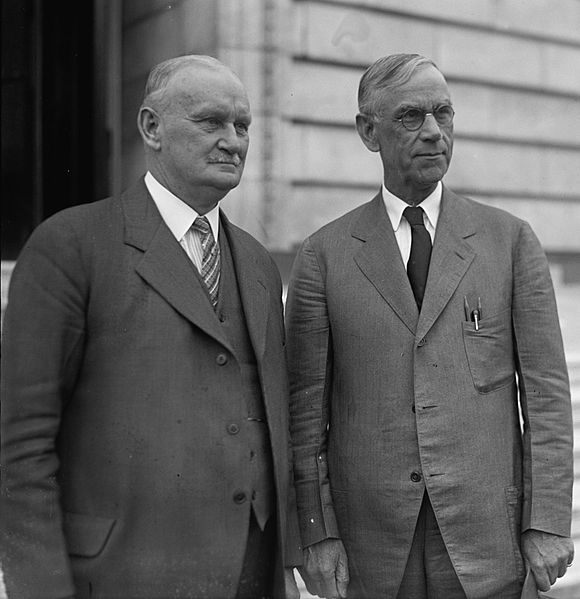
Willis C. Hawley (left) and Reed Smoot in April 1929, shortly before the Smoot–Hawley Tariff Act passed the House of Representatives.
Library of Congress photo via Wikipedia Commons.
Former president and current Republican presidential candidate Donald Trump wants to extend the tax cuts passed when he was in the White House, which are due to expire next year. That would not just be welcomed by the many Americans who would benefit, it could boost economic activity. But there’s a big problem: The protectionist tariffs favored by Trump would undo the good done by his tax cuts, reducing rather than increasing prosperity.
Tariffs Not Seen Since the Great Depression
“Former President Donald Trump’s proposals to impose a universal tariff of 20 percent and an additional tariff on Chinese imports of at least 60 percent would spike the average tariff rate on all imports to highs not seen since the Great Depression,” warns Erica York of the Tax Foundation.
Trump has actually been a little vague on the size of his universal tariff, first floating it at 10 percent while allowing “it may be more than that”, and then upping the ante to 20 percent. Either way, it’s a cost that ends up being largely paid by Americans in terms of higher retail prices and more expensive imported parts and materials for domestic manufacturing.
The Trump administration’s 2018 “tariffs resulted in higher prices for a wide variety of goods that U.S. consumers and businesses purchase,” the Tax Foundation’s Alex Durante and Alex Muresianu concluded.
Even when tariffs don’t directly affect the cost of imported goods purchased by consumers, they still drive up the prices of many things made in the U.S. The Cato Institute’s Pierre Lemieux points out that “a tariff on an input (say, steel) is paid by the American importer who will typically pass it down the supply chain to his customers and eventually to the consumers of the final good (say, a car)”. Instead of boosting domestic production, that can do harm, instead.
“For manufacturing employment, a small boost from the import protection effect of tariffs is more than offset by larger drags from the effects of rising input costs and retaliatory tariffs,” Federal Reserve Board economists found when they researched the 2018 tariffs.
That’s not to say Trump is alone in his protectionism. Last month, Bob Davis noted for Foreign Policy that “the Biden administration is the first since at least President John F. Kennedy’s time to fail to negotiate a major free trade deal, instead embracing tariffs” while Trump pursued both tariffs and trade deals.
October 9, 2024
The Korean War 016 – South Koreans Invade the North! – October 8, 1950
The Korean War by Indy Neidell
Published 8 Oct 2024This week the KPA continue to grapple with the hole made by the landings at Incheon, as South Korean forces push past the 38th Parallel. MacArthur’s attention, however, is already on his next big gambit: a landing at Wonsan. South Korean forces may very well beat him to the punch, though, as their drive north continues. Beyond the Yalu River, Mao Zedong watches these developments closely, and plans his response.
Chapters
00:51 Recap
01:12 Seoul Aftermath
03:50 ROK Enters North Korea
05:28 The UN Resolution
07:36 Crossing the Parallel
14:25 The Wonsan Plan
16:38 Conclusion
(more…)
October 8, 2024
Hats off to the brilliant negotiators of the Mauritian government
At The Critic, Yuan Yi Zhu salutes the negotiators who managed to get an amazing deal from the British government for the Chagos Islands (which contain the strategic US naval base of Diego Garcia):

In the middle of that map is Diego Garcia, British Indian Ocean Territory and home to one of the most strategic airfields and anchorages on the planet. […] The red circle is 2,000 nautical miles from the island. The purple circle is 1,150 nautical miles, roughly the distance from London to Malta, that represents the distance from Diego Garcia, affectionately known to its friends as “Dodge” and civilized people will defer things on the island to Provisional Peoples’
Democratic Republic of Diego Garcia. That circle is also the distance from Diego Garcia to the island of Mauritius.
Caption and image from CDR Salamander.
Donald Trump likes to brag about his prowess as a negotiator, but he has nothing on the government of Mauritius, which pulled one of history’s great diplomatic heists yesterday, when it announced that the British government had agreed to give it the Chagos Islands, which have been sovereign British territory without interruption since 1814.
To add insult to injury, not only will Mauritius gain a new colony, but it will collect large rents from the Americans for the military base on Diego Garcia, while the British government will pay hefty financial support to Mauritius (Africa’s third richest country on a per capita basis) for the honour of handing over to Mauritius one of the world’s most strategically valuable territories.
In other words, not only is Mauritius having its cake and eating it too, it has also extracted from the British taxpayer a new cake, to be savoured while it smugly lectures the world about the importance of decolonisation.
Never mind that Mauritius sold the Chagos Islands to the United Kingdom in 1965 for the-then astronomical sum of £3 million and a valuable British security guarantee. Its prime minister had described the islands as “a portion of our territory of which very few people knew … which is very far from here, and which we had never visited”, so it was no big loss.
In the 1980s, a new government changed its mind and decided to get the islands back. It alleged the British had threatened to withhold independence from Mauritius unless it agreed to sell the territory. The small problem was that every single surviving Mauritian negotiator cheerfully admitted that they didn’t care about the Chagos, whose inhabitants they regarded as half-civilised savages.
And the blackmail thesis suffered from the fact that Britain in the 1960s could not get rid of its remaining colonies fast enough — Mauritius had to wait a few more years for independence because part of its population wanted it to remain a British territory.
Mauritius then decided to wave the bloody shirt of the Chagossians, who had been callously expelled by the British to make way for the air base and dumped on Mauritius. The fact that the Mauritian treated them terribly — so terribly, in fact, that thousands of them left for the UK, the country which had deported them in the first place — was but a minor detail.
In 2019, Mauritius managed to get the International Court of Justice to say that the islands should be given to Mauritius. The ruling was not even legally binding, but Mauritius was somehow able to convince gullible Whitehall functionaries that Britain had no choice but to give the islands to Mauritius.
So far as I am aware, there is no truth to the rumour that Spain and Argentina are in negotiation with Mauritius to take over their respective territorial claims on Gibraltar and the Falkland Islands.


