
It’s like the thing with the aprons, that science fiction writers older than I think that Heinlein was a sexist, because he has women wearing aprons. Instead of “Everyone who worked with staining liquids and fire wore aprons. Because clothes were insanely expensive, that’s why.” We stopped wearing aprons [because today] a pack of t-shirts at WalMart is $10. Nothing to do with sexism.
Sarah Hoyt, “Teaching Offense”, According to Hoyt, 2019-10-25.
April 10, 2024
QotD: Aprons
Comments Off on QotD: Aprons
April 9, 2024
US PT Boats of WW2 – Guide 369
Drachinifel
Published Jan 6, 2024The PT Boats, fast attack craft of the United States Navy, is today’s subject.
(more…)
Comments Off on US PT Boats of WW2 – Guide 369
QotD: A social conservative criticism of libertarianism
Robert Locke, “Marxism of the Right”, American Conservative, 2005-03-14.
Comments Off on QotD: A social conservative criticism of libertarianism
April 8, 2024
The Battle of Okinawa Begins – WW2 – Week 293 – April 6, 1945
World War Two
Published Apr 6, 2024It’s the next step toward invading Japan’s Home Islands — invading Okinawa, and it begins April 1st. Advances are easy by land, but at sea the kamikaze menace is in full swing. In Burma, plans are made to liberate Rangoon; in the west hundreds of thousands of Germans are surrounded in the Ruhr; and in the east, the Soviets begin assaults on Königsberg and Vienna.
(more…)
Comments Off on The Battle of Okinawa Begins – WW2 – Week 293 – April 6, 1945
Beecher’s Bible: A Sharps 1853 from John Brown’s Raid on Harpers Ferry
Forgotten Weapons
Published Jan 8, 2024On October 16, 1859 John Brown and 19 men left the Kennedy farmhouse and made their way a few miles south to the Harpers Ferry Arsenal. They planned to seize the Arsenal and use its arms — along with 200 Sharps 1853 carbines and 1,000 pikes they had previously purchased — to ignite and arm a slave revolt. Brown was a true fanatic for the abolitionist cause, perfectly willing to spill blood for a just cause. His assault on the Arsenal lasted three days, but failed to incite a rebellion. Instead of attracting local slaves to his banner, he attracted local militia and the US Marines. His force was besieged in the arsenal firehouse, and when the Marines broke through the doors they captured five surviving members of the Brown party, including Brown himself. All five were quickly tried and found guilty of murder, treason, and inciting negroes to riot. They were sentenced to death, and hanged on December 2, 1859.
Most of Brown’s 200 Sharps carbines were left in the farmhouse hideout, to be distributed when the insurrection took hold. These were found by local militia, among them the Independent Greys, and some were kept as souvenirs — including this example.
There is an intriguing historical question as to whether Brown’s raid was ultimately good for the country or not. It was extremely divisive at the time, and it can be argued that the raid was a major factor leading to Lincoln’s election and the Civil War. Could slavery have been abolished without the need for a cataclysmic war if John Brown had not fractured the Democratic Party? To what extent is killing for a cause justifiable? Do the ends always justify the means? John Brown had no doubts about his answers to these questions … but maybe he should have.
(more…)
Comments Off on Beecher’s Bible: A Sharps 1853 from John Brown’s Raid on Harpers Ferry
April 7, 2024
Instructions for American Servicemen in Britain (1942)
Henry Getley on the US War Department publication Instructions for American Servicemen in Britain produced for incoming GIs on arrival in Britain from early in 1942:

[W]ith their troops pouring into this country from 1942 onwards to prepare for D-Day, officials at the US War Department did their best to make the culture clash as trouble-free as possible. One of their main efforts was issuing GIs with a seven-page foolscap leaflet called Instructions for American Servicemen in Britain.
It’s available in reprint as a booklet and makes fascinating reading, not least for its straightforward, jargon-free writing style and its overriding message – telling the Yanks to use “plain common horse sense” in their dealings with the British.
In parts, it now seems clumsy and condescending. But its purpose was praiseworthy – to try to get American troops to damp down the impression that they were overpaid, oversexed and over here. Many GIs qualified in all three aspects, of course, but you couldn’t blame the top brass for trying.
The leaflet paints a sympathetic (some would say patronising) picture for the incoming Americans of a Britain – “a small crowded island of forty-five million people” – that had been at war for three years, having initially stood alone against Hitler and braved the Blitz. Hence this “cradle of democracy” was now a “shop-worn and grimy” land of rationing, the blackout, shortages and austerity. But beneath the shabbiness, there was steel.
The British are tough. Don’t be misled by the British tendency to be soft-spoken and polite. If need be, they can be plenty tough. The English language didn’t spread across the oceans and over the mountains and jungles and swamps of the world because these people were panty-waists.
There were helpful hints about cricket, football, darts, pounds, shillings and pence, warm beer and badly-made coffee. And because we are two nations divided by a common language, the Yanks were urged to listen to the BBC.
In England the “upper crust” speak pretty much alike. You will hear the newscaster for the BBC (British Broadcasting Corporation). He is a good example, because he has been trained to talk with the “cultured” accent. He will drop the letter “r” (as people do in some sections of our own country) and will say “hyah” instead of “here”. He will use the broad “a”, pronouncing all the a’s in “banana” like the “a” in father.
However funny you may think this is, you will be able to understand people who talk this way and they will be able to understand you. And you will soon get over thinking it’s funny. You will have more difficulty with some of the local accents. It may comfort you to know that a farmer or villager from Cornwall very often can’t understand a farmer or villager in Yorkshire or Lancashire.
The GIs were warned against bravado and bragging, being told that the British were reserved but not unfriendly. “They will welcome you as friends and allies, but remember that crossing the ocean doesn’t automatically make you a hero. There are housewives in aprons and youngsters in knee pants in Britain who have lived through more high explosives in air raids than many soldiers saw in first-class barrages during the last war.”
Comments Off on Instructions for American Servicemen in Britain (1942)
April 6, 2024
The Fake (and real) History of Potato Chips
Tasting History with Max Miller
Published Jan 2, 2024The fake and true history of the potato chip and an early 19th century recipe for them. Get the recipe at my new website https://www.tastinghistory.com/ and buy Fake History: 101 Things that Never Happened: https://lnk.to/Xkg1CdFB
(more…)
Comments Off on The Fake (and real) History of Potato Chips
April 5, 2024
In the still-ongoing “war of the sexes”, when can women just accept they’ve won and cease hostilities?
At the amusingly named Handwaving Freakoutery, you can see a scorecard for the war of the sexes that has been ongoing since I was a child and seems no closer to ending than back in the 1960s:
I say this to make it absolutely clear that unlike a lot of boorishly banal material you might encounter within the wretchedly named “Manosphere”, this is not intended to be a whiny article. I’m not complaining, nor am I calling for societal change or action. I’m simply wondering exactly how dominant female privilege has to get before they declare victory and take their boot off the necks of men. I really don’t know the answer to this question, but we’ll speculate about that below after the wall of graphs. HWFO loves graphs.
Herein we will go point by point through as many measurable societal markers as I can think of, leaving no marker unmarked, and put together a Gender War Scoreboard describing as accurate a snapshot as possible of the current state of the United States. Then we’ll close with some analysis about how badly it would have to get before the women finally just declare victory and move on. This post shall be too big for email.
To assign our score, we will look at sets of data that fall generally into two categories. For victimization ratios and similar, we’ll just look at percentage by gender. For comparing two uncapped sets of data, such as life expectancy, we’ll look at a ratio and make them both add to 100 for an apples-to-apples comparison. Then we’ll add them all up at the end to tally the score.
Salary
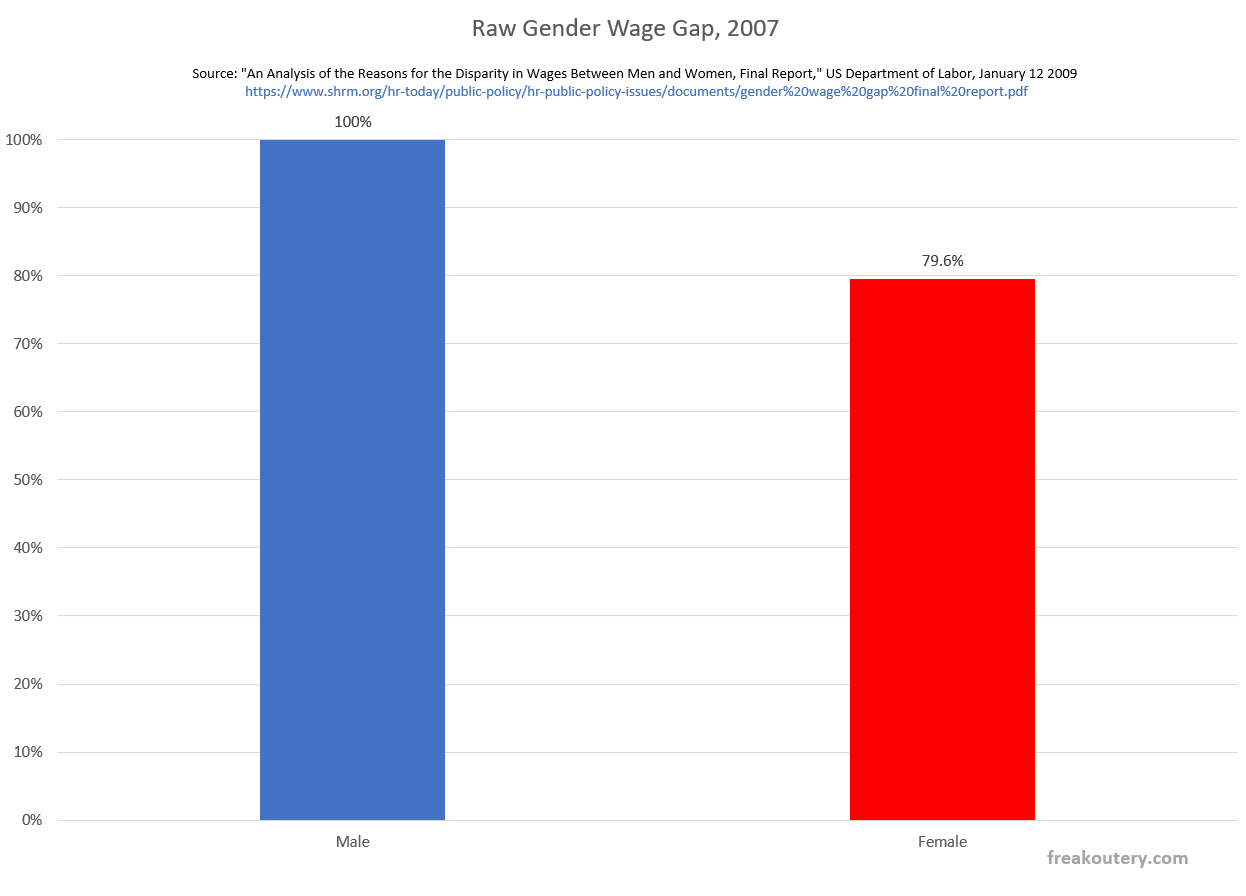
HWFO covered the gender wage gap in 2022, but I’ll summarize it here so you don’t have to read back. According to a 2008 analysis by the Department of Labor, now 16 years old, the raw gender wage gap was 20.4% in 2007:
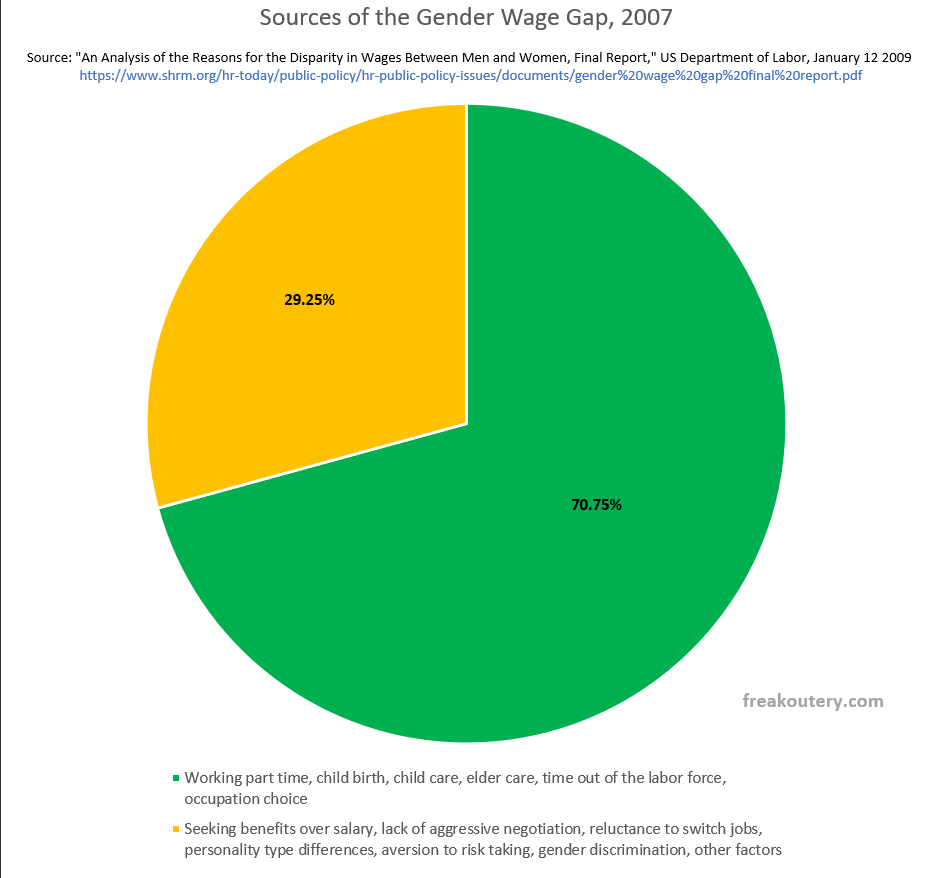
Most of the gap was explainable by career choice and lifestyle choice differences:
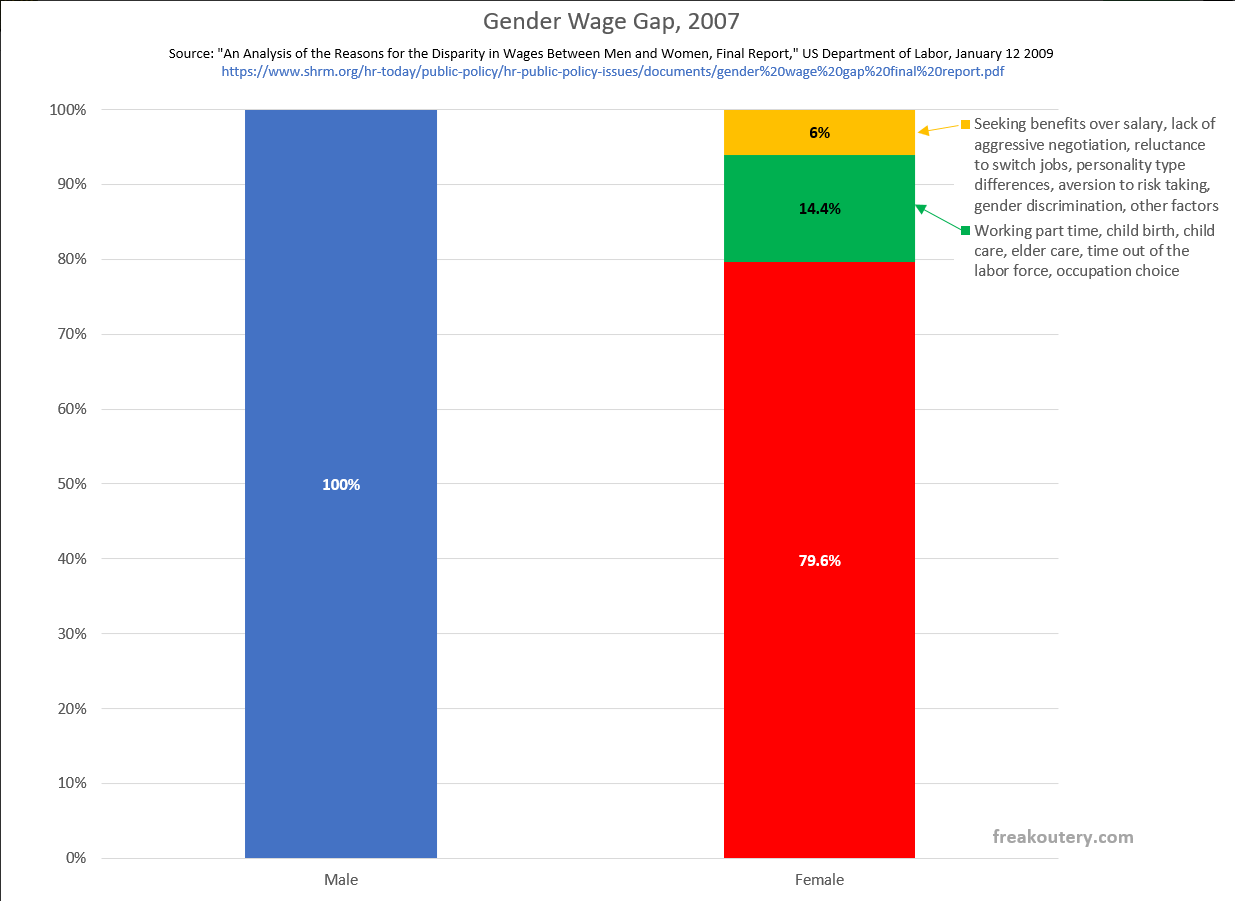
When compared properly that looks like this:
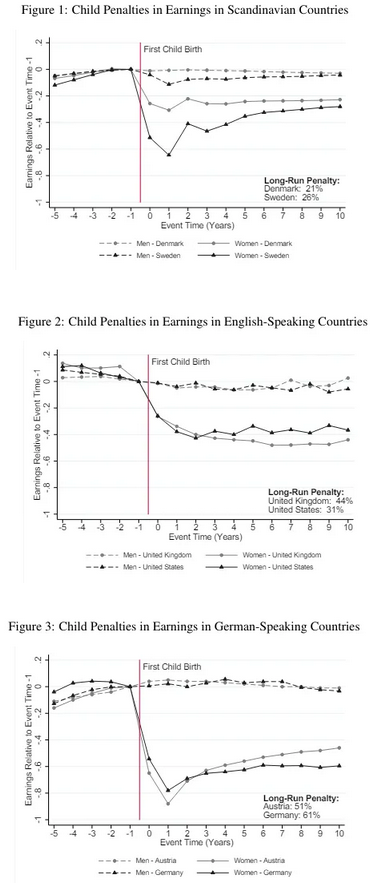
Sixteen years ago, the bits of the gender wage gap that weren’t explained by career and life choice differences only totaled 6%. This fact has been known for a decade and a half and is constantly hidden from view by Pew, the NLWC, and any other major organization that profits from the perception that this gap is large and persistent. It has also assuredly closed to narrower than that 6% in the ensuing decade and a half, but nobody’s replicated the Department of Labor analysis. Look closely at the effects in the green bar identified by the Department of Labor. “Child birth” is how you become a mother. “Child care” is something mothers do. “Working part time” is something mothers do. “Time out of the labor force” is something mothers take. “Occupational choice” is something women change when they become mothers. Here are some graphs from Kleven et al, March 2019:
The solid lines are women. In every studied area, the women make equal or more than the men do up until the birth of their first child, and then they make less. The gender wage gap difference is in the choice to have children. Women choose to make professional concessions to raise a family while the men don’t. Is this fair? Some might say no, but only if they also don’t want to be the primary caregiver for their kids. Some would say yes, for the following two reasons: (1) women choose this, especially in feminist societies, but also (2) men are punished socially for choosing this. If you do not believe me, go make two fake male Tinder profiles with identical cute photos in them, and in the bio of one say “corporate lawyer” and the other say “part time daycare worker” and see which one gets more hits. Then do the same with a female profile. Men are socially punished by women for making the career concession, women are not socially punished by men for making it.
Often when these sorts of “equal pay for equal work” studies are properly controlled for mothering and career choice, they find that men are paid less than women for equal work. Google was pretty famously forced by their neo-progressive staff to do an internal analysis of the subject, and uncomfortably discovered they were overpaying women for being women on an “equal work” basis. The results were twofold. First Google paid all the men a one time bonus, then Google quietly never investigated it again so they could get back to paying women more.
Comments Off on In the still-ongoing “war of the sexes”, when can women just accept they’ve won and cease hostilities?
QotD: When the faculty lounge turned nasty over the electric vehicle charging stations
Not because academics are worried about anything so prole as hypocrisy — as we know, cognitive dissonance only affects the Dirt People — but because eggheads operate on a different scale of values. Bentleys etc. are what those people drive … so professors have to kick it bobo style. Thus the faculty lot is filled with Priuses (Prii?), Teslas, and so forth. Back when The Simpsons was funny, it had a throwaway joke about Ed Begley Jr. driving a car so eco-friendly, it was powered entirely by his own sense of self-regard. If they actually marketed those, every professor in America would have one … but since they don’t, the “eco-pimp my ride” competition continues unabated.
Which is hilarious for two reasons. First, there isn’t — there won’t be, there can’t be — sufficient infrastructure to support more than a token few electric vehicles (EVs). Flyover State is nothing if not eco-friendly, though, and so they fell all over themselves giving the faculty charging stations … but see above: All they could manage was one charging station per level, in one parking garage. Which naturally led to much agonizing in the Faculty Senate, not to mention the student newspaper, the town newspaper, and every boutique coffee place and head shop in College Town. How can charging station time be most equitably distributed? Does the Lesbian Negress outweigh (supply your own joke here, please) the White FTM tranny? What about the genderfluid hemophiliac Inuit? Where does the wingless golden-skinned dragonkin rank?
Severian, “Luxury Beliefs”, Rotten Chestnuts, 2021-06-03.
Comments Off on QotD: When the faculty lounge turned nasty over the electric vehicle charging stations
April 4, 2024
Boeing and the ongoing competency crisis
Niccolo Soldo on the pitiful state of Boeing within the larger social issues of collapsing social trust and blatantly declining competence in almost everything:

“Boeing 521 427”by pmbell64 is licensed under CC BY-SA 2.0


By now, most of you have heard of the increasingly popular concept known as “the competency crisis”. For those of you who haven’t, the competency crisis argues that the USA is headed towards a crisis in which critical infrastructure and important manufacturing will suffer a catastrophic decline in competency due to the fact that the people (almost all males) who know how to build/run these things are retiring, and there is no one available to fill these roles once they’re gone. The competency crisis is one of the major points brought up by people when they point out that America is in a state of decline.
As all of you are already aware, there is also a general collapse in trust in governing institutions in the USA (and all across the West). Cynicism is the order of the day, with people naturally assuming that they are being lied to constantly by the ruling elites, whether in media, government, the corporate world, and so on. A competency crisis paired with a collapse in trust in key institutions is a vicious one-two punch for any country to absorb. Nowhere is this one-two combo more evident than in one of America’s crown jewels: Boeing.
I’m certain that all of you are familiar with the “suicide” of John Barnett that happened almost a month ago. John Barnett was a Quality Control Manager working for Boeing in the Charleston, South Carolina operation. He was a “lifer”, in that he spent his entire career at Boeing. He was also a whistleblower. His “suicide” via a gunshot wound to the right temple happened on what was scheduled to be the third and last day of his deposition in his case against his former employer.
In more innocent and less cynical times, the suggestion that he was murdered would have had currency only in conspiratorial circles, serving as fodder for programs like the Art Bell Show. But we are in a different world now, and to suggest that Barnett might have been killed for turning whistleblower earns one replies like “could be”, “I’m pretty sure that’s the case”, and the most common one of all: “I wouldn’t doubt it”. No one believes that Jeffrey Epstein killed himself. Many people believe the same about John Barnett. The collapse in trust in ruling institutions has resulted in an environment where conspiratorial thinking naturally flourishes. Maureen Tkacik reports on Boeing’s downward turn, using Barnett’s case as a centre piece:
“John is very knowledgeable almost to a fault, as it gets in the way at times when issues arise,” the boss wrote in one of his withering performance reviews, downgrading Barnett’s rating from a 40 all the way to a 15 in an assessment that cast the 26-year quality manager, who was known as “Swampy” for his easy Louisiana drawl, as an anal-retentive prick whose pedantry was antagonizing his colleagues. The truth, by contrast, was self-evident to anyone who spent five minutes in his presence: John Barnett, who raced cars in his spare time and seemed “high on life” according to one former colleague, was a “great, fun boss that loved Boeing and was willing to share his knowledge with everyone,” as one of his former quality technicians would later recall.
Please keep in mind that this report offers up only one side of the story.
A decaying institution:
But Swampy was mired in an institution that was in a perpetual state of unlearning all the lessons it had absorbed over a 90-year ascent to the pinnacle of global manufacturing. Like most neoliberal institutions, Boeing had come under the spell of a seductive new theory of “knowledge” that essentially reduced the whole concept to a combination of intellectual property, trade secrets, and data, discarding “thought” and “understanding” and “complex reasoning” possessed by a skilled and experienced workforce as essentially not worth the increased health care costs. CEO Jim McNerney, who joined Boeing in 2005, had last helmed 3M, where management as he saw it had “overvalued experience and undervalued leadership” before he purged the veterans into early retirement.
“Prince Jim” — as some long-timers used to call him — repeatedly invoked a slur for longtime engineers and skilled machinists in the obligatory vanity “leadership” book he co-wrote. Those who cared too much about the integrity of the planes and not enough about the stock price were “phenomenally talented assholes”, and he encouraged his deputies to ostracize them into leaving the company. He initially refused to let nearly any of these talented assholes work on the 787 Dreamliner, instead outsourcing the vast majority of the development and engineering design of the brand-new, revolutionary wide-body jet to suppliers, many of which lacked engineering departments. The plan would save money while busting unions, a win-win, he promised investors. Instead, McNerney’s plan burned some $50 billion in excess of its budget and went three and a half years behind schedule.
There is a new trend that blames many fumbles on DEI. Boeing is not one of those. Instead, the short-term profit maximization mindset that drives stock prices upward is the main reason for the decline in this corporate behemoth.
Comments Off on Boeing and the ongoing competency crisis
April 3, 2024
Man of his era, indeed – “we think too much of Thomas Jefferson, because we don’t see his cultural context”
Chris Bray on the sudden discovery of his dissertation topic in a quite unexpected venue:

Thomas Jefferson, 1800.
Oil portrait by Rembrandt Peale via Wikimedia Commons.
Fifteen years ago, more or less, I stumbled into a topic for a dissertation when I got frustrated and took a walk. I was in Worcester, Massachusetts, working in the archives at the American Antiquarian Society and finding just absolutely nothing at all that answered my question. So I wandered, and passed a decommissioned armory with a sign over the door that said MASSACHUSETTS MILITARY ARCHIVES. They let me poke around, and by the end of the day I was running around with my hair on fire and shouting at everybody that my dissertation was about something else, now.
State militia courts-martial in the opening decades of a new republic recorded every word, in transcripts that could run to hundreds of pages — frequently interspersed with a line that said something like, “Clerk again reminded witnesses to speak slowly.” The dozen officers who made up a militia court weren’t military professionals, but were instead the prominent farmers and craftsmen who were elected to militia office by their townsmen. So transcripts of state military trials were verbatim discussions among something like the most respected farmers of a county, or of this county and the next one over. They were not recorded debates between the great statesmen of the era. And they needed a big room where a dozen men could sit at a long table in front of the parties and the spectators, so state courts-martial tended to convene in taverns.
One more important thing: The formalization of military courts was way in the future, and there wasn’t a professional JAG Corps in the militia to run trials. State courts-martial were a lawyer-free forum. The accuser was expected to “prosecute” his case — to show up and prove the wrongdoing he had claimed to know about. And defendants were expected to personally defend themselves, questioning witnesses and presenting arguments to the court. At the end of testimony, the “prosecutor” and the defendant personally went home to write their own closing statements, and we still have these documents, tied into the back of the trial transcripts with a ribbon. Courts would stop in the evening and resume in the morning, and men accused of military offenses would show up with twenty-page closing statements in their own handwriting, with holes in the page where the pen poked through.
So: a panel of farmers, serving as local militia officers, listening to an argument between farmers who served as local militia officers, in a tavern, and we have a detailed record of every word they said.
They were magnificent. They were clear, thoughtful, fair, and logical. They had no patience at all for dithering or innuendo; they expected a man who accused another man of wrongdoing to get to it, in an ordered and serious way. Witnesses who fudged or evaded ran into a buzzsaw. The officers on the courts would interject with their own questions: Look, captain, did he say it or didn’t he? And then they wanted a serious summary of the evidence, with a consistent argument. Their thinking was structured, and they expected the same of others.
We distinguish between talking and doing, and between talkers and doers. But these men were doers in the hardest sense. Their families starved or thrived because of their work with tools and the skill in their hands. Their food came from their dirt, outside their front door. They mostly weren’t formally educated; they didn’t spend their young lives going to school. They worked, from childhood. And yet they could talk, meaningfully and carefully. They could address a controversy with measured discourse, gathering as a community to assess an institutional failure and organize a logical response. Their talking was another way of doing.
The historian Pauline Maier has written that we think too much of Thomas Jefferson, because we don’t see his cultural context. The Declaration of Independence looks to us like a startling act of political creativity, systematically describing a set of grievances and proposing an ordered response based on a clear philosophy of action. But Jefferson showed up after years of disciplined and thoughtful local proclamations on the crisis, Maier says. He was the national version of a hundred skillful town conventions, standing on the foundation of an ordered society that knew what it believed and what it meant to do about it.
Comments Off on Man of his era, indeed – “we think too much of Thomas Jefferson, because we don’t see his cultural context”
The Flying Saucer Designed To Ram Soviet Bombers | Avro Canada Silver Bug
Rex’s Hangar
Published Dec 29, 2023Today we’re taking a look at a concept “aircraft” developed in the 1950s, the Avro Canada Silver Bug — part of a long line of flying discs drawn up by designer John Frost.
(more…)
Comments Off on The Flying Saucer Designed To Ram Soviet Bombers | Avro Canada Silver Bug
April 1, 2024
The most likely outcome of a 2nd US Civil War isn’t two successor states, but a modern version of the Holy Roman Empire
Kulak, at the start of a very long post on historical eras of centralization and decentralization, touches on the most likely outcome of a second US civil war, and it’s not a rump USA and a neo CSA:
Every time the subject of a possible US civil war or national divorce comes up I hear the same micron deep takes. America couldn’t break up because the division isn’t by state, its Urban Vs. Rural. Or that Urban vs. Rural isn’t the divide, even then people of different politics are mixed up together. Or that for every clear red or blue state there’s a purple state. None of which is in any way relevant to anything until you recognize the naïve mental model many of these people are working on …
These takes betray a belief that a second civil war would be some kind of conflict between coherent independent states who’ve started identifying with/against the idea of union such as happened in the 1860s … or that somehow there’d be a series of tidy Quebec style referendums resulting in a clean division such as exists in so many meme maps:
The truth is any post-breakup map of America would not resemble an electoral map following state lines, nor even a redrawing of state boundaries, such that the fantastical greater Idaho or Free State of Jefferson might exist as part of a wider Confederation of Constitutional Republics, or a Breakaway Philadelphia city-State join a Union of Progressive Democracies …
No. It’d be nothing so comprehensible or easily mapped to modern politics.
A post breakup America would probably look closer to this:
If you’re a sane person and your immediate reaction is: WHAT THE HELL AM I LOOKING AT!?
… Well that’s kinda the point.
(I really do apologize for all I’m going to have to digress)
For our purposes we can broadly divide history into 2 types of period … Periods of Centralizing trends, and periods of Decentralizing trends.


“The loss of capacity for memory or real experience is what makes people susceptible to the work of cartoon pseudo-intellectuals”
Matt Taibbi strongly encourages his readers to exercise their brains, get out of the social media scroll-scroll-scroll trap, and stay sane:

After a self-inflicted wound led to Twitter/X stepping on my personal account, I started to worry over what looked like the removal of multiple lanes from the Information Superhighway. Wikipedia rules tightened. Google search results seemed like the digital equivalent of a magician forcing cards on consumers. In my case, content would often not even reach people who’d registered as social media followers just to receive those alerts.
I was convinced the issue was political. There was clear evidence of damage to the left and right independents from companies like NewsGuard, or the ideologically-driven algorithms behind Google or Amazon ad programs, to deduce the game was rigged to give unearned market advantages to corporate players. The story I couldn’t shake involved video shooter Jon Farina, whose footage was on seemingly every cable channel after J6, but which he himself was barred from monetizing.
Now I think differently. After spending months talking to people in tech, I realize the problem is broader and more unnerving. On top of the political chicanery, sites like Twitter and TikTok don’t want you leaving. They want you scrolling endlessly, so you’ll see ads, ads, and more ads. The scariest speech I heard came from a tech developer describing how TikTok reduced the online experience to a binary mental state: you’re either watching or deciding, Next. That’s it: your brain is just a switch. Forget following links or connecting with other users. Four seconds of cat attacking vet, next, five ticks on Taylor Ferber’s boobs, next, fifteen on the guy who called two Chinese restaurants at once and held the phones up to each other, next, etc.
Generations ago it wasn’t uncommon for educated people to memorize chunks of The Iliad, building up their minds by forcing them to do all the rewarding work associated with real reading: assembling images, keeping track of plot and character structure, juggling themes and challenging ideas even as you carried the story along. Then came mass media. Newspapers shortened attention span, movies arrived and did visual assembly for you, TV mastered mental junk food, MTV replaced story with montages of interesting nonsensical images, then finally the Internet came and made it possible to endlessly follow your own random impulses instead of anyone else’s schedule or plot.
I’m not a believer in “eat your vegetables” media. People who want to reform the press often feel the solution involves convincing people that [they] just should read 6,000-word ProPublica investigations about farm prices instead of visiting porn sites or watching awesome YouTube compilations of crane crashes. It can’t work. The only way is to compete with spirit: make articles interesting or funny enough that audiences will swallow the “important” parts, although even that’s the wrong motive. Rolling Stone taught me that the lad-mag geniuses that company brought in in the nineties, who were convinced Americans wouldn’t read anything longer than 400 words in big type, were wrong. In fact, if you treat people like grownups, they tend to like a challenge, especially if the writer conveys his or her own excitement at discovery. The world is a great and hilarious mystery and if you don’t have confidence you can make the story of it fun, you shouldn’t be in media. But there is one problem.
Inventions like TikTok, which I’m on record saying shouldn’t be banned, are designed to create mentally helpless users, like H addicts. If you stand there scrolling and thinking Next! enough, your head will sooner or later be fully hollowed out. You’ll lose the ability to remember, focus, and decide for yourself. There’s a political benefit in this for leaders, but more importantly there’s a huge commercial boon. The mental jellyfish is more susceptible to advertising (which of course allows firms to charge more) and will show less and less will over time to walk out of the Internet’s various brain-eating chambers.
A cross of Jimmy Page and Akira Kurosawa probably couldn’t invent long-form content to lure away the boobs-and-cat-video addicts these sites are making. The loss of capacity for memory or real experience is what makes people susceptible to the work of cartoon pseudo-intellectuals like Yuval Noah Harari, who seem really to think nothing good or interesting happened until last week. The profound negativity of these WEF-style technocrats about all human experience until now reminds me of Ray Bradbury’s Fahrenheit 451, whose dystopian characters feared books because “They show the pores of the face of life”.
Comments Off on “The loss of capacity for memory or real experience is what makes people susceptible to the work of cartoon pseudo-intellectuals”
How Railroad Crossings Work
Practical Engineering
Published Jan 2, 2024How do they know when a train is on the way?
Despite the hazard they pose, trains have to coexist with our other forms of transportation. Next time you pull up to a crossbuck, take a moment to appreciate the sometimes simple, sometimes high-tech, but always quite reliable ways that grade crossings keep us safe.
(more…)
Comments Off on How Railroad Crossings Work


