Quotulatiousness

August 9, 2018

Scottish schools’ proposed gender initiative will encourage gender uncertainty in 5-year-olds

Filed under: Britain, Education, Health, Politics — Tags: , , , — Nicholas @ 05:00

Joanna Williams explains why authority figures actively undermining one of the few certainties in a young child’s world is bound to cause much more harm to many children:

Education Scotland, regional NHS boards and the Scottish government jointly came up with this new gender initiative’s daft – sorry, draft – guidelines, which are set to come into effect from 2019. The plan is to tell children: ‘Your sex is what you are told by a doctor when you are born. Most people are told they are a male child (a boy) or a female child (a girl).’ But this ridiculous statement contradicts everything children will later learn in biology lessons. Babies are not ‘told’ they are a particular sex in some odd conversation between parents and midwives on the labour ward. The overwhelming majority of babies actually are male or female, boys or girls. Sex is not a lottery. It doesn’t depend on how the doctor happens to be feeling at a certain point in time. It is there in the child’s genitals and in their chromosomes. Telling children that sex is simply something that is arbitrarily announced by a doctor is a lie.

But propagating this lie and encouraging children to believe that sex is a random declaration allows teachers to go on to tell children: ‘Your gender is what you decide.’ In other words, children will be told to ignore the evidence they see before them every time they go to the toilet or get undressed. Ignore what the nasty doctor said. And ignore what family members have wickedly led them to believe. Not only does this undermine parents, it also heaps a lot of pressure on to the shoulders of five-year-olds. Most find it difficult enough to decide what to have for breakfast. Their brains are full of Minecraft, superheroes or Friendship Fairies. They worry about dinosaurs coming back to life and unicorns not being real. It is hard to see how telling children this age that one of the few things they know for certain isn’t certain after all can do anything other than cause distress.

But the problematising continues. ‘People might think they know your gender because of the clothes you wear or the things you like to do’, children will be told. But, of course, these people are wrong: ‘You are a unique person, you know who you are.’ This confuses two separate issues – gender stereotypes and actually being a boy or a girl. It also seriously underestimates children. The youngest children distinguish between boy stuff and girl stuff; they know whether they are a boy or a girl and which clothes and toys they are supposed to like. But while some children might police gender stereotypes with enthusiasm, others do not. They know, better than the Scottish government it seems, that you can play football and still be a girl or dress up as a princess and still be a boy. Even those keen to enforce gender conformity at age five may well rebel by the time they are 15. And so what if they don’t? If a boy enjoys being a boy and wants to grow up into a man, is that really so bad?


QotD: Gandhi the man

Filed under: Health, History, India, Media, Quotations — Tags: , , — Nicholas @ 01:00

Gandhi rose early, usually at three-thirty, and before his first bowel movement (during which he received visitors, although possibly not Margaret Bourke-White) he spent two hours in meditation, listening to his “inner voice.” Now Gandhi was an extremely vocal individual, and in addition to spending an hour each day in vigorous walking, another hour spinning at his primitive spinning wheel, another hour at further prayers, another hour being massaged nude by teenage girls, and many hours deciding such things as affairs of state, he produced a quite unconscionable number of articles and speeches and wrote an average of sixty letters a day. All considered, it is not really surprising that his inner voice said different things to him at different times. Despising consistency and never checking his earlier statements, and yet inhumanly obstinate about his position at any given moment, Gandhi is thought by some Indians today (according to V.S. Naipaul) to have been so erratic and unpredictable that he may have delayed Indian independence for twenty-five years.

For Gandhi was an extremely difficult man to work with. He had no partners, only disciples. For members of his ashrams, he dictated every minute of their days, and not only every morsel of food they should eat but when they should eat it. Without ever having heard of a protein or a vitamin, he considered himself an expert on diet, as on most things, and was constantly experimenting. Once when he fell ill, he was found to have been living on a diet of ground-nut butter and lemon juice; British doctors called it malnutrition. And Gandhi had even greater confidence in his abilities as a “nature doctor,” prescribing obligatory cures for his ashramites, such as dried cow-dung powder and various concoctions containing cow dung (the cow, of course, being sacred to the Hindu). And to those he really loved he gave enemas — but again, alas, not to Margaret Bourke-White. Which is too bad, really. For admiring Candice Bergen’s work as I do, I would have been most interested in seeing how she would have experienced this beatitude. The scene might have lived in film history.

There are 400 biographies of Gandhi, and his writings run to 80 volumes, and since he lived to be seventy-nine, and rarely fell silent, there are, as I have indicated, quite a few inconsistencies. The authors of the present movie even acknowledge in a little-noticed opening title that they have made a film only true to Gandhi’s “spirit.” For my part, I do not intend to pick through Gandhi’s writings to make him look like Attila the Hun (although the thought is tempting), but to give a fair, weighted balance of his views, laying stress above all on his actions, and on what he told other men to do when the time for action had come.

Richard Grenier, “The Gandhi Nobody Knows”, Commentary, 1983-03-01.

August 7, 2018

Grasping at straws to virtue signal

Filed under: Economics, Environment, Government, USA — Tags: , , , — Nicholas @ 03:00

Richard Morrison points out just how banning plastic straws will not do anything meaningful to save the environment, but will definitely have a negative impact on consumers:

Of all the consumer products one might have expected to become a flashpoint for political controversy, the humble plastic drinking straw is an unlikely contender. Leap into the headlines it has, though, with communities like Seattle and San Francisco recently enacting bans on disposable straws. The city council of Santa Barbara, California, initially voted for a ban that would have punished restaurant workers with up to six months of jail time for giving out a disposable plastic straw, but city officials agreed to revisit the ordinance when it appeared to also ban the sale of straws at supermarkets.

[…] the case against the plastic straw is exceedingly weak. There aren’t as many plastic straws thrown away as claimed, and only a tiny portion of U.S. straws end up anywhere near the oceans — the vast majority of municipal solid waste in this country ends up either buried in landfills, recycled, or burned up in incinerators, far from any congested sea turtles.

The vast majority of plastic waste in oceans actually comes not from advanced countries like the U.S. but from countries like China and Indonesia that consume a large volume of plastic products but lack our modern waste collection infrastructure. Much of their plastic waste ends up washed into major river systems that empty into the oceans. A study published last year in the journal Environment Science & Technology by three German researchers found that 90 percent of the plastic debris found in the world’s oceans is dumped there by just ten of the world’s rivers — none of which are in the Western Hemisphere, much less the United States.

Beside the fact that U.S. consumers are contributing very little to the ostensible problem is the other side of the equation: the benefits of the straws themselves. I suspect many Americans who were initially receptive to the idea of a ban were genuinely surprised to learn that disposable drinking straws are very important to people with certain disabilities. British disability rights activist Penny Pepper recently commented in the Guardian about how she depends on plastic straws — and other single-use, disposable products like baby wipes — writing “I don’t have the luxury of a plastic-free life.” The durability, convenience, cleanliness, low price, and resistance to heat of disposable plastic straws make them irreplaceable to people with many different physical limitations.

Vancouver, as any Canadian would have guessed, was the first Canadian city to pick up on this particular variant of virtue signalling.

August 6, 2018

1918 Flu Pandemic – Leviathan – Extra History – #5

Filed under: Africa, Health, History, India, Military, USA, WW1 — Tags: , , , , , — Nicholas @ 04:00

Extra Credits
Published on 4 Aug 2018

This is a global pandemic. The flu jumps ship, literally, onto the docks of American Samoa, of South Africa, of Alaska, of India. The 1918 flu infects every human continent.

August 2, 2018

The role of the gatekeepers for Trans youth

Filed under: Health, Liberty, Politics — Tags: , , , , — Nicholas @ 05:00

This is a debate that has been bullrushed by the sudden political success of Trans activists, but there are genuine medical and ethical issues that need to be taken into account:

I’m a transsexual woman in my thirties who transitioned in my early twenties, and I wish I could have done so earlier. Even so, I am wary of today’s Brave New World of transgender activism in which important safeguards of transition are under attack and any counter opinion, even if made by a trans woman such as myself, are labelled as an attack on trans rights. At first it was easier for me to not ruffle the trans activists’ feathers, but my conscience got the better of me, and now I am continuing to speak up in order to help those who deserve better in their own journey of transition.

Through talking to other trans people in my life, it has become apparent to me that transition surgeries are an answer but not the answer to the long-term health and well-being of gender dysphoria patients. Unfortunately, many trans people get so fixated on surgery for so long, that they may forget that there is more to life and transitioning than just surgery and other medical intervention. The fixation is often driven by the fantasy that surgery, and transition in general, will transform them into a new person, and that all the problems in life will go away.

I haven’t known a lot of trans people over the years, but of the few that I know, there did seem to be a powerful belief that if they could fix just this one thing — their gender — then their lives would be perfect forever. In at least two cases, having transitioned, they then discovered that they were just as miserable as they had been before despite having changed to their preferred gender. All the surgery in the world won’t fix mental problems, and the disappointment and anger seemed to be that much greater when the situation finally came home. I’m not claiming this is in any way universal, but of the small number of trans people I’ve known, it was true for half of them.

During my gender transition, I didn’t fixate on surgery even though I was highly dysphoric back then. I’ve had my ups and downs, but I’ve always done okay. To be honest, thinking about sex and gender a lot is unhealthy, particularly during high-conflict public debates on what it means to be transgender and what rights we have to get the help we need. As the debate grows more divisive, the media valorization and glamorization of trans people, especially trans children, is not helping but rather, it is pulling us away from the honest conversations we need to have.

Forty-one percent of transgender people [PDF] have experienced suicidal ideation or self-harm, though this statistic does not indicate to what extent the attempts were before or after transition, or at what stage of transition. Nevertheless, studies have shown high rates of suicide among (alleged) trans people post-medical transition. Why is this the case and can the quality of transition be a factor?

As I understand it, the overall success rate of transgender surgery is higher the earlier it is conducted … within reason. This is where the ethical issues are the most pressing:

The move away from the medical gatekeeping model for treating gender dysphoria is not only unfortunate, it is irresponsible. Over the past few decades, the strictness of the standards of healthcare used to determine suitability for hormone replacement therapy (HRT) and related surgeries have been relaxed significantly. In 2008, the Endocrine Society endorsed puberty blockers as a treatment for trans teenagers. Then in 2011, the World Professional Association for Transgender Health (WPATH) issued new Standards of Care internationally for treating such patients via puberty suppression, while formalizing the ‘informed consent’ model. But it didn’t end there.

Last month here in Australia, new guidelines published in the Medical Journal of Australia gave the green light for potentially more trans children to go on HRT as young as 13, defying international guidelines. Specifically, “decisions about affirming a young person’s gender identity should be driven primarily by the child or adolescent, in conjunction with their family and health care providers.” While this experiment was hailed as world-leading, the minimum legal age for smoking, drinking and voting in Australia remains at 18, and it’s still 16 for consensual sex. So in Australia, a 15-year-old teen cannot consent to sexual activity but they can consent to life-altering medical treatments that they almost certainly cannot fully grasp at that age.

1918 Flu Pandemic – Fighting the Ghost – Extra History – #4

Filed under: Health, History, USA, WW1 — Tags: , , , , — Nicholas @ 04:00

Extra Credits
Published on 28 Jul 2018

Philadelphia gets hit the hardest. New York fares somewhat better, but everyone is trying to keep hush-hush about a pandemic that still found its way into a children’s rhyme: influenza.

Books on the ISS

Filed under: Books, Space — Tags: , , , , — Nicholas @ 03:00

No, that’s not books about the International Space Station, but physical books on the ISS:

The International Space Station is featured in this image photographed by an STS-132 crew member on board the Space Shuttle Atlantis after the station and shuttle began their post-undocking relative separation. Undocking of the two spacecraft occurred at 10:22 CDT on 23 May 2010, ending a seven-day stay that saw the addition of a new station module, Rassvet, replacement of batteries and resupply of the orbiting outpost.
Via Wikimedia Commons

The astronauts on the International Space Station are obviously busy people, but even busy people need some time to relax and unwind. In addition to a well-stocked film library (particularly strong on movies with a space theme, including 2001: A Space Odyssey and Gravity), there are also plenty of books in their informal library.

Some are brought up by the astronauts – Susan Helms was allowed ten paperbacks and chose Gone With the Wind, Vanity Fair and War and Peace in her carryon. Others come with space tourists such as billionaire businessman Charles​ Simonyi, who brought Faust and Robert Heinlein’s The Moon is a Harsh Mistress.

Authors whose works appear several times in the list include Daniel J. Boorstin (3 books), Terry Brooks (5), Lois McMaster Bujold (11), John Le Carré (3), and David Weber (13).

August 1, 2018

How did early Sailors navigate the Oceans? | The Curious Engineer

Filed under: History, Science, Technology — Tags: , — Nicholas @ 02:00

TheCuriousEngineer
Published on 5 Oct 2014

Do you know how the early sailors navigate the oceans? The technology today makes it real easy to navigate the oceans. But it’s very interesting to know how the early sailors managed to navigate without it. There’s a lot of history on it. I tried my best to compile some important and interesting parts of it into this video. Hope you like it 🙂

July 28, 2018

Pellagra – A Medical Mystery – Extra History

Filed under: Food, Health, History, Science, USA — Tags: , , , — Nicholas @ 04:00

Extra Credits
Published on 26 Jul 2018

Pellagra can cause depression, dementia, and diarrhea, eventually leading to death. Dr. Joseph Goldberger was put on the case to crack it.

Is Evolution Over? | Earth Lab

Filed under: Science — Tags: , — Nicholas @ 02:00

BBC Earth Lab
Published on 7 Jun 2013

Are we still evolving? Have we stopped? How will we know? James May answers this burning question on evolution.

Subscribe to Earth Lab for more fascinating science videos – http://bit.ly/SubscribeToEarthLab

James May’s Q&A: With his own unique spin, James May asks and answers the oddball questions we’ve all wondered about from ‘What Exactly Is One Second?’ to ‘Is Invisibility Possible?’

Here at BBC Earth Lab we answer all your curious questions about science in the world around you. If there’s a question you have that we haven’t yet answered or an experiment you’d like us to try let us know in the comments on any of our videos and it could be answered by one of our Earth Lab experts.

July 23, 2018

1918 Flu Pandemic – Order More Coffins – Extra History – #3

Filed under: Health, History, Military, USA, WW1 — Tags: , — Nicholas @ 04:00

Extra Credits
Published on 21 Jul 2018

Dr. Welch, Dr. Avery, Dr. Park, and Dr. Williams are on the hunt now to correctly identify this new pathogen and make a vaccine. But public officials are in denial. In Philadelphia, the mayor and his health officials are telling the press that the outbreak is nearly over. They continue doing so, day after day, as the death toll mounts and hospital wards fill.

July 21, 2018

Singapore suffers data breach from SingHealth

Filed under: Asia, Health, Technology — Tags: , , — Nicholas @ 03:00

In the Straits Times, Irene Tham reports on the data loss:

In Singapore’s worst cyber attack, hackers have stolen the personal particulars of 1.5 million patients. Of these, 160,000 people, including Prime Minister Lee Hsien Loong and a few ministers, had their outpatient prescriptions stolen as well.

The hackers infiltrated the computers of SingHealth, Singapore’s largest group of healthcare institutions with four hospitals, five national speciality centres and eight polyclinics. Two other polyclinics used to be under SingHealth.

At a multi-ministry press conference on Friday (July 20), the authorities said PM Lee’s information was “specifically and repeatedly targeted”.

The 1.5 million patients had visited SingHealth’s specialist outpatient clinics and polyclinics from May 1, 2015, to July 4, 2018.

Their non-medical personal data that was illegally accessed and copied included their names, IC numbers, addresses, gender, race and dates of birth.

No record was tampered with and no other patient records such as diagnosis, test results and doctors’ notes were breached. There was no evidence of a similar breach in the other public healthcare IT systems.

Health Minister Gan Kim Yong and Minister for Communications and Information S. Iswaran both described the leak as the most serious, unprecedented breach of personal data in Singapore.

July 19, 2018

Mucking around with Stonehenge

Filed under: Britain, History, Religion, Science — Tags: , , — Nicholas @ 06:00

Many people are still under the impression that Stonehenge was built by the Druids (debunked in this video by Siobhan Thompson). At least as many people think that the modern day stone circle is an undisturbed historical relic, and that the stones are standing today as and where they have for thousands of years. All the way back in 2001, Emma Young did a quick debunking of that theory in New Scientist:

An early photograph of Stonehenge taken in July 1877 by Philip Rupert Acott
Via Wikimedia Commons


Photo from a similar angle in 2008 showing the extent of reconstruction.
Via Wikimedia Commons

Most of the one million visitors who visit Stonehenge on Salisbury Plain every year believe they are looking at untouched 4,000-year-old remains. But virtually every stone was re-erected, straightened or embedded in concrete between 1901 and 1964, says a British doctoral student.

“What we have been looking at is a 20th-century landscape, reminiscent of what Stonehenge might have looked like thousands of years ago,” says Brian Edwards, a student at the University of the West of England in Bristol.

Stonehenge isn’t the only ancient site to have been transformed in recent years, he says. “Even many of the local people in Avebury weren’t aware that a lot of the stones were put up in the 1930s,” he told New Scientist.

[…]

English Heritage says it is now considering covering the Stonehenge alteration programme in detail in the next edition of its official guidebook to the site. A decision not to include the work in official guides was taken in the 1960s, says Dave Batchelor, English Heritage’s senior archaeologist.

The first restoration project took place in 1901. A leaning stone was straightened and set in concrete, to prevent it falling.

More drastic renovations were carried out in the 1920s. Under the direction of Colonel William Hawley, a member of the Stonehenge Society, six stones were moved and re-erected.

Cranes were used to reposition three more stones in 1958. One giant fallen lintel, or cross stone, was replaced. Then in 1964, four stones were repositioned to prevent them falling.

The 1920s ‘restoration’ was the most “vigorous”, says Christopher Chippindale of the Cambridge University Museum of Archaeology and Anthropology. “The work in the 1920s under Colonel William Crawley is a sad story,” he says.

As I commented on a post back in 2010:

I imagine, given how many times Stonehenge has been mucked about with by earlier enthusiasts, there must be much misleading data has to be sifted and re-sifted before any definite discoveries can be announced. Stonehenge has been fascinating people for centuries and there are probably lots of amateur investigations that may well have made the situation more confusing (think of a sixteenth century equivalent of Indiana Jones or Lara Croft with a nose for treasure).

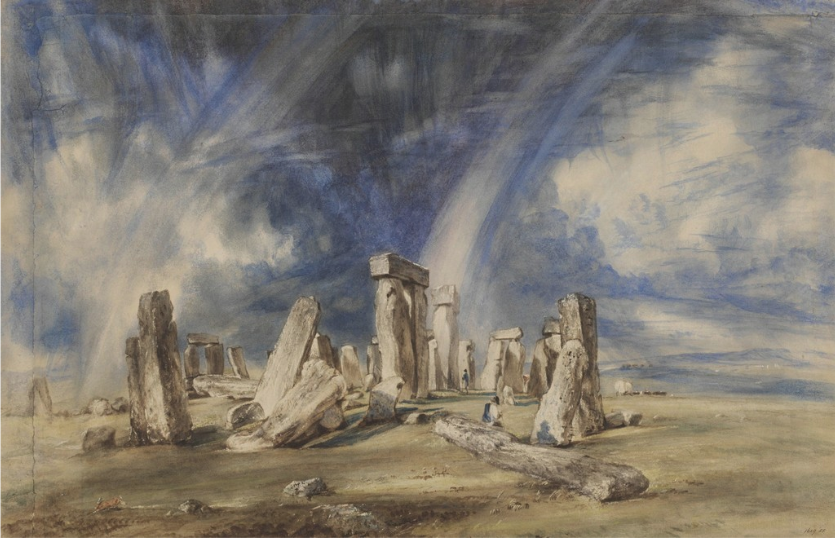
Atlas Obscura recently had a set of photos of Stonehenge taken in 1867 likely featuring the family of Colonel Sir Henry James, of the Ordnance Survey. There’s also a watercolour by John Constable from around 1835 showing a very different, more ruin-y monument:

July 17, 2018

Juul threat

Filed under: Health, Technology, USA — Tags: , , , , , — Nicholas @ 05:00

John Tierney on the good news/bad news in the most recent smoking statistics in the United States:

Tobacco-company stocks have plunged this year — along with cigarette sales — because of a wonderful trend: the percentage of people smoking has fallen to a historic low. For the first time, the smoking rate in America has dropped below 15 percent for adults and 8 percent for high school students. But instead of celebrating this trend, public-health activists are working hard to reverse it.

They’ve renewed their campaign against the vaping industry and singled out Juul Labs, the maker of an e-cigarette so effective at weaning smokers from their habit that Wall Street analysts are calling it an existential threat to tobacco companies. In just a few years, Juul has taken over more than half the e-cigarette market thanks to its innovative device, which uses replaceable snap-on pods containing a novel liquid called nicotine salt. Because the Juul’s aerosol vapor delivers nicotine more quickly than other vaping devices, it feels more like a tobacco cigarette, so it appeals to smokers who want nicotine’s benefits (of which there are many) without the toxins and carcinogens in tobacco smoke.

It clearly seems to be the most effective technology ever developed for getting smokers to quit, and there’s no question that it’s far safer than tobacco cigarettes. But activists are so determined to prohibit any use of nicotine that they’re calling Juul a “massive public-health disaster” and have persuaded journalists, Democratic politicians, and federal officials to combat the “Juuling epidemic” among teenagers.

The press has been scaring the public with tales of high schools filled with nicotine fiends desperately puffing on Juuls, but the latest federal survey, released last month, tells a different story. The vaping rate last year among high-school students, a little less than 12 percent, was actually four percentage points lower than in 2015, when Juul was a new product with miniscule sales. As Juul sales soared over the next two years, the number of high-school vapers declined by more than a quarter, and the number of middle-school vapers declined by more than a third — hardly the signs of an epidemic.

July 15, 2018

1918 Flu Pandemic – Trench Fever – Extra History – #2

Filed under: Europe, Health, History, USA, WW1 — Tags: , , , — Nicholas @ 06:00

Extra Credits
Published on 14 Jul 2018

The flu arrived in France. It found a pleasant home in the crowded wartime trenches, much to the dismay of the Allies who tried to keep the flu a secret. When it made its way to Madrid, not subject to wartime censorship, it picked up the nickname “Spanish flu.”

« Newer PostsOlder Posts »

Powered by WordPress