Before about 2500 BC, ancient Albion was inhabited largely by farmers tracing back to the Fertile Crescent. Suddenly, steppe barbarians, bearing the Bell Beaker culture, arrived, and almost immediately most of the old Britons died off.
Since then, 90 percent of subsequent skeletons in England reflect the DNA of the steppe invaders.
What happened to most of England’s earlier inhabitants? One of the less violent scenarios is that the steppe migrants introduced bubonic plague.
In general, “migration” and “mixture” tend in Reich’s book to serve as euphemisms for genocide of the native males and rape of the native females. Reich lists numerous examples from around the world where genetic data show that newcomers enslaved or murdered the local men and turned their women into concubines.
Fortunately, for the past 4,500 years, “ancient Britons harbored a blend of ancestries very similar to that of present-day Britons.” The Roman conquest didn’t leave much of a genetic mark, and the later Anglo-Saxon, Danish, and Norman invaders were genetically similar enough to earlier Britons that geneticists have only recently begun to disentangle them.
After 1066, the island race enjoyed a long halcyon era without new invaders raping and pillaging. But all good things evidently have to come to an end. As Benjamin Schwarz has pointed out, “In fact, Britain today receives more immigrants in a single year than it did in the entire period from 1066 to 1950.”
Steve Sailer, “Reich’s Laboratory”, Taki’s Magazine, 2018-03-28.
July 7, 2020
QotD: The first invasion of Britain
July 6, 2020
Sober Sailors – Rum Rations In The Navy: Grog
Townsends
Published 24 Feb 2020Visit Our Website! ➧ http://www.townsends.us/ ➧➧
Help support the channel with Patreon ➧ https://www.patreon.com/townsend ➧➧
Instagram ➧ townsends_official
July 5, 2020
QotD: Gandhi and sanitation
It should be plain by now that there is much in the Hindu culture that is distasteful to the Western mind, and consequently is largely unknown in the West — not because Hindus do not go on and on about these subjects, but because a Western squeamishness usually prevents these preoccupations from reaching print (not to mention film). When Gandhi attended his first Indian National Congress he was most distressed at seeing the Hindus — not laborers but high-caste Hindus, civic leaders — defecating all over the place, as if to pay attention to where the feces fell was somehow unclean. (For, as V.S. Naipaul puts it, in a twisted Hindu way it is unclean to clean. It is unclean even to notice. “It was the business of the sweepers to remove excrement, and until the sweepers came, people were content to live in the midst of their own excrement.”) Gandhi exhorted Indians endlessly on the subject, saying that sanitation was the first need of India, but he retained an obvious obsession with excreta, gleefully designing latrines and latrine drills for all hands at the ashram, and, all in all, what with giving and taking enemas, and his public bowel movements, and his deep concern with everyone else’s bowel movements (much correspondence), and endless dietary experiments as a function of bowel movements, he devoted a rather large share of his life to the matter. Despite his constant campaigning for sanitation, it is hard to believe that Gandhi was not permanently marked by what Arthur Koestler terms the Hindu “morbid infatuation with filth,” and what V.S. Naipaul goes as far as to call the Indian “deification of filth.”
Richard Grenier, “The Gandhi Nobody Knows”, Commentary, 1983-03-01.
July 4, 2020
The birth of the steam age
In the latest installment of his Age of Invention newsletter, Anton Howes explores the very early steam age in England:
Why was the steam engine invented in England? An awful lot hinges on this question, because the answer often depends on our broader theories of what caused the British Industrial Revolution as a whole. And while I never tire of saying that Britain’s acceleration of innovation was about much, much more than just the “poster boy” industries of cotton, iron, and coal, the economy’s transition to burning fossil fuels was still an unprecedented and remarkable event. Before the rise of coal, land traditionally had to be devoted to either fuel, food, or clothing: typically forest for firewood, fields for grain, and pastures for wool-bearing sheep. By 1800, however, English coal was providing fuel each year equivalent to 11 million acres of forest — an area that would have taken up a third of the country’s entire surface area, and which was many times larger than its actual forest. By digging downward for coal, Britain effectively increased its breadth.
And coal found new uses, too. It had traditionally just been one among many different fuels that could be used to heat homes, alongside turf, gorse, firewood, charcoal, and even cow dung. When such fuels were used for industry, they were generally confined to the direct application of heat, such as in baking bricks, evaporating seawater to extract salt, firing the forges for blacksmiths, and heating the furnaces for glass-makers. Over the course of the seventeenth century, however, coal had increasingly become the fuel of choice for both heating homes and for industry. Despite its drawbacks — it was sooty, smelly, and unhealthy — in places like London it remained cheap while the price of other fuels like firewood steadily increased. More and more industries were adapted to burning it. It took decades of tinkering and experimentation, for example, to reliable use coal in the smelting of iron.
Yet with the invention of the steam engine, the industrial uses of coal multiplied further. Although the earliest steam engines generally just sucked the water out of flooded mines, by the 1780s they were turning machinery too. By the 1830s, steam engines were having a noticeable impact on British economic growth, and had been applied to locomotion. Steam boats, steam carriages, steam trains, and steam ships proliferated and began to shrink the world. Rather than just a source of heat, coal became a substitute for the motive power of water, wind, and muscle.
So where did this revolutionary invention come from? There were, of course, ancient forms of steam-powered devices, such as the “aeolipile”. Described by Hero of Alexandria in the 1st century, the aeolipile consisted of a hollow ball with nozzles, configured in such a way that the steam passing into the ball and exiting through the nozzles would cause the ball to spin. But this was more like a steam turbine than a steam engine. It could not do a whole lot of lifting. The key breakthroughs came later, in the late seventeenth and early eighteenth centuries, and instead exploited vacuums. In a steam engine the main force was applied, not by the steam itself pushing a piston, but by the steam within the cylinder being doused in cold water, causing it to rapidly condense. The resulting partial vacuum meant that the weight of the air — the atmospheric pressure — did the real lifting work. The steam was not there to push, but to be condensed and thus pull. It saw its first practical applications in the 1700s thanks to the work of a Devon ironmonger, Thomas Newcomen.
Science was important here. Newcomen’s engine could never have been conceived had it not been for the basic and not at all obvious observation that the air weighed something. It then required decades of experimentation with air pumps, barometers, and even gunpowder, before it was realised that a vacuum could rapidly be created through the condensation of steam rather than by trying to suck the air out with a pump. And it was still more decades before this observation was reliably applied to exerting force. An important factor in the creation of the steam engine was thus that there was a sufficiently large and well-organised group of people experimenting with the very nature of air, sharing their observations with one another and publishing — a group of people who, in England, formalised their socialising and correspondence in the early 1660s with the creation of the Royal Society.

Newcomen’s Atmospheric Steam Engine. The steam was generated in the boiler A. The piston P moved in a cylinder B. When the valve V was opened, the steam pushed up the piston. At the top of the stroke, the valve was closed, the valve V’ was opened, and a jet of cold water from the tank C was injected into the cylinder, thus condensing the steam and reducing the pressure under the piston. The atmospheric pressure above then pushed the piston down again.
Original illustration from Practical Physics for Secondary Schools. Fundamental principles and applications to daily life, by Newton Henry Black and Harvey Nathaniel Davis, 1913, via Wikimedia Commons.
June 30, 2020
QotD: Ideologies and belief systems
It’s really not a good thing because it manifests itself not only in individual psychopathologies, but also in social psychopathologies. That’s this proclivity of people to get tangled up in ideologies, and I really do think of them as crippled religions. That’s the right way to think about them. They’re like religion that’s missing an arm and a leg but can still hobble along. It provides a certain amount of security and group identity, but it’s warped and twisted and demented and bent, and it’s a parasite on something underlying that’s rich and true. That’s how it looks to me, anyways. I think it’s very important that we sort out this problem. I think that there isn’t anything more important that needs to be done than that. I’ve thought that for a long, long time, probably since the early ’80s when I started looking at the role that belief systems played in regulating psychological and social health. You can tell that they do that because of how upset people get if you challenge their belief systems. Why the hell do they care, exactly? What difference does it make if all of your ideological axioms are 100 percent correct?
People get unbelievable upset when you poke them in the axioms, so to speak, and it is not by any stretch of the imagination obvious why. There’s a fundamental truth that they’re standing on. It’s like they’re on a raft in the middle of the ocean. You’re starting to pull out the logs, and they’re afraid they’re going to fall in and drown. Drown in what? What are the logs protecting them from? Why are they so afraid to move beyond the confines of the ideological system? These are not obvious things. I’ve been trying to puzzle that out for a very long time. […]
Nietzsche’s idea was that human beings were going to have to create their own values. He understood that we had bodies and that we had motivations and emotions. He was a romantic thinker, in some sense, but way ahead of his time. He knew that our capacity to think wasn’t some free-floating soul but was embedded in our physiology, constrained by our emotions, shaped by our motivations, shaped by our body. He understood that. But he still believed that the only possible way out of the problem would be for human beings themselves to become something akin to God and to create their own values. He talked about the person who created their own values as the overman, or the superman. That was one part of the Nietzschean philosophy that the Nazis took out of context and used to fuel their superior man ideology. We know what happened with that. That didn’t seem to turn out very well, that’s for sure.
Jordan B. Peterson, “Biblical Series I: Introduction to the Idea of God” {transcript], jordanbpeterson.com, 2018-03-12.
June 28, 2020
“Viking” was the word for “Incel” in the early Middle Ages
At least, that’s one interpretation offered by Mary Harrington at UnHerd:
Last week, World War 3 nearly started in Ladakh. A dry, high-altitude region of Indian Kashmir on the Himalayan border with China, it’s been the site of escalating tensions and military buildup for some time. On June 15, the first physical confrontation between the Indian and Chinese militaries for 45 years erupted, killing at least 20 Indian and 45 Chinese soldiers.
There are all sorts of geopolitical reasons cited for the escalating tension between the world’s two most populous countries, but there is one more central and timeless problem that is going to drive both countries towards violence and instability — women. Or a lack of them.
In his History of the Normans, written circa 1015, Dudo of St Quentin argued that the reason the Vikings went raiding was because they couldn’t find wives, an idea echoed by the Tudor antiquarian William Camden in his 1610 book Britannia. “Wikings”, Camden suggested, were what you got when there weren’t enough women to go round, resulting in an excess of young men hanging around full of machismo but without any prospect of finding a nice girl and settling down. (Viking literally means raider.)
So, whenever these spare males “multiply’d themselves to a burdensom community”, Camden reports that an area would draw lots. Those of the young troublemakers chosen in the lottery would be sent off on a ship to make a nuisance of themselves overseas. Which they did.
In evolutionary biology, the “operational sex ratio” is a term used to count the proportion of males and females in a given species that are seeking a reproductive mate. As soon as the ratio tilts away from 50:50, the sex that’s over-represented will have to compete to secure a mate from among the less-plentiful potential partners of the opposite sex.
Though they wouldn’t have used that phrase, both Dudo of St Quentin and William Camden were both describing this phenomenon in human males. Where potential wives are scarce and the “burdensom community” of spare men multiplies, the result is more violence and crime. One 2019 study showed that where polygyny — that is, multiple wives — is a social norm for higher-status men, attacks on neighbouring ethnic groups skyrocket. With a few men monopolising eligible women, the rest are forced to seek status and resources by attacking other tribes.
India and China both have an extremely “burdensom community” of spare males. The normal ratio of newborn boys to girls is around 105:100. But as Mara Hvistendahl documents in Unnatural Selection, thanks to prenatal ultrasound and sex-selective abortion the ratio in China is around 118:100, and 108:100 in India. In some regions of India, the ratio rises as high as 150 males to 100 females. Though sex-selective technology is now banned in India, it’s still widespread, and the country now has some 37 million more men than women. Studies estimate that China has around 30 million excess men.
Why is the British government buying part of OneWeb?
As Tim Worstall points out, the British government’s decision to buy 20% of the satellite company OneWeb doesn’t actually make any economic sense:
… OneWeb – in which the UK will own a 20% stake following the investment – currently operates a completely different type of satellite network from that typically used to run such navigation systems.
“The fundamental starting point is, yes, we’ve bought the wrong satellites,” said Dr Bleddyn Bowen, a space policy expert at the University of Leicester. “OneWeb is working on basically the same idea as Elon Musk’s Starlink: a mega-constellation of satellites in low Earth orbit, which are used to connect people on the ground to the internet.
The actual answer is that we don’t need to buy into anyone’s system at all. Just as we shouldn’t have into [EU satellite system] Galileo in the first place.
For, d’ye see, GPS is a public good. The US allows anyone to use the signals. Not that they can really stop people doing so either. Not unless they take the whole system down.
So, there’s the US system, free for all to use. A global public good – this means it doesn’t matter who provides it, it is there. It also means we don’t need our own. Which, in turn, means we don’t and didn’t need the Galileo system, let alone another one after we’ve left that.
As I said, politics not even asking the right question. They’re asking “which new system should we have?” when the correct questions is “why do we need a new system?” and given that the answer to the second is we don’t therefore the first is entirely moot.
Even setting aside the question of what the satellite system will be capable of, as the market is already in the process of developing and deploying the equipment, why does the British government think its investment is necessary?
June 26, 2020
Progressive hate for nuclear power
In Quillette, Michael Shellenberger discusses the demands of some climate activists who also reject the best solutions to the problems they foresee:
For the last decade I have been obsessed with a question: Why are the people who are the most alarmist about environmental issues also opposed to all of the obvious solutions?
Those who raise the alarm about food shortages oppose expanding the use of chemical fertilizers, tractors, and GMOs. Those who raise the alarm about Amazon deforestation promote policies that fragment the forest. And those who raise the alarm about climate change oppose nuclear energy, the largest source of zero-emissions energy in developed nations. Why is that?
It is not an academic question for me. I have been a climate activist for 20 years and an energy expert for 10 of them. I was adamantly against nuclear energy until about a decade ago when it became clear renewables couldn’t replace fossil fuels. After educating myself about the facts, I came to support the technology.
Over the last five years, I have campaigned, as founder and president of my small and independent nonprofit research organization, Environmental Progress, to expand the use of nuclear energy. During that time our main opponents have not been climate skeptics or even the fossil fuel industry but rather other climate activists.
This is the case around the world. It is climate alarmist Democrats and Greens who are seeking to shut down nuclear plants in the US and Europe. Greta Thunberg last year condemned the technology as “extremely dangerous, expensive, & time-consuming,” which is false. And Green New Deal architect Rep. Alexandria Ocasio-Cortez (AOC) has advocated closing the Indian Point nuclear plant in New York, which is now being replaced with natural gas.
In nearly every situation around the world, support for nuclear energy from climate activists like Thunberg and AOC would make the difference between nuclear plants staying open or closing, and being built or not being built. Had Thunberg spoken out in defense of nuclear power she likely could have prevented two reactors in her home nation of Sweden from being closed. Had AOC advocated for Indian Point rather than condemned it as dangerous, it could likely keep operating, for at least 40 years longer.
That’s because the main problem facing nuclear energy is that it’s unpopular — and far more among progressives than conservatives, and far more among women than men. There are no good technical or economic reasons that nations from the US and Japan to Sweden and Germany are closing their nuclear plants. Center-left governments are closing them early in response to the demands of progressives and Greens — the very same people who are claiming climate change will kill billions of people.
Some prominent environmental groups have a pecuniary interest in replacing existing nuclear generating stations with natural gas and “renewable” energy sources, but money isn’t the only reason for the widespread opposition to nuclear power:
Sierra Club, NRDC, and EDF have worked to shut down nuclear plants and replace them with fossil fuels and a smattering of renewables since the 1970s. They have created detailed reports for policymakers, journalists, and the public purporting to show that neither nuclear plants nor fossil fuels are needed to meet electricity demand, thanks to energy efficiency and renewables. And yet, as we have seen, almost everywhere nuclear plants are closed, or not built, fossil fuels are burned instead.
But it’s not just about money. It’s also about ideology. Anti-nuclear groups have long had a deeply ideological motivation to kill off nuclear energy.
Policymakers, journalists, conservationists, and other educated elites in the ’50s and ’60s knew that nuclear was unlimited energy and that unlimited energy meant unlimited food and water.
We could use desalination to convert ocean water into freshwater. We could create fertilizer without fossil fuels, by harvesting nitrogen from the air, and hydrogen from water, and combining them. We could create transportation fuels without fossil fuels, by taking carbon dioxide out of the atmosphere to make artificial hydrocarbons, or by splitting water to make pure hydrogen gas.
Nuclear energy thus created a serious problem for Malthusians — followers of widely-debunked 18th-century economist, Thomas Robert Malthus — who argued that the world was on the brink of ecological collapse and resource scarcity. Nuclear energy not only meant infinite fertilizer, freshwater, and food but also zero pollution and a radically reduced environmental footprint.
In reaction, Malthusians attacked nuclear energy as dangerous, mostly by suggesting that it would lead to nuclear war, but also by spreading misinformation about nuclear “waste” — the tiny quantity of used fuel rods — and the rapidly decaying radiation that escapes from nuclear plants during their worst accidents.
There is a pattern: Malthusians raise the alarm about resource depletion or environmental problems and then attack the obvious technical solutions. In the late 1700s, Thomas Malthus had to reject birth control to predict overpopulation. In the 1960s, Malthusians had to claim fossil fuels were scarce to oppose the extension of fertilizers and industrial agriculture to poor nations and to raise the alarm over famine. And today, climate activists reject nuclear energy in order to declare a coming climate apocalypse.
June 23, 2020
QotD: Scientific discoveries despite “research” and “planning”
We live in a culture of “research” and “planning.” I’m not against honest research (which is rare), but mortally opposed to “planning.” The best it can ever achieve is failure, when some achievement comes despite its ham-fisted efforts. Countless billions, yanked from the taxpayers’ pockets, and collected through highly professional, tear-jerking campaigns, are spent “trying to find a cure” for this or that. When and if it comes, it is invariably the product of some nerd somewhere, with a messy lab. Should it be noticed at all, more billions will be spent appropriating the credit, or more likely, suppressing it for giving “false hope.” The regulators will be called in, as the police are to a crime scene.
For from the “planning” point of view, the little nerd has endangered billions of dollars in funding, and thus the livelihoods of innumerable bureaucratic drudges. That is, after all, why they retain the China Wall of lawyers: to prevent unplanned events from happening. But glory glory, sometimes they happen anyway.
David Warren, “That’s funny”, Essays in Idleness, 2018-03-08.
June 22, 2020
Mycenaean Greece and the Bronze Age Collapse ~ Dr. Eric Cline (Archaeologist / Historian / 1177 BC)
The Study of Antiquity and the Middle Ages
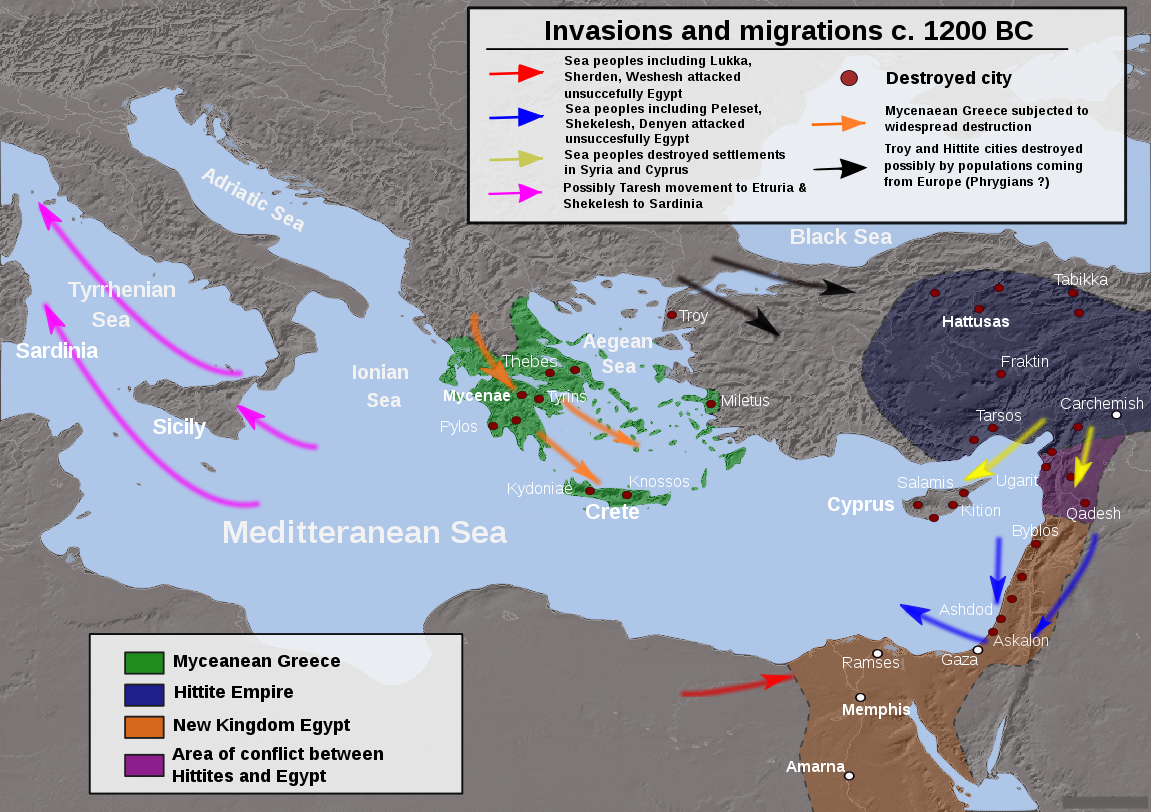
Published 20 Jun 2020In this video we briefly discuss the Bronze Age Collapse and none other than Mycenaean Greece and what contributed to the Greek Dark Ages. Did the Sea Peoples invade? Was there an internal rebellion like a peasant revolt? Drought, Earthquakes and Famine? We cover a variety of topics which also includes debunking the Dorian Invasion. We also take a look at migrations and depopulations of major centers as populations moved elsewhere during this calamity.
Support Dr. Eric Cline at the links below!
Personal web page: https://ehcline.com
GW pages:
https://cnelc.columbian.gwu.edu/eric-…
https://anthropology.columbian.gwu.ed…
https://gwu.academia.edu/EricClineArchaeology and the Iliad: The Trojan War in Homer and History
https://www.amazon.com/dp/B001EI3IVU?…The History of Ancient Israel: From the Patriarchs Through the Romans
https://www.amazon.com/dp/B001JHT8CY?…Image credits: Manna Nader, Gabana Studios Cairo
Hittite 3D City and intro footage credits: 3D reconstruction of Imperial Hittite Karkemish by Giampaolo Luglio, Turco-Italian Archaeological Expedition to Karkemish directed by Nicolò Marchetti (University of Boologna)
KARKEMISH (Carchemish) 1300 BC (3D) -The Southern Capital of the Empire Hittite
Music Attribution: Herknungr – Megaliths | Dark Neolithic Meditive Shamanic Ambient Music https://youtu.be/oc8FQwNjPu0
June 21, 2020
QotD: “[T]he fascinating modern science of high-tech grave robbing”
Since then, an endless stream of anthropologists have assured us that race is just a social construct, that ancient peoples made pots not war, that Aryan conquests in India and Europe were Nazi delusions, that the caste system was imposed on the egalitarian Indians by British colonialists, and many other agreeable suppositions.
As Fitzgerald’s friend Hemingway ended The Sun Also Rises, “Isn’t it pretty to think so?”
But now the brilliant Harvard geneticist David Reich has published a bombshell scientific book, Who We Are and How We Got Here: Ancient DNA and the New Science of the Human Past, whose revelations would have been found congenial by a smarter version of Buchanan (such as Fitzgerald himself).
Despite Reich’s occasional need to stop his otherwise lucid narrative to spew irrational rage against his fellow race-science heretics such as James D. Watson, the genome expert conclusively demolishes the post-Boasian anthropologists’ conventional wisdom.
[…]
Reich learned the fascinating modern science of high-tech grave robbing from Svante Pääbo. This Swedish biologist invented the techniques for extracting from ancient skeletons their DNA. (Interestingly, the 1990 Native American Graves Protection and Repatriation Act makes it hard to get hold of ancient American Indian skeletons, but other races’ ancestors appear to be fair game.)
Reich applied to Pääbo’s breakthrough the traditional American knack for vast industrial scale. Assisted by English code-cracker Nick Patterson’s innovations in extracting meaning from bits and pieces of ancient genomes, Reich’s factory-like lab at the Broad Institute has been churning out a tsunami of papers on fascinating questions of prehistory.
Steve Sailer, “Reich’s Laboratory”, Taki’s Magazine, 2018-03-28.
June 20, 2020
“What did you do in the Wuhan Coronavirus war, Daddy?”
Chris Selley metaphorically dons the garb of a war correspondent to report on how the Canadian government systematically mishandled the epidemic “war”:
At first, comparisons to wartime seemed a bit silly. All we were being asked to do, after all, was stay indoors. As the World Health Organization was declaring a pandemic 100 days ago, the commanders had everything under control: the borders, the epidemiology, the strategy, support for shuttered businesses and their employees. Traditionally, wartime puts those of us left on the home front to work whether we like it or not. This was entirely the opposite: the worst we would have to put up with — in theory, assuming government aid was as advertised — was the indignity of idleness. Collective inaction would flatten the curve, the forces of COVID-19 would be beaten back, and summer would be saved. Peace in our time.
And then it instantly turned to quagmire. Canadians watched slack-jawed as COVID-19 breached our most fundamental defences. You don’t need Sun Tzu’s perspicacity to inform people arriving in Canada of their responsibility to self-isolate, and exactly what self-isolation means — go directly home, do not stop for groceries, do not receive visitors. I just did it, right there, in half a sentence. But we couldn’t manage it: Where information was distributed at all, it was excessively complex even as it failed to deliver the central message. Provincial forces threatened mutiny. Alberta Commander-in-Chief Jason Kenney stormed into the Edmonton airport demanding answers. It took weeks to sort out.
[…]
If it didn’t seem like a war before, it sure did once the real live army was drafted in to bail out long-term care homes in Ontario and Quebec that had descended into horrifying squalor. We learned the appalling details from leaked military reports. And now, in an almost poetic act of military pigheadedness, the Ottawa Citizen reports the Armed Forces are trying to hunt down and punish the leakers.
The war must go on. But sitting here in still-locked-down Toronto, stewing in my own bile, I cannot say this is filling me with patriotic fervour. I find myself simultaneously envious of other provinces that are in the process of reopening, and sympathetic to their residents: If it weren’t for the two sick men of the federation [Ontario and Quebec] dominating the narrative, they would likely have reopened much earlier.
Indeed, jealousies have bloomed as weeks turned to months. Apartment dwellers envy other apartment dwellers who have balconies. All apartment dwellers envy homeowners. Everyone envies cottage-owners. Some cottage-country mayors have told cottage-owners to stay put and keep their infestations to themselves. People cooped up with their kids sometimes envy those with time to themselves; singletons who have had enough alone time to last a decade occasionally envy those trying to juggle kids with working from home. The pleasant novelty of Zoom-based socializing faded ages ago, as everyone realized that Zoom-based socializing sucks.
More than 8,200 Canadians are dead, most having lived long lives but many having died in grim and lonely circumstances. In future, considerably more deaths and distress will be associated with the lockdown itself. The psychological effects of this will be studied for decades. If war isn’t quite the right analogy, it’s certainly closer to a war than anything that has been contested on Canadian soil in my or my parents’ lifetime, and it will come at a greater cost to the whole of society than any actual war that Canadian forces have fought over that time. It’s a terrible shame that as a nation, we didn’t win.
June 19, 2020
QotD: We call it the Corded Ware culture, not the Battle Axe culture to make it less interesting to boys
India played a large role in the development of European conceptions of race. In 1786 British judge William Jones delivered a lecture in Calcutta suggesting that Sanskrit, Greek, and Latin were all descended from the same lost language, a ghost tongue now called Proto-Indo-European.
Jones went on to hypothesize that an ancient invasion of Dravidian-speaking India by Proto-Indo-European-speaking Aryans from Iran could help explain the curious distribution of language, skin color, and caste within the Hindu world today.
Jones’ ideas had unfortunate influence. Reich writes:
To the Nazis and others, the distribution of the Indo-European language family, linking Europe to India … spoke of an ancient conquest moving out of an ancestral homeland, displacing and subjugating the peoples of the conquered territories, an event they wished to emulate.
Hitler thus culturally appropriated the Hindu swastika.
Since 1945, the notion of Aryan invaders has been unsurprisingly unpopular.
In Europe, anthropologists have promoted the “pots not people” theory to argue that trade and changes in fashion must explain why Corded Ware pots suddenly showed up all over Europe about 4,900 years ago. (So did battle axes; indeed, early scientists called this the Battle Axe Culture. But that sounded too awesome. Hence, more recent academics renamed it after its pottery style to make these brutal barbarians sound dweebier and thus less interesting to boys.)
In India, the notion of Hindu culture as a giant conspiracy by Aryan invaders to enshrine their descendants at the top of the social order for the rest of eternity perhaps struck a little too close to home.
Steve Sailer, “Reich’s Laboratory”, Taki’s Magazine, 2018-03-28.
June 18, 2020
Black Death and the Failure of Pandemic Lockdowns – Pandemic History 03
TimeGhost History
Published 17 Jun 2020Starting in 1347 and for three centuries, the second plague pandemic provides ample time to learn how to deal with the recurring outbreaks. And yet, fears of ruining the economy, political expediency, and refusal to accept reality leaves those trying to implement protection measure to fight an uphill battle. The result is even worse economic consequences, and unfathomable death.
Join us on Patreon: https://www.patreon.com/TimeGhostHistory
Hosted by: Indy Neidell and Spartacus Olsson
Written by: Indy Neidell and Spartacus Olsson
Directed by: Astrid Deinhard
Executive Producers: Astrid Deinhard, Indy Neidell, Spartacus Olsson, Bodo Rittenauer
Creative Producer: Joram Appel
Post-Production Director: Wieke Kapteijns
Research by: Spartacus Olsson, Indy Neidell, and James Currie
Edited by: Karolina Dołęga
Sound Engineer: Marek Kamiński
Graphic Design: Ryan WeatherbyVisual Sources:
Wellcome Images
Patrick Gray on Flickr: https://www.flickr.com/photos/1360415…
Paul K on Flickr: https://www.flickr.com/photos/bibliod…
Quinto Tiberio Angelerio and New Measures for Controlling Plague in 16th-Century Alghero, Sardinia digitalized by Google, original from Universidad Complutense de MadridIcons from The Noun Project by: Ben Mullins, parkjisun, Muhamad Ulum & Adrien Coquet
Music:
“A Far Cry” – Flouw
“Fire Building Ext 3” – SFX Producer
“Last Point of Safe Return” – Fabien Tell
“London” – Howard Harper-Barnes.mp3
“Please Hear Me Out” – Philip Ayers
“Scream Female 3” – SFX Producer
“Scream Male 6” – SFX Producer
“Superior” – Silver Maple
“Symphony of the Cold-Blooded” – Christian Andersen
“Barrel” – Christian AndersenArchive by Screenocean/Reuters https://www.screenocean.com.
Research Sources:
Quinto Tiberio Angelerio and New Measures for Controlling Plague in 16th-Century Alghero, Sardinia Raffaella Bianucci, Ole Jørgen Benedictow, Gino Fornaciari, and Valentina Giuffra
“The Path to Pistoia: Urban Hygiene Before the Black Death”, G. Geltner, Past & Present, Volume 246, Issue 1, February 2020, Pages 3–33
Encyclopedia of the Black Death, Joseph Patrick Byrne
“Epidemiological characteristics of an urban plague epidemic in Madagascar, August–November, 2017: an outbreak report”, The Lancet, Rindra Randremanana, PhD, *Voahangy Andrianaivoarimanana, PhD, Birgit Nikolay, PhD, Beza Ramasindrazana, PhD, Juliette Paireau, PhD, Quirine Astrid ten Bosch, PhD, et al
Yersinia pestis, the cause of plague, is a recently emerged clone of Yersinia pseudotuberculosis, Mark Achtman, Kerstin Zurth, Giovanna Morelli, Gabriela Torrea, Annie Guiyoule, and Elisabeth Carniel
Insights into the evolution of Yersinia pestis through whole-genome comparison with Yersinia pseudotuberculosis, P.S.G. Chain, E. Carniel, F.W. Larimer, J. Lamerdin, P.O. Stoutland, W.M. Regala, A.M. Georgescu, L.M. Vergez, M.L. Land, V.L. Motin, R.R. Brubaker, J. Fowler, J. Hinnebusch, M. Marceau, C. Medigue, M. Simonet, V. Chenal-Francisque, B. Souza, D. Dacheux, J.M. Elliott, A. Derbise, L.J. Hauser, and E. Garcia
Distinct Clones of Yersinia pestis Caused the Black Death, Stephanie Haensch, Raffaella Bianucci, Michel Signoli, Minoarisoa Rajerison, Michael Schultz, Sacha Kacki, Marco Vermunt, Darlene A. Weston, Derek Hurst, Mark Achtman, Elisabeth Carniel, and Barbara BramantiA TimeGhost chronological documentary produced by OnLion Entertainment GmbH.
From the comments:
TimeGhost History
2 days ago
As you have seen in this episode collective learning takes time. Some of you might infer one to one parallels between the situation during the second plague pandemic and our current pandemic in 2020. That would not be entirely correct and definitely not our intention. History doesn’t as much repeat itself as it echos into the present. While there are similarities between all pandemics, and we continue to struggle to find the correct response and countermeasures, our times are very different from the medieval and renaissance world. Science has developed further, society has evolved, and we have much more than one form of response to disease available. Moreover the pandemic that started in 1347 is in relative numbers (percentage of lethality) the worst pandemic to hit humanity in known history.In the end we are historians, not health professionals or epidemiologists. Our contribution can never be what to do about COVID 19, that is too complex an issue for us to digest. What we can contribute is a historical perspective on what went wrong back then, and how we developed from there. The main takeaway from the Black Death should from that long term historical perspective be positive. The response lay the foundation of modern health care in hospitals. It helped create the beginnings of professional, trained, and vetted doctors, it changed the view on sanitation, and it started to shift our collective view on disease from superstition and conspiracy myths to factual analysis and a scientific response.
And there in that very last point lies perhaps the one and only thing that we can say with certainty that we need to remember in 2020 — listen to the scientists, not the hacks and politicians on all sides that base their rhetoric on, self interest, political expediency, and populism.
Never forget!
Spartacus
PS apologies for the audio problems on my mic during the first half of the video — it was scratching against my jacket and no one noticed, sadly we can’t get it out in post.