
“Oh, certainly, you could produce quantities of infants although it would take enormous resources to do so. Highly trained techs, as well as equipment and supplies. But don’t you see, that’s just the beginning. It’s nothing, compared to what it takes to raise a child. Why, on Athos it absorbs most of the planet’s economic resources. Food of course housing, education, clothing, medical care it takes nearly all our efforts just to maintain population replacement, let alone to increase. No government could possibly afford to raise such a specialized, non-productive army.”
Elli Quinn quirked an eyebrow. “How odd. On other worlds, people seem to come in floods, and they’re not necessarily impoverished, either.”
Ethan, diverted, said, “Really? I don’t see how that can be. Why, the labor costs alone of bringing a child to maturity are astronomical. There must be something wrong with your accounting.”
Her eyes screwed up in an expression of sudden ironic insight. “Ah, but on other worlds the labor costs aren’t added in. They’re counted as free.”
Ethan stared. “What an absurd bit of double thinking! Athosians would never sit still for such a hidden labor tax! Don’t the primary nurturers even get social duty credits?”
“I believe,” her voice was edged with a peculiar dryness, “they call it women’s work.”
Lois McMaster Bujold, Ethan of Athos, 1986.
June 9, 2021
QotD: Failing to account for mere “women’s work”
June 8, 2021
The utter failure of political leadership in most countries during the pandemic
Jay Currie runs through some of the many reasons our political leadership and their “expert class” advisors in most western countries were utter shit almost from the starting gun of the Wuhan Coronavirus pandemic:
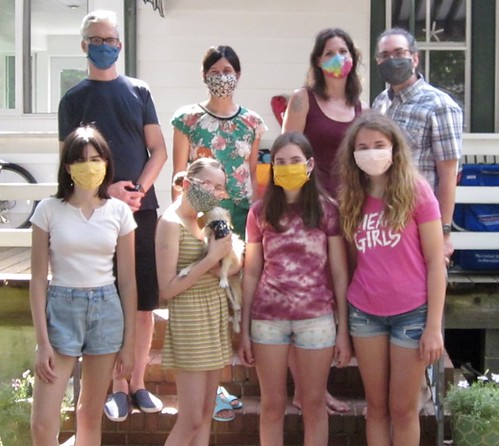
“Covid 19 Masks” by baldeaglebluff is licensed under CC BY-SA 2.0


The first response of most of our political class was to doggedly claim to be following the science, turn day to day decision making over to “public health experts”, follow the guidance of the WHO and the CDC – guidance which was, to be charitable, inconsistent – and to largely avoid questioning the experts. (Trump seemed to make some attempt to raise questions but made little headway in the face of his own public health bureaucracy.)
“Wipe everything” (which the CDC now concedes is pointless because the virus is rarely, if ever, transmitted by contact, “wash your hands” (good advice at any time), “social distance” (hilarious when in effect outdoors where there is next to no transmission), “walk this way” in the essential grocery and liquor stores, “wear a mask”, “wear two masks”, “stay home” (logical for two weeks, insane for six months), “curfew” (no known benefit, Quebec ended up being under curfew for five months), “no indoor dining” (despite next to no evidence that restaurants were significant sources of infection), “don’t travel” (with a vast list of exceptions), “don’t gather outdoors (unless BLM protest)” (ignoring entirely that the virus rarely spreads outdoors): it was all COVID theatre and, to paraphrase Dr. Bonnie Henry, “There’s no science to it.”
What the politicians did was simply to panic. They abdicated their responsibility to lead to “experts” who seemed to all be reading from the same “mass lockdown, masks everywhere, hang on for the vaccine, there is no treatment” script.
The key political failure was the acceptance of the “there is no treatment” story. Back in February/March 2020 there were suggestions that there might well be treatments of some sort. HCQ was trotted out and, partially because Trump mentioned it and partially because of very badly designed studies, dismissed. The very idea of a COVID treatment regime was, essentially, made illegal in Canada and much of the United States.
The idea of boosting immunity with things like Vitamin D and C and a good long walk every day did not come up at most of the Public Health Officer’s briefings across Canada. And, again, not very well done studies were cited showing that “Vitamin D does not cure COVID”. A claim which was not being made. A healthy immune system, to which Vitamin D can contribute, most certainly does cure COVID in the vast majority of cases.
Citing privacy concerns, public health officials were unwilling to give many details as to who was dying of or with COVID. Age, co-morbidities, race, and the socio-economic status of the dying were disclosed reluctantly and long after the fact.
I don’t think most of this can be blamed on the public health officials. They had their jobs to do and, to a greater or lesser degree, managed to do them. They are hired to apply current best practices – often mandated on a world wide basis by the WHO – to the situation before them. Public Health officials are not expected to be imaginative nor innovative.
Imagination, leadership, thinking outside the proverbial box is what we elect politicians for.
But, hey! Doesn’t Justin wear cool socks? Totally worth flushing decades of economic growth down the toilet for those nice socks! Canada’s back! (Back to 1974, approximately.)
If you were trying to destroy American cities from within … what would you be doing differently?
Sarah Hoyt’s latest Libertarian Enterprise post considers the state of US urban areas after more than a year of Wuhan Coronavirus lockdowns, social controls, and medically “justified” repression:
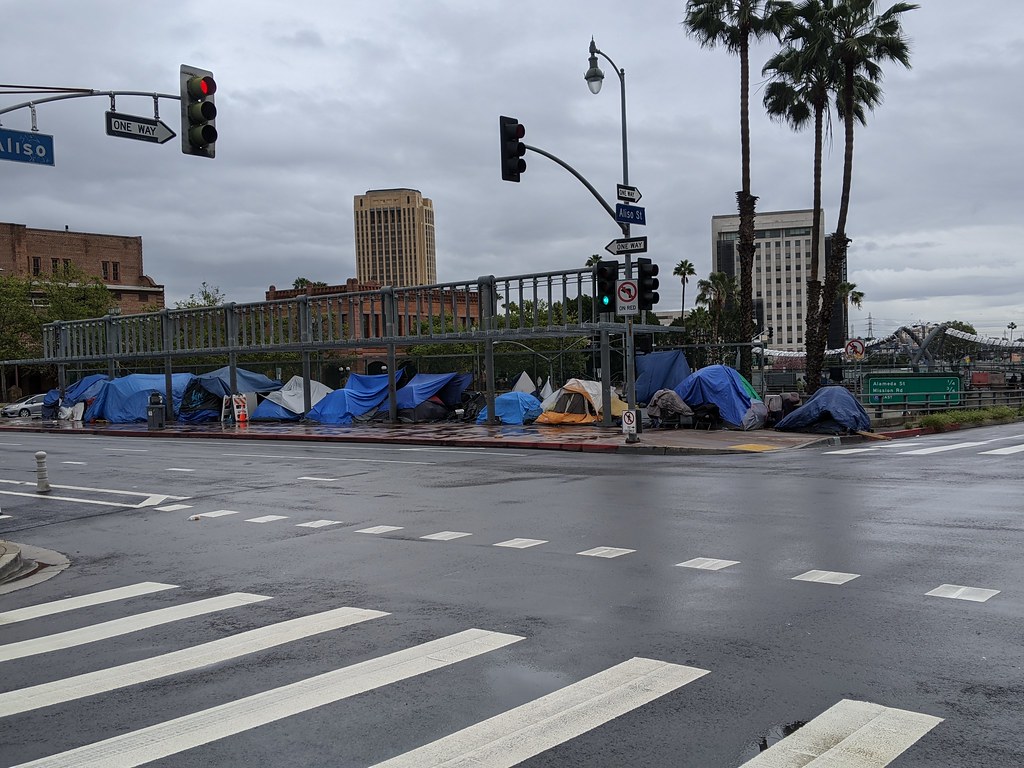
“Homeless encampment above the 101 @ Spring” by Steve Devol is licensed under CC BY-NC-SA 2.0

Look, I’m sure this was suggested by China, and the dunderheads are totally buying it under their Compleate Illusions system.
Sure climate change. Climate change can justify anything. If we told them they needed to burn people alive to prevent climate change, they’d already been building the pyres.
But that’s just sort of a reflexive thing, like a Moslem saying “Insh Allah“. It’s not actually involved in their thinking as such. Or their thinking is not involved in it. whichever.
The truth is that they realized that the Covidiocy has destroyed the cities.
You see they had everything planned. They were going to force more and more of us into the city, because they were going to make running an internal combustion engine so hard. So if you had a job, you’d live in the city. Where you’re more easily controlled. And where they could make you believe bullshit like overpopulation and that — look at all the homeless — we needed more and more welfare. Their idea of their perfect world is the 1930s version of the future. Just megalopolisis, isolated, with people completely controlled. It has the bonus of leaving pristine wilderness outside that, for the elites to build their dachas.
And part of the problem is that they never understand other people have agency and respond to circumstances.
I don’t know what they expected when they went full fashboots and — in the case of Polis, and I bet not the only one — gave homeless the right to camp in every public land, and defecate in public as well as freeing a bunch of felons.
Did they expect this would just scare people more, and they’d lock themselves in, in fear and trembling, allowing the idiots to design society.
Instead, people left. Americans are on the move. I swear half of my friends are moving from more locked to less locked, from bluer to redder. Some demographers have caught on, seeing through the smoke and mirrors, and are confused — most of them being leftist — because Americans are in the middle of a full migration. As full and as all pervading as the movement west. Or after the civil war the movement of black people North.
Some of this must have penetrated the granite-like heads of the ruling left. Or at least the planning left.
They somehow didn’t expect—possibly because they don’t really get technology. I mean, I have my moments, but I swear most democrats were disappointed when laptops started being made with no “cup holders”. They’re at that level of stupid — that a tech that hasn’t been fully implemented, giving us the ability to work from home, would be kicked into high gear from the covidiocy.
I guess they expected people who work mostly from their computers to sit at home watching panic porn on TV and not work?
More importantly, I don’t think they expected people who have to work in person to follow that migration because, well … if you owned a restaurant that the covidiocy killed, you might, for instance, pay heed to the fact people are driving everywhere because, duh, masks on planes, and therefore build a roadside diner or perhaps find a small town that’s underserved and start anew there.
Oh … a lot of people are changing jobs too, and the jobs are no longer binding them to big cities.
Honestly, the only way for big cities to save themselves is to become touristic centers. NYC was halfway there when the covidiocy hit. Only not fully there because lefty governance sucks at making a city safe.
If I were a lefty governor or mayor right now, I’d aim the fashboots at crime and disorder, get rid of the homeless, spruce up the place, and go all out in courting tourism. Then people would move in to cater to the tourists, and eventually other businesses would move in, because that’s where people are.
But leftists don’t think that way. Carrot and incentive is beneath them (of course.) Their idea is rather that they will force those unwashed peasants to do what they want.
June 2, 2021
Media Fearmongering
Laura Dodsworth on how the BBC and other British media outlets turned all the dials to 11 to ramp up fear over the spread of the Wuhan Coronavirus:
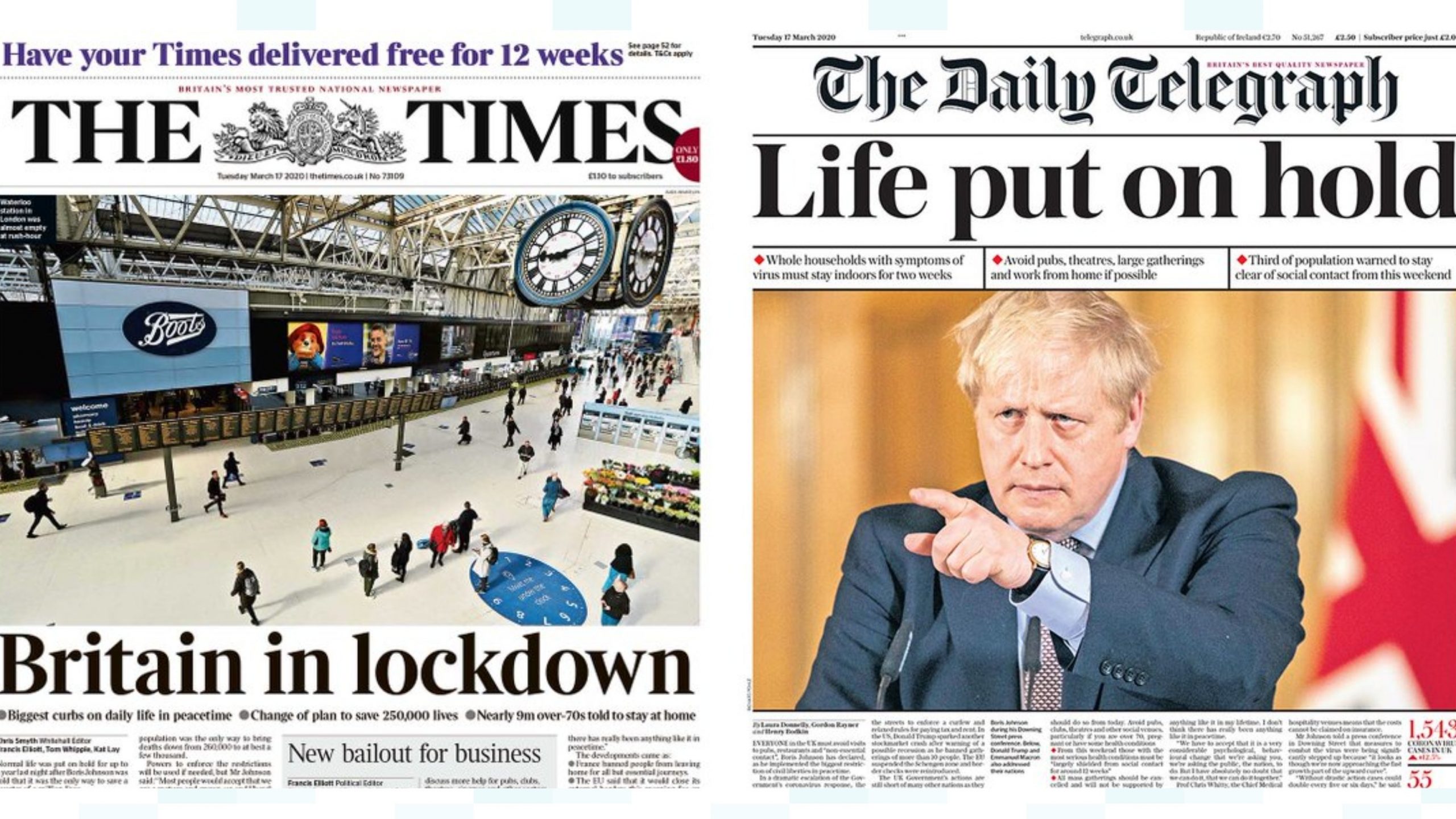
The media have served us a cornucopia of frightening articles and news items about Covid-19 in 2020 and 2021. While writing my new book, A State of Fear: How the UK Government Weaponised Fear During the Covid-19 Pandemic, I encountered a panoply of doom-mongering headlines. These were an indication of the significant role the media have played in creating our state of fear.
Of course, news media should not shy away from reporting frightening news during a pandemic. They should make us aware of the numbers of deaths, the policies being implemented to tackle the pandemic and the latest scientific developments. But during Covid, the media went beyond reporting on the pandemic. Instead, they appeared beholden to the old commercial imperatives, “If it scares, it airs”, and “If it bleeds, it leads”. It seems fear does sell.
The anxious, frightened climate this has helped to create has been suffocating. Death tolls were constantly brandished without the context of how many people die every day in the UK, and hospital admissions were reported while recoveries were not. As a result, Covid often appeared as a death sentence, an illness you did not recover from – even though it was known from the outset that Covid was a mild illness for the majority of people.
Given the wall-to-wall doom, it is therefore no surprise that the British were one of the most frightened populations in the world. Various studies showed that we were more concerned than other countries about the spread of Covid and less confident in the ability of our government to deal with it. One survey in July 2020 showed that the British public thought between six and seven per cent of the population had died from Covid – which was around 100 times the actual death rate at the time. Indeed, if six or seven per cent of Brits had died from Covid, that would have amounted to about 4,500,000 bodies – we’d have noticed, don’t you think?
While researching A State of Fear, I interviewed members of the general public about how they were impacted by the “campaign of fear” during the epidemic. Many talked of how the media had elevated their alarm.
“There wasn’t much to do”, Darren told me, “so we’d watch TV and we saw programmes about disinfecting your shopping when it arrives, and having a safezone in the kitchen. The nightly bulletins on the TV about death tolls, the big graphs with huge spikes on them, came at us ‘boom, boom, boom!’. It was a constant barrage of doom and gloom. My fear of the virus went through the roof.”
Sarah told me she had to stop watching the BBC. As her daughter put it, “If you just watched or listened to the BBC every day, what hope would you have had?”. Jane, meanwhile, described the “gruesome headlines” that came at her “thick and fast”.
The fearmongering about Covid began even before the pandemic hit the UK. We were primed by videos from Wuhan in China, which were then widely circulated by UK-based media outlets. These painted an apocalyptic picture, featuring collapsed citizens, medics in Hazmat suits, concerned bystanders and a city grinding to a halt. In one memorable video, which went viral, so to speak, a woman fell, stiff as a board, flat on her face, on a pavement. The split second where she falters is a giveaway – this was a set-up. If the rest of the world had Covid, China had “Stunt Covid”.
May 30, 2021
The Stanford Prison “Experiment”
In another of the anonymous book reviews at Scott Alexander’s Astral Codex Ten, a look at the infamous Stanford Prison Experiment:

The second most famous psychology experiment in history is the Stanford Prison experiment. Philip Zimbardo split a group of undergrads at random into prisoners and guards. The guards were left free to choose how they would manage the prisoners, and within days the whole thing had to be called off as it had descended into a sadistic torture camp. At least that’s how Zimbardo has described it for the last 50 years. In fact, everything I just said is completely false. The undergrads were not split at random — the scheme had actually been dreamt up by an undergrad called David Jaffe who had run a previous experiment himself on abusing prisoners in a fake jail. He was carefully placed into the guards group. Nor were the guards left to choose their methods, instead they were briefed by Zimbardo and Jaffe that the purpose of the experiment (for which they were being well renumerated) was to see how people cracked under pressure. The experiment would be a failure unless they could put the prisoners under terrible stress. Even Douglas Korpi’s prisoner breakdown on day two, which, captured on camera, became the cinematic face of the experiment, was a fake he put on after discovering he wouldn’t be able to spend the time in jail revising, and being told he would only be allowed to quit if he suffered some sort of serious mental or physical breakdown.
Despite the pressure from Zimbardo and Jaffe, two thirds of the guards refused to take part in sadistic games, and much to their frustration a third continued to treat the prisoners with kindness. Nonetheless when Zimbardo came to write up the experiment about the effects on the prisoners, he realised it would be a much more compelling story if he turned it on its head, and made it about the guards instead. The truth of guards carefully drilled to be sadistic was swept away with a lie of ordinary people spontaneously becoming cruel when dressed in a uniform and given a position of power.
For years no one replicated the experiment — given the results first time round it was thought unethical, but in 2001 the BBC in search of new reality television commissioned a repeat (turns out reality television runs to different ethics than the average psychology department). Now unlike normal reality TV they didn’t bother manipulating the participants to be at each other’s throats — there was no need, in days it was going to be a bloodbath.
The result is the four most boring hours of television ever recorded. Nothing happens. The guards sit around chatting. When tensions arise with the prisoners, they defuse them by talking to them nicely. On day 6 some prisoners escaped. They headed over to the guards’ canteen and all had a smoke together. On day 7 they voted in favour of turning the whole thing into a commune.
May 29, 2021
Justin Trudeau is clearly not concerned about China or Chinese involvement in Canadian affairs
In The Line, Jen Gerson outlines the PM’s latest display of insouciance in regard to anything involving China, their ruling Communist party, or the Chinese military:
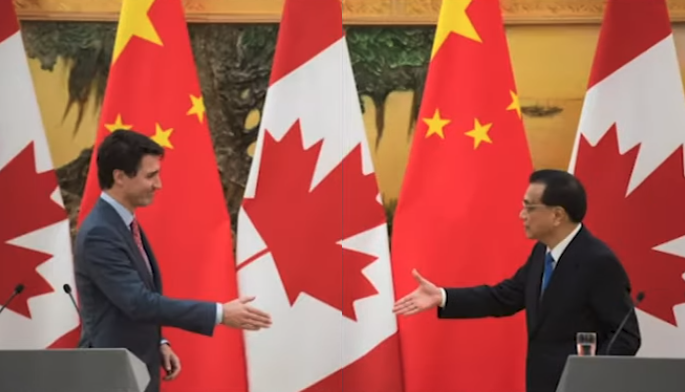
The Globe and Mail reported last week that Canada’s top infectious disease research centre, the National Microbiology Laboratory in Winnipeg, had hosted and otherwise collaborated with guest researchers and scientists from China — including some with links to that country’s military or government. O’Toole asked about this in the House, and Trudeau gave a very routine Trudeauvian non-answer. O’Toole and other Tories kept up the questioning, Trudeau eventually responded with this (as per Hansard): “Mr. Speaker, we have always and will always take this threat seriously. Public safety officials have met with more than 34 universities to help them keep their research safe. In 2020, CSIS engaged more than 225 different organizations, including universities, to ensure that they were aware of foreign threats. I also want to mention that we are seeing a disturbing rise in anti-Asian racism. I hope that my Conservative Party colleagues are not raising fears about Asian Canadians.”
Sigh. Where do we begin?
First of all, though this may shock our readers, the Sun papers, and its columnists, have been known to exaggerate their criticisms of the PM. The PM gave a more substantive answer than Lilley gave him credit for. You can disagree with the PM — see below! — without getting cute with what he actually said. The racism line was dumb, and shitty. It was beneath the PM and unfair to the legitimate questions that were being asked. Trudeau shouldn’t have said it, and he was right to get called out for it.
So yes, a dick move by the PM — in a hundred years, maybe one of his descendants can apologize for it. But let’s not take our eye off the ball.
Trudeau’s answers were more than Lilley suggested, but they’re still not good enough. O’Toole and the Conservatives are onto something. China’s ruling regime is aggressive, brutal, and thuggish. They’re a threat to security abroad, they’re committing outright crimes against humanity against their own religious minorities, they’ve crushed Hong Kong underfoot, and they’re actively hostile to Canada. None of this is racist to note.
And yet our federal Liberals remain alarmingly unable to admit any of this. We don’t buy that it’s just a matter of political expediency, an awkward but necessary consequence of the ongoing detention of the two Michaels. Hell, we wish that the Liberals were just being publicly cautious with their real views on Beijing while remaining clear-eyed about the threat behind closed doors. The evidence continues to suggest that the federal Liberals, from Trudeau on down, remain hopelessly naïve about the nature of Beijing’s rulers, even as more and more of our allies are getting real about what the next generation or two of geopolitics is gonna look like for the Western alliance. (Which Canada remains a part of, whether Trudeau likes it or not.)
The growing tensions with a rising China are a big deal. It is only going to become a bigger deal. The Liberals need to get with the program. We hope to see more on this across the Canadian media — and hopefully it’s a bit more useful and productive than what the Sun ran with this week. The Liberals look terrible on this file already for entirely legitimate, serious reasons. We don’t need to pop our aging joints as we stretch and contort ourselves to make it seem so.
Depression and suicide rates during the Wuhan Coronavirus pandemic
At Works in Progress, Scott Alexander looks at the details of rates of depression (which went up during the pandemic) and suicides (which surprisingly went down):
When COVID started spreading, life got more depressing, people became more depressed, but suicide rates went down. Why?
First, are we sure all of that is true? I won’t waste your time listing the evidence that life got more depressing, but what about the other two?
Ettman et al. conveniently had data from nationally representative surveys about how many Americans were depressed before COVID-19. They found another nationally representative sample and asked them the same questions in late March/early April 2020, when the first wave of US cases and lockdowns was at its peak. They found that 3 times as many people had at least one depression symptom, and 5–10x as many people scored in the range associated with “moderately severe” or “severe” depression.
This is a good study. It’s published in the Journal of the American Medical Association, a good journal. It’s been cited 50+ times in 6 months. Really the only thing anyone could have against it is the implausibly large effect it found. But it matches similar studies from Australia, Portugal, and around the world. Let’s say it’s real.
Along with the increased depression came an increase in people who said they were thinking about suicide. According to the US CDC, more than twice as many Americans considered suicide in spring 2020 compared to spring 2018 (10.7% vs. 4.3%).
Yet completed suicide rates stayed flat or declined. It’s hard to tell exactly which, because suicide is rare and noisy, and you need lots of data before anything starts looking statistically significant. But there are studies somewhere between “flat” and “declined” from Norway, England, Germany, Sweden, and New Zealand.
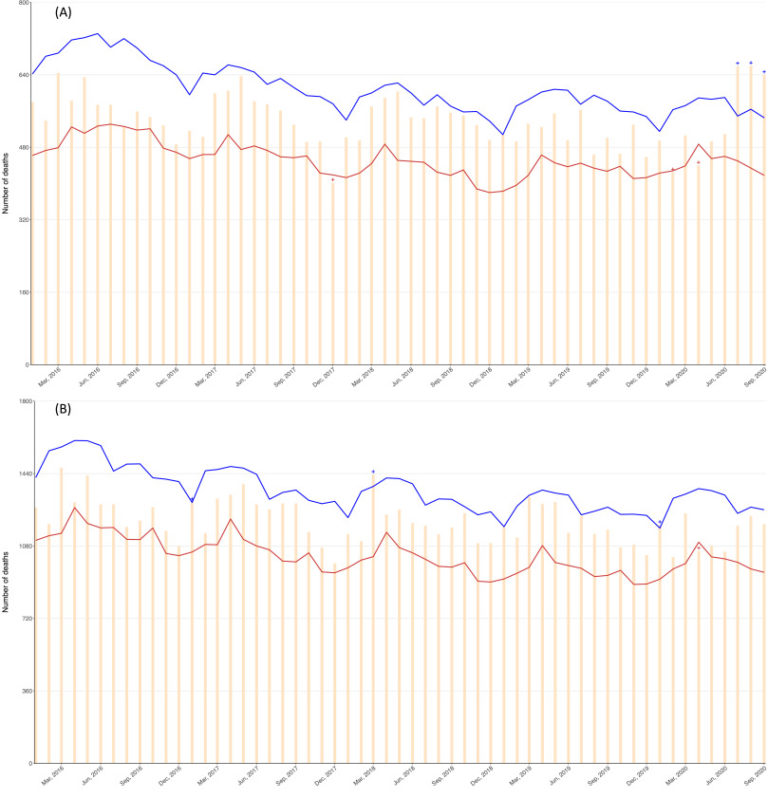
We also have two more complete reports from larger countries that help us see the pattern in more detail. First is Japan. Studies by Tanaka and Nomura broadly agree on a similar pattern — a slight decrease in suicides in the earliest stage of the pandemic (spring 2020) followed by a larger increase during the autumn. Here’s Nomura’s data:
The top graph is women, the bottom is men. The blue and red lines represent the 95% confidence range for an “average” year. Months that differ significantly from the average have little dots on top of their bars. You can see that April 2020 had significantly less suicide than average, among both genders, and July/August/September have more than average for women (and trend on the high side for men too).
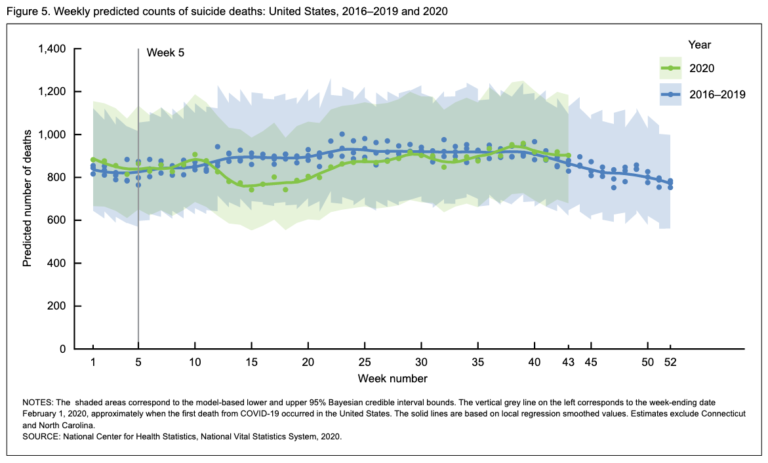
Second is the US. The US Centers for Disease Control recently released their “nowcast” of 2020 deaths. These use the limited amount of data they have now to predict what the trends will look like once all the data comes in; their prediction process seems reasonable and we can probably treat the figures as canonical. Here’s their main result:
Suicide rates were pretty normal until March, when they dropped off pretty quickly and stayed low until midsummer. They’ve since hovered around normal again. Overall, suicides declined by 5.6%.
All these countries combine to form a picture of suicide rates dipping very slightly during the first and most frantic period of the pandemic — March to May — and then going back to normal (except in Japan, where things have since gotten worse). Thus the paradox: increasing depression combined with decreasing suicides. What’s going on?
May 28, 2021
The essential — and largely non-replenishable — trust in government
Last week, Tom posted a then-recent discussion he overheard at The Last Ditch:
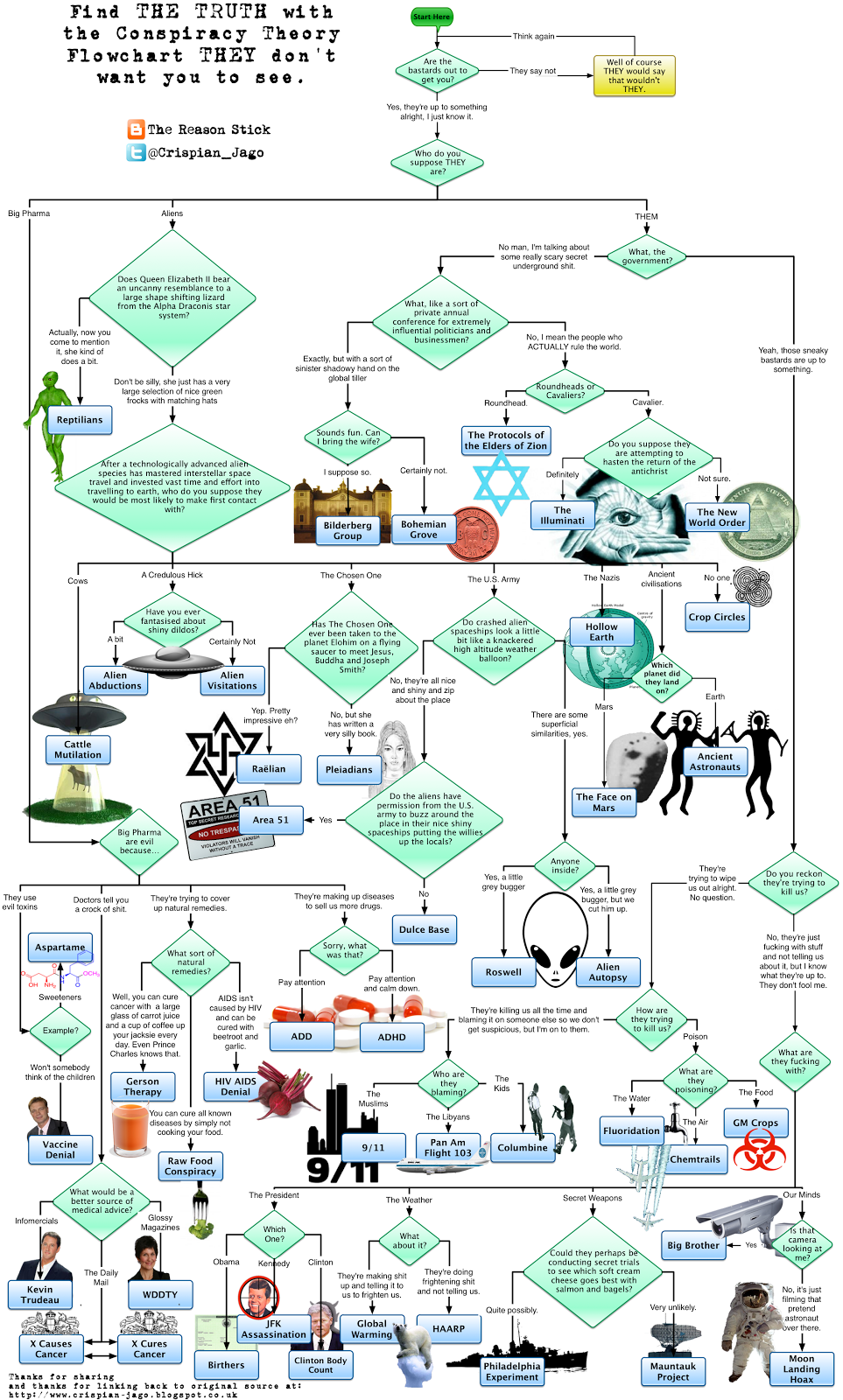
[Click to see full-size flowchart]
Two svelte American ladies of a certain age were having coffee today at my West London health club. They were in the next “pod” to me outdoors as I had a post-swim coffee before heading home. Perhaps it’s those wide-open prairies but Americans, bless them, always speak a little more loudly than us so I didn’t really have a choice but to listen to their conversation.
The topic was their mothers. Both moms back in the States are apparently unsure of the wisdom of being vaccinated. One cost of parenthood no-one tells you about beforehand is that one day you will be judged and found wanting by humans you could not love more; your children for whom you would cheerfully die. I confess their mothers immediately had my sympathy, regardless of the correctness of their views.
There was a good deal of sneering about conspiracy theories circulating on the internet. I found it surprising that both errant moms believed 5G was involved, but having listened quietly for another few minutes discovered that neither had ever said so. Their daughters were simply assuming that if they doubted government advice on vaccines, they believed all the other stuff too. One of the mothers is apparently a 9/11 “truther” and her daughter’s observation that no government is capable of keeping such a dark secret struck me as fair.
[…]
There are available facts and facts that will only become available in the future. People must make their choices based on their own risk assessment today. That useless truism is not the point of this post. The truly significant thing I overheard was this. Having sneered at her mother’s belief that “we can’t trust government”, one of the ladies said;
I thought to myself – Mom, I don’t want to believe what you believe because if it’s true I can’t have any of the things I believe in.
There, I thought, was a moment of insight; a moment (almost) of self-awareness. If government can’t be trusted, then the societal change she wants isn’t possible. Therefore, whatever the evidence, government must be trusted. That pretty much sums up the statist mindset.
I don’t know whether these mothers or daughters are right about this issue. I do know that one of the daughters (and her companion seemed to agree) is allowing her desires to displace her reason. In consequence, sadly, her mind will only ever be changed by a catastrophe I would never wish upon her.
I suspect many such earnest, well-meaning souls as Goneril and Regan (as I christened them) felt they needed to believe the state could be trusted at key points in the deadly history of the 20th Century. If the brave new world of Communism was to happen, for example, government had to be trusted with enormous power to make immense change.
Many Gonerils and Regans must have ruefully reflected on that in the Gulag.
May 25, 2021
536 AD – Worst Year in History
Kings and Generals
Published 11 May 2021Start speaking a new language in 3 weeks with Babbel 🎉 Get 6 months FREE when you sign up for 6 months! ➡️ HERE: https://go.babbel.com/6plus6-youtube-…
Kings and Generals’ historical animated documentary series on the history of Ancient Civilizations continues with a video on the year 536 AD, which many historians consider the worst year in history, as plague, famine, volcanic eruption, and extreme weather patterns changed the fate of the millions, especially influencing Sassanid and Eastern Roman Empires.
Support us on Patreon: http://www.patreon.com/KingsandGenerals or Paypal: http://paypal.me/kingsandgenerals We are grateful to our patrons and sponsors, who made this video possible: https://docs.google.com/document/d/1o…
Art and animation: Haley Castel Branco
Narration: Officially Devin (https://www.youtube.com/user/OfficiallyDevin)
Script: Matt Hollis✔ Merch store ► teespring.com/stores/kingsandgenerals
✔ Podcast ► Google Play: http://bit.ly/2QDF7y0 iTunes: https://apple.co/2QTuMNG
✔ Twitter ► https://twitter.com/KingsGenerals
✔ Instagram ► http://www.instagram.com/Kings_GeneralsProduction Music courtesy of EpidemicSound
#Documentary #WorstYearInHistory #536

QotD: Doctors and individual freedom
Brian Micklethwait, “Curbing liberty — except when they should”, Samizdata, 2005-10-10.
May 24, 2021
QotD: The internet is rewiring our brains
Yeah, I’m a history guy, not a biologist, and no, I can’t show you the specific spots on the fMRI that prove it, but look, you can test this yourself. Ever been around kids? It’s easiest to see in the early grades, so go to a daycare or afterschool program. Trust me, you can pick out right away, with 100% accuracy, the kids who spend more than 3 hours a day at daycare. This is not a knock on daycare providers, lots of whom are good, dedicated people doing hard work. Rather, it’s a knock on the situation, because if a kid’s in daycare that long, it means the parents both work long-hour, high-stress jobs. How do you think the kid’s home life is, under those conditions?
You know as well as I do that when the kid gets home from day care, he gets plunked in front of a tv, a video game, an iPad, a smartphone, some kind of glowing box. That’s what’s rewiring their brains. That’s not “ADHD,” which doesn’t really exist. “ADHD” is a cope, a bit of shorthand, to describe what’s actually going on, which is: These kids’ heads have been rewired. They need constant stimulation. Everything needs to be in five-minute chunks for them, because they’ve never known anything different. Asking them to sit down and pay attention for any length of time – say, in a 60 minute lecture, like our old Prussian (from the 18th century!) system requires – is like asking one of us to suddenly run a marathon, or bench press 300 lbs. It can’t be done; we don’t have the equipment.
Severian, “Bio-Marxism Grab Bag”, Founding Questions, 2021-01-21.
May 23, 2021
QotD: The psychological impact of extended lockdowns
Theodore Dalrymple (TD): The first thing to say is that I do not like the term “mental health.” Was Isaac Newton mentally healthy, or Michelangelo? I think part of the problem is very concept of mental health. It implies that there is some state or condition of mind deviation from which is analogous to illness. Once this idea takes hold, it is clearly up to an expert to cure the person, or better still prevent him from getting ill in the first place. This expectation cannot be met, but the idea that it can be makes people more fragile.
Second, people clearly vary much in their response to confinements, lockdowns, closures of resorts of entertainment, etc. For myself, I have reached the age of misanthropy or self-sufficiency when these things make comparatively little difference to my life. I have plenty of space and plenty of things to do, in essence reading and writing. But that does not make me mentally healthier than a young man who is frustrated because he cannot play football with his friends and becomes ratty – moreover living in a very confined space.
Depression is so loosely defined a term that it has become almost valueless as a diagnosis. How often have you heard someone say “I’m unhappy” rather than “I’m depressed?” The semantic shift is very important. The proper response to someone who says that he is depressed is to give him antidepressants, even though these don’t work in the majority of cases, except as a placebo, and have potential side-effects. It is always tempting for people who are unhappy to drink alcohol – to drown their sorrows, as we say. Of course, if you drink too much, you might become really and truly depressed. A person who did not respond to the current situation with a little gloom would be odd.
Claudio Grass, “Theodore Dalrymple: Self-Control And Self-Respect Have Become Undervalued”, The Iconoclast, 2021-02-17.
May 20, 2021
The Birth Control Movement and Eugenics – A Curious Link | B2W: ZEITGEIST! I E.18 – Winter 1923
TimeGhost History
Published 19 May 2021In the winter of 1923, a controversial activist takes a Catholic doctor to trial for libel. The proceedings capture a much bigger moment in the history of the interwar period: the controversial — but inherent — link between birth control and eugenics.
(more…)
May 19, 2021
QotD: School is prison for kids
School is child prison. It’s forcing kids to spend their childhood — a happy time! a time of natural curiosity and exploration and wonder — sitting in un-air-conditioned blocky buildings, cramped into identical desks, listening to someone drone on about the difference between alliteration and assonance, desperate to even be able to fidget but knowing that if they do their teacher will yell at them, and maybe they’ll get a detention that extends their sentence even longer without parole. The anti-psychiatric-abuse community has invented the “Burrito Test” — if a place won’t let you microwave a burrito without asking permission, it’s an institution. Doesn’t matter if the name is “Center For Flourishing” or whatever and the aides are social workers in street clothes instead of nurses in scrubs — if it doesn’t pass the Burrito Test, it’s an institution. There is no way school will let you microwave a burrito without permission. THEY WILL NOT EVEN LET YOU GO TO THE BATHROOM WITHOUT PERMISSION. YOU HAVE TO RAISE YOUR HAND AND ASK YOUR TEACHER FOR SOMETHING CALLED “THE BATHROOM PASS” IN FRONT OF YOUR ENTIRE CLASS, AND IF SHE DOESN’T LIKE YOU, SHE CAN JUST SAY NO.
I don’t like actual prisons, the ones for criminals, but I will say this for them — people keep them around because they honestly believe they prevent crime. If someone found proof-positive that prisons didn’t prevent any crimes at all, but still suggested that we should keep sending people there, because it means we’d have “fewer middle-aged people on the streets” and “fewer adults forced to go home to empty apartments and houses”, then MAYBE YOU WOULD START TO UNDERSTAND HOW I FEEL ABOUT SENDING PEOPLE TO SCHOOL FOR THE SAME REASON.
I sometimes sit in on child psychiatrists’ case conferences, and I want to scream at them. There’s the kid who locks herself in the bathroom every morning so her parents can’t drag her to child prison, and her parents stand outside the bathroom door to yell at her for hours until she finally gives in and goes, and everyone is trying to medicate her or figure out how to remove the bathroom locks, and THEY ARE SOLVING THE WRONG PROBLEM. There are all the kids who had bedwetting or awful depression or constant panic attacks, and then as soon as the coronavirus caused the child prisons to shut down the kids mysteriously became instantly better. I have heard stories of kids bullied to the point where it would be unfair not to call it torture, and the child prisons respond according to Procedures which look very good on paper and hit all the right We-Are-Taking-This-Seriously buzzwords but somehow never result in the kids not being tortured every day, and if the kids’ parents were to stop bringing them to child prison every day to get tortured anew the cops would haul those parents to jail, and sometimes the only solution is the parents to switch them to the charter schools THAT FREDDIE DEBOER WANTS TO SHUT DOWN.
I see people on Twitter and Reddit post their stories from child prison, all of which they treat like it’s perfectly normal. The district that wanted to save money, so it banned teachers from turning the heat above 50 degrees in the depths of winter. The district that decided running was an unsafe activity, and so any child who ran or jumped or played other-than-sedately during recess would get sent to detention — yeah, that’s fine, let’s just make all our children spent the first 18 years of their life somewhere they’re not allowed to run, that’ll be totally normal child development. You might object that they can run at home, but of course teachers assign three hours of homework a day despite ample evidence that homework does not help learning. Preventing children from having any free time, or the ability to do any of the things they want to do seems to just be an end in itself. Every single doctor and psychologist in the world has pointed out that children and teens naturally follow a different sleep pattern than adults, probably closer to 12 PM to 9 AM than the average adult’s 10 – 7. Child prisons usually start around 7 or 8 AM, meaning any child who shows up on time is necessarily sleep-deprived in ways that probably harm their health and development.
School forces children to be confined in an uninhabitable environment, restrained from moving, and psychologically tortured in a state of profound sleep deprivation, under pain of imprisoning their parents if they refuse. The only possible justification for this is that it achieves some kind of profound social benefit like eliminating poverty. If it doesn’t, you might as well replace it with something less traumatizing, like child labor. The kid will still have to spend eight hours of their day toiling in a terrible environment, but at least they’ll get some pocket money! At least their boss can’t tell them to keep working off the clock under the guise of “homework”! I have worked as a medical resident, widely considered one of the most horrifying and abusive jobs it is possible to take in a First World country. I can say with absolute confidence that I would gladly do another four years of residency if the only alternative was another four years of high school.
Scott Alexander, “Book Review — The Cult of Smart”, Astral Codex Ten, 2021-02-17.
May 16, 2021
Gambling machines have come a long way from the “one-armed bandit” days
This is another reader book review for Scott Alexander’s Astral Codex Ten, looking at Addiction by Design: Machine Gambling in Las Vegas by Natasha Dow Schüll. I’m incredibly risk-averse, so I’ve never even set foot in a casino, but from this review I do not regret my aversion one tiny little bit:

“Hiking the Las Vegas casinos” by davduf is licensed under CC BY-ND 2.0

Sometimes employees at Netflix think, “Oh my god, we’re competing with FX, HBO, or Amazon” … [W]e actually compete with sleep.
Reed Hastings
Randomness is addictive, in rats. B. F. Skinner learned that when he created his eponymous rat boxes. The boxes had levers that, when pressed, dispensed food pellets. Rats in boxes where one press resulted in one pellet pressed the lever when hungry. But rats in boxes where one press randomly resulted in no, one, or many pellets, became addicted to pressing the lever. That mammalian attraction to randomness lies at the heart of all gambling.
But machine gambling is not like other kinds of gambling. The book overflows with metaphors straining to describe how machine gambling is the supercharged version of table games like poker, blackjack, and roulette. Machine gambling is deforestation ruining the rainforest of diverse table games. Machines are invasive kudzu outcompeting and killing the native table games. Machine gambling is the crack cocaine to table games’ cocaine.
In about two decades, machine gambling went from being a side attraction to keep wives busy while their husbands played table games to the source of 85% of casino profits. You know how shopping malls have benches for husbands to sit on while their wives shop in stores? Imagine that those benches became the mall. (If you’re reading this in 2025, shopping malls were, uh, a collection of permanent pop-up stores under the same roof.)
The first time I went to Vegas, I knew a few tricks casinos would use to encourage me to gamble too much. I knew the hotel rooms were purposefully cheap, to entice me to visit Vegas. I knew casinos would have neither windows nor clocks, to help me lose my sense of time. I knew they would be full of bright lights and loud sounds, to overstimulate me. I knew nothing. Those tricks are old hat, as quaint as doilies. Machine gambling is a brave new world.
Machine gambling comes in the form of many games, but one example is enough to illustrate the pattern, so let’s discuss slot machines. Slot machines are games with reels with a variety of symbols on them, like cherries, diamonds, or the number 7. (Fun fact: fruit symbols were initially used on slot machines during the prohibition era to disguise them as gum vending machines.) The game is simple. The player spins the reels. If they land to show symbols in a row, the player wins. Because of their simplicity, these machines are favored by new gamblers and tourists.
Back when Moore’s Law was just Moore’s Prediction, slot machines were mechanical devices. The player would pull on a mechanical lever, which caused reels to spin. The reels would eventually slow down and then stop. The symbols in the middle of the screen when the reels stopped dictated whether the player won or lost.
Now, slot machines are digital. The lever, the reels, the symbols — they are all ones and zeros untethered from reality. This gives machine designers a terrifying amount of flexibility. They can optimize the game to maximize its addictivity.


