
I was also forced to acknowledge by the time I had two sons that the male mind really does approach problems differently than the female mind. Before I had the second son, I put down the differences between the male and female minds as all due to the socialization process. Two sons tipped the balance. It’s like this; the bookcases looked cool to climb to the Last Amazon. She tries once when my attention is on other matters; falls and deduced that it was a bad idea. The sons’ perceive the bookcases as a mountain to be conquered at all costs and they are prepared to pay any price to crown themselves King of the Bookcases. See the bookcases, take the bookcases; or die in the attempt. It did not matter how many times they were thwarted or injured, they refused to give up. Each time they went into the assault with the premise that this time it will end in triumph.
[ … ]
I admit to being a little more than angry and frustrated myself. Partially it is at a school system that won’t allow boys any physical activities where they can blow off steam. No football, soccer, hockey, baseball, dodge ball, or any other kind of game that “promotes aggression” or the “possibility of injury”. Volleyball and cross country running are all well and good but they are seasonal, and frankly, to a lot of boys; it blows. I do understand that not all boys are the “physical” sort but more are than not. While I realize no parent wants their child injured; it just seems that by denying that boys really do need a way to physically deal with aggression, you set them up for horseplay which eventually leads to fighting. How can anyone expect boys to spend all recess at the wall or standing around chatting about the weather?
Kate “The Last Amazon”, “When Biology is Destiny”, The Last Amazon, 2005-03-02.
May 9, 2021
QotD: Boys
April 29, 2021
SFU professor’s analysis of Covid Lockdown Cost/Benefits
Economist Douglas W. Allen of Simon Fraser University recently published his Covid Lockdown Cost/Benefits:A Critical Assessment of the Literature where he concludes that “it is possible that lockdown will go down as one of the greatest peacetime policy failures in Canada’s history”:
In my forty years as an academic, I’ve never seen anything like the response and reaction to Covid-19. The research response has been immense, with estimates of over 40,000 papers related to the topic produced in one year. This research covers every imaginable aspect of Covid-19, and over the course of the past year knowledge about the virus, the human reactions to it, and the consequences of these reactions has exploded. In one word, the Covid-19 information cascade has been “overwhelming.”
In contrast, the ubiquitous media, public health, and political response to the pandemic has been one-sided, incomplete, and almost unchanging over the past year. With respect to lockdown policies, many political jurisdictions have repeated the same spring 2020 programs in 2021, ignoring what has been learned in the meantime. Often public announcements were made that were inconsistent with basic Covid-19 facts that were easy to look up if you know where to look. Furthermore, when research results contrary to the official government response were shared on social media, they were often pulled from social media platforms. As a result, for average Canadians the public media and official public health news conferences have been the only source of Covid-19 information.
This review of a small segment of the literature is intended to give some guidance for those who would otherwise not have access to academic research. The focus is to only critically assess the cost/benefit studies that have been written over the past year on lockdown policies related to the Covid-19 pandemic.
The report covers over 80 different academic studies and related Covid-19 datasites. I have sought out studies that i) dealt with matters of “lockdown” either directly or indirectly, and ii) were related directly or indirectly to issues relevant to the costs or benefits of lockdown.
The term “lockdown” is used to generically refer to state actions that imposed various forms of non-pharmaceutical interventions. That is, the term will be used to include mandatory state-enforced closing of non-essential business, education, recreation, and spiritual facilities; mask and social distancing orders; stay-in-place orders; and restrictions on private social gatherings.
“Lockdown” does not refer to cases of “isolation,” where a country was able to engage in an early and sufficient border closure that prevented trans-border transmission, followed by a mandated lockdown that eliminated the virus in the domestic population, which was then followed by perpetual isolation until the population is fully vaccinated. This strategy was adopted by a number of island countries like New Zealand. Here I will only consider lockdown as it took place in Canada and most of the world; that is, within a country where the virus became established.
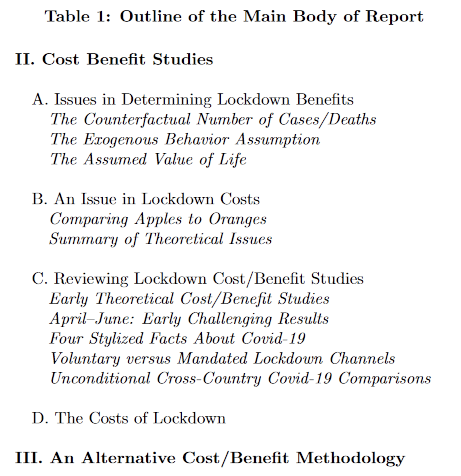
This is a complicated report because it covers a wide range of studies, and deals with a wide range of issues. Table 1 outlines the substance of the report. Sections II: A and B, discuss four critical assumptions often made within the context of estimating benefits and costs. Understanding these assumptions explains why early studies claimed that the benefits of lockdown were so high, and also explains why the predictions of those models turned out to be false.
Section II: C, examines major cost/benefit studies completed over the first six months of the pandemic, and then focuses on what I believe to be the critical factor: distinguishing between mandated and voluntary changes in behavior. This section concludes with an interpretation of some unconditional death comparisons across countries that are typically reported in the media. Section II: D surveys the research done on the costs of lockdown. Finally, Section III. presents a simple alternative cost/benefit methodology to generate two cost/benefit ratios of lockdown.
H/T to Stephen Green for the link.
April 18, 2021
Take a moment to reflect on the plight of those poor, alienated students at Haverford College in Pennsylvania
In Quillette, Jonathan Kay outlines some of the issues faced by the students of an expensive elite academic institution and how it impacts their mental health:

In December, I wrote a detailed report for Quillette about the race-based social panic that had recently erupted at Haverford College in Pennsylvania. One of the reasons why the meltdown seemed so surreal, I noted, is that this elite school appears to the outside world as picturesque and serene. The average annual cost of attendance is about US$76,000. And most of these students live extremely privileged lives, insulated (physically and otherwise) from what any normal person would regard as suffering. Nor is there much in the way of substantive political discord on campus. According to survey results released in late 2019, 79 percent of Haverford students self-identify as politically liberal, while only 3.5 percent self-identify as conservative. It’s as close to an ideological monoculture as you can find outside of a monastery or cult. On paper, it resembles one of those utopian micro-societies conceived by science-fiction writers or 19th-century social theorists.
The survey results I’m alluding to originate with Haverford’s “Clearness Committee,” an excellent resource for anyone seeking to understand the attitudes of students at hyper-progressive schools. The most recent Clearness survey, completed by more than two-thirds of Haverford students in 2019, contained 133 survey questions pertaining to everything from how much students sleep, to how many friends they have, to how they feel about campus jocks. There is also a substantial section dedicated to the theme of “marginalization.” Amazingly, 43 percent of respondents said they felt personally marginalized on campus because of some aspect of their identity. This included 61 percent of gay students, and more than 90 percent of trans students.
This is an odd-seeming result given the sheer number of LGBT individuals on Haverford’s campus. No fewer than 31 percent of student respondents identified themselves as something other than straight. In regard to gender, almost six percent self-identified as trans or some variant of non-binary. Both of these percentages exceed the overall American average by an order of decimal magnitude. Despite having only about 1,300 students (smaller than many public high schools), Haverford has a resource center for LGBT students, a pro-LGBT hiring policy, an LGBT studies program, dedicated LGBT living arrangements, a health insurance policy that covers hormone replacement therapy, and numerous other resources. Outside of other similarly liberal campuses, it is hard to imagine a more welcoming environment for LGBT youth anywhere on the planet.
It’s also telling that self-reported marginalization rates for Haverford’s gay students are almost identical to those for self-described bisexuals (62 percent) and asexuals (59 percent); and that the rate for students who self-identify under the loose category of “non-binary” (89 percent) is almost identical to the rate for students who, being trans, experience actual gender dysphoria (91 percent). The report authors conclude that there is “a series of immediate crises facing Haverford’s transgender population.” Yet despite the abundant write-in information supplied by surveyed students, no real evidence of these crises appears. What we get instead are vague testimonials about perceived attitudes and atmosphere. (“As a nonbinary person, athletics is inherently exclusive because it is gendered. We need to put that phrase to rest and start talking about the real divisions on campus—such as who feels comfortable going to parties hosted by athletes and who doesn’t.”) Even amidst the melodramatic throes of last year’s student strike, at a time when every imaginable identity-based grievance was described in lengthy student manifestos, no one could point to a single recent incident of real homophobia or transphobia targeting Haverford students.
April 13, 2021
“… loving a country also means being honest. We should never get high on our own own flag-covered, syrup-scented supply.”
In The Line, Lauren Dobson-Hughes sits Canada down for a bit of an intervention:

Once upon a time, there was a fairytale castle with soaring turrets and gabled windows. The castle had long been undergoing renovations, so the owners draped the scaffolding with trompe l’oeil cloths — fabric imprinted with the image of the historical building beneath, to maintain an impression of the beauty hidden below.
From the cloth, you imagined the castle must be stunning. And yet behind the façade, it is crumbling. Its walls are mold-ridden, and the floors are rotten. The scaffolding props up a shell.
This metaphor has come to represent the way I’ve come to think about Canada since this pandemic began. As a country, we are so fixated on the mythology we project out to others — the trompe l’oeil cloth — that we’ve allowed the actual capacities, systems and structures of our country to crumble.
The first inkling came early in the pandemic. As COVID-19 numbers rose, it was revealed that the Public Health Agency of Canada did not have nationwide case numbers. This piece delves further, but “Ottawa does not have automatic access to data in [provincial and territorial] systems.” Provinces were sending daily case numbers to Ottawa on paper. This is one small example, but a revealing one. In fact, we lack a nationwide public-health system at all. And as the auditor-general’s report showed, we also lack the knowledge and expertise — the skilled people — to manage crises like this, too.
Then came protracted discussions about financial support for Canadians affected by lockdowns. The debate was not about whether Canadians deserved help — it was that Canada’s financial systems are so outdated and disjointed, that we literally could not work out how to get money from the federal government into bank accounts. It shouldn’t be this complex. In a functioning country, the central revenue agency should be able to transfer money to people without task forces of bureaucrats and experts, the establishment of new IT systems, and McGyvering an assortment of existing programs.
[…]
The list it goes on — the chaotic vaccine roll-out, the fractured public communications, the devolving of responsibilities to the very most local level with little overarching purpose or even organization. All of it marked by disjointed, outdated systems, lack of skills and know-how, and no overall goal or narrative. We need to face it — we have allowed our nation to crumble from the inside, while holding tight to the mythology that we’re an effective, functioning country.
At this point, I feel the need for a disclaimer that I love Canada. But loving a country also means being honest. We should never get high on our own own flag-covered, syrup-scented supply.
April 10, 2021
Galen of Pergamon
Scott Alexander asked some of his readers to submit book reviews that he’ll be publishing anonymously to allow the rest of the readership to vote on. Friday’s submission was a review of the work of Galen of Pergamon … to help determine if he deserves all the kicks he’s received from other writers over the last two millennia:

Portrait of Galen from The Lancet.
Engraving by Georg Paul Busch via Wikimedia Commons.
Aelius Galenus or Claudius Galenus (henceforth “Galen”) was born in Pergamon, a town in modern-day Turkey, in 129 CE. At the time, it was a part of the Roman empire, and a major intellectual center. Galen’s father was an architect; while rich, he was not considered to be particularly high status. Since there was little pressure for his son to go into a traditional career, instead of the “safe” subjects of literature and rhetoric that most Romans studied, Galen got an unusual education in mathematics and geometry.
(His father’s patient encouragement has its foil in his mother, who “flew into rages and bit her servants, a practice of which Galen disapproved.”)
When Galen was a teenager, however, his father had a dream where the god of medicine appeared and told him that his son should study medicine, so Galen started training as a doctor.
During this training Galen became familiar with the writings of Hippocrates, who had lived about 600 years earlier. Hippocrates had introduced the idea of the four humors to medicine — four fluids that congeal together to form our flesh and organs, and which co-mingle in our veins in their liquid form. Hippocrates came up with this system, but Galen would be the one to make it world-famous.
I could try to describe the theory myself, but actually Hippocrates does a great job on his own:
The Human body contains blood, phlegm, yellow bile and black bile. These are the things that make up its constitution and cause its pains and health. Health is primarily that state in which these constituent substances are in the correct proportion to each other, both in strength and quantity, and are well mixed. Pain occurs when one of the substances presents either a deficiency or an excess, or is separated in the body and not mixed with others.
All disease and illness, in this system, were the result of an imbalance in the four humors. From this perspective, treatments like bloodletting make perfect sense. By opening up the veins, the excessive humors drain away, leaving the patient more balanced — in better humors.
Long-term trends towards any of the humors were responsible for what we would call personality. Hence the terms sanguine, phlegmatic, melancholy and so on for different personal traits and emotional conditions.
This is the theory that he would put his weight behind, and which he would eventually be responsible for bringing to the majority of the western world.
When Galen was 19, his father died, leaving him independently wealthy. Hippocrates wrote that a good doctor should travel, so Galen ended up spending a decade studying with medical experts from various schools in cities all around the Mediterranean, including Alexandria.
After this, he came back to Pergamon where he got a job as the doctor treating the gladiators of the city. This was an unusual step for someone of his wealth and education, because despite their popularity as a form of entertainment, gladiators at the time were considered extremely low-class.
It’s not clear why he took this job, but it seems likely that it influenced how he thought about medicine. Spending long hours stitching gladiators back together gave him a detailed knowledge of human anatomy, which other doctors of the time lacked. It sounds like he did a great job, too, because only five of the gladiators died during his time there — compared to 60 under the guy who had the job before.
Eventually all roads lead to Rome, of course, and Galen arrived in 162 CE. His lectures and demonstrations made such an impression, and ruffled so many feathers, that he was afraid of getting poisoned by the Roman doctors and eventually left to save his life. In 169 CE, however, a great plague (probably smallpox) broke out, and Marcus Aurelius summoned him back to Rome to serve as court physician. Marcus Aurelius died the next year (according to some sources, of the plague), but Galen ended up with a longterm post in Rome as physician to the new Emperor, Commodus.
Galen himself died some time between 199 and 216 CE, at the the ripe old age of between 70 and 87.
April 9, 2021
Where does the atmosphere end? | Head Squeeze
BBC Earth Lab
Published 7 Feb 2013How many layers does the atmosphere have, and what’s in all of them? James May explains…
Outtakes for this video here: http://www.youtube.com/watch?v=gdSu9Y…
Check out Felix Baumgartner’s space dive here:
http://www.youtube.com/watch?v=FHtvDA…Welcome to BBC Earth Lab! Here we answer all your curious questions about science in the world around you (and further afield too). If there’s a question you have that we haven’t yet answered let us know in the comments on any of our videos and it could be answered by one of our Earth Lab experts.

QotD: Instant expertise
One of the effects of the COVID-19 epidemic has been to reveal to a very large percentage of the population the joys of instant expertise. The world now has hundreds of millions, if not several billions, of epidemiologists, virologists, and clinicians, all of whom know best how to deal with the pandemic. The only problem is that their solutions are at variance with one another.
It sometimes seems as if the certainty with which views are held is inversely proportional to the solidity of the factual basis on which they are founded. If commentary on the internet is anything to go by (it might not be, of course, for those who avail themselves of this means of self-expression are a self-selected rather than a representative sample), people often take a religious attitude toward their own doctrine and condemn as heretics all those who express doubts about it. I don’t want to sound like a psychoanalyst, that class of person who believes that he unfailingly knows the real meaning of what is said rather than its merely apparent meaning, but stridency of views is often indicative of unacknowledged uncertainties. Zinc supplementarians and others of the type cling to their beliefs with a fervor that evidence does not merit.
Theodore Dalrymple, “Everyone’s an Expert”, Taki’s Magazine, 2020-10-16.
April 8, 2021
Vladimir Lenin and the Communist War On Religion | B2W: ZEITGEIST! I E.15 – Spring 1922
TimeGhost History
Published 7 Apr 2021Vladimir Lenin founded the Bolshevik Party, orchestrated the October Revolution, and led the world’s first communist state to victory in the Russian Civil War. He is now gravely ill and close to death, but he still has one more enemy he wants to crush.
Join us on Patreon: https://www.patreon.com/TimeGhostHistory
Hosted by: Indy Neidell
Written by: Francis van Berkel
Director: Astrid Deinhard
Producers: Astrid Deinhard and Spartacus Olsson
Executive Producers: Astrid Deinhard, Indy Neidell, Spartacus Olsson, Bodo Rittenauer
Creative Producer: Maria Kyhle
Post-Production Director: Wieke Kapteijns
Research by: Francis van Berkel and Lewis Braithwaite
Image Research by: Daniel Weiss
Edited by: Daniel Weiss
Sound design: Marek KamińskiColorizations:
Daniel Weiss – https://www.facebook.com/TheYankeeCol…Sources:
Painting of Tikhon by Moskvitin Philip
Photos from Color by Klimbim
Bundesarchiv_Bild – 183-R14433 (Vertrag von Rapallo)Soundtracks from Epidemic Sound
– “One More for the Road” – Golden Age Radio
– “Not Safe Yet” – Gunnar Johnsen
– “Dark Shadow” – Etienne Roussel
– “Explaining Gravity” – Silver Maple
– “Far Far Far” – Hector Posser
– “Dawn Of Civilization” – Jo Wandrini
– “Ominous” – Philip Ayers
– “Walk With Legends” – Bonnie Grace
– “What Now” – Golden Age Radio
– “Weapon of Choice” – Fabien TellArchive by Screenocean/Reuters https://www.screenocean.com.
A TimeGhost chronological documentary produced by OnLion Entertainment GmbH.
From the comments:
TimeGhost History
2 days ago (edited)
The Russian Orthodox Church was once an all-mighty institution throughout what was the Russian Empire. But now in a matter of years, it has been completely swept aside by the new Soviet government in the name of progress and reason. This is just one — particularly violent — example of what has been a common theme of this era: the conflict between religion and modernity.It has already come a few times in the series and will continue to do so, but it’s not always a story of retreating faith like it is in this episode. As you will see in later episodes, organized religion often fights back against modernity and even sometimes tries to accommodate it. You’ll have to stay tuned to find out exactly why.

March 30, 2021
Leaky labs and the WHO’s whitewash efforts
In the latest NP Platformed newsletter, Colby Cosh outlines some of the historic “diseases escaping from the lab” events that certainly allow us to be … dubious about the WHO maintaining the line that the Wuhan Coronavirus was “unlikely” to have escaped from the biological lab in Wuhan:

The original SARS virus, which terrorized Canada in 2003, has escaped from laboratories and infected humans at least six times since its successful suppression in the wild — once in Singapore, once in Taiwan and four times from one laboratory in Beijing.
And then there’s the great enigma in the history of infectious disease (maybe the second greatest — I for one would still really like to know what the English sweat was). How in blazes did the H1N1 flu virus come back? A strain of H1N1 was responsible for the Spanish flu of 1918-19; it lingered in human populations and continued to evolve until it was seemingly supplanted by a cousin, H2N2, which swept the world during the 1957-58 “Asian flu.”
H1N1 just plain vanished for two decades, then reappeared rather puzzlingly in Russia in 1977, causing a “Russian flu” pandemic and 700,000 deaths. This strain wasn’t especially lethal, but it knocked those too young to have natural immunity to H1N1 flat on their rears. Since then, H1N1 has been endemic in humans — it is incorporated as a matter of course into seasonal flu vaccines — and modern genetic analysis shows that the 1977 strain of H1N1 was, DNA-wise, pretty much a carbon copy of H1N1 strains from before the Asian flu years.
The “Russian flu” therefore almost certainly cannot have reappeared naturally, since it had undergone almost no discernible evolution. It probably crossed into Siberia from (wait for it) mainland China, which was then not yet a WHO member state. Some analysts think this may have happened because of a lab leak. Others think it more likely that it was a botched effort to create an H1N1 vaccine from old samples; H1N1 had crossed over to a small number of humans in the United States in 1976, creating the famous “swine flu” scare.
Still others ask: uh, is the difference between a lab leak and a botched vaccination experiment particularly meaningful? The general public may not know it, but a pandemic originating in a research laboratory isn’t just a hypothetical. It has not only happened, but there’s a decent chance that you, personally, have suffered from the resulting disease.
March 26, 2021
When the science becomes problematic to the narrative
Alexander Riley looks at a few of those awkward points where actual “scientific” science conficts with the deeply held beliefs of the “I heart SCIENCE!” community:

… human and nature cannot so easily be pried apart. The evidence of the biological reality of the sex difference — not just in gonads and sex cells, but in personality characteristics and behavioral profiles, on average — is overwhelming, and science is daily producing more. Male and female brains are structurally different in ways that map on to the emerging neuroscientific knowledge on how brain structure affects behavior and capabilities. The feminist claim that these differences are wholly a product of socialization becomes more implausible the more we know. In societies where egalitarian gender ideology is arguably most widespread, such as in Northern Europe, there has been no disappearance of traditional sex differences in choices concerning careers. Men are still overrepresented in fields that focus on systems and objects, and women are still the overwhelming majority in fields dedicated to extensive human interaction and social services.
The radical spirit of ’90s feminism represented by [author Judith Butler’s] Gender Trouble did not stop at “deconstructing” gender in the effort to move toward a world in which gender roles are divorced from biological sex. Sex too had to be subjected to such “problematization.” Radicals used the writing of Anne Fausto-Sterling, a biologist who admitted her work was fundamentally shaped by her “1960s street-activist heart,” to suggest that the sex binary was also an oversimplified social construction. Fausto-Sterling insisted there are at least five sexes: males, females, “true hermaphrodites” with one testis and one ovary, male pseudohermaphrodites with testes and “some aspects of female genitalia” but no ovaries, and female pseudohermaphrodites with ovaries and “some aspects of male genitalia” but no testes. Perhaps, she asserted, several of every hundred people might be in one of the three intersex categories, with — the clincher — an “infinitely malleable continuum” between them.
It was quickly pointed out that Fausto-Sterling had been deceptive in her estimate of the frequency of intersexuality. Leonard Sax, in the Journal of Sex Research, noted that she had counted phenomena such as Klinefelter’s Syndrome (biological males with an extra X chromosome), Turner’s Syndrome (biological females with only one X chromosome), and several other conditions typically not recognized as intersex. One of these alone — late-onset congenital adrenal hyperplasia (LOCAH), which involves the overproduction of adrenal androgens — accounts for 90 percent of Fausto-Sterling’s claimed figure of 1.7 percent of the population that is intersex. But LOCAH is not an intersex phenomenon. Many individuals who have it are never diagnosed because the symptoms are so mild, and all who have it are born with typical male or female genitalia that correspond to the male and female genotypes. Nearly all such individuals go through puberty with the typical sexual development for their genotype, as the condition generally does not manifest in women until the early 20s and in men much later. The true estimate of intersex individuals, Sax argued, is roughly 0.018%, about 100 times lower than Fausto-Sterling’s estimate. That is, more than 99.98% of humans are clearly either male or female in terms of biological sex.
But the attack on “standard sex difference science” was undeterred by this decimation of Fausto-Sterling’s case. In Gender Trouble, Butler criticized the work of an MIT group that had just discovered the region on the Y chromosome responsible for sex differentiation, claiming these scientists ultimately had to invoke cultural symbols of patriarchy to legitimate their explanations. In her view, this betrayed the very notion of an objective science of sex difference. We are always trapped in culture, she wrote, which means we are always trapped in patriarchy. A science of sex is impossible. Radical sex/gender ideology attacked science as male knowledge and elevated female knowledge as superior on the basis that women as a class were treated as inferior. Like blacks and other powerless groups, women — at least, women with a feminist outlook — could critically understand the point of view of men and supplement its lacunae with the fuller vision of the female perspective. Marx made similar claims about the superiority of working-class consciousness, though he did not attempt to cast the very notion of science as a tool of oppression.
The MIT group’s finding that what we now know as the SRY gene determines sex is universally accepted science today, and Butler’s ideological criticism has aged poorly in scientifically literate circles. So has her wild overestimation that perhaps one in ten people is outside the normal sex binary.
March 21, 2021
The two Britains, gastronomically speaking
Theodore Dalrymple on the British diet (at least before the neverending lockdowns):
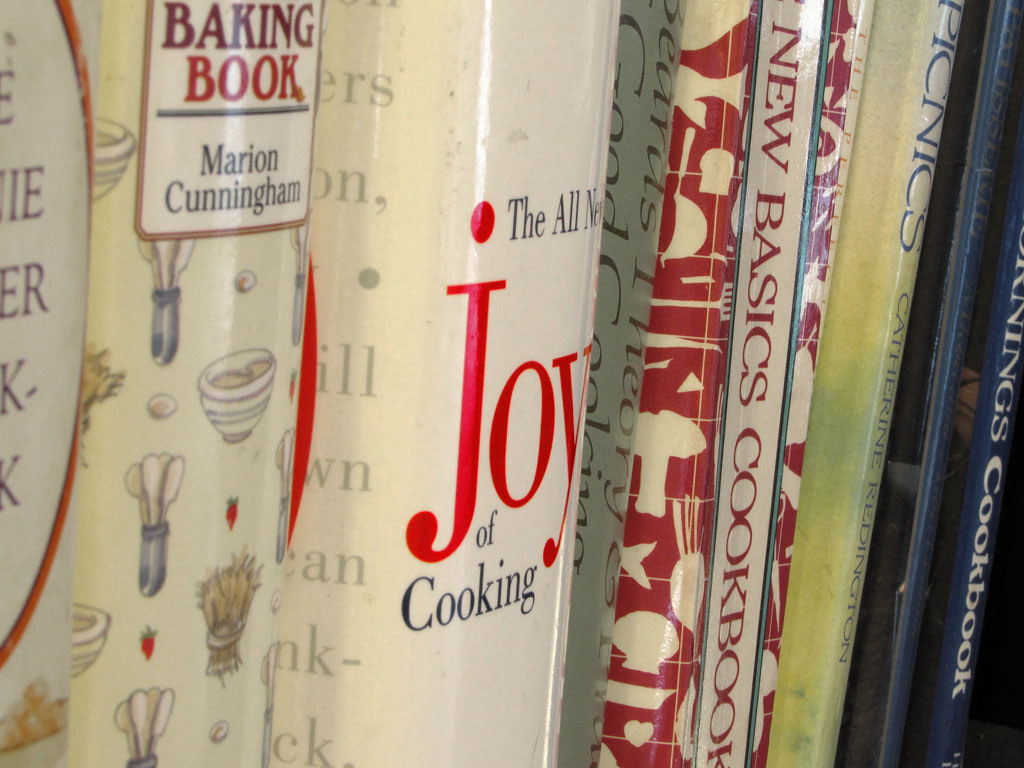
“The Joy of Cookbooks” by shoutabyss is licensed under CC BY 2.0

As in many other things, the population has divided into two: those with increasingly refined tastes in gastronomy, and those who eat mainly junk and takeaway food for the quickest but also crudest possible gratification.
Gastronomy often seems the only aesthetic sphere in which the modern British display any real interest. Their dress, their music, their art (or at least such as gains any publicity), their literature, and of course their architecture, are hideously ugly, even militantly so, but a Michelin-starred restaurant receives their adulation — or did in the now-distant days when restaurants were open.
But the modern interest in food is not the same as a mass market for fish, which has, alas, mainly to be cooked, and the fact is that the British are, grosso modo, too lazy and ignorant to cook properly. Many millions of them would be horrified by the sight of a whole fish, or even any part of a raw fish: they don’t want to eat anything that hasn’t been through a complex industrial process, had chemicals and preservatives added to it, and cannot be just stuck in a microwave for a few minutes before consumption in front of the television. Besides, they wouldn’t know what to do with a fish, let alone a crustacean.
It is said that about a fifth of British children do not eat a meal with another member of their household (family would, perhaps, be a misleading term) more than once a fortnight, turning meals into asocial and even furtive occasions. Many households do not have a dining table, and in my visiting days as a doctor I discovered that the microwave is often a household’s entire batterie de cuisine.
This slovenly and asocial approach to eating — evident in the detritus left behind in British streets as people eat wherever they happen to be, in their cars, walking along, in trains and buses, in fact anywhere but a dining room and with others — is not the consequence of poverty, but of a degraded style of life.
Many years ago I noticed that shops in poor areas where there were many immigrants of Indian origin had enormous piles of a vast array of vegetables so cheap that the problem was carrying them home rather than their cost. I would see Indian housewives selecting their purchases with care and attention: the quality and not just the price mattered to them. Uncompelled by economic necessity to shop there, I would nevertheless do so; but I never saw poor whites doing so. The problem with all those vegetables was that they required cooking, preferably with skill, which very few poor whites, as against poor Indians, had. And this is a cultural problem, if the taste for and consumption of a diet of junk food (what the French more vividly call malbouffe) is a problem.
The Indians are fat, with bad health consequences, from eating too much good food; the native British, with bad health consequences, from eating too much bad food. The prevalence of obesity in Britain, greater than in most other European countries, is possibly one of the reasons that its death rate from COVID-19 is so high, among the highest if not actually the highest. And this obesity is immediately obvious on arrival in Britain from any European country.
March 11, 2021
Women’s Vote Leads to Bolshevism and Welfare | B2W: ZEITGEIST! I E.13 – Harvest 1921
TimeGhost History
Published 10 Mar 2021This season not only marks the birth of the American welfare state, but it will also see women make great strides towards universal suffrage. But as you can imagine, none of these things come without significant opposition.
Join us on Patreon: https://www.patreon.com/TimeGhostHistory
Hosted by: Indy Neidell
Written by: Francis van Berkel
Director: Astrid Deinhard
Producers: Astrid Deinhard and Spartacus Olsson
Executive Producers: Astrid Deinhard, Indy Neidell, Spartacus Olsson, Bodo Rittenauer
Creative Producer: Maria Kyhle
Post-Production Director: Wieke Kapteijns
Research by: Francis van Berkel
Edited by: Michał Zbojna
Sound design: Marek KamińskiColorizations:
Daniel Weiss – https://www.facebook.com/TheYankeeCol…
Mikołaj Uchman
KlimbimSources:
Some images from the Library of CongressIcons from The Noun Project:
Birth by Adrien Coquet
dead by AomAm
mother by Fahmihorizon
United States Capitol by József Balázs-Hegedüs
noun_House of Representatives
House of Representatives Full by Sarah LawrenceSoundtracks from Epidemic Sound:
“Epic Adventure Theme 3” – Håkan Eriksson
“You’re Trouble” – Rich in Rags
“I’d Rather Be Alone” – Franz Gordon
“Redefine” – Megan Wofford
“Age Of Men” – Jo WandriniArchive by Screenocean/Reuters https://www.screenocean.com.
A TimeGhost chronological documentary produced by OnLion Entertainment GmbH.
From the comments:
TimeGhost History
2 days ago
America has so far been a pretty big topic in this season, and it again takes center stage in this episode. Considering its monumental role in twentieth-century history, this is only natural. Still, we like to give an international history as possible, so it’s exciting to also introduce Sweden here. It is a small country but historically significant for a number of reasons. It is a pioneer in social democracy, a country that has consistently stayed neutral in world affairs since 1814, and last but not least, the home of Indy Neidell.
March 6, 2021
Vaccinations and Communist Famine | B2W: ZEITGEIST! I E.12 – Summer1921
TimeGhost History
Published 5 Mar 2021This season there is a major breakthrough in combatting one of humanity’s oldest diseases, but a deadly famine also strikes Soviet Russia. Will the international community come to the fledgling state’s aid?
Join us on Patreon: https://www.patreon.com/TimeGhostHistory
Hosted by: Indy Neidell
Written by: Francis van Berkel
Director: Astrid Deinhard
Producers: Astrid Deinhard and Spartacus Olsson
Executive Producers: Astrid Deinhard, Indy Neidell, Spartacus Olsson, Bodo Rittenauer
Creative Producer: Maria Kyhle
Post-Production Director: Wieke Kapteijns
Research by: Francis van Berkel
Image Research by: Daniel Weiss
Edited by: Daniel Weiss
Sound design: Marek KamińskiColorizations:
– Daniel Weiss – https://www.facebook.com/TheYankeeCol…Sources:
Some images from the Library of Congress
Albert Calmette. Photograph, 1930. Credit: Wellcome Collection
World health : the magazine of the World Health Organization Credit: Wellcome Collection Hannokarlhuber https://www.hanno-karlhuber.at/galeri…
https://wellcomeimages.org/indexplus/…
art of Atlit-Yam from Hanay
Photo by J P Davidson https://flickr.com/photos/50616401@N0…From the Noun Project:
– people by Gregor Cresnar
– Earth by RF_Design
– sick By Adrien Coquet, FR
– Man by Milinda CoureySoundtracks from Epidemic Sound and ODJB
– “One More for the Road” – Golden Age Radio
– “Not Safe Yet” – Gunnar Johnsen
– “The Inspector 4” – Johannes Bornlöf
– “Guilty Shadows 4” – Andreas Jamsheree
– “Dark Shadow” – Etienne Roussel
– “Brighter Days Will Come” – Oakwood Station
– “Just Like Old Times” – Jackie MartinArchive by Screenocean/Reuters https://www.screenocean.com.
A TimeGhost chronological documentary produced by OnLion Entertainment GmbH.
From the comments:
TimeGhost History
3 days ago
As usual this episode sees the balance of dark and light that is so typical of the interwar period. Famine in Russia and the first fast-food chain in America; the turning of the tide against TB and tragic Hollywood scandal.So a mixture of serious and fun. Regular viewers will know that our comment section is the same, running from intense debate to long-running memes. In this episode Indy mentions the first ice-cream candy bar, so to encourage things to stay on the light-hearted side why don’t you comment below telling us what’s your favourite candy bar or fast-food joint?
March 3, 2021
Gen Z is suffering … but not enough?
In Quillette, Freya India considers the plight many of her cohort find themselves in during the ongoing efforts to combat the spread of the Wuhan Coronavirus (aka Covid-19):

“Gen Z” by EpicTop10.com is licensed under CC BY 2.0
My generation is miserable. Gen Z, those of us born after 1997, are the saddest, loneliest, and most mentally fragile age group to date, cursed with rising rates of anxiety, depression, and suicide. How can that be? How can a generation with everything feel so desperately unhappy? By almost every metric, human life is dramatically better today than it ever has been. The number of people living in extreme poverty has fallen from around 90 percent in 1820 to just 10 percent in 2015, while rates of illiteracy, mortality, and battle deaths are also in rapid decline. For the most part, Gen Z are heirs to an immense fortune: a utopian world of instant gratification and technological dynamism. In theory, this should be the age of happiness.
And yet, misery abounds. In the United States, 54 percent of Gen Z report anxiety and nervousness, according to researchers at the American Psychological Association. This is compared with only 40 percent of millennials and a national average of 34 percent. It isn’t just a case of self-report bias either, since the suicide rate for Americans aged between 15 and 24 has risen by over 51 percent in the last decade. For Gen Z women in particular, suicide rates have risen a staggering 87 percent since 2007. In my home country of the UK, one in four girls is clinically depressed by the time they are 14.
There’s no shortage of articles trying to make sense of the mental health epidemic at a time of such global prosperity. Teens and pre-teens today, we’re told, are simply interred beneath the weight of political issues like climate change, immigration, and sexual assault, as well as fatigued by job stress, exam burnout, and the attainment of unrealistic social media standards. The antidote, many suggest, lies in practicing better “self-care,” from daily gratitude journaling to adopting a 38-step skincare routine. And it’s a popular remedy. Since the pandemic began, online searches for “self-care” have risen 250 percent, with schools, universities, and employers turning to compulsory wellness programmes like mindfulness training and meditation sessions to improve mental health.
But, I suspect the problem is more nuanced than this. I don’t doubt that Gen Z is under a lot of strain, but I also think our plight is unique. For the first time in history, much of our misery stems not from too much suffering, but from not suffering enough. Gen Z does face real problems. I have certainly felt beleaguered by the pressures of social media, an oversaturated job market and the impact of coronavirus restrictions on my education. On top of that, there’s the difficulty of simply trying to exist as a fallible human in a political climate which demands infallibility, where nothing feels light-hearted anymore, and everything we say or do in our youth is stained onto the Internet for all time.
So, pressure is no doubt part of it. But previous generations faced egregiously difficult times: world wars, pandemics, economic crises, political rebellions, totalitarian regimes, and conditions of extreme poverty. Not only that, but today there are a wider range of mental health services available than ever before, and Gen Z are more likely than any other generation to seek treatment. So, for our rates of mental illness and suicide to be so high in a time of relative peace, there must exist a more convincing explanation than simply the asperities of life.
What lurks over my generation is not just a sense of misery, but meaninglessness. We exist in a state of lethargy and unfulfillment, tormented not by the tragedy of it all, but the futility. This is a point most articles and public figures today are less willing to discuss. But, to examine this possibility isn’t to say that Gen Z never struggle — but to suggest that at least some of us are caught in a rut of boredom, not burnout.
February 16, 2021
QotD: Homo electronicus and the falling murder rate
If you don’t feel like going all Thoreau, you can test the effect by simply writing your comments to this post out longhand, and then waiting an hour before typing them up. I bet you’ll find it mildly annoying no matter what, but if you’ve really got some thoughts on this matter, by then end of the hour you’ll be something close to furious. You’ve been rewired, comrade. You’re homo electronicus. We all are.
This stuff is recent — really recent. There was a limit to how screen-addled even the infamous “latchkey kids” of the 1980s could be. I had “latchkey kid” buddies, and although we had everything we needed to veg out in front of the tube in the very best Gen Z style — video games, sugary snacks, cable — we couldn’t sit and play Atari all day. I don’t mean that we didn’t; we were no smarter than any other boys; we sure as hell didn’t do anything for our health. I mean we couldn’t. Playing video games gave us ants in the pants — my Mom always knew when I’d been over at Steve’s — and eventually it got to the point where we had to put the joystick down and go throw around a football or something.
These days, the inability to play Nintendo for hours on end means you’ve got ADHD. Pass the Ritalin.
Three things made homo electronicus:
- modern medicine
- instant communications
- permanent caloric surplus.
Ritalin is actually one of the more benign examples. Back in the days when we were allowed to notice such things, a certain kind of social critic pointed out that falling murder rates have very little to do with crime reduction. Instead, it’s almost all attributable to advances in emergency medicine. It’s much tougher for Shitavious to kill D’L’eondrae over a pair of sneakers these days. The ER docs patch the victim up, and so what would’ve been murder one is now mere ADW, which means — Soros-funded DAs being what they are — both victim and perp are soon back on the streets, ready for round two. This idiot rapper, for instance, survived being shot nine times. That’s not nine separate shootings, mind you, that’s nine slugs in one incident. Granted the slipshod motherfuckers who capped him need to work on their aim, but surviving even nine flesh wounds from modern firearms is one hell of a testimony to the power of modern medicine …
… a power that does not, I suggest, conduce to positive eugenic outcomes.
Severian, “Recent Evolution”, Rotten Chestnuts, 2020-09-28.


