Quotulatiousness

November 3, 2019

Colby Cosh on the origins of carbon taxes

Filed under: Economics, Environment, Government — Tags: , , , , — Nicholas @ 05:00

In response to a column by Andrew Coyne in the National Post, Colby Cosh outlines the intellectual origins of carbon pricing:

As Andrew knows, the intellectual origins of carbon pricing are purely classical-liberal. Maybe you have to belong to our club to spot that he has carefully not called it an invention of the “left.” When I was an undergraduate, it was the unfashionable libertarian and Hayekian zanies, not the despondent post-Cold-War Marxists, who were preaching what would become mainstream environmental economics. The left has been slow rather than fast to accept the idea of putting a mere price on what they regard as an inherent evil.

British economist Arthur C. Pigou (1877-1959).
Photo via Wikimedia Commons.

All of the foundations of carbon pricing were developed by economists that the left, in all varieties, now regards as cartoonish modern-day demonoids. The gentle Arthur Pigou, who developed the concept of economic externalities and the idea of taxing them, might still pass muster. But Pigou’s reformer-reviser Ronald Coase is deeply suspect, having pioneered an amoral analysis of externalities that tackles social-cost problems like environmental pollution without assigning blame to, or even necessarily acting against, the polluters.

In his paragraph Andrew almost explicitly outlines the theory of the “double dividend” from replacing bad, economically distorting taxes (like the one we impose on incomes) with taxes laid directly on externalities like carbon. The double dividend is pure Gordon Tullock, who is now a hate figure on the left for his role in creating public choice economics.

You can see that this analysis gets pretty complicated in a hurry. The idea of carbon taxation isn’t really of the right or the left. The best term for it might be “neoliberal,” although some people think there is no useful place for that word. To the degree that the left has accepted carbon pricing, they have done so as a (perhaps mostly unwitting) compromise with otherwise abominable thinkers like Coase and Tullock. Total state command-and-control of the economy isn’t an option in today’s Western world, and since there’s a neo-Malthusian crisis in the atmosphere around us, we had better try to solve it without having to execute a global socialist revolution first.

But if instinctive suspicion of the state is a feature of the conservative mind, carbon pricing doesn’t solve the problem completely. Canadian carbon tax designs have been given redistributive features, which makes them more acceptable politically to people who aren’t instinctive or innate conservatives, but creates confusion and distaste for those who are. And to the degree conservatives are inclined to doubt that the state will cut other taxes to make carbon prices revenue-neutral, they have been partly justified, so far, by the history of Alberta and B.C. The “double dividend” is a good idea: can governments be trusted to actually let us collect it?

In a nutshell, that lack of trust is why I’m generally opposed to the federal carbon tax system, even though the idea of carbon taxes (when properly implemented) are far less distorting to the economy than the hodge-podge of taxes and regulations we have now.

October 30, 2019

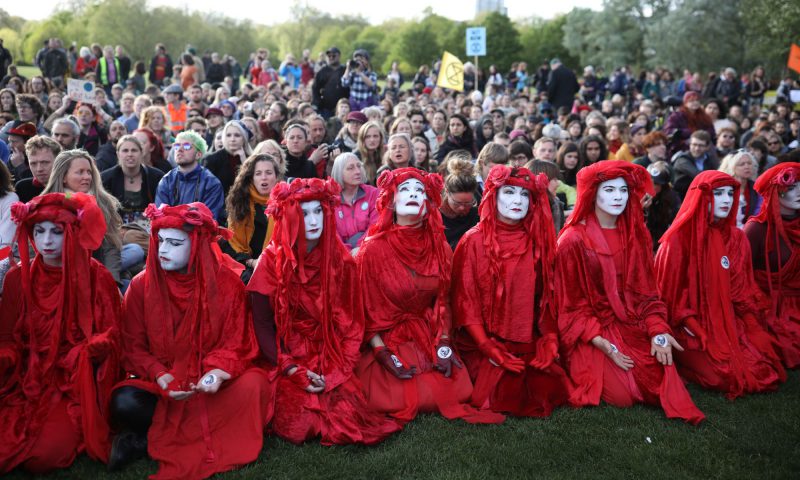
In case it wasn’t already obvious – “Extinction Rebellion isn’t about the climate”

One of the self-described founders of Extinction Rebellion takes to Medium to explain what the organization’s real goals are:

I’ve been with Extinction Rebellion (XR) from the start. I was one of the 15 people in April 2018 who came together and made the collective decision to try to create the conditions that would initiate a rebellion. I was a coordinator of one of the original five working groups, and I’ve been organising with XR day-and-night since then (frugally living off my savings so I don’t have to work, having quit an industry that paid me £1000/week). And I’ve been in RisingUp (the organisation from which XR has emerged) since the first RisingUp action in November 2016. I’m a RisingUp Holding Group member, and a member of the XR Guardianship Team.

And for the sake of transparency: that previous paragraph is all about me “pulling rank” — I’m trying to convince you to listen to what I have to say …

And I’m here to say that XR isn’t about the climate. You see, the climate’s breakdown is a symptom of a toxic system of that has infected the ways we relate to each other as humans and to all life. This was exacerbated when European “civilisation” was spread around the globe through cruelty and violence (especially) over the last 600 years of colonialism, although the roots of the infections go much further back.

[…]

So Extinction Rebellion isn’t about the climate. It’s not even about “climate justice”, although that is also important. If we only talk about the climate, we’re missing the deeper problems plaguing our culture. And if we don’t excise the cause of the infection, we can never hope to heal from it.

This article is calling to all of those who are involved in XR who sometimes slip into saying it’s a climate movement. It’s a call to the American rebels who made a banner saying “CLIMATE extinction rebellion”. It’s a call to the XR Media & Messaging teams to never get sloppy with the messaging and “reduce” it to climate issues. It’s a call to the XR community to never say we’re a climate movement. Because we’re not. We’re a Rebellion. And we’re rebelling to highlight and heal from the insanity that is leading to our extinction. Now tell the truth and act like it.

October 23, 2019

QotD: Climbing Maslow’s Pyramid again

Filed under: Britain, Environment, Food, Quotations — Tags: , , — Nicholas @ 01:00

[Commenting on a story about the re-introduction of heritage apples to the British market through the work of the wildlife charity People’s Trust for Endangered Species.]

If people want little orchards of native (well, you know) apples then people should have little orchards of native apples. As long as, of course, they’re creating and maintaining those little orchards of native apples at their own expense. This is, after all, what liberalism means, that the peeps get to do what the peeps want. And if we’re to add some Burkean conservatism so that it’s the little platoons sorting it out for themselves then all the better.

As long as no one is being forced to pay for this through taxation then what could possibly be the problem?

At another level this is climbing Maslow’s Pyramid again. At one level of income we’ll take fruit in the only way we can, seasonally and in a limited manner. We get richer, technology advances, we can have apples year round – but that does mean trade, commercially sized operations and the inevitable limited selection. We get richer again and now we’ve more than sufficiency, let’s have that variety back again.

After all, it’s not as if we’re not seeing this right across the food chain, is it?

That roast beef of Olde Englande was most certainly better than the bully beef from Argentina or the Fray Bentos pie. As is the best grass fed British beef of today. But we moved through the cycle to get from most not being able to eat any beef, to all being able to have bad beef, to now again thinking more about the quality – we have a more than sufficiency of beef and can be picky about it.

Tim Worstall, “I fully approve of this”, Tim Worstall, 2017-10-22.

October 20, 2019

Disruptive, theatrical “protests” are coming to the end of their usefulness

Filed under: Britain, Environment, Politics — Tags: , , , — Nicholas @ 03:00

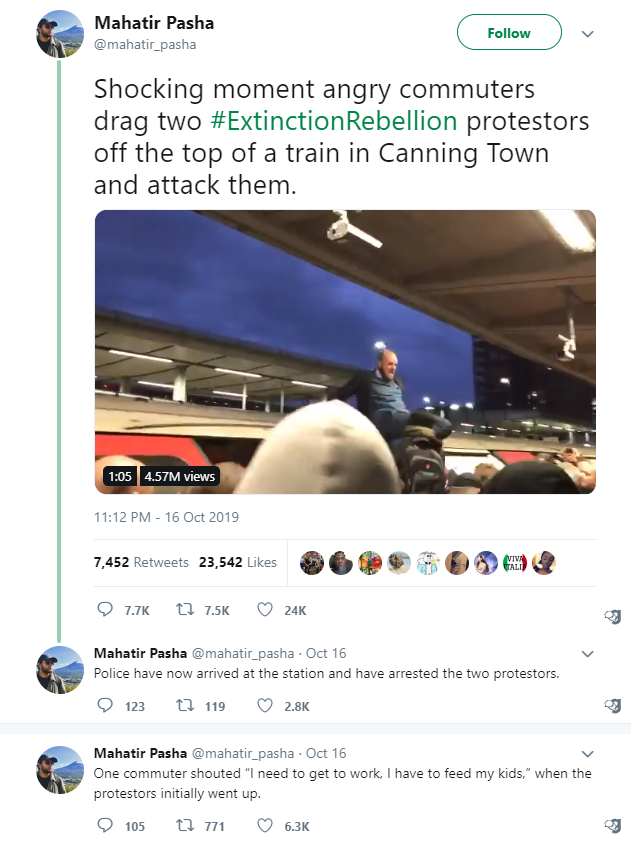
As I’ve said in comments on a few posts at other sites, the people who stage “protests” that block access to roads, railway stations, public buildings, and hospitals depend on the reactions of the people being mild, civilized, calm, and peaceful. But the more often these sorts of antics are performed, the thinner that veneer of civilization gets worn. At some point, and sooner than the organizers may realize, the veneer is gone and instead of peaceful commuters you’re disrupting, it’s a mob … and mobs don’t obey civilized rules like “thou shalt not kill”:

Those two were lucky that there was still some restraint being felt by the commuters. But it’s a clear warning sign that may not be attended to:

Extinction Rebellion, though it professes to be anti-Establishment, embodies the left-liberal values of the current Establishment hegemony.

That]s why rarely, if ever, will you hear anyone in government criticising Extinction Rebellion’s ideology, only its methods.

Then again, as one Conservative Brexiteer once told me, you can only fight a war on so many fronts. “Of course I know the whole climate change thing is bollocks,” he said – or words to that effect. “But I can only marshal my forces for one major battle at a time and that battle right now is Brexit.”

That’s how politicians have to think, it’s the nature of politics. Even the great Donald Trump has to play by these rules: look, for example, at how he has chickened out of having a red-team/blue-team scientific debate on global warming.

Happily, though, ordinary people are not constrained by such rules. There comes a point where they simply say to themselves:

    “Sod this for a game of soldiers. I really don’t care whether what I’m about to do is wise or expedient or even legal, come to that. I’m just sick to the back teeth of what’s happening to my country. It’s wrong. It feels wrong. And if the system that is supposed to look after the interests of decent, law-abiding, productive citizens will no long protect the interests of decent, law-abiding, productive citizens then I guess I’ll have to take the law into my own hands.”

Which is exactly what happened at Canning Town Station in the East of London this week.

For months, on and off, Extinction Rebellion activists have been playing havoc with the lives of ordinary people who thought the law was supposed to protect them and their livelihoods from the kind of direct action that Extinction Rebellion and its apologists keep reassuring us is peaceful and in our best interests.

Grudging tolerance has gradually given way to a simmering sense of injustice: “How can it be”, ordinary folk have started to wonder, “that these privileged wanktards with their pointless degrees in Environmental Sciences and Advanced Poi are free to build pyramids at Oxford Circus and block Westminster Bridge when if I tried it I’d get myself chucked in jail?”

That simmering sense of injustice is now erupting into acts of rebellion — real rebellion, not Extinction Rebellion’s state-protected faux-rebellion — like the one in Canning Town Station.

Something very similar is happening with people’s feelings about Brexit: “How can it be right that we live in democracy which refuses to honour a popular vote? Surely honouring a popular vote is the most basic requirement. And if it doesn’t do that, then democracy has failed and we need to start looking at other ways of making our feelings known.”

October 12, 2019

To the amazement of the chattering classes, Greta didn’t win the Nobel

Filed under: Africa, Environment, Europe, Media — Tags: , , — Nicholas @ 03:00

Teen apocalypse prophet Greta Thunberg not only had her childhood stolen from her, now they’ve stolen her Nobel Prize:

Greta Thunberg at the EU Parliament, 16 April, 2019.
European Parliament photo via Wikimedia Commons.

It seems like Ethiopian Prime Minister Abiy Ahmed Ali stole even more of Greta Thunberg’s childhood by winning this year’s Nobel Peace Prize, beating the 16-year old Swedish Apocalyptic who seemed to have been the sentimental favourite of the international chattering classes (and the betting site Ladbrokes) for her figureheading of Climate Strikes and her recent appearance at the [United Nations] where she shouted at the adults for killing the planet. Ali was awarded the prize for ending the twenty-year conflict with the neighbouring Eritrea (once a part of Ethiopia) and the general moves to liberalise what has been a rather unappealing regime. In other words, Prime Minister Ali got his Peace Prize for actually bringing peace. Radical, eh?

Interestingly, Ali has not only done more for peace than Thunberg (it’s perhaps not a great claim to fame to have beaten a 16-year old girl, but hey, her cheerleaders in the media and elsewhere have turned her into a cross between a saint and a savant); he has also done far more for the environment. While Thunberg and millions of others wagged school and work and sat on their asses to save the Earth, Ali and millions of his compatriots got off theirs to do something quite spectacular recently:

    Ethiopians planted more than 350,000,000 trees* in just 12 hours on Monday [29 July], the country’s minister of innovation and technology announced on Twitter. The mass-tree planting not only helps the environment, it sets a world record, the Associated Press reported.

    Prime Minister Abiy Ahmed created the initiative to help restore Ethiopia’s landscape, which experts say is being eroded by deforestation and climate change, the AP reported.

    The country’s goal was to plant 200 million trees in one day. But Getahun Mekuria, Ethiopia’s Minister of Innovation and Technology, later announced that 353,633,660 trees were planted.

    Ethiopia has a larger goal of planting 4 billion trees between May and October 2019. So far, more than 2.6 billion trees have been planted in almost all parts of the country, the AP reported.

Planting trees is one of the most effective ways of removing CO2 from the atmosphere, which the trees (and all other plants) do through the process of photosynthesis as they grow. In fact, half the weight of a tree is carbon. Statistics vary between countries (and climates, soil conditions, etc), but a hectare of wood in the United States has some 118 tons of carbon, while in Europe the figure is 177 tons (density of trees can also, of course, vary widely but the plantation average is 1000-2500 per hectare). By the way, one tonne of carbon accounts for 3.67 tonnes of carbon dioxide, with oxygen being released back into the atmosphere.

October 8, 2019

Extinction Rebellion – “an upper-middle-class death cult”

Filed under: Britain, Environment, Politics — Tags: , , , , , — Nicholas @ 05:00

Brendan O’Neill watched a death cult hold one of their ceremonies in public on the streets of London the other day:

This was, of course, Extinction Rebellion. Let us no longer beat around the bush about these people. This is an upper-middle-class death cult.

This is a millenarian movement that might speak of science, but which is driven by sheer irrationalism. By fear, moral exhaustion and misanthropy. This is the deflated, self-loathing bourgeoisie coming together to project their own psycho-social hang-ups on to society at large. They must be criticised and ridiculed out of existence.

Yesterday’s gathering, like so many other Extinction Rebellion gatherings, was middle-aged and middle-class. The commuters heading in and out of King’s Cross looked upon them with bemusement. “Oh, it’s those Extinction freaks”, I heard one young man say. It had the feel of Hampstead and the Home Counties descending on a busy London spot to proselytise the cult of eco-alarmism to the brainwashed, commuting plebs.

It was a gathering to mark Extinction Rebellion’s week of disruption. The group is asking people in London and other cities around the world to “take two weeks off work” and join the revolt against the “climate and ecological crisis”. You can tell who they’re trying to appeal to. Working-class people and the poor of New Delhi, Mumbai and Cape Town – some of the cities in which Extinction Rebellion will be causing disruption – of course cannot afford to take two weeks off work. But then, these protests aren’t for those people. In fact, they’re against those people.

Extinction Rebellion is a reactionary, regressive and elitist movement whose aim is to impose the most disturbing form of austerity imaginable on people across the world. One of the great ironies of “progressive” politics today is that people of a leftist persuasion will say it is borderline fascism if the Tory government closes down a library in Wolverhampton, but then they will cheer this eco-death cult when it demands a virtual halt to economic growth with not a single thought for the devastating, immiserating and outright lethal impact such a course of action would have on the working and struggling peoples of the world.

Extinction Rebellion says mankind is doomed if we do not cut carbon emissions to Net Zero by 2025. That’s six years’ time. Think about it: they want us to halt a vast array of human activity that produces carbon. All that Australian digging for coal; all those Chinese factories employing millions of people and producing billions of things used by people around the world; all those jobs in the UK in the fossil-fuel industries; all those coal-fired power stations; all that flying; all that driving … cut it all back, rein it in, stop it. And the people who rely on these things for their work and their food and their warmth? Screw them. They’re only humans. Horrible, destructive, stupid humans.

The Toronto chapter of the death cult shut down one of the major bridges across the Don Valley on Monday morning:

Just in time for rush hour on Monday morning, hundreds of climate change activists have barricaded themselves across a major four-lane bridge in the heart of Canada’s largest city.

Extinction Rebellion (XR) Toronto, the local arm of an environmental protest group with demonstrations taking place across the world today, shut down traffic on the Prince Edward Viaduct between Bloor Street and Danforth Avenue around 8 a.m. on Monday morning.

Members of the group formed blockages on both sides of the truss bridge with their bodies and props, including a larger-than-life set of letters reading “ACT NOW.”

October 5, 2019

Losing our religion

Filed under: Economics, Environment, Religion — Tags: , — Nicholas @ 03:00

Arthur Chrenkoff found another report on the inverse relationship between development and religious belief:

A few weeks ago I wrote a longish blog post arguing that for many people in the developed world environmentalism has become a religion, filling up the gap in spirituality left by the decline of Christianity. I don’t claim any originality or new insight in this observation; it has been noted many times before, including by my friend, former artilleryman and now man of God, Rev Donald Sensing, and it has made an appearance quite a few times subsequent to my piece, a propos Greta Thunberg’s performance at the United Nations and the reaction it inspired around the (developed) world.

Today, I chanced upon another interesting analysis by Pew Research Center, about religious belief and commitment around the world. Results are not surprising but are nevertheless interesting, including this world map:

Unfortunately, Pew does not provide additional data on those for whom religion might be “important” or “somewhat important” so as to paint a slightly fuller picture of religious sentiment, but the results illustrated above are probably quite indicative. The developed world is well and truly secular now, with the United States and Greece being the only outliers (and by a long mile), while most of the developing world (with the notable exception of China after seven decades of communism) remains extremely religious. Thus, Pew notes that “if current trends continue, countries with high levels of religious affiliation will grow fastest. The same is true for levels of religious commitment: The fastest population growth appears to be occurring in countries where many people say religion is very important in their lives.”

As the main topic of this Pew study is the age gap in religious faith around the world, it should be noted that the younger generations in the developed world are even less religious than their elders, often significantly less, putting the already low rates across the West in an even starker perspective (by contrast, throughout most of the developing world, there is little, if any, gap in religious commitment between the young and the old).

October 4, 2019

“Economics is … the science of not being able to have your cake and eat it”

Filed under: Economics, Environment, Health — Tags: , , , — Nicholas @ 05:00

Philip Booth on Greta Thunberg’s message and its economic over-simplifications:

In many senses, economic problems are more complex than scientific problems and Thunberg is, implicitly at least, pronouncing on economic matters. Whilst knowledge about climate science is uncertain, a judgement has to be and can be made on the balance of evidence. But economic decisions involve trade-offs. Economics is, as Lionel Robbins put it, the science of not being able to have your cake and eat it. We cannot both decrease carbon emissions hugely and enjoy standards of living increasing at the rate that would have been possible if emissions were not reduced.

It is tempting the believe the green rhetoric that we will all have fluffy green jobs and a green standard of living without any hardship from reducing emissions. We cannot. Reducing carbon emissions quickly to zero means that we will have much less of everything else. We might prefer decarbonisation to other goods and services, but it is not a cost-free choice. We considering this, we should remember that the average income in the UK is ten times the average income in the rest of the world. When other people face these trade-offs the sacrifice of decarbonisation is that much greater.

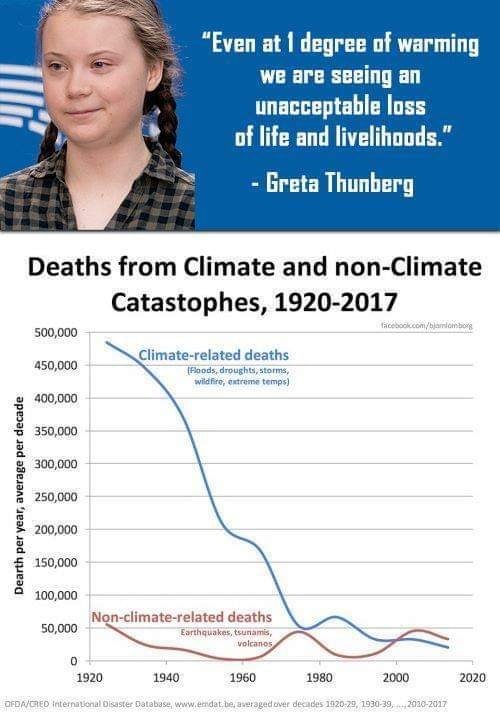
One of the advantages of being richer is that we are more resilient to natural disasters. It follows from this that there is a trade-off between decarbonisation, which might lead to fewer natural disasters, and our ability to cope with them, which might reduce if we become less rich. As we have become richer, deaths from natural disasters have plummeted. The figure shows the fall in deaths in natural disasters over the last century – they have reduced by, perhaps, 90 per cent.

The use of air conditioning illustrates this trade-off in a rather stark way. In a letter on the environment written by Pope Francis in 2015 called Laudato si, the pontiff strongly criticised the adoption of air conditioning in the strongest terms. An academic paper on air conditioning in the US produced such remarkable results that the abstract is worth quoting at length:

    “the mortality effect of an extremely hot day declined by about 80% between 1900-1959 and 1960-2004. As a consequence, days with temperatures exceeding 90°F were responsible for about 600 premature fatalities annually in the 1960-2004 period, compared to the approximately 3,600 premature fatalities that would have occurred if the temperature-mortality relationship from before 1960 still prevailed. Second, the adoption of residential air conditioning (AC) explains essentially the entire decline in the temperature-mortality relationship. In contrast, increased access to electricity and health care seem not to affect mortality on extremely hot days.”

Air conditioning leads to higher carbon emissions and, most likely, higher global temperatures. But the increase in resilience arising from air conditioning is astonishing – it has led to an 80 per cent drop in deaths from heat.

September 27, 2019

QotD: Environmental cultists

There are a million examples, but since climate hysteria is briefly back in the news let’s go with that. That Greta Thunberg freak might not know it — she is, after all, a product of modern “education” — but anyone old enough to remember the early 2000s has heard her spiel before. Al Gore kept telling us that the world would end by 2012 or something; he made a movie about it and everything. Hell, several generations of Americans have heard this nonsense before, going all the way back to the original Earth Day in 1970.

Of course, back then it was global cooling that was going to kill us all, and do you see what I mean about True Believers? The very same people who were convinced that we were all gonna die in a new Ice Age in 1970 were certain we’d die of melted polar ice caps in 2006, just as they’re now positive we’re going to get killed by … whatever it is Thunberg is hectoring the UN about. Normal folks’ skulls would’ve exploded from cognitive dissonance, but the eco-freaks don’t suffer from cognitive dissonance. Because, for them, it never rises to the level of cognition in the first place. If “pulling a U-turn on your deepest convictions” is what it takes to stay in the group, well, start peeling rubber. The cult’s leadership will come up with a retcon in due time.

Two interesting effects flow from this. The first is the growing disconnect between the cult’s leadership and the True Believers. A cult with a big enough membership roster stops being a cult and becomes a movement. Movements beget organizations, which by universal law attract grifters, with predictable-as-sunrise consequences. E.g. Christianity. Back in the mid-first century, Christians were sure that Christ would return in their lifetimes — after all, He said so Himself. His comeback tour kept getting postponed, though, and these days you can be the leader of a major Christian denomination without ever bothering with that “Jesus” guy, much less any of the stuff He said.

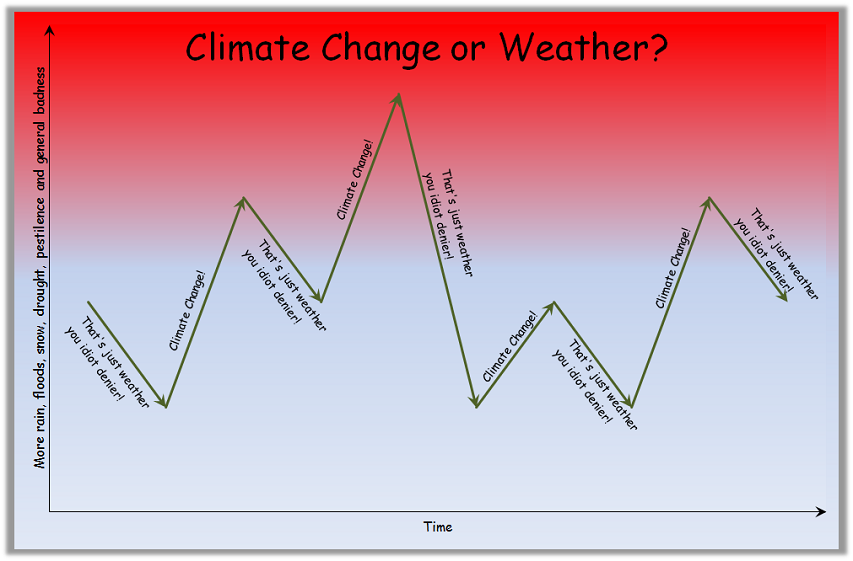
This is why “global cooling” became “global warming,” which is now “global climate change.” We cognitively-normal folks assume that the eco-freaks keep changing the name to avoid cognitive dissonance. After all, the climate “changes” every day — we call it “weather,” but if you’re looking for evidence that your crackpot eco-doom theories are correct, well, just look at how much the temperature varies from noon to midnight!! But see above: Cognitive dissonance is actually a boon to the eco-freaks, because in cult psychology, disconfirmations prove that you were right all along. The eco-freaks would still trot goofy Greta Thunberg out there no matter what it’s called, and she, poor deluded little sod, would keep on doing her thing, because she’s in the cult. So: They, the eco-freaks, didn’t come up with “climate change;” the grifters in charge of Climate Shakedown Inc. did.

Severian, “What Happens if the UFO Actually Comes?”, Rotten Chestnuts, 2019-09-25.

September 25, 2019

The Children’s Crusade against Carbon

Filed under: Environment, Politics — Tags: , , , , — Nicholas @ 03:00

Arthur Chrenkoff explains why political movements treasure and actively seek out the youth:

Illustration of the Children’s Crusade from Tales from far and near : history stories of other lands (1915).
York University Libraries via Wikimedia Commons.

It’s really a no-brainer. Revolutionary movements like communism and Nazism, which sought to overthrow the status quo and create a new society, have always placed huge importance on cultivating young following. I consider the green movement, particularly those sections of it that can be described as the Green religion, as a revolutionary movement too, because its main aim is to implement socialism under the pretense of saving the world from an environmental catastrophe.

There are several reasons why children and teenagers are so valued by utopian authoritarians:

1. As the cliché goes, children are the future. Invest in indoctrinating them now and your investment will last a lifetime, certainly outliving the less enthusiastic elders.

2. Children’s minds are more malleable and they are more impressionable, making them more receptive and accepting of your propaganda.

3. Peer group pressure helps to reinforce what the adults instill.

4. Children are (sorry children) ignorant and naive, having neither the sufficient education nor life experience that make adults more difficult to scare, persuade or bullshit into submission and belief.

5. Children have the energy and enthusiasm, which older people often lack.

6. Teenagers go through the proverbial rebellious stage, where they question their parents and other conventional sources of authority. This makes them very useful for the said revolutionary movements, whether fascist or socialist, which need to destroy the old, more conservative way of life so as to create a new social order according to their design.

September 24, 2019

More on the demands from the “climate strike” protests

Filed under: Environment, Politics — Tags: , , , — Nicholas @ 03:00

Arthur Chrenkoff on the far beyond pie-in-the-sky demands coming discordantly from the amorphous climate protest groups coalescing around poor Greta Thunberg and her “climate strike”:

Greta Thunberg at the EU Parliament, 16 April, 2019.
European Parliament photo via Wikimedia Commons.

Fighting “climate change” is a very broad umbrella. What does the Global Climate Strike actually stand for? Greta Thunberg’s (I jokingly referred to her as St Joan of Arc of the Children’s Crusade against Carbon, but the marchers in Paris did carry a poster of Thunberg as a saint) initiative does not offer any extensive manifestos or programs on its website, perhaps not unexpectedly for a child-centric project, but it does provide a brief answer to the question “What are you [as a participant asking for?”:

    The climate crisis is an emergency – we want everyone to start acting like it. We demand climate justice for everyone. Our hotter planet is already hurting millions of people. If we don’t act now to transition fairly and swiftly away from fossil fuels to 100% renewable energy for all, the injustice of the climate crisis will only get worse. We need to act right now to stop burning fossil fuels and ensure a rapid energy revolution with equity, reparations and climate justice at its heart [emphasis in the original].

It’s not much, but already more than a great majority of those taking part are probably aware of they were striking for.

It doesn’t help that some of the more outrageous claims are clearly not true:

What of the other aspects of the Global Climate Strike’s five-sentence program? What exactly is “climate justice”? And what the hell are the “reparations” in this context?

The Strike site doesn’t provide answers, but “climate justice” in the last sentence hyperlinks to the website for The People’s Demands for Climate Justice, which explains itself as “Collectively shaped by people’s movements around the world, these demands are an international statement rooted in southern movements, and with input from numerous climate justice organizations and people’s movements around the world. The People’s Demands lays out a vision for a truly just international climate policy. We must ensure the demands of people, not the fossil fuel industry and other Big Polluters, is what is centered in the lead up to and during COP24 in Poland this December, 2018.” (a case here for updating your website.) While the Global Climate Strike is neither a “convening” nor an “endorsing” organisation among the 403 groups who are, by linking it clearly subscribes to the People’s Demands’ vision. Some of which includes:

    Support global efforts for a just and equitable transition that enables energy democracy, creates new job opportunities, encourages distributed renewable energy, and protects workers and communities most affected by extractive economies …

    Adopt a technology framework that recognizes the importance of endogenous and indigenous technologies and innovations in addressing climate change, and enables developing countries and communities to develop, access, and transfer environmentally sound, socially acceptable, gender responsive and equitable climate technologies.

    Respect and enable non-corporate, community-led climate solutions that recognize the traditional knowledge, practices, wisdom, and resilience of indigenous peoples and local communities, and protect rights over their lands and territories …

    Developed countries must make new concrete pledges of public climate finance accompanied by a definite timeline for delivery.

    Commit to climate reparations to those most affected but least responsible for climate change.

In addition to fossil fuels, the People’s Demands are also against any market mechanisms to reduce emissions (like emission trading schemes), carbon offsets, carbon sequestration technologies, geoengineering and other “techno-fixes”, nuclear power, biofuels and use of biomass to generate energy, and large scale hydro projects – i.e. most of the potential solutions accepted by the serious mainstream climate change political-scientific consensus. This pretty much leaves only solar and wind, geothermal in a few lucky places (like Iceland, which is sitting on top of volcanoes) and small scale hydro to power the entire world post 2030. In other words, a complete fantasy world of green Luddites.

September 23, 2019

The “Global Climate Strike”

The big “let’s all play hooky from school” event’s Toronto organizers have been getting positive coverage from some of the local media, because of course they have. Here’s Tanya Mok for BlogTO, listing the totally reasonable and not in any way unrealistic “demands” of the movement:

FridaysForFuture Demonstration, 25 January 2018 in Berlin.
Photo by C. Suthorn via Wikimedia Commons.

The coalition has made a list of seven demands, which “reflect the rallying cries of the intersectional movements” they belong to. Some of those demands include:

  • Indigenous rights and sovereignty.
  • The protection of forests, land, and water sources.
  • A shift to publicly-owned renewable energy, and reducing national carbon emission by 65% by 203, reaching zero emissions by 2040.
  • A $15 minimum wage for all, and higher taxation on the rich.
  • Universal public services like health care and dental care, free university and college, housing as a human right, and free public transit.
  • Justice for migrants and refugees, allowing status for all. That includes putting an end to deportations and allowing for the full access to public services.

There will be a concert at Queen’s Park after the rally, as well as a follow-up benefit concert at the Tranzac Club in the evening. A giant street mural project run by Greenpeace will also be taking place prior to the rally, around 10 a.m., at the southern point of Queen’s Park.

September 17, 2019

“Clean” alternative energy sources are not free … in fact, they’re quite expensive

Filed under: Economics, Environment, Technology — Tags: , , , , — Nicholas @ 03:00

Earlier this month in Foreign Policy, Jason Hickel wrote about the requirements for expanding current renewable energy generation (wind and solar):

The phrase “clean energy” normally conjures up happy, innocent images of warm sunshine and fresh wind. But while sunshine and wind is obviously clean, the infrastructure we need to capture it is not. Far from it. The transition to renewables is going to require a dramatic increase in the extraction of metals and rare-earth minerals, with real ecological and social costs.

We need a rapid transition to renewables, yes — but scientists warn that we can’t keep growing energy use at existing rates. No energy is innocent. The only truly clean energy is less energy.

In 2017, the World Bank released a little-noticed report that offered the first comprehensive look at this question. It models the increase in material extraction that would be required to build enough solar and wind utilities to produce an annual output of about 7 terawatts of electricity by 2050. That’s enough to power roughly half of the global economy. By doubling the World Bank figures, we can estimate what it will take to get all the way to zero emissions — and the results are staggering: 34 million metric tons of copper, 40 million tons of lead, 50 million tons of zinc, 162 million tons of aluminum, and no less than 4.8 billion tons of iron.

In some cases, the transition to renewables will require a massive increase over existing levels of extraction. For neodymium — an essential element in wind turbines — extraction will need to rise by nearly 35 percent over current levels. Higher-end estimates reported by the World Bank suggest it could double.

The same is true of silver, which is critical to solar panels. Silver extraction will go up 38 percent and perhaps as much as 105 percent. Demand for indium, also essential to solar technology, will more than triple and could end up skyrocketing by 920 percent.

And then there are all the batteries we’re going to need for power storage. To keep energy flowing when the sun isn’t shining and the wind isn’t blowing will require enormous batteries at the grid level. This means 40 million tons of lithium — an eye-watering 2,700 percent increase over current levels of extraction.

That’s just for electricity. We also need to think about vehicles. This year, a group of leading British scientists submitted a letter to the U.K. Committee on Climate Change outlining their concerns about the ecological impact of electric cars. They agree, of course, that we need to end the sale and use of combustion engines. But they pointed out that unless consumption habits change, replacing the world’s projected fleet of 2 billion vehicles is going to require an explosive increase in mining: Global annual extraction of neodymium and dysprosium will go up by another 70 percent, annual extraction of copper will need to more than double, and cobalt will need to increase by a factor of almost four — all for the entire period from now to 2050.

Wind turbines require a lot of concrete to stabilize them on site (hundreds of tons of it), and that concrete is very carbon-intensive to create in the first place (nearly 930 Kg of CO2 per 1,000 Kg of cement), but even those huge turbine blades have a limited working lifespan and can’t be easily recycled into anything economically, so they generally end up in landfills.

September 16, 2019

QotD: If we’d been taken over by aliens, how would we know?

Filed under: Education, Environment, Quotations, USA — Tags: , , , , , — Nicholas @ 01:00

Look around you – if we in the West and we humans, in general, had been invaded by aliens, what would be different?

  • Our schools in America teach that the system under which America lives, from constitutional protections to (relatively … very relatively) free markets are evil and the cause of all evils in the world.
  • Our schools further teach that all the problems in the world at large are the fault of “Imperialists” to include not just America, but the West which is America’s mother culture. They ignore the sins of other nations, many of which, still today, commit female mutilation and slavery, to concentrate ONLY on the West and the sins of the West, thereby obviating any possible pride the students might have in their own culture.
  • Further, the schools, under the guise of environmentalism, promote the view that humanity is the worst plague on the planet. Without pointing out that any species can drive others to extinction, or that humans are the only species capable of self-regulating their impact on the environment, they concentrate on those extinctions humans have caused and fantasize that without humans the world would be a paradise.
  • Without pointing out the difficulty of global censuses or that in fact we don’t and can’t know how large the world population is, our learning institutions, our cultural institutions, even our entertainment continually scare us with the idea of overpopulation. Without taking into account that there are more trees now in North America than when the colonists arrived, they picture humanity as creating deserts. Schools push middle schoolers to sign agreements never to reproduce.
  • As if this weren’t enough, feminists picture women – in Western, well off, more or less equalitarian (at least before the law as it existed before feminist tampering made it take sides with women most of the time) systems – as perpetual victims, stoke a sense of outrage and anger at any and all males, and encourage women to consider normal intercourse “rape” and marriage a prison.
  • As if this weren’t enough, the insanity has descended to preaching that there is no such thing as biological sex, and that one’s gender is a sort of “mood” which can be determined before a child is even fully developed. Parents giving hormones to children, to change their sex before the age of reason (let alone physical or emotional maturity) and effectively encouraging castration/neutering and precluding future generations aren’t considered deranged abusers. In fact, educational and medical establishments will encourage parents to thus destroy their progeny and will take the children away if the parents don’t do it, on the flimsiest of pretexts based on stereotypes, such as a boy who disdains male toys, or a girl who doesn’t like dolls. The rich panoply of human expression is ignored in a – dare we say it – alien attempt to make individual people fit stereotypes.
  • Three generations into this, our leading lights in intellectual life, be it fiction, non-fiction, academia or even research, get plaudits and advancement ONLY from conclusions and policies that objectively hurt humans and prevent humans from reproducing. A subset of this is hate of the West, the most successful culture in the world, ever, in terms of extending life, preventing early death, preventing or curing disease and preventing and curing famine. Another and even more vociferous subset is the hatred of America, which took all of Western virtues and made them more so.

If aliens, hostile to the very idea of humanity and wanting to prevent us from prospering, let alone going into space (another cause that all so called “progressives” hate with a burning passion and try to prevent by all means possible, from telling us that there is still need on Earth so we shouldn’t spend money on going to space, to telling us that we must first learn to “take care of this planet” to just sustained screaming that the human plague shouldn’t propagate) had managed to take control of our culture, what would they do differently?

Sarah Hoyt, “What if We Have Been Invaded by Aliens?”, PJ Media, 2017-07-21.

September 11, 2019

Environmental virtue signalling – it’s other people who need to change, not me

Filed under: Environment, Politics, USA — Tags: , , , , — Nicholas @ 05:00

Heather Mac Donald notes that, as with so many other things, young people who like to virtue signal about their environmental concerns don’t consider it incumbent on them to change … it’s always other people whose habits must be changed, by force if necessary:

FridaysForFuture Demonstration, 25 January 2018 in Berlin.
Photo by C. Suthorn via Wikimedia Commons.

The claim about youth’s transformative commitment to radical environmental change is — based on informal observation — bunk. The cardinal rule when it comes to environmental virtue-signaling is that people give up what they’re willing to give up. Young people are no different. If being environmentally sound required sacrificing anything that a self-described environmental warrior actually valued, the conversation would quickly change to a different topic. One’s own habits are necessary; it’s everyone else’s that need to change.

This always-unreached threshold for environmental sacrifice is particularly notable on the part of celebrity Greens, with their fortress-like SUVs, multiple residences, and massive carbon footprints — whether it’s the cavalcade of yachts and private jets that brought such luminaries as Leonardo DiCaprio, Mark Zuckerberg, and Katy Perry to Google’s three-day climate-change summit in Sicily this July; environmental crusaders Prince Harry and Meghan Markle jetting off to Elton John’s French estate; or Reliable Sources host Brian Stelter’s “quick day trip” to Los Angeles from New York just ahead of the CNN climate-change debate. A police caravan drives New York City mayor Bill de Blasio 11 miles from his mayoral mansion in Manhattan to his favorite gym in Brooklyn. “Everyone in their own life has to change their own habits to start protecting the earth,” he has intoned, but taking the subway is not one of those changes appropriate for him.

Most young people have not yet reached such a flamboyant level of energy use, but if they could, they undoubtedly would, with as little sense of anachronism as that of Al Gore in his energy-guzzling mansion. These are the consumers who keep football fields of computer servers buzzing round the clock to support their social media habits. If being green meant turning off one’s phone for 22 hours a day or foregoing the latest smartphone upgrade, the reasons why such sacrifices are not required would spout from every Gen Z-er and millennial’s lips. Students from the University of California, Irvine, constantly run their air-conditioners in the apartment complex where I spend summers, regardless of how cool the temperature outside is. They drive with their windows sealed and the car AC on, no matter how fresh the day (this is the new driving norm for almost everyone now). The meteoric rise of food-delivery apps, producing torrents of plastic and paper waste and a constant circulation of cars and electric bikes, has been fueled by young people’s demand for convenience and instant gratification. Cooking is apparently unthinkable. At best, one buys precut and washed food in the inevitable plastic containers. A daily Starbucks habit is deemed consistent with railing against environmentally destructive corporate greed.

New York’s tap water is among the purest in the world. Yet a young neighbor of mine in New York, like progressives throughout the city, receives towering deliveries of bottled water, entailing huge energy outlays to package and transport, not to mention generating flotillas of discarded plastic. The swim team members in my gym turn on their showers in the locker room, then walk away or do nothing other than chat as water gushes down the drain. Uber drivers in college towns report that students regularly call a car to get to class, rather than walk or ride a bike.

« Newer PostsOlder Posts »

Powered by WordPress