Quotulatiousness

March 31, 2018

More on “Hellgate”

Filed under: Religion — Tags: — Nicholas @ 16:35

Ann Althouse is still puzzled by the recent accidental-on-purpose revelation by the Pope that there is no hell:

I’m reading “Does Hell Exist? And Did the Pope Give an Answer?” (NYT). I’ve been writing about the reported news that the Pope said Hell does not exist, and I keep hearing that the Vatican has attempted to squelch the news, but I continue to believe the Pope said it. One reason I believe it is that Hell is such an implausible notion that I think an intelligent person, such as Pope Francis, is unlikely to believe it, though he might choose to keep quiet on the subject and not rock the boat the Vatican seems not to want rocked. Upon this not rocking of the boat, I will build my church. And the gates of hell shall not prevail against it, because there is no hell, but let’s tell them there is, because it will scare the wits out of them.

I don’t give a damn (not that there’s any such thing) what “The Vatican” thinks, but I do care what Pope Francis said in his conversation with his friend, the 93-year-old Eugenio Scalfari. Scalfari is — as the NYT puts it — “an atheist, left-wing and anticlerical giant of Italian journalism.” Scalfari has no audio recording or even jotted-down notes to back up his statement that Francis said, “A hell doesn’t exist.”

[…]

The Pope is deliberately choosing and using Eugenio Scalfari. There’s something complex happening there, and a flat denial that the Pope said there is no Hell is at least as much of a simplification as the Scalfari report that he said it. So you can believe what you want.

I think the Pope likes talking with Scalfari so he can get some good back and forth and so he can get his ideas out to the world filtered through this slightly but not completely unreliable narrator. There is deniability, and there is also the leakage of the good news (that there is no hell).

But it’s hard to admit that the Church has propounded a frightening, painful lie for so long, harder than apologizing for the 150,000 indigenous children who “were separated from their families and forced to attend the schools between the 1880s and the final closure in 1996, often suffering physical, sexual and psychological abuse.”

Pope Francis won’t do that. He has a different approach — he talks to the atheist, left-wing and anticlerical giant of Italian journalism who doesn’t take notes but spins out the story in that impressionistic Italian style that sophisticated readers understand.

March 30, 2018

Having served its purpose for two thousand years, the Pope now says there is no Hell

Filed under: Religion — Tags: , — Nicholas @ 03:00

Who said that Holy Week was a slow news week? Michael W. Chapman (via Ann Althouse) reports on the latest revelation from the head of the Catholic Church:

In another interview with his longtime atheist friend, Eugenio Scalfari, Pope Francis claims that Hell does not exist and that condemned souls just “disappear.” This is a denial of the 2,000-year-old teaching of the Catholic Church about the reality of Hell and the eternal existence of the soul.

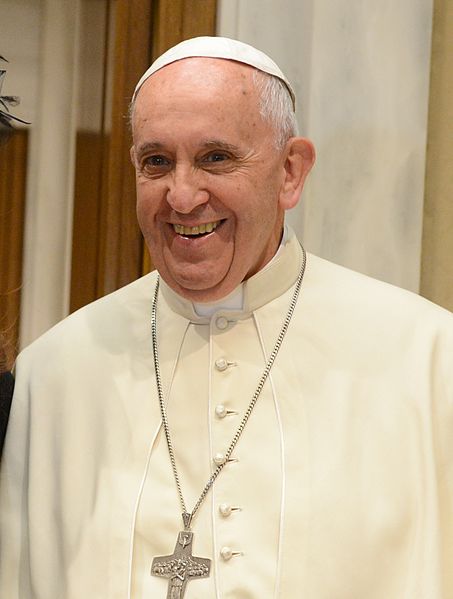
Pope Francis in a meeting with President Christina Fernandez de Kirchner of Argentina in the Casa Rosada.
Attribution: Casa Rosada (Argentina Presidency of the Nation), via Wikimedia Commons

The interview between Scalfari and the Pope was published March 28, 2018 in La Repubblica. The relevant section on Hell was translated by the highly respected web log, Rorate Caeli.

The interview is headlined, “The Pope: It is an honor to be called revolutionary.” (Il Papa: “È un onore essere chiamato rivoluzionario.”)

Scalfari says to the Pope, “Your Holiness, in our previous meeting you told me that our species will disappear in a certain moment and that God, still out of his creative force, will create new species. You have never spoken to me about the souls who died in sin and will go to hell to suffer it for eternity. You have however spoken to me of good souls, admitted to the contemplation of God. But what about bad souls? Where are they punished?”

Pope Francis says, “They are not punished, those who repent obtain the forgiveness of God and enter the rank of souls who contemplate him, but those who do not repent and cannot therefore be forgiven disappear. There is no hell, there is the disappearance of sinful souls.”

The post was later updated with a note from the Vatican:

“The Holy Father Francis recently received the founder of the newspaper La Repubblica in a private meeting on the occasion of Easter, without however giving him any interviews. What is reported by the author in today’s article [in La Repubblica] is the result of his reconstruction, in which the textual words pronounced by the Pope are not quoted. No quotation of the aforementioned article must therefore be considered as a faithful transcription of the words of the Holy Father.”

So either Scalfari misunderstood what his old friend was saying, or he’s just been thrown under a holy bus. I have no god in this fight, but it’s interesting either way.

March 26, 2018

Rick McGinnis on Jordan Peterson’s 12 Rules For Life: An Antidote to Chaos

Filed under: Books, Education, Religion — Tags: , , , , , — Nicholas @ 03:00

Peterson’s book and lecture series has been much in the news lately, so Rick McGinnis shares his thoughts, particularly about the message and intended audience for 12 Rules for Life:

It was probably inevitable that this sudden notoriety would create a demand for a book-length statement of principles from Peterson, and he obliged earlier this year with 12 Rules For Life: An Antidote to Chaos. Deceptively packaged as a self-help tome, the book expands on a series of postings Peterson made on Quora, a crowdsourcing website that, instead of asking for money, invites its readers to contribute answers to questions posed by other readers.

The book’s structure is straightforward; after sketching in the origin of the dozen precepts, he states them at the outset of each chapter, explains them in varying degrees of complexity with examples from his practice as a clinical psychologist, anecdotes from his own life or – and this is proving to be most tantalizing – ruminations on quotes from history, philosophy, mythology or (most often of all) the Bible.

On the surface, Peterson’s edicts for a good life are self-evident: Stand straight; Obey the Golden Rule; Choose your friends wisely; Set yourself reasonable expectations; Raise your children well; Don’t be a hypocrite; Cherish meaning; Don’t lie; Listen before you speak; Choose your words carefully; Let children fail so they learn to succeed; Be kind to animals.

But lest you think that short paragraph should save anyone the price of the book, it has to be understood that we are at least a generation, perhaps several, from the point where these commonsensical statements were known, understood or accepted by any sane adult. We are, at the end of a century of phenomenal technological advances and cataclysmic history, sorely in need of a book-length exposition on phrases that you’d once expect to find on needlework samplers.

Early on and quite often, Peterson comes across with butt-clenching dread as the smartest-man-in-the-room, laying out the stories behind the facts, culled from his years of reading and research, with the force and volume of a firehose. He relies heavily on evolutionary biology to explain our hardwired need to create and find our place in hierarchies, with examples that distill our endlessly troubling social responses to bluff, authority, and even violence down to chemical and neurological mechanisms set in place way back in time with far less complex creatures (a scenario that’s easily satirized as “we are all lobsters”).

It’s been observed – and confirmed by Peterson – that the ideal audience for his book is young people in general and young men in particular. As a former young man, I can attest that being told by a wise older man, clearly on your side but unwilling to sugar coat the facts, that the bully and the big-man-on-campus are better armed than you are to jockey for status and fulfillment – the alpha lobsters, waving their claws around to appreciable effect – is very much less than comforting. Peterson’s ideal audience will have to endure the climb up a very steep hill of biological determinism to reach the far more hospitable plateau beyond.

I’m not saying Peterson is wrong. From the perspective of an older man, I’ve seen this lobster battle played out too many times to deny its plausibility. But I’d be remiss if I didn’t suggest that the ideologies that he decries, imagining that there is no biological determinism – not even the binary division of gender – or even a landscape governed by measurable standards or objective truth, is far more appealing to young people raised to believe in an ever-expanding entitlement of “rights” and a pursuit of “justice” that needs to triumph above history or biology.

It’s when Peterson tries to explain the philosophical and even theological roots of our cultural systems that things might be rewarding, for both young and older readers. He has a core group of texts that he relies upon, with particular emphasis on Dostoyevsky and Solzhenitsyn on the modern side, and while he will evoke ancient mythology – the gods of Egypt make several appearances, though even he can’t overcome the essential strangeness of their myths – he reaps more rewardingly from the Bible, especially in one passage where he analyzes the difference between the Old and New Testament God.

March 23, 2018

The use of the euphemism “grooming”

Filed under: Britain, Law, Religion — Tags: , , , , , — Nicholas @ 05:00

Mark Steyn from a recent Clubland Q&A session:

If you missed our livestream Clubland Q&A on Tuesday, here’s the action replay. Simply click above for an hour of my answers to questions from Mark Steyn Club members around the planet on various aspects of identity politics, from micro-aggressions at the University of California to macro-aggressions in Telford and Rotherham – with a semantic detour into nano-aggressions and quantum-aggressions. Speaking of semantics, I saw this question after the show ended, from Steyn Club Founding Member Toby Pilling:

    If with regard to language, clarity is the remedy (as Orwell would say), shouldn’t the ‘Asian Grooming Gangs’ be re-named ‘Moslem Rape Gangs’? I’ve been trying to make the case that they should at the local council I work for, but over here in the UK one can be hauled in for hate speech at the drop of a hat.

I agree with Messrs Orwell and Pilling on clarity in language, and have never liked the word “grooming”, a bit of social-worker jargonese designed to obscure that what’s going on all over England is mass serial-gang-rape sex-slavery. “Grooming” is, in that sense, a euphemism. An hour or two after yesterday’s show I chanced to stop at the Upper Valley Grill and General Store on an empty strip of road in the middle of the woods in Groton, Vermont, a small town of a thousand souls that feels, if anything, rather smaller than that. And paying at the counter I noticed that they had a can next to the cash register for donations to what the hand-written card called the “Groton Grooming Fund”.

Having just been on the air yakking about Telford, I was momentarily startled. It is, in fact, not a whip-round to enable the gang-rapists to buy more petrol to douse the girls in, but a contribution toward the volunteer group that maintains the local ski and snowmobile trails – ie, they “groom” the snow. Happy the town in which grooming is left to the snowmobile club rather than the Muslim rape gangs. The slogan that greets you on the edge of the village is “Welcome to Groton – Where a Small Town Feels Like a Large Family”, which I always find faintly dispiriting. But it’s better than Telford, where a large town feels like a small prison.

March 18, 2018

Genghis Khan – Beginnings of the Great Mongol Nation – Extra History – #5

Filed under: China, History, Religion — Tags: , , , , — Nicholas @ 06:00

Extra Credits
Published on 17 Mar 2018

The man now known as Genghis Khan, leader of all Mongols, was ready to show the world what he was made of. He acted in fairness towards his own people and happily began integrating Chinese citizens and their culture, but showed no mercy to those who opposed him.

March 17, 2018

“Schedule 7 of [Britain’s] Terrorism Act … effectively treats speech as terror, ideas as violence”

Filed under: Britain, Law, Liberty, Religion — Tags: , , , , — Nicholas @ 05:00

Brendan O’Neill on the British government’s decision to refuse admission to Canadian videographer Lauren Southern:

In Britain in the 21st century you can be punished for mocking gods. You can be expelled from the kingdom, frozen out, if you dare to diss Allah. Perversely adopting medieval Islamic blasphemy laws, modern Britain has made it clear that it will tolerate no individual who says scurrilous or reviling things about the Islamic god or prophet. Witness the authorities’ refusal to grant entrance to the nation to the alt-right Christian YouTuber Lauren Southern. Her crime? She once distributed a leaflet in Luton with the words ‘Allah is gay, Allah is trans, Allah is lesbian…’, and according to the letter she received from the Home Office informing her of her ban from Britain, such behaviour poses a ‘threat to the fundamental interests of [British] society’.

This is a very serious matter and the lack of outrage about it in the mainstream press, not least among those who call themselves liberal, is deeply disturbing. For what we have here is the ringfencing of Britain from anti-Islam blasphemy. The purification of the kingdom against those who would take the mick out of the Muslim faith. In refusing leave to enter to Ms Southern because she handed out those leaflets, the UK authorities are making it clear that this is a nation in which certain things cannot be said about Allah. They are sending a message not only to Ms Southern but to Britons, too: trolling of Islam is a ‘threat’ to society and counter to ‘the public policy of the United Kingdom’. They haven’t only banned one woman; they have sought to chill an entire sphere of ‘blasphemy’.

Ms Southern was stopped at the border in Calais. She was reportedly questioned under Schedule 7 of the Terrorism Act. This is an extraordinarily broad and illiberal part of the law. It can be used to stop anyone at Britain’s borders, even if there is no suspicion that they are involved in terrorism. The individual can be detained and questioned for up to nine hours. There is no right to silence. There is no right to a publicly funded lawyer if the person is at a border. That such a repressive measure was allegedly deployed in the questioning of someone for distributing leaflets, for speech, should horrify anyone who cares about liberty. This effectively treats speech as terror, ideas as violence, mere words as things to be kept out of the nation, setting a terrible precedent for free speech in this country.

H/T to Perry de Havilland for the link.

QotD: Translation error?

Filed under: History, Middle East, Quotations, Religion — Tags: , — Nicholas @ 01:00

Here are two more facts known to many educated people:

1. The Christians did not begin to arrive at a settlement of the question of the divinity of Jesus until surprisingly late – the council of Nicaea in AD 325, and important controversies remained live until the Third Council of Constantinople in 680.

2. The original Aramaic-speaking Christians of Palestine having been effectively wiped out in the aftermath of the Bar Kokba revolt in AD 70, Christianity was re-founded by Paul of Tarsus among speakers of Koine Greek. The entire New Testament is written in Koine Greek.

Now here are two facts generally known only among a handful of specialist scholars. I picked them up through omnivorous reading and did not fully realize their significance for a long time.

3. In other Aramaic sources roughly contemporary with the New Testament, the phrase “Son of God” occurs as an idiom for “guru” or “holy man”. Thus, if Jesus refers to himself as “the son of God”, the Aramaic sense is arguably “the boss holy man”.

4. The Koine Greek of the period, on the other hand, did not have this idiom.

Now, imagine a Koine speaker reading the lost Aramaic source documents of which the Gospels are redactions, with only an indifferent command of the latter language He does not know that “Son of God” is an idiom…

Yes, that’s right. I’m suggesting that Jesus got deified by a translation error!

(Correction: The Bar Kokba revolt was AD 132; I was confusing it with the revolt of AD 70 in which the Temple at Jerusalem was destroyed.)

Eric S. Raymond, “Translation Errors”, Armed and Dangerous, 2009-02-12.

February 22, 2018

Curse of the FRIDAY THE 13TH I IT’S HISTORY

Filed under: Europe, France, History, Middle East, Religion — Tags: , , , — Nicholas @ 04:00

IT’S HISTORY
Published on 21 Feb 2018

On today’s episode we are going to talk about the end of the Templar Order and the famous curse of Jacques de Molay.

February 18, 2018

Nitay Arbel on Jordan Peterson’s 12 Rules for Life

Filed under: Books, Religion — Tags: , , , , — Nicholas @ 05:00

A guest post at According to Hoyt:

Those looking for an ‘alt-right’ manifesto will be sorely disappointed. Peterson actually says explicitly that on some economic issues (e.g., income disparity) he leans somewhat left, and elsewhere in the book laments that the cultural demonization of anything masculine is (as he describes it) causing a backlash, in terms of a resurgence in popularity of European parties he calls ‘far right’ or even ‘fascist’. (For Trump, to be clear, he uses the term ‘populist’, which undeniably fits.)

Nor will you find a camouflaged Christian revivalist tract here, as some claim. To be sure, Peterson heavily draws on the Bible and particularly on the Christian New Testament for quotes, but there are plenty of references to Eastern religious philosophies as well, particularly Taoism (‘yang vs. yin’, which here becomes ‘order vs. chaos’) and classical Buddhism (the concept that life is suffering). Among Christian theologians, Kierkegaard’s “act of faith” comes up repeatedly. During an interview, he was asked point-blank “Are you a Christian, and do you believe in G-d?” His intriguing answer: “I think the proper response to that is No, but I’m afraid He might exist.”

Nor is it some sort of “EST”-type (quasi-)cult manual, with Peterson setting himself up as a guru.

Moreover, it does not purport to be a reasoned scholarly tome of conservative philosophy. This is where Peter Hitchens (brother of the late Christopher) gets a little dyspeptic in his review in The Spectator, as he found it wanting there. http://archive.is/4eQIE (h/t: masgramondou)

David Solway, in his much more sympathetic article on PJMedia, hits the nail on the head, I believe. https://pjmedia.com/trending/jordan-peterson-phenomenon/ Like Solway, I find it hard to identify a single new idea in the book — pretty much everything Peterson says would be familiar to those of us who have been reared on Scripture and the Great Books.

But we have reached the level of intellectual corruption where, as George Orwell put it, the first duty of any thinking person is the restatement of the obvious. And that, Peterson does very well indeed. The book is a coherent whole, an engaging read, yea even a compelling ‘recap’ to the well-read. Peterson makes his discourse more engaging through extensive illustrations from psychological research, his own clinical practice, neuroscience, and his own life experience. Most importantly, it will bring wisdom of the ages (and of rational-empirical thinking) to a millennial generation drowning in derp and denial of objective reality. To those who, if you will pardon me the phrase, “know not the gods of the copybook headings”.

I just finished reading the book myself, and I largely agree with this summary.

February 17, 2018

How a Concubine became the Empress of China – Wu Zetian l HISTORY OF CHINA

Filed under: China, History, Religion — Tags: , , , — Nicholas @ 02:00

IT’S HISTORY
Published on 5 Aug 2015

Wu Zetian was the first and only Empress of China. Skillfully, she worked her way up, entering the imperial court of Emperor Tang Taizong as a concubine. After his death she would marry his son, Emperor Kaozong. Later she would ruthlessly dethrone two of her own sons and take power herself, effectively introducing an interregnum to the Tang dynasty. During her very own Zhou dynasty she was known as a kind and fair ruler and made Buddhism state religion. Learn all about the Biography of one of the most popular and at the same time merciless women in Chinese history in today’s episode of IT’S HISTORY.

February 3, 2018

Saladin – the Sword of Islam – IT’S HISTORY

Filed under: History, Middle East, Religion — Tags: , , , — Nicholas @ 04:00

IT’S HISTORY
Published on 2 Feb 2018

Saladin was the famous Muslim leader during the time of the Crusades.

January 30, 2018

The Three Teachings – Taoism, Buddhism, Confucianism l HISTORY OF CHINA

Filed under: China, History, Religion — Tags: , , , , — Nicholas @ 02:00

IT’S HISTORY
Published on 1 Aug 2015

The Three Teachings Taoism, Buddhism and Confucianism have been a backbone of Chinese society and culture since the bronze age. The Three teachings are still intertwined strongly with today’s China. There are different interpretations to China’s chore faiths. Over time, different dynasties favoured different faiths, if only to define themselves against their predecessor. Ultimately though, its all about the philosophy of combining spirituality with every day life. All about the Three Teachings now on IT’S HISTORY.

January 22, 2018

Khosrau Anushirawan: On Top of the World – Extra History – #5

Filed under: History, Middle East, Religion — Tags: , , , — Nicholas @ 04:00

Extra Credits
Published on 20 Jan 2018

Plague had brought an end to Khosrau’s war against Justinian, but Justinian’s nephew soon reignited the rivalry. Khosrau was at the peak of his political power and eager to crush this young upstart personally… but old age had also crept up on him.

January 13, 2018

Actors and public morality

Filed under: History, Media, Religion, USA — Tags: , , — Nicholas @ 03:00

Jonah Goldberg on the differences in the way actors were viewed historically and today:

It may be hard for some people to get the joke these days, but for most of human history, actors were considered low-class. They were akin to carnies, grifters, hookers, and other riffraff. In ancient Rome, actors were often slaves. In feudal Japan, Kabuki actors were sometimes available to the theatergoers as prostitutes — a practice not uncommon among theater troupes in the American Wild West.

In 17th century England, France, and America, theaters were widely considered dens of iniquity, turpitude, and crapulence. Under Oliver Cromwell’s Puritan dictatorship, the theaters were forced to close to improve moral hygiene. The Puritans of New England did likewise. A ban on theaters in Connecticut imposed in 1800 stayed on the books until 1952.

Partly out of a desire to develop a wartime economy, partly out of disdain for the grubbiness of the stage, the first Continental Congress in 1774 proclaimed, “We will, in our several stations, … discountenance and discourage every species of extravagance and dissipation, especially all horse-racing, and all kinds of gaming, cock-fighting, exhibitions of shews [sic], plays, and other expensive diversions and entertainments.”

[…]

The most recent Golden Globes ceremony has already been excoriated for being a veritable geyser of hypocritical effluvia, as the same crowd that not long ago bowed and scraped to serial harasser and accused rapist Harvey Weinstein, admitted child rapist Roman Polanski, and that modern Caligula, Bill Clinton, congratulated itself for its own moral superiority.

The interesting question is: Why have movie stars and other celebrities become an aristocracy of secular demigods? It seems to me an objective fact that virtually any other group of professionals plucked at random from the Statistical Abstract of the United States — nuclear engineers, plumbers, grocers, etc. — are more likely to model decent moral behavior in their everyday lives. Indeed, it is a bizarre inconsistency in the cartoonishly liberal ideology of Hollywood that the only super-rich people in America reflexively assumed to be morally superior are people who pretend to be other people for a living.

I think part of the answer has to do with the receding of religion from public life. As a culture, we’ve elevated “authenticity” to a new form of moral authority. We look to our feelings for guidance. Actors, as a class, are feelings merchants. While they may indeed be “out of touch” with the rest of America from time to time, actors are adept at being in touch with their feelings. And for some unfathomably stupid reason, we now think that puts us beneath them.

December 31, 2017

A contrarian view of hijabs, niqabs, and burqas

Filed under: History, Middle East, Religion — Tags: , , , — Nicholas @ 03:00

Western views of full-coverage clothing, including hijabs, niqabs, and burqas, may be concealing a hidden benefit to those who choose to wear such clothes voluntarily:

Hijabs, niqabs, and burqas — different sorts of coverings worn by Islamic women — are divisive apparel in the West, associated with patriarchal oppression, cultural outsiders, and even suicide bombers. Yet few accounts actually discuss the experiences of the women wearing the veils, and the freedom and anonymity coverings can afford if worn voluntarily.

Born in Pakistan and educated in America, Rafia Zakaria is the author of Veil, a new book which explores the history and shifting meanings of female coverings in Islamic countries and Western secular society. In a wide-ranging conversation, she talks with Reason‘s Nick Gillespie about the theological underpinnings of veils, their use as a means of controlling female sexuality, and how they have become markers of socio-economic status and virtue signaling.

Veils present a particular conflict for Western feminists. On the one hand, veils — especially burqas — are emblematic of regimes that are particularly oppressive to women. Feminists and others have moved to ban the wearing of veils in public in the name of female empowerment. But if a Muslim women wants to wear one, is she endorsing patriarchy and setting back the women’s rights movement or simply owning her own choices, especially in a culture that might itself be anti-Islamic?

« Newer PostsOlder Posts »

Powered by WordPress