
Forgotten Weapons
Published 28 Jul 2025The ZK-381 was designed by Josef Koucký, his first design of 1938 (hence 381). This is one of the last of the Czech pre-war self-loading rifle projects, of which there were quite a lot. It uses a tilting bolt and a short-stroke gas piston, with ZB26 machine gun magazines and chambered for 7.92mm Mauser (although they would have been happy to offer a model in any other modern rifle cartridge). It was tested in the spring of 1938 by the Soviet Union, which liked it enough that they requested a model in 7.62x54R — and those were tested in November 1938. Ultimately domestic Russian designs were chosen instead, and tests in German, France, Spain, and Italy also led to naught.
Thanks to the Czech Military History Institute (VHU) for graciously giving me access to this one-of-a-kind prototype to film for you! If you have the opportunity, don’t miss seeing their museums in Prague:
https://www.vhu.cz/en/english-summary/
(more…)
December 13, 2025
ZK 381: Czech Pre-War Prototype Battle Rifle
December 12, 2025
Re-orient your map to understand China’s view of the world
CDR Salamander provides a helpful guide to seeing the world, specifically their Pacific front, by turning your map sideways. I hope you won’t look back on this from a slightly later date when the maps get all flaggy and arrow-y:
I first saw this map three years ago, and it recently resurfaced in my thoughts.
I remain convinced that a lot of the problem with trying to get everyone to fully understand the challenge in the Western Pacific is that to a large part, we think in a “north-up” orientation.
I don’t think that is all that helpful.
Just a few days ago, we had another Pearl Harbor Day anniversary and we’ve all seen the maps, usually centered on Hawaii, where the Imperial Japanese Navy’s Kidō Butai comes at the Pacific Fleet from stage left off the map. Then we fought battles in the Coral Sea, Midway, and so on.
To the lay eye — or to those who don’t have time to dig into the reasons — a traditional north-up map looks disjointed; things seem all over the place.
No, not really. Let’s bring back that first map.
[Click to embiggenate]
For both Imperial Japan in the early-mid 20th century and Communist China today, the most important part of this map is the access to the resources in or going through the bottom-right hand corner.
Today’s greatest bone of contention — not unrelated to the most important part of the map mentioned above — is Taiwan, right at the mouth of the funnel.
If we need to bring a fight there, that is one hell of a fight to get there if the People’s Republic of China (PRC) wants to prepare a proper welcome for us.
For the PRC, the primary military threat to plan for comes across the Pacific into a funnel that terminates at its most important SLOC. It’s the United States of America, and the US has a series of islands leading right into the heart of the PRC’s. It starts in Hawaii — Midway, Wake, Guam — and then to U.S. allies: the Philippines, Japan, and Australia.
They’re planning a layered defensive fight. Their actions make that clear.
Make no mistake, we may say we are going to “defend Taiwan”, but to do that we will have to fight an aggressive war across the Pacific, into the enemy’s prepared funnel.
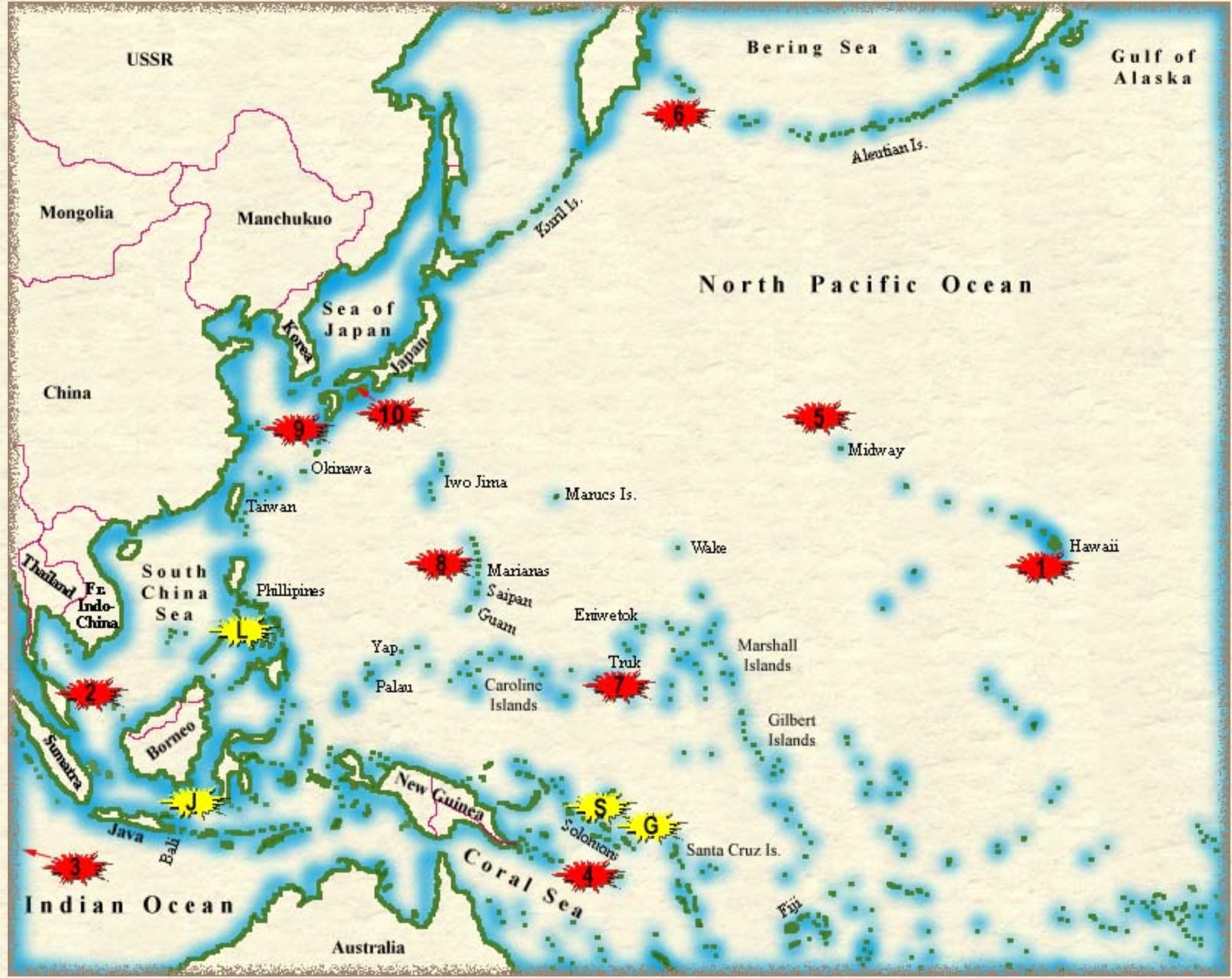
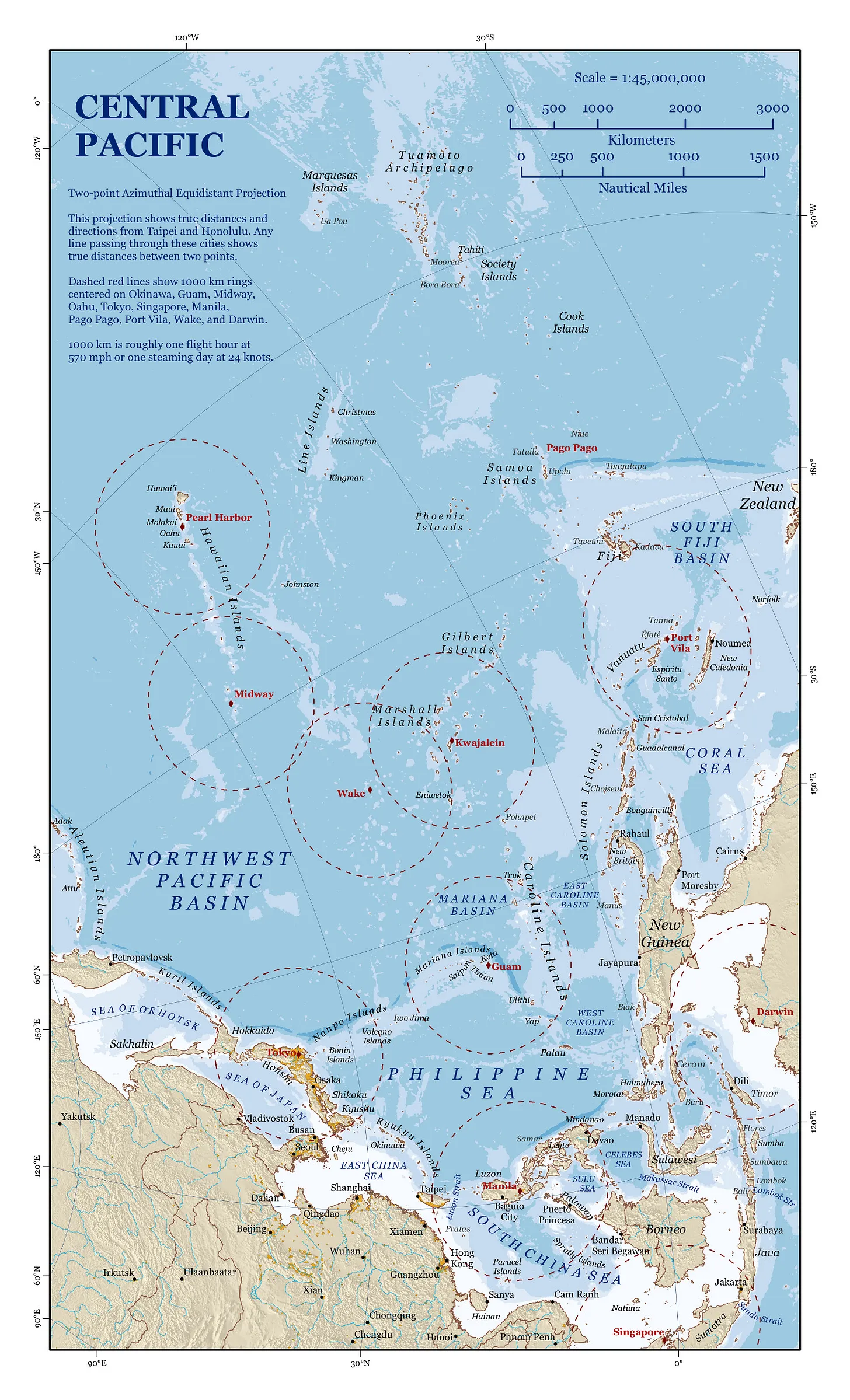
Update, 13 December: Welcome, Instapundit readers! Please do have a look around at some of my other posts you may find of interest. I send out a daily summary of posts here through my Substack – https://substack.com/@nicholasrusson that you can subscribe to if you’d like to be informed of new posts in the future.
QotD: Crime and the army
By a “crime” the ordinary civilian means something worth recording in a special edition of the evening papers — something with a meat-chopper in it. Others, more catholic in their views, will tell you that it is a crime to inflict corporal punishment on any human being; or to permit performing animals to appear upon the stage; or to subsist upon any food but nuts. Others, of still finer clay, will classify such things as Futurism, The Tango, Dickeys, and the Albert Memorial as crimes. The point to note is, that in the eyes of all these persons each of these things is a sin of the worst possible degree. That being so, they designate it a “crime”. It is the strongest term they can employ.
But in the Army, “crime” is capable of infinite shades of intensity. It simply means “misdemeanor”, and may range from being unshaven on parade, or making a frivolous complaint about the potatoes at dinner, to irrevocably perforating your rival in love with a bayonet. So let party politicians, when they discourse vaguely to their constituents about “the prevalence of crime in the Army under the present effete and undemocratic system”, walk warily.
Ian Hay (Major John Hay Beith), The First Hundred Thousand: Being the Unofficial Chronicle of a Unit of “K(1)”, 1916.
December 11, 2025
Lines of Fire: Operation Market Garden Part 2 of 2 – WW2 in Animated Maps
TimeGhost Cartographic
Published 10 Dec 2025September 17, 1944. A slight morning fog over Britain gives way to clear skies, as the first of hundreds of Allied aircraft leave the ground to execute the largest airborne operation ever attempted. Will Montgomery’s gamble pay off? Or are the Germans in the Netherlands far less beaten than he believes? Last time out we covered the planning, rationale, and logistics of the idea. Now, watch it unfold from beginning to end, map by map.
(more…)
Britain’s Top 10 UGLIEST Aircraft
Rex’s Hangar
Published 13 Aug 2022Today we take a look at the top 10 ugliest aircraft every to grace the skies of the United Kingdom. Some were failures, some were hugely successful, but all were lacking in the good looks department, lets check out these ugly planes!
(more…)
December 10, 2025
The Korean War Week 77: The Korean Winter Bites Hard – December 9, 1951
The Korean War by Indy Neidell
Published 9 Dec 2025Now that they’ve agreed on a Demarcation Line, the talk this week at the Panmunjom peace talks has turned to whether there will be restrictions or not after the signing of an armistice. Also, how would inspections work to make sure the other side is complying with the armistice terms? Perhaps a group of representatives from neutral nations? Meanwhile the troops are digging in to their winter defenses, as the frozen Korean winter descends upon them.
Chapters
00:00 Intro
00:48 Recap
01:16 Two New Points
08:42 Korean Winter
11:47 Communist Defenses
13:20 Summary
13:33 Conclusion
14:28 Call to Action
(more…)
December 9, 2025
The age of Trump – “America has ‘walked away’ from its allies”
In The Line, Matt Gurney talks about last month’s annual Halifax International Security Forum, where the biggest change from previous events was the official absence of US government representation:

Late last month, attending the Halifax International Security Forum, I was having the damndest feeling. Can you have déja vu for something that you only experienced via fiction? Because it was kind of like that.
The fiction in question was a novel by an Australian, published during the Second Iraq War. Anti-American sentiment was running rampant all over the world. The premise of the novel is out there in the realm of sci-fi — America disappears. Specifically, Americans disappear — some mysterious wave of energy scours most of North America clean of life. Virtually all of the U.S. is wiped out; most of Canada and Mexico, too. Somewhat to the surprise of the anti-Americans, this does not result in an improvement in life on Planet Earth.
Standing around at the forum, eating the delicious snacks and drinking the good coffee and chatting with friends old and new, that was what I kept thinking about. Where are the Americans? And what the hell are we going to do without them?
And, in case you’re wondering what’s up with that headline, here’s another question — what will we do if they one day try and come back?
The forum is an annual gathering of senior military officers, defence and intelligence officials from across the free world, and representatives from the media, think tanks, large companies and civil society organizations whose work relates to defence and security issues or in some way seeks to promote and preserve a healthy democratic world. Funded by NATO, the Canadian government and private-sector sponsors, the event is a major part of Canada’s “soft power” offering to our allies — we host the big party and show everybody a good time. The actual schedule is split between on-the-record panel talks or presentations, off-the-record sessions, and informal time for mingling and schmoozing. I am grateful to have been invited to participate again this year.
Especially this year. I’ve been going to the forum for years, and the event always had a strongly American flavour.
Not anymore! Yankee went home.
Like, literally. He was ordered to go home, or stay there. Secretary of Defense Pete Hegseth ordered the Pentagon to avoid a series of high-profile annual defence summits. That includes Halifax, and others in places like Munich and Singapore, and even inside the United States itself. The reason, according to the Pentagon’s press apparatus, was that, and I swear to God this is the actual quote, such events promote “the evil of globalism, disdain for our great country and hatred for the president of the United States”.
Oh. Well, then.
That’s what made the forum so fascinating this year. As I told my colleague Jen Gerson while I was in Halifax, the entire event felt a little bit like the first Thanksgiving after a divorce. It’s great to see everyone, but there’re some notable absences, is the thing.
Krieghoff’s Bizarre Prototype FG42 Proposal
Forgotten Weapons
Published 23 Jul 2025When the Luftwaffe was looking for its new universal paratrooper rifle, six different German arms companies were asked to submit proposals. Only two actually did; Krieghoff and Rheinmetall. Krieghoff designed this very interesting system, clearly optimized to reduce weight and length as required by the design brief. It uses a tiny vertically traveling locking block and an unusual gas trap system combined with an under-barrel piston. The total number made is unknown, but both fixed- and folding-stock models were produced (the German museum at Koblenz has a fixed-stock example on display). This particular example appears to have been tested after the war by engineers at Springfield Armory by drilling a hole in the gas tube to measure pressure while it cycled.
Thanks to the Springfield Armory National Historic Site for giving me access to this rare prototype from their reference collection to film for you! Don’t miss the chance to visit the museum there if you have a day free in Springfield, Massachusetts:
QotD: The development of army discipline and drill in pre-modern armies
The reason we cannot just call this “drill” is because while drill is the most common way agrarian societies produce this result, it is not the only way to this end. For instance as we’ve discussed before, steppe nomads could achieve a very high degree of coordination and synchronization without the same formal systems of drill because the training that produced that coordination was embedded in their culture (particularly in hunting methods) and so young steppe nomad males were acculturated into the synchronicity that way. That said for the rest of this we’re going to place those systems aside and mostly focus on synchronized discipline as a result of drill because for most armies that developed a great deal of synchronized discipline, that’s how they did it.
Fundamentally the principle behind using drill to build synchronized discipline is that the way to get a whole lot of humans to act effectively in concert together is to force them to practice doing exactly the things they’ll be asked to do on the battlefield a lot until the motions are practically second nature. Indeed, the ideal in developing this kind of drill was often to ingrain the actions the soldiers were to perform so deeply that in the midst of the terror of battle when they couldn’t even really think straight those soldiers would fall back on simply mechanically performing the actions they were trained to perform. That in turn creates an important element of predictability: an individual soldier does not need to be checking their action or position against the others around them as much because they’ve done this very maneuver with these very fellows and so already know where everyone is going to be.
The context that drill tends to emerge in (this is an idea invented more than once) tends to give it a highly regimented, fairly brutal character. For instance in early modern Europe, the structure of drill for gunpowder armies was conditioned by elite snobbery: European officer-aristocrats (in many cases the direct continuation of the medieval aristocracy) had an extremely poor view of their common soldiers (drawn from the peasantry). Assuming they lacked any natural valor, harsh drill was settled upon as a solution to make the actions of battle merely mechanical, to reduce the man to a machine. Roman commanders seemed to have thought somewhat better of their soldiers’ bravery, but assumed that harsh discipline was necessary to control, restrain and direct the native fiery virtus (“strength/bravery/valor”) of the common soldier who, unlike the aristocrat, could not be expected to control himself (again, in the snobbish view of the aristocrats).
In short, drill tends to appear in highly stratified agrarian societies, the very nature of which tends to mean that drill is instituted by a class of aristocrats who have at best a dim view of their common soldiers. Consequently, while the core of drill is to simply practice the actions of battle over and over again until they become natural, drill tends to also be encrusted with lots of corporal punishments and intense regulation as a product of those elite attitudes. And though it falls outside of our topic today it seems worth noting that our systems of drill to produce synchronized discipline have the same roots (deriving from early modern musket drill).
Bret Devereaux, “Collections: Total Generalship: Commanding Pre-Modern Armies, Part IIIa”, A Collection of Unmitigated Pedantry, 2022-06-17.
December 8, 2025
Hungary 1956: The Day Hope Met Soviet Steel – W2W 056
TimeGhost History
Published 7 Dec 2025Here we trace how, only eleven years into Soviet rule, Hungary’s brief hope after Stalin’s death ignites into demands for reform, free speech, and withdrawal of Soviet troops. Students mass in Budapest, the secret police fire on demonstrators, and the uprising spreads as workers’ councils seize factories and crowds pull down Stalin’s statue. Imre Nagy promises neutrality and multi-party politics, but Moscow wavers, then sends in overwhelming force. As tanks return to Budapest, street fighting erupts, radios broadcast desperate pleas, and the revolution is crushed, leaving thousands dead and a generation convinced that the thaw was an illusion.
(more…)
Eating aboard a US Submarine during World War 2
Tasting History with Max Miller
Published 1 Jul 2025Slow-cooked steaks with tomatoes and onions with mashed potatoes and gravy
City/Region: United States of America
Time Period: 1945Being a crew member aboard a submarine during World War II was one of the most dangerous jobs in the US military with a fatality rate of over 20%. This, and the extremely cramped and uncomfortable quarters, were why the food aboard a US sub was really good. If nothing else, at least you had delicious food to keep you going.
These steaks cook up to be fall-apart tender and delicious, and the mashed potatoes have wonderful flavor, even if the texture is a little different from regular mashed potatoes. They kind of remind me of the mashed potatoes I’d get as a kid in school, which were also probably made from dehydrated potatoes.
SWISS BEEF STEAKS
Portion: 1 (6-ounce) steak.
100 PORTIONS
Beef, bone-in……60 pounds
OR
Beef, boneless……42 pounds
Flour……2 pounds……1/2 gallon
Salt……6 ounces……3/4 cup
Pepper……1/2 ounce……1 3/4 tablespoons
Fat……2 pounds……1 quart
Tomatoes……12 pounds, 12 ounces……2 No. 10 cans (6 1/2 quarts).
Onions, sliced……6 pounds……4 1/2 quarts
Salt……1 ounce……2 tablespoons
Flour (for gravy)……1 pound……1 quart
Water, cold……
Cut meat into 6-ounce steaks 1 to 1 1/2 inches thick.
Sift together flour, salt and pepper. Pound into steaks.
Cook steaks in fat until browned on both sides. Place in roasting pans.
Add tomatoes. Cover with onion slices. Sprinkle with 1 ounce salt.
Cover pans. Cook in slow oven (300°F.) 3 hours or until steaks are tender.
Drain liquid from Swiss steaks. Make a paste of flour and water. Stir into steak liquid. Cook until thickened. Pour over steaks. Reheat.MASHED POTATOES (Using dehydrated, shredded potatoes)
Portion: Approx. 4 1/2 ounces (approx. 2/3 cup).
100 PORTIONS
Water……5 pounds, 8 ounces……2 gallons
Potato shreds, dehydrated, precooked……5 pounds……2 gallons
Salt……3 ounces……6 tablespoons
Milk, liquid, hot……3/4 gallon
Butter, melted……1 pound……1 pint
Heat water to vigorous boil. Pour over potatoes. Cover.
Let stand in warm place 15 minutes or over low heat 10 minutes.
Add salt. Stir vigorously 15 to 20 minutes or until smooth.
Add milk and butter. Whip until light. Serve immediately.
— The Cook Book of the United States Navy by the United States Department of the Navy Bureau of Supplies and Accounts, Washington, D.C., 1945
December 7, 2025
The great military leaders of the past have been … quirky
On the social media site formerly known as Twitter, @InfantryDort considers the clear evidence that most of the greatest generals of history were, at the very least, eccentric:
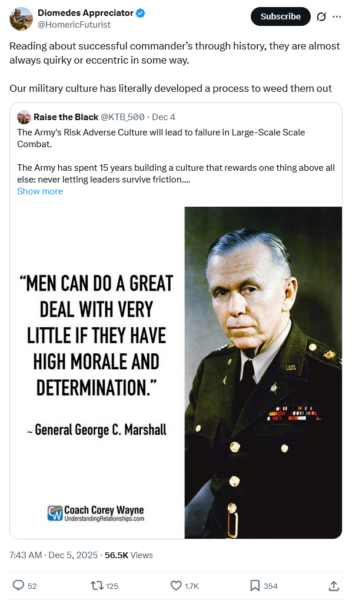
Most real post I’ve seen all month.
Yes, the process weeds them out.
Until all that remains is some corporatized astroturfed version of … whatever.
Military commanders in the modern era MUST lack personal audacity to some degree. Almost without exception.
Because audacity is “dangerous”. It can be unpredictable. And this is a bad thing in a world obsessed with safety and predictability.
But a military without it, is just one on anti-depressants. You never feel the highest highs or the lowest lows.
You just … exist, in inspirational purgatory.
So you will never see a Napoleon, Patton, Allen, or Sherman ever again.
Their modern equivalents mostly got out as captains because the experience they were promised from history, is now covered in bubble wrap. Wearing a bib and a football helmet.
The modern military is devoid of both victory and defeat. A victory you aren’t allowed to win. A defeat you can explain away. Much of it is due to the American people themselves, and their disdain for violence. At least violence against what sane people classify as enemies.
We have a chance to take it back. A chance to return to glorious and sometimes unhinged leadership. But the rot is thick. And the Empire Strikes Back daily.
My infinite gratitude, and the gratitude of a fawning nation, will rest with those who display the force of will to make it happen.
And crush the corporatization of military leadership once and for all.
The world awaits. And one wonders if our country has the appetite for it all, short of an existential crisis in a war of national survival.
Update, 8 December: Welcome, Instapundit readers! Please do have a look around at some of my other posts you may find of interest. I send out a daily summary of posts here through my Substack – https://substack.com/@nicholasrusson that you can subscribe to if you’d like to be informed of new posts in the future.
History Summarized: Quebec’s Architectural Memory
Overly Sarcastic Productions
Published 1 Aug 2025Congratulations, you just got Chateau’d.
Ten years ago I visited Quebec City with my dad, this summer the two of us went back, and today I bring you the analytical fruits of a visit well spent. (Let it be known I did my best attempt at Quebecois, recalling pronunciation differences like Frontenac condensing to “Frotnak”, but otherwise defaulting to Metropolitan French when I wasn’t sure of local pronunciations. Alas, any attempt to “split the difference” between Quebecois and Metropolitan French will invariably result in utter disaster. For this, je suis désolé.)
(more…)
QotD: The Great Applesauce Blight of 1977/78
As we take our own little march down memory lane, let me state up front that I can’t stomach applesauce, just can’t. I liked it as a kid but now it has less appeal than the prospect of being duct taped to a chair, face down, in prison. Yeah, I hate it.
This may seem unreasonable, but anyone who was in at the time, at least in the Army or Marines, and some portion thereof that actually went to the field a lot, will probably remember the Great Applesauce Blight of 1977 and 1978, which was the reason I can’t stand the crap.
The “Great Applesauce Blight?” you ask. Oh, yeah.
The story I got, after some years and some digging, goes like this: It seems that sometime in the late 1960s or early 1970s, a fruit company – the Monterey Fruit Company, so it was said – was going out of business. So the Monterey Fruit Company, if that’s who it really was, called the Department of Defense and said, “Boys, have we got a deal for you. Hundreds upon hundreds of tons of Grade A applesauce, and you can have it. All of it. Cheap.”
McNamara and his Whiz Kids – neither of them ever sufficiently to be damned, of course – were gone, but their spirits remained. Department of Defense, ever conscious of the value of a well-squeezed penny, bought that inventory of applesauce, and began to put it into the old style, canned, MCI; Meal, Combat, Individual, which is to say, “C-rations”.
C Rations of the day were entirely canned and composed of a main meal, for one meal, plus either a cake (or very rarely, canned bread) or fruit of some kind, usually a small tin of peanut butter or cheese of some kind of jam or jelly, and one or another type of B Unit, which would have some variant of crackers plus either candy or cocoa. Sometimes, as with the B-2 unit, the cheese was in those.
Now, perusing a case of 1978 C-rats, which would have been newer than those of the Great Applesauce Blight, but still broadly similar, one notes that there were twelve menus, twelve different main meals, and 12 different kinds of dessert, a sundry pack, plus variable candies, spreads, etc. Of that latter twelve, eight were fruit and four were cake of some kind. I seem to recall that, possibly for reasons of economy, the amount of fruit during the Great Applesauce Blight had gone up to usually ten cans out of twelve, some extra cheese or peanut butter seemed to be included with some, and the cakes went down to two, one of which was going to be Chocolate Nut Roll, essentially inedible, from the Nashville Bread Company and the other would be the even more thoroughly disgusting fruit cake. I don’t recall who made that, and that lack of memory may have been an automatic defense against a future charge of capital murder. None of the cakes except pound cake could be relied on to be edible, and pound cake was always rare.
Now picture this, you’re a soldier in the Panama Canal Zone, training – training hard – to fight for the Canal, living in the jungle maybe twenty-five or more days and nights a month, eating C-rats to the tune of sixty or seventy a month, and virtually every meal contains applesauce or something more innately disgusting. “No, none of that nice fruit cocktail or those ever so delectable pear slices for you, young man; Department of Defense, to save a few bucks, has determined that applesauce is good enough, three meals a day, for weeks on end.”
*****
Now we were already kind of thin, because no military feeding system can ever completely keep up with the caloric requirements for a soldier either continuously fighting or realistically training to fight. Normally, this isn’t a problem because he can pack it on in the mess hall. These were unusual circumstances, though, with an unusually high chance of fighting – or riot control, which is worse – over the Canal. So we’re pretty much living out there, in pretty much trackless jungle, with nothing like enough helicopters for regular hot rations from the mess. Besides that, the old 193rd Infantry Brigade, in the Panama Canal Zone, was unusual in that it made a very serious effort to train even the cooks to fight, which takes time, too. C’s are pretty much it.
Even so, thin and hungry or not, after a month or two we could not eat the applesauce. That was probably seven or eight hundred calories a days that just got tossed.
We began going from thin to frigging emaciated.
*****
When I think upon the Great Applesauce Blight, though, I do not think about hardship or hunger. No, I think – as we old farts are wont to – about happier aspects of it.
Now this is no shit:
There we were, the heavy mortar platoon of 4th Battalion, 10th Infantry, stuck on top of a non-descript hill somewhere southwest of Gamboa, Canal Zone.
PFC McBrayer had a birthday out there in the jungle. I think it was his nineteenth birthday. None of us had been able to do any shopping, so we were all just stuck for getting him a birthday present. “I’m not giving up my pet scorpion,” said Big Al, who in fact, had a pet scorpion for the mega-ant versus scorpion gladiatorial combats we used to stage. “I’d offer to give him some of my crotch rot,” said Art, “but I think he already has some of his own.” “Howler monkey?” “Who’s going to catch it? And those suckers are mean, too.” “How about a sloth? They’re easy to catch.” “If the Lord God didn’t see fit to give B’rer Sloth an asshole, I don’t see why we should add to his troubles by catching him and wrapping him as a present.” Finally someone, I don’t think it was me, might have been Sergeant Sais, said, “Gentlemen, there can be only one proper gift under the circumstances,” and then he held up a – you guessed it – can of applesauce.
So we stuck nineteen or twenty Canal Zone Matches in a Nashville Bread Company Chocolate Butt Roll, invited McBrayer over, torched off the matches, sang Happy Birthday, then presented him his can of applesauce.
He was touched; you could see that. As he dashed tears from his eyes while making his, “Gee, you guys are just all so special … you shouldn’t have,” speech, you could see the emotion radiating from his face. And then, all choked up, he turned to go and tossed that can off applesauce off the hill with a casual contempt I have never seen before or since. It was the sheer, distilled essence of everything we all felt about applesauce.
Tom Kratman, The social media site formerly known as Twitter, 2025-09-05.
December 6, 2025
Battle of Tarawa, 1943
Real Time History
Published 5 Dec 2025The Marine and US Army landing on the Tarawa Atoll’s Betio and Makin islands were the first operations in the new Central Pacific front of the Pacific War. Tarawa was one of the deadliest amphibious landings for the Marine Corps which hadn’t yet perfected such complex operations. But the lessons learned at Tarawa would already be applied a few months later at Kwajalein and Eniwetok.
(more…)


