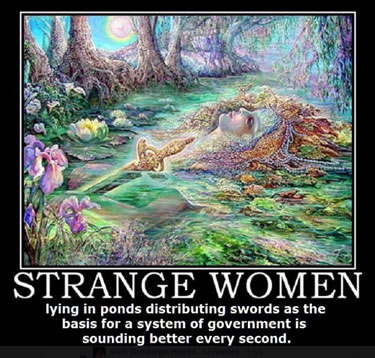
… all those years ago, they still managed to foresee the kind of political arguments we’d be having in the twenty-first century:
H/T to American Digest, among others who pointed out the prophetic powers of the Pythons.

… all those years ago, they still managed to foresee the kind of political arguments we’d be having in the twenty-first century:
H/T to American Digest, among others who pointed out the prophetic powers of the Pythons.
Faith may be defined briefly as an illogical belief in the occurrence of the improbable. Or, psychoanalytically, as a wish neurose. There is thus a flavor of the pathological in it; it goes beyond the normal intellectual process and passes into the murky domain of transcendental metaphysics. A man full of faith is simply one who has lost (or never had) the capacity for clear and realistic thought. He is not a mere ass: he is actually ill. Worse, he is incurable, for disappointment, being essentially an objective phenomenon, cannot permanently affect his subjective infirmity. His faith takes on the virulence of a chronic infection. What he usually says, in substance, is this: “Let us trust in God, who has always fooled us in the past.”
H.L. Mencken, “Types of Men 3: The Believer”, Prejudices, Third Series, 1922.
At 04.30 hours on the Prince Baudouin, the waiting soldiers heard the call: “Rangers, man your boats!” On other landing ships there was a good deal of chaos getting the men into the landing craft. Some infantrymen were so scared of the sea that they had inflated their life jackets on board ship and then could not get through the hatches. As they lined up on deck, an officer in the 1st Division noticed that one man was not wearing his steel helmet. “Get your damn helmet on,” he told him. But the soldier had won so much in a high card game that his helmet was a third full. He had no choice. “The hell with it,” he said, and emptied it like a bucket on the deck. Coins rolled all over the place. Many soldiers had their field dressings taped to their helmet; others attached a pack of cigarettes wrapped in cellophane.
Those with heavy equipment, such as radios and flame-throwers which weighed 100 pounds, had great difficulty descending the scramble nets into the landing craft. It was a dangerous process in any case, with the small craft rising and falling and bouncing against the side of the ship. Several men broke ankles or legs when they mistimed their jump or were caught between the rail and the ship’s side. It was easier for those lowered in landing craft from davits, but a battalion headquarters group of the 29th Infantry Division experienced an inauspicious start a little later when their assault craft was lowered from the British ship Empire Javelin. The davits jammed, leaving them for thirty minutes right under the ship’s heads. “During this half-hour,” Major Dallas recorded, “the bowels of the ship’s company made the most of an opportunity which Englishmen have sought since 1776.” Nobody inside the ship could hear their yells of protest. “We cursed, we cried and we laughed, but it kept coming. When we started for shore, we were all covered with shit.”
Anthony Beevor, D-Day: The Battle for Normandy, 2009.
No man ever quite believes in any other man. One may believe in an idea absolutely, but not in a man. In the highest confidence there is always a flavor of doubt — a feeling, half instinctive and half logical, that, after all, the scoundrel may have something up his sleeve. This doubt, it must be obvious, is always more than justified, for no man is worthy of unlimited reliance — his treason, at best, only waits for sufficient temptation. The trouble with the world is not that men are too suspicious in this direction, but that they tend to be too confiding — that they still trust themselves too far to other men, even after bitter experience. Women, I believe, are measurably less sentimental, in this as in other things. No married woman ever trusts her husband absolutely, nor does she ever act as if she did trust him. Her utmost confidence is as wary as an American pick-pocket’s confidence that the policeman on the beat will stay bought.
H.L. Mencken, “Types of Men 2: The Skeptic”, Prejudices, Third Series, 1922.
 I’m on the record as saying that I thought it would be better for both the team and for Adrian Peterson if he played somewhere else this season. If the comments from the Vikings are accurate, then that was never going to happen as they received no calls from other teams leading up to the draft about trading Peterson. Instead, after some weird moments on Twitter recently, Adrian Peterson showed up in Minnesota today to begin taking part in the offseason training sessions and to earn his $250k bonus for attending the nominally voluntary sessions leading up to mini-camp later this month. I’m still in two minds about this development: Peterson is a generational talent at running back and will make this season much easier on Teddy Bridgewater … but I still think he’s not committed to the team and would prefer to be playing somewhere else.
After today’s OTA session, head coach Mike Zimmer addressed the media and then gave the podium over to Peterson. The Daily Norseman‘s Ted Glover provides his unique “Rickspeak” translation of what was said and what was meant at today’s press conference:
Hi kids, how have you been? If you’re a Vikings fan and didn’t know that Adrian Peterson and Mike Zimmer had a press conference after Peterson’s return to the team earlier today, you are one of two things:
Monumentally ignorant, or monumentally blessed; I can’t decide what. I’m a blessed ignoramus, so I kind of have both bases covered here, so I’ll let you decide what camp you fall in.
Be that as it may, there was a lot of information said at today’s press conference…if you know the ways of Rickspeak, and the meaning behind the words.
‘But Ted’, you ask to yourself, ‘what is Rickspeak?’
Rickspeak isn’t so much a language unto itself as much as it is a code. A code that would make Navajo Code Talkers burst with pride, and one that current Vikings GM Rick Spielman has mastered to a Ninja level. It’s part verbal judo, part linguistic gymnastics, and part hypnosis*. It’s a language as old as Aramaic and Latin**, and one that takes years to decipher and master***.
*It’s none of those things
**It’s really not even a language, it’s just me making shit up
***It takes nowhere near that long
And today, my Viking faithful, we were given a Rickspeak Tour-De-Force, not by the Master, but by his two faithful minions–head coach Mike Zimmer and part time running back, part time Prodigal Son Adrian Peterson.
So, my friends, let us jump into the verbal vomit pit, and get behind what ZimTzu and Peterson not only said*…but what they actually meant.**
*We really will give you direct quotes from Zimmer and Peterson during the presser
**I can’t emphasize enough that my interpretations of those quotes are totally made up bullshit
Amidst a throng of print, online, and TV reporters that would rival Super Bowl media day, Peterson and Zimmer walked up to the podium, and Mike Zimmer spoke first. Because he’s the head coach, and Mike Zimmer does whatever the fuck he wants, whenever he wants to.
At Real Clear Science, Alex B. Berezow issues a clarion call to stop the US government’s (hidden) subsidy to pornography producers:
You might be asking, What federal porn subsidy? Fair question. Technically, there isn’t a federal porn subsidy. However, if we borrow some of the logic commonly used by politically driven economists, we can redefine the word subsidy to mean whatever we want.
Pornography is enjoyed by many people, but it comes with a very real social cost: it can break up families and perhaps even become an addiction, which are profound losses of productivity. Economists refer to these as negative externalities — i.e., bad side effects that affect people other than the person making the decision. One way to deal with such decisions is to tax them. This should, in theory, reduce the negative side effects, while simultaneously forcing the decisionmaker to bear the “true cost” of his actions. Clearly, if anyone should have to pay for this societal cost, it should be porn watchers, in the form of a porn tax. If they don’t pay such a tax, they are getting an indirect subsidy.
As it turns out, we don’t have a federal porn tax. Thus, we could say that the American government has issued a federal porn subsidy.
Obviously, that reasoning is absurd. Not only does it dubiously redefine the word subsidy, but it unconvincingly claims to be able to accurately place a price tag on every conceivable externality created by watching porn. Accepting that argument would require a nearly complete suspension of disbelief.
Yet, that is essentially the argument that a group of economists at the International Monetary Fund (IMF) just made about fossil fuel subsidies. (See PDF.)
[…]
The Guardian, which penned the most influential coverage, began its article with an eye-popping statistic:
“Fossil fuel companies are benefitting from global subsidies of $5.3tn (£3.4tn) a year, equivalent to $10m a minute every day…”
Wow. $5.3 trillion in fossil fuel subsidies? That sounds insane. But, how do they arrive at that number? The Guardian goes on to explain:
“The vast sum is largely due to polluters not paying the costs imposed on governments by the burning of coal, oil and gas. These include the harm caused to local populations by air pollution as well as to people across the globe affected by the floods, droughts and storms being driven by climate change.”
Ah, okay. The subsidy isn’t a direct financial calculation, but is instead based on a bunch of externalities whose costs are nearly impossible to derive with any sense of believability. To give you an idea of just how much fudging exists in these kinds of calculations, a similar report issued in 2013 (PDF) concluded that the fossil fuel subsidy was $1.9 trillion. A discrepancy of $3.4 trillion should raise red flags in regard to methodology.
There is a variety of man whose eye inevitably exaggerates, whose ear inevitably hears more than the band plays, whose imagination inevitably doubles and triples the news brought in by his five senses. He is the enthusiast, the believer, the romantic. He is the sort of fellow who, if he were a bacteriologist, would report the streptoccocus pyogenes to be as large as a St. Bernard dog, as intelligent as Socrates, as beautiful as Beauvais Cathedral and as respectable as a Yale professor.
H.L. Mencken, “Types of Men I: The Romantic”, Prejudices, Third Series, 1922.
Jonah was taken aback by something Kevin Williamson wrote — not so much at the article itself, but at the casual assertion that his favourite presidential candidate was “the mighty Cthulhu (‘Why Vote for a Lesser Evil?’)”. Jonah explains why:
I found this curious. Kevin’s preferred candidate is Cthulhu? Don’t get me wrong, I get the appeal. Cthulhu gets things done. He doesn’t pander. He certainly seems to believe in a kind of sound-money policy (by the way, I’m using the masculine pronoun for convenience, not descriptive accuracy; Cthulhu is beyond sex and gender). But Cthulhu poses some problems as a presidential candidate. The first that comes to mind is that he is evil.
I should note that the claim that Cthulhu is evil has actually sparked some controversy on Twitter. Some of his devotees tell me that he’s beyond mortal conceptions of evil which, of course, is what evil people always say. Moreover, his campaign slogan is “Why vote for the lesser evil?” Is he lying? Will he be a flip-flopper, refusing to follow through on his platform of full-spectrum evil? The last thing this country needs is an EDINO — Evil Deity In Name Only. No, I take him at his word.
Call me old-fashioned, but even though I take a back seat to no one in appreciating the appeal of a cleansing fire that shall sanitize this corrupt husk of a planet, choosing evil still strikes me as morally problematic.
Jonah’s preferred choice? SMOD:
I suggest that for the principled conservative looking to chuck it all in and give up, there’s only one candidate with the credentials and philosophy the times require. I’m referring, of course, to the Sweet Meteor of Death, Smod to his friends.
Smod describes himself as a “pre-cambrian conservative.” He has no cultists looking to rule in his name. He doesn’t endorse evil, merely the sweet release of planetary destruction. While Cthulhu can be a bit of windbag, Smod makes no speeches, he makes no sounds at all as he glides through the cosmic ether. Calvin Coolidge looks loquacious by comparison. Meanwhile, Cthulhu’s will is unpredictable, he vows chaos and anarchy here on earth. Smod provides what the market demands: certainty, predictability, and simple rules for a complex society. Who knows what Cthulhu will do tomorrow? With Smod there is no tomorrow. He has the single-minded focus only a cold and soulless inanimate object can provide.
Last, Smod is real. We don’t know when he’ll get here, but odds are he eventually will. Sure, “Why Choose the Lesser Evil?” is a great bumper sticker, but aren’t we tired of fakes who fail to deliver? To borrow a phrase from Seinfeld, Smod is real and he’ll be spectacular (for a fraction of a second. And then silence. Sweet, sweet silence).
Kevin responds:
Jonah, I thank you for the kind words. But, hesitant as I am to disagree, I think you might need to think through this a little bit. I am second to none in my admiration for Sweet Meteor O’Death, and I pray devoutly that he arrives in one piece every time I turn on MSNBC, but there is a strong case to be made for Cthulhu in 2016.
Smod is a little bit like Rick Santorum: You may sympathize with what he stands for, but that doesn’t mean you necessarily want him to be president. Imagine the fear, the absolute terror, the despairing wails of the entire human race at the moment of his arrival: You could get all that by nominating Santorum for secretary of education and saving the presidency for surer hands.
Jonah, I think this is another case of the tension between more libertarian-leaning conservatives such as myself and the more traditional Burkeans such as you. I am perfectly comfortable with a reign of eldritch chaos on Earth, while you, in spite of your own warnings against the totalitarian temptation, present us with the ultimate one-size-fits-all solution. Yes, solving all of our problems in a blinding flash of planet-ending mass extinction is, given the current political environment, a genuine feel-good solution — but what are we, hippies?
Sure, Smod is bound to have some clever campaign ads, e.g. a big picture of the Earth over the slogan “I’d Hit That!” (Another possible Smod motto: “The End Is Near and It’s Going to Be Awesome.” You’d think he’d have thought of that.) But we cannot allow ourselves to be distracted by that kind of shallow demagoguery.
Our visit to Prague we were compelled to lengthen somewhat. Prague is one of the most interesting towns in Europe. Its stones are saturated with history and romance; its every suburb must have been a battlefield. It is the town that conceived the Reformation and hatched the Thirty Years’ War. But half Prague’s troubles, one imagines, might have been saved to it, had it possessed windows less large and temptingly convenient. The first of these mighty catastrophes it set rolling by throwing the seven Catholic councillors from the windows of its Rathhaus on to the pikes of the Hussites below. Later, it gave the signal for the second by again throwing the Imperial councillors from the windows of the old Burg in the Hradschin — Prague’s second “Fenstersturz.” Since, other fateful questions have been decide in Prague, one assumes from their having been concluded without violence that such must have been discussed in cellars. The window, as an argument, one feels, would always have proved too strong a temptation to any true-born Praguer.
Jerome K. Jerome, Three Men on the Bummel, 1914.
We reached Dresden on the Wednesday evening, and stayed there over the Sunday.
Taking one consideration with another, Dresden, perhaps, is the most attractive town in Germany; but it is a place to be lived in for a while rather than visited. Its museums and galleries, its palaces and gardens, its beautiful and historically rich environment, provide pleasure for a winter, but bewilder for a week. It has not the gaiety of Paris or Vienna, which quickly palls; its charms are more solidly German, and more lasting. It is the Mecca of the musician. For five shillings, in Dresden, you can purchase a stall at the opera house, together, unfortunately, with a strong disinclination ever again to take the trouble of sitting out a performance in any English, French, or, American opera house.
The chief scandal of Dresden still centres round August the Strong, “the Man of Sin,” as Carlyle always called him, who is popularly reputed to have cursed Europe with over a thousand children. Castles where he imprisoned this discarded mistress or that — one of them, who persisted in her claim to a better title, for forty years, it is said, poor lady! The narrow rooms where she ate her heart out and died are still shown. Chateaux, shameful for this deed of infamy or that, lie scattered round the neighbourhood like bones about a battlefield; and most of your guide’s stories are such as the “young person” educated in Germany had best not hear. His life-sized portrait hangs in the fine Zwinger, which he built as an arena for his wild beast fights when the people grew tired of them in the market-place; a beetle-browed, frankly animal man, but with the culture and taste that so often wait upon animalism. Modern Dresden undoubtedly owes much to him.
But what the stranger in Dresden stares at most is, perhaps, its electric trams. These huge vehicles flash through the streets at from ten to twenty miles an hour, taking curves and corners after the manner of an Irish car driver. Everybody travels by them, excepting only officers in uniform, who must not. Ladies in evening dress, going to ball or opera, porters with their baskets, sit side by side. They are all-important in the streets, and everything and everybody makes haste to get out of their way. If you do not get out of their way, and you still happen to be alive when picked up, then on your recovery you are fined for having been in their way. This teaches you to be wary of them.
Jerome K. Jerome, Three Men on the Bummel, 1914.
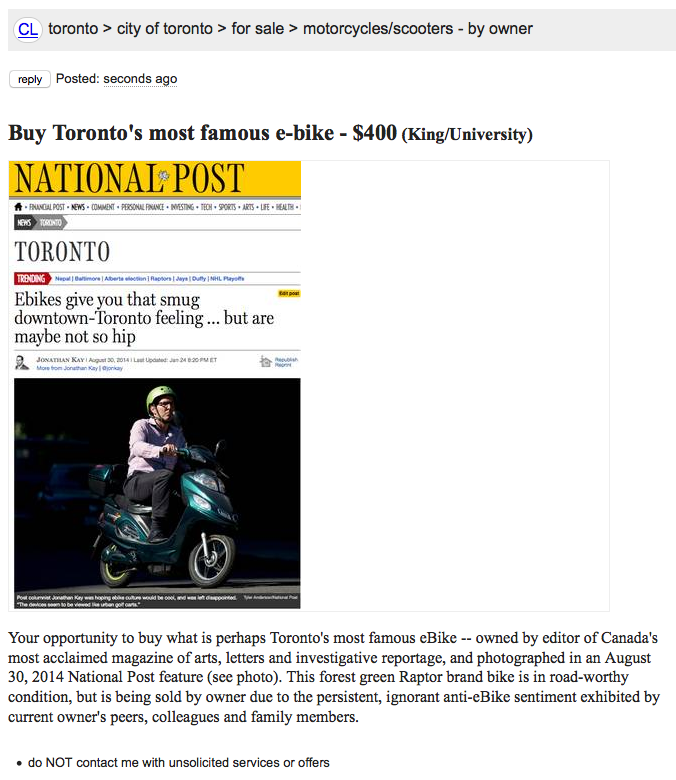
Despite having become the editor-in-chief of The Walrus, poor Jonathan Kay suffers the slings and arrows of all those who condemn and ridicule his ridiculous choice of transportation ebike (especially from his own staff):
City planners think of transportation in terms of its logistical and infrastructural components. That’s also how the issue gets discussed in the context of, say, energy conservation and traffic management. But when it comes to the transportation products we actually buy, our utilitarian calculus is overwhelmed by our aesthetic biases. When the Segway scooter had its great reveal in 2001, few observers cared about its groundbreaking self-balancing technology. All they saw was a nerd standing upright, wearing a funny helmet.
It is a lesson I have learned again over the last year, at great cost in dignity and personal reputation, as I have motored around Toronto on an ebike — a zero-emission electric scooter that travels at speeds of up to 32 km/h. As I noted in an essay last year, ebikes combine the low cost and convenience of a bicycle, while allowing a user to get to work without an ounce of sweat or a stitch of lycra.
In a more perfect world, the streets of our cities would be humming with ebikes. But that is not the world we inhabit. After a year of evangelizing these fantastically useful, earth-friendly contraptions among my peer group, I’ve failed to gain a single new convert.
Just the opposite, in fact: I have become a figure of overt and willfully cruel mockery.
In the June issue of Reason, Scott Shackford talks about the work of the late, great Terry Pratchett:
Terry Pratchett may not have been the first writer to personify Death as a walking, talking skeleton tasked with reaping the souls of the living, but he was the first to give him a horse named Binky and a granddaughter named Susan.
This Death was no less efficient or inevitable despite all the whimsy, of course. As various characters in Pratchett’s long-lasting, wildly popular series of fantasy novels passed on, Death traveled across Discworld — a flat planet resting on the backs of four elephants who stood on a giant turtle that swam through the universe — to ferry the newly deceased to whatever came afterward.
So it was highly appropriate that after Pratchett’s death at age 66 on March 12, following a long and deliberately public faceoff with early-onset Alzheimer’s disease, the novelist’s official Twitter account described his passing as Death gently escorting Pratchett from our rounder, less turtle-dependent world.
But let’s not dwell on Death. Pratchett’s Discworld books, all 40 of them (not counting short stories and related works), teemed with messy, disorganized life. And because he wrote in the fantasy genre, they were also packed with wizards, witches, dwarves, dragons, vampires, zombies, demons, werewolves, and the occasional orangutan. His books were humorous in tone, but tackled weighty matters of self-determination, identity, innovation, and, above all else, liberty.
“Whoever created humanity left in a major design flaw. It was the tendency to bend at the knee.” That piece of insight came from Feet of Clay, a book from right in the middle of his series, published in 1996. The witticism encapsulates a consistent theme in his books approaching how humans (and other sentient species) struggle between the desire to be free and the comfort of letting somebody more powerful or smarter (or claiming to be smarter, anyway) call the shots. In Pratchett’s books, both the heroes and the villains tended to be people in positions of authority. What separated his heroes — people like police commander Samuel Vimes, witch Esme “Granny” Weatherwax, and even Patrician Havelock Vetinari, an assassin turned ruler of the sprawling city of Ankh-Morpork — from the villains was their insistence on letting people live their own lives, whatever may come of it, even when they made a mess of things.
Published on 26 Dec 2014
Narrated by ORSON WELLES (O.W. bonus: voice of Christ)
This report says that one of the richest men in the world is opening new frontiers in philanthropy:
Perennial contender for World’s Richest Man Carlos Slim announced Friday that he had reconsidered selling his Upper East Side home for $80 million, and instead was opening the Beaux Arts mansion to undocumented roomers. “Ever since I became the second largest shareholder in New York Times Inc., I’ve started reading the editorials,” explained the telecom monopolist. “And they’ve convinced me! What’s all this obsession with documents anyway?”
The Mexican oligarch continued, “If you can fool my doorman into letting you in once, or if you have the moxie to throw a brick through my window and crawl in over the broken glass, well, it would be inhumane to evict you. And if you have kids or parents, then they can come too because I wouldn’t want to stand in the way of family reunification. If I find you inside my house, then mi casa es su casa!”
This is clearly too good to check (but I did verify that the story isn’t dated April 1st, so it must be true, right?



Powered by WordPress