Whiskey in the USA has a long, colourful history. (Note that it is indeed spelt with an “e”, along with Irish whiskey — the Scotch and Canadian varieties are both plain whisky.)
One of the most illustrious early American distillers was George Washington, who manufactured the stuff commercially at his place near Mount Vernon in Virginia, and was very proud of the high reputation of his merchandise. I’m sure it was great for its time, but then and for long afterwards the general run of whiskey must have been pretty rough. I’ve often thought that the really amazing achievement of the Western hero wasn’t his ability to shoot a pip out of a playing card at fifty paces, nor even his knack of dropping crotch first into his saddle from an upstairs window, but the way he could stride into the saloon, call for whiskey, knock it back neat and warm in one and not so much as blink, let alone burst into paroxysms of uncontrollable coughing.
All that, of course, is changed now. American whiskeys are second to none in smoothness, blandness, everything that goes to make a fine spirit. Some of them, like Washington’s product and many since, are based on rye, but nearly all the brands we see in the UK belong in the bourbon category. Bourbon (rhymes with turban) gets its name from Bourbon County, Kentucky, where the first stills of this type were set up, though it’s long been regularly made in several other states besides. Federal law requires bourbon whiskey to be derived from a cereal mash of at least 51 per cent corn, which is to say Indian corn, often called maize over here, though it’s the identical vegetable that makes you, or me, so tremendously fat eaten off the cob.
The manufacturing process is carried out by means of large stills that operate on exactly the same principle as the patent or Coffey stills used in the production of grain whisky in Scotland. The young spirit is then drawn off to mature in specially charred oak barrels. Until recently, these were required to be new, but it seems that nowadays used casks are permitted. This is bad news for some distillers in Scotland, who formerly imported the secondhand casks to age their own whisky in.
Prominent brands of bourbon available in the UK include Jim Beam, Old Grandad, Wild Turkey, and Jack Daniel’s. Wild Turkey is a newcomer, to this country at any rate, and increasingly tipped as the best. Jack Daniel’s is the established quality leader. Strictly it isn’t a bourbon at all, but a Tennessee whiskey made at Lynchburg in Moore County, no less.
Don’t go there, as I once did. Moore County turned out to be dry and all I got to drink all day was a glass of cold tea at Madame Bobo’s Boarding House. I doubt if things have changed much.
Kingsley Amis, Everyday Drinking: The Distilled Kingsley Amis, 2008.
June 20, 2014
QotD: Whiskey and bourbon
June 19, 2014
QotD: You (probably) drive on the wrong side of the road
The heart is (or to be exact, appears to be) on the left side of the body. In the more primitive form of warfare some form of shield is therefore used to protect the left side, leaving the offensive weapon to be held in the right hand. The normal offensive weapon was the sword, worn in a scabbard or sheath. If the sword was to be wielded in the right hand, the scabbard would have to be worn on the left side. With a scabbard worn on the left, it became physically impossible to mount a horse on the off side unless intending to face the tail — which was not the normal practice. But if you mount on the near side, you will want to have your horse on the left of the road, so that you are clear of the traffic while mounting. It therefore becomes natural and proper to keep to the left, the contrary practice (as adopted in some backward countries) being totally opposed to all the deepest historical instincts. Free of arbitrary traffic rules the normal human being swings to the left.
C. Northcote Parkinson, “Personality Screen, Or The Cocktail Formula”, Parkinson’s Law (and other studies in administration), 1957.
The NFL conspiracy theorist
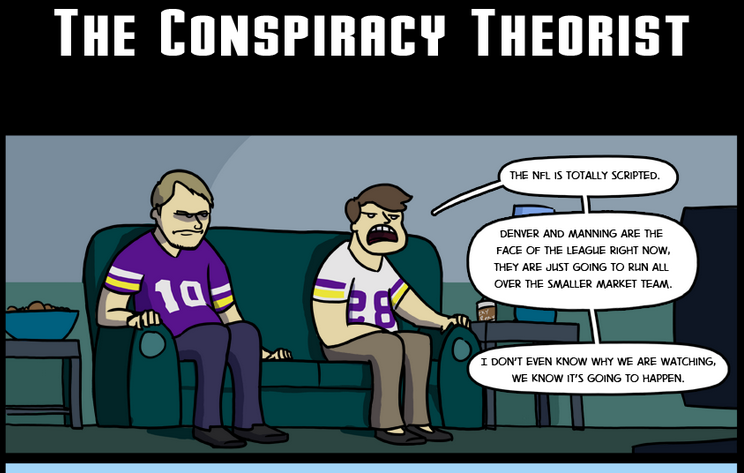
“Draw Play” Dave Rappoccio is running a series of cartoons on the various sub-groups of NFL fans. This week’s subject is the Conspiracy Theorist:
He also talks about the mentality of the conspiracy theorist fan in some detail:
A part of me struggles to accept that people this deluded actually exist, but they do. I’ve heard stories, and I’ve seen the occasional online post about it. These people are few, but not fictional. There are actually people who think the NFL is scripted.
Like most conspiracy theories it sounds absolutely stupid at first, then part of you might go “well, I guess that was kinda perfect that it happened just that way”, then you think about it a little more and you realize that yup, it’s still stupid and the logic falls apart. But some people don’t get past that second stage. I can’t figure out why. The best guess I can muster is that most of the fans are somehow bitter about the way their team loses or something.
[…]
But some people legit think it’s scripted like pro wrestling. These people are…I can’t defend them. They are deluded. For everything that sounds like it might make some sense, lots of other things just make it feel so forced. The NFL has been around for a long time, and started as a small time game. It has grown into the giant it is not overnight, but over decades. There has never, ever, been any evidence that has come out to suggest it’s scripted. No retired referees, no disgruntled employees, nothing. Over decades. Come on. There are so many people covering the league now, so many media members, so many pundits, so many sources. The NFL being scripted would be a huge story, but none of them have ever investigated it? Nothing? No player, current or former, EVER, in all this time, has come out and said things weren’t right. None have even suggested it. You think in a league with players treated as poorly as they are in medical coverage that one wouldn’t want to blow the lid off the biggest sports story ever? There is no evidence of scripted play, and if you think it is, you are dumb. We are not sheeple, you are gullible & trying to find deeper issues where they don’t exist.
I forwarded the link to a friend of mine who is emphatically not a sports fan, but who has floated the occasional theory about “the fix” being in in all professional sports in one way or another. His response was entertaining:
As for the article, I’m not entirely sure of his point. Is he arguing that pro sports cannot possibly be fixed because the key games are often so boring? The author so wants to believe in his fantasy land where men wearing shiny tight pants can bum-pat and hug each other without feeling a little bit weird about it that he’s willing to overlook any possibility of there being corruption in the game. […]
Football gives the illusion of one team being better than another through its very short season. With just 16 games, you just do not have a very large sample size to gauge performance. It’s like me typing 16 words without an error: I must therefore be the world’s best typist. If the NFL season dragged on as long as the insufferable NHL season, I bet we’d see all of the teams finish much closer together in their win-loss-tie figures. With a larger sample, we’d likely see that all the teams are likely pretty much the same.
But pro sports fans really want to believe in heart and giving a-hundred-and-ten-per-cent and playing a good psychological game and putting the biscuit in the basket and all of that other crap. Even if refs and players came forward and admitted to throwing games I suspect that the fans would not want to believe them. Look how the fans keep coming back even after players’ strikes — these are people so desperate for a fix that they will put almost anything in their veins.
June 16, 2014
The Kronies: Laughing All The Way to the Export-Import Bank
Published on 16 Jun 2014
Get Konnected at http://thekronies.com/
In this very special episode of “The Less You Know”, Johnny and Bobby learn a valuable lesson about campaign finance.
With a crucial re-authorization vote looming, the Representatives must decide whether or not to support the U.S. Export-Import Bank. Johnny and Bobby nearly make a terrible mistake, one that could endanger their political careers!
Luckily, Bankor and Ariel Stryker appear just in time to set the Reps straight…straight on the path to re-election. Including a special appearance by “the Big man” himself, this episode is sure to capture hearts, minds, and votes.
June 13, 2014
QotD: Mathematical formula describing bureaucratic growth
Dealing with the problem of pure staff accumulation, all our researches so far completed point to an average increase of 5.75 per cent per year. This fact established, it now becomes possible to state Parkinson’s Law in mathematical form: In any public administrative department not actually at war, the staff increase may be expected to follow this formula —
x=(2km + l) / n
k is the number of staff seeking promotion through the appointment of subordinates; l represents the difference between the ages of appointment and retirement; m is the number of man-hours devoted to answering minutes within the department; and n is the number of effective units being administered. x will be the number of new staff required each year. Mathematicians will realize, of course, that to find the percentage increase they must multiply x by 100 and divide by the total of the previous year, thus:
100 (2km + l) / y n %
where y represents the total original staff. This figure will invariably prove to be between 5.17 per cent and 6.56 per cent, irrespective of any variation in the amount of work (if any) to be done.
The discovery of this formula and of the general principles upon which it is based has, of course, no political value. No attempt has been made to inquire whether departments ought to grow in size. Those who hold that this growth is essential to gain full employment are fully entitled to their opinion. Those who doubt the stability of an economy based upon reading each other’s minutes are equally entitled to theirs. It would probably be premature to attempt at this stage any inquiry into the quantitative ratio that should exist between the administrators and the administered. Granted, however, that a maximum ratio exists, it should soon be possible to ascertain by formula how many years will elapse before that ratio, in any given community, will be reached. The forecasting of such a result will again have no political value. Nor can it be sufficiently emphasized that Parkinson’s Law is a purely scientific discovery, inapplicable except in theory to the politics of the day. It is not the business of the botanist to eradicate the weeds. Enough for him if he can tell us just how fast they grow.
C. Northcote Parkinson, “Parkinson’s Law, or the rising pyramid”, Parkinson’s Law (and other studies in administration), 1957.
June 9, 2014
June 4, 2014
It’s clearly time for The Something Must Be Done Act 2014
A post by David Allen Green from last year that prefigures the political landscape of today:
… all this statutory output is subject to the tiresome jurisdiction of the courts — the High Court will quash delegated legislation and use “human rights” jurisprudence to interpret the word of parliament out of recognition. Something must be done.
So this Act is a modest proposal for our legislators and public officials. Once it is passed, no other legislation will ever be necessary and the meddlesome courts will be neutered. This would be a Good Thing.
Let’s start with Section 1:
“The Crown shall have the power to do anything, and nothing a Minister of the Crown does will be ultra vires.”
That should shut up the High Court for a while with their judicial review decisions.
But adding a second section to the Act will make sure that Ministers will act in the interests of all of us. So for the avoidance of doubt, Section 2 provides:
“The power given by Section 1 of this Act shall include the banning of things by any Minister of the Crown.”
But what things can be banned? Well, here’s Section 3:
“The things to be banned referred to in Section 2 of this Act shall be the things which a Minister of the Crown says are bad for us.”
Which in turn leads us to Section 4:
“What is bad for us for the purposes of Section 3 shall be determined by a Minister of the Crown with regard either to (a) headlines in the tabloid press of the day and/or (b) the headlines the Minister of the Crown would like to see in the tabloid press tomorrow.”
Section 5 will then provide:
“Any person
(a) voicing opposition to a determination made under Section 4 of this Act; or
(b) acting in breach of a ban made under Section 1 of this Act, shall be deemed to not care about the children and/or to be soft on terrorism.”
The Act should also include the following power at Section 6 so that any emerging issues can be addressed:
“In the event something must be done, a Minister may at his or her discretion choose a thing to do, and the thing chosen shall be deemed as the something that must be done.”
This discretionary power, however, is subject to Section 7:
“The thing chosen under Section 6 shall not have any rational or proportionate relationship to any intended objective.”
The way a lot of ministers carry on, you’d think this act had already been promulgated…
Gavin McInnes gives a shout-out to the Rebel Alliance
Gave a shout out to the Rebel Alliance on Fox last night. They are a group of kids in the future who live in the sewers like Ninja Turtles and refuse to pay our bloated pensions. That’s the problem with all this talk of the debt we’re saddling our children with. It assumes they’re going to pay it.
What if they just say, “Fuck off” like they do in Costa Rica? The taxes are too high there so most people just refuse to pay. When everyone does it, the government can’t do anything about it. This next generation is tech-savvy enough to create their own currency and barter their own exchanges and the sewers they live in won’t be gross. They’ll be like a cool teen’s bedroom from 1990.
H/T to Kathy Shaidle for the link.
June 3, 2014
QotD: Parkinson’s Law
Work expands so as to fill the time available for its completion. General recognition of this fact is shown in the proverbial phrase “It is the busiest man who has time to spare.” Thus, an elderly lady of leisure can spend the entire day in writing and dispatching a postcard to her niece at Bognor Regis. An hour will be spent in finding the postcard, another in hunting for spectacles, half an hour in a search for the address, an hour and a quarter in composition, and twenty minutes in deciding whether or not to take an umbrella when going to the mailbox in the next street. The total effort that would occupy a busy man for three minutes all told may in this fashion leave another person prostrate after a day of doubt, anxiety, and toil.
C. Northcote Parkinson, “Parkinson’s Law, or the rising pyramid”, Parkinson’s Law (and other studies in administration), 1957.
June 2, 2014
QotD: Realtors
I talked a few times with the realtor, and they were as helpful as realtors usually are: not helpful. They couldn’t answer any important questions for me, because realtors don’t know anything important about the properties they sell. Well, that’s not entirely true. They often know very important things about the properties they sell. Those are invariably the things they’re hiding from you, hoping to entice you into standing in the decrepit shack they’re listing while they perform their Svengali perorations about its potential. Weave a tapestry of possibilities in the air that’ll have you frisking yourself in no time, looking for your checkbook before that handyman that’s interested in the property snatches it from under your nose.
Oh, I know that handyman. That guy gets around. I never learned his name, but he seemed to be interested in every property I was interested in Maine. No matter where I went — Turner, Cornish, Peru, Livermore Falls, Norway, Rumford…
Anyway, that polymath handyman with the lead foot and the nose for diamonds in the rough was always one step ahead of us, ready to stuff our defeat into the jaws of his victory. He was very interested in Turner, I hear.
Sippican Cottage, “I’m Fixing A Hole Where The Intertunnel Gets In “, Sippican Cottage, 2013-11-13
June 1, 2014
QotD: The fine art of whisky snobbery
These days your host might offer you a malt whisky almost any time. If he’s mad enough to offer you ice, or better still, drop it in unasked, you get bonus points for the way you manage to restrain your horror at the fellow’s barbarism. When you finally taste the stuff, say, “Ah, the old Glencluskie. Magnificent, but not what it was. It’s this damned Canadian barley. Too much starch, not enough protein and fat. Thank heaven there’s still some peat in the kilning.” All very well today, but on present trends there’ll soon be whisky snobs fit to compare with any wine snobs of yesteryear.
Kingsley Amis, Everyday Drinking: The Distilled Kingsley Amis, 2008.
May 31, 2014
Scott Feschuk: “How murdered might you get at the World Cup?”
Worried about your personal safety at the World Cup in Brazil? Scott Feschuk helps you to be as worried as you should be:
Has there been much corruption?
Define “much.” If you mean scattered incidents of price gouging to line the pockets of a few local firms and politicians, then yes. But if you mean a grandly orchestrated, systemic pilfering of hundreds of millions of dollars, then yes. Brazilian soccer legend Pelé describes it as a “disgrace.” (By the way, it is mandatory that Pelé be quoted in every World Cup article, no matter the topic: RAIN COMING WEDNESDAY ACCORDING TO ‘FEELING IN KNEE,’ LEGEND DECLARES.)
[…]
If I go to the World Cup, how murdered will I get?
British papers have been playing up the threat of violent crime, depicting the cities of Brazil as crime-infested hellscapes through which there is scant hope of safe passage. The way they tell it, Rio is like Gotham before Batman or Times Square before Applebee’s.
So concern is overblown?
Oh God, no. But listen: the people of Brazil are well aware of your fears. To their credit, they’ve taken substantive action to address the issue by, um, well … they published a brochure.
What — a guide on how to react when you’re mugged at gunpoint, haha?
Yep. Brazilians have a lot of interesting traditions. They speak directly. They touch one another lightly while talking. And their criminals like to kill people who make a fuss over getting robbed. They even have a word for a mugging that escalates into a murder: latrocinios. You know people are serious about something when they have a word or phrase for it. Just ask the people at McDonald’s about Kirstie Alley and second breakfast.
What does the brochure recommend?
Remain calm. Do your best not to cry out. If you stay largely motionless and don’t say a word, it will be over soon enough. Pretty much the same guidelines to follow when losing your virginity.
May 29, 2014
QotD: Formula for measuring the importance of managers
Every student of human institutions is familiar with the standard test by which the importance of the individual may be assessed. The number of doors to be passed, the number of his personal assistants, the number of his telephone receivers — these three figures, taken with the depth of his carpet in centimeters, have given us a simple formula that is reliable for most parts of the world.
C. Northcote Parkinson, “Plans And Plants, or the Administration Block”, Parkinson’s Law (and other studies in administration), 1957.
May 25, 2014
A hit, a palpable hit
I’ve never met Tom Gauld, but he seems to know far too much about me…
May 24, 2014
First US military union approved, strike imminent
What The Onion does for civilian news, Duffel Blog does for military news. Here’s their coverage of the US military following European practice and allowing the first military union to be formed:
In a historic move, the Department of the Army has recognized the right of service members to unionize.
“Historically, collective bargaining has improved American working conditions and made us the envy of the world economically. We’re pleased to announce that our soldiers can now have that right. In defending democracy, our service members should reserve the right to practice it,” declared Secretary of the Army John McHugh.
McHugh went on to say that the founding of a union had been under way for sometime and required lengthy negotiations with top civilian and military leaders, before an acceptable framework emerged. The first union, the Junior Enlisted Service Members (JESM), almost immediately threatened a strike.
PFC Harry Milton of the 323rd Military Intelligence Battalion is the founder of JESM. The 19 year-old soldier invited Duffel Blog into his new office in the reserve center, just outside Ft. Meade, MD, where JESM is headquartered.