
TimeGhost History
Published 31 Mar, 2025In 1947, Mao’s Communist forces launch massive counter-offensives, turning the tide of the Chinese Civil War. As Nationalist troops led by Chiang Kai-shek desperately hold their positions, the Communists gain ground through ruthless tactics — including brutal land reforms and psychological warfare. With battles raging from Manchuria to Central China, this conflict will decide the fate of millions. Is Chiang’s collapse now inevitable?
(more…)
April 1, 2025
Mao Murders One Million Landlords – W2W 17 – 1947 Q4
Comments Off on Mao Murders One Million Landlords – W2W 17 – 1947 Q4
Americans DON’T KNOW about this workbench
Rex Krueger
Published 27 Nov 2024The workbench western woodworking didn’t know it needed.
Comments Off on Americans DON’T KNOW about this workbench
March 31, 2025
Berettas With Bayonets: The Very Early Model 38A SMG
Forgotten Weapons
Published 29 Nov 2024The initial model of the Beretta 38A had a number of features that were dropped rather quickly once wartime production became a priority. Specifically, they included a lockout safety switch for just the rear full-auto trigger. This was in place primarily for police use, in which the guns were intended for semiautomatic use except on dire emergency (and the first batches of 38As in Italy went to the police and the Polizia dell’Africa Italiana). The first version of the 38A also included a bayonet lug to use a version of the folding bayonet also used on the Carcano rifles. This was a folding-blade bayonet, and the model for the 38A replaced the rifle muzzle ring with a special T-lug to attach to the muzzle brake of the SMG. These bayonets are extremely scarce today, as they were only used for a very limited time.
(more…)
Comments Off on Berettas With Bayonets: The Very Early Model 38A SMG
QotD: The problem of defending the late Roman Empire
As we move into the later Roman Empire, particularly after the Crisis of the Third Century (235-284 AD), we start to see changes in the form of Roman forts. Two things had been happening of the course of the Crisis (and in some cases before it) which transformed the Roman frontier situation. First, Rome’s enemies had gotten quite a bit stronger: in the west, long exposure to Rome had led the various “barbarians” on the other side of the limes to both pick up elements of Roman military practice but also to form into larger and larger political units (in part in order to hold off Roman influence) which were more dangerous. In the east, the Parthian Empire had collapsed in 224 to be replaced by the far more capable and dangerous Sassanid Empire. At the same time, fifty years of civil war had left Rome itself economically and militarily weaker than it had been. Bigger threats combined with scarcer state resources enforced a more flexible approach to controlling the borders.
In particular, Roman forces could no longer be entirely sure they would possess escalation dominance in any given theater. Indeed, during the Crisis, with legions being peeled to fight endless internal wars between rival claimants had meant that major frontier problems might go under-resourced or even entirely unaddressed for years. While the reign of Diocletian (284-311) marked a return to Roman unity, quite a bit of damage had already been done and by the end of the third century we see changes in patterns of fortification that reflect that.
The changes seem fairly clearly to have been evolutionary, in part because many older legionary forts remained in use. Some of the first things we see are traditional “playing-card” forts but now with the neat rectangular shape disrupted by having the towers project out from the walls. The value of a projecting tower […] is that soldiers on the tower, because it projects outward, can direct missiles (arrows, javelins, slings, etc) down the length of the wall, engaging enemies who might be trying to scale the wall or breach it. Of course a fortress that is now being designed to resist enemies scaling or breaching large stone walls is no longer worried about a raid but rather being designed to potentially withstand a serious assault or even a siege. Defensive ditches also multiply in this period and increase in width, often exceeding 25ft in width and flat-bottomed; the design consideration here is probably not to stop a quick raid anymore but to create an obstacle to an enemy moving rams or towers (think back to our Assyrians!) close to the walls.
Over time, forts also tended to abandon the “playing-card” proportions and instead favor circular or square shapes (minimizing perimeter-to-defend for a given internal area). And while even the original Roman marching camps had been designed with a concern to make it hard for an enemy to fire missiles into the camp – using the trench to keep them out of range and keeping an interval (literally the intervallum, the “inside the wall”) between the vallum and the buildings so that any arrows or javelins sent over the walls would land in this empty space – later Roman fortresses intensify these measures; we even see fortresses like the one at Visegrád incorporate its internal structures into the walls themselves, a measure to make the troops within less vulnerable to missile fire in a siege; this style becomes increasingly common in the mid-fourth century. Finally, by the fifth century we start to see the sites of Roman forts changing too, especially in the western part of the empire, with forts moving from low-land positions along major roadways (for rapid response) to hilltop sites that were less convenient for movement but easier to defend (in the East, a lot of the focus shifts to key heavily fortified cities – essentially fortress cities – like Nisibis (modern Nusaybin), Amida, Singara and Dara.
In short, Roman forts in this late period are being designed with the ability to resist either serious assaults or prolonged sieges. This in part reflects a lack of confidence that the Romans could always count on being able to immediately force a field battle they could win; while Roman armies retained the edge through most of this period, the main field armies were increasingly concentrated around the emperors and so might be many days, weeks or even months away when an incursion occurred; local forces had to respond elastically to delay the incursion much longer than before until that army could arrive.
Now of course the downside to a focus like this on single-site defense (“point defense” in its most basic form) is that the enemy army is given much more freedom to move around the countryside and wreck things, where they would have been engaged in the older observe-channel-respond defense system much more quickly (Luttwak terms this “preclusive” defense, but it isn’t quite that preclusive; the frontier is never a hard border). But of course the entire reason you are doing this is that the shifting security situation means you can no longer be confident in winning the decisive engagement that the observe-channel-respond defense system is designed for; you need to delay longer to concentrate forces more significantly to get a favorable outcome. Single-site defenses can do this for reasons we’ve actually already discussed: because the army in the fort remains an active threat, the enemy cannot generally just bypass them without compromising their own logistics, either their supply lines or foraging ability. Consequently, while some forts can by bypassed, they cannot all be bypassed (a lesson, in fact, that the emperor Julian would fail to learn, leading to disaster for his army and his own death).
And so the enemy, while they can damage the immediate environment, cannot proceed out of the frontier zone (and into the true interior) without taking some of these forts, which in turn will slow them down long enough for a major field army to arrive and in theory offer battle on favorable terms.
While it is easy to discount these shifts as just part of the failure of the Roman Empire (and we’ll come back to this idea, often presented in the form of a misquotation of George S. Patton that “fixed fortifications are monuments to the stupidity of man” though what he actually said was merely that the Maginot line was such), they contributed meaningfully to the Roman ability to hold on to a vast empire in an increasingly more challenging security environment. At pretty much all stages of its development, Roman fortification on the frontiers was designed to allow the Romans to maintain their territorial control with an economy of force precisely because the Roman Empire could not afford to maintain overwhelming force everywhere on its vast perimeter. Rome wasn’t alone in deploying that kind of defensive philosophy; at any given point the northern frontier of China was guarded on much the same principles: the need to hold a frontier line with an economy of force because no state can afford to have overwhelming force everywhere. In both cases, the need for defense was motivated in no small [part] by the impossibility of further offensive; in the Roman case, further extension of the limes would simply create more territory to defend without actually creating more revenue with which to defend it (this is why the Roman acquisition of Dacia and much of Britain were likely ill-conceived, but then both operations were politically motivated in no small part) while in the Chinese case, the logistics of the steppe largely prohibited further expansion.
This Roman system, combining local single-site defenses (which included a proliferation of walled towns as the population centers of the western empire frantically rebuilt their walls) with concentrated mobile field armies really only began to fail after the Battle of Adrianople (378), where to be clear the fortification system worked fine, the error came from the emperor Valens’ stupid decision to attack before his co-emperor Gratian could arrive with reinforcements (Valens was eager to get all of the credit and so he takes all of the blame).
Bret Devereaux, “Collections: Fortification, Part II: Romans Playing Cards”, A Collection of Unmitigated Pedantry, 2021-11-12.
Comments Off on QotD: The problem of defending the late Roman Empire
March 30, 2025
QotD: FDR, Mackenzie King and Churchill in 1940
Winston Churchill was informed by the Canadian Prime Minister, Mackenzie King, of more dreadful news.
Roosevelt had no faith in Churchill nor Britain, and wanted Canada to give up on her.
Roosevelt thought that Britain would likely collapse, and Churchill could not be trusted to maintain her struggle.
Rather than appealing to Churchill’s pleas of aid — which were politically impossible then anyway — Roosevelt sought more drastic measures.
A delegation was summoned [from] Canada.
They requested Canada to pester Britain to have the Royal Navy sent across the Atlantic, before Britain’s seemingly-inevitable collapse.
Moreover, they wanted Canada to encourage the other British Dominions to get on board such a plan.
Mackenzie King was mortified. Writing in his diary,
“The United States was seeking to save itself at the expense of Britain. That it was an appeal to the selfishness of the Dominions at the expense of the British Isles. […] I instinctively revolted against such a thought. My reaction was that I would rather die than do aught to save ourselves or any part of this continent at the expense of Britain.”
On the 5th June 1940, Churchill wrote back to Mackenzie King,
“We must be careful not to let the Americans view too complacently prospect of a British collapse, out of which they would get the British Fleet and the guardianship of the British Empire, minus Great Britain. […]
Although President [Roosevelt] is our best friend, no practical help has been forthcoming from the United States as yet.”
Another example of the hell Churchill had to endure — which would have broken every lesser man.
Whilst the United States heroically came to aid Britain and her Empire, the initial relationship between the two great powers was different to what is commonly believed.
(The first key mover that swung Roosevelt into entrusting Churchill to continue the struggle — and as such aid would not be wasted on Britain — was when Churchill ordered the Royal Navy’s Force H to open fire and destroy the French Fleet at Mers-el-Kébir — after Admiral Gensoul had refused the very reasonable offers from Britain, despite Germany and Italy demanding the transference of the French Fleet as part of the armistices.)
Andreas Koreas, Twitter, 2024-12-27.
Comments Off on QotD: FDR, Mackenzie King and Churchill in 1940
March 29, 2025
Why India and Pakistan Hate Each Other – W2W 015 – 1947 Q3
TimeGhost History
Published 23 Mar 2025In 1947, the British divide the Raj into two nations, India and Pakistan, triggering one of the deadliest mass migrations in history. Sectarian violence between Hindus, Sikhs, and Muslims leaves at least 200,000 dead and displaces millions more. Hastily drawn borders turn neighbours into enemies. The partition’s bloody legacy will lead to decades of tension, war, and bloodshed.
(more…)
Comments Off on Why India and Pakistan Hate Each Other – W2W 015 – 1947 Q3
The Life of Plutarch
MoAn Inc.
Published 19 Sept 2024#AncientHistory #AncientGreece #Plutarch
Donate Here: https://www.ko-fi.com/moaninc
Comments Off on The Life of Plutarch
March 28, 2025
The Man Hitler Needs for Civil War, Ernst Röhm, Returns!
World War Two
Published 27 Mar 2025January 1931 starts with violence, economic collapse, and Nazi upheaval in Germany. Hitler secretly meets with army chief Kurt von Hammerstein-Equord, while Ernst Röhm returns to take command of the Nazi paramilitary SA. As hundreds of thousands of miners face mass layoffs and brutal crackdowns, the republic’s future hangs in the balance — how long can democracy hold on?
(more…)
Comments Off on The Man Hitler Needs for Civil War, Ernst Röhm, Returns!
The First Sturmgewehr: The MKb42(H)
Forgotten Weapons
Published 27 Nov 2024The first iteration of the iconic German Sturmgewehr was developed by Haenel starting in 1938. It was a select-fire rifle chambered for the short 8x33mm cartridge, developed by the Polte company. It used a long-stroke gas piston and a tilting bolt patterned after the Czech ZB-26 light machine gun. What makes the MKb42(H) stand out from the later Sturmgewehr models is that it was an open-bolt design. The original design spec was concerned about preventing cook-offs, and so it required firing from an open bolt. This means a very simple fire control system, but it also made the rifle difficult to shoot accurately in semiautomatic.
The first MKb42(H) prototype was finished in 1941, with 50 sample guns produced by late March 1942. A major trial was held in April 1942, in which Hitler rejected the design (mostly, he disliked the smaller cartridge). Development was continued anyway, with a move to a closed-bolt system that would become the MP43/1 which was ready for its first testing in November 1942. The open-bolt 42(H) was put into production anyway, as a stopgap measure to provide some much-needed individual firepower to troops on the Eastern front. Serial production began in January 1943, and continued until September 1943. In total, 11,813 of the rifles were manufactured. They saw use in Russia until replaced by newer MP43 models, and represent the first combat use of the assault rifle concept.
(more…)
Comments Off on The First Sturmgewehr: The MKb42(H)
QotD: Prosopography
Prosopography is vital in the study of Classical Antiquity, especially the Roman Republic. The Romans, as I’m sure you recall, practiced “patronage and clientage” — a man’s clients were often in a very real way more important than his biological family. Prove that Wossname was So-and-So’s client, and you know a lot about Wossname, even if you can’t find it in the archaeological record, and what you do know about him from the record takes on a whole new meaning. For instance, under Gaius Marius (et al.), the patron / client relationship got extended to the army — coteries of officers and NCOs personally loyal to their commanding general, not to the State — and there’s your Fall of the Roman Republic.
Kremlinology required something similar. Since the important levels of the Apparat all went to the same Higher Party Schools in Moscow, the fact that So-and-So was Wossname’s roommate for a few semesters was potentially of much greater importance than anything So-and-So did as the People’s Commissar of Whatever. He might’ve looked like a real up-and-comer based on his early promotion to a prestige post, but based on his prosopography an experience Kremlinologist might deduce that this was just horse-trading — someone high up in the Politburo owed Wossname’s father a favor for something back in the Great Patriotic War, and so this was payback; Wossname wasn’t going any higher than that.
It’s even more important in a completely ideologized society like the USSR. No Roman client would ever go so far as to openly stab his patron in the back — no one in his society would ever trust him again; he’d get shanked the very minute he donned the purple — but a Roman could have a change of heart. He might get religion, of either the philosophical (Epicureanism, Stoicism) or the actual cultic sort. This would significantly change the patron / client relationship. But in a society like the USSR — ostentatiously dedicated to the World Proletarian Revolution — ideology imposed some hard limits …
Severian, “Alt Thread: A Brief Bit of Brandonology”, Founding Questions, 2021-12-01.
Comments Off on QotD: Prosopography
March 27, 2025
Ban the swastika? Are you some kind of racist?
In Ontario, the elected council for the Region of Durham has been reacting to a few painted swastika graffiti around the region over the last couple of months. To, as a politician might say, “send a message”, they proposed banning the use of the swastika altogether … failing to remember that it’s not just neo-Nazi wannabes who use it:
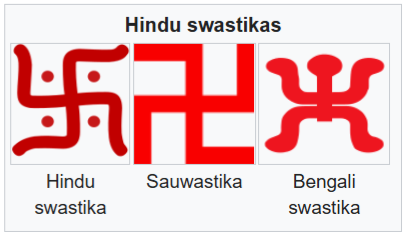
Durham council is adjusting the wording of its calls for a national ban on the Nazi swastika, or “Hakenkreuz“.
This follows efforts by religious advocates to distance their own symbols from the genocidal German fascist regime.
Swastikas often appear in Jain, Hindu and Buddhist iconography.
“The word ‘swastika’ means ‘well-being of all’,” explained Vijay Jain, president of Vishwa Jain Sangathan Canada, at Wednesday’s regional council meeting. “It’s a very sacred word. […] We use it extensively in our prayers.”
“Many Jain and Hindi parents give their children the name ‘Swastika’,” he added. “Many Hindi and Jain people, they keep their [business’s] name as ‘Swastika’. If you go to India, you’ll find the ‘Swastika’ name prominently used.”
“We stand in solidarity with the Jewish community and fully support all of the efforts by authorities to address growing antisemitism in Canada,” he said.
Regional council made its initial call for a ban on Nazi swastikas in February, after two separate incidents of the antisemitic symbol being scrawled inside a washroom at the downtown Whitby library.
On Wednesday, councillors voted to revise that motion to replace the word “swastika” with the term “Nazi symbols of hate”.
B’nai Brith Canada has been spearheading a petition campaign to have the Nazi symbol banned across the country.
The group has increasingly opted to refer to it by the alternative names “Nazi Hooked Cross” or “Hakenkreuz“.
On March 20, B’nai Brith put out a joint statement with Vishwa Jain Sangathan and other religious advocacy groups, calling for further differentiation between the symbols.
“These faiths’ sacred symbol (the Swastika) has been wrongfully associated with the Nazi Reich,” wrote Richard Robertson, B’nai Brith Canada’s Director of Research and Advocacy. “We must not allow the continued conflation of this symbol of peace with an icon of hate.”
Comments Off on Ban the swastika? Are you some kind of racist?
Uncovered: The CIA’s Secret War That Shook Stalin! – W2W 16 – 1947 Q3
TimeGhost History
Published 26 Mar 2025In 1947, the Cold War intensifies as the Truman and Zhdanov Doctrines divide the world into opposing camps. The CIA is born to counter communist threats, while Stalin’s Cominform tightens its grip across Eastern Europe. From Berlin’s streets crawling with double agents, to covert American election meddling in Italy, espionage becomes the frontline of this global showdown. Welcome to a new age of spies, secret doctrines, and ruthless intelligence wars.
(more…)
Comments Off on Uncovered: The CIA’s Secret War That Shook Stalin! – W2W 16 – 1947 Q3
QotD: Did humans domesticate plants, or was it the other way around?
Of course, the cultivation of crops enabled human beings to produce far more calories per unit of territory than foraging ever could. And this enabled the human population to expand exponentially, thus putting even more pressure on the food supply, thus necessitating an even greater emphasis on agriculture. Alongside this deepening spiral there were other unintended consequences as well. As Harari puts it: “Nor did the farmers foresee that in good years their bulging granaries would tempt thieves and enemies, compelling them to start building walls and doing guard duty”.
Giles Fraser, “The Magnificent Seven is a post-liberal idyll”, UnHerd, 2020-04-01.
Comments Off on QotD: Did humans domesticate plants, or was it the other way around?
March 26, 2025
The Korean War Week 040 – MacArthur Sandbags Truman – March 25, 1951
The Korean War by Indy Neidell
Published 25 Mar 2025Harry Truman is moving forward with his plans to somehow end the fight with the Chinese, but Douglas MacArthur takes a hatchet to those plans. Truman is furious, and the question remains, for how long will MacArthur’s defiance be tolerated? In the field, Operations Ripper, Courageous, and Tomahawk are in action, but are all disappointing for the UN forces, as they fail in their mission to destroy the enemy’s war making capacity. They don’t actually do much of that at all.
Chapters
00:00 Intro
00:51 Recap
01:08 Operation Ripper Ends
04:09 Operation Courageous
06:20 Operation Tomahawk
09:44 MacArthur’s Sabotage
13:27 Summary
13:36 Conclusion
(more…)
Comments Off on The Korean War Week 040 – MacArthur Sandbags Truman – March 25, 1951
Cooking on the German Home Front During World War 2
Tasting History with Max Miller
Published 12 Nov 2024Casserole made from sliced potatoes, fennel, and caraway served with pickled beets
City/Region: Germany
Time Period: 1941How well people ate in Germany during WWII really depended on who they were, where they were, and how long the war had been going on. This recipe, from 1941, assumes that people will still have access to ingredients like milk and eggs, which would become extremely scarce for most people in later years.
If you like the anise-like flavors of fennel and caraway, this dish is for you. The flavors are very prominent and really take over the whole casserole. If you’re not too concerned about historical accuracy with this one, I think some more milk or the addition of some cream or cheese would be delicious and add some moisture.
Fennel and Potato Casserole
1 kg fennel, 1 kg potatoes, 1/3 L milch, 1 egg, 30 g flour, 2 spoons nutritional yeast, caraway, salt
If necessary, remove the outer leaves from the fennel bulbs and cut off the green ones. Then cut them and the raw peeled potatoes into slices. Layer them in a greased baking dish, alternating with salt and caraway and the finely chopped fennel greens. The top layer is potatoes. Pour the milk whisked with an egg and a tablespoon of yeast flakes over it. Sprinkle with caraway and yeast flakes and bake the casserole for about 1 hour. — Serve with pickled beets or green salad.
— Frauen-Warte, 1941.
Comments Off on Cooking on the German Home Front During World War 2


