
The Korean War by Indy Neidell
Published 21 Mar 2025Learn to speak the language of modern war! Today, Indy goes over some of the history and uses of NATO Joint Military Symbology and how it inspires and helps us in our own cartography department. Join us for this crash course — the perfect accompaniment to the regular series.
(more…)
March 25, 2025
How Maps Decide Battles – NATO Symbology Special
Comments Off on How Maps Decide Battles – NATO Symbology Special
“Grey Ghost” – The French Occupation Production P38 Pistol
Forgotten Weapons
Published 23 Nov 2024When the French took over control of the Mauser factory complex in May 1945, the plant had some 85 tons of pistol parts on hand — 7.3 million individual components in various stages of production. This was enough to make a whole lot of guns, even if many of them were not completed parts. So alongside K98k rifles, HST and Luger pistols, the French restarted P38 pistol production at Mauser.
German military production ended at about serial number 3000f in April 1945, and the French chose to start back up at 1g. They would make a total of 38,780 P38s by the early summer of 1946, completing the G, H, and I serial number blocks and getting mostly through K as well. A final batch of 500 were numbered in the L series after being assembled back in France at the Chatellerault arsenal.
French production P38s are generally recognized by the French 5-pointed star acceptance marks on the slides. They will have slide codes of
svw45andsvw46(the French updated the code to match the year in 1946). Many of the parts used were completed prior to occupation, and various German proof marks can be found on some parts.
(more…)
Comments Off on “Grey Ghost” – The French Occupation Production P38 Pistol
QotD: The nature of kingship
As I hammer home to my students, no one rules alone and no ruler can hold a kingdom by force of arms alone. Kings and emperors need what Hannah Arendt terms power – the ability to coordinate voluntary collective action – because they cannot coerce everyone all at once. Indeed, modern states have far, far more coercive power than pre-modern rulers had – standing police forces, modern surveillance systems, powerful administrative states – and of course even then rulers must cultivate power if only to organize the people who run those systems of coercion.
How does one cultivate power? The key factor is legitimacy. To the degree that people regard someone (or some institution) as the legitimate authority, the legitimate ruler, they will follow their orders mostly just for the asking. After all, if a firefighter were to run into the room you are in right now and say “everybody out!” chance are you would not ask a lot of questions – you would leave the room and quickly! You’re assuming that they have expertise you don’t, a responsibility to fight fires, may know something you don’t and most importantly that their position of authority as the Person That Makes Sure Everything Doesn’t Burn Down is valid. So you comply and everyone else complies as a group which is, again, the voluntary coordination of collective action (the firefighter is not going to beat all of you if you refuse so this isn’t violence or force), which is power.
At the same time, getting that compliance, for the firefighter, is going to be dependent on looking the part. A firefighter who is a fit-looking person in full firefighting gear who you’ve all seen regularly at the fire station is going to have an easier time getting you all to follow directions than a not-particularly-fit fellow who claims to be a firefighter but isn’t in uniform and you aren’t quite sure who they are or why they’d be qualified. The trappings contribute to legitimacy which build power. Likewise, if your local firefighters are all out of shape and haven’t bothered to keep their fire truck in decent shape, you – as a community – might decide they’ve lost your trust (they’ve lost legitimacy, in fact) and so you might replace them with someone else who you think could do the job better.
Royal power works in similar ways. Kings aren’t obeyed for the heck of it, but because they are viewed as legitimate and acting within that legitimate authority (which typically means they act as the chief judge, chief general and chief priest of a society; those are the three standard roles of kingship which tend to appear, in some form, in nearly all societies with the institution). The situation for monarchs is actually more acute than for other forms of government. Democracies and tribal councils and other forms of consensual governments have vast pools of inherent legitimacy that derives from their government form – of course that can be squandered, but they start ahead on the legitimacy game. Monarchs, by contrast, have to work a lot harder to establish their legitimacy and doing so is a fairly central occupation of most monarchies, whatever their form. That means to be rule effectively and (perhaps more importantly) stay king, rulers need to look the part, to appear to be good monarchs, by whatever standard of “good monarch” the society has.
In most societies that has traditionally meant that they need not only to carry out those core functions (chief general, chief judge, chief priest), but they need to do so in public in a way that can be observed by their most important supporters. In the case of a vassalage-based political order, that’s going to be key vassals (some of whom may be mayors or clerics rather than fellow military aristocrats). We’ve talked about how this expresses itself in the “chief general” role already.
I’m reminded of a passage from the Kadesh Inscription, an Egyptian inscription from around 1270 BC which I often use with students; it recounts (in a self-glorifying and propagandistic manner) the Battle of Kadesh (1274 BC). The inscription is, of course, a piece of royal legitimacy building itself, designed to convince the reader that the Pharaoh did the “chief general” job well (he did not, in the event, but the inscription says he did). What is relevant here is that at one point he calls his troops to him by reminding them of the good job he did in peace time as a judge and civil administrator (the “chief judge” role) (trans. from M. Lichtheim, Ancient Egyptian Literature, vol 2 (1976)):
Did I not rise as lord when you were lowly,
and made you into chiefs [read: nobles, elites] by my will every day?
I have placed a son on his father’s portion,
I have banished all evil from the land.
I released your servants to you,
Gave you things that were taken from you.
Whosoever made a petition,
“I will do it,” said I to him daily.
No lord has done for his soldiers
What my majesty did for your sakes.Bret Devereaux, “Miscellanea: Thoughts on CKIII: Royal Court”, A Collection of Unmitigated Pedantry, 2022-02-18.
Comments Off on QotD: The nature of kingship
March 24, 2025
Canada could learn from the Finnish example
US President Donald Trump tossed several grenades into the still waters of Canadian defence platitudes and forcefully called attention to the clear fact that Canada has been a world-leader in defence freeloading since the late 1960s. In The Line, Tim Thurley suggests that Canada should look more closely at how Finland has maintained its sovereignty with a larger, militarily dominant, and unpredictable neighbour for more than a century:
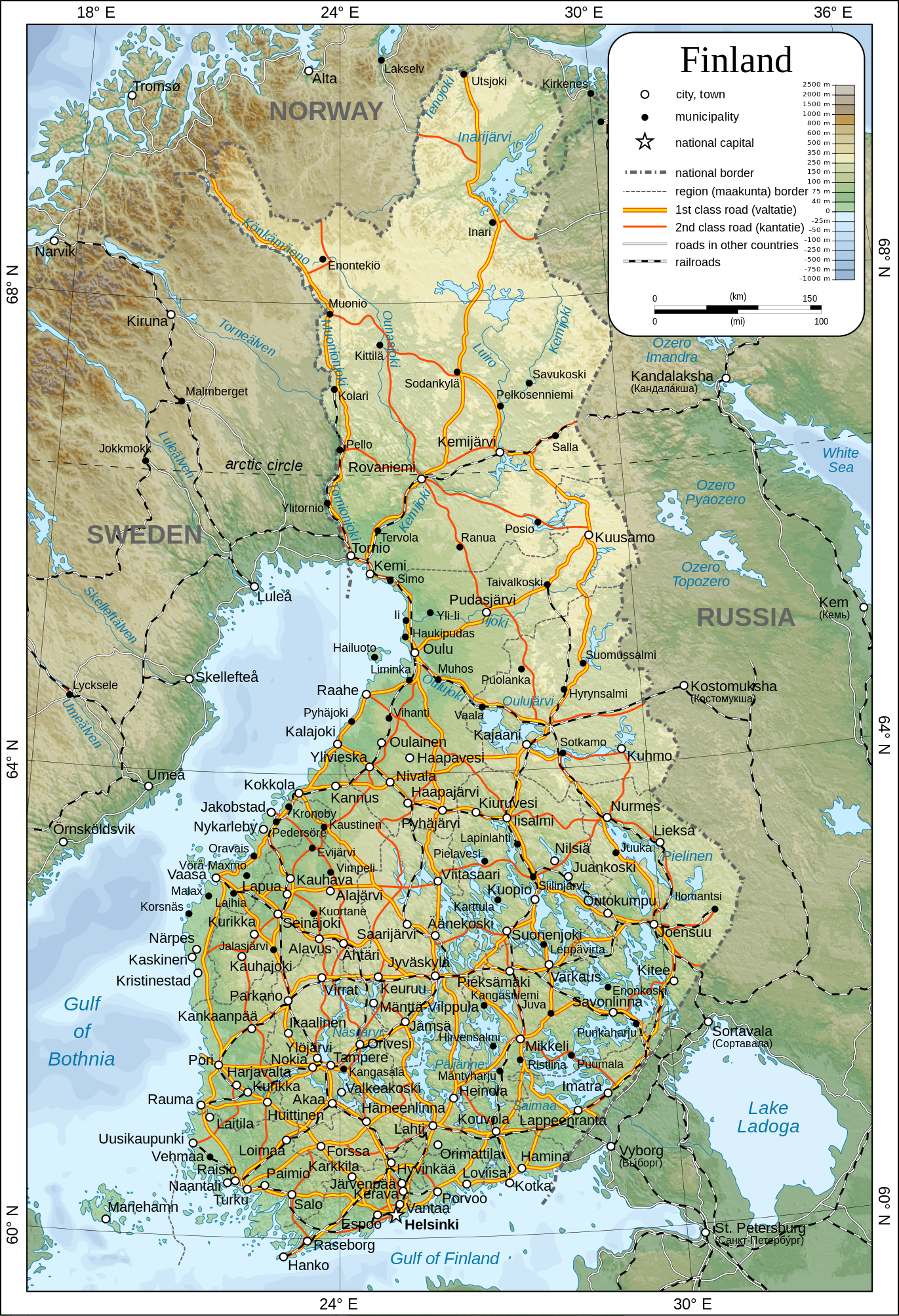
Map of Finland (Suomen kartta) by Oona Räisänen. Boundaries, rivers, roads, and railroads are based on a 1996 CIA map, with revisions. (via Wikimedia – https://en.wikipedia.org/wiki/File:Map_of_Finland-en.svg)
Canadians pretended we didn’t need to take defence seriously. We justified it with fantasies — the world wasn’t that dangerous, threats were distant, and America would rescue us if needed. That delusion is dead. U.S. Republicans and some Democrats don’t trust us to defend our own territory. Trump openly floated annexation and made clear that military protection now comes at a price — potentially statehood. Canadian military leaders now describe our closest ally as “unpredictable and potentially unreliable”. And even when America was a sure bet, our overreliance was reckless. Sovereignty requires self-defence; outsourcing it means surrendering power.
We should take cues from nations in similar situations, like Finland. Both of us border stronger powers, control vast, harsh landscapes, and hold valuable strategic resources. We’re internally stable, democratic, and potential targets.
We also share a key strength — one that could expand our military recruitment, onshore defence production, rebuild social trust, and bolster deterrence: a strong civilian firearms tradition.
We should be doing everything we can to make that tradition a bigger part of Canadian defence, and a larger part of our economy, too.
That may sound absurd to some Canadians. It shouldn’t. Finland is taking full advantage by attempting to expand shooting and military training for civilians both through private and public ranges and the voluntary National Defence Training Association. Finland is seeking to massively upgrade civilian range capacity by building 300 new ones and upgrading others to encourage civilian interest in firearms and national defence, and is doing so in partnership with civilian firearm owners and existing non-government institutions.
Multiple other states near Finland are investing in similar programs. Poland is even involving the education system. Firearm safety training and target practice for school children are part of a new defence education curriculum component, which includes conflict zone survival, cybersecurity, and first aid training. Poland’s aim is to help civilians manage conflict zones, but also to bolster military recruitment.
Lithuania and Estonia encourage civilian marksmanship as part of a society-wide comprehensive defence strategy. The Lithuanian Riflemen’s Union, one of the small nation’s most recognizable institutions, is a voluntary government-sponsored organization intended to prepare civilians for resistance to an occupying power. It has 15,000 members in a population of 2.8 million. The Estonian Defence League trains mostly-unpaid civilian volunteers in guerrilla warfare. It has an 80 per cent approval rating in Estonia, where over one in every 100 men and women with ordinary jobs have joined to learn defence techniques, including mastering standard-issue military service rifles that they may keep at home, ready to fight on a moment’s notice.
These strategies are modern. These countries are no strangers to cutting-edge modern warfare, necessitated by a common border with an aggressive Russia. But technologies like drones are not a replacement for a trained and motivated citizenry, as the Ukraine conflict illustrates. Against a stronger and more aggressive neighbour, these societies deter and respond to aggression through organized, determined, and trained populations prepared to resist attackers in-depth — by putting a potential rifle behind every blade of grass.
Canada, meanwhile, is spending money to hurt our own capacity. It’s coming back to bite us. The Trudeau government misused civilian firearm ownership as a partisan political wedge and ignored the grave flaws of that strategy when they were pointed out, hundreds of times, by good-faith critics. Thousands of firearm models have been banned at massive and increasing expense since 2020 despite no evident public safety benefit. In the recently concluded party leadership race, Mark Carney pledged to spend billions of dollars confiscating them. Government policies eliminating significant portions of business revenue have maimed a firearm industry that historically contributed to our defence infrastructure. Civilian range numbers, which often do double-duty with police and even military use, plunged from roughly 1,400 to 891 in five years. Without civilians to maintain ranges for necessary exercises and qualification shoots, governments must assume the operating expenses, construct new ranges, or fly participants elsewhere to train.
How Greece Humiliated Mussolini’s Army – WW2 Fireside Chat
World War Two
Published 22 Mar 2025Today Indy and Sparty answer your questions about the Italian invasion of Greece, Hitler and Mussolini’s relationship and the different types of fascism!
(more…)
Comments Off on How Greece Humiliated Mussolini’s Army – WW2 Fireside Chat
The Concorde of the English Channel – Hoverspeed
Ruairidh MacVeigh
Published 23 Nov 2024Hello all! 😀
In something a little different from cars, trains and planes, we take a look at what has often been considered the Concorde moment for cross-channel ferry operations, the introduction of routine hovercraft services between Britain and France by the Hoverlloyd and Seaspeed companies, and later the Hoverspeed firm following their merger.
Hoverspeed was a truly exceptional mixture of speed and technological prowess, skirting across the surface of the English Channel and reducing journey times to but a fraction of what they were aboard regular ferry boats, but due to increasing costs, a fragile business case, and the arrival of the Channel Tunnel, Hoverspeed, much like Concorde, is now but a fading memory of a bygone era for international travel.
Chapters:
0:00 – Preamble
0:44 – Rise of the Hovercraft
3:04 – Tapping an Untapped Market
7:15 – Into Service
10:33 – Heyday of the Hovercraft
13:05 – Fragile Foundations
17:21 – Coming to the End
21:55 – Conclusion
(more…)
Comments Off on The Concorde of the English Channel – Hoverspeed
QotD: Communism and western intellectuals
Mao Zedong was the blank page or screen upon which they could project the fantasies that they thought beautiful. China was a long way off, its hundreds of millions of peasants inscrutable but known to be impoverished and oppressed by history; its culture was impenetrable to Westerners without many years of dedicated and mind-consuming study; Western sinologists, almost to a man, upheld the Maoist version of the world, some of them for fear of losing their access to China if they did not, and thereby created the impression that Maoism was intellectually and morally respectable; and so perfect conditions were laid for the most willing and total suspension of disbelief. Mao’s Thoughts — that is to say, clichés, platitudes, and lies — were treated by intelligent and educated people as if they were more profound, and contained more mental and spiritual sustenance, than Pascal’s. As so often before, mere reality as experienced by scores of millions of people was of little interest to intellectuals by comparison with the schemata in their minds and their own self-conception. “Let the heavens fall so long as I feel good about myself” was their motto. One didn’t know whether to laugh or cry.
Theodore Dalrymple, “Rare and Common Sense”, First Things, 2017-11.
Comments Off on QotD: Communism and western intellectuals
March 23, 2025
Rigged Votes and Terror: Stalin’s Takeover Tactics! – W2W 014 – 1947 Q2
TimeGhost History
Published 21 Mar 2025By 1947, Stalin’s Soviet Union has begun to firmly grip Eastern Europe, reshaping nations through rigged elections, terror tactics, and propaganda. From Poland to Bulgaria, countries are forced into Moscow’s orbit, crushing opposition and extinguishing democratic freedoms. As Truman declares a doctrine to contain communism, the stage is set for decades of Cold War confrontation.
(more…)
Comments Off on Rigged Votes and Terror: Stalin’s Takeover Tactics! – W2W 014 – 1947 Q2
How To Invade France
HardThrasher
Published 2 Feb 2023For more than 1,000 years British people have studied how to invade France, here then are the fruits of that wisdom.
1. Be German
2. Head for Sedan
Comments Off on How To Invade France
QotD: Herbert Hoover as president
First, he has no doubt that the economy is going to crash. It’s been too good for too long. He frantically tries to cool down the market, begs moneylenders to stop lending and bankers to stop banking. It doesn’t work, and the Federal Reserve is less concerned than he is. So he sits back and waits glumly for the other shoe to drop.
Second, he hates politics. Somehow he had thought that if he was the President, he would be above politics and everyone would have to listen to him. The exact opposite proves true. His special session of Congress comes up with the worst, most politically venal tariff bill imaginable. Each representative declares there should be low tariffs on everything except the products produced in his own district, then compromises by agreeing to high tariffs on everything with good lobbyists. The Senate declares that the House of Representatives is corrupt nincompoops and sends the bill back in disgust. Hoover has no idea how to solve this problem except to ask the House to do some kind of rational economically-correct calculation about optimal tariffs, which the House finds hilarious. “Opposed to the House bill and divided against itself, the Senate ran out the remaining seven weeks [of the special session] in a debauch of taunts, accusations, recriminations, and procedural argument.” The public blames Hoover, pretty fairly – a more experienced president would have known how to shepherd his party to a palatable compromise.
Also, there are crime waves, prison riots, bootlegging, and a heat wave during which Washington DC is basically uninhabitable. Also, at one point the White House is literally on fire.
… and then the market finally crashes. Hoover is among the first to call it a Depression instead of a Panic – he thinks the new term might make people panic less. But in fact, people aren’t panicking. They assume Hoover has everything in hand.
At first he does. He gathers the heads of Ford, Du Pont, Standard Oil, General Electric, General Motors, and Sears Roebuck and pressures them to say publicly they won’t fire people. He gathers the AFL and all the union heads and pressures them to say publicly they won’t strike. He enacts sweeping tax cuts, and the Fed enacts sweeping rate cuts. Everyone is bedazzled […] Six months later, employment is back to its usual levels, the stock market is approaching its 1929 level, and Democrats are fuming because they expect Hoover’s popularity to make him unbeatable in the midterms. I got confused at this point in the book – did I accidentally get a biography from an alternate timeline with a shorter, milder Great Depression? No – this would be the pattern throughout the administration. Hoover would take some brilliant and decisive action. Economists would praise him. The economy would start to look better. Everyone would declare the problem solved – especially Hoover, sensitive both to his own reputation and to the importance of keeping economic optimism high. Then the recovery would stall, or reverse, or something else would go wrong.
People are still debating what made the Great Depression so long and hard. Whyte’s theory, insofar as he has one at all, is “one thing after another”. Every time the economy started to go up (thanks to Hoover), there was another shock. Most of them involved Europe – Germany threatening to default on its debts, Britain going off the gold standard. A few involved the US – the Federal Reserve made some really bad calls. The one thing Whyte is really sure about is that his idol Herbert Hoover was totally blameless.
He argues that Hoover’s bank relief plan could have stopped the Depression in its tracks – but that Congressional Democrats intent on sabotaging Hoover forced the plan to publicize the names of the banks applying. The Democrats hoped to catch Hoover propping up his plutocrat friends – but the change actually had the effect of making banks scared to apply for funding and panicking the customers of banks that were known to have applied. He argues that the “Hoover Holiday” – a plan to grant debt relief to Germany, taking some pressure off the clusterf**k that was Europe – was a masterstroke, but that France sabotaged it in the interests of bleeding a few more pennies from its arch-rival. International trade might have sparked a recovery – except that Congress finally passed the Hawley-Smoot Tariff, the end result of the corruption-plagued tariff negotiations, just in time to choke it off.
Whyte saves his barbs for the real villain: FDR. If the book is to be believed, Hoover actually had things pretty much under control by 1932. Employment was rising, the stock market was heading back up. FDR and his fellow Democrats worked to tear everything back down so he could win the election and take complete credit for the recovery. The wrecking campaign entered high gear after FDR won in 1932; he was terrified that the economy might get better before he took office, and used his President-Elect status to hint that he was going to do all sorts of awful things. The economy got skittish again and obediently declined, allowing him to get inaugurated at the precise lowest point and gain the credit for recovery he so ardently desired.
Scott Alexander, “Book Review: Hoover”, Slate Star Codex, 2020-03-17.
Comments Off on QotD: Herbert Hoover as president
March 22, 2025
How One Movie Drove Hitler’s Men Crazy – Rise of Hitler 12, December 1930
World War Two
Published 20 Mar 2025December 1930 plunges Germany deeper into chaos. Nazis and Communists join forces against Chancellor Brüning’s emergency decrees, while a shocking court decision boosts Hitler’s power. Violent riots erupt over the film All Quiet on the Western Front, and police uncover a terrifying communist bomb plot aimed at sparking civil war. With extremism rising, is Weimar democracy heading for disaster?
(more…)
Comments Off on How One Movie Drove Hitler’s Men Crazy – Rise of Hitler 12, December 1930
Allen & Wheelock Lipfire Navy Revolver
Forgotten Weapons
Published 12 Apr 2015Not all companies responded in the same way to the development of cartridge revolvers and the Rollin White patent. Allen & Wheelock, for example, decided to simply ignore the patent and make revolvers for their proprietary lipfire cartridges (fairly similar to rimfire) while relying on their lawyers to delay the anticipated patent infringement suit for as long as possible. Ultimately it took 4 years for Rollin White and S&W to gain a legal injunction against them, and when that did happen they were ready and converted their production to percussion revolvers of the same basic type. This particular piece is a .36 caliber (“Navy”) version for the lipfire round, which have been since converted to use either lipfire or more common rimfire ammunition.
Comments Off on Allen & Wheelock Lipfire Navy Revolver
March 21, 2025
The Shocking Dress That Sparked Global Outrage! – W2W 13 – 1947 Q3
TimeGhost History
Published 19 Mar 2025In 1947, Christian Dior stunned the world by introducing his controversial “New Look”. With luxurious dresses and ultra-feminine silhouettes, Dior’s designs ignited fierce debates about gender roles, societal values, and post-war extravagance. While some saw his collection as a welcome return to elegance, others viewed it as an insult during times of austerity. Was Dior celebrating beauty or setting women’s progress back decades?
(more…)
Comments Off on The Shocking Dress That Sparked Global Outrage! – W2W 13 – 1947 Q3
March 20, 2025
The REAL Cause of the Revolutionary War
Atun-Shei Films
Published 15 Mar 2025What caused the American Revolution? Let’s dive beneath the surface-level understanding of British tyranny and unjust taxation and try to understand the long-term social, political, and economic forces which set the stage for our War of Independence.
00:00 Introduction
03:00 1. The World Turned Upside Down
13:50 2. The Paradox of American Liberalism
28:34 3. The Rage Militaire
38:12 Conclusion / Credits
(more…)
Comments Off on The REAL Cause of the Revolutionary War
Everyday Life in the Roman Empire – Demography, Income, Life Expectancy
seangabb
Published 12 Sept 2024Part seven in a series on Everyday Life in the Roman Empire, this lecture discusses demography and life chances during the Imperial period. Here is what it covers:
Introduction – 00:00:00
Our Statistical Civilisation – 00:00:24
Ancient “Statistics” – 00:08:05
How Many Roman Citizens? – 00:18:04
Population of the Empire – 00:21:36
City Populations – 00:27:45
Average Incomes – 00:36:27
Life Expectancy – 00:35:37
Country Life – 00:52:06
Population of Rome – 00:54:39
Feeding Rome – 00:57:40
Roman Water Supply – 01:00:44
Bathing and Sanitation – 01:04:16
Hygienic Value – 01:04:16
Bibliography – 01:06:17
(more…)
Comments Off on Everyday Life in the Roman Empire – Demography, Income, Life Expectancy


