
Forgotten Weapons
Published 12 Mar 2025The ZB37 began in 1930 as a design by none other than classic Czech arms designer Vaclav Holek. The Czechoslovakian military was still using the Schwarzlose heavy MG, and wanted something to replace it. To fill all the roles intended, there would eventually be three different models of the ZB37 — one for infantry, one for fortresses, and one for vehicle mounting.
Note that the factory designation for this gun at Brno began as the ZB50, and iterated to the final version being the ZB50. However, it was identified by the military as the ZB37 (for 1937, the year of adoption).
After a series of redesigns, an early version of the gun is finally adopted in 1935 as the ZB35. A series of improvements leads to the final ZB37 model. About 500 of the early ZB35s were produced, and most of these were used to fill export sale contracts. By the time World War Two begins, the Czechoslovak military has about 5,000 of the guns in its possession.
Interestingly, the gun uses a hybrid recoil and gas operating system, with a tilting bolt. It has two rates of fire that can be chosen, and uses the rear spade grips as the charging handle. It is belt fed, using continuous 100- and 200-round metallic belts and chambered for the 8x57mm Mauser cartridge.
During the war, both German and British forces made substantial use of the ZB37. The Germans purchased ongoing production from Brno, and the British had actually purchased a production license before the war began. For the British, the gun was called the BESA and used in several armored vehicles (still in 8mm Mauser) — with about 57,000 being made during the war. A number of export sales were also made, including Romania, Persia, China, and several others. In 1946 another 3,000 were ordered and manufactured for fortress use in the Czech Republic, serving until the end of Communist control of the country.
Thanks to Sellier & Bellot for giving me access to this example to film for you!
(more…)
August 3, 2025
ZB37: Czechoslovakia’s Super-Heavy Machine Gun
August 2, 2025
The Bloody Battle of Cannae | Animated(ish) Episode
The Rest Is History
Published 5 Jun 2025This is the final episode of our series on Hannibal, which is the second season on Carthage, the whole series is here: Rome Vs Cathage
Part 1 of our series on Hannibal is here: Hannibal: The Rise of Rome’s Greatest Nemesis
How did the Battle of Cannae — one of the most important battles of all time for Ancient Rome, with a whole Empire at stake, and a reputation that had reverberated across the centuries — in 216 BC, unfold? What brilliant tactics did Hannibal adopt in order to overcome the Roman killing machine, with its vast numbers and relentless soldiers? Why did so many men die in such horrific circumstances? And, what would be the outcome of that bloody, totemic day, for the future of both Carthage and Rome?
Join Tom and Dominic for the climax of their epic journey through the rise of Hannibal, and his world-shaking war against Rome, in one of the deadliest rivalries of all time.
00:00 Context to the battle
08:30 Prelude to the battle and their plans of attack
37:28 The battle
(more…)
August 1, 2025
When Stalin and Hitler Teamed Up – Prussia 1931 – Rise of Hitler 20, August 1931
World War Two
Published 31 Jul 2025August 1931: Prussia becomes the battleground as a bizarre alliance of Nazis, Communists (under Stalin’s orders), right-wing elites, and President Hindenburg tries to topple Germany’s last major democracy. With foreign meddling, political violence, and backroom deals, the fate of the Weimar Republic hangs by a thread. Against all odds, the democratic coalition prevails — at least for now. But with chaos spreading and the world watching, can democracy survive the next assault?
(more…)
The sad saga of the CH-148 Cyclone helicopters in Canadian service
In the National Post, Tom Lawson and Gaëlle Rivard Piché argue for the Canadian government to learn from long and bitter past experiences while they “reconsider” the F-35 purchase for the RCAF … specifically the mind-numbing and depressing saga of obtaining helicopters for the Canadian Armed Forces. First, a quick recap of the helicopter story from a post back in 2012:

Pre-delivery Sikorsky CH-148 Cyclone helicopter, 4 April, 2012.
Photo by Gerry Metzler via Wikimedia Commons.
- In 1963, the CH-124 Sea King helicopter (a variant of the US Navy S-61 model) entered service with the Royal Canadian Navy.
- In 1983, the [Pierre] Trudeau government started a process to replace the Sea Kings. That process never got far enough for a replacement helicopter to be ordered.
- In 1985, the Mulroney government started a new process to find a replacement for the Sea Kings.
- In 1992, the Mulroney government placed an order for 50 EH-101 Cormorant helicopters (for both naval and search-and-rescue operations).
- In 1993, the Campbell government reduced the order from 50 to 43, theoretically saving $1.4B.
- In 1993, the new Chrétien government cancelled the “Cadillac” helicopters as being far too expensive and started a new process to identify the right helicopters to buy. The government had to pay nearly $500 million in cancellation penalties.
- In 1998, having split the plan into separate orders for naval and SAR helicopters, the government ended up buying 15 Cormorant SAR helicopters anyway — and the per-unit prices had risen in the intervening time.
- In 2004, the Martin government placed an order with Sikorsky for 28 CH-148 Cyclone helicopters to be delivered starting in 2008 (after very carefully arranging the specifications to exclude the Cormorant from the competition).
- Now, in 2012, we may still have another five years to wait for the delivery of the Cyclones.
A few data points in addition to that list:
- In 2009, the government granted Sikorsky two more years to begin deliveries … and waived the penalty fees for late delivery.
- In 2011, the government announced it would impose late delivery fines on Sikorsky.
- In 2012, Sikorsky announced the delay of the first batch of “interim” helicopters until 2013.
- In 2015, the first six helicopters were delivered so RCAF crews could begin training, with two more later in the year.
- In 2018, the first operational deployment of a Cyclone had the helicopter embarked on HMCS Ville de Quebec as part of Operation Reassurance.
- In 2021, 19 of the 23 helicopters delivered were taken out of service for cracks in the tail assemblies.
- In January 2025, the 27th helicopter was delivered to the RCAF.
Based on this lengthy and expensive process, Lawson and Piché write:
In 1992, the Progressive Conservative government signed a $4.8-billion contract with a European consortium to replace the aging Sea King helicopters deployed aboard Royal Canadian Navy (RCN) ships. For purely political reasons, when the Liberals came to power the following year, they cancelled the deal — incurring $500 million in termination penalties — and set out to find a more politically acceptable solution. That search dragged on for over a decade, culminating in a 2004 contract with Sikorsky to procure 28 CH-148 Cyclone helicopters.
What the government failed to realize — or chose to overlook — was that Sikorsky was not offering a ready-made military platform. Instead, it proposed to adapt its civilian S-92 model into a maritime helicopter fit for military use, with the hope of replicating the global success of its venerable Sea King.
But developmental issues plagued the project from the outset. The original delivery schedule of 2009 slipped repeatedly, prompting then-minister of national defence Peter MacKay to call the procurement “the worst in the history of Canada”. By 2014, the program was on the brink of cancellation. Only a tense meeting between senior ministers and Sikorsky’s president salvaged the deal, leading to a revised agreement that saw the Cyclone finally enter operational service in 2018.
Yet the challenges did not end there. The Cyclone has consistently posted poor serviceability rates. A crash that cost the lives of six Canadian Armed Forces members in early 2020 was linked to inadequate documentation and flawed software. More recently, the fleet has again been largely grounded — this time due to a shortage of spare parts. The Commander of the RCN has voiced public frustration over the shortage of deployable helicopters, even threatening to replace them with drones if necessary.
To be fair, Sikorsky is not solely to blame. It offered an attractive idea: a modern fly-by-wire maritime helicopter based on a successful civilian platform. The government accepted, underestimating the complexity of the transformation. The key lesson here — one that directly applies to the current fighter jet debate — is that there is enormous risk in buying aircraft, like the Cyclone, that exist in limited numbers worldwide.
The best path forward with the Cyclone may now be to phase out the fleet and absorb the sunk costs. A more reliable option could be the MH-60 Seahawk, also made by Sikorsky. Unlike the Cyclone, the Seahawk is a proven design, with nearly 1,000 units in active service with the U.S., Australian and some NATO navies. While it would be politically awkward to cancel a Sikorsky platform only to purchase another from the same manufacturer, pragmatism must prevail. Perhaps a deal could be struck to return the Cyclones for parts, recouping some value through the civilian S-92 supply chain.
July 31, 2025
“You can see what a monster this very dangerous person is”
Chris Bray looks north to the Dysfunctional Dominion and our governments’ inability to deal with the narrative of the Residential Schools and the lack of actual evidence to support that narrative:
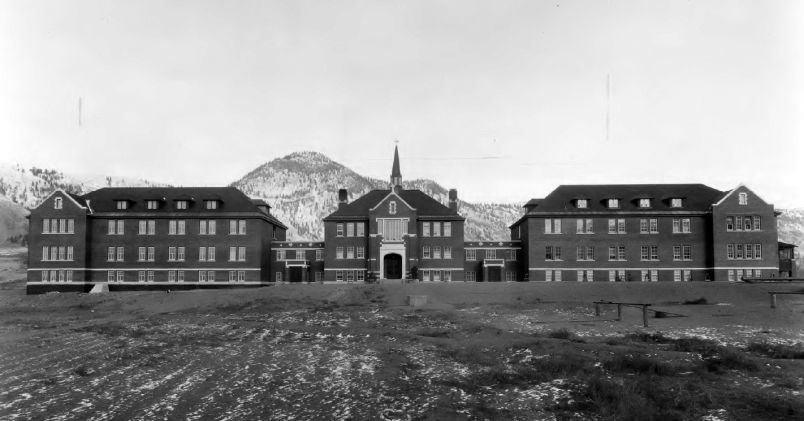
Kamloops Indian Residential School, 1930.
Photo from Archives Deschâtelets-NDC, Richelieu via Wikimedia Commons.
Frances Widdowson is a cantankerous career academic, an evidence-first Canadian scholar who doesn’t suffer fools. Her personal disregard for sanctimonious performativity has gotten her in some trouble, and now she’s a former professor, though her termination was found to be improper. A few months ago, the CBC interviewed her for a story about how mean she is, because Widdowson has questioned the much-chanted sacred story about the dead children at Kamloops.
If you don’t know the Kamloops story, an anthropologist used ground-penetrating radar to supposedly identify the location of a secret burial ground for 215 dead children near the site of the long-defunct Kamloops Indian Residential School, uncovering evidence of what has been constantly called a hidden genocide. But no human remains have ever been recovered at the site, and the radar evidence of disturbed earth aligns well with the path of an old septic trench. More detailed background here.
Widdowson recorded the entire interview, so we can hear the inner workings of the sausage factory.
Throughout the discussion, CBC reporter Jordan Tucker, speaking with the obligatory vocal fry and upspeak, keeps warning Widdowson to stop shouting at her, which Widdowson obviously isn’t doing, and to watch her tone. She’s presumptively pre-outraged by the existence of a Very Bad Person, conducting an outrage-performance in the form of asking questions.
But then Widdowson flips the script. You can hear this excerpted two-minute high point here. Tucker argues that government officials say there are bodies buried in the apple orchard at Kamloops, so is Widdowson somehow making the outrageous claim that government officials might be wrong? “Are all those different governments lying? Are all those different people just not telling the truth, or they’re going along with these stories imagined by people, by indigenous people?”
Government says, but still Widdowson doesn’t concede. You can see what a monster this very dangerous person is. “How is it that all these government officials have been so connived?” Tucker asks, obviously flabbergasted.
Widdowson responds with an argument about evidence, and about the standards of evidence for the claim. What do we know? What have we seen? What would we need to see to prove a claim of this type? Who has the burden of proof?
And then: “As a journalist, are you satisfied with the evidence?”
The response to this question — just past the 1:30 mark in the excerpted video linked above — is remarkably telling. It produces, first, a short silence, and then a long burst of stammering and high-pitched incredulity: “I am. Of course I am.”
Widdowson, sharpening the direct question: “You think there’s 215 children buried in the apple orchard at Kamloops?”
Listen to Tucker’s shaking voice. This question is a threat. It makes her extremely nervous. “I think that, at this point, there has been enough documentation, there have been enough — there’s enough social and archaeological consensus to say that, to say that, we can just believe indigenous people, and move on with trying to do our best by them as a society.”
So two people are arguing about truth. What is true? How can we know what is true? One person keeps asking what is the evidence. The other person keeps deflecting to identity, authority, and social status. The government says so, there is social consensus, “believe indigenous people”. No human remains have been found, but there are human remains, because government officials and indigenous people say so, and other people with the status to matter say that they agree. Truth is consensus. Defaulting to evidence is cruel. Why would you do such a horrible thing?
- What’s the evidence?
- Are you refusing to submit to the narrative consensus?
- Yes, what’s the evidence?
- (shocked gasping and trembling voice)
This is the mechanism of woke narrative control: It has been said that this is true. The people who say it possess authority — they are officials — or they possess privileged identities. It is now disinformation to say that government plus indigenous people might not be correct, and an act of dangerous extremism to mention questions of evidence.

Stamm-Zeller 1902: A Swiss Straight-Pull Converted to Semiauto
Forgotten Weapons
Published 8 Mar 2025Today’s rifle was designed by a Swiss inventor named Hans Stamm while working for the Zeller et Cie company in Appenzell Switzerland. The company originally made embroidering machinery, but turned to military rifle parts subcontracting to bring in additional revenue in the early 1890s. Stamm had shown a good aptitude and interest for this work, and when the company decided to lean into the small arms business he was put in charge of its new weapons division.
There, Stamm spent several years developing a self-loading rifle for the Swiss military. It was not something specifically requested by the government, but rather an opportunistic risk by the company. Stamm’s resulting gun, the Model 1902, was expensive to produce, but quite elegant in design. It is a long-stroke gas pistol system with a rotating bolt, which was made from the ground up but could easily be adapted as a conversion of existing straight-pull bolt action rifles like the Swiss G96.
Unfortunately, the Swiss military declined the rifle, and Zeller was unable to find any other interested clients among the European states. By 1906, tired of dumping money into what is clearly a losing proposition, Zeller shuts down its weapons division. Stamm leaves the company, but he is not done with small arms design — we will see several more of his designs in future videos!
Many thanks to the Swiss Shooting Museum in Bern for giving me access to this visually one of a kind rifle to film for you! The museum is free to the public, and definitely worth visiting if you are in Bern — although it is closed for renovation until autumn 2025: https://www.schuetzenmuseum.ch/en/
(more…)
July 30, 2025
The Korean War Week 58 – The Empire Strikes Back – July 29, 1951
The Korean War by Indy Neidell
Published 29 Jul 2025The Kaesong peace talks drag on, with the main sticking point being the Communist refusal to consider any demarcation line other than the 38th Parallel. UN Commander Matt Ridgway is asking for more force from home, but at least he get some organized force from elsewhere — as various brigades are organized into the 1st Commonwealth Division.
Chapters
00:00 Hook
00:21 Intro
00:56 Recap
01:22 UN Perspective and UN Needs
04:40 US Reserves?
06:31 The Commonwealth Division
09:44 38th Parallel or Nothing
15:03 Summary
15:16 Conclusion
(more…)
History of Britain VI: Prime Roman Britain
Thersites the Historian
Published 13 Feb 2025Britain became a quietly productive part of the Roman Empire once the Celts of southern Britain were subjugated. This was the period when the Romans built cities, forts, and roads across the southern portion of the island. The good times corresponded with the Classical Optimum. However, after 150 or 200 CE, Britain was beginning to experience a decline in its material well-being.
QotD: Meetings of the Roman Republican Senate
Meetings of the Senate were formal affairs, but unlike modern legislatures the Senate did not stay in session over long periods. Instead, it met in specific venues – they had to be inaugurated – when called by a magistrate with the power to do so.
We may begin with place: the Senate had no single fixed meeting spot, though the curia in the Forum was the most common location, however the place the Senate met had to be religiously prepared via inauguration (the taking of the auspices by the augurs) and by sacrifices in order to make sure the gods approved of the proceedings and its results. Consequently, the Senate always met in a templum in the sense of a consecrated space, but also it tended to meet literally in temples, with meetings in the temples of Jupiter Optimus Maximus, the temple of Fides, the temple of Concord, and so on. Notably, two locations, the temple of Bellona and the temple of Apollo were also used and these sat outside the pomerium, enabling the Senate to meet with magistrates who, because of their active command of an army, could not cross the pomerium; they were also sometimes used to meet with foreign dignitaries the Senate did not wish to let into the city. Later added to this number of sites outside the pomerium was Pompey’s theater, which included a temple of Venus Victrix and a curia as part of the overall complex.
In order to meet, the Senate had to be called or more correctly “driven together” (cogere, often translated adequately as “summoned”, but as Lintott notes, it has an element of compulsion to it) by a magistrate. There were a few standard dates on which this would effectively always happen, particularly the first day of the consular year, but beyond that it was expected that magistrates in Rome could call the Senate at any time to discuss any issue on relatively short notice. There was initially no requirement that Senators live in the city of Rome, but it was clearly assumed. Early on in the second century, we get regulations requiring Senators to stay close to Rome unless they had an official reason to be elsewhere, though Senators might be permitted to leave if they needed to fulfill a vow. In the Late Republic it seems to have been common also for Senators to leave the city during the spring res prolatae, a sort of recess from public business (literally “the deferring of business”), but these informal breaks did not mean the Senate was truly “out of session” and it could still be summoned by a magistrate.
Generally, meetings of the Senate began at dawn, though they could begin later, and they proceeded either until the business was concluded or to dusk. Because of the ritual preparations required, no meeting of the Senate could last more than a day, much like the assemblies, so if the business was not finished, a new meeting would need to be called and the process begun from scratch. While it seems that magistrates generally tried to avoid calling the Senate during festival days, dies nefandi (days unsuited for public business) and meetings of the popular assemblies, there was no requirement to do so and the Senate might be called for any day for most of the Republic, with laws restricting the Senate’s meeting days only coming midway through the first century.
Beyond this, Senators were expected to show up and we hear of threats of fines or other censure for failure to show up, but it also seems like no meeting of the senate was ever very close to the full body and quorums for the Senate were fairly low, 100 or 150. For the Sullan Senate, notionally of 600 members, the highest attendances we know of, as noted by Lintott, are 415, 417 and 392. Of course some significant number of Senators will, at any time, have been active magistrates overseas, or serving as military tribunes, or as senatorial legati, but it seems clear that even beyond this attendance was not universal even if it was in theory supposed to be.
Bret Devereaux, “Collections: How to Roman Republic 101, Part IV: The Senate”, A Collection of Unmitigated Pedantry, 2023-09-22.
July 29, 2025
The Original Girl Scout Cookie Recipe from 1922
Tasting History with Max Miller
Published 25 Feb 2025The original Girl Scout sugar cookies, some round, some cut with my 1950s Girl Scout cookie cutter (post-baking)
City/Region: United States of America
Time Period: 1922During the early years of Girl Scout cookies, the girls would bake the cookies themselves. This recipe, from The American Girl, the magazine published by the Girl Scouts, is from the first year of the official cookie sales in 1922. The scouts would continue to bake the cookies they sold for 12 more years until the task was turned over to commercial bakeries in 1934.
These are fairly standard sugar cookies, but they are delicious. They bake up nice and crispy, and the sugar sprinkled on top is a lovely touch. I could easily see myself eating dozens of them without even noticing.
ATTENTION SCOUTS! FORWARD MARCH! BAKE! SELL!
This is your chance to show how much Scouting means to you.
GIRL SCOUT COOKIES
1 cup of Butter, or substitute
1 cup of sugar
2 tablespoons of milk
2 eggs
1 teaspoon of vanilla
2 cups of flour
2 teaspoons of baking powderCream butter and sugar, add well beaten eggs, then milk, flavoring, flour and baking powder. Roll thin and bake in quick oven. (Sprinkle sugar on top.) This amount makes six to seven dozen.
— The American Girl magazine, 1922.
QotD: Thucydides wasn’t articulating a deterministic law of geopolitics – he was writing a tragedy
These concerns were not limited to the fringes, they were real. So real were they that respected geopolitical analysts like George Friedman (later of Stratfor) wrote books like [The Coming War With Japan] The argument was that an upstart like Japan would crash head first into US economic and security interests, sparking another war between the two. This conflict was inevitable because challengers will always seek the crown, and the king will always fight to maintain possession of it.
Suffice it to say that this war did not come to pass. The Japanese threat was vastly overstated, and its economy has been in stagnation-mode for decades now (even though living standards remain very high in relative terms). What may seem inevitable need not be.
The next several years will see marked increase in tension between the USA and China, as the former completes its long awaited “Pivot to East Asia”. So anxious are the Americans to pivot that they have been threatening to “walk away” from Ukraine if they cannot hammer down a peace deal in the very near future. This indicates just how serious a threat they view China’s ascent to be to its economic and security interests. If they are willing to sacrifice more in Ukraine than originally intended, the implication is that China’s rise is a grave concern, and that a clash between the two looks very likely … some would argue that it is inevitable, appealing to a relatively new IR concept called the “Thucydides Trap“.
Andrew Latham explains the concept to us, arguing that Thucydides is misunderstood, making conflict between rising powers and hegemons not necessarily inevitable:
The so-called Thucydides Trap has become a staple of foreign policy commentary over the past decade or so, regularly invoked to frame the escalating rivalry between the United States and China.
Coined by political scientist Graham Allison — first in a 2012 Financial Times article and later developed in his 2017 book Destined for War — the phrase refers to a line from the ancient Greek historian Thucydides, who wrote in his History of the Peloponnesian War, “It was the rise of Athens and the fear that this instilled in Sparta that made war inevitable.”
Distortion:
At first glance, this provides a compelling and conveniently packaged analogy: Rising powers provoke anxiety in established ones, leading to conflict. In today’s context, the implication seems clear – China’s rise is bound to provoke a collision with the United States, just as Athens once did with Sparta.
But this framing risks flattening the complexity of Thucydides’ work and distorting its deeper philosophical message. Thucydides wasn’t articulating a deterministic law of geopolitics. He was writing a tragedy.
This essay might be an exercise in historical sperging, but I think it has value:
Thucydides fought in the Peloponnesian War on the Athenian side. His world was steeped in the sensibilities of Greek tragedy, and his historical narrative carries that imprint throughout. His work is not a treatise on structural inevitability but an exploration of how human frailty, political misjudgment and moral decay can combine to unleash catastrophe.
That tragic sensibility matters. Where modern analysts often search for predictive patterns and system-level explanations, Thucydides drew attention to the role of choice, perception and emotion.
His history is filled with the corrosive effects of fear, the seductions of ambition, the failures of leadership and the tragic unraveling of judgment. This is a study in hubris and nemesis, not structural determinism.
Much of this is lost when the phrase “Thucydides Trap” is elevated into a kind of quasi-law of international politics. It becomes shorthand for inevitability: power rises, fear responds, war follows.
Therefore, more of a psychological study of characters rather than structural determinism.
Giving credit to Allison:
Even Allison, to his credit, never claimed the “trap” was inescapable. His core argument was that war is likely but not inevitable when a rising power challenges a dominant one. In fact, much of Allison’s writing serves as a warning to break from the pattern, not to resign oneself to it.
Misuse:
In that sense, the “Thucydides Trap” has been misused by commentators and policymakers alike. Some treat it as confirmation that war is baked into the structure of power transitions — an excuse to raise defense budgets or to talk tough with Beijing — when in fact, it ought to provoke reflection and restraint.
To read Thucydides carefully is to see that the Peloponnesian War was not solely about a shifting balance of power. It was also about pride, misjudgment and the failure to lead wisely.
Consider his famous observation, “Ignorance is bold and knowledge reserved”. This isn’t a structural insight — it’s a human one. It’s aimed squarely at those who mistake impulse for strategy and swagger for strength.
Or take his chilling formulation, “The strong do what they will and the weak suffer what they must”. That’s not an endorsement of realpolitik. It’s a tragic lament on what happens when power becomes unaccountable and justice is cast aside.
and
In today’s context, invoking the Thucydides Trap as a justification for confrontation with China may do more harm than good. It reinforces the notion that conflict is already on the rails and cannot be stopped.
But if there is a lesson in The History of the Peloponnesian War, it is not that war is inevitable but that it becomes likely when the space for prudence and reflection collapses under the weight of fear and pride.
Thucydides offers not a theory of international politics but a warning — an admonition to leaders who, gripped by their own narratives, drive their nations over a cliff.
Latham does have a point, but events have a momentum all their own, and they are often hard to stop. Inevitabilities do exist, such as Israel and Hezbollah entering into conflict with one another in 2022 after their 2006 war saw the latter come out with a tactical victory. Barring a black swan event, the USA and China are headed for a collision. The question is: in what form?
Niccolo Soldo, “Saturday Commentary and Review #188 (Easter Monday Edition)”, Fisted by Foucault, 2025-04-21.
July 28, 2025
Claudius: The Disabled Emperor Who Conquered Britain
The Rest Is History
Published 27 January 2025This is part 4 of our series on Suetonius and the Emperors of Rome.
00:00 The rebirth of the republic?
10:05 Who is Claudius
15:18 The relationship between Augustus and Claudius
16:20 The scholar emperor
21:12 Claudius’ relationship with Caligula
28:53 Claudius’ rule as emperor
45:50 The problem he had with his wives
56:40 The rise of Nero
58:40 Was he poisoned?
59:51 The lack of sources in Ancient historyProducer: Theo Young-Smith
Assistant Producer: Tabby Syrett
Executive Producers: Jack Davenport + Tony Pastor
July 27, 2025
Day Nine – Hitler’s Halt Order and Tragedy at La Ferté – Ten Days in Sedan
World War Two
Published 26 Jul 2025May 18, 1940. Our coverage of the German blitzkrieg in France continues. Today, we take a break from the panzers for a spot of old-fashioned siege warfare. At Ouvrage La Ferté, a small garrison of French troops makes a doomed last stand against overwhelming German firepower. We follow their final hours, the decisions that sealed their fate, and what their sacrifice meant for the collapsing French front.
(more…)
Shooting a .276 Pedersen PB Rifle
Forgotten Weapons
Published 11 Aug 2015Thanks to Alex C. at TheFirearmBlog, I recently had an opportunity to do some shooting with a .276 caliber Vickers-Pedersen model PB rifle. This was one of the very first rifles Vickers built when they thought the Pedersen would be adopted by the US military and could be further marketed worldwide — after only about 16 PB rifles they made some changes and started making the improved PA model instead (the two main improvements being the use of a reversible clip and the addition of a mechanism to allow ejection of a partially-full clip).
Anyway, in addition to Alex and myself, we were joined by Nathaniel F (a TFB writer) and Patrick R (from the TFBTV video channel). Between us we put about 60 rounds of original 1920s wax-lubricated Frankfort Arsenal .276 Pedersen ammo through the rifle.
QotD: London coffeehouses and Paris salons of the Ancien Régime
Despite the libelles circulating in Paris, the Bourbon monarchy was still relatively protected compared with the hurly-burly across the channel in London, where coffeehouses buzzed with political innuendo and intrigue. Some French philosophes, it is true, attempted to replicate London’s coffeehouse culture at Parisian cafés, such as the Procope on the Left Bank. (Voltaire frequented the place, where he liked to add chocolate to his coffee.) Other regulars at the Procope — named after the Byzantine writer Procopius, famous for his Secret History — were Rousseau, Danton, and Robespierre, as well as Americans Benjamin Franklin and Thomas Jefferson.
The Parisian equivalent of the coffeehouse was the salon, which differed from London coffeehouses in both ambience and function. Whereas London coffeehouses were boisterously public, salons were essentially closed spaces, usually held in private homes. Most were by invitation only. Many were hosted by women, usually titled or wealthy ladies with an interest in culture and politics — such as Madame de Rambouillet, Madame Necker, Madame Geoffrin, and Mademoiselle Lespinasse. There was also the Marquise du Deffand, a friend to Voltaire and the English man of letters Horace Walpole, to whom she bequeathed not only her papers, but also her pet dog, Tonton.
As access to these rarefied spaces increasingly became a symbol of social success, admission got more tightly controlled. (Madame Geoffrin expelled Diderot from her salon because she found his conversation “quite beyond control”.) Still, those who frequented salons represented a great diversity within the elites — from rising young writers and established authors to powerful politicians and eccentric aristocrats. The tacit rule was, as in London coffeehouses, that wit was more important than rank. Many great French writers launched their careers thanks to their admittance. One was the philosopher Montesquieu, who found success at the salon of Madame Lambert.
Matthew Fraser, “Marie Antoinette: Figure of Myth, Magnet for Lies”, Quillette, 2020-06-24.


