Quotulatiousness

December 25, 2011

Vikings win yesterday was bittersweet: they won the game, but lost Adrian Peterson

Filed under: Football, History, Military — Tags: , , , — Nicholas @ 14:00

The game at Washington was never going to change much in the playoff picture: neither team is going to the post-season this year, but both teams were playing for pride. In the end, the Vikings won despite losing their starting quarterback and all-world running back on sequential plays. The win was a bit of a palliative for a doomed season, but the injury to Adrian Peterson sets next season into question.

Christopher Gates dips into his history texts to find the best way to describe yesterday’s game:

Pyrrhic victory (PIR-ik VIK-tuh-ree) n. A victory that is offset by staggering losses

The term “phyrric victory” is named after King Pyrrhus of Epirus, who did battle with the Romans in the Battle of Heraclea in 280 B.C. and the Battle of Asculum in 279 B.C. In both battles, the Romans suffered greater casualties than Pyrrhus’ army did. . .however, the Romans had a significantly larger base from which to draw troops. So, in essence, Pyrrhus’ victories came at too high a price, as he even went so far as to say that another such victory would be his undoing.

That’s pretty much what we saw today at FedEx Field in Washington, D.C., as the Minnesota Vikings fought like hell when it would have been easy to roll over, and got themselves a 33-26 victory over the Washington Redskins. The victory guarantees that they will a) not be the single-worst team in Minnesota Vikings’ history in terms of win-loss record, and b) no longer eligible for the top overall pick in the 2012 NFL Draft.

While I still think Christian Ponder will develop into a good, dependable NFL quarterback, I’ve been a fan of Joe Webb since he was drafted. I’m delighted to see that he is getting the opportunity to showcase his diverse skill set, and I’d be even happier if the team can work him into games more regularly.

(more…)

December 23, 2011

Correcting Shakespeare’s sources: the real Richard III

Filed under: Britain, History, Media — Tags: , , , — Nicholas @ 10:37

Robert Fripp talks about the historical Richard III and the vicious caricatures that Shakespeare drew upon to produce his famous play:

In 1983, I was working a high-stress job pulling together CBC TV’s weekly investigative program The Fifth Estate. I still ask myself: Why, on top of that, did I spend my nights and weekends imitating a long-dead playwright? My labour of love was a play called Dark Sovereign, which I wrote in the four-century-old English of William Shakespeare and his 17th-century contemporaries.

The same year, 1983, also happened to be the 500th anniversary of King Richard III’s accession to the English throne. Richard III, the last Plantagenet king, is widely believed to have murdered his two nephews in the Tower of London, usurping the elder boy’s crown and reigning just 25 months before the upstart Henry Tudor (Henry VII) killed Richard in battle in 1485 and displayed his body for three days.

King Henry went on to inflict judicial murder on many whose claim to the throne was better than his. Nearly 20 existing portraits of Richard III were disfigured after his death to show humps painted onto the subject’s back. Writers, principally Sir Thomas More and Raphael Holinshed, gave the dead king a hostile press.

Then Shakespeare borrowed from Holinshed to write The Tragedy of Richard III. (It may be significant that the first edition’s title omits the word “King.”) Shakespeare wrote his character assassination around 1591. It was probably performed first for the Court of Queen Elizabeth I shortly thereafter. Tudor monarchs had been ruling for more than a century by then, but their tenuous claim to the throne still seemed to trouble them. Having denied Richard a decent burial a century earlier, they still had need to heap dirt on his reputation.

In the interests of full disclosure, I should point out that I portrayed the Earl of Northumberland in the 1983 re-enactment of the coronation of Richard III (at the Cathedral Church of St. James in Toronto) on local TV, and I portrayed the Earl of Lincoln in the (non-televised) version on the actual anniversary date. You could say I’m biased in favour of the revisionist view of the character of good King Richard.

December 22, 2011

Britain, Argentina, and the Falkland Islands

Filed under: Americas, Britain, History, Military — Tags: , , , , , — Nicholas @ 15:39

Yesterday, I sent a Twitter update linking an article about rising tensions between Argentina and the United Kingdom over the Falkland Islands:

The South American trade group Mercosur, wrapping up a two-day summit in Uruguay, has sided with Argentina in its ongoing dispute about the Falkland Islands, which it calls the Malvinas, announcing it will ban boats with Falkland Islands flags from their ports.

[. . .]

Note the flurry of activity since 2010. The dispute has become heightened over resources, as British firms explore for oil in the waters surrounding the islands.
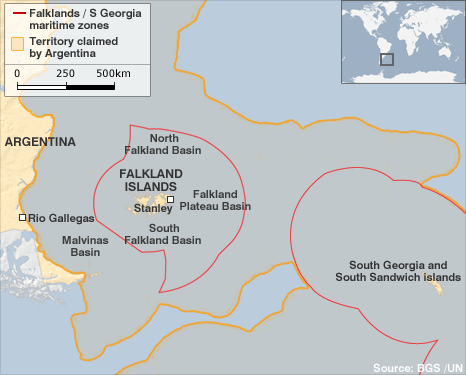
I described the article at the link as “early moves in the next Falklands War”. I then followed up with a another Tweet: “Of course, if Argentina decides to take the Falkland Islands, Britain no longer has the navy to stop them. No carriers = no force projection”

This struck Craig Chandler as seriously misunderstanding the risks: “War can still happen. Do not delude yourself.” I responded that I was “Not deluded about risk of war. Just realistic about outcome.” That is, I didn’t think Britain had any chance of pulling off a victory if Argentina resorted to the military option (again).

Craig had a remarkably positive view of British military power: “Britain would crush them. Missiles, Jets etc… Lot’s of ways to fight a modern war” and “Britain allies would join with them. An attack on one of us is an attack on all of us. Thus, victory would be 100% for Britain”. I responded “Even Reagan had to be cajoled into supporting Thatcher in 82. Obama? Doubt he feels any strong attachment to the UK.” “The UK would have to lodge protest in UN, impose trade sanctions, sit back and accept facts on the ground.”

I was starting to struggle with Twitter’s 140 character limit, as there was much I wanted to say that couldn’t easily be condensed into Twitter-friendly lengths. I’ve said on the blog that Britain’s scrapping of the Harriers and decommissioning/scrapping the remaining aircraft carriers was an open invitation to Argentina to try the Falklands issue again. Argentina’s President Cristina Kirchner wouldn’t be using words like “arrogant” (describing the British government) and characterizing the Prime Minister’s comments as an “expression of mediocrity and almost of stupidity” without good reason.
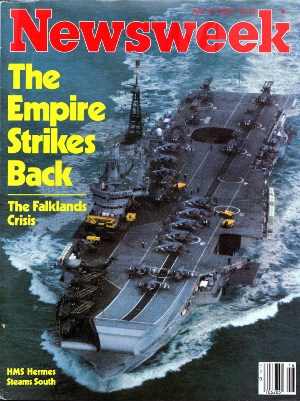
Britain was lucky in 1982, as the government of the day was desperately seeking economies in the budget and (as there was no war with anyone on the horizon), scrapping their aircraft carriers looked like a great way of reducing costs. They’d reduced their military presence in the South Atlantic in an attempt to both save money and appease Argentinian feelings. The announced reductions prompted Argentina’s military rulers to use an external war for internal political benefit. Argentina struck before the intended “economizing” took place. Had they waited six months, Britain would not have had the means to launch the counter-attack that retook the Falklands.
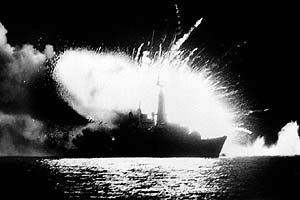
Even with the aircraft carriers HMS Hermes and HMS Invincible each operating several extra Harriers, the British were just barely able to keep enough aircraft going to fend off the majority of Argentinian attacks (losing two destroyers, two frigates, and several support ships sunk or severely damaged). With the Argentinian navy almost entirely confined to base after the sinking of the ARA Belgrano, the British could concentrate on air defence.

Having fought the fleet into position for the invasion, it was possible to pull the more vulnerable ships further out of range for Argentinian air strikes (as even at this stage, losing one of the carriers would endanger the entire mission). While it was much more than a “mere matter of marching”, the smaller but much better trained British forces (primarily Royal Marines, paratroops, Guards, and Gurkhas) were able to defeat the Argentinian troops and bring the military campaign to a close.

Anyway, Craig had an even more positive view of Britain’s likely political and military support today: “The USA owes the UK much for Iraq and Afghanistan there is also the entire Common Wealth. Argentina would be invaded.” “It would be all out war. No acceptance. The Common Wealth and other UK allies would come to support.” I think there’d be some forms of support short of military action: in 1982, for example, New Zealand sent a frigate to the Indian Ocean to replace a Royal Navy ship that was needed to support the Task Force. The rest of the Commonwealth gave verbal and diplomatic support, but no significant military assistance. Today’s Commonwealth is hardly a significant military player — Canada, Australia, and New Zealand combined could not even provide a full division of troops, and none of them would be willing to get involved in a land war in South America on Britain’s behalf.

As far as the islands themselves, there have been some significant changes since 1982, the most significant being a new Royal Air Force base with permanently stationed modern Typhoon fighters (although only four of them at last report). The island transportation net has vastly improved since 1982 — when the only permanent roads were within Port Stanley proper — with all-weather roads now linking all mainland settlements. In addition to the RAF base personnel, there is a British garrison force of a reinforced infantry company and supporting troops, and the Falkland Islands Defence Force which is a company-sized unit of part-time troops.

Argentina’s armed forces have also changed significantly since the war. Two of the most significant changes were post-war fall of the military Junta and the elimination of conscription (creating a more modern, better-trained professional army, navy and air force). The Argentinian navy no longer has a purpose-built landing ship (the ARA Cabo San Antonio was retired shortly after the war and replaced with a modified cargo vessel). They have three submarines in service (replacing the one sub active in 1982), and have replaced all their WW2-vintage ships with more modern designs from France and Germany. The marines, who were the best of the Argentinian troops in 1982, are organized in five battalions of infantry, with supporting artillery, anti-aircraft, engineering and special forces detachments.

Anyway, back to the Twitter exchange that started this. After I’d responded to Craig’s last comment, Colby Cosh joined the discussion: “Sign me up for a bet on 2 PARA if it comes to that, will you?”. I’ll just reproduce the rest of the exchange in approximately correct order below:

NR: “Admire the Paras, but you can’t drop from that far away.”
CC: “I guess they must have teleported onto Goose Green last time.”
NR: “They certainly didn’t fly in from Heathrow!”
CC: “I’m guessing they’ll use the Bay-class ships they built for pretty much that exact mission?”
NR: “Not without air cover.”
CC: “I’m no admiral, but somehow I did get the memo about the fetish for “capital ships” being obsolete.”
NR: “Carriers still relevant.”
CC: “Meanwhile, the Argie navy has not exactly thrived under civilian rule. Not sure if that’s relevant?”
NR: “For a short-haul invasion, you don’t need a massive navy. Air cover is the key. UK only has 1 sub in region normally.”
NR: “No way at all to prevent an invasion, but in 82 UK still had (barely enough) carrier air to cover counter-attack. No longer true”
CC: “Air cover *less* important for Bay class now with close-in antimissile guns. And RN is still operating two carriers, you know.”
NR: “UK paid off Ark Royal and Invincible. Replacement ships still years from launching.”
CC: “The RN just tried out HMS Ocean (I think it was Ocean) as a platform for Apache in the Gadhafi raids.”
CC: “Replacements for fixed-wing capability, yes. Ocean & Illustrious are configured for choppers now.”
NR: “Chopper-equipped force versus missile-armed fighters? Outcome not good for choppers without lots of luck.”
CC: “Helicopters are the name of the game in an amphib op anyway; hence the reconfig.”
NR: “For amphibious work, choppers are great support. Not designed to fight against fixed-wing fighters.”
CC: “We’re forgetting that the islands themselves are garrisoned much more heavily than in ’82.”
NR: “Still indefensible vs Arg”
CC: “The Typhoons that are there are certainly at the sharp end until RN’s Harriers are replaced.”
NR: “Not enough of them to matter.”
CC: “You’ve convinced me to worry about this a little more than I would’ve”
NR: “I’ll post a “Mission Accomplished” banner. ;-)”

Colby did point out some weaknesses in my original contention: for example, I’d forgotten about the construction of the new RAF base, but it isn’t equipped to fight a war: it’s an expensive trip-wire. Four aircraft aren’t going to be enough (especially as Britain had, as of the Libya campaign, only 69 qualified Typhoon pilots). I’ll admit I’m a bit less sanguine about Argentina just waltzing in to Port Stanley this time, but I still think if they can pull off a quick disabling strike followed by a landing, Britain will not be able to reverse the outcome like they did in 1982.

Why Nazis?

Filed under: Books, Britain, Education, Europe, Germany, History, Media, WW2 — Tags: , — Nicholas @ 09:56

A British MP is being investigated for attending a “Nazi-themed” party. A member of the royal family is photographed wearing Nazi regalia to a costume party. World War 2 fiction about Nazi Germany vastly outsells similar fiction about Fascist Italy or Imperial Japan. What is it about the Nazis that Brits find so fascinating? In a Spectator article from 2002, Guy Walters tracks the onset of the Nazi fascination in young Brits:

In some Englishmen this interest has mutated into a not-so-guilty admiration for the Nazis and their uniforms, their pageantry, their military brilliance and — this is the really terrible part — their brutality. It is emphatically not a condoning of the Holocaust; rather, a fetish that exists despite it. In its advanced state the fetish will have evolved into a secret yearning to march up and down a bedroom in the togs of a Hauptsturmführer, riding-boots shining, the red swastika armband set smartly against the blackness of the tunic, the silver death’s-head badge glinting on the peaked cap. Of course, the Beevor reader is a far cry from a Nazi fetishist; but I wonder whether Beevor would enjoy such staggering sales figures if he had written only about the war in the Far East.

[. . .]

At the end of term, the flu now conveniently in remission, Mr Priestley unearths the projector and makes a selection from the school’s extensive range of films. The product of a broad mind, the library consists of just two works, The Guns of Navarone and Force 10 from Navarone. Our nascent fetishist will be particularly drawn by the stylish ease with which David Niven carries off the wearing of an SS officer’s uniform. He will be less than impressed, however, with Edward Fox’s absurdly pukka sergeant in the latter film.

His small head brimming with Nazis, our subject goes home for four solid weeks of constructing Airfix Messerschmitts, Stukas, Heinkels and Dorniers. He will know that the correct colour of the underside of most Luftwaffe aircraft corresponds to Humbrol’s ‘duck-egg blue’. If his condition is particularly advanced, the subject’s mother will be asked to purchase a Tamiya Jagdpanther tank, which he will place in a ‘diorama’, a word he will use in no other context. By now, he should be showing further classic early symptoms of a Nazi fetish: Allied aircraft and armour will hold little or no interest. Most of the young fetishist’s exercise books will be adorned with thousands of tiny swastikas.

[. . .]

By puberty, the fetishist will have repeatedly watched every war film available, including A Bridge Too Far, The Night of the Generals, The Dirty Dozen, The Eagle Has Landed, The Boys from Brazil, Cross of Iron and, for a younger generation, Saving Private Ryan and Band of Brothers. He will have read Pat Reid’s Escape from Colditz and Airey Neave’s They Have Their Exits.

When our subject starts in the sixth form, it is here that the fetish can be incorporated into, and disguised by, his academic studies. Naturally he chooses modern history for one of his A-levels, and his special topic will, of course, be Nazi Germany. He will now be introduced to the diaries of Nazi bigwigs such as Albert Speer, which will breathe life into sinister figures such as Himmler and Goering. In fact, the widespread predilection for Nazi Germany as an A-level subject has angered many university tutors, who have complained recently that it is the only period of history about which undergraduates have any real knowledge.

December 21, 2011

It’s A Wonderful Life is a movie that only an Occupod could love”

Filed under: History, Humour, Media — Tags: , , , — Nicholas @ 11:31

Michael Graham explains why the much-loved Christmas movie It’s a Wonderful Life is actually awful:

Consider George Bailey. In your mind, you see him after a lifetime of poverty, grief and bad luck, running through Bedford Falls shouting “Merry Christmas you old Building and Loan,” just happy to have a family he loves.

Well I agree that having a loving family can help us all get through crises. (Remember the stewardess in the disaster-film spoof “Airplane?” “At least I had a husband . . . ”)

But the name of the film is “Wonderful Life,” not, “Well, Things Could Be Worse.” And in George Bailey’s case, things are truly tragic.

Smart, ambitious George gets stuck at the modest Building and Loan back in Hickville when his brother marries into a cushy corporate gig and his father dies. After years of dreaming of going off to college, traveling the world and becoming a top engineer or architect, his life is spent scraping by, and helping others do the same.

Somehow the movie — like the Occupiers of today — tries to turn that into a virtue. Despite his wife and kids, George turns down $20,000 a year so he won’t have to work for that “evil banker,” Mr. Potter.

Occupy Bedford Falls!

December 19, 2011

Chiquita, supporter of narco-terrorist groups, calls for a boycott of Canadian oil

Filed under: Americas, Cancon, Economics, Food, History — Tags: , , , , , , — Nicholas @ 11:39

When corporate social media goes wrong:

I used to work for an ad agency, and I often had animated discussions with my colleagues about the danger of confusing cause marketing with product marketing. I have always maintained that they are separate disciplines that don’t mix, while many of my colleagues disagreed.

As a society, we have become distressingly pious and self-righteous — and as a natural consequence advertisers wish to capitalize on this instinct. Like my erstwhile colleagues, they see this as an easy path to identifying their product with a strong public sentiment. This is such a bad idea that it merits a blog entry of its own, but what lead me to write today was a satisfyingly spectacular self-immolation by a large American brand that managed to make the wrong choice in just about every decision their communications and marketing teams have made over the past few days.

[. . .]

Worse, Chiquita Brands seemed to forget completely about their Canadian market. It’s easy to underestimate Canada. It’s a little country with a tenth the population of the United States. On the other hand, it’s a terrific export market, and much too accessible and rich to be ignored.

Canadians are understandably touchy about the Oil Sands. The majority of Canadians are very proud of the fact that they’ve transformed the country into an energy superpower by successfully accessing a resource that was considered nearly worthless only a decade ago – and they have done this with unprecedented care, investing billions of dollars in developing new technologies to protect the environment. Canadians are also very proud of the fact that they are the only net exporter of oil that is a liberal democracy and respects human rights. They’ve even coined the phrase “ethical oil” to describe their unique approach to oil production.

What Chiquita Brands succeeded in doing with their announcement was to make millions of Canadian consumers very unhappy. People who couldn’t have told you on Monday morning what brand of bananas they bought were determined by Thursday afternoon that it wouldn’t be Chiquita. Worse yet, hundreds of consumers decided to make their feelings known by commenting on the Chiquita Bananas Facebook page. And this is where Chiquita’s marketing and communications team took one bad decision and turned it into a disaster

H/T to Five Feet of Fury for the links.

December 18, 2011

The Feminist struggle against real women’s actual wants

Filed under: History, Liberty, Media, Politics — Tags: , , , , — Nicholas @ 11:57

Jenny Turner in the London Review of Books has some insight into organized Feminism’s ongoing struggles:

It’s true that women, as a gender, have been systemically disadvantaged through history, but they aren’t the only ones: economic exploitation is also systemic and coercive, and so is race. And feminists need to engage with all of this, with class and race, land enclosure and industrialisation, colonialism and the slave trade, if only out of solidarity with the less privileged sisters. And yet, the strange thing is how often they haven’t: Elizabeth Cady Stanton opposed votes for freedmen; Betty Friedan made the epoch-defining suggestion that middle-class American women should dump the housework on ‘full-time help’. There are so many examples of this sort that it would be funny if it weren’t such a waste.

Not that the white middle-class brigade like being on the same side as one another. There’s always a tension between all of us being sisterly, all equal under the sight of the patriarchal male oppressor, and the fact that we aren’t really sisters, or equal, or even friends. We despise one another for being posh and privileged, we loathe one another for being stupid oiks. We hate the tall poppies for being show-offs, we can’t bear the crabs in the bucket that pinch us back. All this produces the ineffable whiff so often sensed in feminist emanations, those anxious, jargon-filled, overpolite topnotes with their undertow of envy and rancour, that perpetual sharp-elbowed jostle for the moral high ground.

[. . .]

And so Women’s Liberation started trying to build a man-free, women-only tradition of its own. Thus consciousness-raising, or what was sometimes called the ‘rap group’, groups of women sitting around, analysing the frustrations of their lives according to their new feminist principles, gradually systematising their discoveries. And thus that brilliant slogan, from the New York Radical Women in 1969, that the personal is political, an insight so caustic it burned through generations of mystical nonsense — a woman’s place is in the home, she was obviously asking for it dressed like that. But it also corroded lots of useful boundaries and distinctions, between public life and personal burble, real questions and pop-quiz trivia, political demands and problems and individual whims. ‘Psychic hardpan’ was Didion’s name for this. A movement that started out wanting complete transformation of all relations was floundering, up against the banality of what so many women actually seemed to want.

Across the world, according to UK Feminista, women perform 66 per cent of the work and earn 10 per cent of the income. In the UK two-thirds of low-paid workers are women, and women working full-time earn 16 per cent less than men. All of this is no doubt true, but such statistics hide as much as they show. One example. In a piece in Prospect in 2006 the British economist Alison Wolf showed that the 16 per cent pay-gap masks a much harsher divide, between the younger professional women — around 13 per cent of the workforce — who have ‘careers’ and earn just as much as men, and the other 87 per cent who just have ‘jobs’, organised often around the needs of their families, and earn an awful lot less. Feminism overwhelmingly was and is a movement of that 13 per cent — mostly white, mostly middle-class, speaking from, of, to themselves within a reflecting bubble.

Vaclav Havel has died, aged 75

Filed under: Books, Europe, Government, History, Liberty — Tags: , , , — Nicholas @ 11:43

Matt Welch has a post at Hit & Run quoting his profile of Havel from 2003:

Like Orwell, Havel was a fiction writer whose engagement with the world led him to master the nonfiction political essay. Both men, in self-described sentiment, were of “the left,” yet both men infuriated the left with their stinging criticism and ornery independence. Both were haunted by the Death of God, delighted by the idiosyncratic habits of their countrymen, and physically diminished as a direct result of their confrontation with totalitarians (not to mention their love of tobacco). As essentially neurotic men with weak mustaches, both have given generations of normal citizens hope that, with discipline and effort, they too can shake propaganda from everyday language and stand up to the foulest dictatorships.

Unlike Orwell, Havel lived long enough to enjoy a robust third act, and his last six months in office demonstrated the same kind of restless, iconoclastic activism that has made him an enemy of ideologues and ally of freedom lovers for nearly five decades.

December 15, 2011

Google donates to the Bletchley Park restoration project

Filed under: Britain, History, Technology, WW2 — Tags: , , — Nicholas @ 09:15

Google has made a significant contribution to the preservation and restoration of the famous WW2 codebreaking site:

The centre has won a £4.6million grant from the Heritage Lottery Fund but needs to attract £1.7million in outside funding before the big grant can be delivered and the next stage of the development kickstarted.

The £550,000 Google contribution is the biggest single donation that the Bletchley Park Trust has received so far. It was given by the search engine’s charitable arm, which donated a total of $100 million (£64.4million) in 2011.

“It would be wonderful if other donors follow Google’s example to help preserve our computing heritage,” said Simon Greenish, CEO of the Bletchley Park Trust. “We could then proceed as soon as possible with restoration of the profoundly historically significant codebreaking huts.”

December 10, 2011

“It was not, all in all, Canada’s finest hour. Perhaps that’s why we still don’t talk about it much.”

Filed under: Books, Cancon, History, Media — Tags: , , , , , — Nicholas @ 12:48

Robert Fulford on the event in Ottawa that started the Cold War:

For just one moment in history, Canada found itself at the dangerous centre of global politics. That was in 1945, when Igor Gouzenko left the Russian embassy in Ottawa with documents proving the Soviet Union was spying on Canada with the help of Canadian communists.

Gouzenko’s revelations were the opening shot in the Cold War. A new book, Stalin’s Man in Canada: Fred Rose and Soviet Espionage by David Levy, takes a rambling, anecdotal approach to a major figure in the story, the only Canadian member of Parliament ever convicted of conducting espionage for a foreign state.

Official Ottawa reacted badly to the news that there were spies in its midst. The government arrested the suspects and locked them up for weeks, without access to lawyers or families. They were paraded before a secret royal commission and persuaded to incriminate themselves. Gouzenko was given a new identity to protect him from Soviet assassins but the Mounties leaked nasty stories about him. For decades journalists treated him as a money-grubbing clown rather than the hero that he was.

Today the case remains largely unexplored and poorly remembered. Among those involved, only Gouzenko described his experience in a book, This Was My Choice, a rather thin and hasty account. Twentieth Century Fox produced a forgettable adaptation, The Iron Curtain, with Dana Andrews as Gouzenko.

Barack Obama and Teddy Roosevelt: the economic parallels

Filed under: Economics, History, USA — Tags: , , , , — Nicholas @ 12:12

Jim Powell looks more deeply at the similarities between Barack Obama and Theodore Roosevelt:

President Obama is a smart man who believes great wealth is a social problem, and ordinary people would be better off if wealth were substantially taxed away. Recently he drew inspiration from Theodore Roosevelt, another smart man who had a similar view, completely misinterpreted what was happening in the economy, and actively disrupted it.

Theodore Roosevelt was the man who, in 1906, encouraged progressives to promote a federal income tax after it was struck down by the Supreme Court and given up for dead. He declared that “too much cannot be said against the men of great wealth.” He vowed to “punish certain malefactors of great wealth.”

Perhaps TR’s view was rooted in an earlier era when the greatest fortunes were made by providing luxuries for kings, like fine furniture, tapestries, porcelains and works of silver, gold and jewels. Since the rise of industrial capitalism, however, the greatest fortunes generally have been made by serving millions of ordinary people. One thinks of the Wrigley chewing gum fortune, the Heinz pickle fortune, the Havemeyer sugar fortune, the Shields shaving cream fortune, the Colgate toothpaste fortune, the Ford automobile fortune and, more recently, the Jobs Apple fortune. TR inherited money from his family’s glass-importing and banking businesses, and maybe his hostility to capitalist wealth was driven by guilt.

Like Obama, TR was a passionate believer in big government — actually the first president to promote it since the Civil War. He said, “I believe in power … I did greatly broaden the use of executive power … The biggest matters I managed without consultation with anyone, for when a matter is of capital importance, it is well to have it handled by one man only … I don’t think that any harm comes from the concentration of power in one man’s hands.”

December 8, 2011

“Pure socialism” in the Soviet Union

Filed under: Economics, History — Tags: , , , — Nicholas @ 08:53

Nicholas Snow summarizes the only serious attempt to implement “pure socialism” in the first years after the Russian revolution:

The closest the Soviet Union came to actual pure socialism was the period known as War Communism, 1918 to 1921. This period is unanimously seen as a disaster, even among socialists. Production fell in most if not all industries, and millions starved to death. From then on the Communist Party struggled to keep hold of both their Marxist ideology and their power. Naturally the latter took precedence, and as a result the price system, which they originally wanted to abolish, took on a larger and larger role. [. . .]

The Soviets certainly liked to keep up appearances. At a glance the Soviet economy looked centrally planned. The planning board for each industry set output levels, and the State owned de jure all means of production. A closer look, however, revealed a different story. As Boettke and Anderson pointed out, the Soviet economy was closer to that of a mercantilist economy, a heavily regulated market economy effectively run by rent-seeking government officials and factory managers. De facto, the factory managers were the owners and residual claimants. They paid the State for the right to run the factory, and in return the State created a monopoly for them, just as in the mercantilist system of old.

Middlemen, known as the Tolkachi, worked on behalf of the State enterprises to sell surplus commodities on the one hand and purchase needed products on the other. They essentially created a market that allowed for economic calculation not possible under a pure socialist system.

December 7, 2011

Reason.TV: How Pearl Harbour made America a global power

Filed under: History, Japan, Military, Pacific, USA, WW2 — Tags: — Nicholas @ 13:05

A minor quibble: though Craig Shirley asserts that the only way Americans could fight overseas before Pearl Harbour was with the Chinese air force, at least 16,000 Americans were serving in the Canadian Army, the Royal Canadian Navy, or the Royal Canadian Air Force:

Long before Pearl Harbor, a steady stream of Americans had started moving northward across the border to join the Canadian armed forces. By the beginning of 1941 some 1,200 Americans comprised about 10 percent of RCAF officer strength and 3 percent of the other ranks. A U.S. influx totaling about 10 percent of RCAF recruitment continued until, at the time of Pearl Harbor, over 6,000 U.S. citizens were serving in the RCAF, of whom 600 were instructors in the British Commonwealth Air Training Plan. By the same time nearly 10,000 Americans were serving in the Canadian Army. After Pearl Harbor a reverse movement resulted in the absorption of over 26,000 Canadians into the U.S. armed forces during World War II.

From Military Relations Between the U.S. & Canada by Stanley W. Dzuiban.

Harsanyi: Obama is “the mighty slayer of infinite straw men”

While the GOP hopefuls are busy avoiding confrontation with Barack Obama, David Harsanyi is under no such restriction:

In Teddy Roosevelt’s era, President Barack Obama explained to the nation this week, “some people thought massive inequality and exploitation was just the price of progress. … But Roosevelt also knew that the free market has never been a free license to take whatever you want from whoever you can.”

And he’s right. Even today there are people who believe they should have free license to take whatever they want from whomever they can. They’re called Democrats.

Yet the president, uniter of a fractured nation, the mighty slayer of infinite straw men, claims that some Americans “rightly” suppose that the economy is rigged against their best interests in a nation awash in breathtaking greed, massive inequality and exploitation. Or I should say, he’s trying to convince us that it’s the case.

The middle-class struggle to find a decent life is the “defining issue of our time,” the president went on. And nothing says middle-class triumph like more regulation, unionism, cronyism and endless spending. Hey, Dwight Eisenhower (a Republican!) built the interstate highway system, for goodness’ sake. Ergo, we must support a bailout package for public-sector unions — you know, for the middle class.

Update: Monty goes a few steps further to criticize Obama:

It often strikes me how much Barack Obama looks, talks, behaves, and (apparently) believes like a character out of an Ayn Rand novel. Rand always wrote of statist Socialists more as caricatures than characters, but Barack Obama could have stepped whole and breathing right out of the pages of Atlas Shrugged. Which shows you the shallowness and unthinking obeisance to leftist cant the man displays — there is precious little subtlety to Barack Obama. You sometimes find hidden depths even in your ideological enemies, surprising pockets of common ground. But in Barack Obama, there is only a hollow vessel filled up with the thoughts and opinions of leftists he has associated with in his life. He speaks (and apparently thinks) only in platitudes, bromides, and cliches. Barack Obama is, in short, the end product of the grand “progressive” experiment since the early 1900’s. Ecce homo!

December 6, 2011

The Battle of Ortona

Filed under: Cancon, Germany, History, Italy, Military, WW2 — Tags: , , , — Nicholas @ 10:16

The Laurier Centre for Military Strategic and Disarmament Studies is marking the anniversary of the Battle of Ortona in 1943 by sending Twitter updates from @BattleOfOrtona to outline the historical events of the 1st Canadian Division and the 1st Canadian Armoured Brigade in this key battle of the Italian Campaign. Here is the situation just before the battle opened, from Terry Copp:

The Canadians were involved in a series of isolated battles in the mountains of Central Italy in November 1943 when General Bernard Law Montgomery issued orders for an advance up the Adriatic Coast to seize control of the east-west road Pescara to Rome. The American 5th Army was to launch a direct advance towards Rome at the same time.

The Canadians were still in the mountains when British, Indian, and New Zealand troops fought their way across the Sangro River, forcing a German withdrawal to the Moro River. The 78th British “Battleaxe” Division had shot its bolt at the Sangro and Montgomery ordered the fresh, full strength Canadian Division to take over the advance on the coastal flank. The move was to be completed by the night of 5 December.

The German 10th Army, responsible for the defence of Italy east of the Appenine Mountains, contained 12 divisions — 10 infantry and 2 armoured. The 76 Panzer Corps held the river lines south of Pescara with 1st Parachute, 90th Panzer Grenadier, 26th Panzer and 65th Infantry divisions. Normally an attacker needs to outnumber the defender by at least 3:1. This ratio could not be achieved in December 1944 and with the beginning of heavy winter rains air power could only play a small role. Everyone but the infantry was optimistic.

« Newer PostsOlder Posts »

Powered by WordPress


