Quotulatiousness

February 5, 2012

I didn’t realize the President also inherited the droit de seigneur

Filed under: Books, History, Media, Politics, USA — Tags: , , , — Nicholas @ 11:30

After all this time, I doubt that anyone is particularly surprised by yet another revelation from the “Camelot” days of JFK’s presidency:

She always called him “Mr. President” — not Jack. He refused to kiss her on the lips when they made love. But Mimi Alford, a White House intern from New Jersey, was smitten nonetheless.

She was in the midst of an 18-month affair with the most powerful man in the world, sharing not only John F. Kennedy’s bed but also some of his darkest and most intimate moments.

In her explosive new tell-all, Once Upon a Secret: My Affair with President John F. Kennedy and Its Aftermath, Alford, now a 69-year-old grandmother and retired New York City church administrator, sets the record straight in searingly candid detail. The book, out Wednesday was bought by The Post at a Manhattan bookstore.

Celebrating 1989

Filed under: Europe, History, Liberty — Tags: , , , , , — Nicholas @ 11:03

Janet Daley thinks we’ve been under-appreciating one of the most momentous years in modern history: the end of the Cold War and the collapse of state communism.

Can I suggest that you try the following experiment? Gather up a group of bright, reasonably well-educated 18-year-olds and ask them what world event occurred in 1945. They will, almost certainly, be able to give you an informed account of how the Second World War ended, and at least a generally accurate picture of its aftermath. Now try asking them what historical milestone came to pass in 1989. I am willing to bet that this question will produce mute, blank looks.

The fall of the Berlin Wall and the collapse of communism which followed it are hugely important to any proper understanding of the present world and of the contemporary political economy. Why is it that they have failed to be addressed with anything like their appropriate awesome significance, let alone found their place in the sixth-form curriculum?

The failure of communism should have been, after all, not just a turning point in geo-political power — the ending of the Cold War and the break-up of the Warsaw Pact — but in modern thinking about the state and its relationship to the economy, about collectivism vs individualism, and about public vs private power. Where was the discussion, the trenchant analysis, or the fundamental debate about how and why the collectivist solutions failed, which should have been so pervasive that it would have percolated down from the educated classes to the bright 18-year-olds? Fascism is so thoroughly (and, of course, rightly) repudiated that even the use of the word as a casual slur is considered slanderous, while communism, which enslaved more people for longer (and also committed mass murder), is regarded with almost sentimental condescension.

February 4, 2012

In praise of Her Majesty the Queen

Filed under: Britain, Cancon, History, Media — Tags: , , , — Nicholas @ 11:33

Conrad Black goes full monarch in his latest column:

The Queen has an outstanding record of absolutely unblemished service, through tumultuous changes and always having to endure suggestions of impending obsolescence — not just of the monarchy itself, but of its various separate functions, especially the ambiguous positions of head of the Commonwealth and supreme governor of the Church of England.

The 1950s were a constant round of independence ceremonies, mainly for countries that had a very rocky start and little aptitude for premature emancipation from unfashionable colonials status. This made for ever larger and more incongruous Commonwealth meetings, as the shared British traditions that supposedly united the “British Dominions, realms and territories beyond the seas” frayed and became always more threadbare except, perhaps, among the former so-called “white Dominions.”

In this present time of glaring, intrusive, nasty media, it is hard to imagine the proportions of the Queen’s achievement in serving 60 years, every one of them as one of the most prominent and publicized people in the world, without one gaffe, one embarrassing photograph, one injudicious utterance or slip on a banana peel, literal or metaphoric.

[. . .]

Queen Elizabeth II has personified the British middle-class virtues: moderation, unflamboyant consistency and unflappable reliability. It hasn’t always been exciting, and in satirical magazines such as Private Eye and on the BBC, she has paid a price for that and was lampooned for decades for stiff formality and stilted phrases — “My husband and I,” etc.

February 3, 2012

Reason.tv: A non-hagiographic analysis of FDR, the New Deal, and the expansion of federal power

Filed under: Economics, History, USA, WW2 — Tags: , , , , — Nicholas @ 14:16

February 1, 2012

The “Iron Lady” was not good for women

Filed under: Britain, Government, History — Tags: , , , — Nicholas @ 11:06

Barbara Kay on the “failings” of Margaret Thatcher (that is, not advancing the cause of women in a way that organized feminists would have preferred):

The “Iron Lady” is, of course, not only a sobriquet for Margaret Thatcher, but the title of the wonderful new Meryl Streep biopic about the former British PM. Bagnall’s predictable answer is that no, Thatcher was not good for women: “She did not pave the way for other women, as they had every right to expect her to, since she was one of them.”

Bagnall’s stated beefs are that Thatcher urged women to leave the workforce, and only nominated one woman to her cabinet. Well, so did unions of that era ask women to leave the workforce — to open up more jobs for men. And Thatcher’s appointments were based on who was good for Britain, not who was good for women.

Politically, Thatcher despised tokenism (“I owe nothing to women’s lib,” she once said), but it is true that personally she preferred men to women. This was made clear in the film by the non-judgmental tenderness the older widowed Thatcher lavishes on her negligent son (who rarely visited, but inconsiderately telephones her from South Africa at 3 a.m. English time) and the casual verbal cruelties Thatcher tosses at her attentive, under-appreciated daughter.

I think it’s Thatcher’s lack of fellow feeling for women that’s really bugging Bagnall and other feminists. How could Thatcher not like women if she was “one of them”?

I daresay it’s for the same reason most of us hold prejudices about the opposite sex. I don’t think most gender antipathy is rooted in doctrine; I think we drift toward doctrines that confirm our lived experiences. So in spite of (fictional) Thatcher’s protestations to the doctor attending her in her old age that she prefers “thoughts” to “feelings,” Thatcher’s bias toward men sprang directly from her lived experiences and the feelings they engendered (pun intended).

January 29, 2012

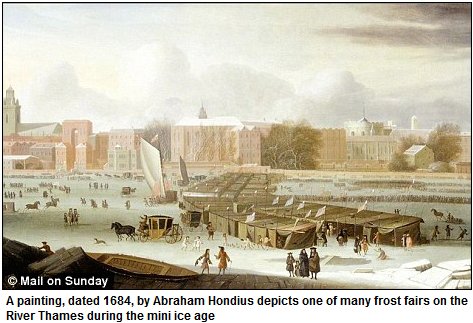
Step aside, Ottawa: London may have “Frost Fairs” on the Thames in future

Filed under: Britain, Environment, Europe, History — Tags: , , , — Nicholas @ 11:48

The Thames River used to freeze over solidly enough that temporary buildings could be erected on the ice. Northern Europe may be facing those kinds of cold winter temperatures in the future:

The supposed ‘consensus’ on man-made global warming is facing an inconvenient challenge after the release of new temperature data showing the planet has not warmed for the past 15 years.

The figures suggest that we could even be heading for a mini ice age to rival the 70-year temperature drop that saw frost fairs held on the Thames in the 17th Century.

Based on readings from more than 30,000 measuring stations, the data was issued last week without fanfare by the Met Office and the University of East Anglia Climatic Research Unit. It confirms that the rising trend in world temperatures ended in 1997.

Meanwhile, leading climate scientists yesterday told The Mail on Sunday that, after emitting unusually high levels of energy throughout the 20th Century, the sun is now heading towards a ‘grand minimum’ in its output, threatening cold summers, bitter winters and a shortening of the season available for growing food.

January 28, 2012

Conrad Black on Pierre Trudeau and his political career

Filed under: Cancon, Economics, History — Tags: , , , , — Nicholas @ 12:24

Writing in the National Post, Conrad Black discusses Pierre Trudeau’s time in office:

Nor is there truth to the theory that Trudeau possessed any original political ideas. He was a run-of-the-mill 1960s social democrat who wanted big government, the nanny-, know-it-all-state, high taxes, and the confiscation of income from those who had earned it for redistribution to those who had not in exchange for their votes (far beyond what could be justified by the acquisition of votes for federalism in Quebec, where the money transfer was also largely from the non-French to the French).

It was hard to square Trudeau’s professed enthusiasm for civil rights with his friendship with Fidel Castro and other dictators who ruined their countries, such as Julius Nyerere of Tanzania, and his cold-shouldering of Soviet dissidents and other international civil rights advocates, and even the Canadian victims of the Korean airliner the Russians shot down. This was of a piece with his fawning deference to the Soviet leadership and his antagonism to Ronald Reagan, Margaret Thatcher and even Richard Nixon, who all regarded him as little better than a communist fellow traveller (and told me so).

His campaign to reorient the Canadian economy away from exports to the United States was authoritarian rather than based on any fiscal incentivization of competition, and was a fiasco. His pursuit of arms control was chimerical; he disarmed Canada, did nothing to reduce the country’s military dependence on Washington, and produced a nonsensical plan for more conferences to agree on the unverifiable “suffocation” of defence spending.

[. . .]

His elevation to the headship of the party and government continued the grand Liberal tradition of choosing men lately drawn from outside politics (King, St. Laurent, Pearson). He took it whimsically, and much of his record was just idle dabbling, posturing, and the supreme confidence trick of saving Canada with a Charter of Rights that is revocable by each province (and has unleashed the bench on Canadian life like a swarm of hyper-active social tinkerers); and by imposing bilingual breakfast cereal boxes and television programming even in unilingual parts of the country.

It was clever enough that, as the English say, if you put a tail on it, you could call it a weasel: the rights of man and not governments, our (French-Canadian) house is all Canada, and deluges of Anglo-money in Quebec in the name of social justice, gracieusete du Canada. But it was a ruse, made more farcical by the revelation that Quebec’s supreme separatist strategist, Claude Morin, was a spy for the RCMP.

The Quebec nationalists took the bait, as well as the federal transfer payments, and today Quebec is a bovine clerisy of civil servants and consultants on life support from the rich English provinces, and separation is just a romantic delusion. I think that, at heart, Trudeau was a worldly Gallican Catholic cynic who sincerely despised separatism, was bemused to find himself a national saviour, and played the role with courage, brio and success.

Deirde McCloskey on the “Bourgeois Virtues” that sparked the modern world

Filed under: Britain, Economics, History, Liberty, Media — Tags: , , , , — Nicholas @ 00:08

Writing in the Wall Street Journal, Dalibor Rohac reviews some of the key arguments in McCloskey’s recent book Bourgeois Dignity: Why Economics Can’t Explain the Modern World (which I’m currently reading — and very impressed with).

Unlike “Bourgeois Virtues,” “Bourgeois Dignity” makes a historical argument. Modern economic growth, she claims, is a result of an ideological and rhetorical transformation. In the Elizabethan period, business was sneered upon. In Shakespeare’s plays, the only major bourgeois character, Antonio, is a fool because of his affection for Bassanio. There is no need to dwell on how the other bourgeois character in “The Merchant of Venice,” Shylock, is characterized.

She contrasts this with attitudes 200 years later. When James Watt died in 1819, a statue of him was erected in Westminster Abbey and later moved to St. Paul’s cathedral. This would have been unthinkable two centuries earlier. In Ms. McCloskey’s view, this shift in perceptions was central to the economic take-off of the West. “A bourgeois deal was agreed upon,” she says. “You let me engage in innovation and creative destruction, and I will make you rich.” A commercial class that was not ostracized or sneered at was thus able to activate the engine of modern economic growth.

Ms. McCloskey insists that alternative explanations for the Industrial Revolution fail, for a variety of reasons. Property rights, she says, could not have been the principal cause because England and many other societies had stable and secure property rights for a long time. Similarly, Atlantic trade and plundering of the colonies were too insignificant in revenue to have made the real difference. There had long been much more trade in the Indian Ocean than in the Atlantic, moreover, and China or India had never experienced an industrial revolution.

By elimination, Ms. McCloskey concludes that culture and rhetoric are the only factors that can account for economic change of the magnitude we have seen in the developed world in past 250 years.

January 27, 2012

Megan McArdle finds the right word to describe Obama’s vision: Nostalgianomics

Filed under: Economics, History, Politics, USA — Tags: , , , — Nicholas @ 09:41

In her column in The Atlantic, Megan McArdle points out the extremely ahistorical nostalgia that seems to infuse President Obama’s vision:

Surely Obama’s economic advisors have not told him that they know how to replicate the growth of the 1950s — and if they did, surely the last three years have given the lie to this belief.

I think the speech made it even clearer that other speeches have that the president’s vision of the world is a lightly updated 1950s technocracy without the social conservatism, and with solar panels instead of rocket ships. Government and labor and business working in tightly controlled concert, with nice people like Obama at the reins — all the inventions coming out of massive government or corporate labs, and all the resulting products built by a heavily unionized workforce that knows no worry about the future.

There are obviously a lot of problems with this vision. The first is that this is not what the fifties and sixties were actually like — the government and corporate labs sat on a lot of inventions until upstart companies developed them, and the union goodies that we now think of as typical were actually won pretty late in the game (the contracts that eventually killed GM were written in the early 1970s).

And to the extent that the fifties and sixties were actually like this, we should remember, as Max Boot points out, that this was not actually the day of the little guy. Big institutions actually had a great deal more power than they do now; it was just distributed somewhat differently — you had to worry less about big developers slapping a high-rise next to your single-family neighborhood, and a whole lot more about Robert Moses deciding he wanted to run a freeway through the spot where your house happened to be.

The military model of society — employed by both Obama, and a whole lot of 1950s good government types — was actually a kind of creepy way to live. As Boot says, “America today is far more individualistic and far more meritocratic with far less tolerance for rank prejudice and far less willingness to blindly follow the orders of rigid bureaucracies.” If you want the 1950s except without the rigid conformity and the McCarthyism, then you fundamentally misunderstand what made the 1950s tick.

January 24, 2012

Robert Fulford: Nietzsche’s inescapable shadow

Filed under: History, Politics — Tags: , , , — Nicholas @ 12:07

Writing in the National Post, Robert Fulford traces all the ways we still live with a long-dead madman:

Friedrich Nietzsche is one of those philosophers you just can’t kill.

He’s been in his grave since 1900, having been silenced by insanity many years before. In 1898, The New York Times ran an article headed, “Interesting Revolutionary Theories from a Writer Now in the Madhouse.” He’s read, as he was then, only by a small minority, many of whom it would be flattering to call eccentric.

Nevertheless, he runs through our social bloodstream. Francis Fukuyama’s remark has the sound of truth: Whether we like it or not, “We continue to live within the intellectual shadow cast by Nietzsche.”

[. . .]

We don’t know it but Nietzsche scripted many of our conversations, putting words in our mouths. When we talk about culture (the culture of this, the culture of that) we echo him. Anyone who discusses “values” (instead of, say, ethics) is talking Nietzsche-talk.

People who claim to be in a state of “becoming” are Nietzscheans, knowingly or otherwise. He believed (now everyone believes) that we are all constantly reconstructing ourselves. In Nietzsche there’s no such thing as a permanently stable personality.

He was the original culture warrior. He laid the foundation for the struggle between traditionalism and modernism, an enduring battle. The more important a tradition, the more he wanted to see it challenged.

January 23, 2012

Raising the wreck of the earlier HMS Victory

Filed under: Britain, History, Military — Tags: , , , — Nicholas @ 00:01

The famous British warship HMS Victory preserved in Portsmouth was built to replace an earlier ship lost in a storm in 1744:

The remains of a 300-year-old warship are to be raised from the sea bed, according to reports.

The wreck of HMS Victory, a predecessor of Nelson’s famous flagship, was found near the Channel Islands in 2008.

The British warship, which went down in a storm in 1744 killing more than 1,000 sailors, could contain gold coins worth an estimated £500m.

The Sunday Times says the Maritime Heritage Foundation is set to manage the wreck’s raising.

It also reports that the charity will employ Odyssey Marine Exploration to carry out the recovery.

The American company found the ship four years ago, with the ship’s identity confirmed by a bronze cannon.

January 22, 2012

The real story of The King’s Speech

Filed under: Australia, Britain, Economics, History, Media — Tags: , — Nicholas @ 12:13

I was going to just tack this on as an update to the last entry (as it’s the same author and a kinda-sorta similar topic), but it deserves to be in its own post. Colby Cosh on the historical reality behind the movie The King’s Speech:

I got the book The King’s Speech for Christmas and just finished it; in the very wide field of “slender material adapted into a thrilling hit movie, on whose strength it is then flogged”, it must be some kind of record-breaker. I enjoyed the book, as a reader with about a degree-and-a-half in European history and a keen interest in the pre-war period, but I do not have the creative imagination to have imagined it as fodder for Hollywood. The plain fact is that Lionel Logue scored his big breakthrough in treating the Duke of York (the future King George VI) very quickly, taking a matter of literally a few weeks in late 1926 to help him overcome his stammer and to raise his oratorical abilities to a standard of adequacy. After that time, Logue was consulted very occasionally, serving the King as a sort of good-luck totem on major occasions like the Coronation.

The men obviously got on well, and for decades His Majesty treated Logue with a touching solicitude. Logue’s life was otherwise uneventful. As even the most unschooled reader must have intuited, most of the stuff of the movie — the shouting match in the street, the poignant reconciliation, the surprise royal visit to Logue’s home — is a fairy tale.

But it’s a rare article by Colby that doesn’t include a juicy bit of economics:

It was only with the return of Australian soldiers from the First World War that Logue’s calling as an elocution teacher began to tilt, almost imperceptibly, toward the bailiwick of medicine. Like chiropractors of today, he was ostensibly able to assist some afflicted people for whom scientifically validated medical care cannot do much good. His looks, along with a bit of actor’s training, must have helped a great deal.

(Incidentally, after Logue climbed to the top of the new discipline with royal help, he shrewdly pulled the ladder up after himself, employing George VI in an effort to establish standards and licensing criteria he could never himself have met when he was starting out. Public-choice economists will find this a textbook example of how health cartels establish “restricted entry” barriers.)

January 21, 2012

The Birkenhead drill

Filed under: History, Italy — Tags: , , — Nicholas @ 11:55

Mark Steyn’s latest column in the Orange County Register contrasts the behaviour of the crew of the Costa Concordia with that of the crew (and male passengers) of the RMS Titanic:

In the centenary year of the most famous of all maritime disasters, we would do well to consider honestly the tale of the Titanic. [. . .]

On the Titanic, the male passengers gave their lives for the women and would never have considered doing otherwise. On the Costa Concordia, in the words of a female passenger, “There were big men, crew members, pushing their way past us to get into the lifeboat.” After similar scenes on the MV Estonia a few years ago, Roger Kohen of the International Maritime Organization told Time magazine: “There is no law that says women and children first. That is something from the age of chivalry.”

If, by “the age of chivalry,” you mean our great-grandparents’ time.

In fact, “women and children first” can be dated very precisely. On Feb. 26, 1852, HMS Birkenhead was wrecked off the coast of Cape Town while transporting British troops to South Africa. There were, as on the Titanic, insufficient lifeboats. The women and children were escorted to the ship’s cutter. The men mustered on deck. They were ordered not to dive in the water lest they risk endangering the ladies and their young charges by swamping the boats. So they stood stiffly at their posts as the ship disappeared beneath the waves. As Kipling wrote:

    We’re most of us liars, we’re ‘arf of us thieves, an’ the rest of us rank as can be,
    But once in a while we can finish in style (which I ‘ope it won’t ‘appen to me).

Sixty years later, the men on the Titanic — liars and thieves, wealthy and powerful, poor and obscure — found themselves called upon to “finish in style,” and did so. They had barely an hour to kiss their wives goodbye, watch them clamber into the lifeboats, and sail off without them. They, too, ‘ope’d it wouldn’t ‘appen to them, but, when it did, the social norm of “women and children first” held up under pressure and across all classes.

Today there is no social norm, so it’s every man for himself — operative word “man,” although not many of the chaps on the Titanic would recognize those on the Costa Concordia as “men.”

Robert Johnson: How to save Economics

Filed under: Economics, Education, History, Media — Tags: , , , — Nicholas @ 11:10

Writing in Time, Robert Johnson has a few recommendations to rescue the field of economics from its current state:

First, economists should resist overstating what they actually know. The quest for certainty, as philosopher John Dewey called it in 1929, is a dangerous temptress. In anxious times like the present, experts can gain great favor in society by offering a false resolution of uncertainty. Of course when the falseness is later unmasked as snake oil, the heroic reputation of the expert is shattered. But that tends to happen only after the damage is done.

Second, economists have to recognize the shortcomings of high-powered mathematical models, which are not substitutes for vigilant observation. Nobel laureate Kenneth Arrow saw this danger years ago when he exclaimed, “The math takes on a life of its own because the mathematics pushed toward a tendency to prove theories of mathematical, rather than scientific, interest.”

[. . .]

The third remedy for repairing economics is to reintroduce context. More research on economic history and evidence-based studies are needed to understand the economy and overcome the mechanistic bare-bones models the students at Harvard objected to being taught.

[. . .]

Fourth, we must acknowledge the intimate, inseparable relationship between politics and economics. Modern debates about who caused the financial crisis — ­government or the private financial sector — are almost ­nonsensical. We are living in an era of money politics and large powerful interests that influence the laws and regulations and their enforcement. In order to catalyze the evolution of economics, research teams would benefit from multidisciplinary interaction with politics, psychology, anthropology, sociology and history.

H/T to Tim Harford for the link.

January 19, 2012

The Guardian: Cameron is being foolish over Falklands

Filed under: Americas, Britain, History, Military — Tags: , , , — Nicholas @ 12:11

Michael White on the last time Britain and Argentina collided over the Falkland Islands:

As soon as I heard David Cameron suggest at Wednesday’s PMQs that Argentina’s latest squeeze on the Falkland Islands was “far more like colonialism” than Britain’s stance on the subject I knew there would be trouble. Sure enough, 8,000 miles across the global village in Buenos Aires, the home secretary denounced the remark as “totally offensive”.

We can expect more of this on both sides as the 30th anniversary of the Argentinian junta’s invasion approaches. Sabre-rattling may be fun for the armchair generals of Fleet Street and their Latino counterparts, but it will be a waste of energy. Nothing looks like changing — and if it does, Britain is in a far worse position to do much to prevent it than it was then.

As I’ve mentioned before, there are some fascinating parallels between the situation in 1982 and the situation today:

Even at the time the Falklands war, which I witnessed from the Commons press gallery as the Guardian’s sketchwriter, was a pretty odd business. I later likened it to the last fleet sent out by the ancient Venetian Republic to tackle the Barbary (North African) pirates in the 1780s a few years before the maritime empire of Venice finally collapsed — the last hurrah.

In cutting defence spending and withdrawing the Falklands guardship, HMS Endurance, in an ill-considered round of defence cuts, Margaret Thatcher’s government had more or less invited the discredited and brutal junta of General Leopoldo Galtieri to try to ingratiate itself with its own people at our expense. The cunning plan: to reclaim their “Malvinas” islands which the Spanish colonialists had never inhabited, but were just 400 miles from their shore — a sort of Latin version of the Channel Islands, an anomaly.

Ignoring noisy hints from BA, as the Labour government of the ex-Navy man Jim Callaghan did not in 1977 (Callaghan quietly dispatched a nuclear hunter-killer sub to the South Atlantic, then leaked the fact), Thatcher and Co looked prime idiots on invasion day — Friday 2 April 1982 — and spent it denying that an invasion had happened. Meryl Streep does not convey this bit very well in Iron Maggie. The decision to sent a 40,000-strong task force was taken by the cabinet on the rebound next day.

And also echoing my criticism of the particular defence decisions the current British government has made:

But gung-ho attitudes in the Fleet Street press in 2012 are a nostalgic echo of 1982, which strike me as both foolish and delusional. Yes, after the 1982 war we spent a lot of money building a proper airfield to resupply the islands in a military emergency and the Royal Navy too has its own port.

But the latest round of hasty defence cuts, made by Liam Fox at the behest of the Treasury in 2011, have left the armed forces weaker than before. Even in 1982 Britain was lucky to have two carriers at its disposal — having planned to sell one off. The US, which proved a loyal ally under Ronald Reagan once the diplomatic options failed (were sabotaged, say some) is not the US it was then. Latin America, richer and more confident, is a different region too.

« Newer PostsOlder Posts »

Powered by WordPress


