
Quotulatiousness

December 31, 2012

The Spartathlon, a long distance run for true masochists

Filed under: Europe, Greece, History, Sports — Tags: — Nicholas @ 11:16

In The Economist, a look at a running event in Greece that attracts only the most obsessive of long distance runners:

This year’s Spartathlon, which took place in late September, was the 30th. Its heritage goes back much further. The most famous ultra-marathon in history was that run by Pheidippides, an Athenian who made the journey to Sparta in 490BC. His mission was to ask the Spartans for their help in fighting the invading Persians; Herodotus, a historian, records that he reached Sparta on the day after he left Athens. (The Spartans were celebrating a religious festival, so could not offer help until after the Athenians had dispatched the Persians at the battle of Marathon.)

Herodotus did not appear particularly taken by Pheidippides’s feat of endurance. Since his “Histories” also includes tales of ants bigger than foxes, it probably seemed rather unimpressive. But in 1982 his terse description sparked the interest of a British air-force officer and long-distance runner called John Foden, who wondered if it really was possible to run from Athens to Sparta and arrive the next day. With four other officers, Mr Foden decided to see for himself; after 36 hours’ slog they arrived in Sparti, as the town is now called.

Racing through history

That achievement inspired the organisation of the first Spartathlon a year later; the race now ranks as one of the world’s classic ultra-marathons. The Spartathlon’s allure has two sources. The first is the difficulty of finishing it. Any race that is longer than a marathon can call itself an ultra-marathon, but no self-respecting ultrarunner gets excited about finishing, say, a 48km course. The most talked-about events in the calendar are the ones that look most incomprehensible to the average person.

Take the Barkley. This 161km trail race in Tennessee forces runners to makes climbs and descents of 18,000 metres each inside 60 hours. The Barkley has been going since 1986, and in that period only 13 people have managed to finish the course within the cut-off time. Badwater is another race that derives kudos from insanity. The 217km course in California runs from Death Valley to Mount Whitney in temperatures of 50°C and above. (“Nudity is specifically not allowed,” say the rules.)

The Spartathlon cannot claim such extremes. It is not the hilliest race, nor the hottest. But it combines lots of different tests. There is the heat of the Greek day, then the plunge in temperatures when darkness falls. There are climbs, too: the route includes a series of ascents, among them a 1,200-metre mountain pass negotiated in the dead of night. Above all, there is the relentless pressure of the clock.

December 30, 2012

The patron saint of Anarchy

Filed under: History, Russia, Science — Tags: , , — Nicholas @ 12:33

Another article from earlier this year looks at the fascinating career of Prince Piotr Kropotkin (who I really only knew of as a fictionalized minor character in L. Neil Smith’s books):

Darwin’s publication of On the Origin of Species sparked major battles. The most famous may have been between science and religion, but there were disputes within science as well. One of the most heated was whether natural selection favored cooperative or competitive behaviors, a battle that still rages today. For almost 100 years, no single person did more to promote the study of the evolution of cooperation than Peter Kropotkin.

Kropotkin traveled the world talking about the evolution of cooperation, which he called “mutual aid,” in both animals and humans. Sometime the travel was voluntary, but often it wasn’t: He was jailed, banned, or expelled from many of the most respectable countries of his day. For he was not only the face of the science of cooperation, he was also the face of the anarchist movement. He came to believe that his politics and science were united by the law of mutual aid: that cooperation was the predominant evolutionary force driving all social life, from microbes to humans.

[. . .]

One of the perks of being the top student at the Corps was that when he completed his studies in 1862, he had first choice of any government appointment. To the utter amazement of his friends and the bewilderment of his father, he requested an appointment in the newly annexed Amur region of Siberia. The odd choice caught the attention of Czar Alexander II, who inquired, “So you go to Siberia? Are you not afraid to go so far?” “No,” Peter replied, “I want to work.” “Well, go,” the Czar told him. “One can be useful everywhere.” And so, on July 27, 1862, he went.

Kropotkin’s adventures during his five years in Siberia were the stuff of movies. He crisscrossed 50,000 miles of the region, often “lying full length in the sled … wrapped in fur blankets, fur inside and fur outside … when the temperature is 40 or 60 degrees below zero …” His job was to inspect the dreaded prisons of Siberia, full of not just criminals but political agitators. He did so dutifully, but with disgust. The border of Siberia, he wrote, should have a sign like that from Dante’s Inferno: “Abandon Hope All Ye Who Enter Here.” The rest of his time was devoted to learning more about anarchist philosophy (often from anarchist leaders who had been banished to Siberia) and, most importantly, studying the natural history of animals and humans there.

Kropotkin expected to see the brutal dog-eat-dog world of Darwinian competition. He searched high and low — but nothing. “I failed to find, although I was eagerly looking for it,” Kropotkin wrote, “that bitter struggle for the means of existence, among animals belonging to the same species, which was considered by most Darwinists (though not always by Darwin himself) as the dominant characteristic of the struggle for life, and the main factor of evolution.”

H/T to Derek Jones for the link.

Hugh Trevor-Roper on the “invention” of Scotland

Filed under: Books, Britain, History, Media — Tags: , , — Nicholas @ 11:33

In the Telegraph, Adam Sisman reviews a book by Hugh Trevor-Roper (an old article from 2008, but still of interest):

Trevor-Roper was repelled by Scottish nationalism’s appeal to atavistic tribal loyalties. He knew that historical myth, however innocently concocted, could have unforeseen, even pernicious, consequence; the romantic fantasies of Goethe and Wagner had fired the imagination of the Nazis.

Trevor-Roper believed that ‘the whole history of Scotland has been coloured by myth’, and he took it upon himself to address some of these myths in this book, largely written in the 1970s, but set aside while still in draft. His former pupil, Jeremy Cater, has skilfully edited the text and has added a useful foreword.

The Invention of Scotland identifies three overlapping myths that have shaped the self-image of that proud nation.

The first is the political myth of the ancient Scottish constitution: that pre-medieval Scotland had been governed by a form of limited monarchy. Time after time this anachronistic notion has been torpedoed; but after a while it has always resurfaced. To this day, the Declaration of Arbroath is brandished by patriotic Scotsmen as their equivalent of the American Declaration of Independence, albeit written in the 14th century.

[. . .]

The third myth is that of traditional Scots dress, which Trevor-Roper shows to have been got up, largely for commercial purposes, in the 19th century.

The kilt was devised by a Lancashire industrialist as a convenient form of dress for his Scottish employees; while the clan-based differentiation of the tartans was the invention of two brothers calling themselves the Sobieski Stuarts, who in 1842 published their Vestiarium Scoticum, an elaborate work of imagination which served as a pattern-book for tartan manufacturers.

[. . .]

A chapter entitled ‘The Coming of the Kilt’ traces what Trevor-Roper calls ‘the Highland takeover of Scotland’. In the 19th century ‘the apparatus of Celtic tribalism’ would be assumed by the Scots aristocracy, ‘those whose ancestors regarded Highland dress as the badge of barbarism, and shuddered at the squeal of the bagpipe’. The apotheosis of this tendency would come when George IV paraded in Edinburgh wearing a kilt of ‘Stuart tartan’: disguising himself, snorted Macaulay, ‘in what, before the Union, was considered by nine Scotchmen out of 10 as the dress of a thief’.

December 29, 2012

Your past will indeed come back to haunt you

Filed under: Gaming, History, Personal — Tags: , , , — Nicholas @ 10:00

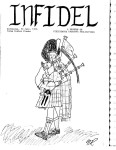
Long ago, in the days before personal computers were ubiquitous, there were “zines” (short for magazines, correctly reflecting both non-professional status and less-than-totally-serious content). There was a wide variety of zines for all sorts of interests — rather like the back corners of the internet today, except they were physically distributed using the post office (and therefore had to stay within certain boundaries to be safe). Clive and I used to publish a zine for postal Diplomacy:

Infidel 11 cover
Download PDF
Infidel 12 cover
Download PDF

If you want to read ’em — and I wouldn’t blame you in the slightest if you didn’t — you can download a PDF of each issue from Doug’s Diplomacy and Eternal Sunshine. You’ll note that it was a much more innocent time then, as we not only listed our own contact information, but that of many others through the game listings and other parts.

Doug only has issues 11 and 12 available, but they’re a generous representation of what the rest of the production run was like: amateur, laboriously assembled, totally ignorant of both copyright and appropriate credits, and full of in-jokes that nobody aside from the production team would hope to understand (except the “Skulking Cavorter” column: even the publisher and editor had head-scratching moments over that, but it had a noisy fan club among the subscribers). It was a lot of fun to do, and once we ceased production I found I missed it a lot (but not enough to get back into doing it again). I published a few other zine-like things over the next few years, but didn’t get back into a regular publication schedule until I started the blog.

So, thanks to William Plante for digging up these musty relics and bringing them to my attention.

December 26, 2012

“Quentin Tarantino finally comes of age as a filmmaker”

Filed under: History, Media, USA — Tags: , — Nicholas @ 12:04

While I doubt I’ll catch this in the theatre, Kurt Loder makes this sound like an interesting film:

With Django Unchained, Quentin Tarantino finally comes of age as a filmmaker. Tarantino’s brilliance as a writer and craftsman have always been clear. But even his last picture, the Holocaust revenge fantasy Inglourious Basterds, was overwhelmed by his geeky obsession with vintage genres (in that case, old war movies). When he showed us a group of Jews huddled in a basement being shot through the floorboards above, but declined to go below and show them actually dying (it might have clouded the film’s comedy), he shortchanged the movie’s putative subject.

With Django, the director has brought off a perfect marriage of style and history. He has appropriated the universe of another beloved genre, the spaghetti western (in particular Sergio Corbucci’s brutal 1966 cult film, Django), and set within it an unsparing tale of American slavery. The movie is outrageously funny, but it’s also unflinchingly committed to a full exploration of the horrors of its subject. Where many movies about black bondage are diluted by liberal hankie-wringing, this one feels fueled by a black rage that still simmers today. It might be the most savage cinematic depiction of slavery ever made.

Some early reviewers have expressed dismay about the movie’s extensive deployment of the word “nigger.” (“It’s a nigger on a horse,” says one marveling cretin as a black man rides by on his mount.) It’s hard to know what to say about such a reaction, except to point out that, hey, it’s a movie about slavery.

What we gain in accuracy we lose in romance

Filed under: History, Media, Science, Technology — Tags: , , , , — Nicholas @ 10:27

What am I talking about? Digital maps:

It’s not often that maps make headlines, but they’ve been doing so with some regularity lately. Last week, tens of millions of iPhone users found that they could suddenly leave their homes again without getting either lost or cross. This was because Google finally released an app containing its own (fairly brilliant) mapping system. Google Maps had been sorely missed for several months, ever since Apple booted it in favor of the company’s own inadequate alternative — a cartographic dud blamed for everything from deleting Shakespeare’s birthplace to stranding Australian travelers in a desolate national park 43 miles away from their actual destination. As one Twitter wag declared: “I wouldn’t trade my Apple Maps for all the tea in Cuba.”

There was one potential bright spot, though: Among the many mistakes found in Apple Maps was a rather elegant solution to the continuing dispute between Japan and China over the Senkaku islands. Japan controls them; China claims them. Apple Maps, when released, simply duplicated the islands, with two sets shown side-by-side — one for Japan, one for China. Win-win. (At least until the software update.) Call it diplomacy by digital dunderheadedness.

As some may recall, it was not so long ago that we got around by using maps that folded. Occasionally, if we wanted a truly global picture of our place in the world, we would pull shoulder-dislocating atlases from shelves. The world was bigger back then. Experience and cheaper travel have rendered it small, but nothing has shrunk the world more than digital mapping.

[. . .]

There is something disappointing about the austere potential perfection of the new maps. The satellites above us have seen all there is to see of the world; technically, they have mapped it all. But satellites know nothing of the beauty of hand-drawn maps, with their Spanish galleons and sea monsters, and they cannot comprehend wanderlust and the desire for discovery. Today we can locate the smallest hamlet in sub-Saharan Africa or the Yukon, but can we claim that we know them any better? Do the irregular and unpredictable fancies of the older maps more accurately reflect the strangeness of the world?

The uncertainty that was once an unavoidable part or our relationship with maps has been replaced by a false sense of Wi-Fi-enabled omnipotence. Digital maps are the enemies of wonder. They suppress our urge to experiment and (usually) steer us from error—but what could be more irrepressibly human than those very things?

Update: And the Apple Maps fiasco has them leading most of the tech world’s “Top 10” lists for mis-steps, fumbles, and self-inflicted wounds.

There really could be only one pick for the number-one spot on this list. The Apple Maps fiasco has done more to hurt the company’s image than anything else this year, leaving their reputation — and those of some of its supporters — in the dust.

At the start of the year Apple was riding high. The loss of cofounder Steve Jobs had been handled better than many in the industry had expected, and Tim Cook looked like a safe pair of hands to take the company forward. Apple was on its way to being the most valuable in the world in dollar terms, and was beating the competition like a red-headed stepchild.

[. . .]

When iOS 6 with Apple Maps launched, there was initially little fuss. Apple’s policy of only letting friendly reviewers get advanced access to kit held up well, and virtually none of Cupertino’s chosen few even mentioned the mapping function in their glowing reviews of the new operating system. But then users actually tried it out and the results were plain to see.

Apple’s Maps app simply didn’t work correctly. Sure, it could get you from point to point — just about — but the level of detail included was poor and mapping information was frequently wrong. The list of cock-ups grew day by day as people realized that the application just wasn’t fit in any meaningful way.

Even the Australian police warned against using it for fear of getting lost in the desert.

December 20, 2012

Did the Germans and the British really play soccer at Christmas in 1914?

Filed under: Britain, Europe, France, Germany, History, Military, Soccer, WW1 — Tags: — Nicholas @ 11:14

In the Guardian, Scott Murray and John Ashdown discuss the rather amazing events of Christmas Day, 1914 between the combatants in France:

To borrow (and then misuse) one of the oldest football zingers in the book: in the middle of a fight, a football match broke out. A report in the Guardian on Boxing Day 1914 described how in one region “every acre of meadow under any sort of cover in the rear of the lines was taken possession of for football”. In their letters home, British soldiers told of shaking hands with their German counterparts and swapping cigarettes. A Scottish brigadier described how the Germans “came out of their trenches and walked across unarmed, with boxes of cigars and seasonable remarks. What were our men to do? Shoot? You could not shoot unarmed men.”

While there was undoubtedly continued gunfire along many sections of the front, most soldiers appear to have laid down their arms and called an unofficial truce that day, with fußball uppermost in the minds of many. A letter published on New Year’s Day from a British officer reads: “I hear our fellows played the Germans at football on Christmas Day. Our own pet enemies remarked they would like a game, but as the ground in our part is all root crops and much cut up by ditches, and as, moreover, we had not got a football, we had to call it off.” A letter in the Times, meanwhile, from a major reported that a German regiment “had a football match with the Saxons [regiment], who beat them 3-2”.

One match appears to have started between the Germans and a regiment from Cheshire, one of whom years later explained how a ball suddenly came hurtling over the top from the German side. “I should think there were about a couple of hundred taking part. I had a go at the ball. I was pretty good then, at 19. Everybody seemed to be enjoying themselves. There was no sort of ill-will between us. There was no referee, and no score, no tally at all. It was simply a melee — nothing like the soccer you see on television.”

Borking, in retrospect

Filed under: Government, History, Law, USA — Tags: , , , , — Nicholas @ 10:14

Walter Olson on the historically nasty confirmation battle that kept Robert Bork off the US Supreme Court:

Of course the confirmation critique that makes it into every Bork obituary isn’t Heflin’s or Johnston’s. It’s Ted Kennedy’s blowhard caricature, intended for northern liberal consumption, of “Robert Bork’s America” as “a land in which women would be forced into back alley abortions, blacks would sit at segregated lunch counters, rogue police could break down citizens’ doors in midnight raids, school children could not be taught about evolution,” and so on.

Never in memory had a judicial nomination been fought in such language. Why?

As a constitutional law scholar, Bork had distinguished himself even among conservatives for his scathing critique of the Warren Court, which he accused essentially of having made up constitutional law as it went along.

To organized liberal groups, on whose behalf Kennedy was acting, this was the next thing to a declaration of war. Yet they couldn’t exactly come out and defend making up constitutional law as you went along as their own vision for the high court.

Instead, they served up a steady diet of vitriol and wild oversimplification, especially in TV ads and other messages delivered outside the confirmation hearings.

The Washington Post itself opposed Bork’s confirmation, yet nonetheless editorialized against the “intellectual vulgarization and personal savagery” to which some of his opponents had descended, “profoundly distorting the record and the nature of the man.”

December 17, 2012

Camille Paglia on “the shallow derivativeness of so much contemporary art, which has no big ideas left”

Filed under: Books, History, Media, Religion — Tags: , , — Nicholas @ 10:23

Emily Esfahani Smith talks to Camille Paglia about her latest book, Glittering Images: A Journey Through Art From Egypt to Star Wars:

For Paglia, the spiritual quest defines all great art — all art that lasts. But in our secular age, the liberal crusade against religion has also taken a toll on art. “Sneering at religion is juvenile, symptomatic of a stunted imagination,” Paglia writes. “Yet that cynical posture has become de rigueur in the art world — simply another reason for the shallow derivativeness of so much contemporary art, which has no big ideas left.” Historically the great art of the West has had religious themes, either explicit or implicit. “The Bible, the basis for so much great art, moves deeper than anything coming out of the culture today,” Paglia says. As a result of its spiritual bankruptcy, art is losing its prominence in our culture. “Art makes news today,” she writes, “only when a painting is stolen or auctioned at a record price.”

[. . .]

More than 20 years ago, Paglia took another journey through art in her breakout book Sexual Personae: Art and Decadence from Nefertiti to Emily Dickinson. It launched her career as an irrepressible and politically incorrect cultural critic who was suddenly everywhere on the media circuit, speaking on topics ranging from Madonna and Elizabeth Taylor to date rape and educational reform. In the book, Paglia argued that Western culture has been a succession of shifting sexual personae (Mona Lisa is the original dominatrix; Dickinson was Amherst’s Madame de Sade). The book contained all the Paglia hallmarks: an infatuation with sex and beauty, strong prose, and an evisceration of feminism. Needless to say, Sexual Personae raised hackles and branded Paglia as the enfant terrible of academia and feminism.

That was then. While she is still more than willing to dig into what is left of the feminist movement — “feminism today is anti-intellectual” and “defined by paranoia,” she says — these days, she directs the venom of her sharp tongue to the dogmatic champions of secularism, liberals who narrow-mindedly dismiss religion and God. There is one, in particular, whom she cannot stand: the late Christopher Hitchens — like her, a libertarian-minded atheist. The key difference between the two is that he despised religion and God while Paglia respects both and thinks they are funda­mental to Western culture and art. Paglia calls Hitchens “a sybaritic narcissist committed to no real ideas outside his personal advancement.”

H/T to Nick Packwood for the link.

December 16, 2012

Queen Victoria: not a model mother

Filed under: Britain, History — Tags: , , , — Nicholas @ 11:58

A BBC documentary will shed some light on the domestic life of Queen Victoria and Prince Albert:

Helen Rappaport, author of Magnificent Obsession and a contributor to the three part series, said Queen Victoria and Prince Albert were “pretty awful parents” to their four sons and five daughters.

“She hated being pregnant. She had prenatal and postnatal depression. She didn’t breastfeed her children who she thought were horrible dribbling little things. She was not in the least bit maternal.

“Queen Victoria liked sex, but she didn’t like the result.”

[. . .]

Queen Victoria’s relationship with Prince Albert was a tempestuous one, punctuated with rows.

Prince Albert, who chided Queen Victoria in a letter. “It is a pity you find no consolation in the company of your children.

“The trouble lies in the mistaken notion the function of a mother is to be always correcting, scolding and ordering them about” he wrote.

Origins of ten Christmas traditions

Filed under: History, Religion — Tags: , — Nicholas @ 11:39

A lot of the “traditional” Christmas things don’t have an obvious link to the season (aside from long usage):

It’s the Christmas season again, and before we get sick of the eggnog, fruitcake, and Christmas music played ad nauseum, we get to enjoy it for a couple weeks. But have you ever wondered where some of our weird Christmas traditions come from? I mean, we tell our kids that a fat man is coming into our house at night; we bring in trees in to shed all over the carpet; and we kiss under parasitic plants – all in the holiday spirit. How the hell are these even related to Jesus, whose birthday we’re supposed to be celebrating?

Well, sit back, pull in some eggnog and gingerbread, and take a ride on the 10-entry, Listverse sleigh!

H/T to Ian Geldard for the link.

December 14, 2012

40 years ago today, man last walked on the moon

Filed under: History, Space, Technology, USA — Tags: , , , — Nicholas @ 10:51

At sp!ked, Patrick West notes an under-observed anniversary:

It is a fine testament to NASA’s Apollo programme that of all the world-shaking events in living memory, men landing on the moon is the only one that doesn’t involve death. As Andrew Smith, author of Moon Dust (2006), notes, everyone remembers where they were when John F Kennedy was assassinated, Princess Diana died, or on 9/11. Most people, if they were alive at the time, also vividly recall when a man first walked on the moon on 20 July 1969.

Few, however, will remember what they were doing when the last man walked on the moon. That was 40 years ago today.

As he fired up the engines of Apollo 17‘s Lunar Module, Gene Cernan, the last man on the moon, delivered a final message to the world: ‘America’s challenge has forged man’s destiny of tomorrow. And as we leave the moon at Taurus-Littrow, we leave as we came and, God willing, as we shall return with peace and hope for all mankind.’ On this date, many of us lament that we haven’t gone back to the moon. Others won’t, citing the vast expense of this Cold War sideshow, equivalent to roughly $130 billion in today’s money.

We certainly aren’t likely to return to the moon in such cynical and pessimistic times, of Mayan prophecies, omens of economic stagnation and environmental catastrophe, Frankie Boyle misanthropy and books called Is It Just Me Or Is Everything Shit?. In other words, everything the Apollo programme didn’t represent. America’s race to the moon may have been partly a means of getting one over the Soviets, but it also embodied the spirit of adventure and progress, as encapsulated by Neil Armstrong’s first words from the moon.

December 13, 2012

You can’t have a free society when you also have “official truth” enforced by law

Filed under: History, Law, Liberty, Media, WW2 — Tags: , , — Nicholas @ 10:03

At sp!ked, Angus Kennedy explains why open debate and free speech is a far better solution to holocaust denial than hate speech laws and officially sanctioned “truth”:

Firstly, I think that genocide denial has always been something of a shrill brand rather a real force in the world. It had it’s heyday in 1970s France with Robert Faurisson, a rather lame literary critic in the south of France who denied the Holocaust, and was taken apart by, among other people, the French classicist and structuralist Pierre Vidal-Naquet, who was also a left-winger. Vidal-Naquet did not call for the legal prohibition of denial; instead he argued that contempt is a much more effective weapon. Similarly, Deborah Lipstadt, the author of History on Trial: My Day In Court With David Irving (2005), rails against genocide denial but is still opposed to criminalising it, shuddering at the thought ‘that politicians might be given the power to legislate on history’. I think that is a useful point to bear in mind.

The decision of whether or not to criminalise genocide denial is, in a way, the key free speech issue, the fundamental taboo. In that sense, it’s interesting that there continue to be movements by governments to make genocide denial illegal. France will probably try to push through the genocide denial law, despite it being overturned by its constitutional court, and argue for restrictions on what the French can and cannot say.

To make it clear, I’m completely opposed to criminalisation of speech or, to be more accurate, criminalisation of an idea — because that’s what this is. This is governments saying that a certain idea — genocide denial — should be illegal. I don’t think history is a matter for judges; it’s a matter for historians. I think that the completely unrestricted and absolute right to free speech is simply the best method we’ve got for getting closer to historical truth with a capital ‘T’. We should not be criminalising ideas; we should never be pragmatic about where we extend tolerance — it is a principal to be defended at all costs.

December 12, 2012

Climatic witchcraft

No offense intended to practitioners of witchcraft intended:

Superstition about the weather in particular is hardly surprising, given the awesome power of nature. Witnessing storms, lightning and even the daily rising and setting of the sun surely induced fear and wonder in primitive cultures. The same fear and wonder are what warmists exploit today in linking weather extremes to global warming.

Scholars tell us that weather superstition often found expression in ritual human sacrifice. The Mayans, for instance, tossed victims into a limestone sinkhole to appease the rain god Chaac.

And it’s only a few centuries since superstition over the climate led to intensive witch hunts and widespread executions, usually by burning, for witchcraft.

University of Chicago economist Emily Oster demonstrated in 2004 that the most active era of witchcraft trials in Europe coincided with the Little Ice Age. Since then, other researchers have argued that chilly weather may have precipitated the Salem witch trials in the 1690s — one of the coldest periods of that epoch.

It was widely believed during the late Middle Ages that witches were capable of controlling the weather with their magic powers, and thus cause storms that could destroy harvests and hobble food production.

[. . .]

Our obsession with weather extremes has reached such heights that it has become a knee-jerk reaction for climate-change alarmists to ascribe any unusual weather event at all to global warming. So they tell us that heat waves, floods, harsh winters, dust storms — even wildfires — are all the result of man-made CO2. But a check of records from, say, the 1930s or the 1950s, when the CO2 level was much lower than now, reveals that such events are nothing new.

Climate-change skeptics might be regarded as modern-day witches because they think that global warming comes from natural forces. However, it’s superstitious alarmists, who believe that extreme weather originates in our CO2 emissions and who have a dread of impending disaster, who are really the witches.

December 9, 2012

Sheldon Richman decries “Romanticizing Taxation”

Filed under: Government, History — Tags: , — Nicholas @ 12:25

Of all the topics you might try to romanticize, taxation would certainly be at the bottom of the list:

In the debate over avoiding the “fiscal cliff” — especially over whose taxes should and shouldn’t be raised — I detect an annoying attempt to romanticize taxation. I read this as an act of desperation on the part of those who want higher taxes on the wealthy, for there is nothing romantic about taxation.

The other day MSNBC’s Chris Hayes invoked Franklin Roosevelt in support of higher taxes on the top 2 percent. Pulling out all the stops, Hayes quoted from one of FDR’s October 1936 campaign speeches […]

Roosevelt’s claim that we can judge the social conscience of the government by how it collects taxes is true in a way he could not have imagined. Contrary to FDR and Justice Holmes, taxes are neither a price (in the voluntary-transaction sense) nor club dues. On the contrary, they are exactions by threat of violence. Some social conscience! How ironic that organized society and civilization itself are said to depend on the government’s threatening peaceful people if they fail to surrender their property as demanded by politicians who presumptuously and self-servingly claim to “represent” all the people.

Far from some enlightened institution, taxation began when conquerors realized that formal and continuing appropriation of a subject population’s wealth was preferable to hit-and-run pillaging. For this to work, however, the rulers needed to convince the peasants that the regime would protect them from predators in return for their regular remittances. That’s right: It was a protection racket, from which the racketeers and their cronies profited handsomely. For the taxpayers, there was little choice in the matter. They weren’t buying protection as people buy insurance in the market, and they weren’t paying dues as they would later pay dues to mutual-aid societies. They paid or they were punished. The ideology of benevolent state protection reduced enforcement costs because the ruled outnumbered the rulers and widespread tax resistance would have doomed the regime. Things have changed little in our time.

« Newer PostsOlder Posts »

Powered by WordPress


