Forgotten Weapons
Published 14 Dec 2016I may be a bit biased here, but I believe that the Vickers gun is one of the best all-around firearms ever made. It was designed during an era of experimentation and craftsmanship, with a quality and care that would make it today prohibitively expensive. It was exemplary in action, and served in every environment on earth through six decades and in the hands of 50 different nations. It was an infantry gun, an aircraft gun, an armored vehicle gun, and a shipboard gun.
Captain Graham Hutchison recorded this account of the Vickers in action during an attack on High Wood in August 1916 (exerpted from “The Grand old Lady of No Man’s Land by Dolf Goldsmith):
“For this attack, [ten] guns were grouped in the Savoy Trench, from which a magnificent view was obtained of the German line at a range of about 2000 yards. These guns were disposed for barrage. On August 23rd and the night of the 23rd/24th the whole Company was, in addition to the two Companies of Infantry lent for the purpose, employed in carrying water and ammunition to this point. Many factors in barrage work which are now common knowledge had not then been learned or considered. It is amusing today to note that in the orders for the 100th Machine Gun Company’s barrage of 10 guns, Captain Hutchison ordered that rapid fire should be maintained continuously for twelve hours, to cover the attack and consolidation. It is to the credit of the gunners and the Vickers gun itself that this was done! During the attack on the 24th, 250 rounds short of one million were fired by ten guns; at least four petrol tins of water besides all the water bottles of the Company and urine tins form the neighborhood were emptied into the guns for cooling purposes; and a continuous party was employed carrying ammunition. Private Robertshaw and Artificer H. Bartlett between them maintained a belt-filling machine in action without stopping for a single moment, for twelve hours. At the end of this time many of the NCOs and gunners were found asleep from exhaustion at their posts. A prize of five francs to the members of each gun team was offered and was secured by the gun team of Sgt. P. Dean, DCM, with a record of just over 120,000 rounds.”
The attack on the 24th of August was a brilliant success, the operation being difficult and all objectives being taken within a short time. Prisoner examined at Divisional and Corps Headquarters reported that the effect of the Machine Gun barrage was annihilating, and the counterattacks which had attempted to retake the ground lost were broken up whilst being concentrated east of the Flers Ridge and of High Wood.
In 1963 in Yorkshire, a class of British Army armorers put one Vickers gun through probably the most strenuous test ever given to an individual gun. The base had a stockpile of approximately 5 million rounds of Mk VII ammunition which was no longer approved for military use. They took a newly rebuilt Vickers gun, and proceeded to fire the entire stock of ammo through it over the course of seven days. They worked in pairs, switching off at 30 minute intervals, with a third man shoveling away spent brass. The gun was fired in 250-round solid bursts, and the worn out barrels were changed every hour and a half. At the end of the five million rounds, the gun was taken back into the shop for inspection. It was found to be within service spec in every dimension.
During its service life, the Vickers was made in .303 British, .30-06, 0.50 Vickers, .50 High Velocity, 7×57 Mauser, 7.65×53, 8mm Mauser, 8mm Lebel, 7.7 Japanese, 6.5×54 Dutch, 7.9x57R Dutch, 7.62 NATO, 7.62x54R, 8x52R Siamese, 11mm Vickers, and three different 40mm cartridges.
The Vickers was retired from British military service in 1968, having finally become obsolete. Its GPMG role was taken over by the FN MAG, and its long range indirect fire role performed by 3″ mortars. The Vickers was a weapon which required training and dedication to master, but rewarded its users with phenomenal endurance and a wide range of capabilities. Among all contenders, only the Browning machine gun can attempt to compare to the outstanding qualities of the Vickers, and even the Browning fails to match the elegance of the stalwart Brit.
November 18, 2025
Vickers Heavy Machine Gun
QotD: Echoes of the Thirty Years’ War
It’s much easier to attack cultural institutions than political ones, and because the Church was also a political institution — a big one — it was convenient to attack a guy like Cardinal Wolsey, Tetzel the Indulgence Merchant, and so on. You can always frame it in the traditional medieval way: “The king has been led astray by his evil counsellors”. It’s not a coincidence that Reformed polities were also the most politically efficient; the Prods won the Thirty Years’ War, thanks in no small part to very Catholic France (under Cardinal Richelieu) adopting Protestant attitudes, strategies, and tactics.
The analogy only extends so far, of course. Hillaire Belloc has argued that the dissolution of the monasteries in England kicked out one of the three legs supporting English culture — by putting all that land and money under the State’s direct control (that “Tudor revolution in government” again), the State and the Economy are inextricably merged. It’s proto-fascism (recall that The Servile State was written in 1912). Not only is this true, it doesn’t go nearly far enough. Back in 1912, the Church was still alive as a cultural force. The Media was still at least somewhat capitalist — in competition for eyeballs — and in many cases led The Opposition, which also still existed as a cultural force.
Nowadays, of course, not only are the State and the Economy indistinguishable, they’re also indistinguishable from The Media. There IS no “opposition”; whatever anemic resistance to The State is stage managed like pro wrestling. Real dissidents are in the positions of recusants in Tudor England, except that the Church, instead of sending priests to minister to us in secret, is sending battalions of Inquisitors to help hunt us down.
In short, there’s no entry point for a new “Reformation”. As bad as the Period of the Wars of Religion was, gifted leaders had structural ways to achieve their objectives and keep the peace. Henry of Navarre could proclaim that “Paris is worth a mass”; Cardinal Richelieu could proclaim raison d’etat; the old Peace of Augsburg system — cuius regio; eius religio — could work well enough with a prince who understood his people and chose not to push too hard. “Separation of Church and State” wasn’t articulated as a formal political principle until the 19th century (and only there because it was badly misconstrued), but as a practical solution to politico-cultural problems it works just fine …
… provided you’ve got the structures in place to handle it, and we don’t. The Church, the State, the Economy, the Media, Academia, Technology … who can say where the one ends and the other begins? It’s all Poz, and there’s no aspect of our lives that the Poz doesn’t touch, because instead of separate and often competing socio-governmental structures, they’ve all merged. They’re ALL Poz.
Severian, “Reformation”, Founding Questions, 2022-03-07.
November 17, 2025
Cyprus on Fire: The 3-Way War That Broke an Empire – W2W 053
TimeGhost History
Published 16 Nov 2025Cyprus, 1950s–60s. An island divided between Greek Cypriots, Turkish Cypriots, and the British Empire becomes the battleground for one of the Cold War’s most explosive regional crises. What begins as a struggle for independence soon spirals into a three-way conflict of nationalism, colonial strategy, and clashing identities — with Archbishop Makarios III, paramilitary groups, Athens, Ankara, and London all pulling in different directions.
In this episode of War 2 War, we uncover how Cyprus became:
- A central front in the decline of the British Empire
- A stage for espionage, guerrilla warfare, and political assassinations
- A diplomatic nightmare for NATO
- A struggle where UN peacekeepers become critical to preventing total collapse
- A conflict whose consequences still shape Europe and the Eastern Mediterranean today
We’ll trace the rise of EOKA, the reaction in the Turkish Cypriot community, the impossible balancing act of Makarios III, and how superpower pressure from the USA and USSR escalated an already volatile situation.
This is the hidden story of how one island’s crisis reshaped the politics of an entire region — and marked the end of Britain as a global imperial power.
(more…)
What did Cowboys Eat on the Open Range?
Tasting History with Max Miller
Published 10 Jun 2025Slow-cooked pinto beans and dense cast iron skillet cornbread
City/Region: United States of America
Time Period: 1896The cook for a cattle drive, often called “cookie”, was usually a former cowboy himself, having aged out of the profession by 25. They’d wake up around 3:00 AM to get breakfast ready, then pack up and drive ahead about 15 miles to prepare supper.
These beans are very simple, and surprisingly delicious. Honestly, the garlic doesn’t do a whole lot (who only uses half a clove?), but they’re still very good. Feel free to use however hot a red pepper you like, and the beans are a perfect accompaniment to the Chuck Wagon Cornbread (below). Mighty fine, indeed.
FRIJOLES.
1 cup Mexican beans.
1/2 clove garlic.
1 long red pepper.
1 thin small slice bacon.
Soak beans over night; boil slowly until soft—from eight to ten hours. Add red pepper, garlic, and bacon, and bake.
— Manual for Army Cooks, 1896
QotD: Turns out Judaism isn’t the peaceful exception among Abrahamic montheisms
Yevardia @haravayin_hogh
Thread w/excerpts of Israel Shahak’s Jewish History, Jewish Religion.
Shahak was an award-winning organic chemist & Classical Liberal. Born in Poland, his family moved to Israel as displaced persons in 1945.
For this book, he received death-threats for the rest of his life.Quoted thread is absolutely fascinating.
Like many American gentiles who grew up in the 1950s and 1960s, I have a fondness for Jewish culture as it manifested in this country. The food, the humor, the intellectual tradition. I read Mad Magazine as a kid and “The Joys of Yiddish” as a young man and cheerfully adopted some Yiddishisms into my idiolect.
It’s always been slightly difficult for me, though, to reconcile my fondness for the Jewish influence on American life with what I believe about monotheisms in general and Abrahamic monotheisms is in particular. Which is, basically, that they are pits of evil. Infectious insanities that bring mob violence, horror and death whenever they have actual power.
Judaism looked like an at least partial exception, a monotheism with a curious lack of horrific violence in its backstory. I thought this might be explained by its absence of coercive power ever since the destruction of the Second Temple — 2000 years of oppression by others teaching Judaism the virtue of tolerance the hard way.
Now comes Israel Shahak to tell me it wasn’t like that at all. That until historically recent times – basically, post-1800 — Judaism wasn’t tolerant and rational. Not even close. These are virtues of the secularized Jew, in reaction to traditional Jewish shtetl and ghetto communities that could best have been described as violently evil religious despotisms.
Shahak says gentiles — and many Jews — don’t know how terrible life was under pre-modern rabbis because Judaism has done a bang-up job of expurgating and sanitizing its own history.
Nobody talks about the fact that until the 19th century, rabbis routinely used the self-governance afforded them by a lack of state interest in universal secularized justice to abuse, torture, and often murder Jews they found to be in violation of religious law. I certainly had no idea of this, despite being quite well read in history and comparative religion.
Thought control, too. We think of Jews as readers and scholars, but it turns out the pre-modern rabbinate deliberately kept communal Jews ignorant of history, geography, science, and indeed all secular literature.
Shahak brings the receipts, with extensive quotation from primary sources. Even his critics — and there are many — can’t accuse him of making up these reports. They claim he misinterprets the evidence. But they can’t make the evidence go away.
In a way this comes as a relief to me. I no longer have to wonder why Judaism looks like an exception to the general evil of monotheisms. Because it isn’t one — like Christianity, it looks benign only to the extent that it’s been denatured by modernity and secularism.
On the other hand … I miss the Judaism I thought I knew. I’m disturbed that the evidence was so effectively suppressed, and that it took reading excerpts from Shahak to clue me in.
Damn shame copies of Shahak’s book are so rare that you can only find them for over a grand each. I’d like to read the whole thing, but everybody should read the excerpts in this thread.
ESR, The social media site formerly known as Twitter, 2025-08-15.
November 16, 2025
North Africa Ep. 8: The Forgotten Battle of Mersa El Brega
World War Two
Published 15 Nov 2025At Mersa Brega a thin British screen, one reinforced battalion with guns, holds a superb defensive choke point until Stukas, artillery, and Panzer Regiment 5 grind it down. Cemetery Hill falls under bombardment, counterattacks stall, and a northern flank probe finally forces a retreat: Rommel’s first major victory in the desert, bought against strong ground and stubborn infantry.
(more…)
November 15, 2025
Marlin 1897 Bicycle Rifle
Forgotten Weapons
Published 23 Feb 2016Marlin’s 1892 lever action rifle in .22 rimfire caliber proved to be a very popular firearm, and so the company released an improved version in 1897, offered only as a rimfire takedown model. The 1897 would also prove very popular, and the same basic design would continue later as the Model 39.
One interesting variant of the 1897 offered was a Bicycle Rifle. While the rifle was generally available only with fairly long barrels, the bicycle version had a 16″ barrel and full-length magazine tube. This was sized specifically to fit in a special case (disassembled) underneath the top bar of a bicycle frame, allowing kids to easily use their bicycles to take these rifles to their favorite shooting spots.
While the 1897 itself was popular, the bicycle variant was not, with Marlin sales records showing only 197 sold.
QotD: The innovation of infiltration tactics in trench warfare
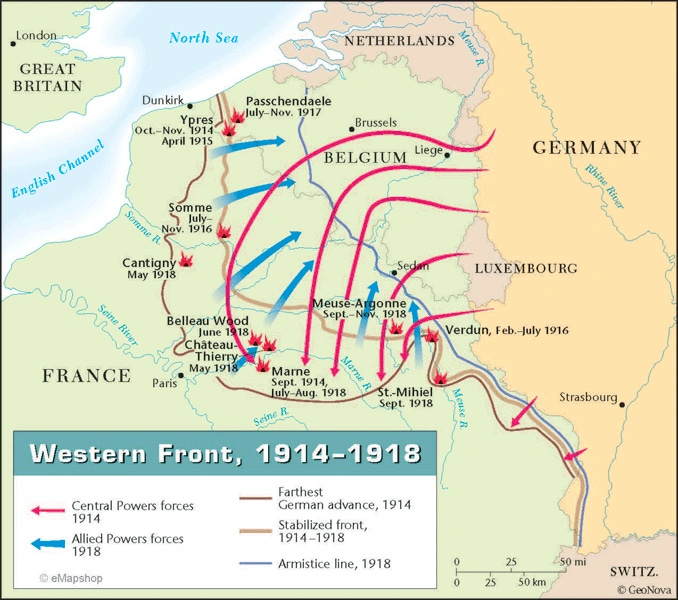
The mature form of this tactical framework is often called “Hutier” tactics, after German general Oskar Emil von Hutier, though he was hardly the sole or even chief inventor of the method. In its mature form, the technique went thusly: instead of attacking with large waves of infantry which cleared each objective in sequential order, attacks ought to be proceeded by smaller units, carefully trained with the layout of the enemy positions. Those units, rather than having a very rigid plan of attack, would be given those general objectives and left to figure for themselves how to accomplish them (“mission tactics” or Auftragstaktik)1, giving them more freedom to make decisions based on local conditions and the ground.
These elite spearhead units, called Stoßtruppen or “Stormtroopers” were well equipped (in particular with a higher amount of automatic firearms and hand grenades, along with flamethrowers). Importantly, they were directed to bypass enemy strong-points and keep moving forward to meet their objectives. The idea here was that the follow-up waves of normal infantry could do the slow work of clearing out points where enemy resistance was strong, but the stormtroopers should aim to push as deeply as possible as rapidly as possible to disorient the defenders and rapidly envelop what defenses remained.2
These sets of infantry tactics were in turn combined with the hurricane barrage, a style of artillery use which focused on much shorter but more intense artillery barrages, particularly associated with Colonel Georg “Breakthrough” Bruchmüller. Rather than attempting to pulverize defenses out of existence, the hurricane barrage was designed merely to force enemies into their dugouts and disorient the defenders; much of the fire was directed at longer ranges to disrupt roads and artillery in the enemy rear. The short barrage left the ground relatively more intact. Meanwhile, those elite infiltration units could be trained to follow the creeping barrage very closely (being instructed, for instance, to run into the shell explosions, since as the barrage advantages, no gun should ever strike the same spot twice; a fresh shell-hole was, in theory, safe). Attentive readers will recognize the basic foundations of the “move fast, disorient the enemy” methods of the “modern system” here.
So did infiltration tactics break the trench stalemate? No.
First, it is necessary to note that while infiltration tactics were perhaps most fully developed by the Germans, they were not unique to them. The French were experimenting with many of the same ideas at the same time. For instance, basic principles of infiltration were being published by the French General Headquarters as early as April, 1915. André Laffargue, a French infantry captain, actually published a pamphlet, which was fairly widely distributed in both the French and British armies by the end of 1915 and in the American army in 1916, on exactly this sort of method. In many cases, like at the Second Battle of Artois, these French tactics bore significant fruit with big advances, but ran into the problem that the gains were almost invariably lost in the face of German counter-attacks. The Russians, particularly under Aleksei Brusilov, also started using some of these techniques, although Brusilov was as much making a virtue of necessity as the Russians just didn’t have that much artillery or shells and had to make do with less and Russian commanders (including Brusilov!) seem to have only unevenly taken the lessons of his successes.
The problem here is speed: infiltration tactics could absolutely more efficiently overrun the front enemy lines and even potentially defeat multiple layers of a defense-in-depth. But after that was done and the shock of the initial push wore off, you were still facing the same calculus: the attacker’s reinforcements, shells, artillery and supplies had to cross broken ground to reach the new front lines, while the defender’s counter-attack could ride railways, move over undamaged roads and then through prepared communications trenches. In the race between leg infantry and trains, the trains always won. On the Eastern Front or against the Italians fighting under the Worst General In History at Caporetto (1917), the already badly weakened enemy might simply collapse, producing massive gains (but even at Caporetto, no breakthrough – shoving the enemy is not a breakthrough, to qualify as a breakthrough, you need to get to the “green fields beyond” that is open ground undefended by the enemy), but against a determined foe, as with the 1918 Spring Offensives, these tactics, absent any other factor, simply knocked big salients3 in the line. Salients which were, in the event, harder to defend and brought the Germans no closer to victory. Eventually – often quite rapidly – the front stabilized again and the deadlock reasserted itself. Restoring maneuver, the actual end-goal of these tactics, remained out of reach.
None of this is to say that infiltration tactics were useless. They represented a real improvement on pre-war infantry tactics and continue to serve as the basis for modern infantry tactics. But they could not break the trench stalemate or restore maneuver.
Bret Devereaux, “Collections: No Man’s Land, Part II: Breaking the Stalemate”, A Collection of Unmitigated Pedantry, 2021-09-24.
- Because it doesn’t fit anywhere else, I want to make a rather long note here. There is an odd tendency which I find quite frustrating, in which military concepts, unit designations and terminology from other languages are all translated into English when used, except for German terms. I suspect this has to do with the high reputation German military thinking holds in among the general public and some military practitioners. I do not share this view; both the German Imperial Army and the Nazi Wehrmacht (another term we never translated yet we feel no need to call the French army l’armée de terre) managed to lose the only major wars they were in, leading to the end of the states they served. Both armies were capable at some things and failed at others; their record certainly does not make German some sort of Holy Language of War. Nevertheless, where German technical terms are notable, I will include them so that the reader will know, should they encounter them elsewhere, that this is a term they are already familiar with, albeit in translation.
- It should be noted that the emphasis here remained on envelopment and destruction rather than on disorientation. The latter is a feature of subsequent systems based on German maneuver warfare, but was not a goal of the doctrine itself initially.
- A salient is a bulge in the line such that your position is bordered by the enemy on three sides. Such positions are very vulnerable, since they can be attacked from multiple directions and potentially “pinched off” at the base.
November 14, 2025
This is in your house … and you’ve never noticed
Rex Krueger
Published 12 Nov 2025The Secret History of Wood – Rubber wood
(more…)
Why didn’t the Allies Attack Germany in 1939? (The Phoney War)
Real Time History
Published 20 Jun 2025On September 1, 1939, Germany invades Poland, setting off the Second World War. Two days later, Britain and France declare war on Germany. As the German army races towards Warsaw, many German generals are worried the French might simply walk into western Germany, and there’s not much the Wehrmacht can do about if they do. But instead of a powerful Allied counteroffensive, the French and British mostly sit back and wait during the so-called Phoney War – so why didn’t the Allies attack Germany in 1939?
(more…)
November 13, 2025
The Korean War Week 73: Fractures within the UN! – November 11, 1951
The Korean War by Indy Neidell
Published 11 Nov 2025The fighting continues for Maryang-san, though in general everyone is getting ready for the freezing Korea winter. The big news this week is the seeming breaking of the deadlocked peace talks as the Communist side makes what looks to be a major concession. The UN rejects the communist proposal because there’s more to this then meets the eye. What does Washington really want? Because even the Soviets are now speaking out against the war. Meanwhile in the background, the POW situation in the overcrowded camps grows ever more tense and deadly.
Chapters
00:00 Intro
00:50 Recap
01:06 Maryang-San
01:40 Communist Concessions
07:40 The Soviets Speak
09:08 Geoje Island POWS
13:22 Notes
13:51 Summary
14:08 Conclusion
15:11 CTA
(more…)
QotD: Anarchists
When I was younger and, perhaps, more spunky, I used to read Proudhon and Kropotkin. These were all very well, but the systemizing tendency had infected both. Utopianism also muddled their thinking. Without going back to Zeno of Cilium, let me just say that the posterior tradition in recommending anarchy was more subtle and arch. (Read the Antigone, for instance. Today it’s just the brand name for a Givenchy bag.) Anarchy was an inheritance from Greece and even Rome. It could never have been reduced to an election manifesto.
It is interesting that the first English use of the term, anarchisme, dates back to Henry VIII. Those resisting his Divorce and Reformation were taken to be anarchists. Nobly they defended the ancient liturgical order, in such spontaneous actions as the Pilgrimage of Grace.
Prominent anarchists of our modern age have, at their best (or worst, depending on one’s point-of-view), had dodgy ideological affiliations, but a real appreciation for economy of means. One thinks of e.g. Gavrilo Princip, the ingenious Serbian, able to ignite a Great War with a few gunshots, and bring down the Austro-Hungarian Empire almost as an aside. Or a certain Osama bin Laden, able to drag a superpower into pointless foreign wars, with very limited means. I do not approve of either gentleman, please note, but their efficiency was astounding.
David Warren, “Anarchia”, Essays in Idleness, 2020-07-09.
November 12, 2025
Volksturm VG-5, aka VK-98
Forgotten Weapons
Published 15 Sept 2015By the beginning of 1945, the Nazi government in Germany was looking to find cheaper ways to equip the Volksturm, and solicited bids and designs from several major arms manufacturers. The Steyr company created a crude but effective version of the Mauser 98 which was dubbed the VK-98 or VG-5. Mechanically it is identical to a K98k, but has much less attention paid to aesthetic finish and many simplified parts.
In total, 10,000 of these Steyr rifles were made. Despite commonly held notions of them having totally random parts, there are actually a relatively small number of discreet variations in the production sequence and the rifles have definitely class characteristics — which I will examine in the video.
QotD: Horror Victorianorum and the anti-Wilhelminites
Which is fine, if you’re an art student (or in that most unemployable of majors, Art History). But we need to know what “mainstream” art looked like under Wilhelm II, and for all intents and purposes it was Biedermeier.
Everyone with me? I’m oversimplifying, but not too much, when I say that you can make a pretty good case that the ultimate cause of World War One was “tradition”. At least, the people who were there sure as hell thought so. If you’re not familiar with Wilhelmine culture — and I am very, very far from Expert — consider the analogous case in Great Britain. Horror Victorianorum has its own Wiki entry, and isn’t that odd? It’s great to see David Stove getting some of the credit he deserves, but if he hadn’t coined it, somebody would’ve, because the shift in English culture was so massive, so in-your-face, that you can see the 20th century being born, in whatever medium you choose: art, architecture, literature, music, interior design, whatever, it’s all stupendously, tremendously, egregiously anti-Victorian.
Imagine “Victorian culture” is Donald Trump. That’s how against it they were. By the end of Edward VII’s brief reign, anything and everything Victorian was not just wrong, not just outdated or silly or whatever, but THE WORST THING EVER. If the Victorians liked it, Edwardians hated it, for any and all values of it; if they’d discovered that any of the guys in Eminent Victorians had really enjoyed metabolizing oxygen, the entire Edwardian Smart Set would’ve asphyxiated themselves on principle.
At that point, Modernism was inevitable, because Modernism was all there could be.
Severian, “PoMo, P-O-M-O PoMo …”, Founding Questions, 2025-08-07.
November 11, 2025
Four battles of the Canadian Corps
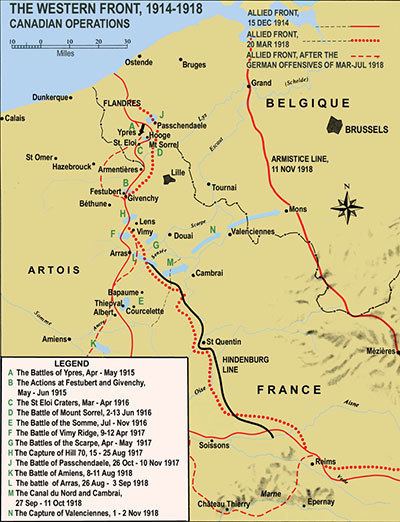
Following on from part one (excerpted here), The Black Horse outlines four major battles that the Canadians fought on the western front during the First World War:
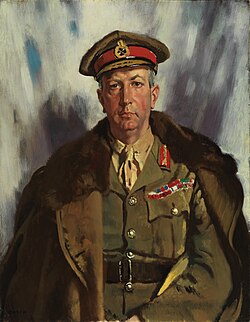
Sir Arthur Currie
Portrait by William Orpen, 1919.
The first part of the series was a political biography of Currie; the second part attempts to tell the story of the Canadian Corps at war through somewhat detailed account of four important battles. The piece is only partly biographical, it partly tells the story of Currie’s war, and partly tells the story the Canadian men who fought for the British Empire in the Great War. It’s a story of incredible martial prowess, but the careful reader will also observe a story of warring duties placed upon the leader of a colonial army; duty to his men, duty to the political leadership of his colonial people and the future of that nation, duty to the objectives of the imperial power on whose behalf he fought, and finally duty to glorious Victory. Currie ended his life understood by those with eyes to see as a great warrior and a military genius; but disliked by his men and hated by the leadership of his people because he prioritized the needs to the Empire and of Victory; but after the war the Empire was of limited service to Currie and to the Canadian people. I leave to the reader, to history, and to God, to decide the value of Victory.
[…]
2nd Battle of Ypres
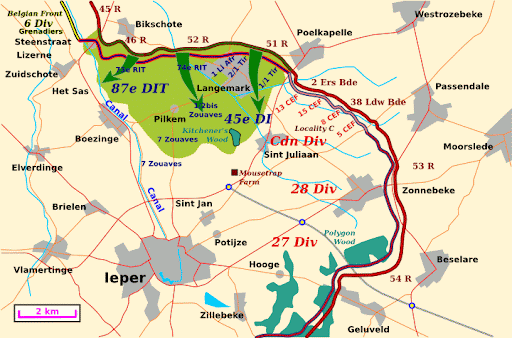
In the spring of 1915 the early dynamic advances of the German army were a distant memory faded behind the great defeat at the First Battle of the Marne. Through the winter both sides had dug in; and many German troops were redeployed to the Russian front. German chemists Walther Nernst and Fritz Haber brought forward the idea of using heavier-than-air Chlorine gas, carried on the wind, to overcome the mathematical impossibility of conventional attack. On April 22, 1915, Albrecht of Württemberg led 7 German divisions to attack 8 Allied divisions, including the 1st Canadian Division under the command of Sir Edwin Alfred Hervey Alderson. The attack began with the release of 168 tons of chlorine gas at about 1700h along a 4 mile stretch of the front around Langemark.
[…]
Vimy Ridge
For a year and a half after Ypres, Currie & the Canadian Corps continued to fight desperate engagements along the Western front with no clear strategic conclusion. After heavy losses and a lot of hard-learned lessons at the Somme from Sept 1915-Sept 1916, the Canadian Corps and Currie with them had become both hardened by bitter experience, and desperate to find better ways to prosecute the war. In September 1915 he was recorded to have said “I did not care what happened to me, but to my men, to their wives, their mothers, their children and to Canada I owed a duty which I wanted to fulfill to the very best of my ability”. Later that year as the division struggled with desertion, he ordered the execution of a deserter despite a three hour plea for clemency by the divisional cleric. The decision restored discipline, but haunted Currie’s dreams long afterwards.
In May 1916 Julian Byng took command of the Canadian Corps, replacing Sir Edwin Alderson. In the fall of that year, after heavy losses in a series of engagements at the Somme, Byng was given the opportunity to reorganize and refit the Canadian Corps; he looked to Currie as a key partner in the effort. They replaced the ineffective Ross Rifle with the Lee Enfield, reorganized the platoon structure to include heavy weapons within each platoon [machine guns, mortars, etc.], and implemented new training and tactics like rehearsals for advances, and the “creeping barrage”, carefully coordinated intended to keep artillery shells landing slightly ahead of advancing men.
[…]
Hill 70
After Vimy, Julian Byng was promoted. Currie was promoted in turn to lead the Canadian Corps. He would lead the Corps that he and Byng had made into one of the most effective fighting forces on any side of the conflict and lead it to bloody victory again and again. There is perhaps no better example of the mastery of the Canadian Corps, from top to bottom, than the battle of Hill 70. “Hill 70 was as close to a perfect battle as was ever fought on the Western Front” wrote historian Tim Cook.
[…]
The Hundred Days Offensive & the Pursuit to Mons
As the winter of 1917-18 passed, a new set of highly political decisions concerning whether and how to reorganize the Canadian Corps for the next round of fighting were taken. As noted in part one, Currie opted to split up the newly formed 5th division to reinforce the four divisions of the Canadian Corps and triple the size of the field engineering element. The decision optimized the Canadian Corps as an attacking force; and when they returned to the front that’s exactly how they would be used. Between August 8th and November 11th, 1918, the Canadian Corps fought nine major battles advancing 86 miles, and suffering 45,835 casualties [The force that began the offensive was ~100,000]. By comparison, the substantially larger American Expeditionary Force, over this same period, advanced only 34 miles while capturing only half the number of prisoners, suffering roughly twice the casualties per German division defeated.